
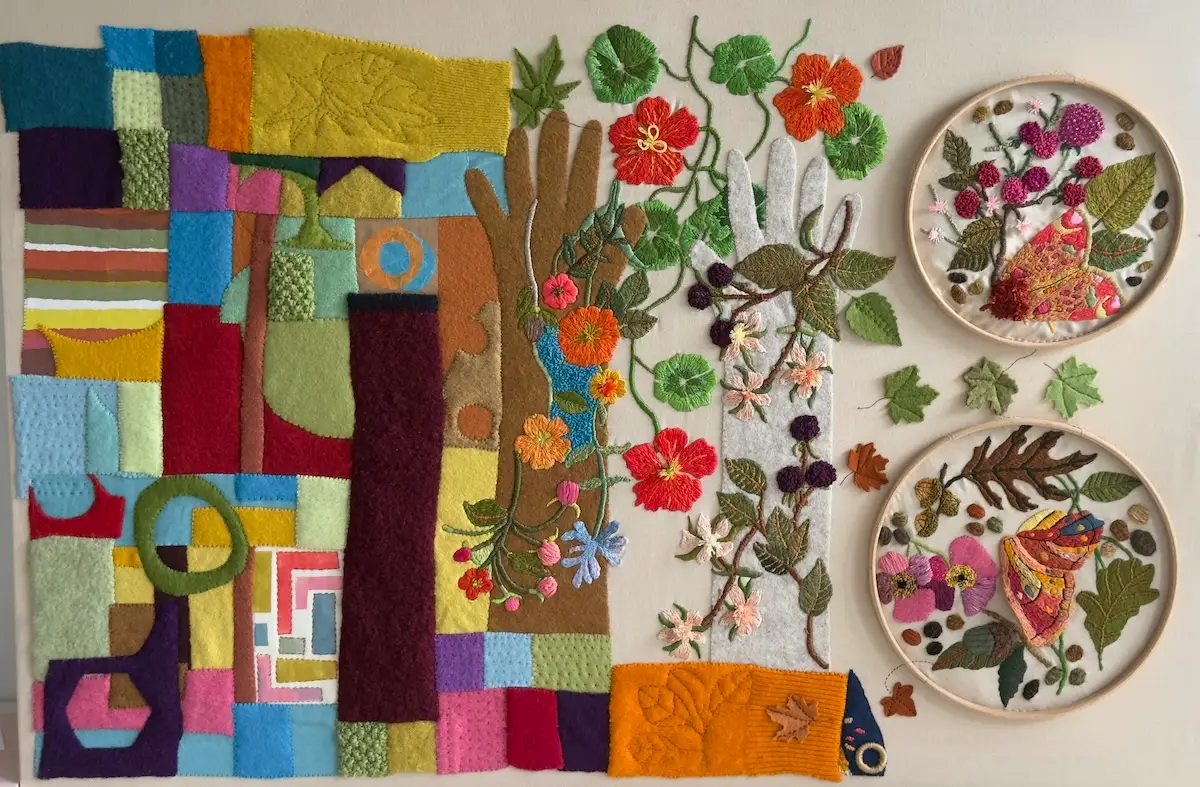
Sabine Kaner weaves stories of identity, memory, and human connection into her layered textile art. Using hand stitch, found fabrics, drawing, and bold colors, she turns everyday materials into thoughtful works that explore the stories we carry and the world around us.
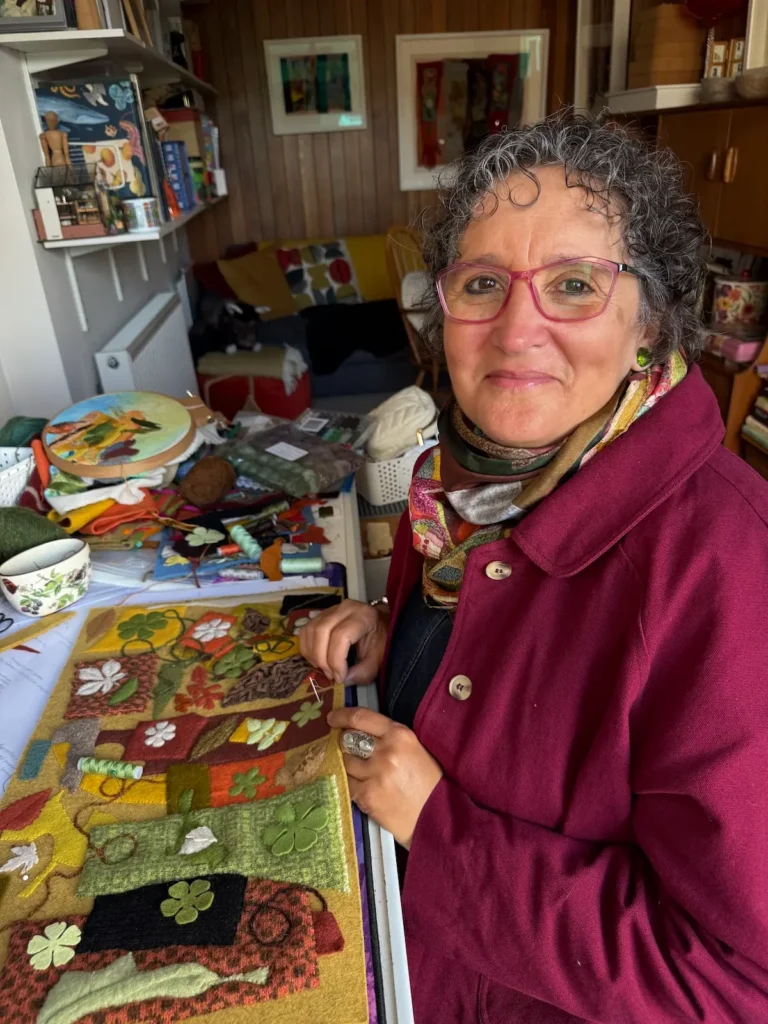
What did you love to make or create when you were a child? Do you remember being drawn to art or making things with your hands?
As a child, I loved to draw and collect coloured pencils and pens. I used to make pencil cases from scraps of fabric to keep them in.
My mother had drawers full of fabrics which she used to make my dresses. I loved opening those drawers and admiring all the different colours, patterns and textures. I was particularly drawn to checked fabrics and Harris Tweed wool, some of which I still have in my fabric stash today.
When I was five, I won my first major art competition in Inner London, as it was called then. I remember visiting the BBC to be presented with my prize by Richard Baker, a well-known newsreader at the time.
As an Amazon Associate I earn from qualifying purchases. Read more about our affiliate linking policy.
At seven, I won one of the national prizes in a road safety art competition.
These early successes cemented the idea of becoming an artist in my mind. From a very young age, art became central to my life.
You trained as a fine art printer before moving into textiles. What did printmaking teach you that still shows up in your work today?
At art school, we were given three areas to specialise in: sculpture, painting or printmaking. I chose printmaking.
Printmaking taught me a great deal about placement, composition and layering. I learnt how to organise an image, build it up through different stages and work within the constraints of a particular process. Each layer had to be considered in relation to the others, and decisions made at one stage would influence what came next. You couldn’t always leave things to chance. I learnt that the process of making was just as important as the final visual image.
What I missed in printmaking was the haptic experience of working with materials, particularly the textures and fluidity of fabric. I wanted something more tactile, something I could manipulate directly with my hands.
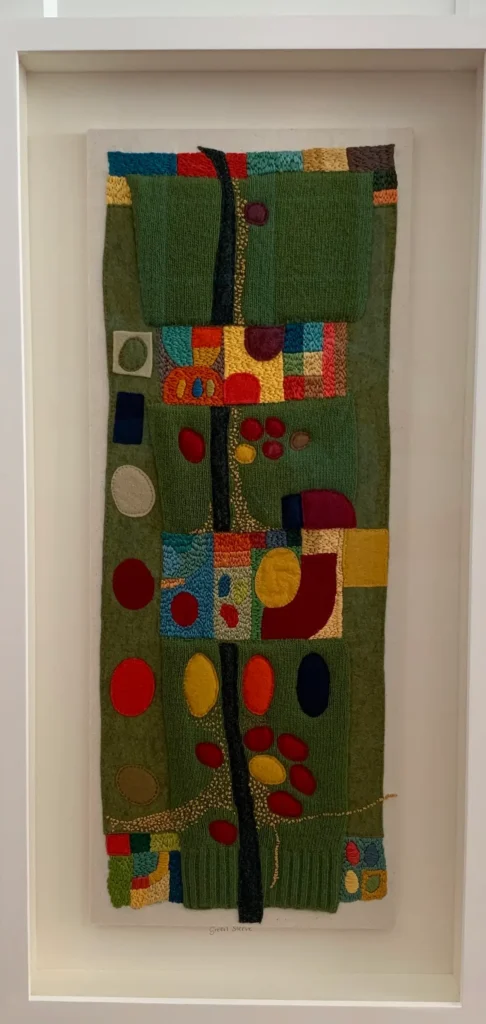
Much of what I learnt through printmaking still influences my work today. I continue to construct images through layers, combining drawing, print, collage, fabric and stitch. The difference is that textiles allow me to work more intuitively, responding to the materials as a piece develops. The materials themselves become part of the visual language and contribute to the story being told.
You spent a period of your life working outside of art, raising a family, and running an Arts and Crafts business. What eventually brought you back to making art?
For many years, I had to balance bringing up a family with developing a creative career. Together with my mother, I started an arts and crafts business. This was an intense period of making, running workshops and producing a wide range of handmade items, including textile pieces.
I drew on all my art skills, and the business became very successful. Eventually, I found myself in the difficult position of having to decide whether to expand and become more commercial or return to making individual, bespoke pieces. In some ways, I had become a victim of my own success.
I realised that unless I employed other people, the business would not be sustainable in the long term.
Life also took a different turn within my family, and some decisions were made for me by circumstances. I chose to continue making my own personal artwork alongside supporting my family.
Although my creative career took a different path, I never really stopped being an artist. Making art remained an important part of my life.
You returned to study as a mature student, including social sciences and art therapy. How did those studies change the way you thought about art and your own creative practice? How would you describe the difference between the artist you were when you first studied art and the artist you are today?
I initially studied art therapy and social sciences out of necessity. My daughter developed a mental illness at a young age, and at the time there was very little support available. I needed to gain the knowledge and understanding to help navigate the system and support her.
Those studies changed the way I understood people and the importance of listening. They also taught me a great deal about teaching, supporting others in their creative journeys and helping people find their own artistic voice.
During periods when family responsibilities allowed, I taught art in schools and ran creative workshops. I have always found textile workshops particularly interesting because of the way people connect through making. Everyone brings something different to the experience. For some, it is about learning new skills, for others, companionship and sharing ideas. Sometimes workshops become places where people feel comfortable discussing difficult experiences. The repetitive movement of stitching and the haptic experience of handling textiles can also have a meditative and healing quality. What each person takes away from a workshop is entirely individual.
My studies also influenced the subjects I explore in my own artwork. I have always been interested in people’s lives, their experiences and the circumstances that shape them. Identity, memory, relationships and the complexities of human experience often find their way into my work. My understanding of psychology and social sciences has given me a greater awareness of how personal experiences are connected to the wider world.
When I first studied art, I was primarily concerned with learning techniques, experimenting with materials and developing my skills. Over time, my experiences of family life, education and working with others have influenced both the subjects I explore and the way I approach making. Today, I am much more interested in how images and materials can communicate ideas and tell stories. I still enjoy experimenting and learning new techniques, but there is now a greater emphasis on the meaning behind the work.
My work is not intended as therapy, but making art has become a way of exploring and communicating these experiences through images, materials and stitch.
Looking back, I can see that all these different experiences, both within and outside art, have contributed to the artist I am today.
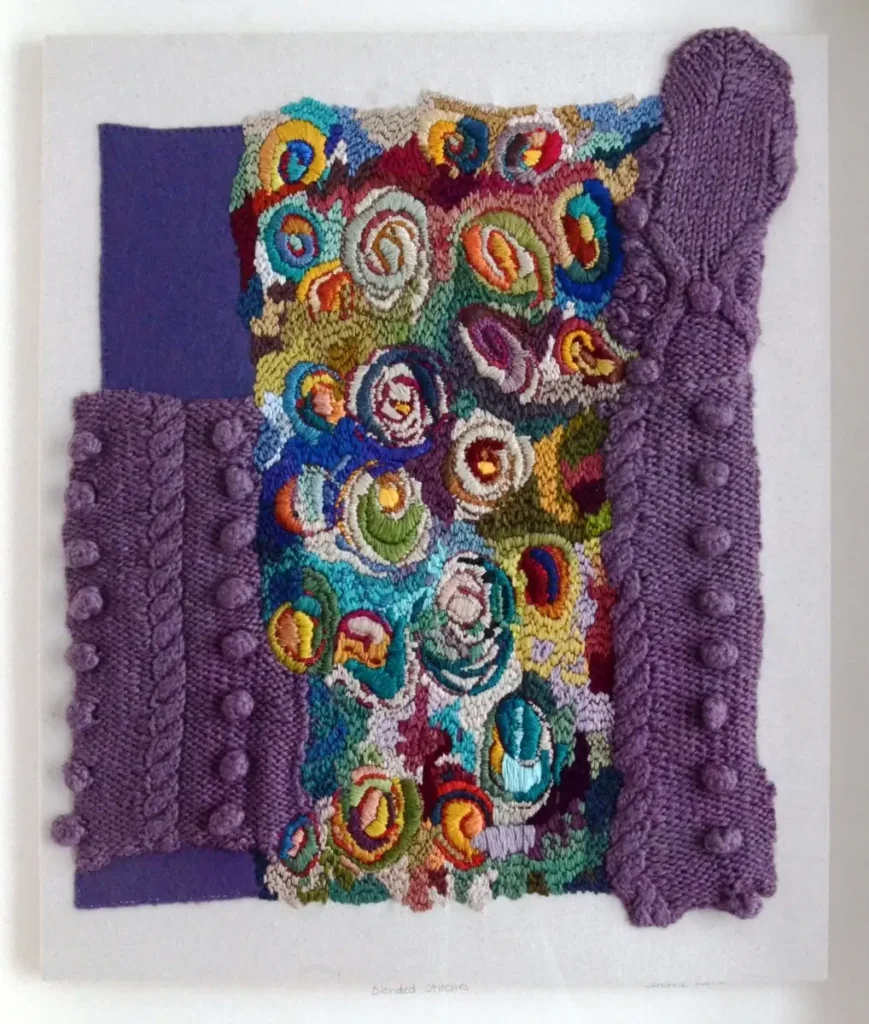
Your work explores identity, memory, mental health and personal experience. Where do you usually find the ideas that become new pieces? Are there memories, people or places that continue to appear in your work, even when you don’t set out to include them?
The ideas I explore in my work generally come from things I have experienced personally or that are familiar to me in some way. They are often generated by social issues, human connections and a need to share experiences and communicate with others. I am interested in the stories that shape people’s lives, particularly those that are sometimes overlooked or difficult to talk about.
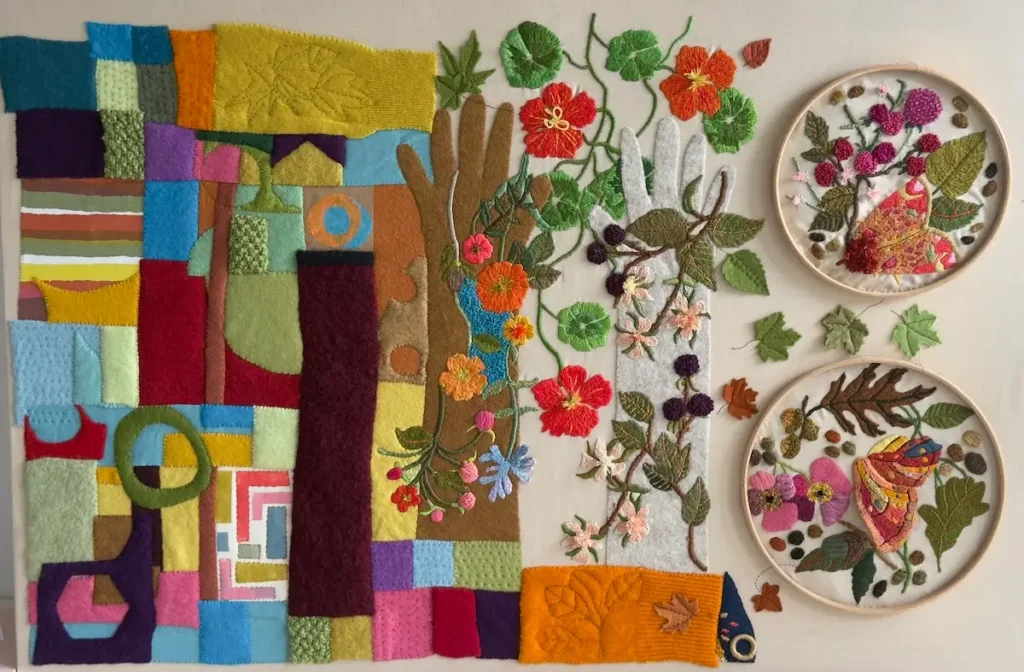
I have a strong connection to nature, and it is often the lens through which I create my images. Nature has become an important part of my visual language, with certain images and symbols appearing and reappearing throughout my work. I use these as a metaphorical language to construct stories.
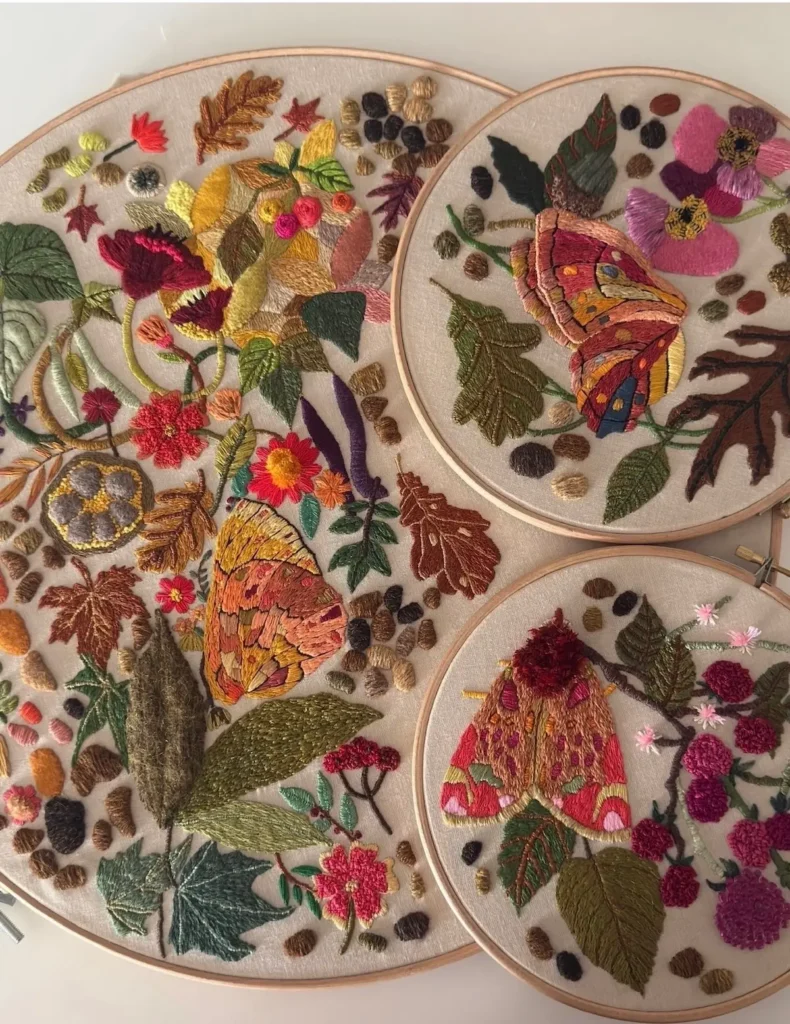
Butterflies, moths, plants and fragments of the natural world frequently inhabit my work. They can suggest change, fragility, resilience or fleeting moments in time. Their meanings are not necessarily fixed but change according to the story and the materials I use.
Clothing and discarded fabrics also feature strongly in my work. They carry traces of people’s lives, memories and experiences. A sleeve, for example, can become a way of exploring identity, absence or the human experience. These familiar materials can communicate something beyond their original purpose.
I often use these visual devices to explore unsettling or difficult subjects in a way that doesn’t immediately alienate the viewer. Nature can offer a gentler way into a story, allowing people to discover its meaning through their own experiences and associations.
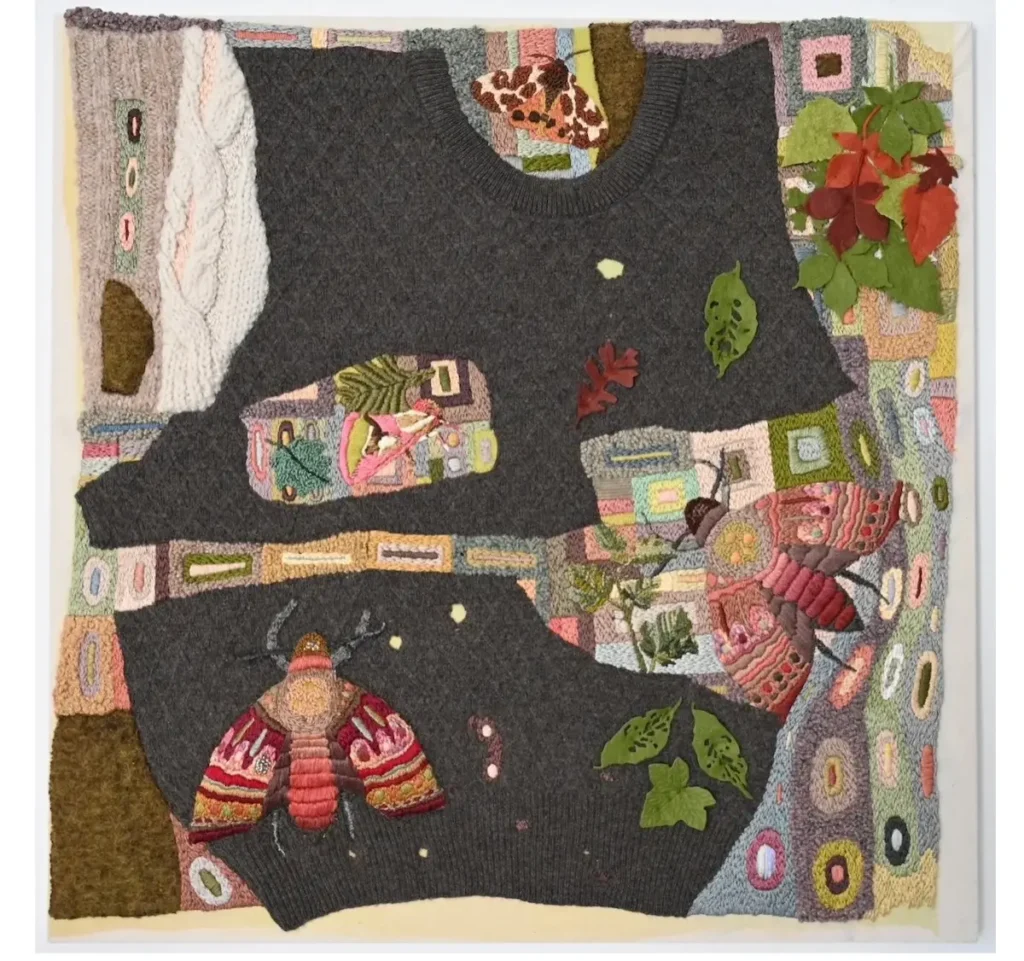
An example is my piece Moth Eaten, which uses the idea of fabric being eaten away as a metaphor for the holes and failings within government and society. It is a familiar image that can suggest something much wider.
I think certain images continue to appear in my work because they have become part of the way I understand and communicate the world around me. They provide a connection between personal memories, human experiences and wider social concerns.
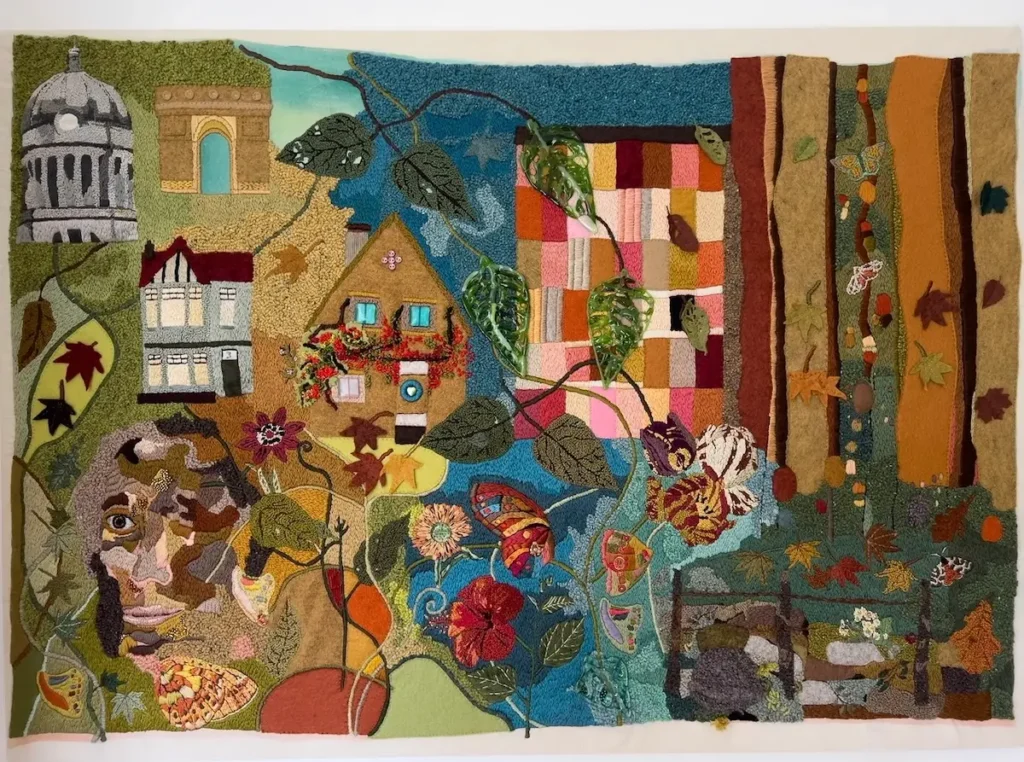
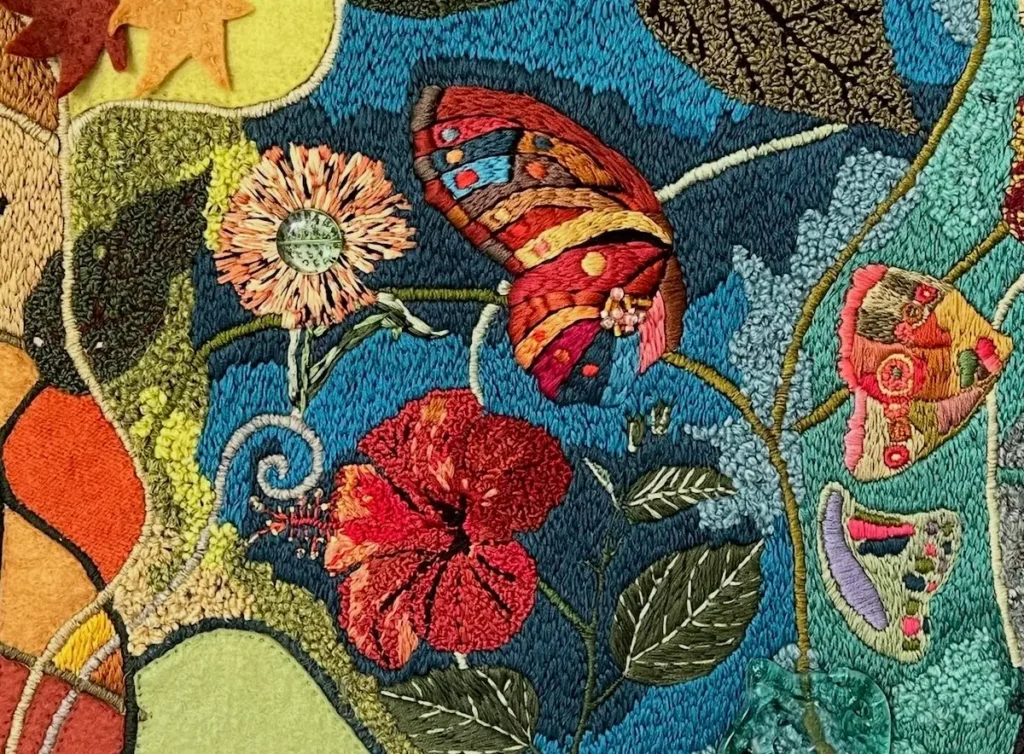
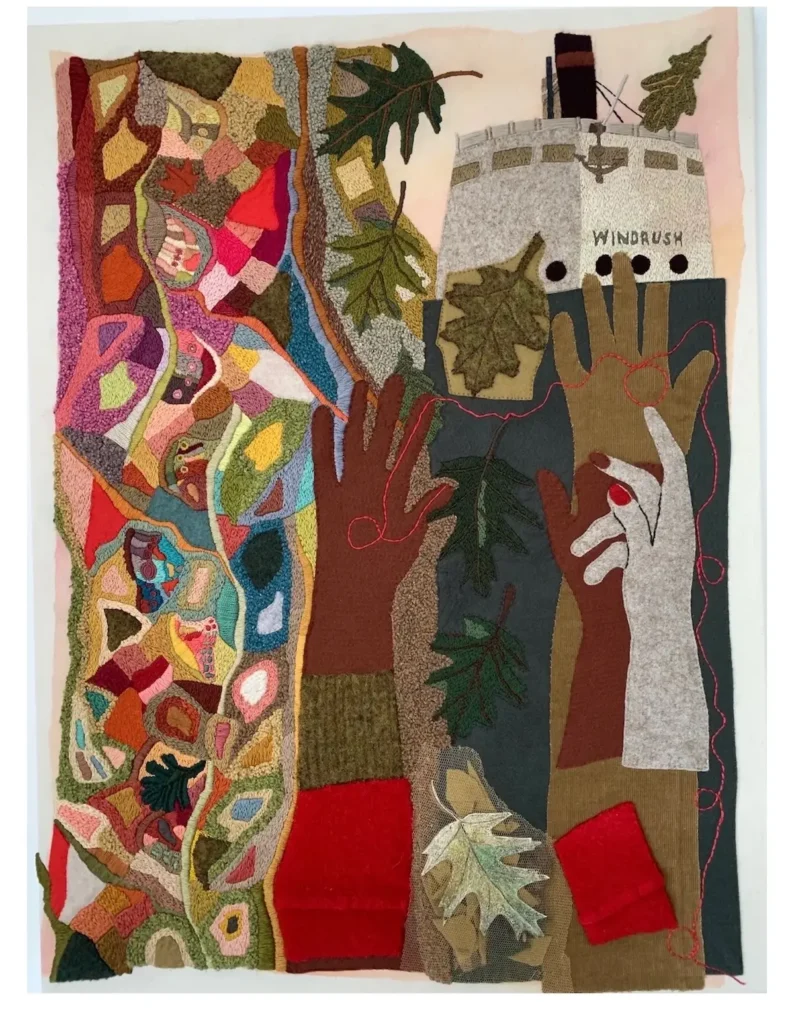
My family history and the places I have lived also find their way into my work. In Memories, I brought together fragments of homes, landscapes and places from my past, weaving them into a collage that reflects my identity and mixed heritage. Colour plays an important part in connecting these different memories.
In Windrush – When the boat comes in.
I drew on my father’s journey from Jamaica to Britain, exploring migration, belonging and the complexities of cultural identity. The work combines personal family history with a much wider social story, using colour, nature and stitch to communicate experiences that reach beyond my own.
How important is color in telling the story of a piece? Do certain colors carry personal meaning for you?
Colour is very important in my compositions. It can signify seasons, moods and emotions. It can highlight or complement other colours, create contrasts or act as a device to draw the viewer’s attention to a particular part of an image.
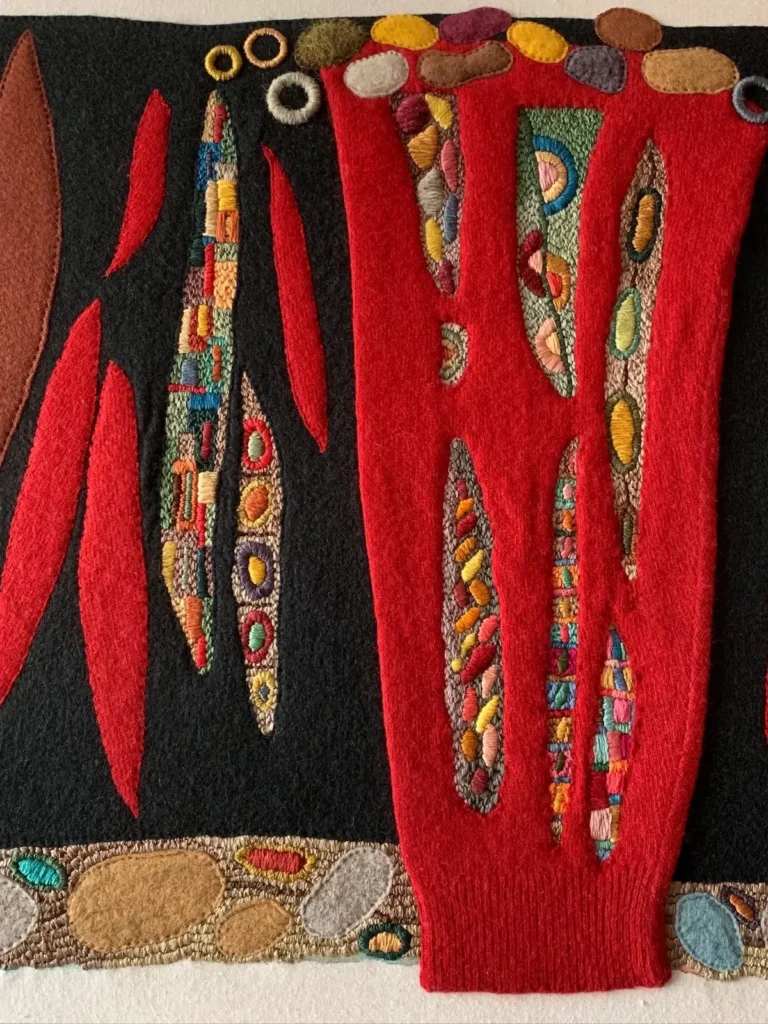
An example is Decorating the Cuts, where I used red against black to make the central image more vivid, drawing the eye directly towards it.
I am interested in how colours interact with one another. Two colours placed together can create the impression of a third colour, changing the way we perceive them. Colour can also suggest something without the need for a recognisable image. It becomes part of the visual language through which a story is told.
I recognise that colour is perceived differently by different people. Our cultural backgrounds, memories and personal experiences all influence the associations we make with particular colours.
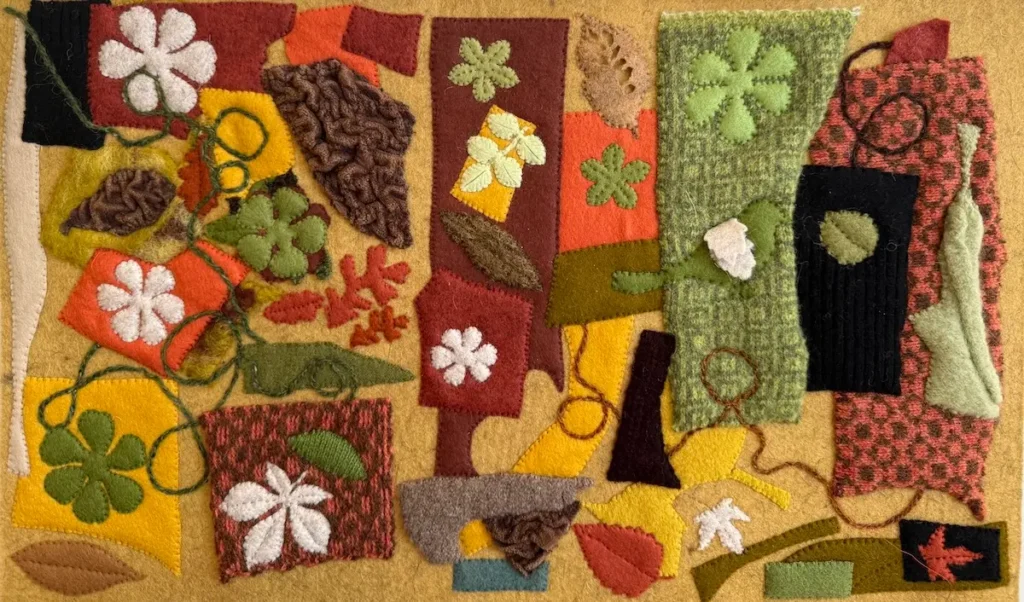
The colours of autumn are probably my favourites. Oranges, rusts, ochres and earthy colours have a particular personal meaning for me. They connect me to nature, the changing seasons and the passing of time. These colours frequently find their way into my work, sometimes consciously and sometimes quite instinctively.
Colour is never simply decorative in my work. It contributes to the atmosphere, meaning and emotional quality of an image.
Your pieces can feel very personal while also leaving room for the viewer to bring their own story. How do you balance sharing something of yourself with allowing the viewer to find their own meaning?
I try to share stories through my work that highlight experiences, emotions or social issues. Often these are subjects that I have a personal connection with or feel need to be brought to people’s attention.
Rather than illustrating everything literally, I use a symbolic and metaphorical visual language that allows the viewer to bring their own interpretation to the work. Nature plays an important part in this. Butterflies, moths, leaves and fragments appear frequently in my images, suggesting ideas of change, vulnerability, loss, resilience and the passing of time.
I am interested in how meaning can be communicated through patterns, colour, composition, materials and the relationships between different elements. Sometimes a small detail can suggest something much larger, while at other times an accumulation of images and materials creates a more complex story.
Cloth itself can carry meaning. A discarded garment, a worn sleeve or a piece of fabric may hold traces of a previous life. Through cutting, layering and stitching, I can give these materials another voice and another story.
I don’t necessarily want the viewer to see exactly what I see. I hope the work offers enough visual information to suggest a story while leaving room for imagination and personal experience. Someone may recognise the subject I am exploring, while another person might find an entirely different connection.
For me, that is part of what makes visual storytelling interesting. The artist begins the conversation, but the viewer brings something of themselves to it.
Take us into your studio. What does a typical day of making look like for you?
I like to start working early in the morning. I usually begin by checking emails and social media, followed by a little reading. Reading is an important part of my creative practice, often introducing new ideas or prompting me to think differently about something I’m working on.
Then I usually begin stitching. All my textile work is hand stitched, so it is a slow, often meditative process. I enjoy the rhythm of stitching and the time it gives me to think and develop ideas as I work.
I tend to have several projects on the go at once. Now, I am working on a commission that has developed over a couple of years. I try to spend a little time on it between other projects. I quite enjoy moving between different pieces, as sometimes working on one project can help resolve something in another.
I’m also currently completing my MA in Illustration, which has given me an opportunity to explore and develop the narrative and storytelling elements of my textile practice. I’ve been creating a number of artists’ books, which involve a great deal of drawing and experimentation.
Drawing underpins everything I do. It is usually the starting point for any piece of work, whether that develops into an illustration, an artist’s book or a stitched textile. I also enjoy the versatility of materials. Watercolours, for example, are something I use in both my drawings and textile work.
Not every day is about making a finished piece. Sometimes I spend time experimenting with materials, looking at other artists’ work or simply exploring an idea through drawing. These are all important parts of the process.
I usually work until around six in the evening, with breaks throughout the day to attend to other things. I’m also a full-time carer for my disabled adult daughter, so her needs naturally take priority. This means I often dip in and out of my work throughout the day rather than having long, uninterrupted periods in the studio.
Over time, I’ve found a way of working that accommodates both my caring responsibilities and my creative practice. The two are very much intertwined, and I think that inevitably influences the stories I choose to tell through my work.
I have a large window in my studio overlooking the surrounding landscape, with my desk positioned beside it. I feel very privileged to have this view, where I can observe the garden, the changing seasons and the natural world throughout the day. These observations naturally find their way into my work, influencing the colours, shapes and imagery I use.
During the warmer months, I often take my stitching outside and work in the garden under an umbrella. In a way, the garden becomes an extension of my studio, allowing me to work surrounded by the very things that inspire so much of my imagery.
You use felt, recycled clothing, donated fabrics, family garments and new materials. What makes a particular piece of fabric catch your eye? You combine stitch, print, collage, drawing, watercolor and, more recently, glass. How do you know when a new material belongs in a piece?
I employ a mixed-media approach to my work and use lots of different materials. I enjoy experimenting. It keeps my thinking engaged by trying out different combinations and juxtaposing materials that might not ordinarily be used together. Discovering their individual qualities and how I can incorporate them into a piece is something I find exciting and interesting.
I was fortunate to receive an Arts Council grant which enabled me to explore materials I had never previously considered working with, such as glass. I collaborated with a local glassmaker, and it turned out to be a very successful pairing. She was already an admirer of my work, so through our conversations she understood the textures and qualities I was hoping to achieve. It opened new possibilities for combining materials and thinking about how they interact.
I am particularly inspired by the textures in fabric and their tactile qualities. I enjoy the way different fabrics respond to stitch, how they can be manipulated, layered, cut or taken apart. Even the smallest fragment can have something interesting to offer.
When I first started working in textiles, I was alarmed by the amount of waste we produced and the mountains of discarded clothing. I began questioning why we were throwing away so much material that could still be used.
To me, fabric is fabric, whether it is new, recycled or something that has already had a previous life. I started exploring how I could incorporate discarded clothing and fabrics into my work. I realised that these materials already had stories inherent within them, through their previous use, the people who had worn them and the lives they had been part of.
This inspired me to take those stories forward and create new ones around the fabrics. A single jumper, cut into pieces, can tell many different stories.
I don’t necessarily choose a material because of its previous history, though. Sometimes it is simply the colour, texture or an interesting fragment that catches my eye. I enjoy discovering how different pieces relate to one another and how their qualities can change when placed together.
I think the materials themselves contribute to the visual language of a piece. They are not simply a surface on which to create an image. Their textures, colours and histories can all influence how a story is told and interpreted.
Where does a new piece usually begin for you: with an idea, an image, a material, a color or something else? You have described your initial vision as loose because the work can take on a life of its own. Can you remember a piece that surprised you as you made it?
When I start making a new piece, I usually respond either to a brief I have been given or, in my personal work, to something that has moved me emotionally. Sometimes the starting point can be as simple as a colour, an image or a particular material.
Drawing is always my starting point. It underpins all my creative work and gives me an opportunity to explore ideas before committing to materials.
I have so many ideas that I need to jot them down first and work out what is actually possible. If I am working within a particular time frame, that can also determine which ideas I take forward.
My initial drawings are often quite loose. They help me establish the composition and explore relationships between shapes, colours and images. However, I don’t regard them as fixed instructions for the finished piece.
Translating a drawing into stitch as an exact replica is not usually possible, nor is it necessarily what I want to achieve. Materials have their own characteristics and can sometimes be challenging to work with. I allow the fabric and other materials to influence the direction of the work.
There are also happy accidents that occur during the making process, particularly when combining different media. Watercolour, print and stitch can behave in unexpected ways, and these discoveries can sometimes take the work in a completely different direction.
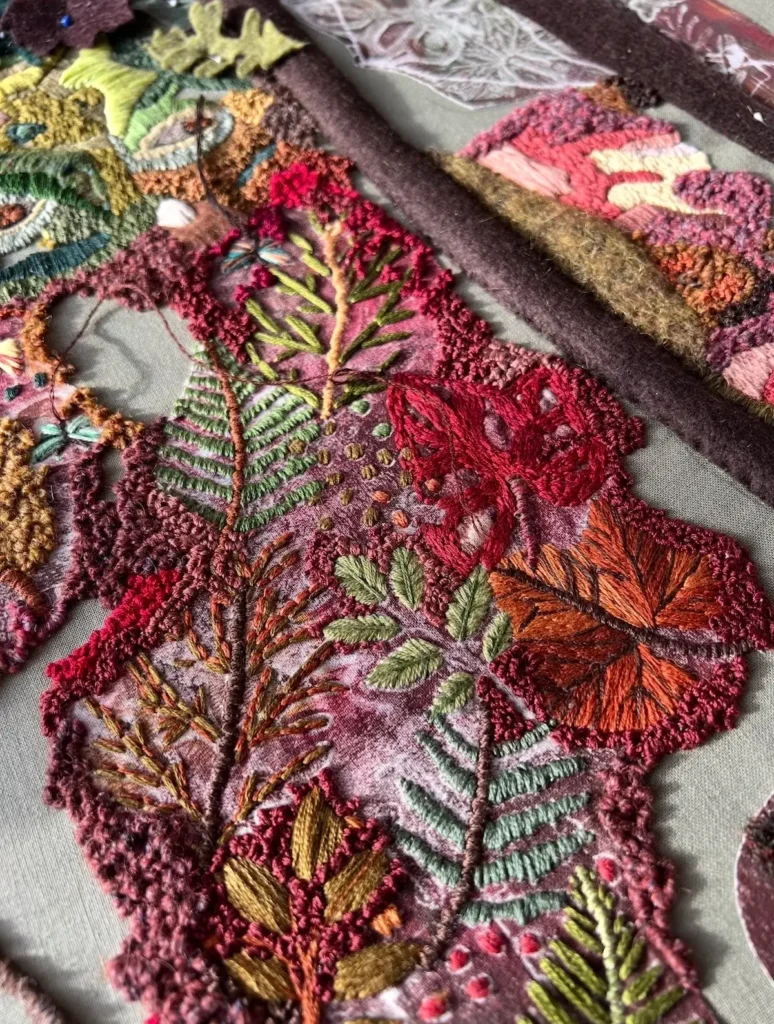
One piece that surprised me was Lost in the Forest.
The background was created predominantly using a Gelli plate, experimenting with layers of colour, shapes and printed textures. I particularly enjoyed the unexpected marks and patterns that emerged through the printing process.
The printed background provided a starting point for the stitched elements. As I began introducing embroidery, the relationship between the printed marks and the stitches became increasingly interesting.
The layers of colour created a sense of depth, while the stitch introduced another dimension through its raised surfaces and tactile qualities. Some areas became densely worked, while others allowed the printed background to remain visible.
What surprised me was how naturally the different processes came together. The printed marks suggested possibilities that I hadn’t necessarily anticipated in my original drawings, and the embroidery developed in response to them.
I think this is an important part of my creative process. I begin with an idea, but I remain open to discovering something new through the act of making. Sometimes the materials reveal possibilities that I wouldn’t have arrived at through drawing alone.
Your work is built in layers. How do you know when a piece needs another layer and when it is time to stop?
Although I build much of my work in layers, my experience with composition guides me throughout the making process.
A lot of my work consists of fragments of a story collaged together, so I need to be particularly mindful of how I arrange the different elements within an image. I want the fragments to have a relationship with one another, allowing the viewer’s eye to move through the composition and discover the connections between them.
I spend quite a lot of time moving pieces around, considering their position, colour, shape and texture, and how they interact with the background and surrounding elements. Sometimes the smallest adjustment can change the balance of the whole piece.
I think it is important to consider the space between the elements as well as the elements themselves. Too much information can overwhelm an image, and too much texture can cause the original idea to become lost. Finding a balance between all these things is essential.
I often work intuitively, responding to what is happening as the piece develops. However, intuition is also informed by years of experience and an understanding of composition. I have learnt to recognise when something isn’t quite working, even if I can’t immediately identify why.
Knowing when to stop can be difficult, particularly as I enjoy working with an abundance of colour, texture and detail. Sometimes I need to leave a piece alone for a while and return to it with fresh eyes.
Looking back at my earlier work, I can clearly see which pieces have been successful and those that haven’t worked quite as well. I think this is part of developing as an artist, learning to recognise what an image needs and, equally importantly, what it doesn’t need.
I am currently exploring this further through my MA research, investigating how much visual information is needed to tell a story. It has made me question what happens when we add or subtract elements from an image and how that changes what the viewer sees and understands.
Your practice has developed through many different stages of your life. What has making given you that you don’t think you could have found anywhere else? What would you say to someone who has spent years putting everyone else first and is wondering if it is too late to begin making art of their own?
My life has taken many different turns, and I have faced challenges that I have had to find ways of overcoming.
Growing up in the UK with two immigrant parents adapting to a new country was always going to present difficulties, particularly as a mixed-race family. Neither of my parents fully understood the challenges their children would encounter growing up in a society that was often very different from the one they had known.
I was the first person in my family to go into higher education and attend university. Education opened a world of possibilities for me, not just academically but in the way I understood myself and the world around me.
Art and creativity, from a very young age, gave me an opportunity to have a voice and created a safe space where I could be myself. It offered a way of expressing things that I couldn’t always put into words. It also gave me the tools to explore and understand life, people and their experiences, developing my sense of compassion, empathy and tolerance.
Throughout my life I have had to overcome serious autoimmune dysfunction, chronic daily pain, disability within the family and many other obstacles. There have been periods when other responsibilities have taken priority and my creative practice has had to fit around them.
However, the need to create has always remained strong. It has weathered all those storms and has been a constant companion and comfort on difficult days. Making art has given me a sense of continuity throughout the different stages of my life. It has allowed me to process experiences, ask questions and explore ideas that matter to me.
I would say to anyone who has spent much of their life pursuing another career, raising a family or caring for others that it is never too late to begin making art.
Whatever you have done previously can become a source of inspiration. The experiences you have accumulated, the places you have lived, the people you have known and the challenges you have faced all contribute to your individual perspective. Nobody else has lived exactly the same life, and that is something you can bring into your creative work.
When I teach workshops, I try to help people recognise their own voice and discover the stories they want to tell. I believe that by tapping into our intuition and allowing ourselves to experiment, a personal visual language can begin to emerge, sometimes in ways that surprise us.
There is no single way of being creative, and people come to making for many different reasons. For some, it may be about learning a new skill; for others, it may offer an opportunity for reflection, connection or simply the pleasure of making something with their hands.
I am currently in the final stage of an MA in Illustration, where I have been exploring storytelling and narrative through cloth and stitch. It has given me an opportunity to examine my own practice more closely, particularly how we communicate ideas visually, how an audience engages with an image and how sequencing can influence the way a story unfolds.
Returning to study at this stage of my life has been an important experience. It has challenged some of my assumptions, introduced me to new ways of thinking and helped me understand my own creative language more deeply.
Learning, for me, has always been a lifelong process. I don’t think we ever reach a point where there is nothing more to discover.
I would encourage anyone thinking about beginning or returning to art to be curious, experiment and not worry too much about where it might lead. Your own experiences are a valuable starting point, and you may discover a creative voice you didn’t realise you had.
Where can people see your work?
You can find my work across three linked Instagram accounts, each focusing on different aspects of my creative practice.
@sabinemake and @morethanonecolour focus on the craft of making, sharing techniques, materials, experiments and the creative processes behind my work.
@sabinekaner is dedicated to my gallery work, where you can see completed pieces in their entirety. I am also represented by London gallerist Ed Cross, whose website features a selection of my work.
My own website, www.sabinekaner.com, will be updated in the future.
You can also find my work and workshops through TextileArtist.org.
My work has been featured in many publications, including Australia’s Inspirations magazine, TextileArtist publications and Charlotte Vannier’s recent book Le fil dans l’art contemporain: 125 artistes au cœur de la création (Pyramyd Éditions, 2025), alongside other contemporary artists working with textiles.
Rapid-Fire Fun
- Hand stitch or machine stitch? Hand stitch, always!
- Colour or texture? Both! I couldn’t imagine working without either.
- Favourite thing to collect for future artwork? Interesting fragments of fabric, particularly discarded textiles with unusual colours and textures.
- A material you can’t resist when you see it in a charity shop or second-hand store? Woollen jumpers. They offer so many possibilities for cutting, deconstructing and stitching.
- What are you curious about right now? How much visual information we need to tell a story, and how colour, shape, texture and stitch influence what the viewer sees and imagines.
Interview posted October 2026
Explore more embroidery projects and inspiration on Create Whimsy.