
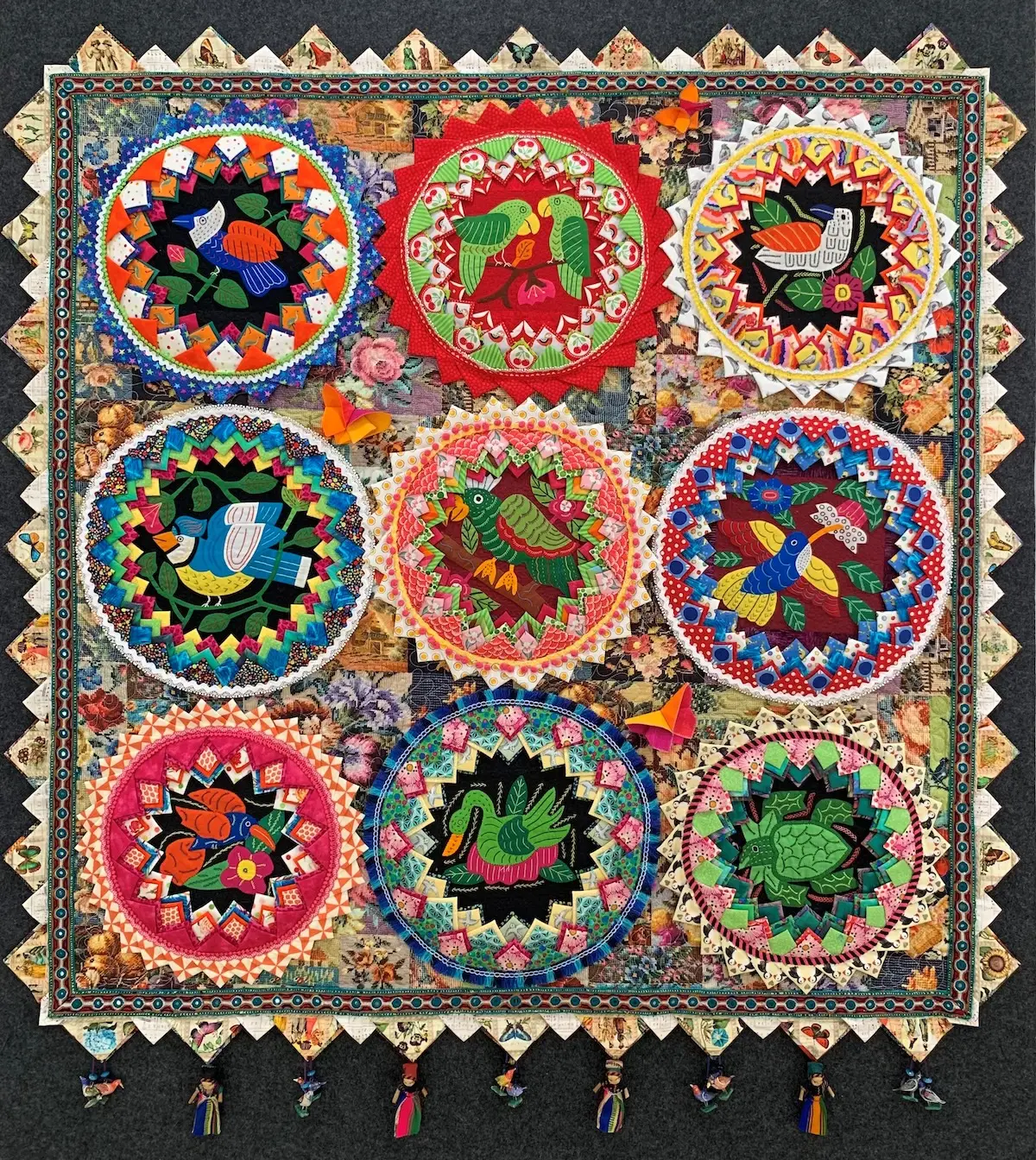
Serap Whitmer brings together the curiosity of a scientist with the joy of a lifelong maker. Her colorful quilts and lifelike birds mix fabric, embroidery, beads, paint, and even technology, turning memories, nature, and found treasures into playful works full of tiny details.
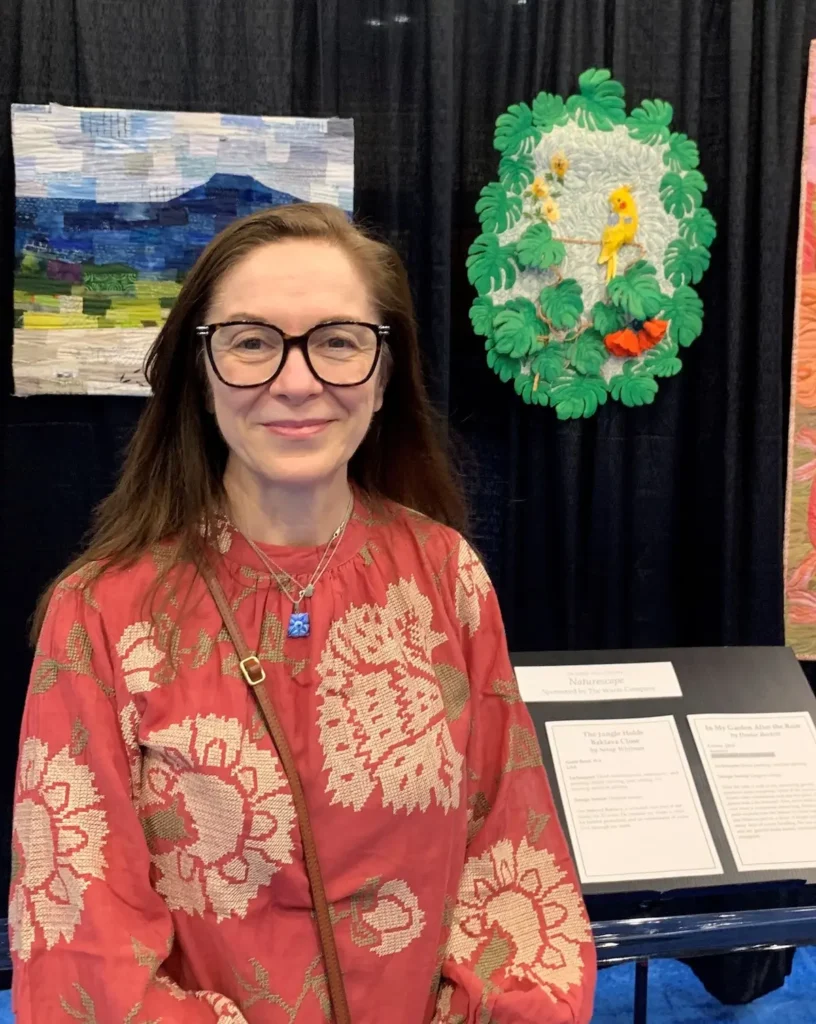
Can you take us back to the beginning? What first drew you to making things with fabric, thread, or other materials?
Necessity and availability! I was an only child, there weren’t many toys, and I often didn’t have exactly what I wanted, so I looked for ways to make the things I wanted to play with.
One lucky day, I was gifted with a Barbie-like doll. My mother was a seamstress, and we had every monthly issue of Burda and Neue Mode magazines at home, along with lots of leftover fabric, which I collected. I wouldn’t cut the fabric because I wanted to be able to reuse it to design more outfits for my doll, so the clothes were pinned onto her instead. I designed so many outfits that, years later, the poor doll looked like a sieve!
My father used to take me to his carpenter friend’s shop where I was allowed to pick out small pieces, and those scraps turned into everything from garden furniture and boats to lounge sets and more.
As an Amazon Associate I earn from qualifying purchases. Read more about our affiliate linking policy.
At what point did making things become more than a hobby for you and start to feel like part of who you are?
I have never really seen “making” as a hobby. I think I learned at an early age that thinking about how to make things and finding solutions to make them made me happy.
I love beautiful things, and I treasure handmade objects, antiques, vintage finds, and, of course, fabrics and paper. In 2020, as we all experienced, I found myself spending much more time at home. I took my children’s unused playroom and turned it into my studio, where I began making birds and art quilts with fabrics I had collected over the years.
Your work today includes quilting, embroidery, sculpture, beads, painting and even laser cutting. How did you collect all of these skills along the way?
My sisters-in-law and my neighbor quilted, and I needed a common interest for us to connect over, so I decided to learn quilting. I bought and read Rodale’s Successful Quilting Library, and after making several quilts, I realized that making patchwork quilts by following a pattern wasn’t for me. I didn’t quilt much again until around 2020, when I was introduced to art quilts and joined SAQA. A couple of years ago, I purchased a longarm machine, and I now love free-motion quilting.
I learned embroidery from Creative Stitching by Sue Spargo and by watching lots of YouTube videos while walking on the treadmill.
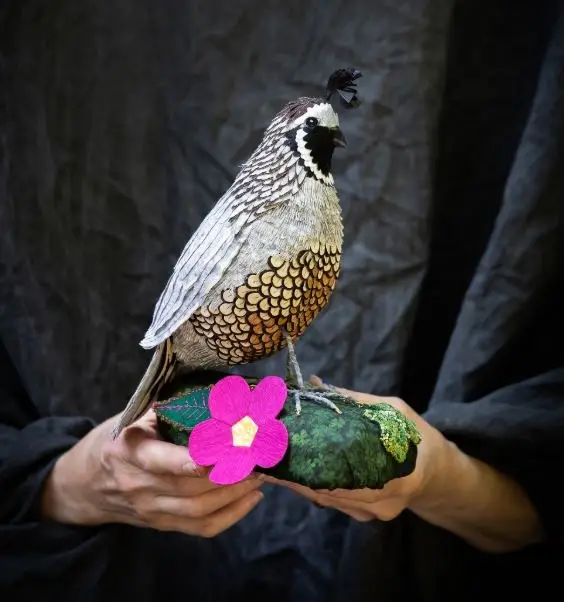
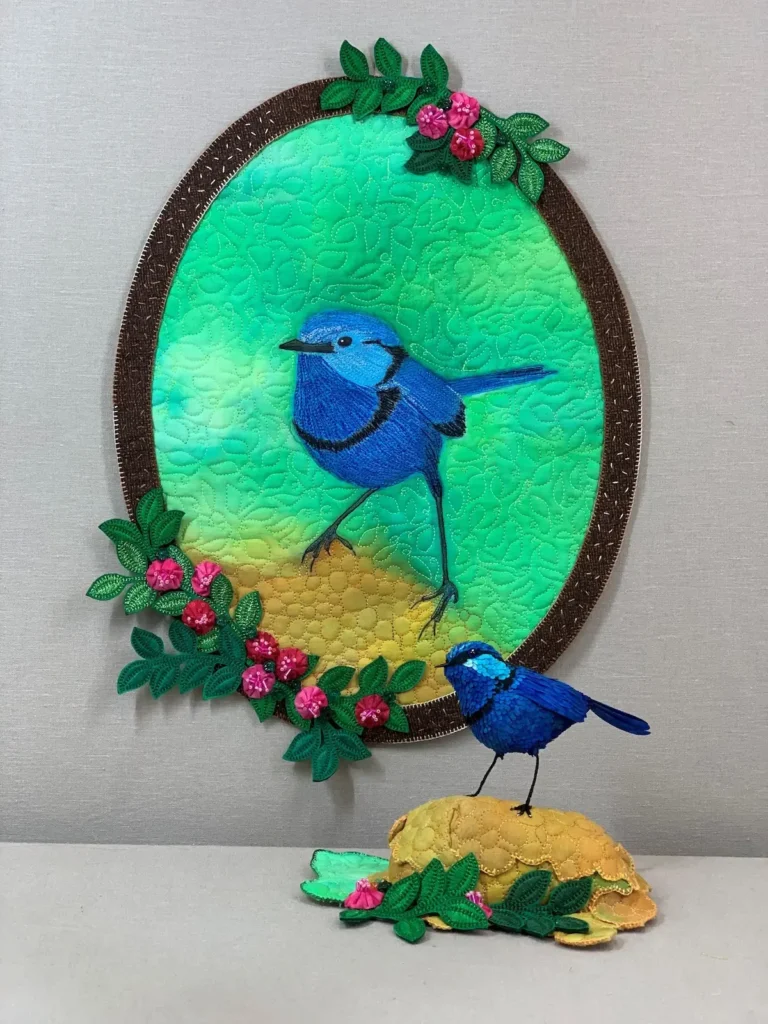
I make realistic bird sculptures, and I found that the best way for me to achieve the shape I wanted was to carve the bodies from foam, which I love doing. Watching a block of foam turn into a bird is very therapeutic and satisfying.
Beading is very tactile work done with my hands. I often use it as a final touch, it adds dimension, light, and color.
I have taken only a couple of quilting related classes, and they are mostly about the materials and techniques for painting on fabric not how to paint. YouTube is also good when I need a quick answer.
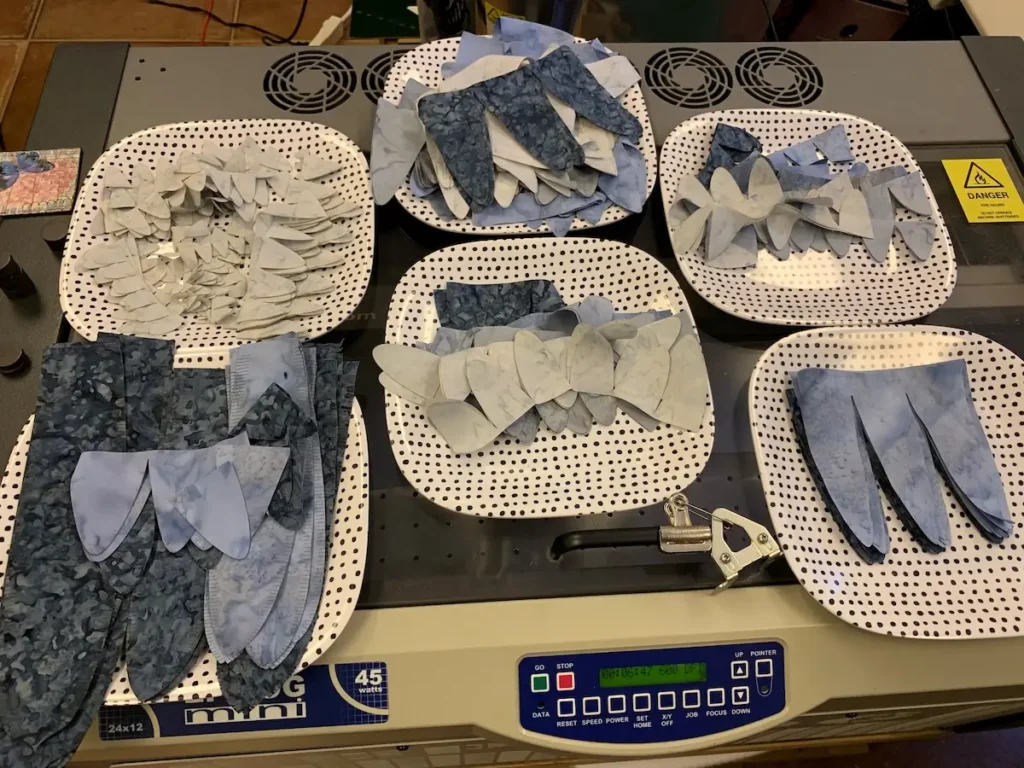
Laser cutting has become an essential part of my work. I spend a lot of time drawing on the computer and use the laser to cut almost all the pieces I need. My husband bought a laser cutter about 20 years ago as a new toy for his shop, but I ended up moving it nearer to my studio and using it more than he does. At first, I used it for scrapbooking. Our scrapbooks became very customized and pretty, and while working on them, I created many digital files and learned skills that I now use to cut fabric.
Was there a project or turning point when you felt your work begin to change into something that felt truly like your own?
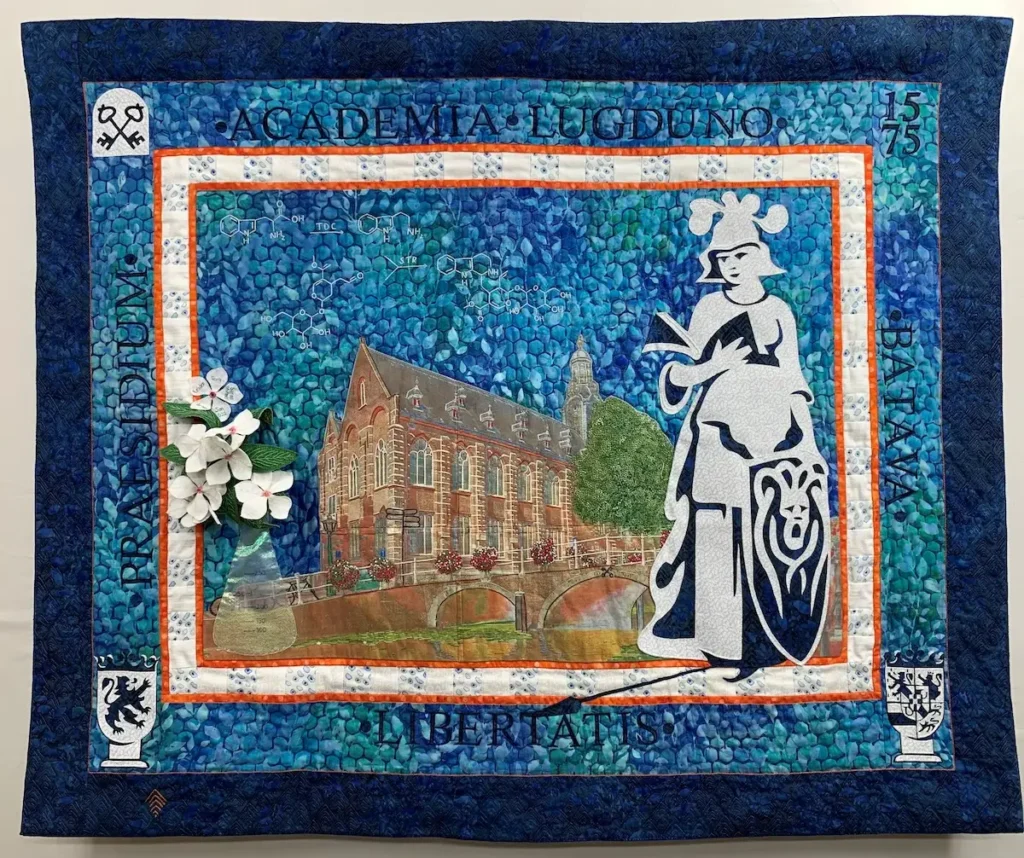
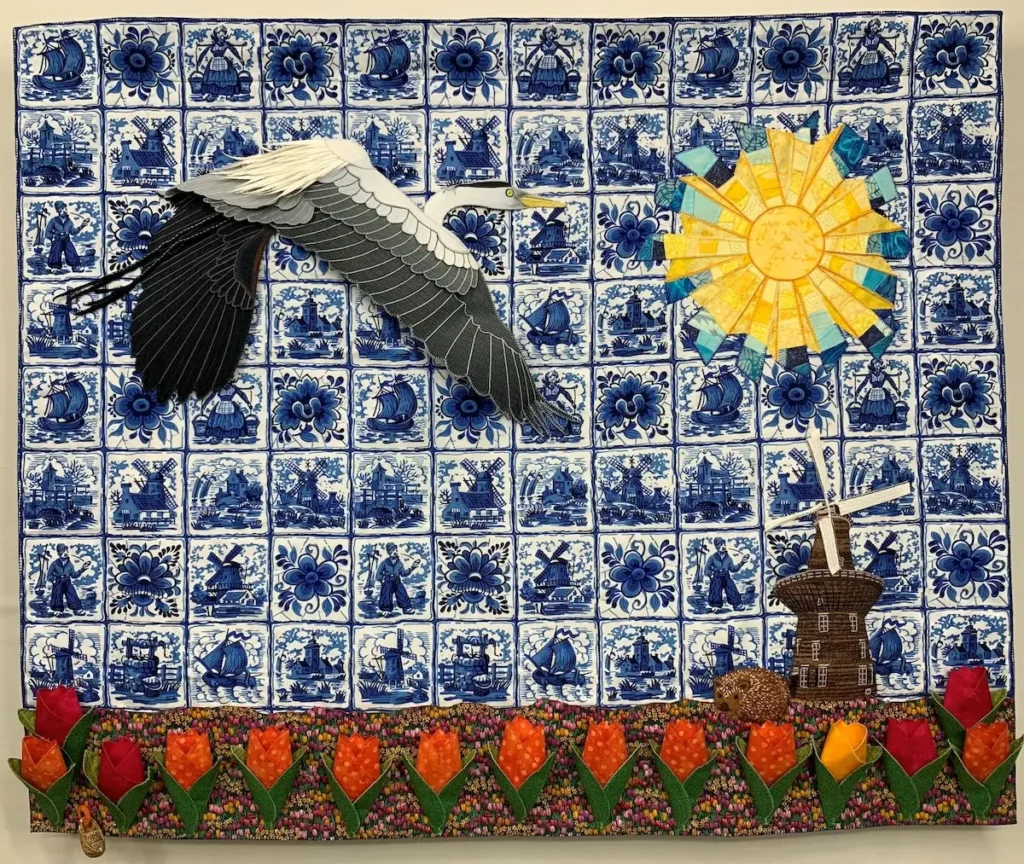
Yes. Two of my first double-sided art quilts, Hometown (2021) and Student Abroad (2022), felt like a turning point for me. They depict growing up in my hometown of Izmir, Türkiye, and my life as a PhD student in Leiden, the Netherlands, respectively.
These memory quilts include dimensional elements. Making them encouraged me to experiment more with dimension, something that has become an important part of almost all my quilts today.
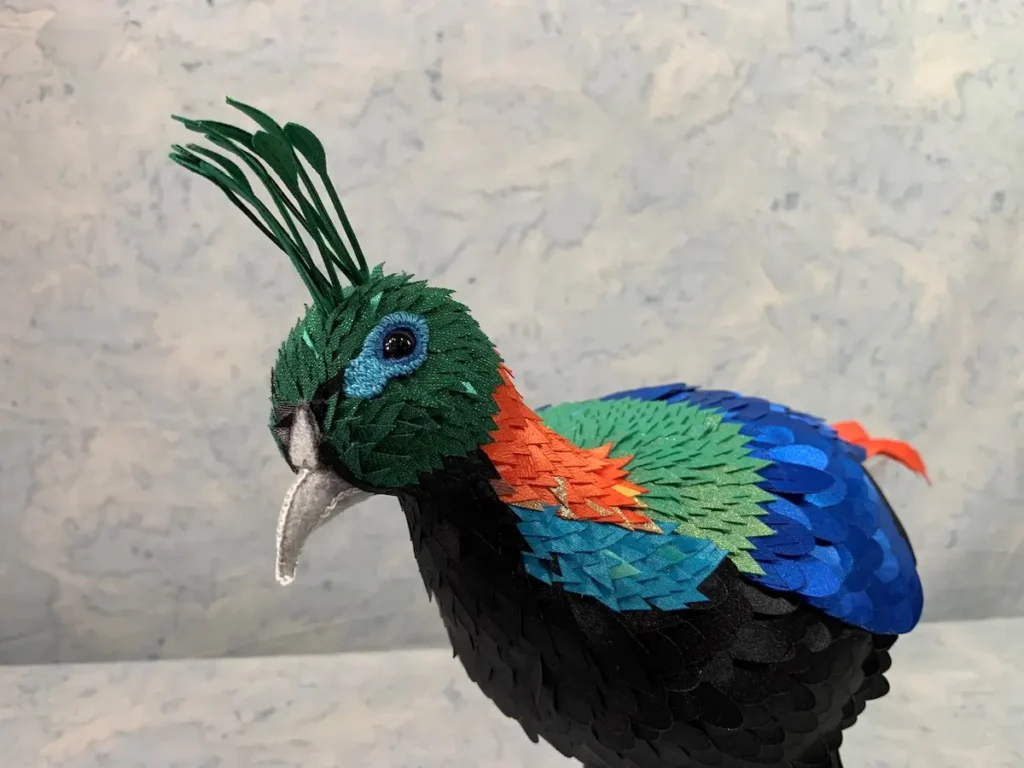
Birds appear in your work, including your three-dimensional bird pieces. What is it about birds that keeps drawing you back?
I studied pharmacy and later earned a PhD in Pharmacognosy, which, in very simple terms, is the study of medicinal plants. I have always loved nature, especially plants and birds.
Some years ago, while visiting London, I saw handmade fabric bird sculptures at Liberty and fell in love with them. Seeing how much I loved them, my older daughter said, “Why don’t you make your own?”
My own… I loved that idea!
Every winter break after that, I set up projects for my children and their friends, many of them related to birds, and I began making my own birds too. In 2020, there was a period when I was making birds daily.
Bird making is a wonderful process for me. It takes me into a flow state, it is my meditation. I study the bird, collect the materials, prepare the files for laser cutting, sculpt the body, and then build it. The process is methodical yet artistic, perhaps a reflection of both the scientist and the artist in me. And in the end, it is completely my own.
Environmental protection is also very important to me, and through my work, I hope to bring attention to the beauty and vulnerability of the natural world. Birds are my muse.
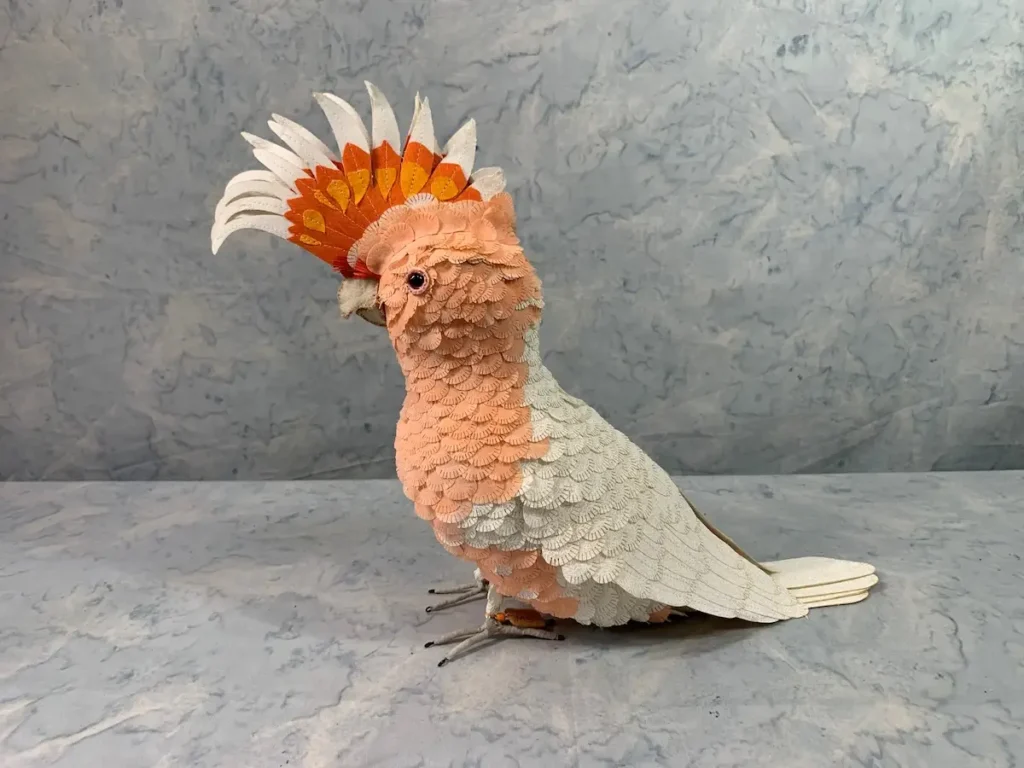
Your work often turns familiar things into something unexpected. What makes an ordinary object, animal, or scene interesting enough for you to recreate it in fiber?
Some of us may do it more than others, but I think we all have the ability to see things outside the box and ask, “what if?” We do it in science, art, literature, stand-up comedy, everywhere. I am always experimenting, learning what materials are out there, and wondering if I can incorporate them into my work.
Reusing fabrics, upcycling plastic, and giving new life to gifted or found fiber art are important to me. Lately, many of my quilts include something made by someone else, a piece of embroidery, lace, or another handmade treasure.
When I finally hang a finished piece that incorporates these elements, I remember my mom, my friends, and the unknown makers whose hands created something long before it came to me. I silently thank them for their part in the work and for the inspiration they left behind.
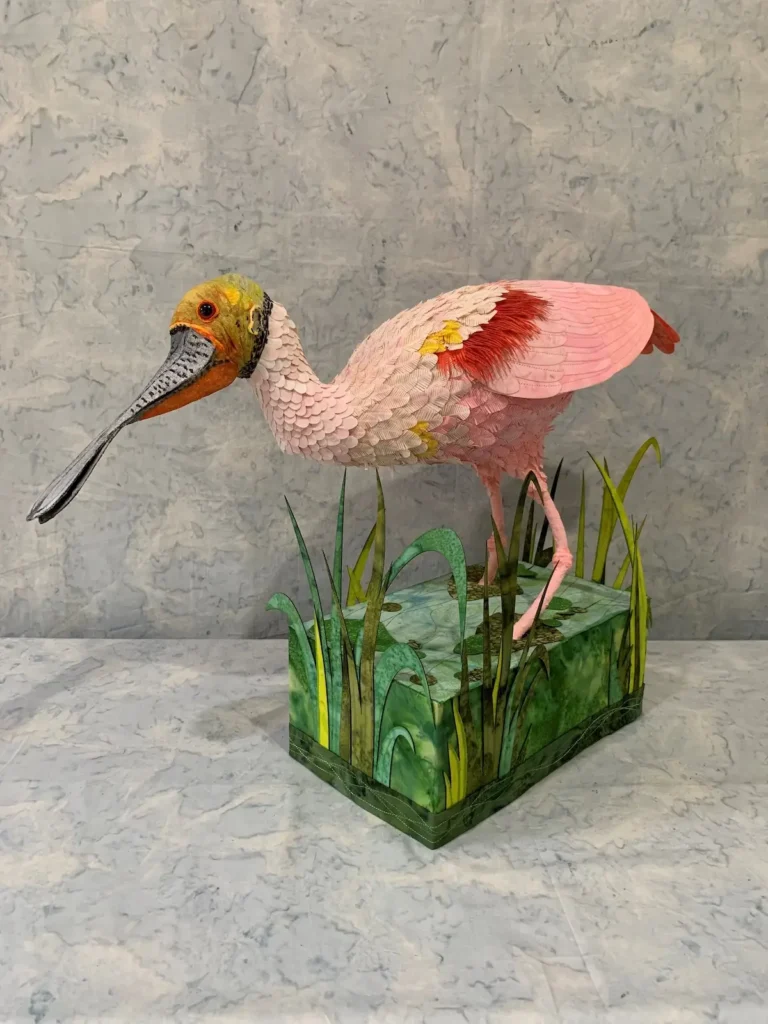
Do you collect photographs, fabrics, objects, sketches, or other things that might become inspiration later?
Absolutely!
Your work can be playful, detailed and very lifelike. What do you hope people feel when they look closely at one of your pieces?
I want people to be curious. Each piece is an experiment for me, and I try to do something different with each one so I can learn.
When my work is displayed, I sometimes quietly watch the viewers. I love hearing, “How did she do that?” “What is that material?” or “It looks real!” But what makes me especially happy is seeing someone spend time with a piece, reading the statement, looking at it from different angles, not rushing, and discovering the little details. When that happens, I feel like I have achieved my goal.
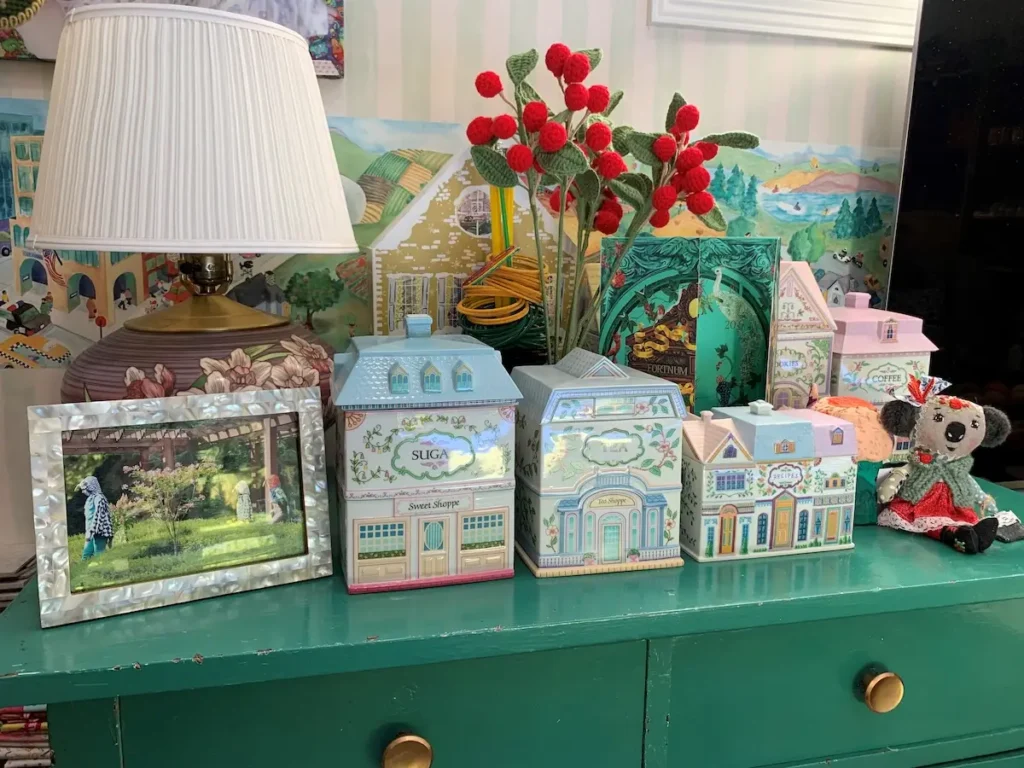
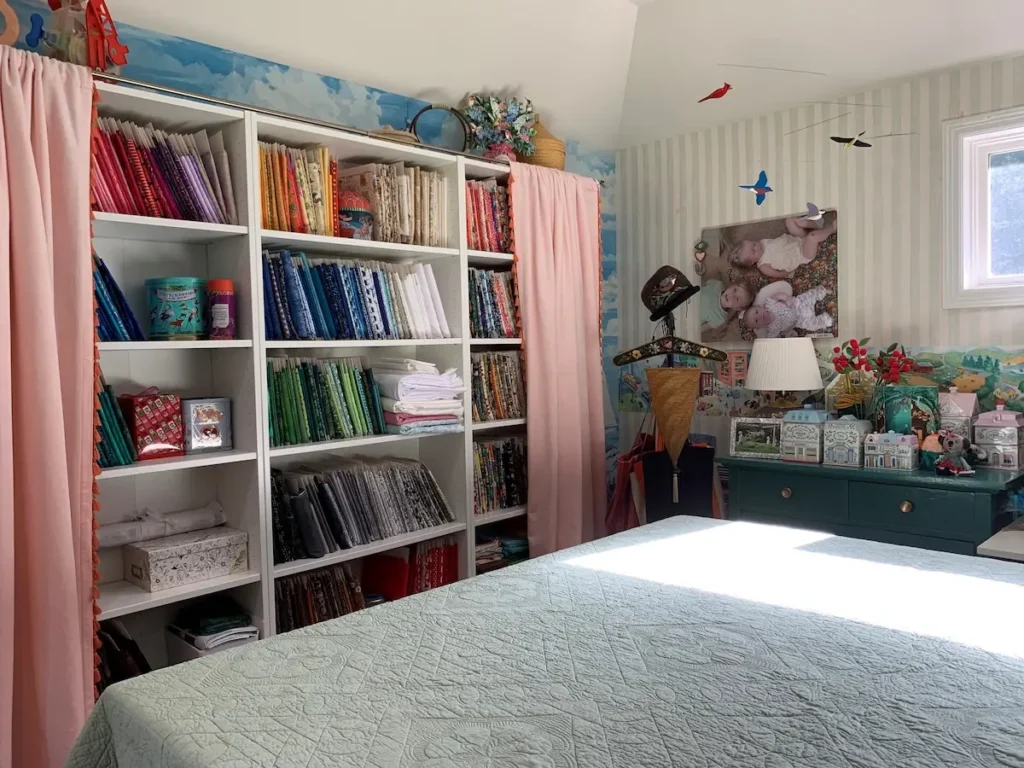
Tell us about your studio (aka playroom). What does your creative space look like when you are working?
Generally, it’s neat! I’m organized and like a tidy space, probably my lab habits. Before I leave my playroom, I tidy up so that when I come back, I can start working right away.
I usually work on one active project at a time. I use boxes with compartments and tiered wheeled carts, and before I start a new project, I go around the room and collect every possible material that might be a candidate. I put everything together so I don’t forget what I have or what might work. While I’m working on one project, I’m already thinking about the next one.
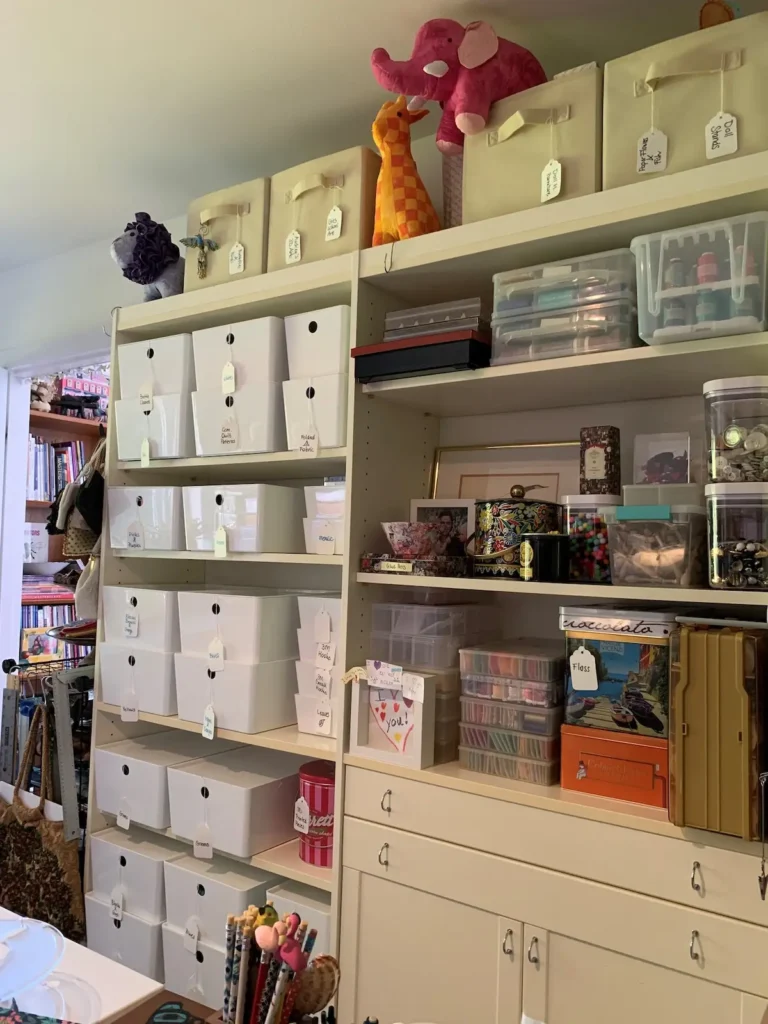
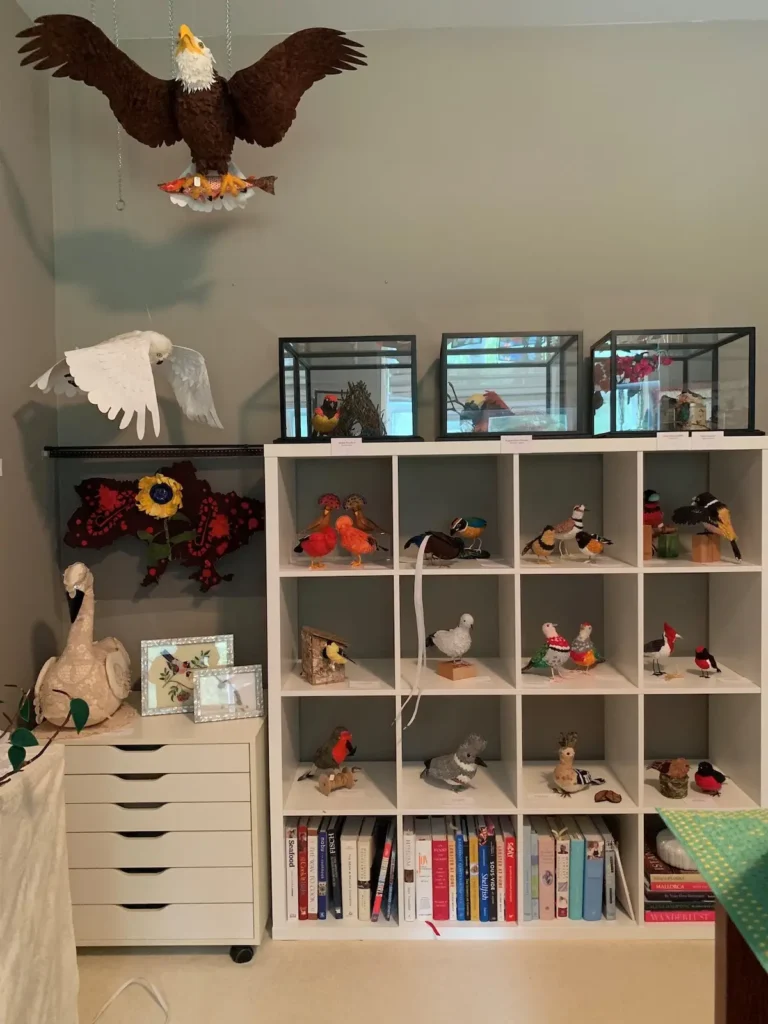
Your pieces can combine many different materials. How do you know when a piece needs fabric, thread, beads, paint, wire, or something completely different?
Most of the time, I already have what I need in my studio, and by now I have enough experience to know what will work. When I go shopping for materials, birds are always somewhere in my mind. I spend so much time looking at and studying photographs of birds that when I see the right fabric, thread, bead, or other material, I usually recognize its potential right away.
And if I can’t find the right fabric, I make it work. I start with white fabric and paint or draw on it until I get what I need.
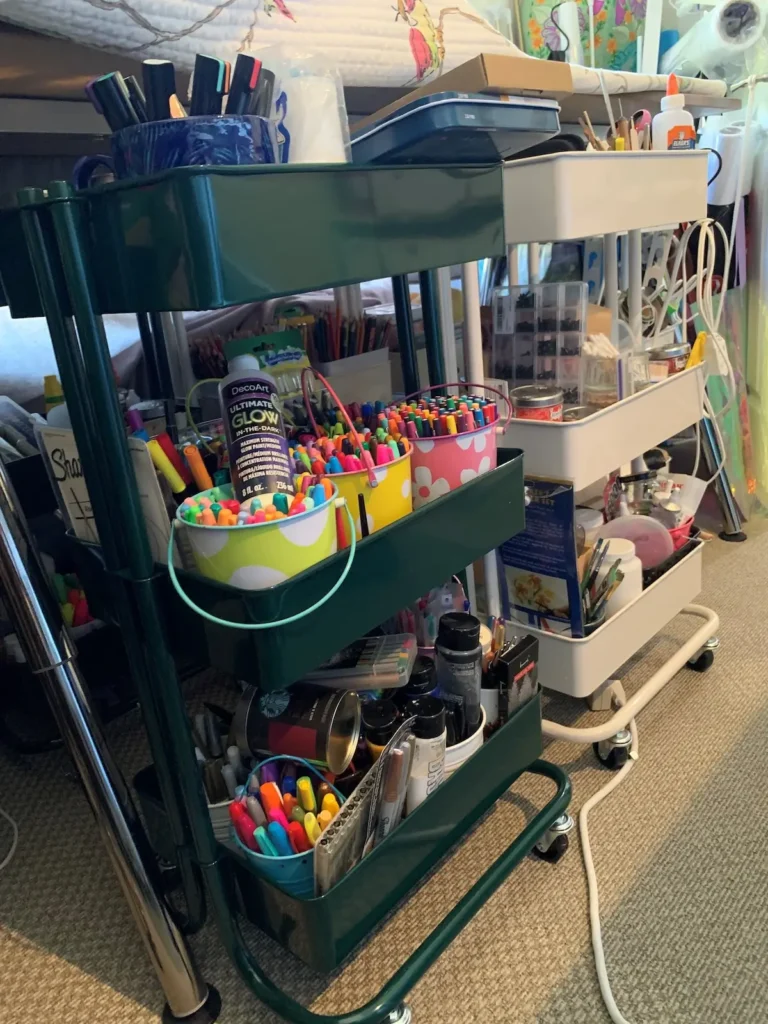
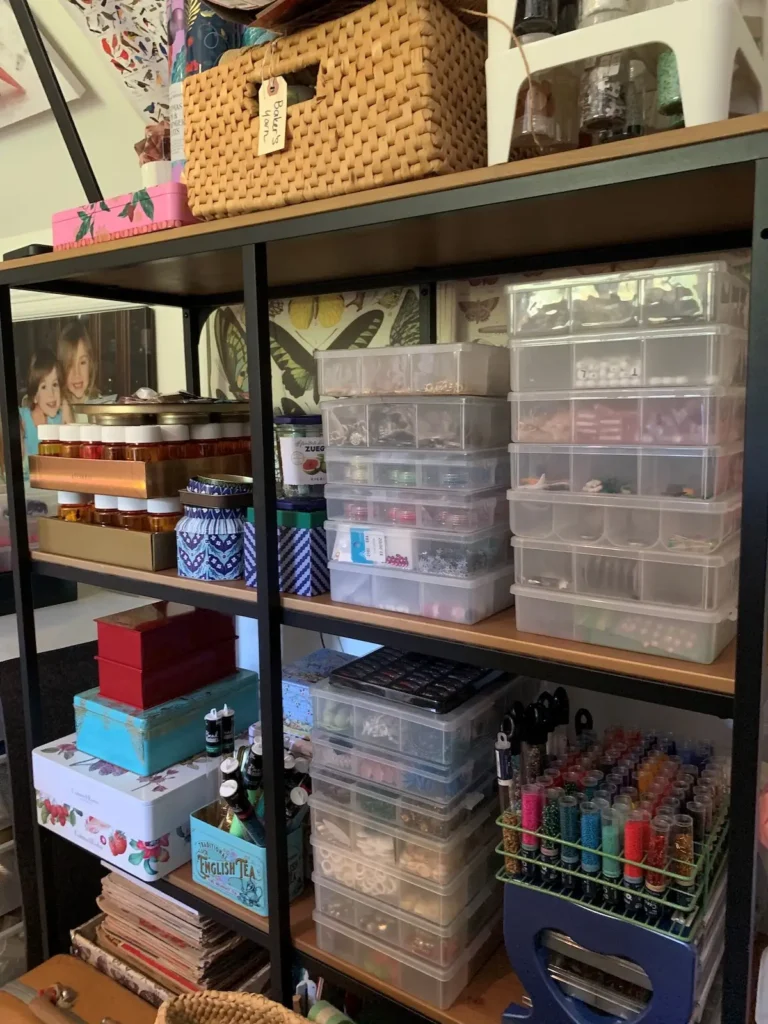
How do you organize all the different supplies that come with working across so many techniques?
If I’m going to spend time in a space and be creative, it needs to be pretty and organized. My thinking is, “if I don’t see it, it isn’t there,” so all my boxes are labeled, and my fabrics are rolled around comic book boards and sorted by color.
I also have several wheeled carts that come out depending on the project, one with bird-making supplies, one with markers, paints, Inktense pencils and brushes, another with felt and wire, and so on. I simply roll the cart I need over to my workstation and start working.
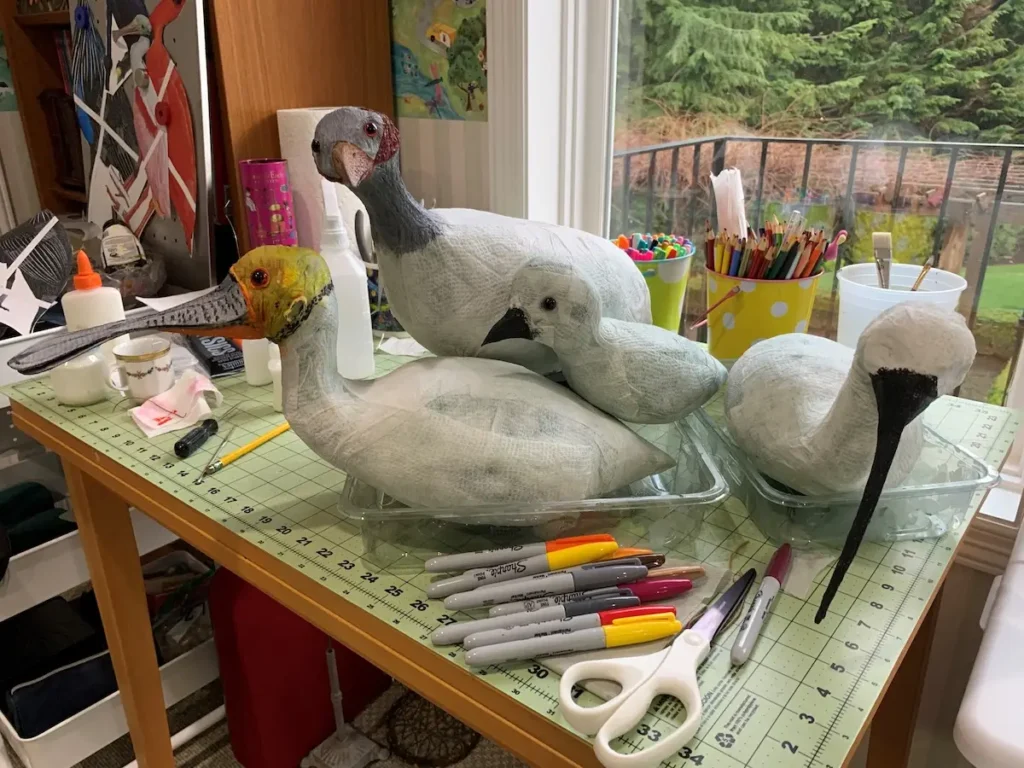
Where does a new piece usually begin for you? With an image, a material, a story, a sketch, or simply a feeling?
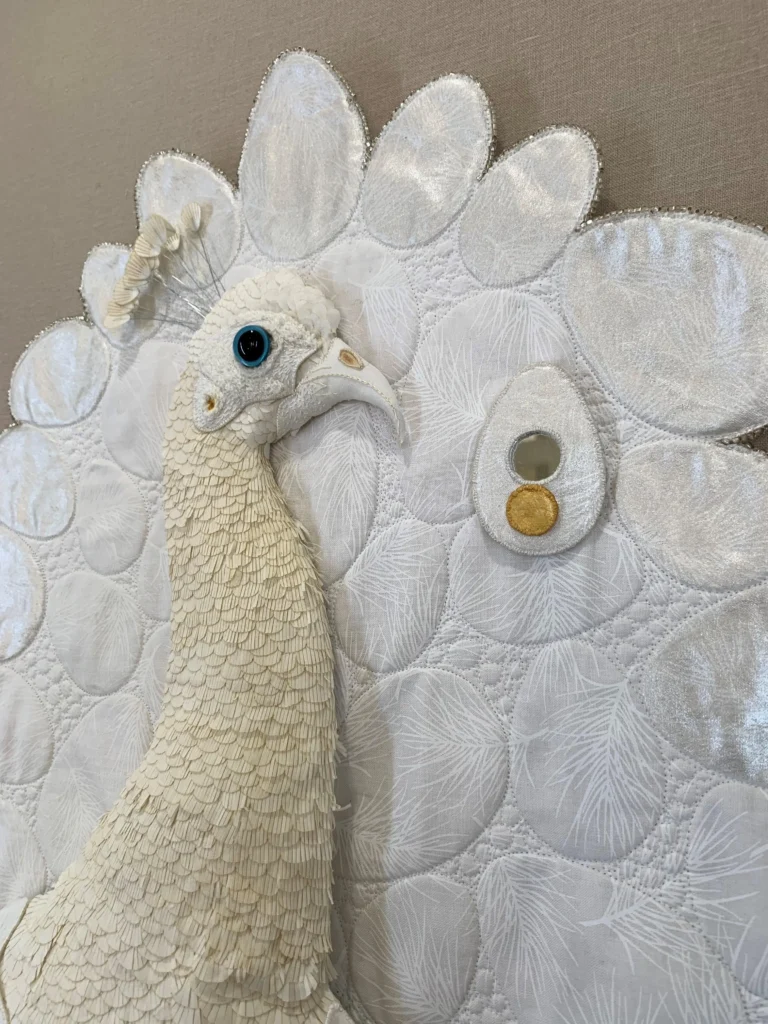
I think all of the above! With my birds, though, this year I have been focusing on endangered, vulnerable, or nearly extinct species. I do my research, make a list, and decide which birds to make.
For my quilts, I often look at calls for entry from the groups I belong to. If a theme interests me, I start thinking about it, and sometimes an idea grows into a piece.
Other times, it can begin with a lovely fabric or a vintage find, something so beautiful and delicate that may have cost me only a dollar but deserves to be seen.
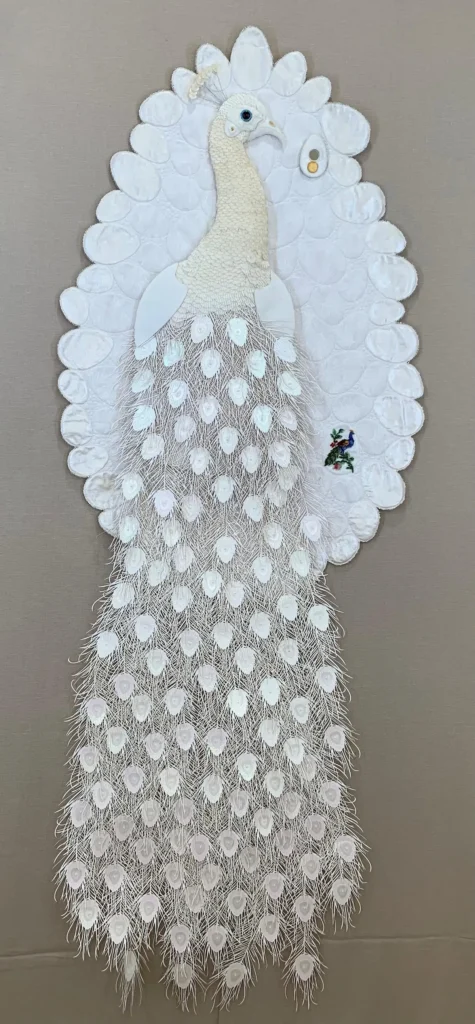
How much planning happens before you begin cutting fabric or stitching?
A lot! While I’m working on one active project, the next one is usually stewing on the back burner. I think about the design, materials, and how I might construct it long before I start cutting or stitching.
Since there is no guide or pattern to rely on, plans often change along the way, and that’s part of the process. If something doesn’t work and I need to recut or try another approach, that’s OK. I’m always experimenting.
Your work brings together traditional textile techniques and newer tools and technology. What do you enjoy about mixing old and new ways of making?
Fusion is good! I enjoy using the best of both worlds. Laser cutting and digital drawing allow me to quickly and accurately create the large number of small pieces I often need. 3D printing helps me make armatures efficiently without spending too much time on the underlying structure.
Once the preparation is done, I can work with my hands, assembling, free motion quilting, embroidering, beading, and adding all the little details that bring a piece to life.
When you have been working on something for a long time, how do you know when it is finished?
It’s mostly a feeling. Sometimes a piece looks finished, but I know it still needs something, and I need to be reminded of it. I hang those pieces in the hallway right outside my studio (aka time-out-wall), alongside some of my finished work.
Every time I walk by, I look at both the finished pieces and the ones still waiting. Eventually, the lightbulb moment arrives, and I know exactly what the piece needs.
What have you learned about yourself through making art that you could not have learned any other way?
I have learned to recognize myself as an artist. I make one-of-a-kind pieces that come from my own ideas, experiences, experiments, and way of seeing things.
Is there a piece you have made that feels especially personal to you? What makes that piece different?
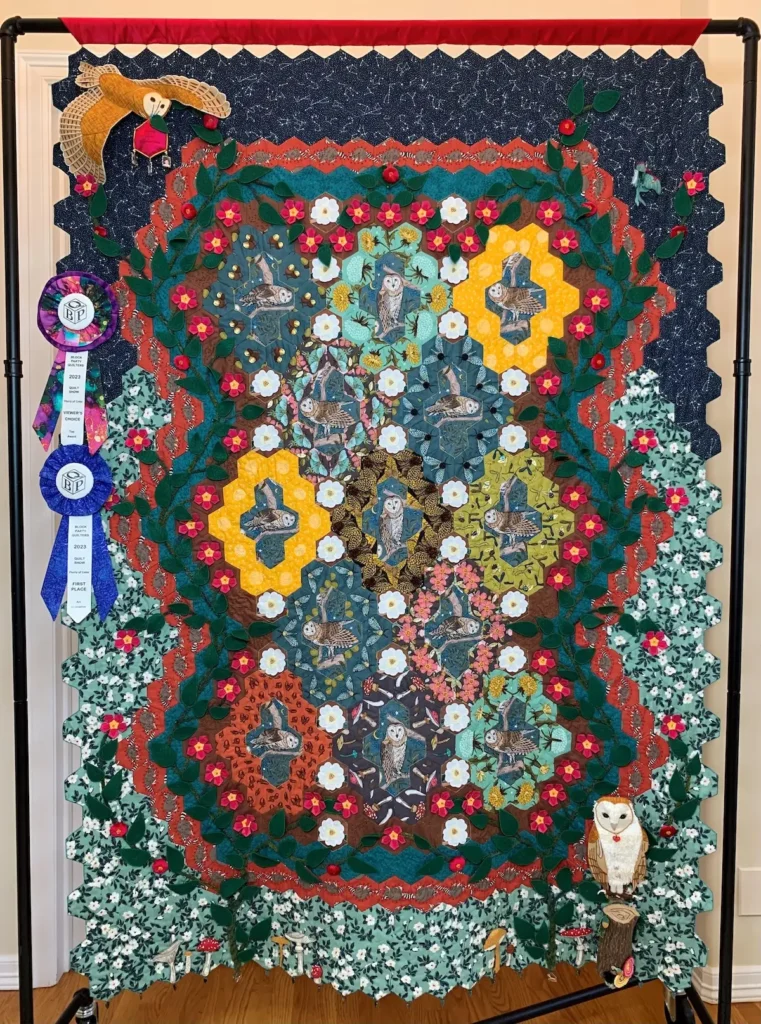
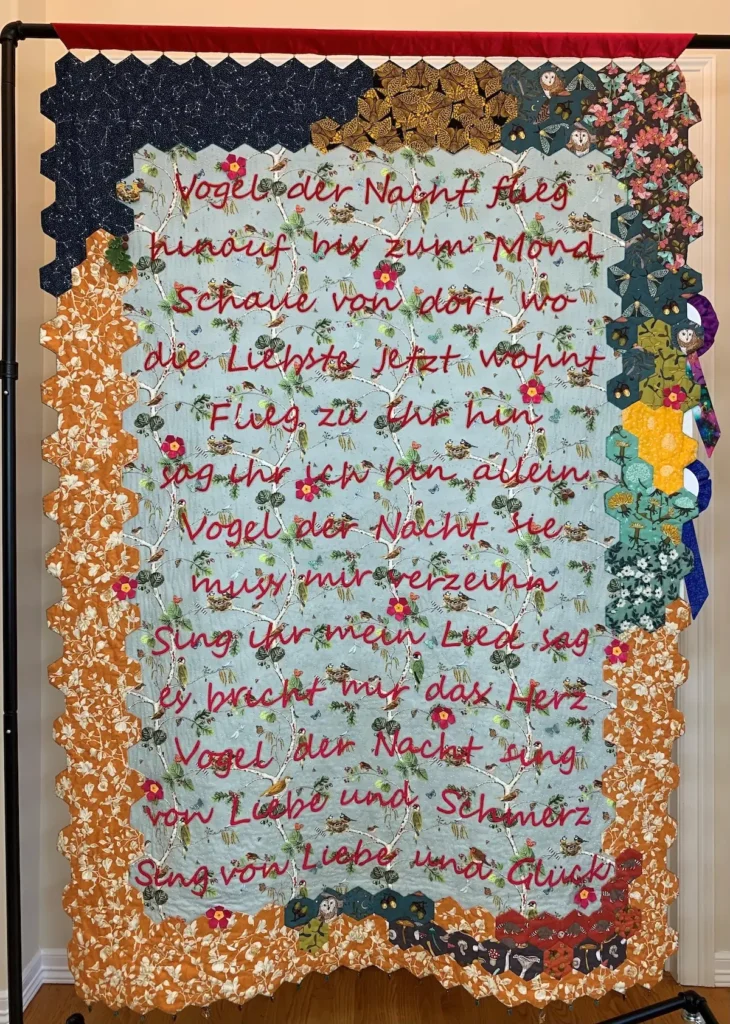
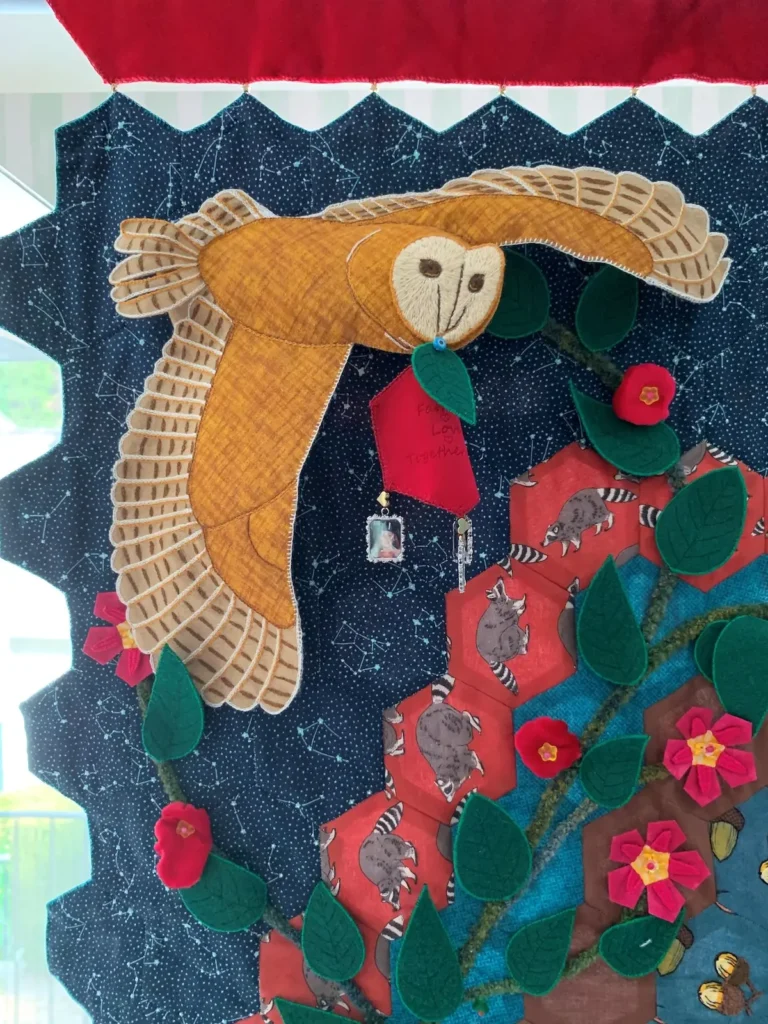
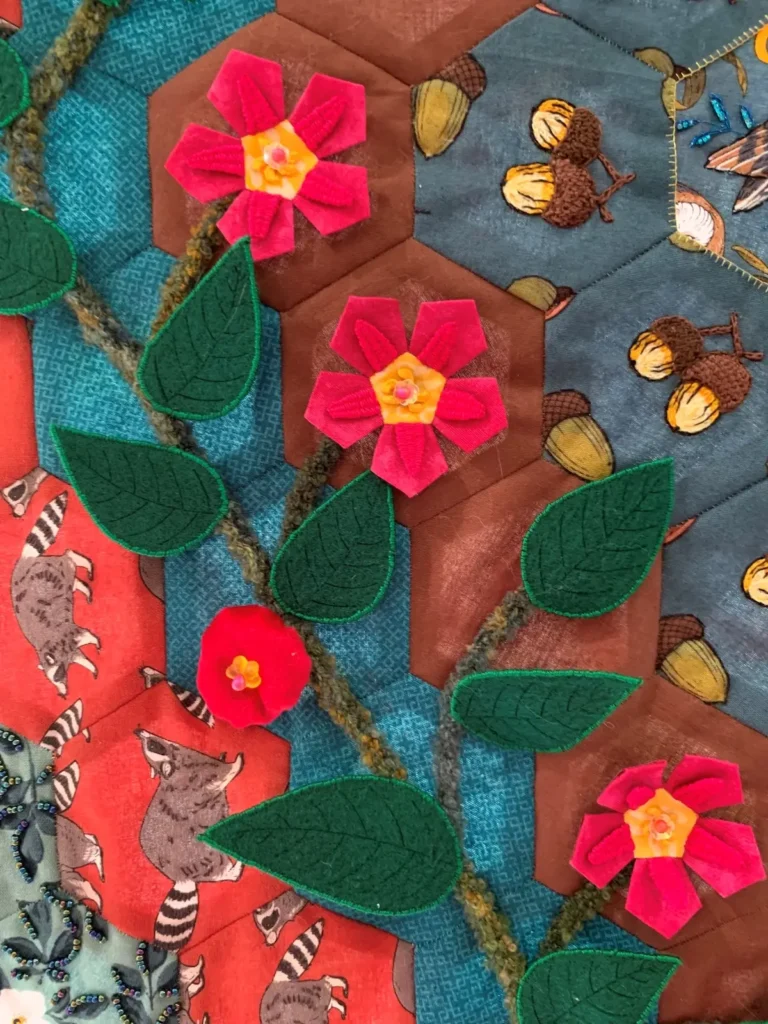
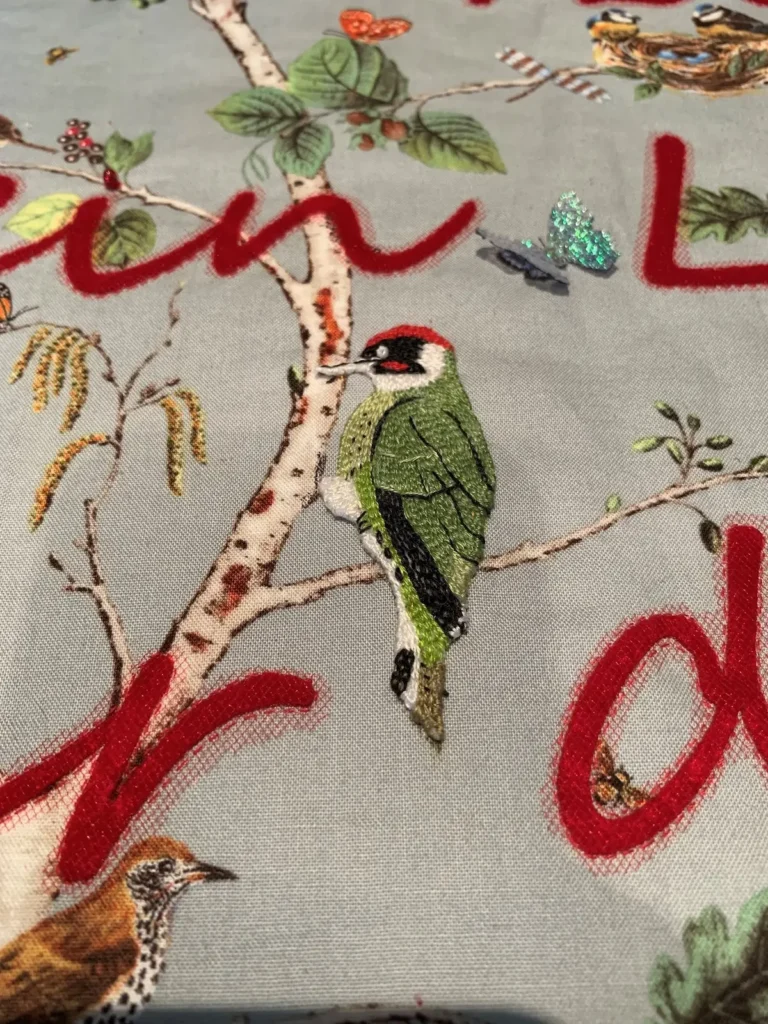
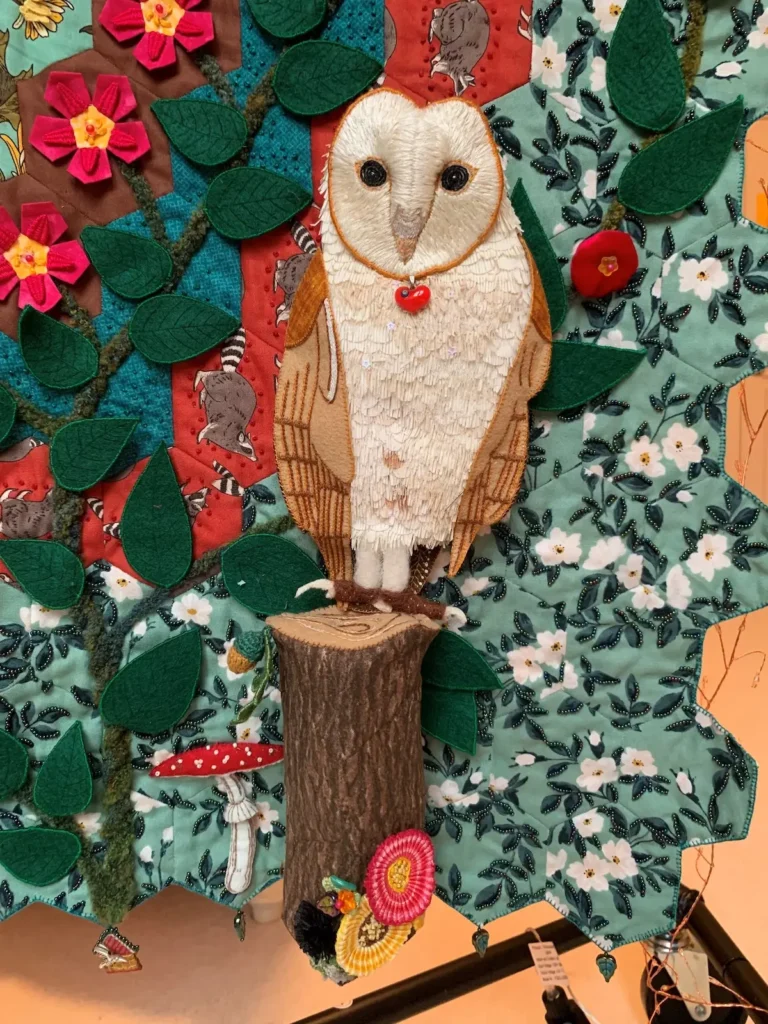
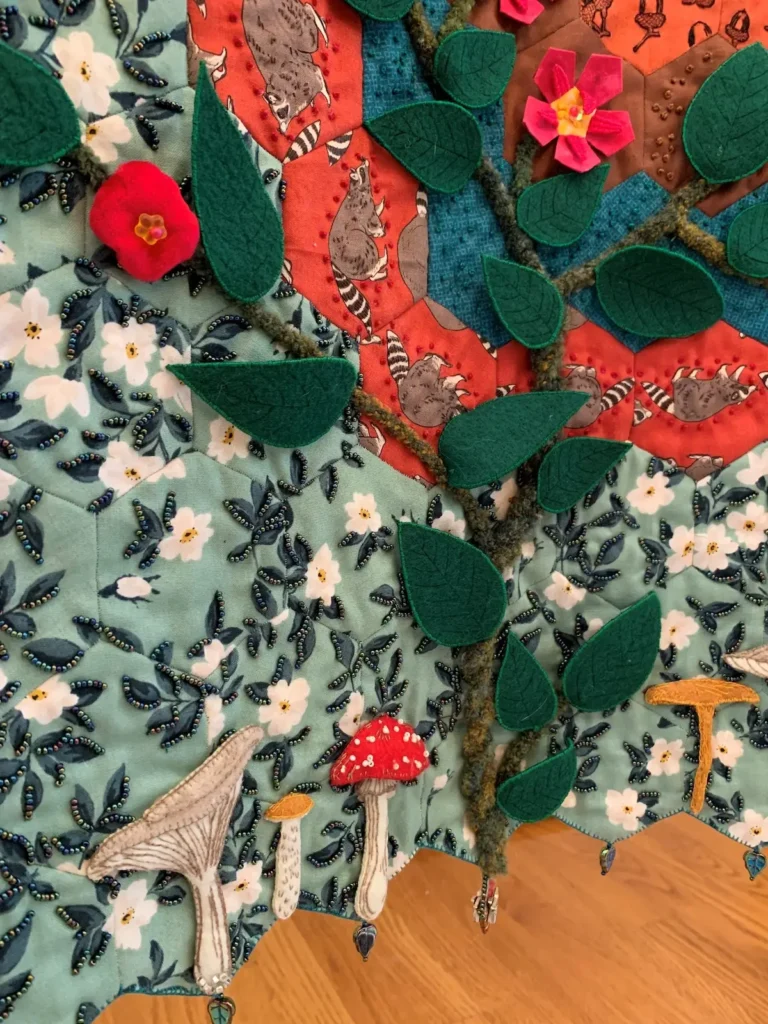
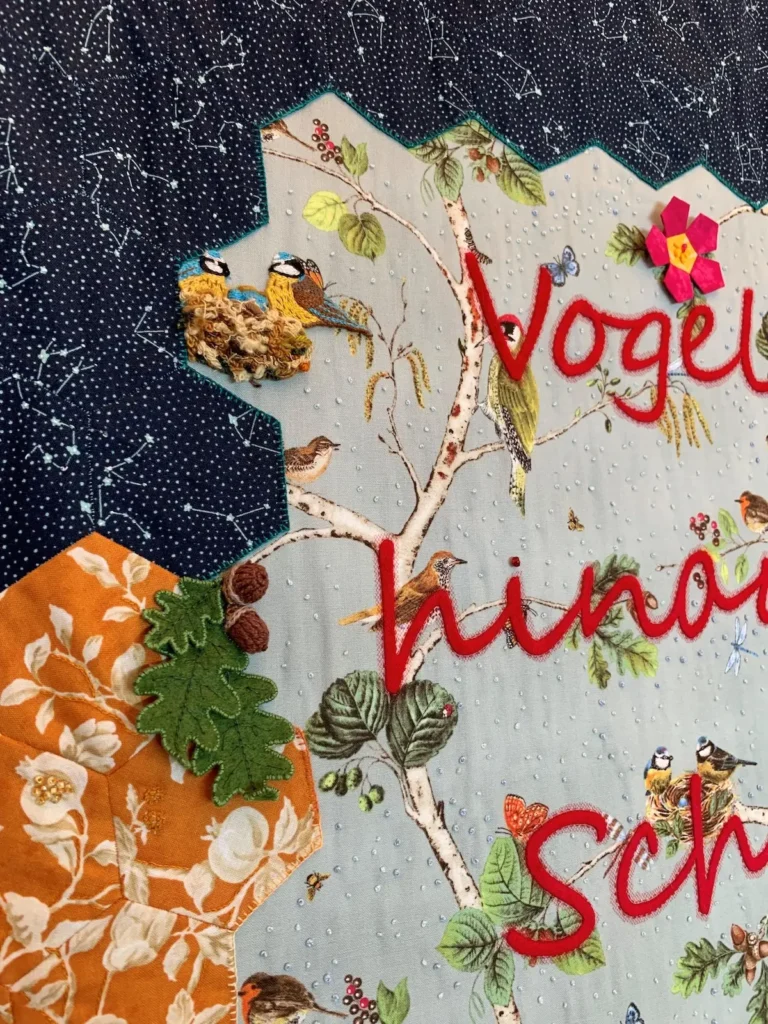
Yes, there is: Vögel der Nacht, a double-sided quilt I made for our 30th wedding anniversary. “Vögel der Nacht” by Stephan Remmler is a very special song for my husband and me. We met in Berlin at the Goethe-Institut, and afterward he sent me a collection of songs. This love song became our song.
See this video of the quilt: https://www.instagram.com/reels/C047IUES6lm/
When I first saw Forest Floor by Rachel Hauer for FreeSpirit Fabrics, I immediately thought, “Vögel der Nacht!” I find it fascinating how a piece of fabric can tell you what it wants to become because of your own memories and experiences.
One side of the quilt features lyrics from the song, and I added a motion-activated sound system that plays the music. It is probably one of my most personal pieces because it holds a part of our story.
What advice would you give someone who loves making things but is still trying to find their own creative voice?
Start with what you like and what you can do well and build from there. Experiment. Play. Try new materials and techniques and see where they take you.
Don’t compare yourself with others, and don’t get discouraged when your submitted work receives one of those “Thank you for submitting your beautiful work…” emails. We all get them! Do the dance and move on. Keep making, keep learning, and keep submitting.
I think your creative voice finds you while you are busy making.
Where can people see your work?
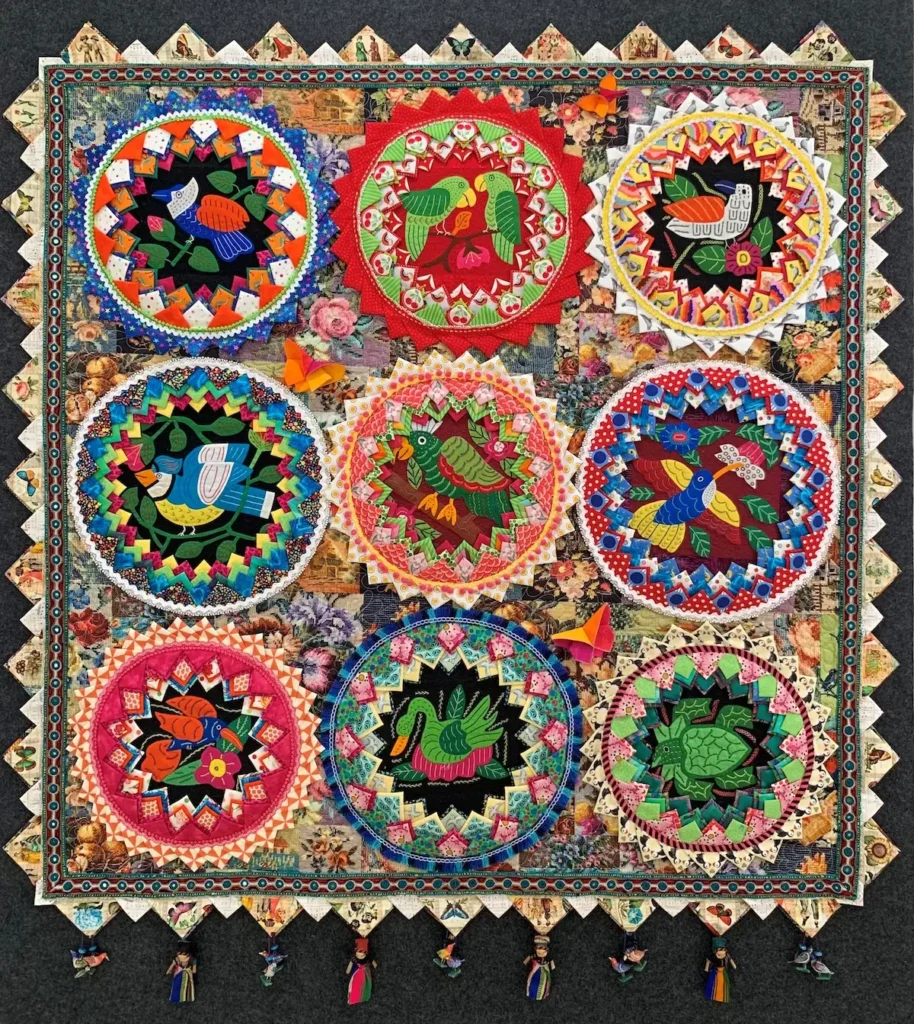
I share some of my work on Instagram, and I submit to shows that accept art quilts and three-dimensional work.
In 2026, Guardian will be exhibited in the Animal Kingdom category at the International Quilt Festival in Houston. Curiously Moreish is in CQA’s Living Colors exhibition at the Everett Event Center, WA, Journeys We Carry is traveling with the WA SAQA regional exhibition Markings: Traces and Impressions, and Pollinated and Plated is part of the SAQA’s Global Exhibition Pollinators, which will travel to several venues from 2026 to 2029.
Rapid-Fire Fun:
- What is always on your cutting table? Self-healing cutting mats and cats.
- Favorite color? Blue.
- Hand stitching or machine stitching? Hand stitching.
- Plan it or make it up as you go? Plan.
- What are you dreaming of making next? Next, I plan to make a 3D habitat scene with birds.
But my biggest dream is to someday see my birds and quilts displayed together in nationally recognized museums, where they can be shared with others. My birds and quilts shouldn’t be “caged” in my studio, they should be out in the world for people to see and enjoy.
Interview posted October 2026
Explore more fiber sculpture inspiration on Create Whimsy.