
Audrey Hyvonen creates colorful, layered quilts filled with playful scenes, hidden treasures, and unexpected details. Inspired by the world around her, she brings a sense of wonder and discovery to her work, inviting viewers to slow down, look closer, and enjoy the journey.
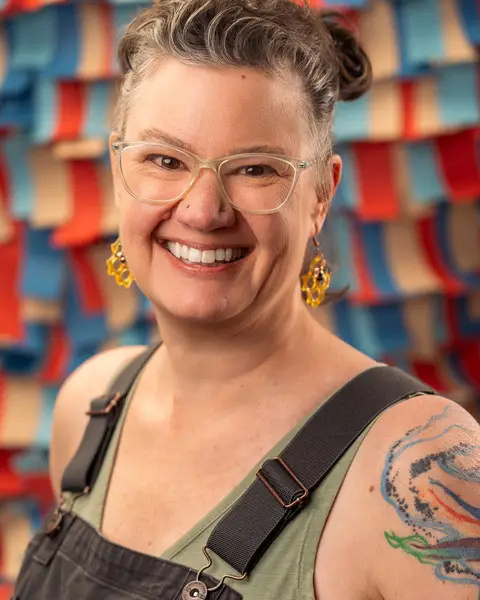
What are some of the earliest memories of making things by hand? Was creativity part of family life growing up?
I remember a lot of creativity in my childhood. It was usually make-believe games outside. I would build forts out of snow and potions out of mud and berries, make up stories, and play intricate games with my friends in the backyard.
I don’t have strong memories of working with fabric. It was more movement-based until my kids were born.
How did quilting first become part of life? Was there a moment when it felt like more than just a hobby?
As an Amazon Associate I earn from qualifying purchases. Read more about our affiliate linking policy.
I started quilting when my second child was born. I took a single class at a traditional shop. Soon after, I found a fabric shop with really modern, bright-colored fabrics, and then I just started making stuff.
I made a lot of improvisational, layered quilt artwork to give as gifts to friends. After about 10 years, it shifted from a thing that I did to a practice that I have.
Looking back at those early quilts, what has changed the most about the way fabric, color, and design come together?
My early work had more of a focus on geometry and balanced color. My work today is more often about creating a scene and an awareness of moving the eye through a composition.
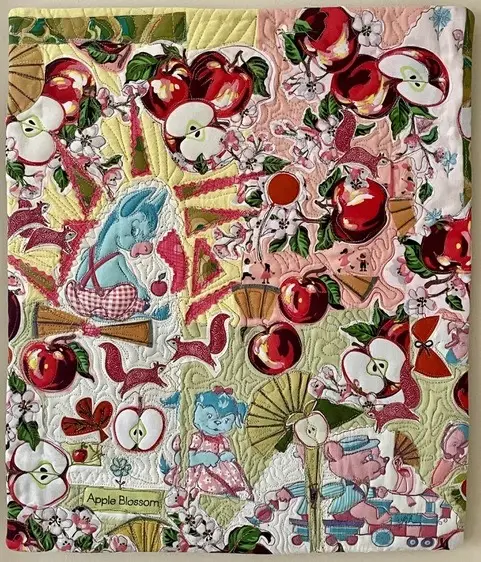
How would you describe your quilting style to someone seeing the work for the first time?
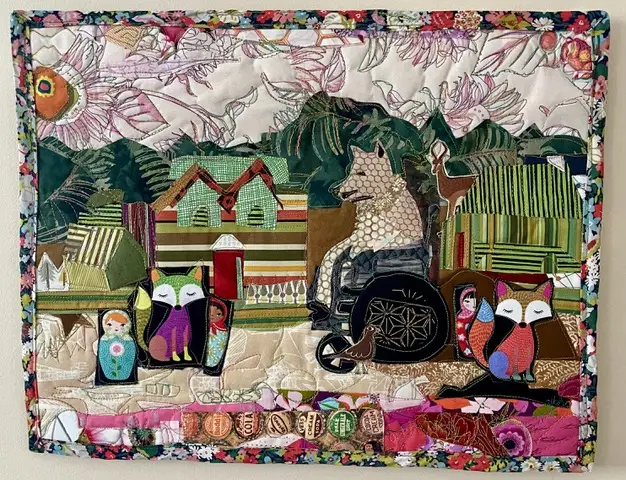
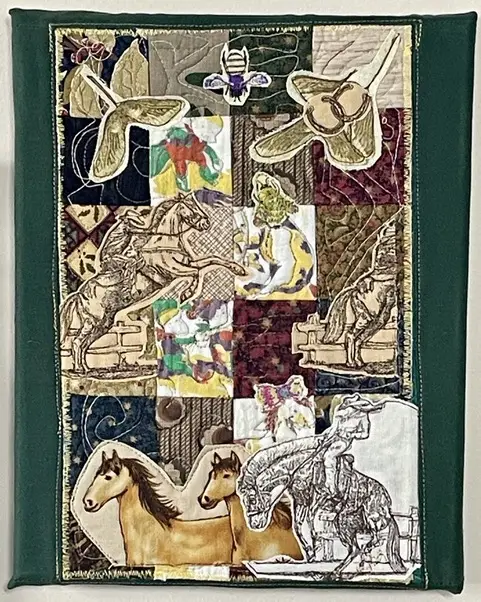
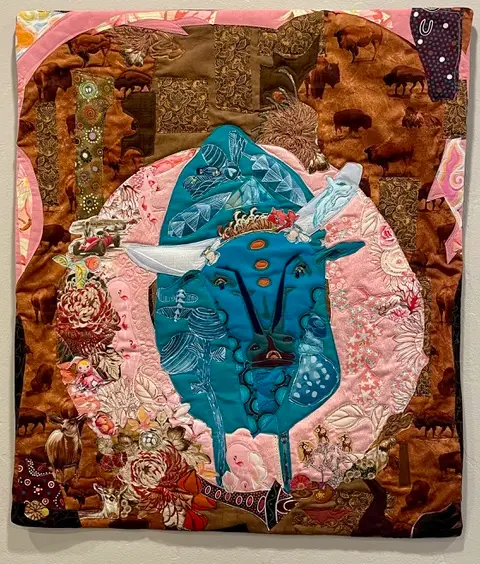
My work has physical and visual layers in a collage format, often creating a magical scene with an assortment of hidden treasures for the viewer to discover if they take some time looking around a piece.
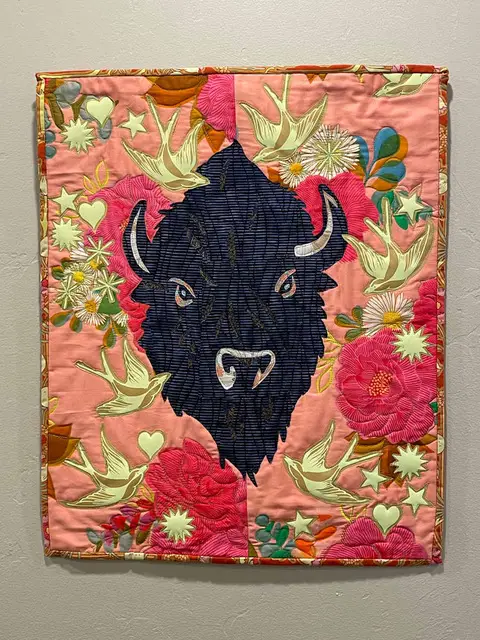
I use pops of bright colors and really enjoy the added texture of quilting on the design as well.
Where does inspiration most often appear? Does it come from the world outside, other artists, or simply playing with fabric?
My inspiration often comes from the outside, but the development of each piece comes as I dig through my stash for certain colors or shapes as needed for each composition.
I spend time listening to music, going for walks, visiting new places, meeting other artists, scrolling Instagram, and taking in current art reactions in the world. All of this combines in a swirl in my brain, sometimes coming out in my artwork.
I love watching circus shows and dance performances. I like quirky, fun, playful, pedestrian, and visionary art.
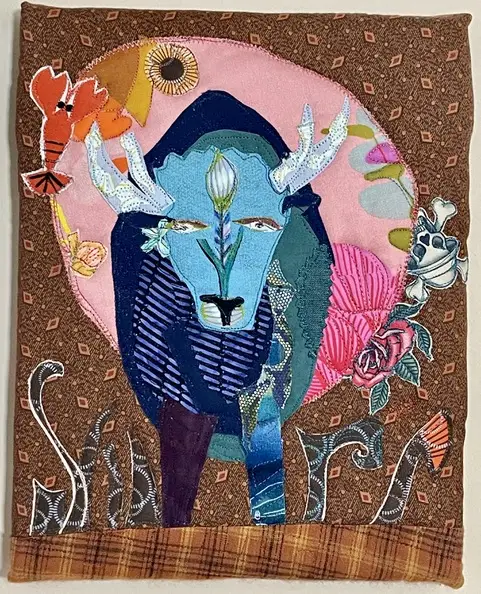
How has your sense of color changed over the years? Are there colors or combinations that once seemed unlikely but now feel just right?
I have spent my adult life learning about color by using color. I had a birthday party once where we had a game of “How well do you know Audrey?” All of my family listed my favorite color as blue, and all of my friends listed my favorite color as yellow.
I have always thought of blue as my favorite color, but my friends had seen me working primarily in yellow. I laughed as I realized that I was unintentionally trying to learn about yellow by working in it so much.
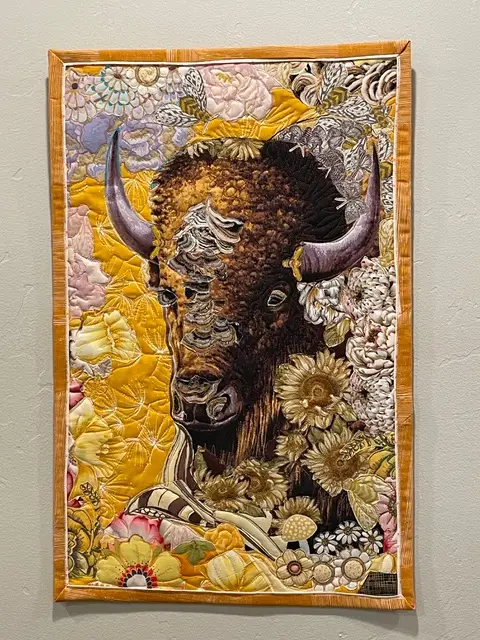
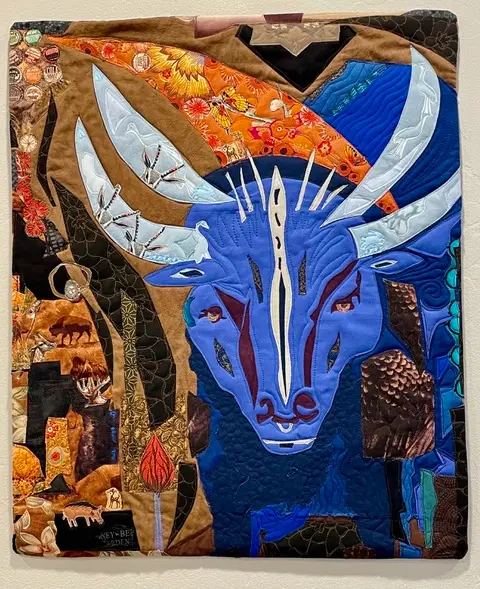
Over time, it clearly surfaced that I work in green and yellow with a layer of pink. This past year, I’ve intentionally been playing with blue and orange in combination.
My current body of work is a series that will eventually depict a calendar year, and the colors I’ve chosen to move through are yellow, green, blue, orange, pink, and chartreuse—a bright chartreuse, which I would call “eye pollution” and which I love.
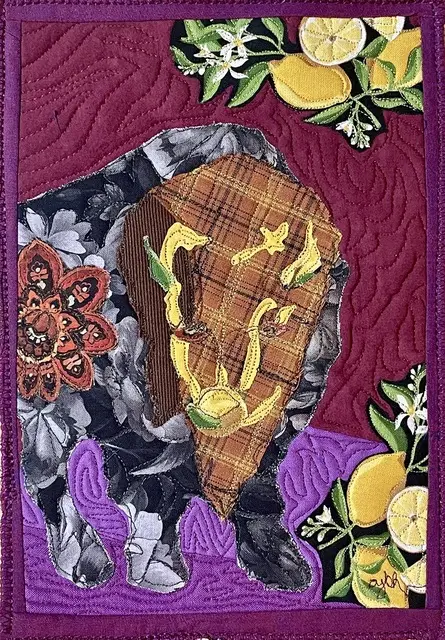
When a new quilt idea begins to take shape, what usually comes first: a sketch, a piece of fabric, a color combination, or a feeling?
I have so many ideas for work, and it comes at me or it comes through me. I’m lucky if I can capture it.
Usually, I try to grab a note card or a scrap of paper and write down the shapes or the lyric, or sketch out a diagram of some shaped sequence. But they don’t all turn into quilts. Many of them are lost.
My favorite fabrics get pinned to my design wall and then hang out there for years, being too precious to use but bringing me such joy.
How much of a quilt is planned before the first cut, and how much is discovered along the way?
The work I’m making starts with a rough sketch, then an improv-pieced background, so I’m not working on a blank canvas, and then a whole lot of discovery along the way.
I have little bags sorted by color of little shapes, motifs, and creatures, and I return to those prepped materials, which adds cohesion to pieces in proximity, either by time or space. But not much is ever planned.
What role does play have in the design process? Is there time set aside to experiment without knowing what the result will be?
I love play, and the ways that I play certainly inform my work. But I don’t set much time aside in my studio to be playtime. The play that happens for me is when I’m cooking, dancing, or out in the world.
My studio time is generally focused on knowing what the result needs to be and doing it.
What happens when a design looks wonderful in your imagination but doesn’t quite work in fabric?
Ugh! This happens with every single piece. I don’t usually hold a design in my imagination, but as it lands on the wall or on my table, it always feels like a roller coaster, hovering at the top, teetering, not knowing if it’s going to slide backwards or rush forwards.
The messy middle of working on a process in fabric is inevitable. If it doesn’t quite work, then it’s just not yet done, and I have to keep working on it.
I heard today on a podcast that the point of creativity is failure. You work on your expression of your message until you’ve failed, and that then leads you to the discovery of how to best communicate it. It’s just part of the process, and you have to push yourself through it if you want to find something that works.
When a quilt isn’t working, what helps most: stepping away, trying something new, or pushing through?
So, I just said you need to push through when a quilt isn’t working. But sometimes that happens after stepping away and/or trying something new. It’s really unique to each piece. I do try to leave a piece on the wall overnight if it’s not working so I can use fresh eyes in the morning.
I’ve trained my family to look at my work and to tell me what’s working and what’s not, especially in terms of where their eye is traveling and where it’s hovering or landing. The most frustrating thing is when a quilt works, and then I tweak something, hoping to make it even better, and it slides backwards. Then I have to re-correct. But again, that’s just part of the process.
Describe your creative space.
My creative space! It’s just my house—my whole house. I decorate every surface with imagery that lifts my mood, comforts me, or makes me laugh. My family tolerates my maximalist nature and is so generous in support.
We just moved to a new home, where I’m fitting my studio again into two walls of the living room and one corner of the dining room. I didn’t realize how much I would need to downsize my studio when we made this move, and it has shifted my practice to be more focused and more intentional because I need to clean up after myself after every work session.
I prop my computer on the edge of my cutting table, where my elbow is rubbing my design wall, and I am kicking my supply bins under the table. It’s easy to get to the kitchen and the couch, so I have to increase my focus to be productive.
How is fabric chosen for a new project? Does the design lead to the fabric, or does a special piece of fabric spark the design?
Ninety percent of the time, I have a design in mind before I pick the fabric. I often have a sense of what fabric I will be using.
If it’s an improv piece, I’ll most likely pull out a selection of solids. If it’s a collage piece, I’ll often choose two or three colors to feature and then pick 12 to 20 of each color to sort through and find the connections I need them to make.
What does your fabric collection look like? Is it carefully organized, or is there a little creative chaos?
I keep my fabric in see-through bins, for the most part, sorted by color. Small fussy-cut pieces that are ready to fuse are in smaller cases inside plastic bags, also sorted by color. There’s a lot of creative chaos, but it is organized now more than ever because of the tight space it needs to live in.
If an earlier version of Audrey could walk into your studio today, what would be the biggest surprise?
Earlier versions of me would be surprised at how easily I’m streamlining my work within my space. My most recent studio was a full master bedroom, and before that I had an entire custom-crafted garage studio with a twelve-foot-long-arm machine. Now my biggest area to work is a 24 x 36” cutting mat and a 40 x 50” design wall pinned to the plaster. I’m making it work!
What creative ideas or techniques are calling for attention right now? Is there something new you’d love to explore?
The series I’m working on now is for an art gallery group show opening this spring, which lit quite a fire under me. I’m hoping I can turn some of the series into a calendar, and I’m excited to see how that works out. Having just moved from Montana to Maine, I’m quite curious to see how my work will shift, having left the mountains and plains behind and moved now, next to the sea.
Where can people see your work?
In person, you can visit my work at The Walking Man Gallery in Whitefish, Montana, and at Radius Gallery in Missoula, Montana. On my website, I have my fuller portfolio: audreyhyvonen.art.
Website audreyhyvonen.art
IG @audreyhyvonen.art
FB @audreyhyvonen
Rapid-Fire Fun
- Favorite color combination? Longtime: yellow and green. Current: blue and orange.
- Bold contrast or subtle shades? Bold contrast!!
- A creative skill still on the wish list? Beatboxing and krumping
- Favorite quilting tool? Freezer paper and a light tablet.
- One word to describe your studio? Integrated.
- What’s bringing you joy today? Tuna fish for lunch.
Interview posted October 2026
Explore more collage art on Create Whimsy.