
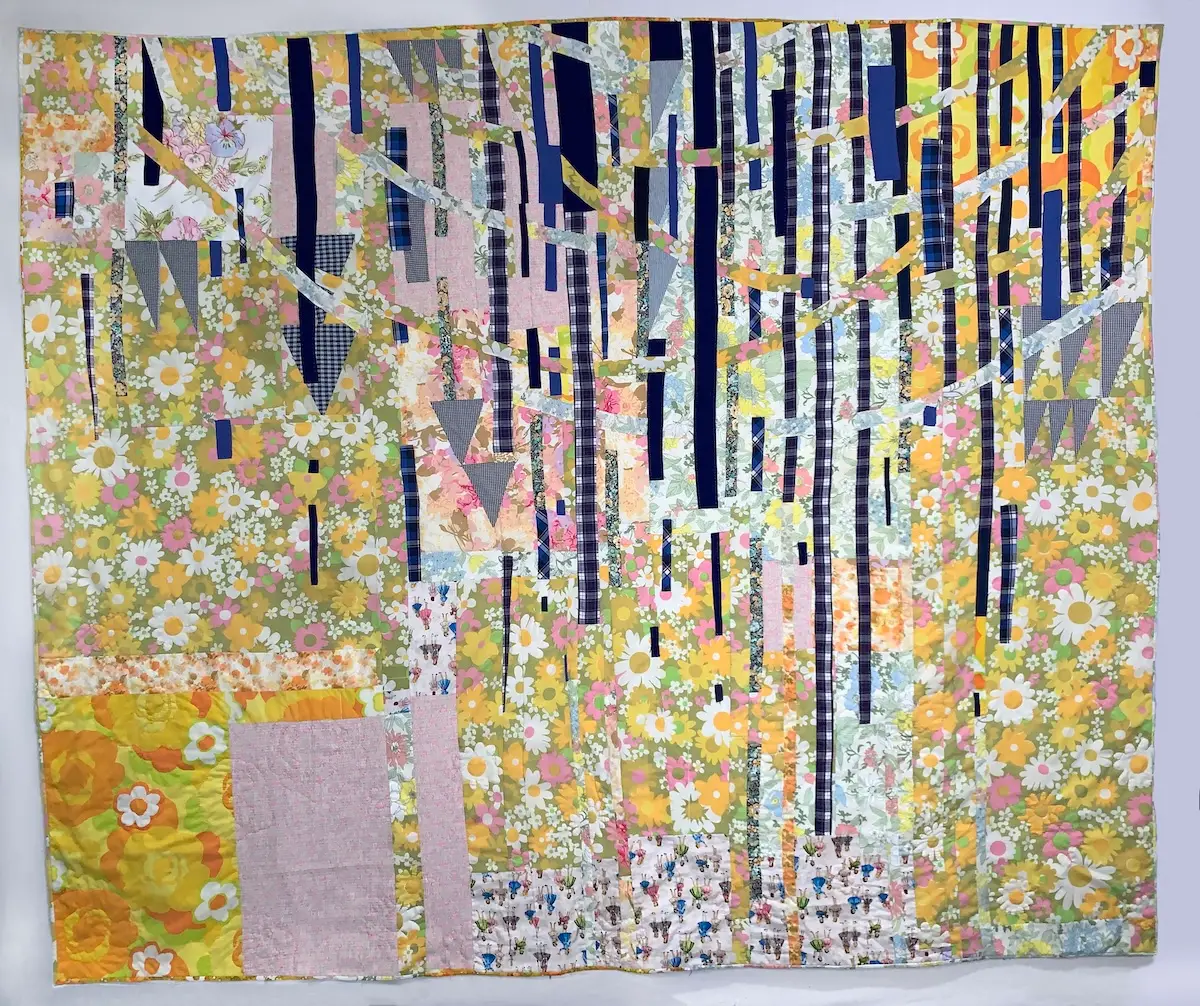
Jessica Wohl turns everyday fabrics, old clothes, and household objects into art that tells powerful stories. With a background in painting and drawing, she uses quilting and embroidery to explore family, motherhood, and the hidden work of caring for others. Her thoughtful textile art invites us to look closer at the things we often overlook.
You grew up in Minneapolis and went on to study illustration and art history before earning your MFA in drawing and painting. What first made you want to be an artist, and what were you making when you were young?
Making art as a child offered an escape from an extremely controlled environment, where I learned to put the needs of others before myself.
While I wouldn’t have been able to put words to it at the time, in hindsight I understand that my art became a place for freedom, expression, experimentation and risk-taking. To this day, it’s the only arena in my life where I truly have full autonomy.
When you were studying art, did you imagine the kind of work you make today, or did your path take some unexpected turns?
As an Amazon Associate I earn from qualifying purchases. Read more about our affiliate linking policy.
My path did take some unexpected turns away from drawing and painting and towards quilting, but it isn’t surprising to me.
Textiles run deep in my family; my great-grandfather was a tailor, my grandmother and mother crocheted afghans and made needlepoints, and my father worked with drapery and upholstery. While no one in my family makes quilts, I’ve always been textile adjacent.
Your early training included drawing, painting, and illustration. What did those ways of working teach you that still shows up in your art today?
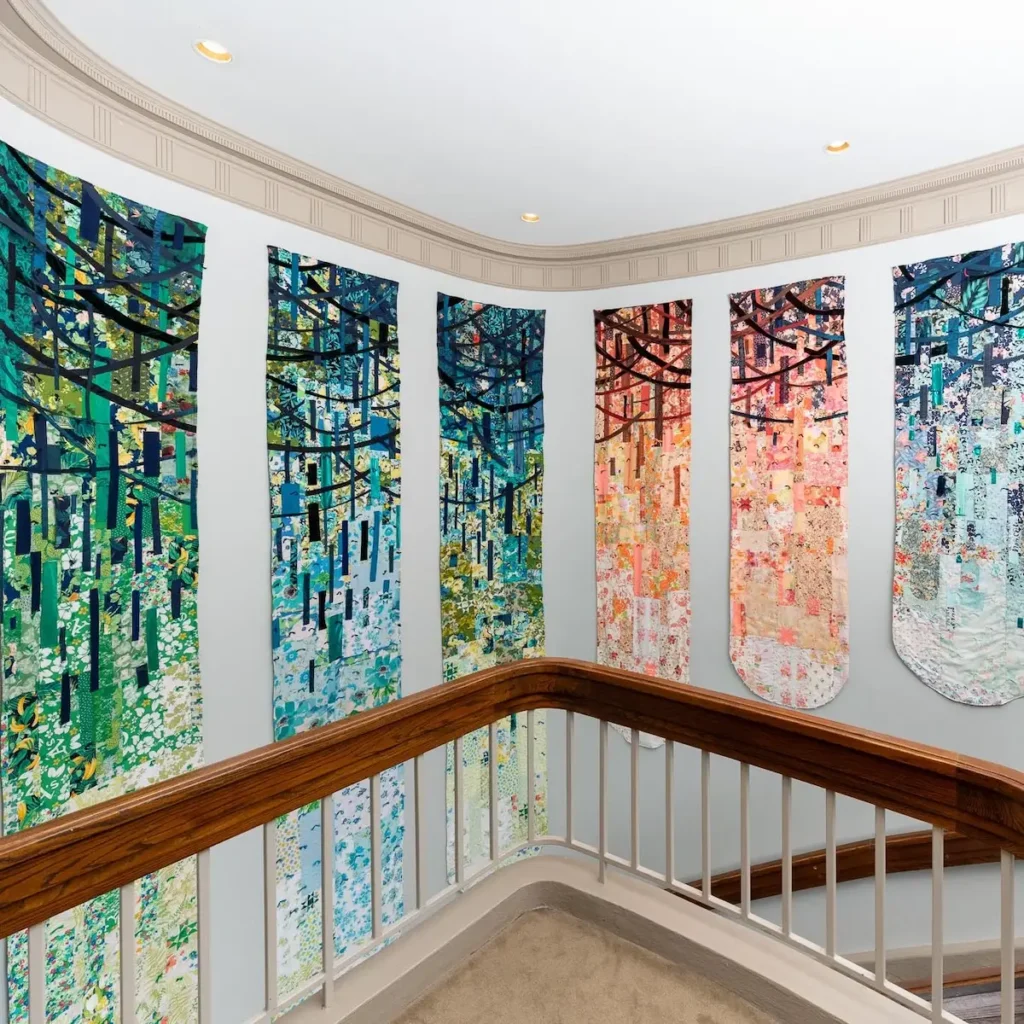
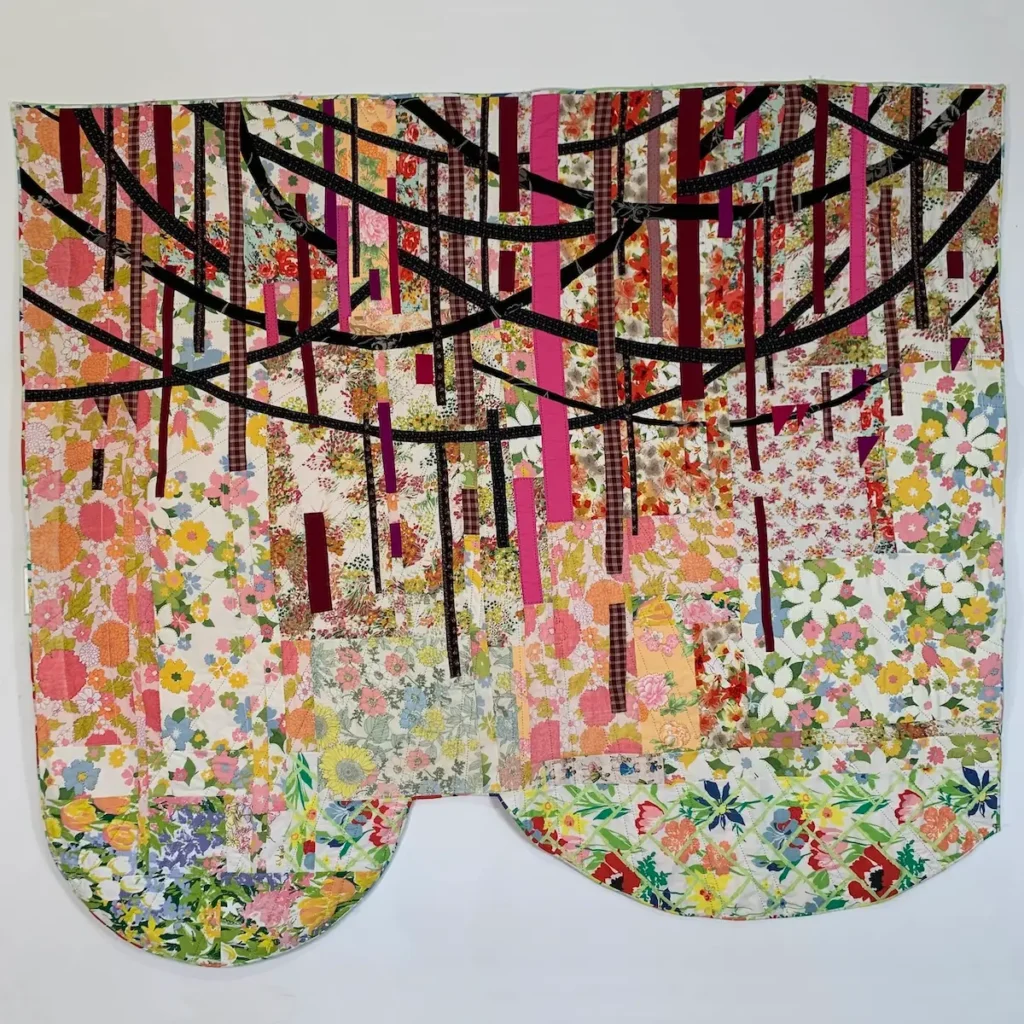
I still approach my quilts through the lens of drawing and painting. I compose the quilt more like a painter, working with one large composition, as opposed to thinking about it in blocks.
I very much think of the quilt top like a painting, and the quilting like a drawing. The quilting thread is like a line that I can touch and hold.
You often use familiar household items, such as clothing, bedsheets, linens, photographs, and furniture. What draws you to these objects, and when did you begin to see them as art materials?
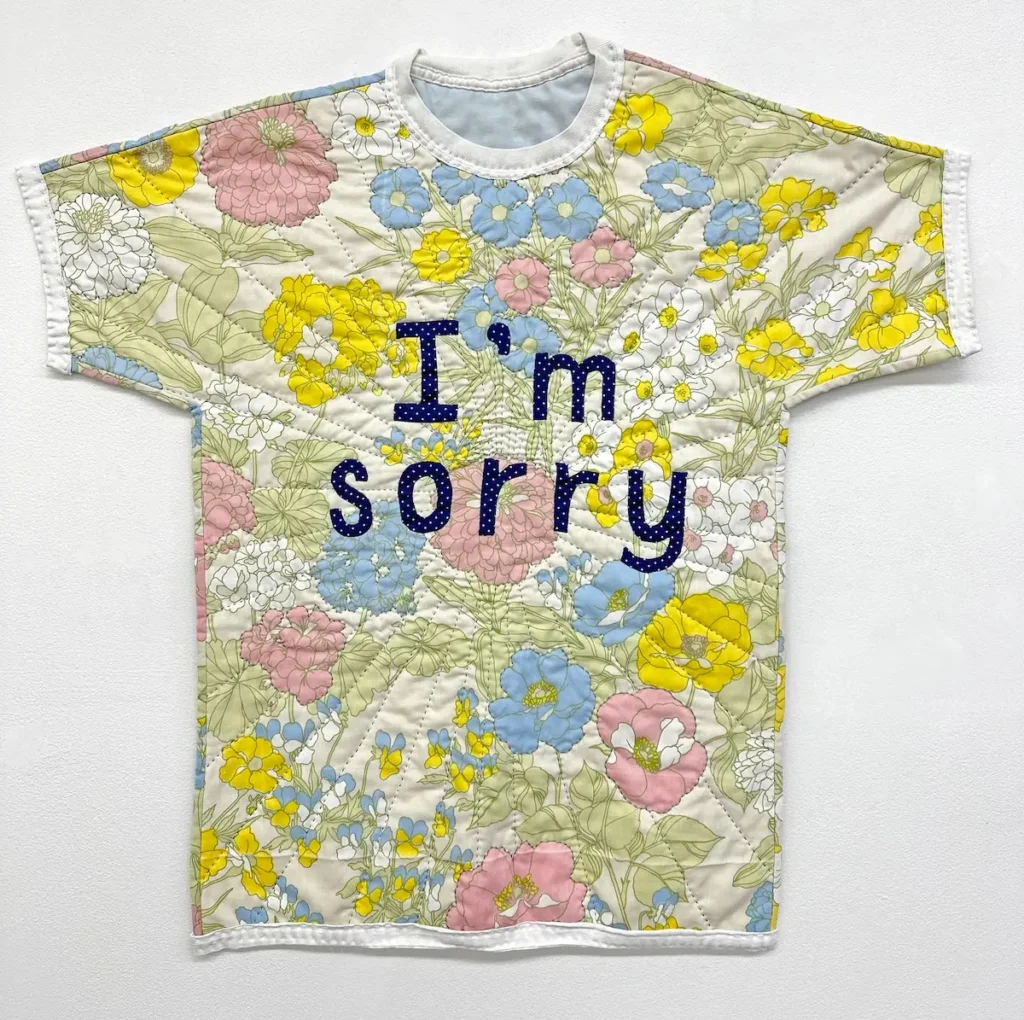
I started using found objects in graduate school. I was drawn to them as extensions of their former owners and originally liked how objects related to collecting and collections.
What we are drawn to ends up often being extensions of ourselves, and I grew to be interested in how the physical materials we acquire and use hold our energy. That energy starts to hold time as well, so the objects’ histories and former owners become an active material in the work.
What do you think everyday objects can tell us about the people who own them, care for them, and use them?
So many things. We make associations with different patterns, from toile to camouflage, and they allow us to imagine stories about how the garments or fabrics were used.
Old bedsheets reveal where their people slept and rubbed their bodies. The objects I’m most interested in are porous; primarily paper and fabric, and retain smells and traces of how they were used.
When you begin a new piece, do you usually start with an idea, a question, an image, or an object that catches your attention?
I start with an idea. Then I’ll go to my fabric stash and see if any fabrics I have make sense to embody the idea. If not, I’ll go to a thrift store to find them.
How do you find the fabrics and other materials you use? Do you collect things over time, save items from your own home, or search for particular objects when you have an idea in mind?
All of the above. I’ve got a growing collection so I always pick things up if I see them. I also have friends who know what I like, so sometimes they’ll grab things for me at yard sales or thrift stores. I use a lot of old clothes, mostly from my husband or the clothes in my own closet I don’t want to wear anymore.
Your work moves between quilting, fabric collage, drawing, painting, and other forms. How do you decide which materials and methods are right for a particular idea?
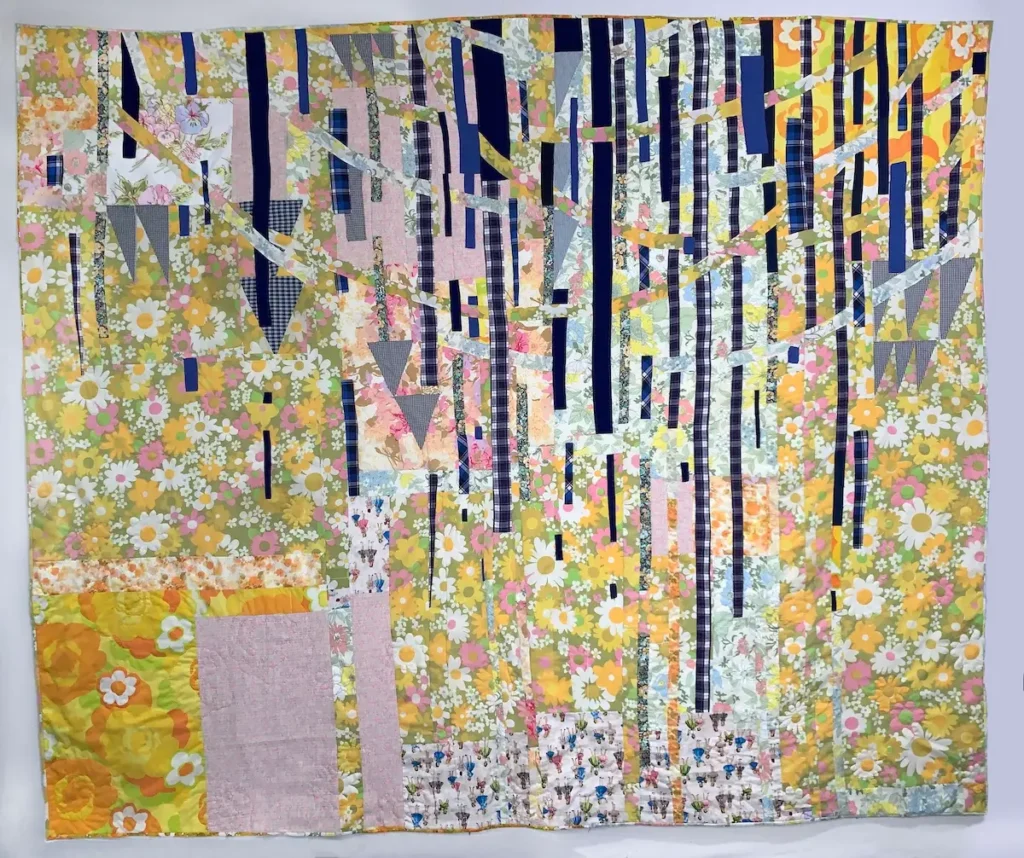
I look for a relationship between the visual qualities of the fabric and what I want to communicate.
If I want to talk about gender roles, I’ll stick to pinks and blues to engage with the visual associations most people in the West understand.
If I want to speak about racial issues in this country, I may stick to blacks and whites.
I tend to use florals and solids the most, and I am very particular about the kinds of patterns I use so I can control the color and value. I tend to avoid high-volume, or high-contrast prints because they attract so much attention that I end up having to fight against them.
Describe your creative space.
My studio is upstairs in my house, and has a half-wall that looks down into my living room, like a loft. It’s open to the whole house, so the sounds of my kids and whatever else is going on is an active part of the space.
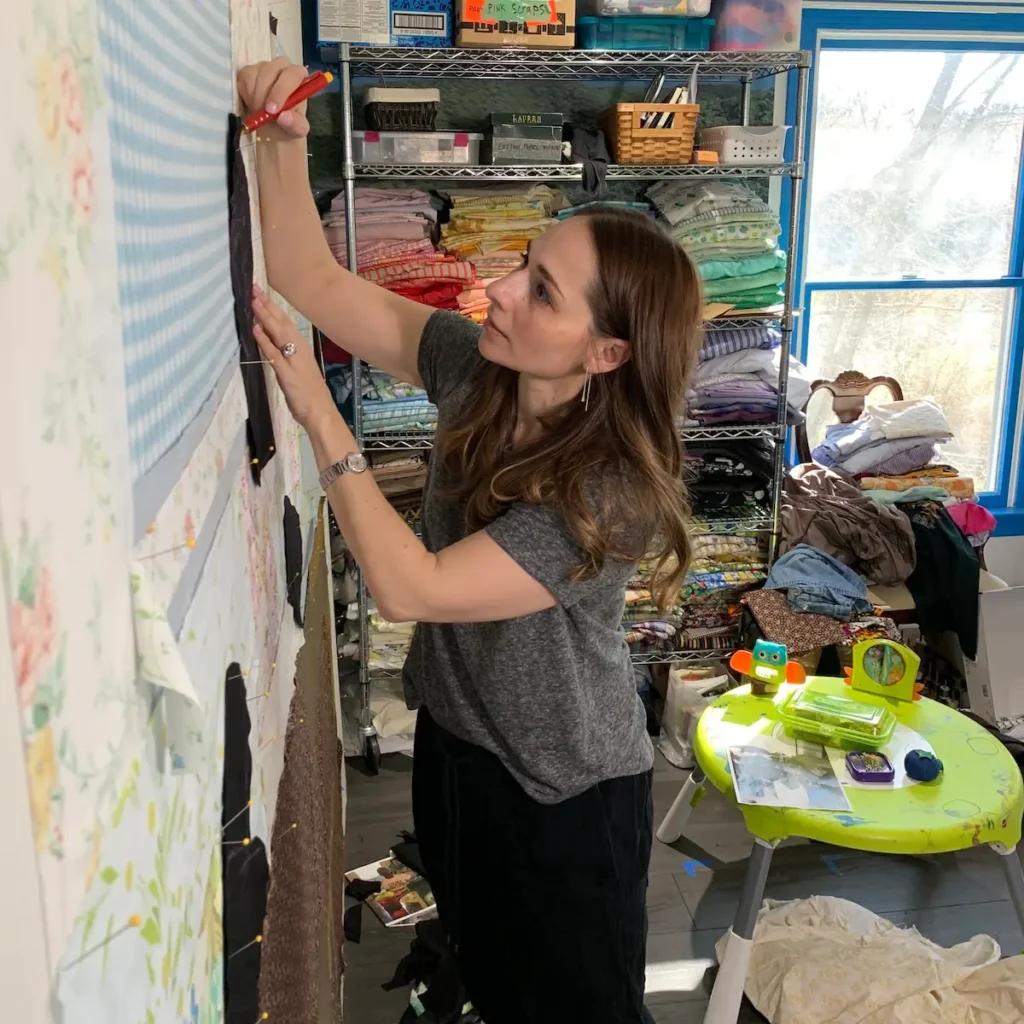
The studio has two sides; one is for sewing, and the other is for drawing and collage. I keep my paints at a small studio at school, where I work. There’s just not room for it all at home! I also tend to work a lot on my couch, where I can hand-quilt, sew, and embroider around my family.
How do you organize your studio and your growing collection of materials? Do you prefer to keep things in order, or do you need to see everything around you to spark ideas?
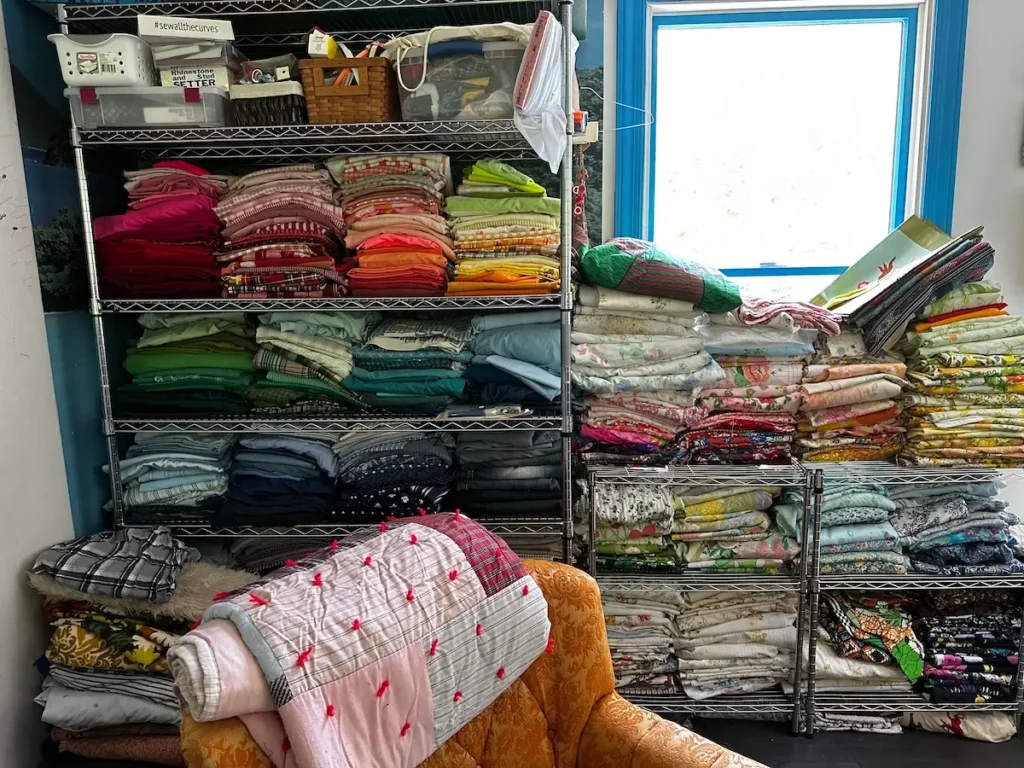
I keep my fabrics very organized. I organize them by color and in stacks from the lightest to the darkest value. For example, my green fabrics are organized into two stacks, one that biases yellow, and the other that biases blue.
There are two shelves of color-coded fabrics, one that is just for solids and stripes/plaids, and the other is just for florals. All of that is visible, so I know what I have. I color-code my smaller scraps and organize them in shoeboxes.
Even though those scraps aren’t visible, I generally know what I’ve worked with before, so I can find what I need pretty easily. I also have stacks of shoeboxes that hold unfinished projects that are labeled so I know where to find what I need.
Once you have an idea, how does a piece usually develop? Do you sketch and plan first, or do you learn what the work needs by cutting, arranging, stitching, and experimenting?
I will draw a quick sketch and then jump right in. Sometimes I get to a point where I don’t know what to do next, and I’ll sit with it for a while to figure it out. Sometimes I’ll snap a picture on my phone and draw on it with the digital paint tools to test out different options.
I generally don’t stitch something down before I’m committed to it, but there are plenty of times when I don’t like what I’ve made, and I’ll cut it completely apart.
How do you know when a work is finished? Is there a point when you have to stop making changes and let it stand on its own?
I guess it’s done when it accomplishes what I need it to. That can be both technically (say, it still needs quilting, or it needs a binding), but also formally and conceptually.
It’s hard to put into words, but I just know when it feels resolved, and when it doesn’t. I guess it’s just a physical manifestation of my ideas and an extension of my own body, so intuition is the determining factor.
Your art often brings together softness and difficult subjects. How do you use materials, texture, and the act of making to explore experiences that may be painful or hard to talk about?
I know that if I’m dealing with a heavy subject, I have to make sure the work hits hard, and by limiting the visual components only to what is essential, and nothing more, I can be very direct.
I consider how the visual choices in my work can generate meaning, and then I exploit those properties according to what I want to say.
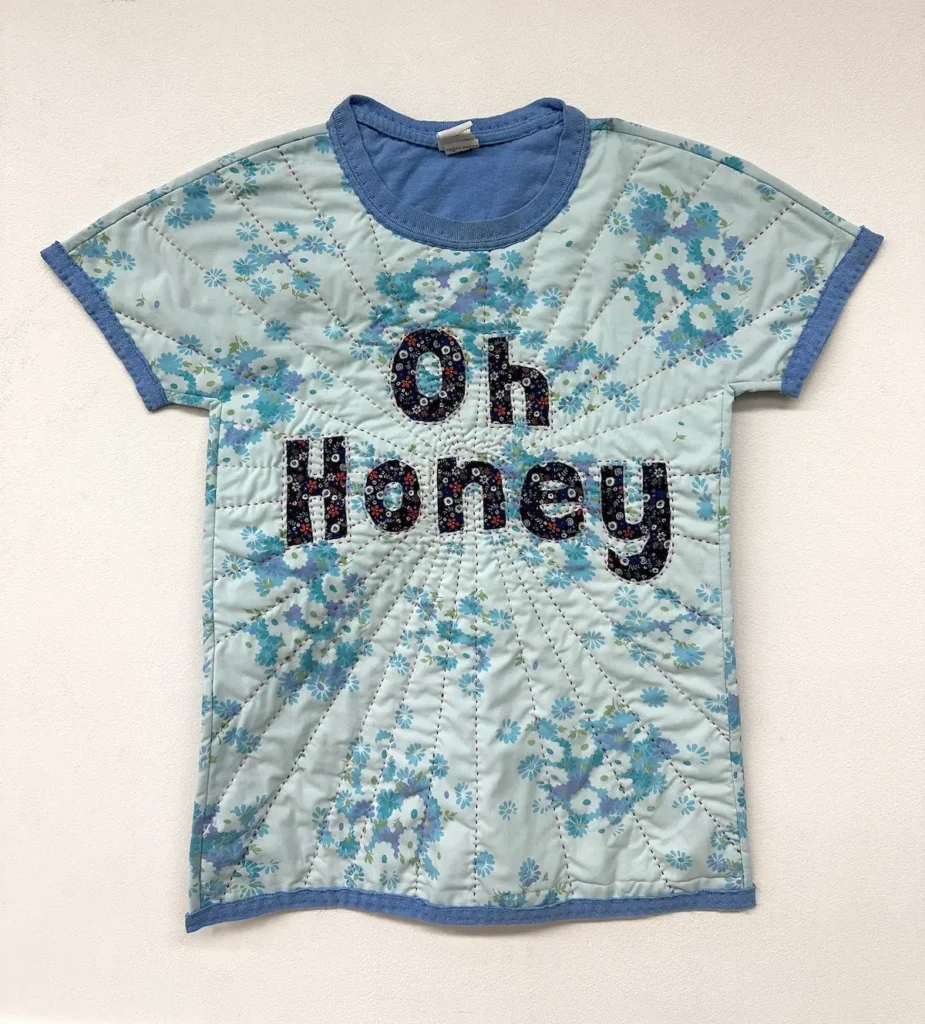
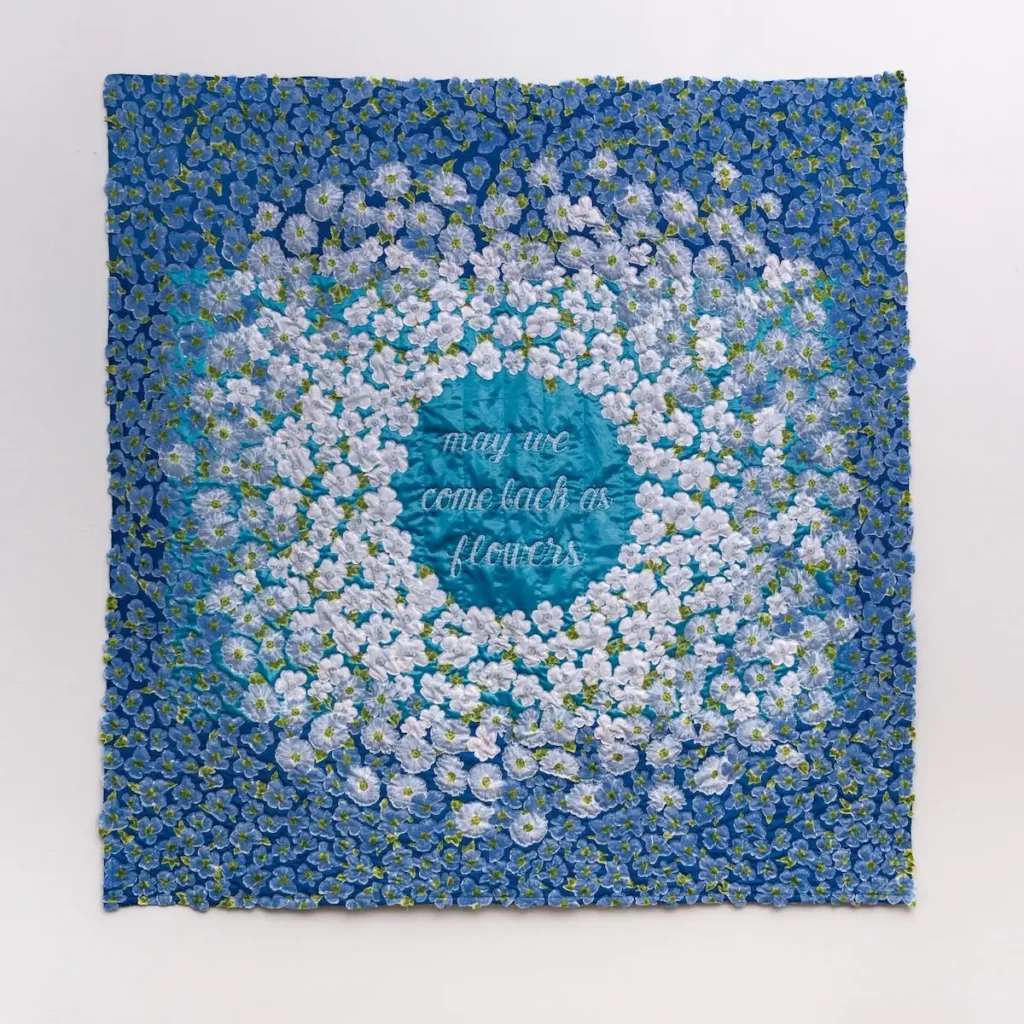
If I’m talking about something painful, I might use a raw or torn edge. If I’m talking about labor and care, I’ll use hand quilting instead of machine quilting. If I’m trying to communicate something invisible, I might use white on white, or something that cannot be easily seen.
I’m in tune with the properties of the materials I use and try to draw out their potential to help me communicate effectively.
During your Artist Residency in Motherhood, you created digital collages that paired moments from everyday parenting with images of well-known artworks. What led you to this project, and what did it help you understand about your own creative life?
I didn’t set out to do this project. It came to me when I was walking in the kitchen, carrying a bowl of cereal while my son was on my chest in a Baby Bjorn. While I was walking, he leaned back and dunked his head in my cereal. When he lifted it up, his hair was covered in milk. I instantly made a connection with this beautiful Mona Hatoum photograph called Van Gogh’s Back, which captures a man’s back covered in soapy water, his back hair swirling in different directions. I just thought, maybe I need to see how I can put these two images together.
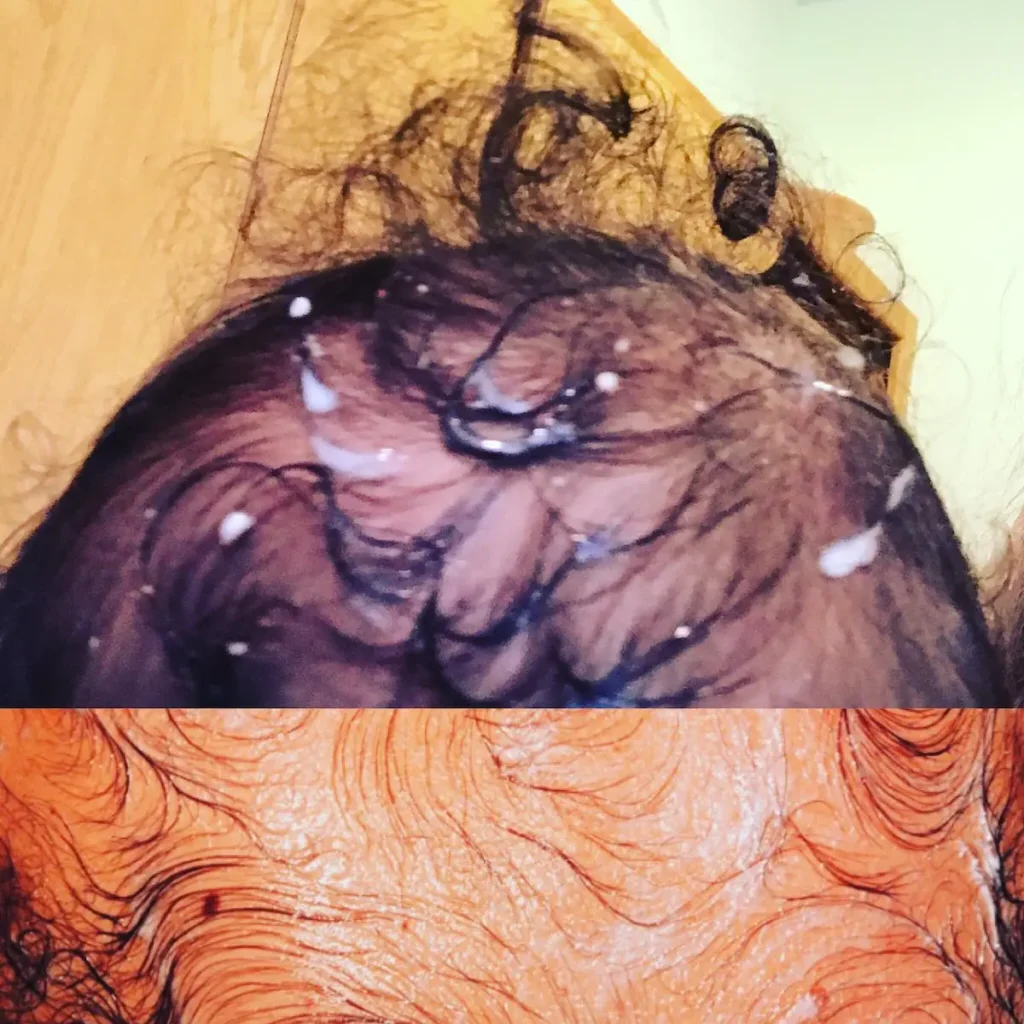
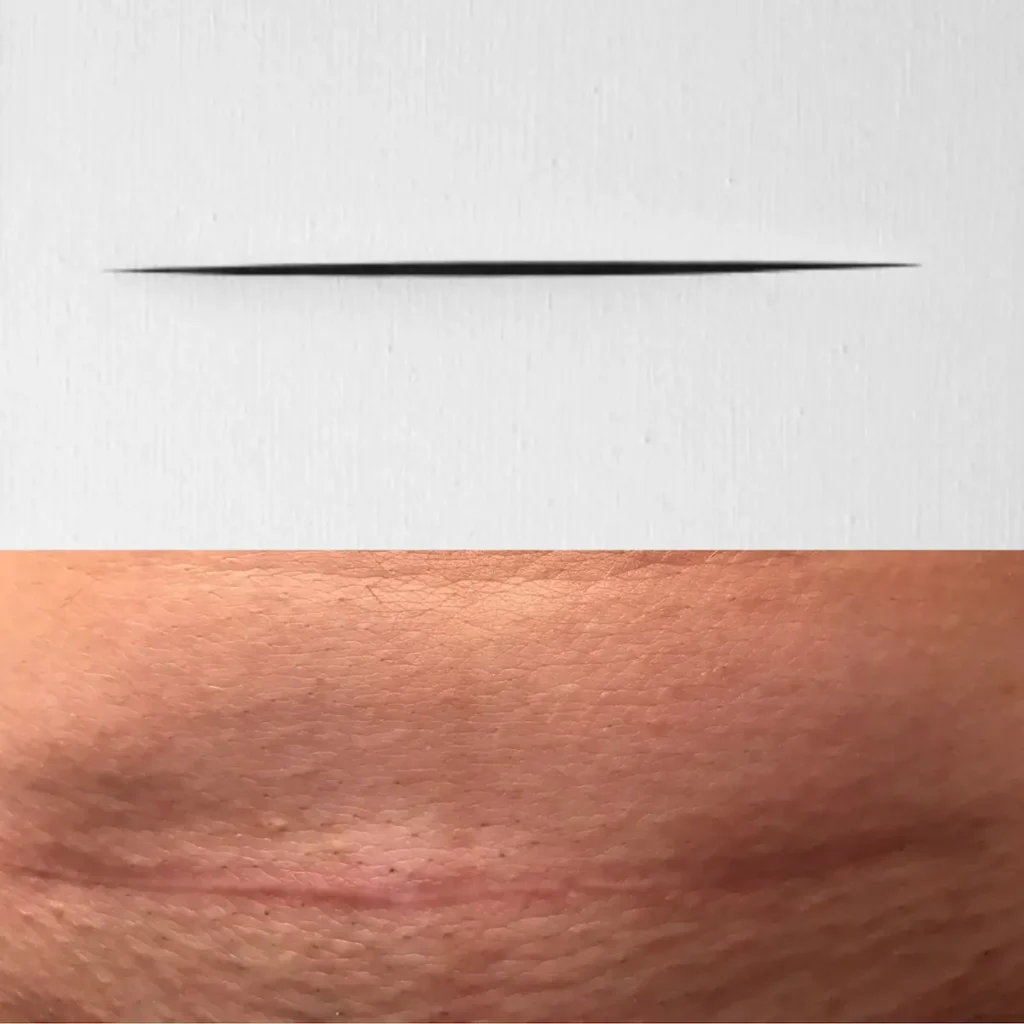
Soon after, I emptied my vacuum in the trash, and the collected dust reminded me of a J.M.W Turner Painting. I guess my degree in art history allowed me to see comparisons to art everywhere, and that’s how the series began.
I started to understand that my creative practice had to adapt to my life because during that time, I was not able to spend large amounts of focused time in the studio. This project allowed me to make something in a matter of seconds, and I could do so from the everyday moments of my life.
Your work asks viewers to look again at things they might otherwise overlook. What do you hope people notice or feel when they spend time with one of your pieces?
Different works address different things, so each work varies, but generally speaking, I want to remind people to pay attention to things in the physical world–things we can touch, hold, and experience in physical proximity to one another.
My work actively avoids digital spaces (though it’s inevitable that it must exist online). I want people to have a physical reminder of something worth doing because of its slowness.
I want to remind people that laboring over something you care about needs to be seen and appreciated, and that usefulness isn’t always the goal.
How has your definition of success as an artist changed since your student days? Are there things you value now that you might not have understood when you were starting out?
I didn’t realize how many hats I would end up wearing, and how many balls I would have in the air at the same time. I didn’t realize how hard it would be to find time in the studio with a full-time job and a family. It’s significantly harder than I imagined.
I value my time with my family very much, and I know my kids won’t be around or interested in spending time with me forever, so my studio practice has taken more of a backseat to that priority than I thought it would when I was younger.
Because of this, I value pacing myself and not overcommitting. I’m more likely to turn down opportunities that I’m not extremely excited about to keep a more peaceful, measured pace in my life.
Is there a piece you have made that holds a special place in your heart, perhaps because it taught you something unexpected or helped you see your work differently?
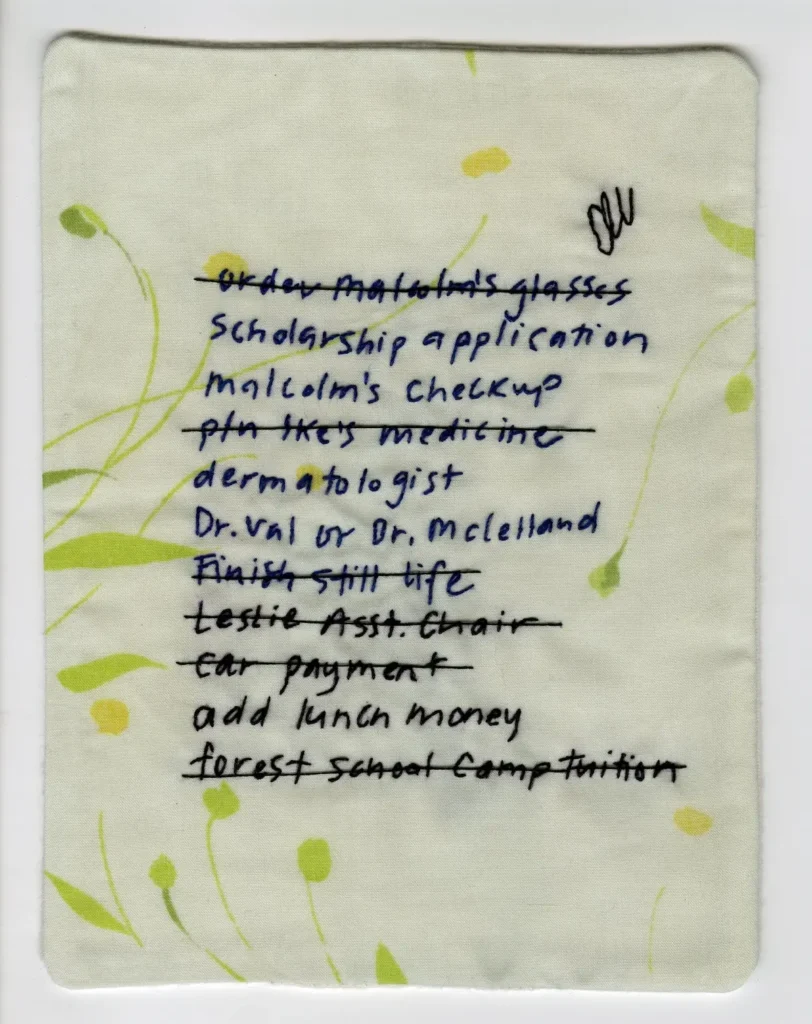
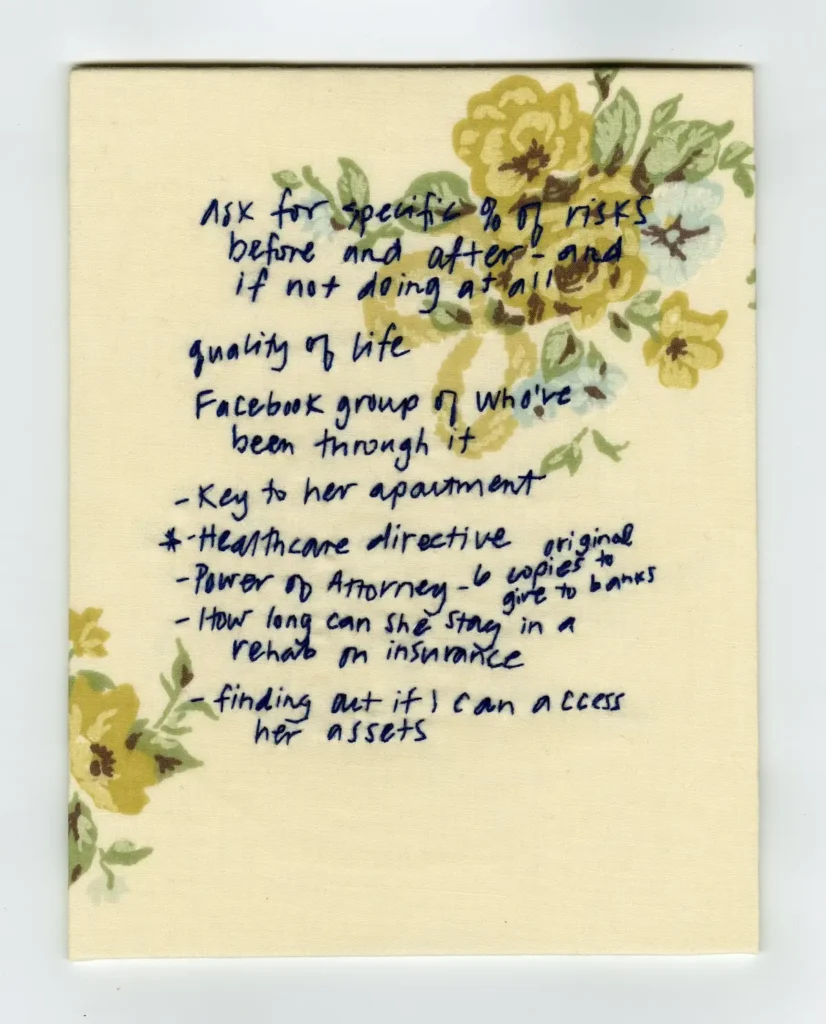
The I’ll Take Care of It series is a special one for me. It’s a series of embroideries of my weekly to-do lists. It not only acts as a diary of what was happening in my life, but it addresses each role I play: professor, mother, wife, friend, daughter, and makes visible all of the emotional labor in my life.
More significantly, however, I was surprised by how many women reached out to me after seeing it, telling me it brought them to tears. I guess it hit on something many women, and especially mothers, experience, and I came to understand that it made many women feel seen.
If you could return to the artist you were just starting out, what would you tell her about making art, finding her voice, and building a life around creative work?
I’d tell her that as long as I put in the work, it will all work out. I spent a lot of time worried about those things, but I think it was inevitable. I can’t imagine going a different path.
Where can people see your work?
Jessicawohl.com, @jessicawohlstudio on Instagram. Currently, I have exhibitions up at the Hunter Museum of American Art in Chattanooga, TN, and at the Mason Scharfenstein Museum of Art in Demorest, GA.
Rapid-Fire Fun:
- What is the strangest thing you have ever saved because it might be useful in your art? Boxes. If I see a good box, something really solid with high-quality materials, or something with an interesting shape, I save it to put a project in. It’s ridiculous.
- What is something you will always stop to look at? Wildflowers
- If your studio could talk, what would it say about you? “I miss her.” Or maybe, “I’m so glad you’re starting to paint again.”
- When you need a fresh idea, where do you turn first? I close my eyes before bed and clear my mind. They always come when I give myself time to stop thinking about everything else. I also have a huge list of ideas in my phone that I keep records of, so that’s always a place to go to remind myself what I was thinking when I didn’t have time to get into the studio.
- What is bringing you joy today? I recently bought two pairs of shoes that make me extremely happy. A red pair of Hunter slip-on mules that look like puffer jackets for my feet, and a pair of Adidas sneakers that are a collaboration with Farm Rio. They’ve got flowers all over them and have these thick, blue ruffled ribbons on the sides. It’s fun on my feet every day.
Interview posted October 2026
Explore more inspiring interviews on Create Whimsy.