
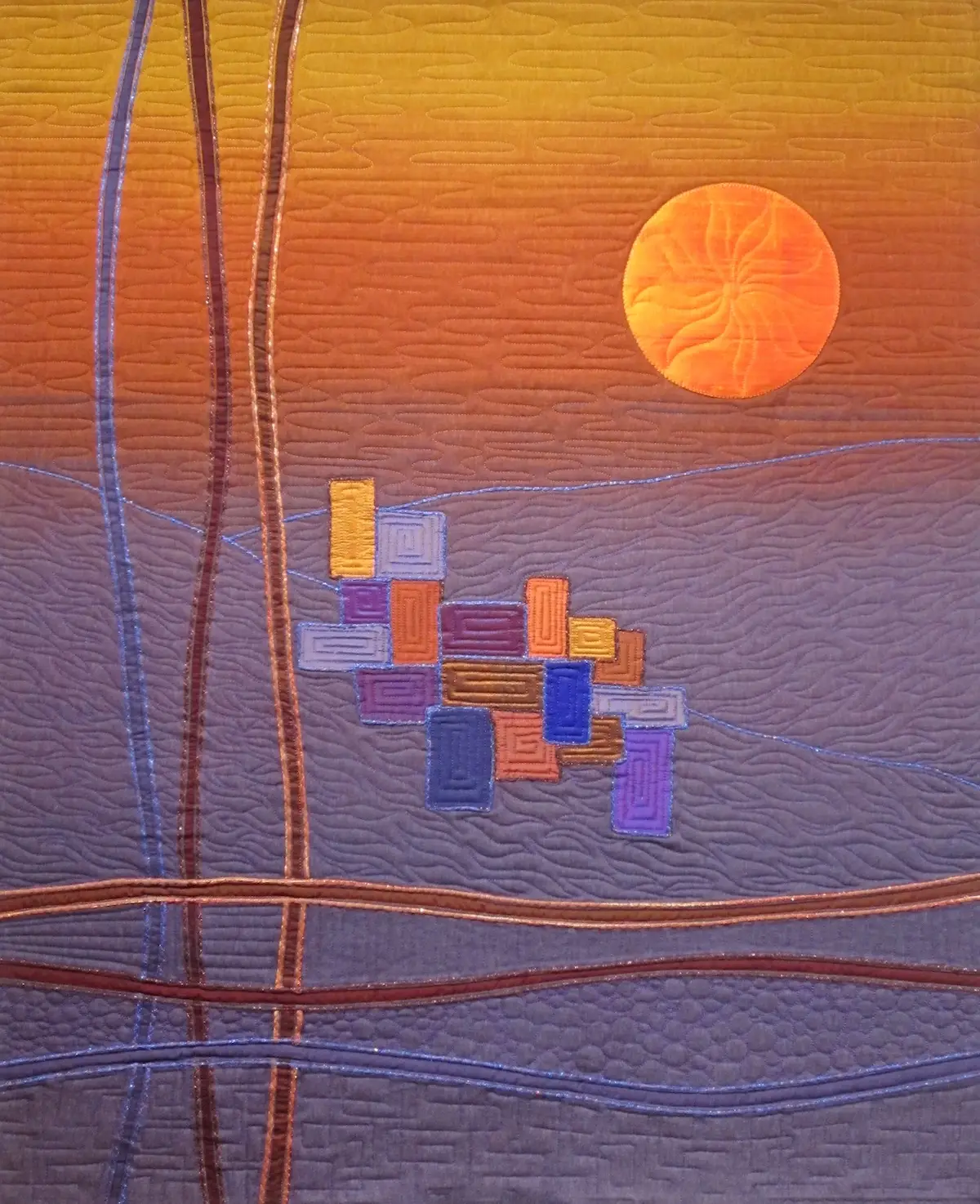
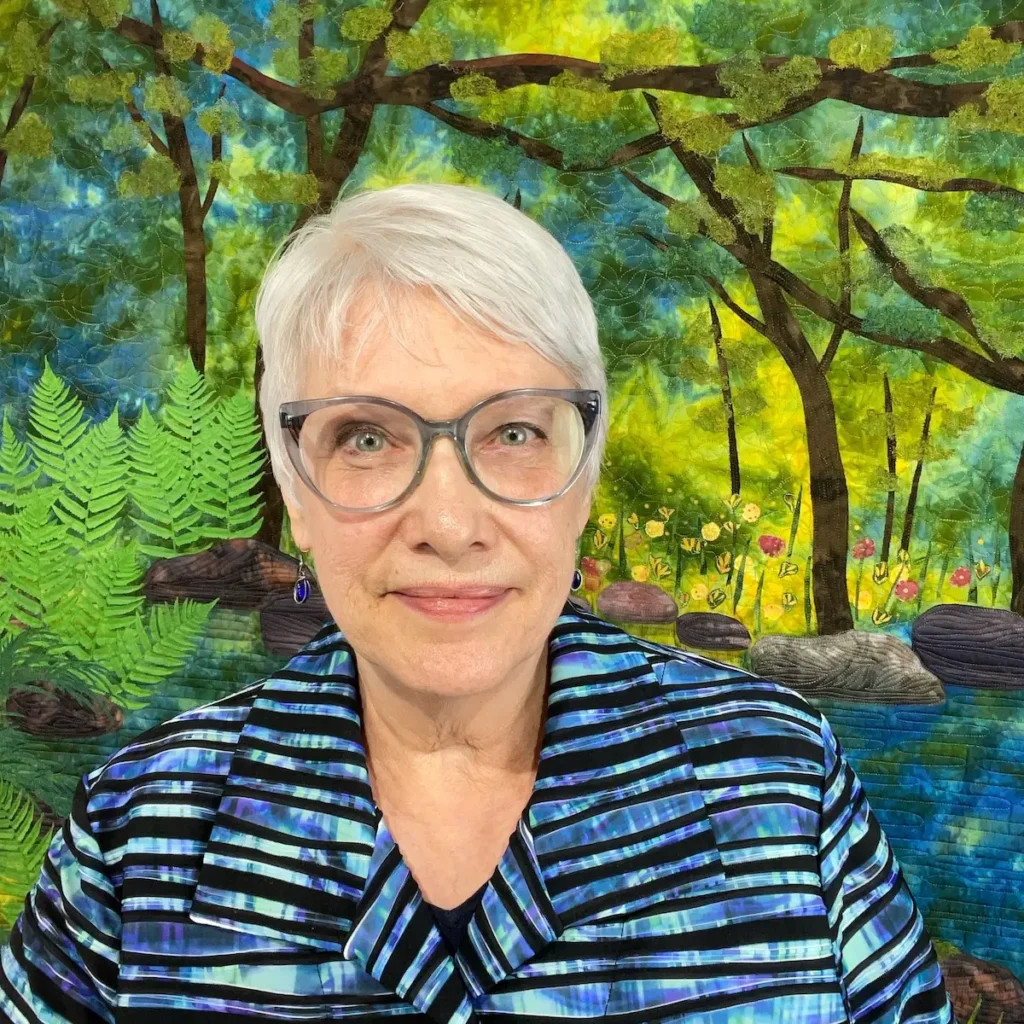
Rachel Derstine brings the beauty of the world around her into her art quilts, from the graceful lines of Japanese art to the colorful streets and historic buildings of Philadelphia. With a love of rich fabrics, light, and color, she transforms everyday scenes into quilts filled with movement, texture, and a little whimsy.
Can you take us back to the beginning? What first drew you to making things with fabric and thread?
My mother brought a treadle Singer sewing machine to Japan with her. I learned how to use it around age 11.
When she bought a new electric sewing machine, sewing lessons were included with it, so she asked me to take the lessons. I thoroughly enjoyed the lessons and began sewing garments for myself, mother, and sister.
You have degrees in piano performance and have spent many years teaching music. How did quilting enter your life, and when did you realize it might become more than a hobby?
As an Amazon Associate I earn from qualifying purchases. Read more about our affiliate linking policy.
My mother-in-law was a very enthusiastic hand quilter. She taught me some basics but then I adapted what I learned from her to the sewing machine. Hand quilting was just too slow for me.
As my girls left home for college, I found more time to quilt, and I gradually segued to more quilting and less piano teaching over the next few years.
Another quilter encouraged me to begin selling my work at fine craft shows, so I tried it and found there was a market for my work.
You grew up in Japan for the first 15 years of your life. What are some of the sights, colors, patterns, or experiences from Japan that have stayed with you?
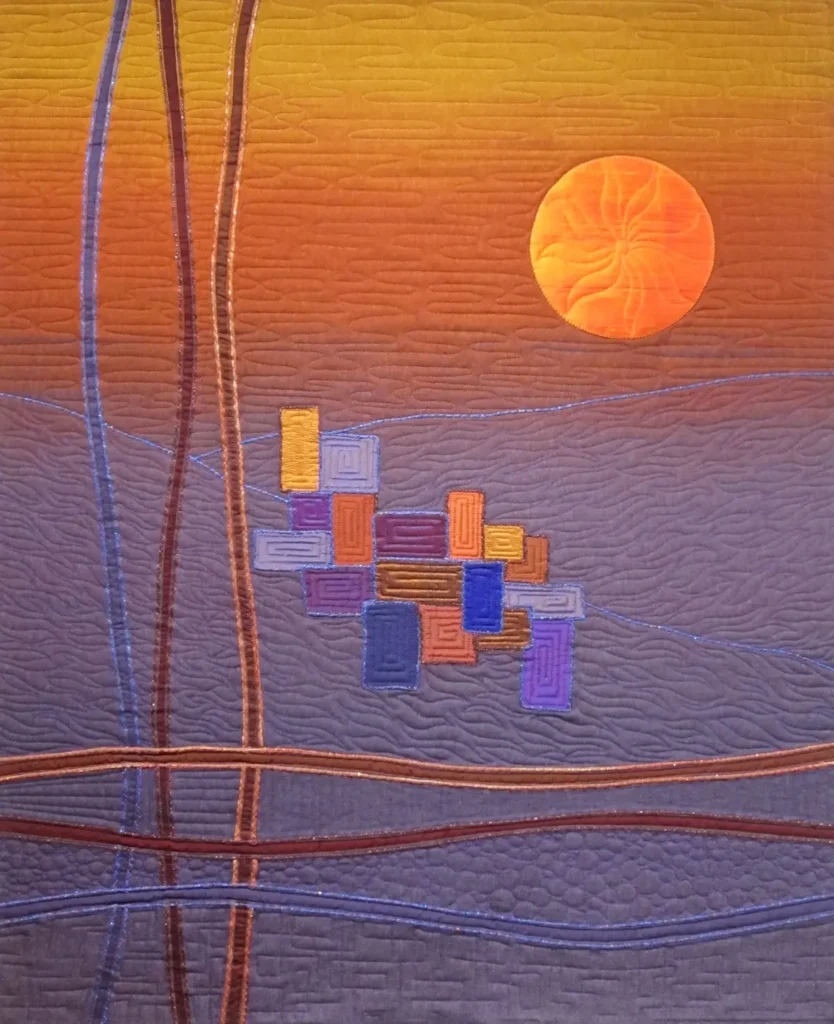
The aesthetic of Japanese art has influenced me, especially its graceful lines and simplicity.
My Keep It Simple, but Pack a Punch lecture and workshops both address this influence.
When you choose the right background fabrics and sparingly add focal points and harmonious color combinations, you can achieve a very pleasing design.
I am not always aware that my work reflects an Asian aesthetic, but people often tell me it does. I love color, but sometimes I like to create work with a very subdued or limited color palette.
Was there a point when you began to see yourself as an artist rather than simply someone who made quilts?
Several events were significant for me.
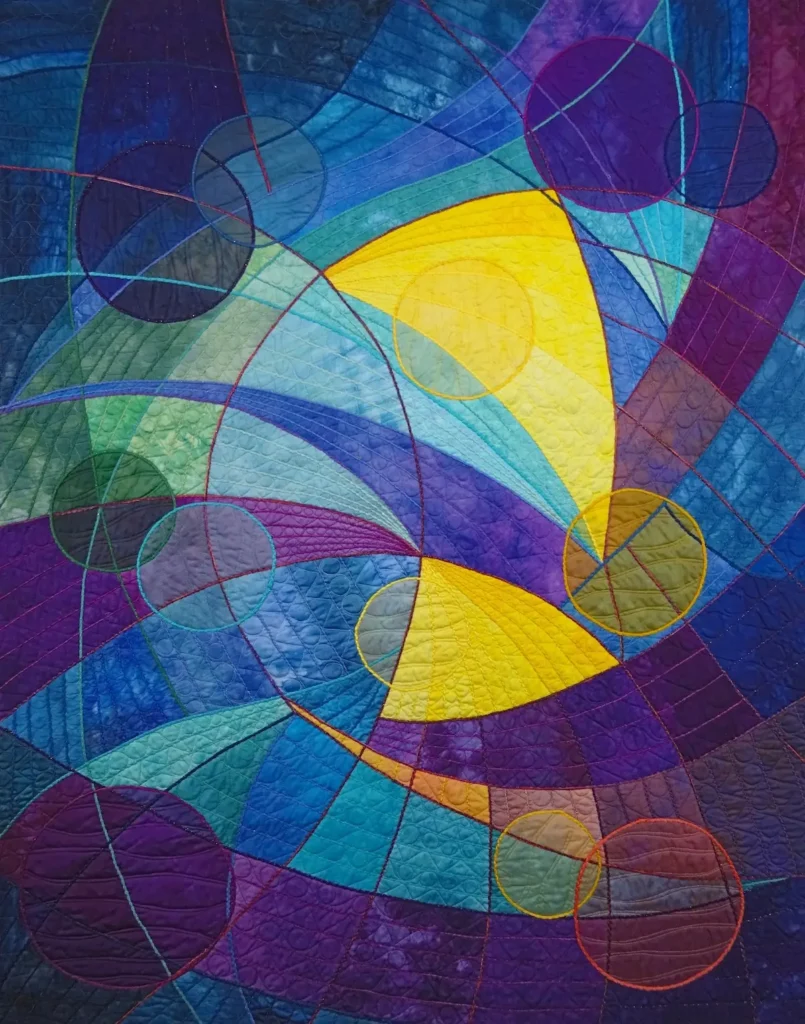
I took art quilting classes from several teachers who encouraged us to look at our work from an artists’ point of view. Rosalie Dace, Carol Taylor, Lisa Call, and Betty Busby were significant influences.
Another thing that encouraged me to view myself as an artist was when I began to win awards at Fine Art and Craft shows across the country. It was a bit shocking to me since I really had no formal art training.
You’ve said that you find inspiration by observing the world around you and by exploring memories from your childhood. What catches your eye when you are simply walking through the world?
I have collected many images on my Pinterest boards of things which catch my eye.
One of my boards is called Beauty. As I scroll through those images, I see that color and combinations of color in nature are a big deal for me.
The presence of water and sky, especially at dawn or sunset, is also significant. The light is just so much more dramatic at those times of day.
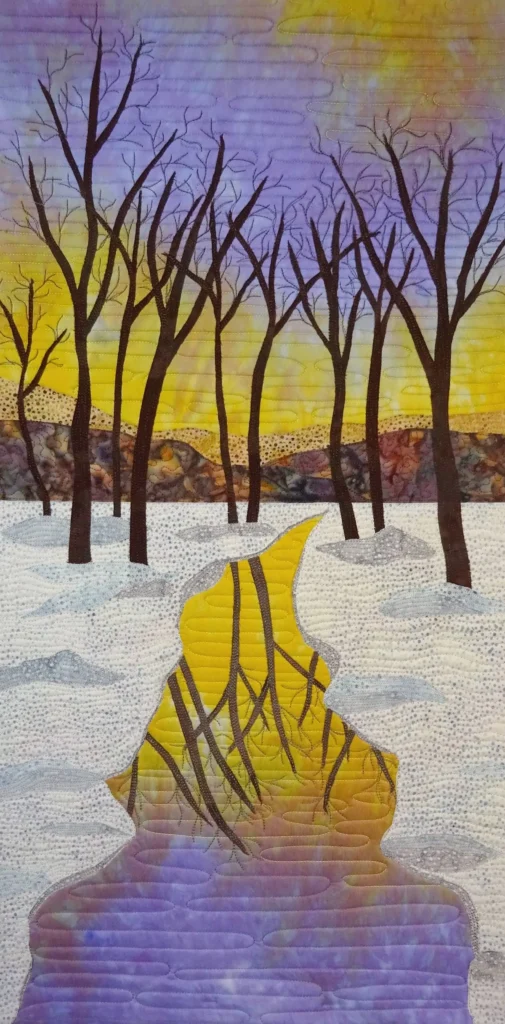
Trees also speak to me, how they are grouped, how they bend and curve, and how light is reflected on them.
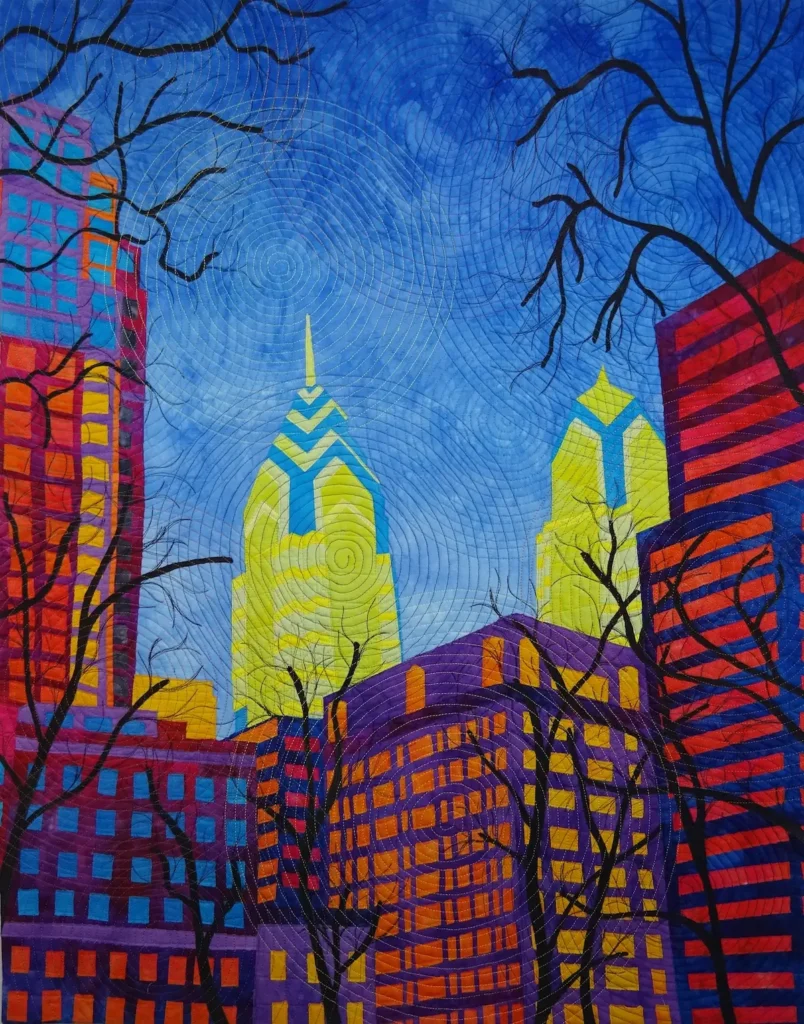
Your Philadelphia work includes buildings, streets, trees, windows, bridges, and gardens. What makes an ordinary city scene become an idea for a quilt?
Our move to Philadelphia felt like a homecoming for me. I love the energy of the city and all the cultural opportunities in the form of concerts, museums, restaurants, and social networking organizations.
Philadelphia is especially beautiful because of the juxtaposition of historic and modern architecture. The city is highly walkable with a significantly large portion of it dedicated to park space.
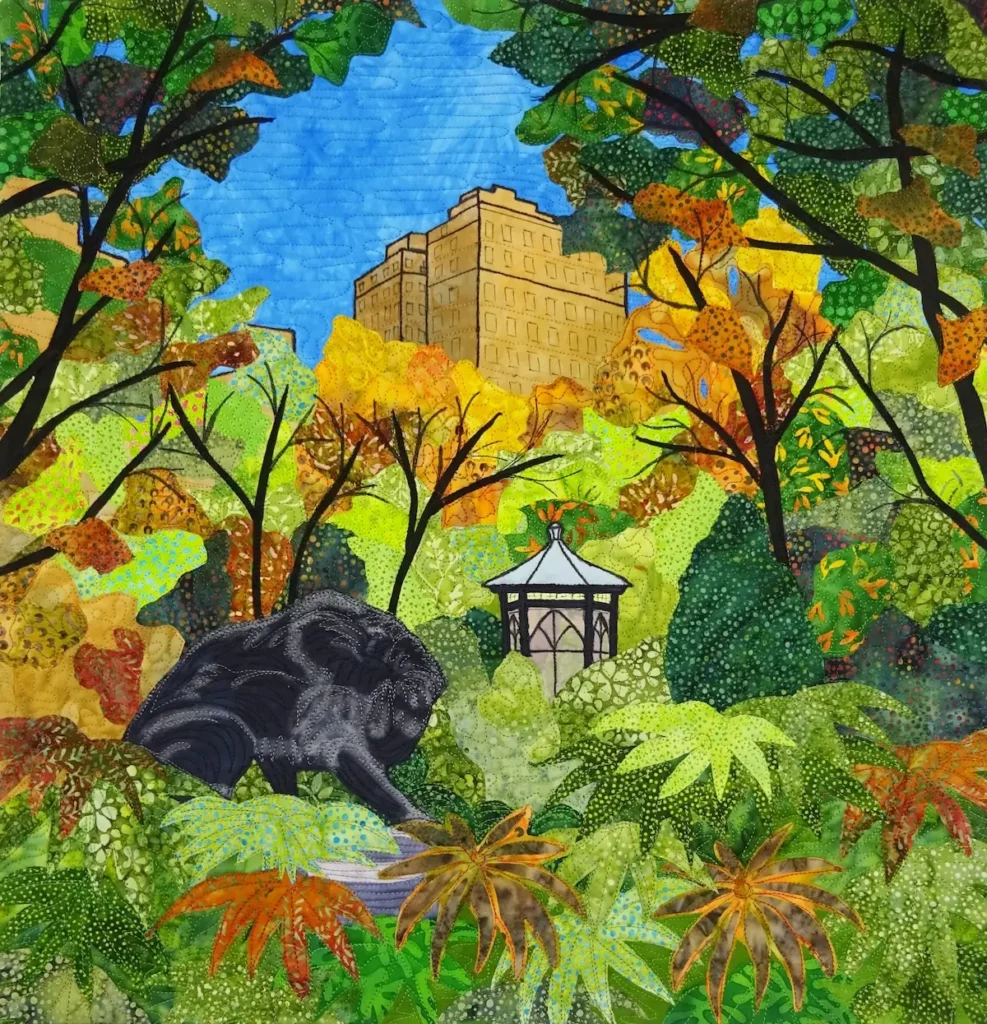
My architecture pieces reflect the places where we like to spend time: the Schuylkill River Trail, Kelly Drive, Rittenhouse Square, strolling along beautiful Delancey Street, Pine Street, Fitler Square, and Old City.
Philadelphians are very passionate about their love for the city. I look for a scene with recognizable architectural shapes: bridges, buildings, and sculptures. Trees and foliage are also an important part of the scene as it frames it or softens the hard edges.
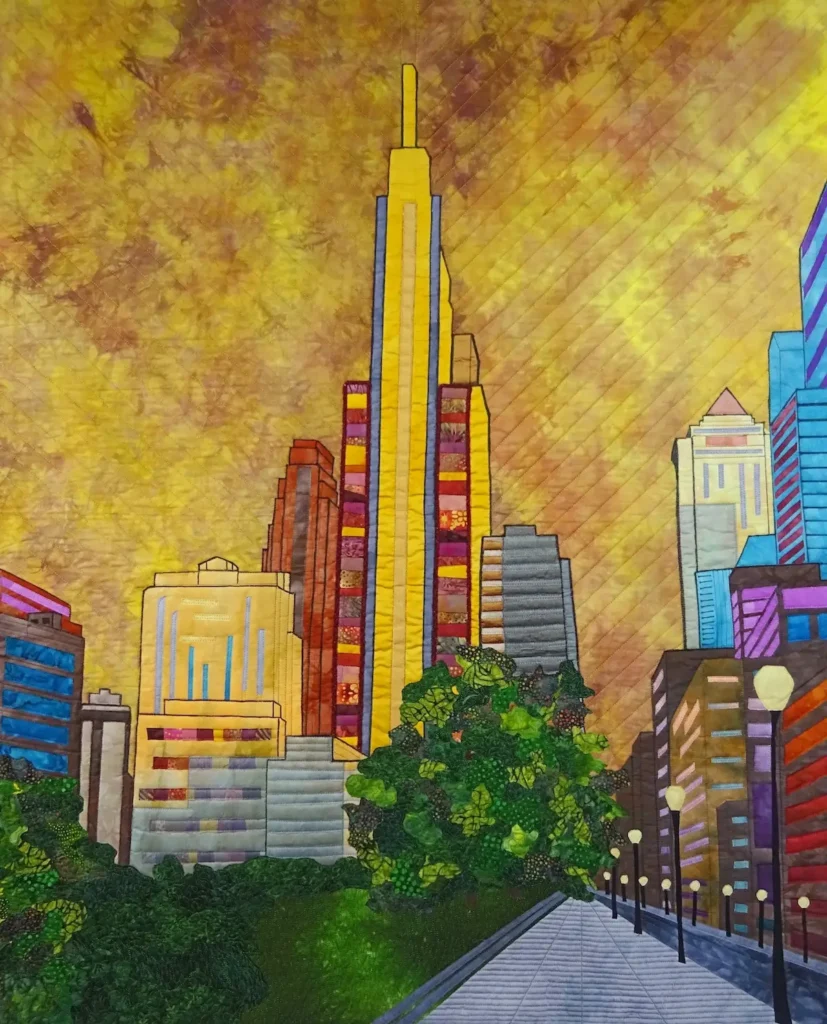
Your architecture quilts aren’t meant to be exact copies of buildings. You talk about creating a feeling rather than perfect realism. How do you decide what to keep and what to leave out?
Creating buildings can get tedious very quickly when you try to be too literal.
I try to frame the view with trees and foliage, if possible. Sometimes, I also quilt the work with spirals to create a sense of energy. Colorful windows create a feeling of mystery and whimsy.
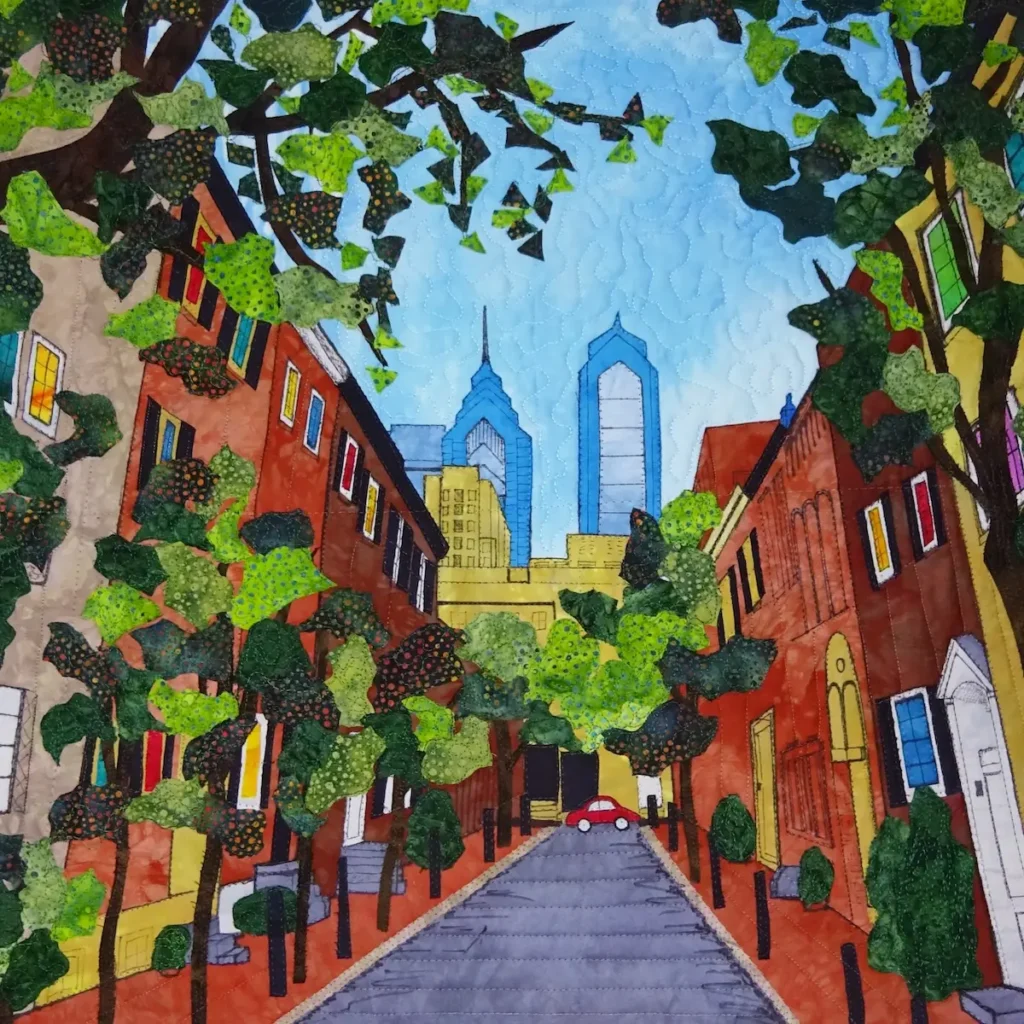
You use kimono silks, Asian fabrics, ikats, batiks, hand-dyed fabrics and painted fabrics. What is it about these fabrics that speaks to you?
I find these Asian and hand dyed fabrics to be utterly gorgeous and love using them in my work. They give the work an organic rich texture that is not always possible with commercial prints.
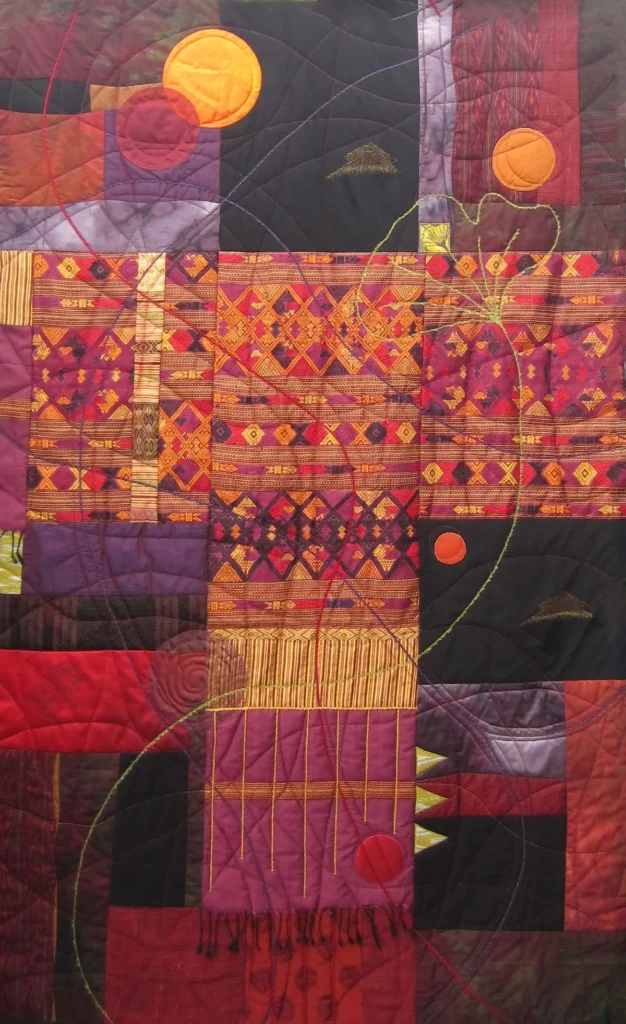
Your music background seems like it could connect naturally to ideas such as rhythm, repetition, movement, and harmony. Do you think like a musician when you design a quilt?
The elements of music are very similar to the elements of art. As you said, rhythm, repetition, movement, harmony of color and focal points of sound and shape, all work together to create both visual and auditory art.
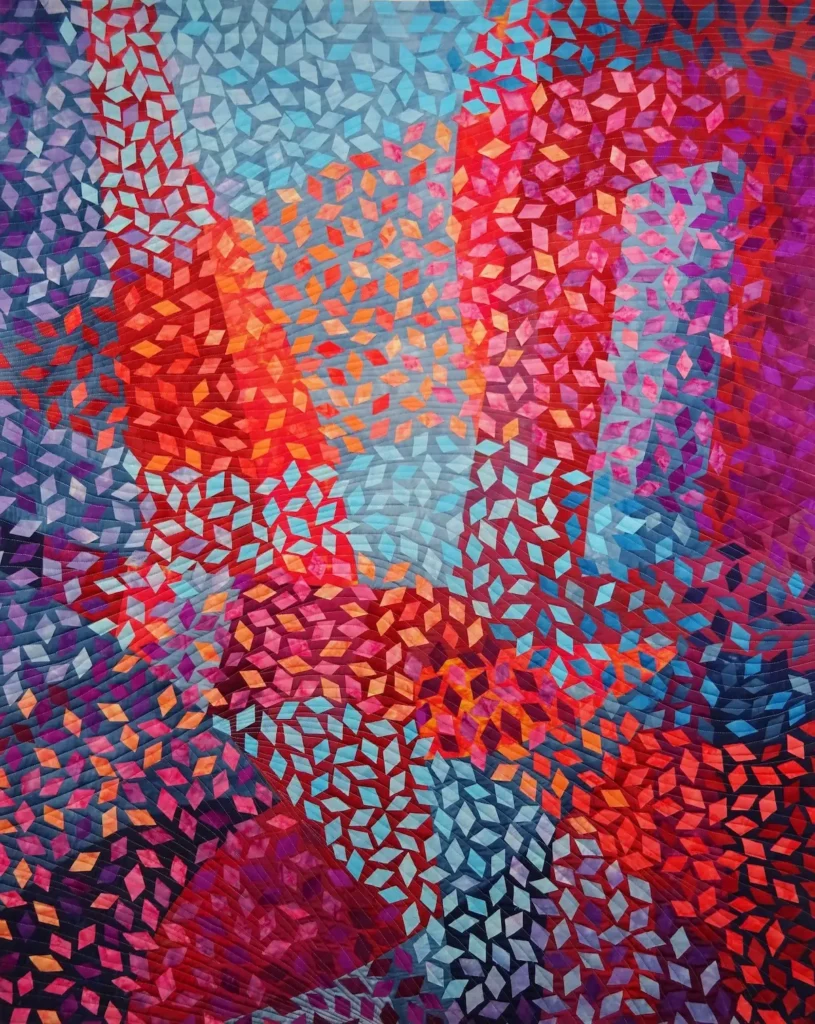
Walk us into your studio. What would we see when we walk through the door?
The original intent for the room I use as a studio is the master bedroom of our apartment. It is the perfect size to house my longarm machine and all the shelves for fabrics, sewing machine, design wall, etc.
I’ve used every inch of space to organize my thread, shipping supplies, and rolled-up quilts. I also sell matted and signed prints, calendars, cards, and other gift items of my work. Many of my smaller works are framed, and I do my own framing. All of that requires storage space.
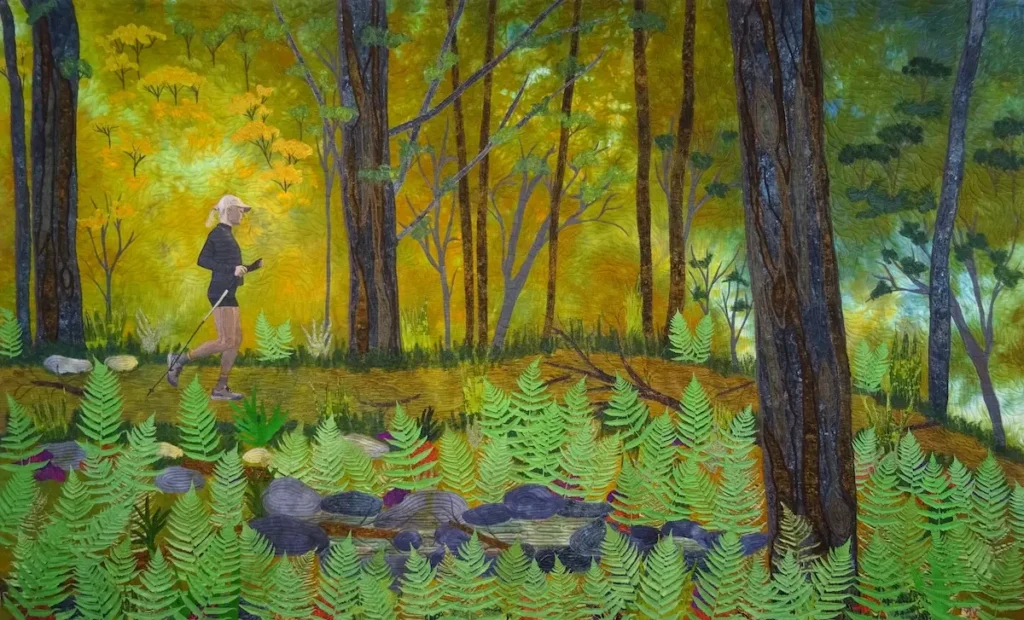
You work with cotton, silk, nonwovens, painted fabrics, sheers and more. How do you know when a fabric is right for a particular piece?
The nonwovens come into play when I want to create something which is too intricate to cut out of fabric.
Evolon is a product that I can paint, back with Mistyfuse, and cut out with my Cricut machine. Many of the ferns and leaves you see in my landscape quilts are created from Evolon.
Sheers have a translucent quality which adds depth to my work. They can also be used to create shadows or luminous areas.
Paints can be mixed to find the perfect shade of a color when you just can’t find the right one in fabric.
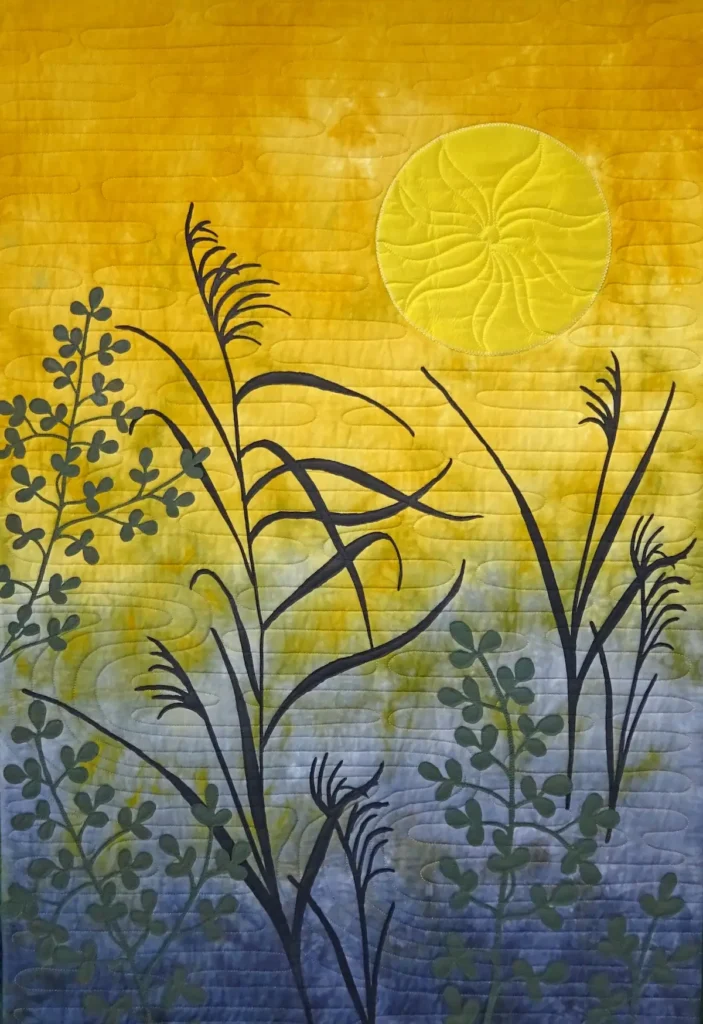
When an idea first pops into your head, what happens next? Do you sketch, take photographs, play with fabric, or simply start experimenting?
I spend a lot of time taking photos with my iPhone. I also follow many photographers and painters on Instagram. I learn a lot from studying their use of color and light. I collect photos on my Pinterest boards so I can go back and find them later.
Sometimes I do sketches. I often use Procreate on my iPad to layer designs and experiment with color. The layering and tracing features are very helpful in that app.
What is usually the hardest part of making a new art quilt for you?
The hardest part is just getting started.
The process of sketching or designing takes a lot of energy for me. I can’t do it when I’m overwhelmed or tired. Once I’m in the flow of bringing a design idea to life, I usually get obsessed, and the day goes by very quickly.
When do you know a quilt is finished? Is there a moment when you simply stop, or do you sometimes have to make yourself put the needle down?
Good question!
I usually find that taking a picture of the quilt and looking at it on my phone is a great way to see it better. It gives it a new perspective, and any issues will jump out at you even though you didn’t notice them when viewing it in person.
I also find that taking a break and going for a walk will help. When you return, refreshed, you have new eyes and might find a new angle to tackle any problems.
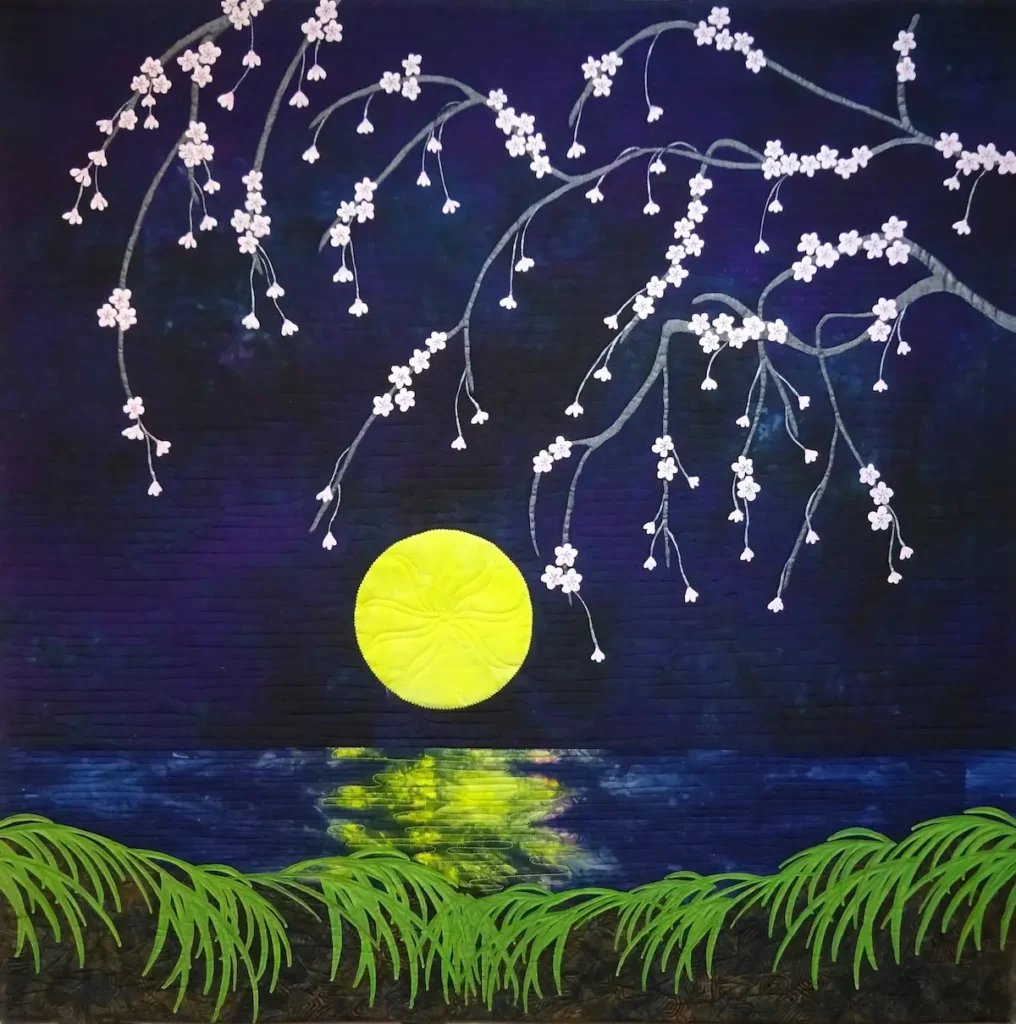
Your teaching idea, “Keep It Simple, but Pack a Punch,” is such a great reminder for quilters. What have you learned about the power of simplicity through your own work?
Many quilters seem to feel that the number of different fabrics or the number of different pieces in a quilt make it a more spectacular quilt. I beg to differ.
Some of the most powerful works in art history are very simple. Look at the Color Field Paintings by Mark Rothko.
Look at the spare minimalist paintings from ancient Japanese art. They are truly breathtaking in their simplicity.
You have exhibited your work, received awards, created commissions, taught workshops, and had your work installed in public and private spaces. How has sharing your work with others changed the way you see yourself as an artist?
It is quite validating to have your work appreciated by so many people.
It is also a balancing act to find the space where you are creating what inspires you and not just what people want. Hopefully, you can maintain that happy place of creating something exciting for yourself, but which also speaks to those who follow you.
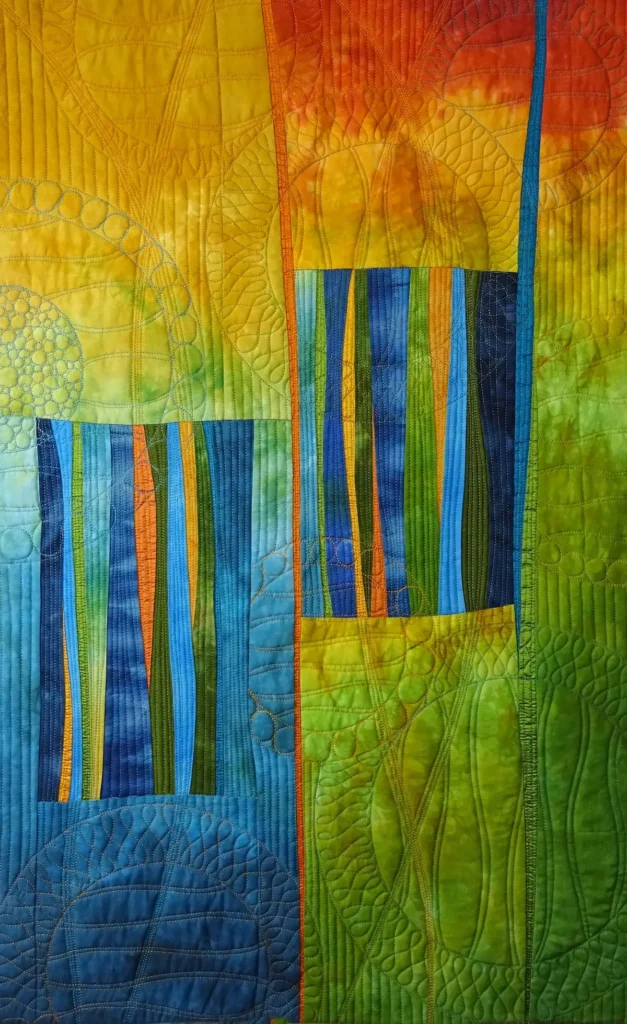
After all these years of making, teaching, and exploring, what still excites you enough to make you rush into the studio?
One thing I’ve noticed lately, is that one needs to have down time to replenish yourself.
Both my husband and I have had some serious health issues this past year, which forced us to slow down. I’m on the mend but have also found that living at a slower pace has its rewards. You notice the world around you more. Spending time together and just sitting in the park makes us appreciate the beauty around us.
I am not in a space where I rush into the studio to create right now, but I’m sure I will get back to it. I enjoy seeing my daughter’s photos of all her hikes in the mountains. That’s truly inspiring.
Where can people see your work?
You may find my work on my website: https://www.rachelderstinedesigns.com/
You may find my online classes here: https://artfulquiltingandsewing.com/all-courses-2/
Instagram – @derstinedesigns
Facebook – Rachel Derstine Designs
Rapid-Fire Fun:
- Favorite color to work with? Blue
- A fabric you can never resist? Hand dyed gradients
- Sunrise or sunset? Sunrise since I’m an early riser
- Something every new art quilter should try? Fused collage
- What are you curious about right now? What makes adults so often lose their playful willingness to create with abandon as they did as children. Why? Just an observation after teaching many adults and many children.