
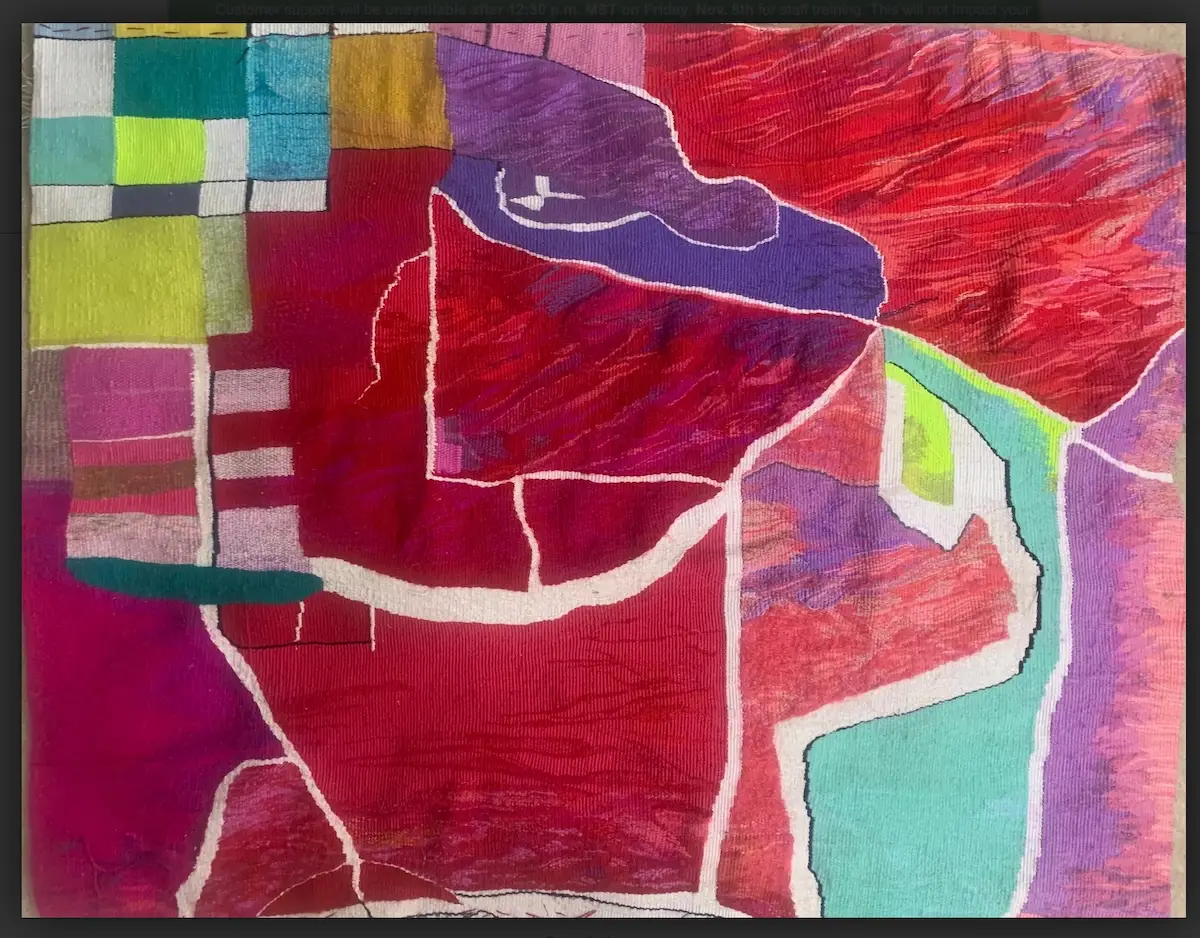
Rowen Schussheim-Anderson turns colorful yarn, beads, and glass into lively tapestries filled with movement, texture, and surprise. Inspired by butterflies, faraway places, and patterns found in everyday life, she brings a fresh twist to the age-old art of weaving. Her work invites us to look closer and discover beauty in unexpected places.
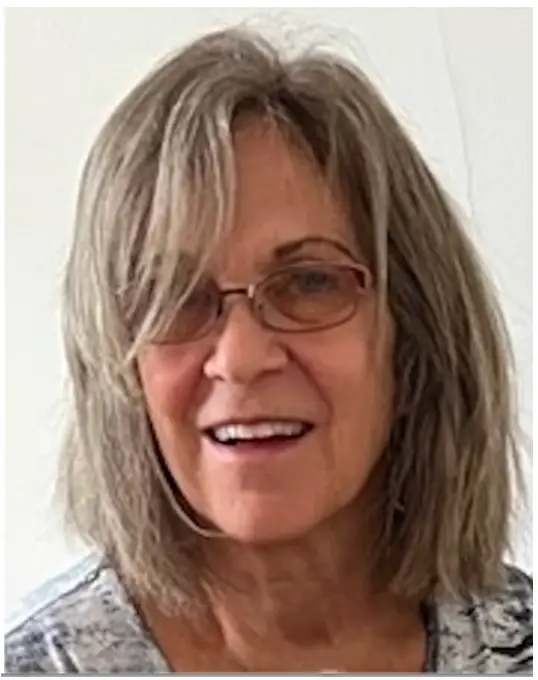
Do you remember when you first became interested in art and making things with your hands? What did you enjoy creating as a child?
I always made things as a child. I took after-school art classes (every Monday!), collected shells when we went to the beach, and made jewelry and sculptures with them, even took a flower arranging and leather carving class. In my teens, after I learned macramé, my high school art teacher brought in a loom for me to use. I sat down, loved it, and have been weaving ever since.
You grew up in Washington, D.C., near the Textile Museum. Did seeing textiles there influence the way you looked at cloth, pattern, and color?
Yes, I went to the Textile Museum often, especially when I was back in DC as a young adult visiting my parents. The traditional textiles and methods represented in the collection and exhibitions resonated with me, from ikat to Andean textiles, to European tapestries, and more. Even the shop had an extensive selection of books that provided wonderful reference material.
As an Amazon Associate I earn from qualifying purchases. Read more about our affiliate linking policy.
I also went often to the Smithsonian’s Museum of African Art and Museum of the American Indian, and the Phillips Collection, where I observed dynamic contemporary art.
How did you find your way to tapestry weaving? Was there a particular class, teacher, or experience that made you want to explore it further?
Yes, after learning how to weave in high school, I sought out a college experience that would allow me to concentrate on textiles. I chose Rochester Institute of Technology’s School for American Craftsmen, where I majored in Weaving and Textile Design.
Sophomore year, we explored tapestry weaving, which allows creative expression and exploration in fiber while creating an abstract or pictorial surface.
I have continued in that vein for decades. A strong influence, mentor, and amazing artist was Professor Stephen Thurston, who was a wonderful weaver and teacher.
How did your experiences studying art in New York and Arizona teach you about art, and how did they shape the artist you were becoming?
I answered above regarding studying in Rochester, NY, where I earned a Bachelor of Fine Arts. Several years later, I earned a Masters of Fine Arts at Arizona State University.
Janet Taylor was my professor and mentor; to this day, we are in close contact and still talk about art, design, textiles, and life! Janet was a talented tapestry weaver, gifted in color study, and taught me a formal approach to color, which I do not necessarily adhere to, but it has informed my practice over the years.
In Arizona, I developed a strong interest in the Native American aesthetic, especially Navajo weaving aesthetics and practice, which had some influence on my artistic development.
Was there a time when you realized that working with fiber could become more than a craft for you? When did you begin to see it as your own artistic language?
From my first year as an undergraduate in art school (at Rochester Institute of Technology) working in fiber was much more than a craft. It was never a craft, actually. It was always art to me. Techniques need to be mastered to create art, to express visual ideas.
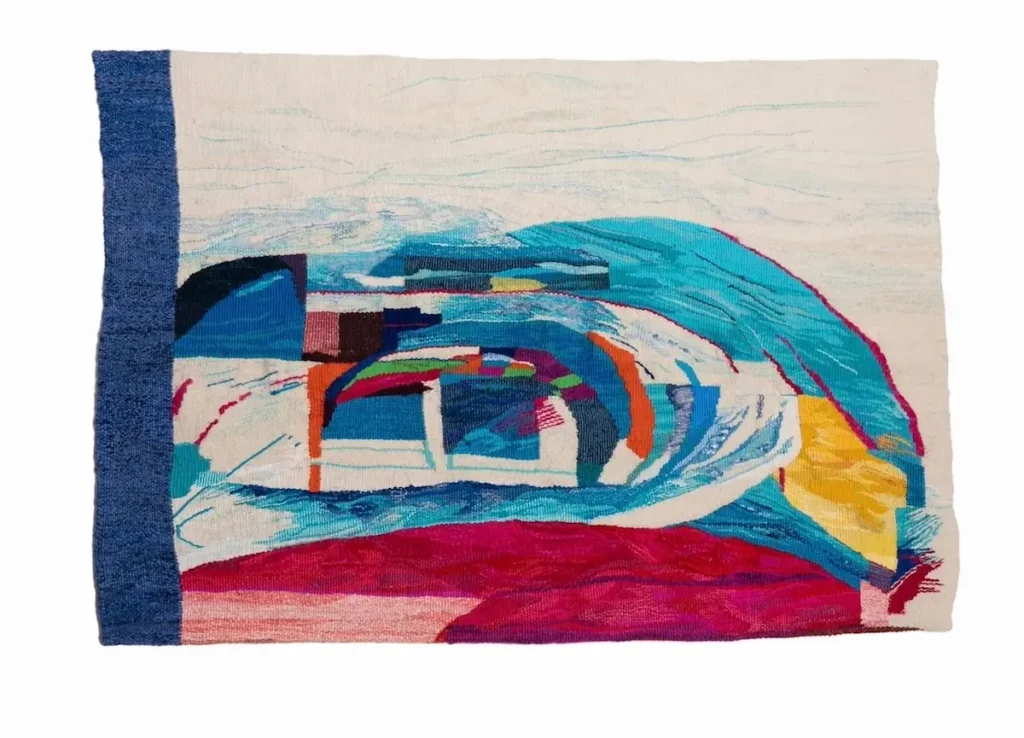
Your travels through South America and West Africa have had a lasting effect on your work. Can you share a particular place or experience that changed the way you think about color, pattern, or textiles?
That is a hard question because there were so many experiences on both of these continents that were impactful, powerful and moving.
Seeing the women walk down the street weaving on their drop spindles in Ecuador and Peru, observing weavers creating unbelievably fine, intricate patterns in the same manner and on the same basic looms that have been utilized since Pre-Columbian times, all made lasting impressions.
The beautiful beadwork, the knitting—including visiting Taquile Island on Lake Titicaca, where the men knit exquisite hats, and studying the importance of textiles to the Pre-Columbian people of the Andes—all have influenced my practice.
In Ghana, the very finely woven kente cloth was a joy to learn about and try to emulate with my students. In Senegal, the boldness of color of the batik, printed cloth, and beadwork was also rich and impactful.
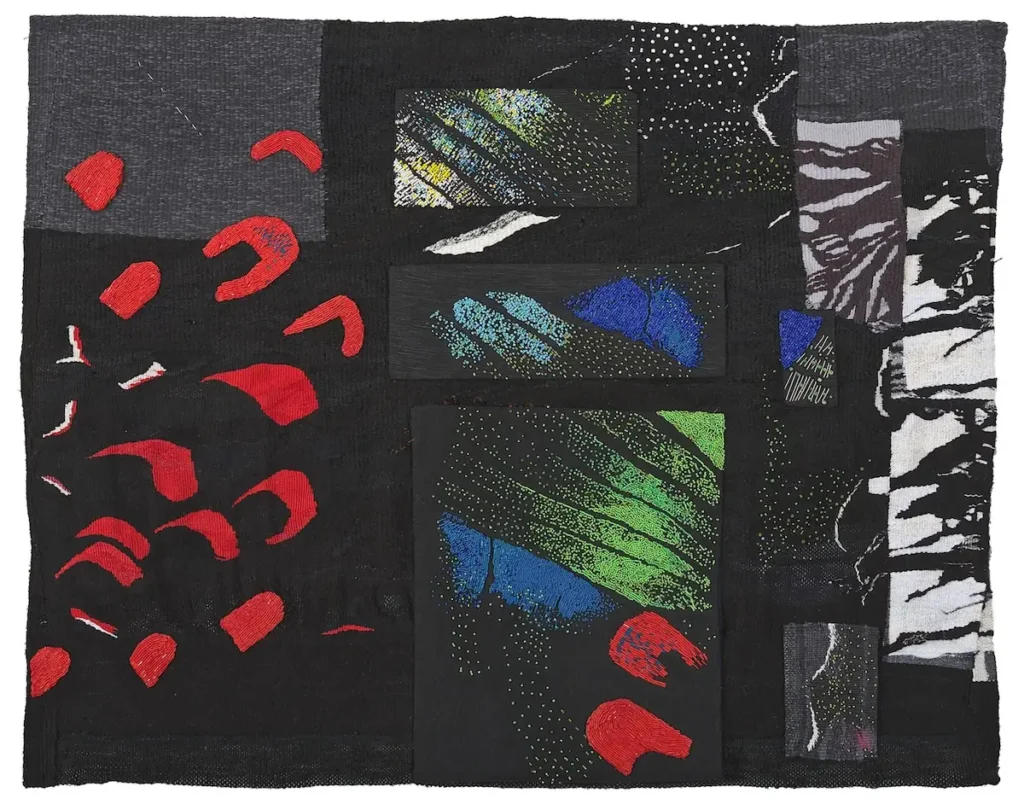
Butterflies have inspired several of your tapestries. What draws you to their shapes, colors, and patterns? Is there something about butterflies that connects with the way you see the world?
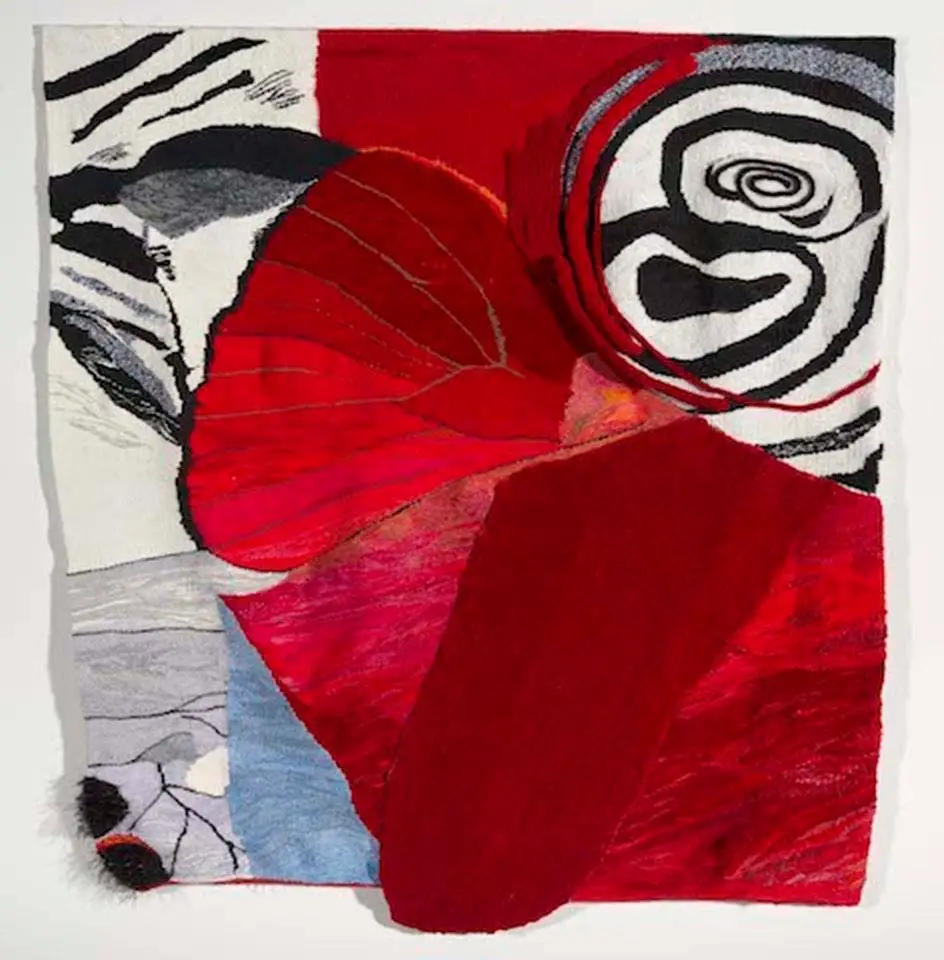
The butterfly series was inspired by the organic latticework of butterflies and other organic forms.
Butterflies represent progressions found in nature, designs ranging from orderly to fluid, from complex to formal symmetry. While grids offer structure, organic grids impose structure upon the abstract.
It is as if I am layering the structure of the butterfly, its color and pointillism-like qualities, with the richness of its pattern.
As artists, we pick and choose, layer, collage, synthesize, and weave it into a tapestry revealing the interplay of pattern, surface, and color.
I am not striving to reproduce an actual butterfly, but rather to play off the beauty of the dots and dashes of patterns and the vibrant contrasting hues that comprise the beauty of the butterfly……
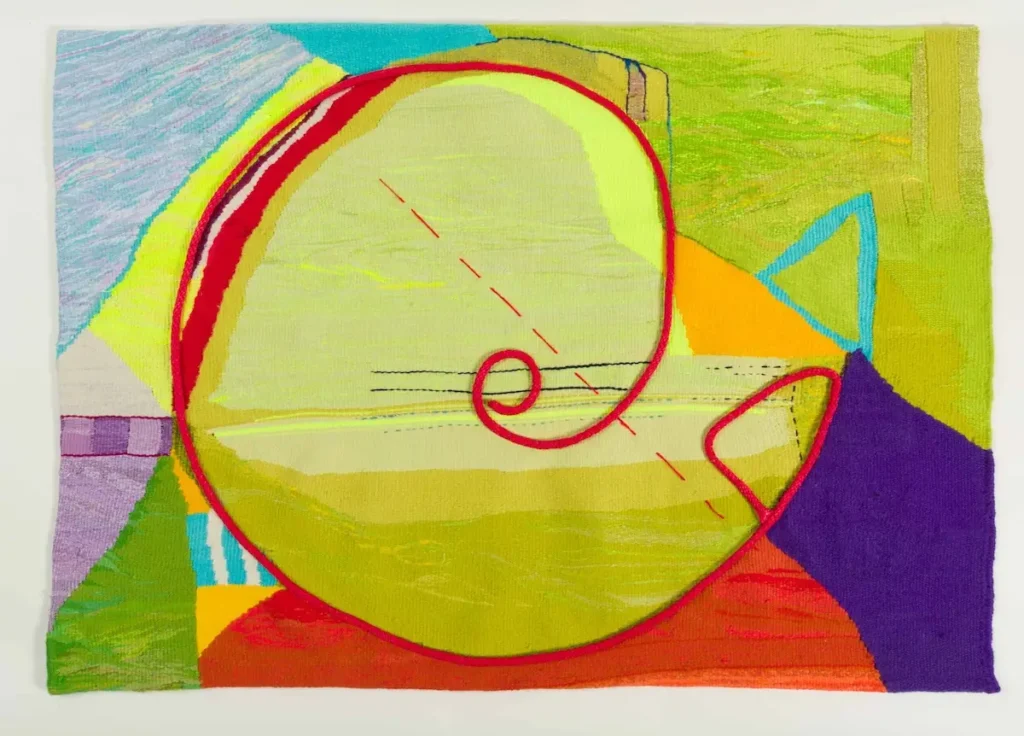
You also find patterns in architecture, landscapes, markets, and everyday surroundings. Do you ever surprise yourself with what catches your attention?
Yes, definitely! I always want to be surprised!
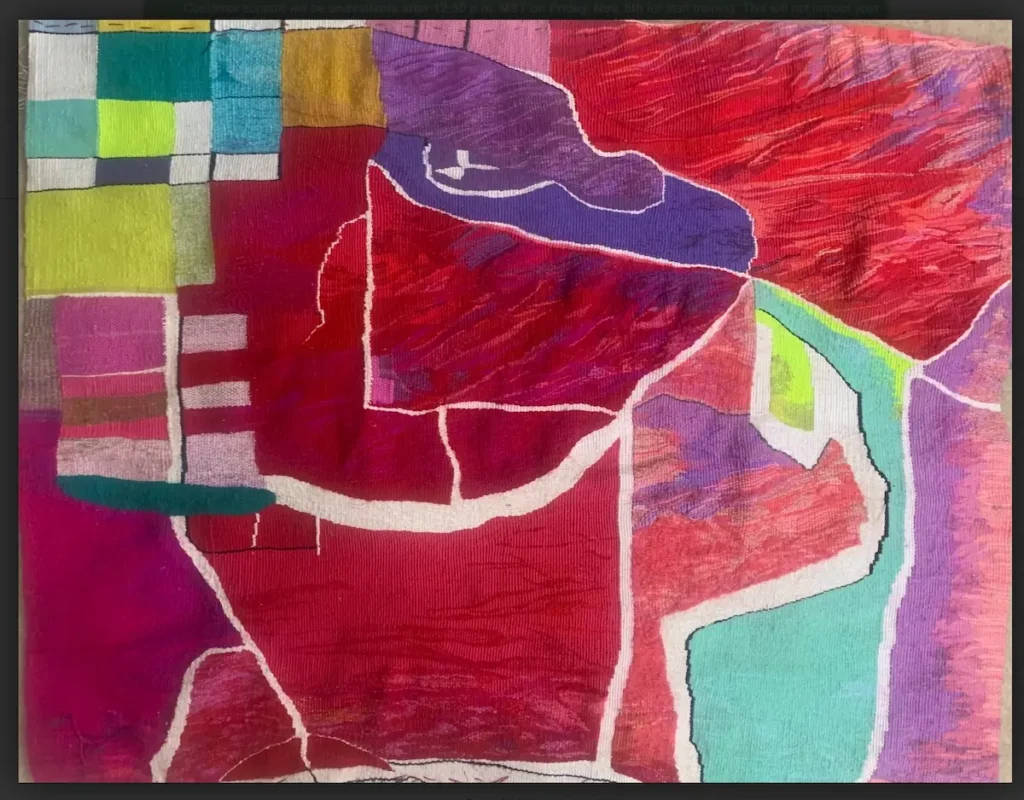
A recent work, Ricochet, was the result of being asked to design a piece with a Mexican color aesthetic.
One of my recent works, Delineations, was inspired by the pattern in a marble step I observed when traveling in Israel. The lines were from the marble, the color was my own.
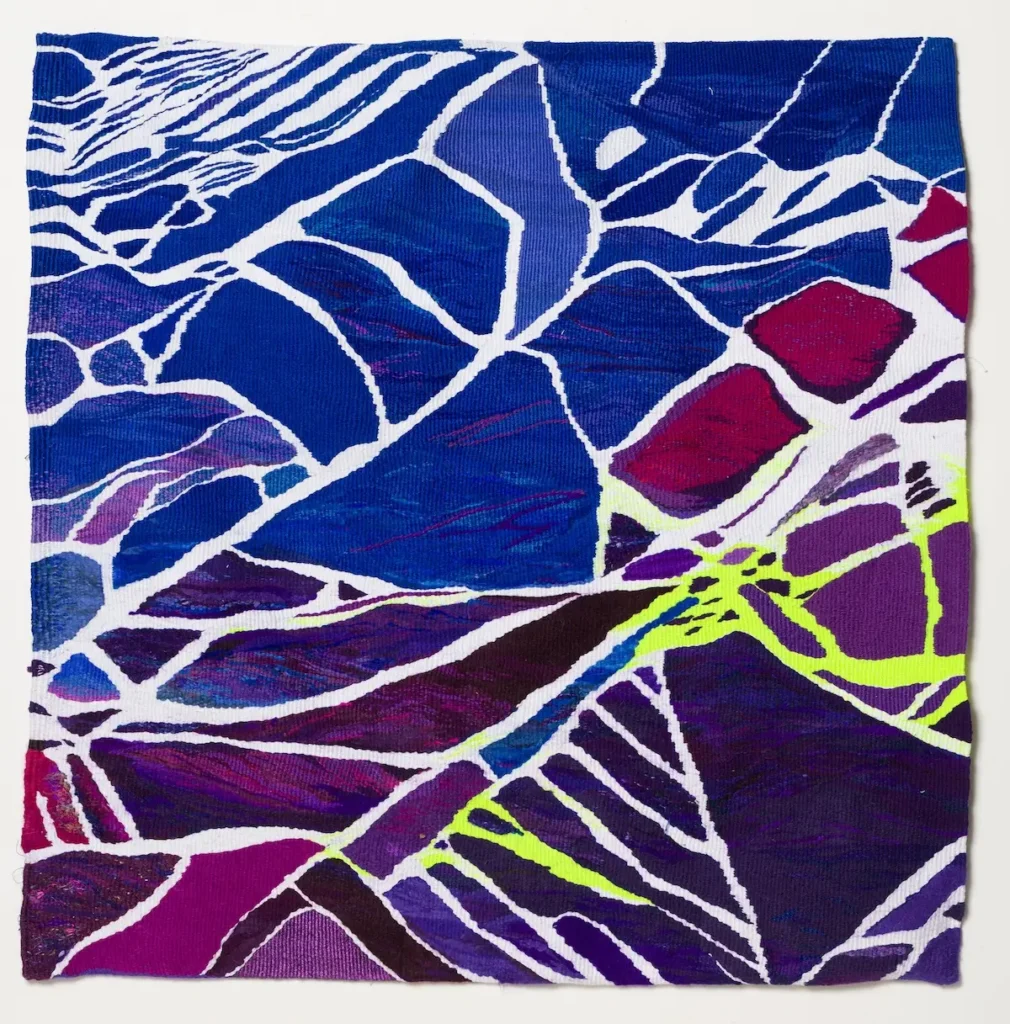
I notice cracks in the sidewalk and road when I walk, ripples in the sand when I am at a beach, feathers, ornamental design in architecture—there is so much rich opportunity for design sources in the natural and humanmade world.
The art expression of young children—the freshness, spontaneity, and color usage—has long resonated with me.
Could you walk us through your studio? What does a typical day in your studio look like? Do you settle into one project at a time, or do you move among several pieces as ideas develop?
I have a studio in my home. I have one wall of yarn, another of art books.
I work on a 56” wide four-harness Macomber floor loom, which I purchased around 1977! I have other smaller looms.
I usually have a large tapestry in progress on the floor loom and warps on smaller looms, that include portable frame looms I may take on a flight or road trip, or to work on while awaiting a doctor’s appointment, or wherever!
I have other equipment such as a warping reel, skein winder, shuttles, and so forth.
The smaller looms I work on sometimes provide a means to produce components that become part of a larger tapestry; other times I weave a small tapestry on these looms.
While I weave, I often listen to podcasts or audiobooks.
You work with wool, linen, silk, cotton, rayon, and other fibers. How do you choose the materials for a new piece, and what does each one bring to the work?
The linen is used for the warp. The other materials are blended together to create a textured surface.
I choose yarns to create an interesting and varied surface. Contrasting materials create interest and add dimension.
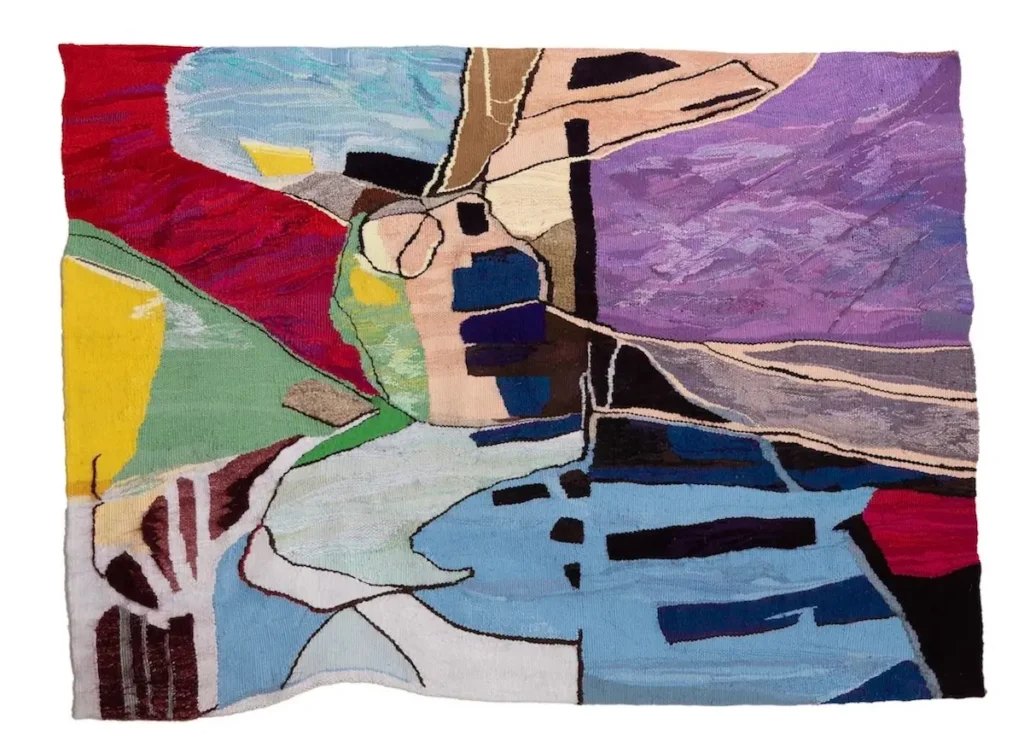
When an idea for a new tapestry first comes to you, what is the first thing you do? Do you sketch, gather images, experiment with color, or begin in another way?
I usually look through images I have photographed of places, patterns, interesting color combinations, and the like.
I sketch, work in collage, and sketch some more until I come up with the next composition.
Sometimes it comes quickly, sometimes it takes days.
If I am involved in a series, it is generally helpful to produce the next design.
Your work often has a strong sense of movement, with flowing lines and shapes that seem to travel across the surface. How do you create that feeling while working within the structure of the loom?
The feeling of movement and flow comes about in the sketching/planning stage.
Once I come up with a composition that works, I enlarge the sketch and make an outline to follow (known as a “cartoon”), which is attached to the back of the warp, and I follow it as I weave, similar to an outline in a coloring book.
I reproduce the piece as close to the sketch as possible.
Do you plan every color and shape before you begin weaving, or do you make important decisions as the work grows? Can you share an example of a piece that took an unexpected turn?
The color and shapes are all planned before the weaving begins.
The important decisions that are made as the work grows are which yarns to use for which areas of the sketch. Color, texture, “sheen,” and which fiber to use play into this decision.
An unexpected turn might be that when a piece comes off the loom and is hung on the studio wall. I might feel it needs something else, an area may need to be “pushed” more.
I might add an outline, stitch on some hatched lines for more shading, perhaps add some glass beads.
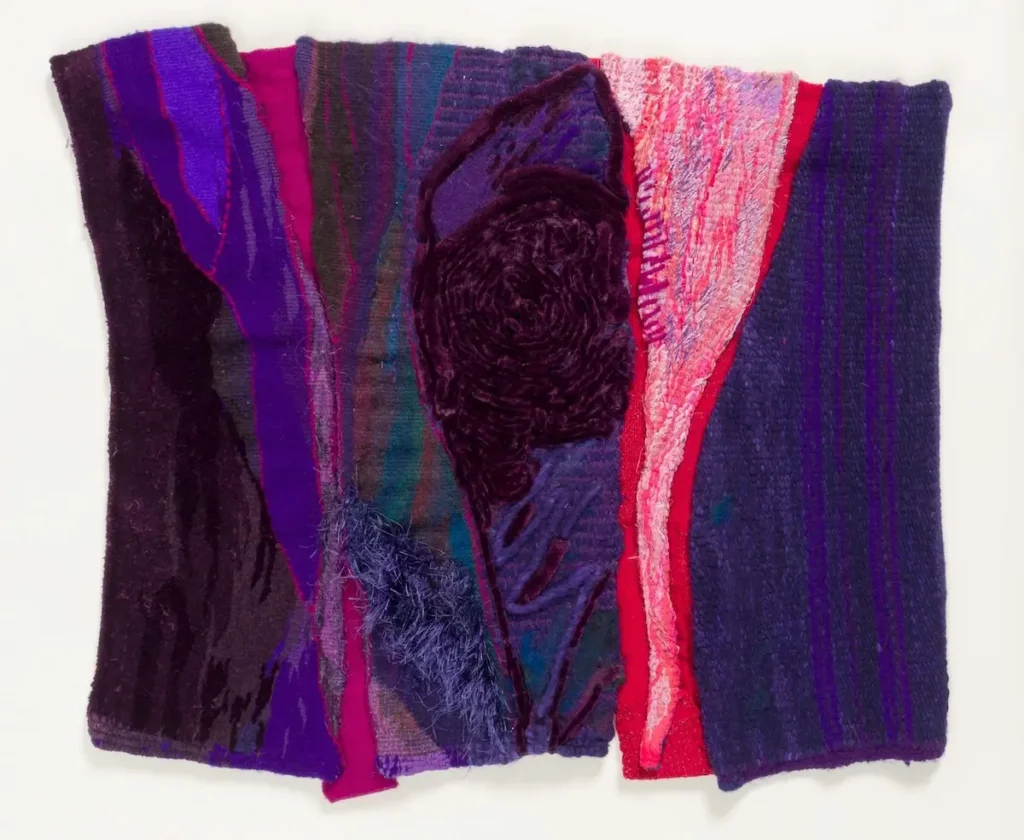
Another unexpected turn happened when a piece, herview did not turn out as envisioned. I cut it apart and reassembled it, including some woven sections leftover from something in the past. The result worked.
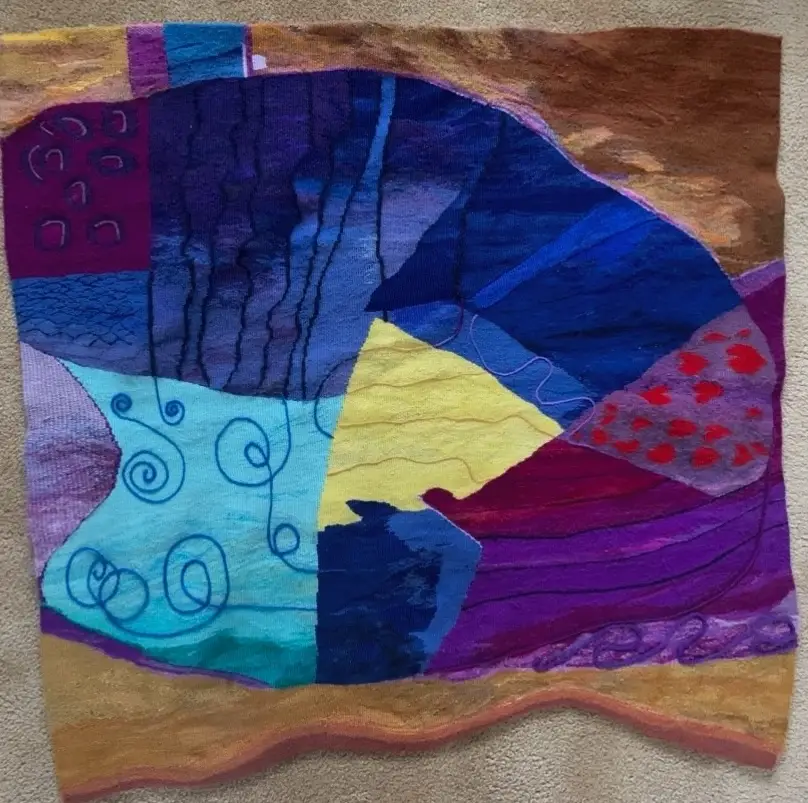
Another time, my loom semi-collapsed and created an uneven edge on the tapestry, which later was named Midnight Dance. I was planning to fix the uneven edge when I hemmed the piece, but found it worked, so I went with it, and it’s actually an interesting variation that I had not planned.
Tapestry weaving has a long history and well-established techniques, yet you continue to push its boundaries. How do you balance respect for tradition with your desire to try something new?
I weave tapestries the same way they have been woven for hundreds of years. Weft threads intersect warp threads, creating an image by changing the colors of yarn.
While I use centuries-old techniques, I introduce new elements and incorporate new materials, innovations, and inspirations.
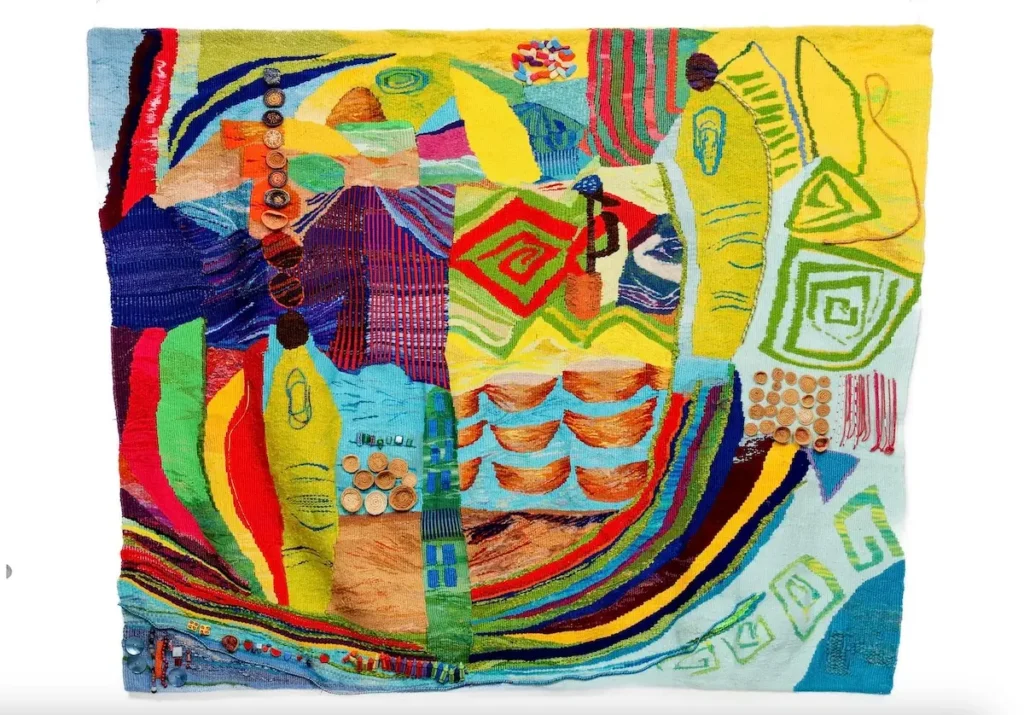
Several techniques are used to push the boundaries of traditional tapestry, incorporating feathers, glass, beads, and other reflective materials to heighten contrast.
Texture and color are integral components. Textured areas create a marked contrast to detailed beaded sections or the luminosity of fused glass. Pointillist-like beaded surfaces and glass areas provide elegant accents and focal points.
When you introduce an unfamiliar material or technique, how do you work out whether it will succeed? Do you make small samples first, or do you sometimes learn by taking a risk in the finished piece?
Working out whether an unfamiliar material or technique works is all about trial and error, and to a degree, experience of having done this for many years.
A lot of it is simply examining the newly introduced material and asking myself, ” Does this work? Is this adding to the piece? Does this belong here?”
Sometimes I ask my husband or an artist friend for feedback, but ultimately I have to decide whether the new element is aesthetically enhancing the work or not.
You spent many years teaching art at Augustana College and working with students in other settings. How did teaching influence your own creative practice, and what did your students teach you?
Although no longer full-time, I continue to teach part-time at museums and art centers. I learn a lot from teaching.
Teaching has pushed me to explore new materials and methods, to learn about many cultures’ expressions and practices, which I pass on to my students, to develop art vocabulary to discuss aesthetics and critique work, and to share ideas and approaches.
Sometimes a student tries something that I had not explored, and I learn from their successes and failures.
None of us can anticipate every outcome, so working together collaboratively exposes all of us to more investigations and more results.
I have also spent months shepherding students to far-flung lands, where I learned as much as they did about textiles in Ghana, Senegal, Morocco, Peru, Ecuador, Uruguay, Brasil, Argentina, and Chile.
We visited artist villages, workshops, and communities I might not have otherwise; this was wonderfully enriching for Augustana College students as well as myself.
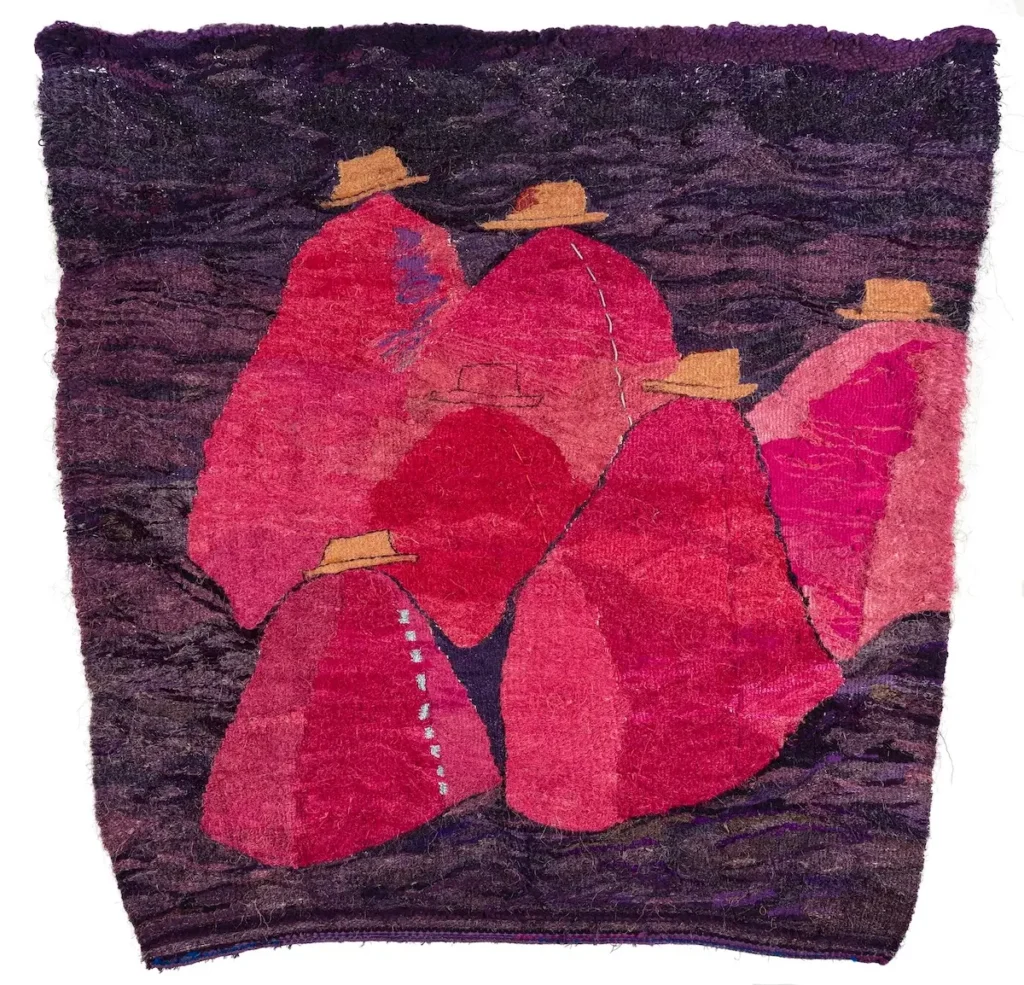
Looking back over your career, how has your work changed? Are there materials, colors, subjects, or ways of working that would have surprised the artist you were at the beginning?
My work has become more detailed.
Some pieces are not quite as large-scale as I did earlier, although most are not small.
My color palette has changed over the years, although many combinations still resonate from early works.
It is hard to say if what I am doing now would have surprised me from what I produced earlier.
Before I was able to travel outside the US, I did not have the richness of other cultures to draw on (except through books, museums, and videos, of which I availed myself).
At the same time, I have always been curious, always tried to push the boundaries.
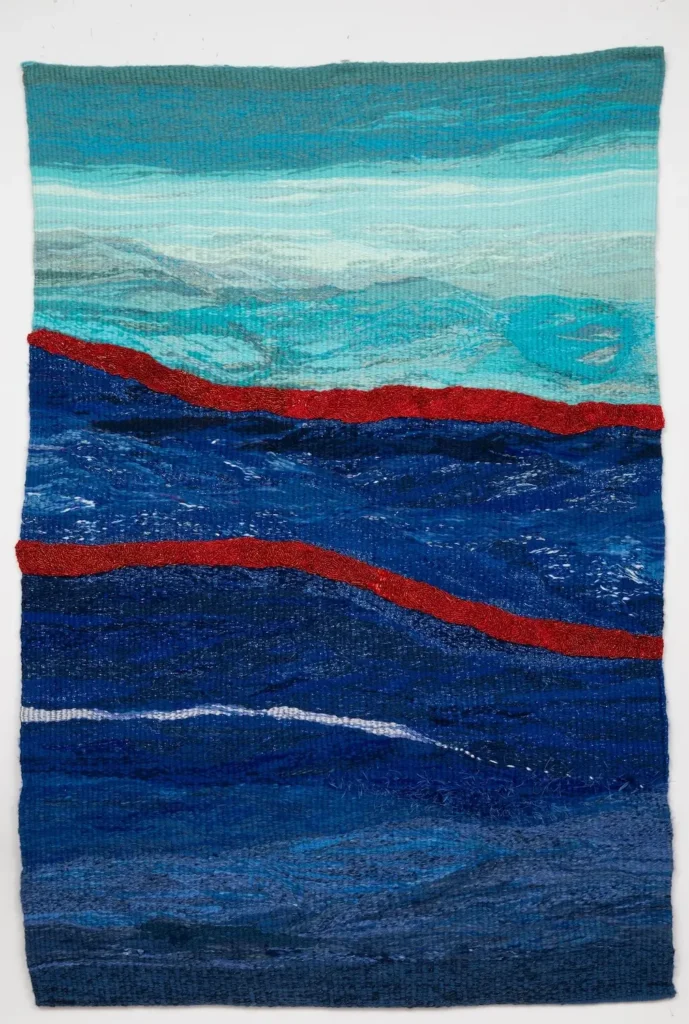
If you could share one lesson that making art has taught you about yourself or about life, what would it be?
Don’t be satisfied with your first solution to a problem.
Question, explore, be curious!
Don’t give up; push through if you feel stuck or blocked.
Try new things and enjoy the process.

Where can people see your work?
Currently [through 1.17.27] at Cedar Rapids Museum of Art, IA. in Threading the Needle , and d’Art Center, Norfolk, VA. In Fibrous [through October 2026],
My website: Tapestryart.com, https://www.ugallery.com, Iowa Artisans Gallery, Iowa City, IA, American Tapestry Alliance.
Upcoming solo exhibition, Looking Both Ways at The Figge Art Museum, Davenport, Ia July 3-Dec 19, 2027
Instagram: rowensa143
Rapid-Fire Fun:
- Sketchbook or straight to the loom? sketchbook
- One tool you cannot live without? loom
- Favorite place you have visited? Cusco, Peru
- Favorite color to weave with? Purple
- Describe your art in three words. Dynamic, vibrant, fresh
Interview posted October 2026
Explore more weaving inspiration on Create Whimsy.