
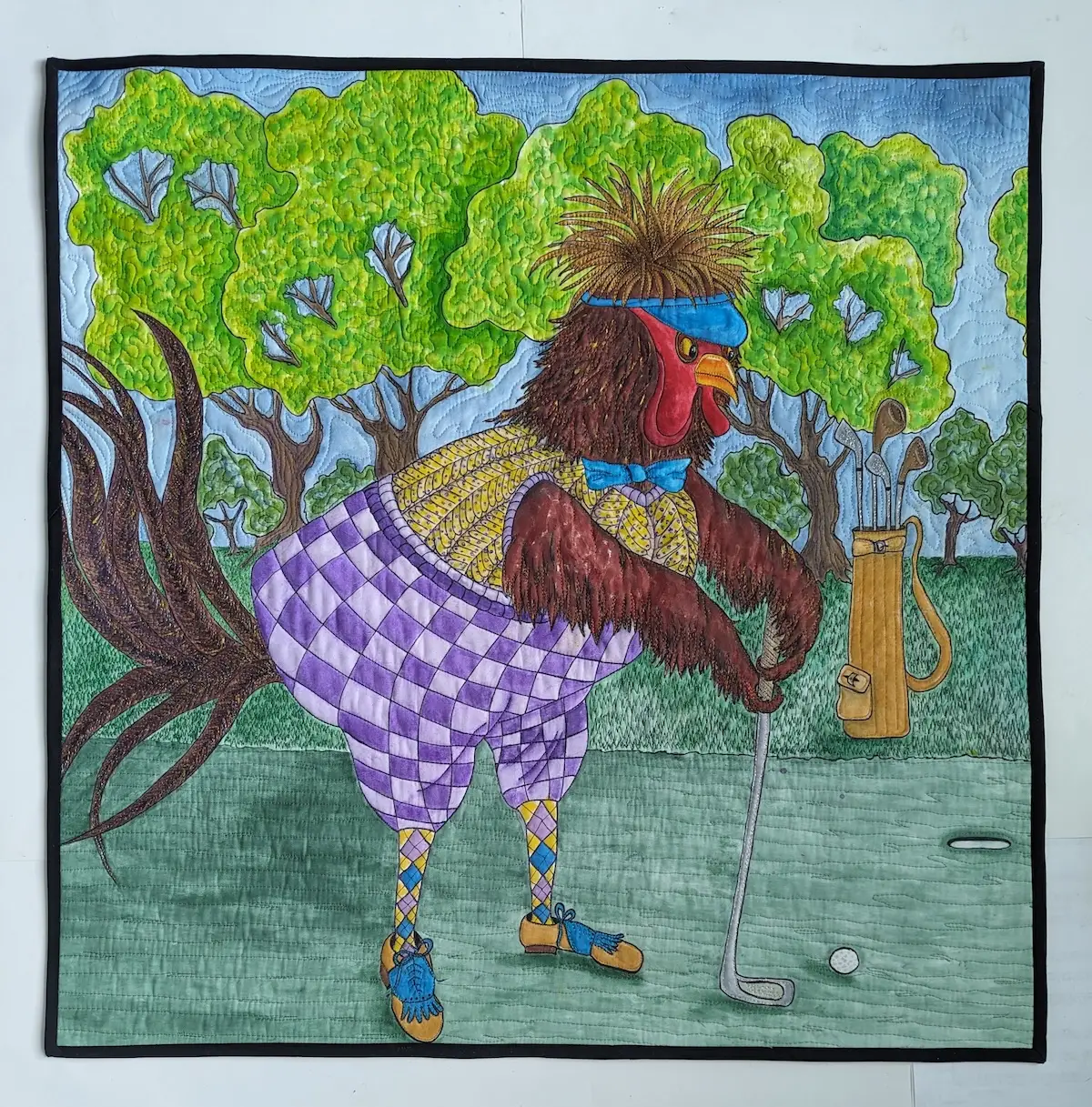
Rosanna Lynne Welter’s path to fiber art began with fabric shopping trips alongside her mother and grew into a full-blown love affair with ink, thread, and fearless experimentation. In this conversation, she shares how grief led her to quilts, how bleach gave way to brush and pen, and why her wildly funny “Chickens Impossible” series is all about making people smile.
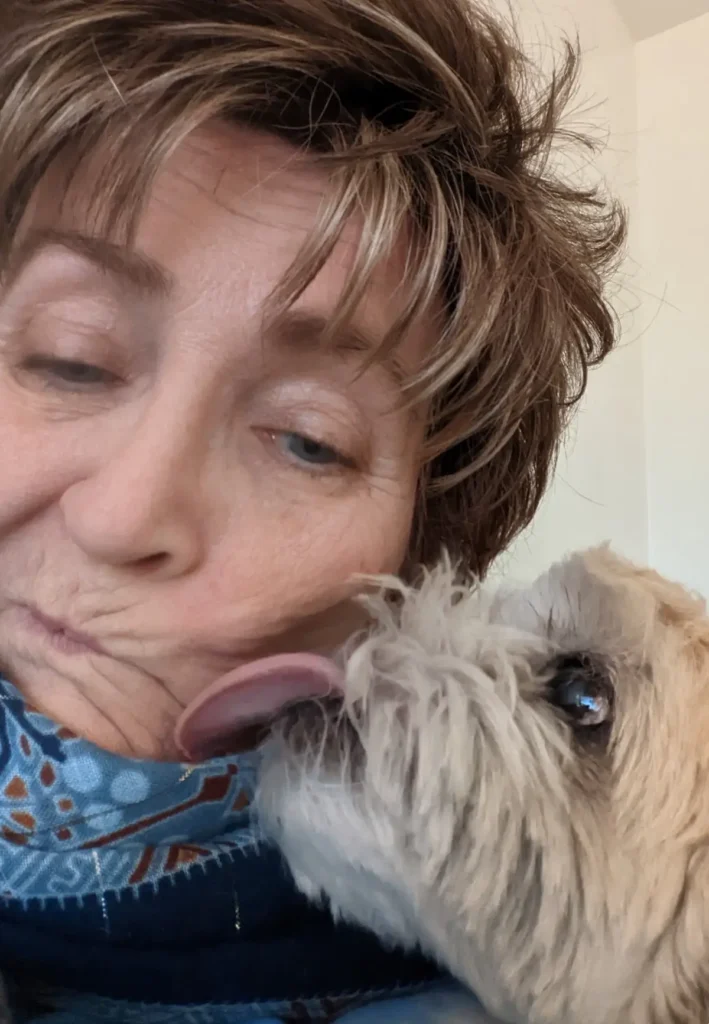
What was the first moment you remember loving fabric or textiles?
I have loved fabric since I was little, mostly because my mother loved fabric. She taught me how to shop (I’m sure to the dismay of the clerks) by touching all the fabric, and I learned to identify, under her instruction, what a textile was made of by sight, feel, and even smell.
She was an artist, but also quite the seamstress, and she taught me to sew clothes before I was a teenager. She and I made all my school clothes, and I always felt so stylish. She painted with oils and watercolors, but she also painted on textiles. By that I mean she painted preprinted designs on pillow cases and pieces of silk. I think it was a thing in the 1950-60s, like embroidery but with paints. At the time, I was not at all interested in that. Ah, the arrogance of youth.
Was there a moment when you realized this is what I want to do forever?
As an Amazon Associate I earn from qualifying purchases. Read more about our affiliate linking policy.
My mom passed away quite suddenly and fairly young. I struggled to find a way to still feel connected and decided that making quilts would help.
I started making traditional quilts, but it did not take long to move into creating my own fabrics with surface design. I was terribly lucky to have some excellent local teachers who helped me see the amazing possibilities in all the emerging techniques.
In the late 1980s-90s, I worked a lot with bleach discharge, which I loved. But it was not at all good for my health, so I had to stop. After I gave that up, I tried exploring a lot of different techniques; in fact, I considered myself (and still do in many ways) a fiber art adventurer as I journeyed through monoprinting, disperse dyeing, flash from trash, and photo transfers on fabric.
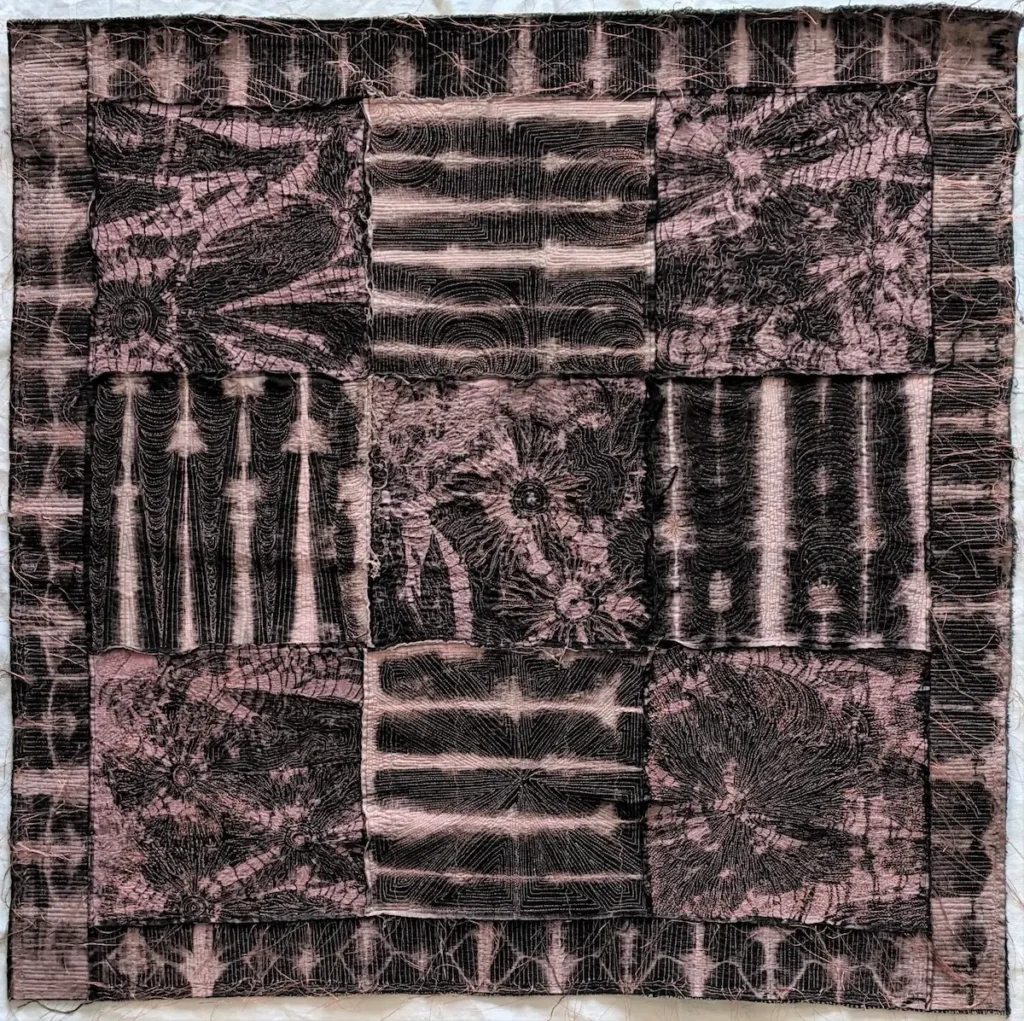
What I have finally settled on is drawing and painting with inks on fabric. I have done more of that than any other technique and stuck with it the longest. It has, I guess, also brought me full circle to very nearly what my mother was doing.
People ask me why I paint on fabric, “Why not just paint on canvas like a real artist?” Humph! Well, I guess I am still trying to stay connected to Mom, and for me, that means fabric plus paint. I think my mom would really be proud of what I am doing. I am happy creating drawings and painting with inks on fabric, and I think I will be for the rest of my life.
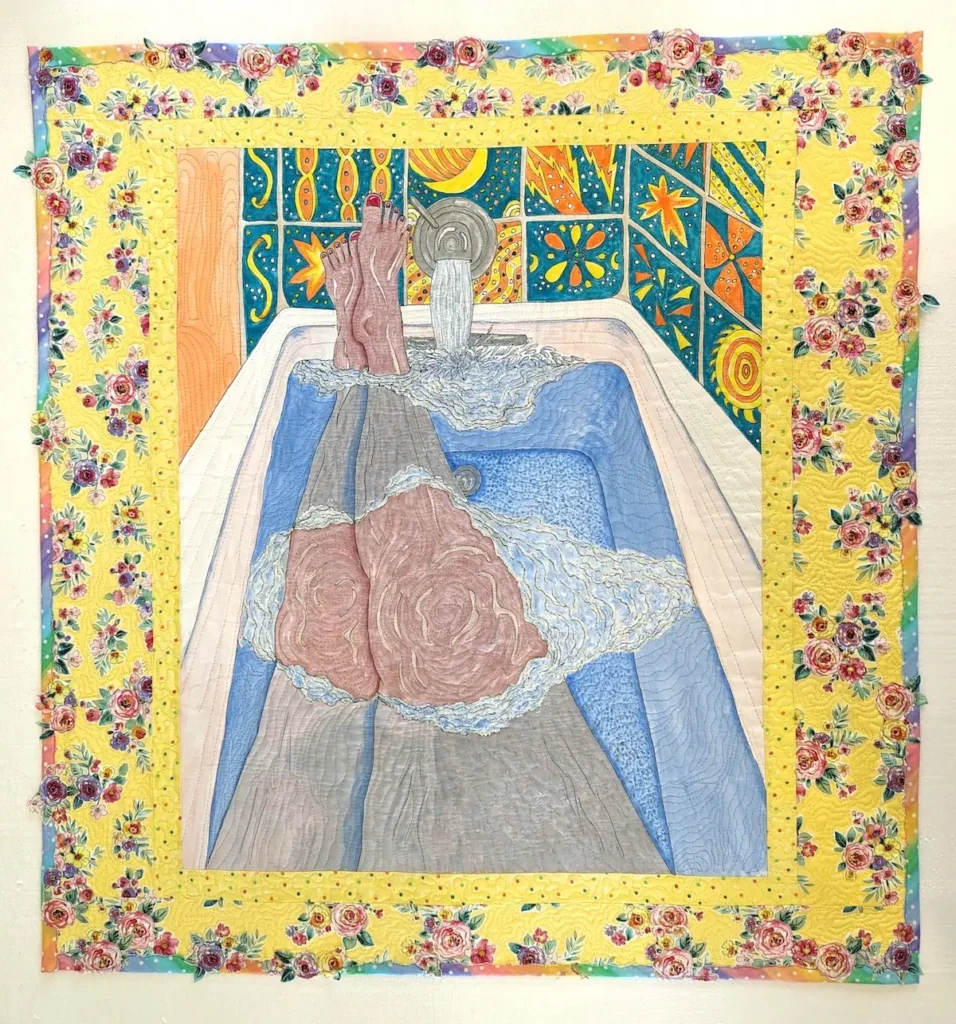
The odd thing is that I never thought I could draw. I have no formal art training. Then one day, I decided I was going to really give drawing a try, and guess what? I can draw, and I believe almost anyone can if they stop being so self-critical. I had previously thought I had to sit down and draw something realistically and perfectly on the first try.
Wait, did I really think my drawings had to rival Michelangelo’s or they did not count? That really was not fair to me, and surely it was never true.
My process, and it works for me, is to draw and refine, revise and refine more, then revise again until I am happy. I am certain plenty of artists work this way. And I am still learning about and studying drawing all the time.
What role does mood or emotion play in choosing what to make next?
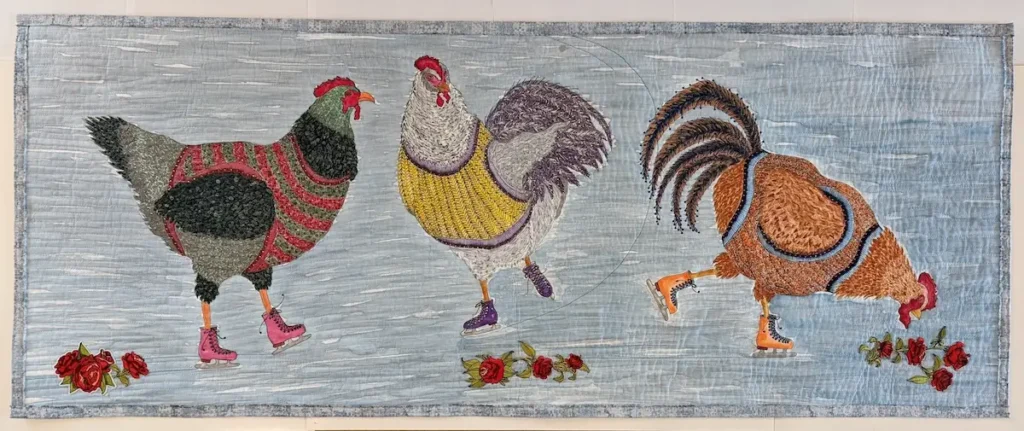
Like almost every artist I know, the pandemic caused a huge shakeup in my art and what I was doing. It was during this time, while we were all stuck indoors, that I got the idea (while watching the 2022 Winter Olympics) to draw ice skating chickens.
At the time, everything was so heavy and dismal in the world. The news was just awful every day. I discovered I really enjoyed drawing and especially loved making funny drawings.
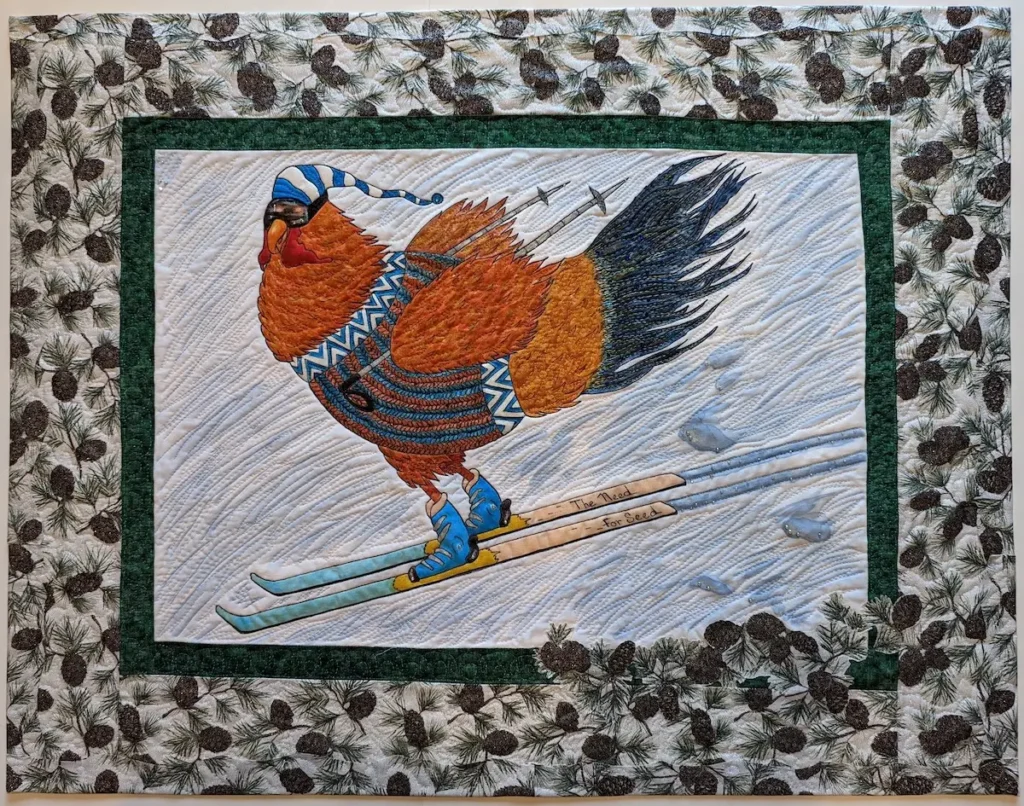
While completing my first chicken quilt, I felt . . . happy! I decided to continue creating slightly crazy chicken characters. That is how my “Chickens Impossible” series started.
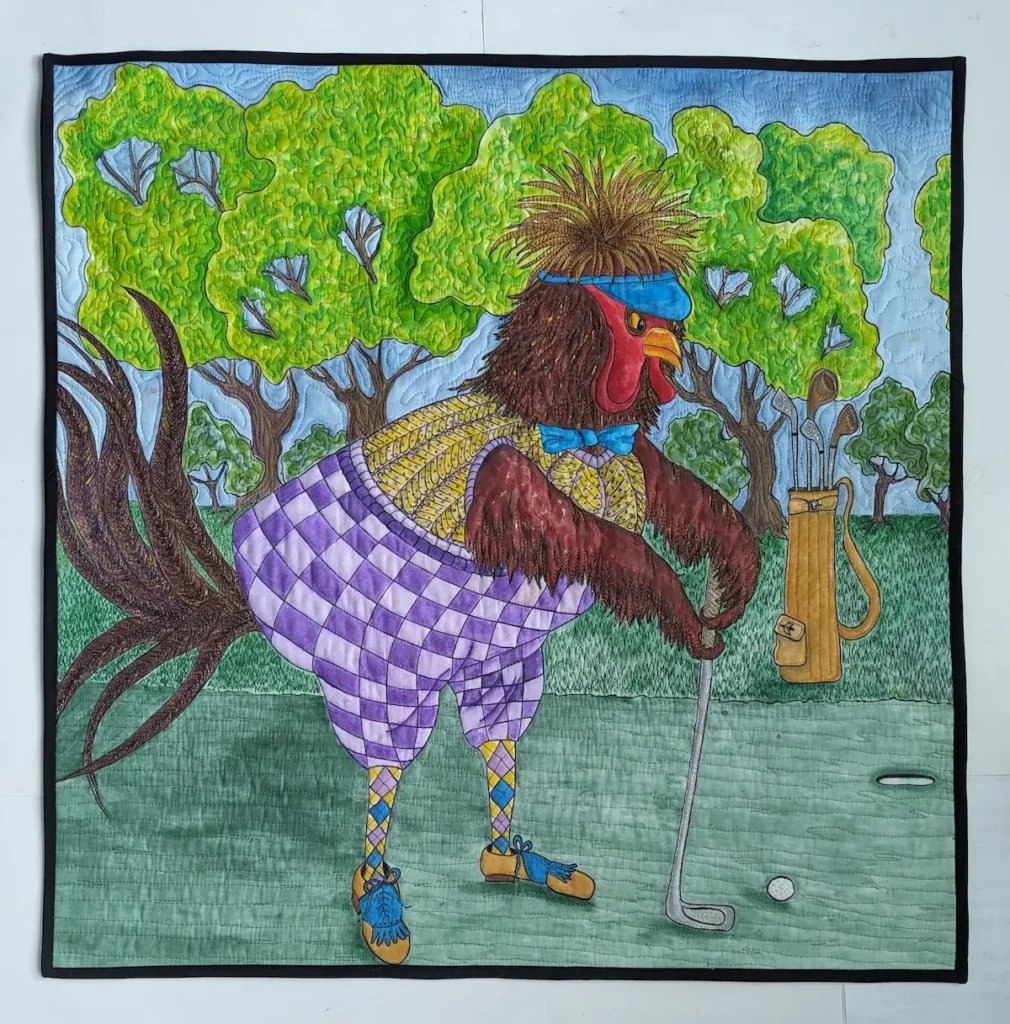
I found that making humorous art was a wonderful distraction for me, and I found it was a wonderful distraction for other people as well when I saw that they laughed out loud at my quilts.
My goal became simply to make art that made people smile, that lightened burdens, and distracted them from everything that was going on in the world, which was (and still is) a lot.
Chicken art is not all I do, but it is a big part of what I create. It’s really been quite a journey from discharging black fabric to drawing colorful and zany chicken characters. I am currently 15 pieces into the series with more to come.
Can you walk us through how one of your pieces evolves from idea to finished work?
For my chicken art, I spend a lot of time thinking about what I want to draw. The details really matter, and the titles are so important and a big part of the humor in the art.
I draw, redraw, and revise images, mostly on 8-1/2 x 11” copy paper. It is not at all fancy or perfect. I work small, I know, but it is just easier for me to draw on that scale.
When a drawing is done, I enlarge it (at a pack and ship business) to the size that I want for the finished project. I transfer my image using a light box and pencil onto a piece of whole cloth, white cotton. Then I use Pigma pens to outline my design, and then I paint with fabric inks.
I use aloe vera gel as a medium because the inks have the consistency of water and want to spread everywhere. I’ve learned how to control where the ink goes and how to make it stay where I want it.
When the inks have dried, I heat set them with an iron, and finally, the piece is ready to be sandwiched and quilted.
For my other art, which is very spontaneous, I have an idea, say a color scheme, and I just start and see where the idea goes. That is also a lot of fun, and I can get completely lost for hours doing that.
I enjoy the stitching almost as much as I enjoy painting. Thread colors and free motion quilting are pure play for me.
How does tactility (touch) influence your art, and why does it matter?
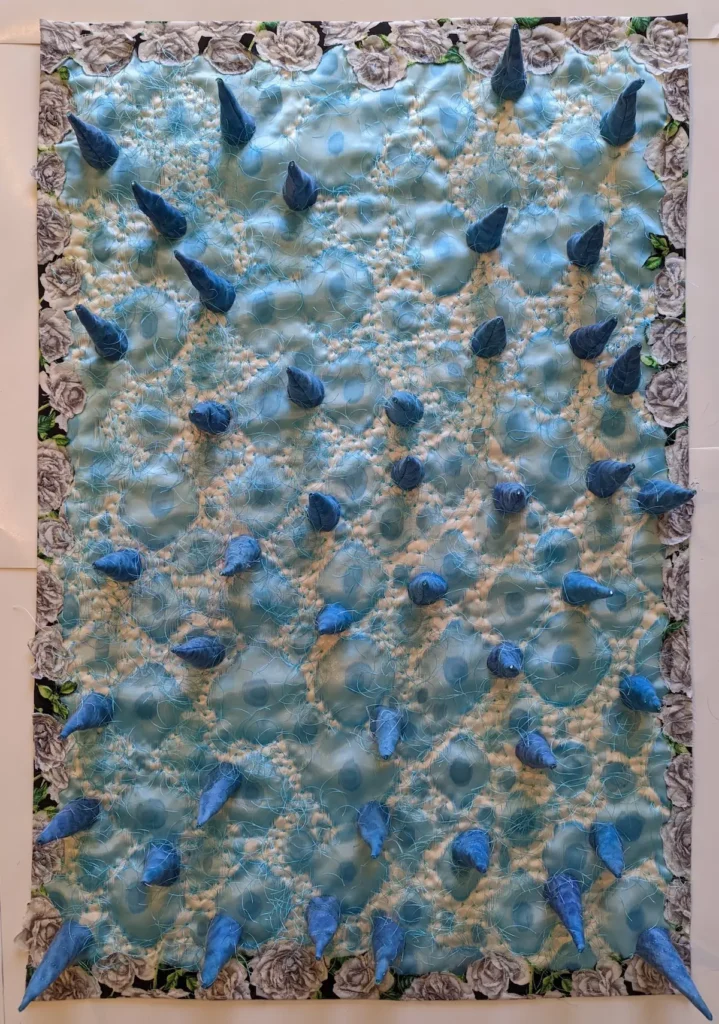
My first solo show was titled, “Sew Tactile: Please Touch My Art,” and I meant it. I invited touching and also supplied hand wipes for people to use if they felt their hands were not clean enough.
I wanted to encourage touching as another connecting point between artist and viewer. The gallery found the idea “interesting.” People were very hesitant and ever so gentle. They have been well-trained not to touch.
I was also invited to participate in an exhibit for children at a local museum. They wanted all the art to be accessible to the kids, and I put four of my chicken pieces in that show. I was also happy to let the children touch my work.
I have always felt (maybe from my fabric shopping days with my mother) that being able to touch fabric is extremely important. It is vital to me as a fiber artist, and is such a part of my work, and I think it should be an option for viewers as well.
I know many artists have quite a different opinion, but I have no problem with people touching my work. As my artist statement says, “we are born to touch.” I think touching connects us.
How do you stay inspired even on hard days?
I never lack inspiration.
I am always thinking about two or three projects that I have in my mind that I want to start. There is never enough time to do everything I think about doing.
First, there are endless possibilities with the chickens, and that keeps me very engaged with the series.
Besides the chickens, I have ideas all the time about how I want to try using inks on various fabrics, how I want to experiment with three-dimensional sewn art, and how I want to work on my drawing skills.
There are so many things to still be explored and so much adventuring still to be done. If I ever find I am in a fallow season, I take it for what it is (a time for rest) and use it to step away and refresh my eyes and my mind and get distance from my work.
Looking, really looking, at the world around you builds a visual vocabulary, and that is a very good thing to do if you are in a lull. Then, when I come back to my work, I am ready to move forward.
What advice would you give to someone just starting their creative journey?
If I were going to give advice to someone just starting their creative journey, it would be to try everything. Don’t be afraid of what you don’t know, and do not be afraid to make mistakes. Everybody makes them, and nothing is perfect in the beginning. That’s how we learn and grow.
Do not let mistakes discourage you or make you want to give up. If you have a season of fallowness, wait it out. Look at the world around you and take inspiration from everything. Find the thing/things you love to do, and that will inspire you every day.
Be persistent. I read somewhere that “being a good artist isn’t about having a huge amount of artistic talent. It’s about practice and having the willpower of a cockroach that has been smacked 20 times with a rolled-up magazine and yet still refuses to die” So, try, be brave, be persistent, and practice.
What do you do when a piece isn’t working the way you imagined?
I generally have a pretty good idea of what I am going to create. I’ve mapped it out in my brain. Sometimes I’ve even drawn it on paper or transferred it to fabric, so I think I know where it’s going.
Usually, if there is a problem, it is because I’ve made a mistake. And I have learned to look at mistakes as creative problem-solving opportunities.
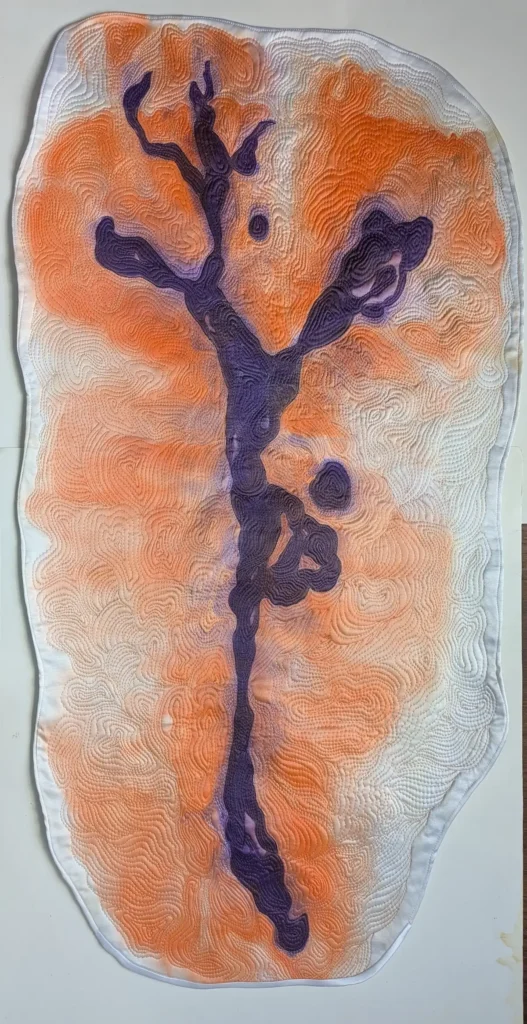
I was painting a design recently when I dropped a big drip of ink where there wasn’t supposed to be a big spot of ink. I could have given up. I could have started over. Instead, I changed my design slightly and added another drop of ink to create balance and continued on with my painting. Who would ever know those drops weren’t intentional? Only me (and now you). I ended up liking the new design even more.
I rarely, I mean almost never, give up on a piece. I may think about giving up, but I don’t, and my sister can confirm (because I whine to her about it all the time). I have an ongoing love/hate relationship with practically every piece I start, right up until it is finished. I think that is pretty common with artists.
Only a few times over many years have I totally given up and gone on to something else. I advise perseverance! Is everything going to be perfect? Heck no! Is it even going to resemble the idea you have in your brain? Maybe not. But there are lessons in every adventure!
Where can people see your work?
I have a website that I try to keep current (with the help of my sister webmaster). Please visit me at rosannalynnewelter.org.
I also try to keep my Instagram account (@rosannalynnewelter) fairly current with in-process photos of what I’m working on. That’s a good place to see how my work begins and how it looks part way through.
I have been included in a number of Studio Art Quilt Associates exhibits, and you can find me on their webpages (SAQA.com) where I’m a juried Artist. I also have a SAQA Skillshare video on how the “Chickens Impossible” series came to be, if any SAQA regions are interested in that.
I am also having the best time participating in a southwestern U.S. invitational fiber art group, 4 Common Corners, and their website is just loaded with amazing work. Well worth a visit. (4commoncorners.com).
Rapid-Fire Fun:
Favorite color: In the beginning, it was all black all the time, and now it is All the colors.
One word to describe your art: On even days: “Experimental.” On odd days: “Hysterical” (hopefully).
Silence, music, or TV while you work: Any of the above works for me. I like background noise while I work, but my husband prefers the quiet, and I am ok with it too.
Best compliment you’ve ever received about your work: “Are you the chicken lady?”
Interview posted February 2026
Browse through more inspiring art quilts on Create Whimsy.