
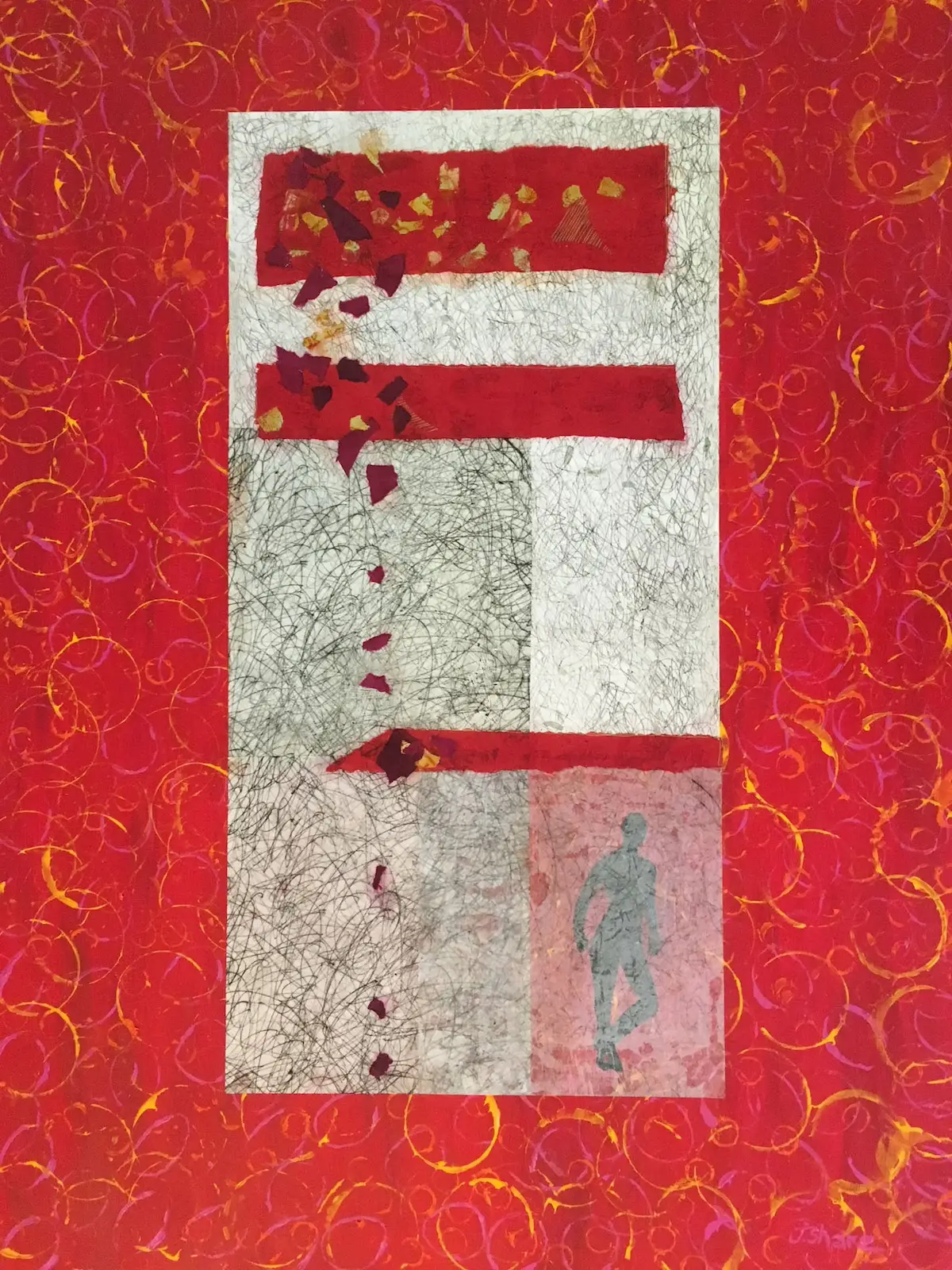
Joani Share’s art is full of bold color, playful shapes, and a spirit of experimentation. From her travels around the world to her growing passion for turning discarded materials into art, Joani continues to explore new ideas and find beauty in unexpected places.
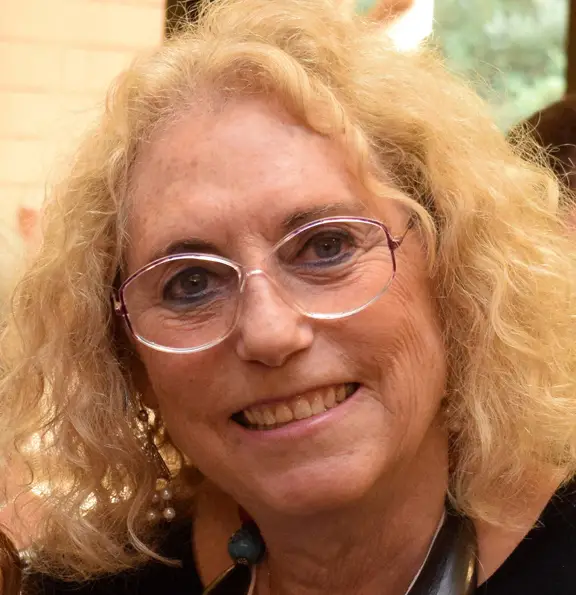
Growing up in New Jersey, you were close enough to New York City to visit its museums. What did those early visits teach you about art, and do any particular artists or works still stay with you?
Growing up just an hour bus ride away from New York City allowed me to become an independent art viewer at a young age. I spent a great deal of time exploring the Village, and all the bohemian sights and sounds it offered, followed by museum or gallery visits.
My most vivid memory is walking up the large curved staircase at the Museum of Modern Art, looking out the tiny windows at the architecture across the way and finally ending at the long gallery. The gallery at the top of the steps featured Picasso’s Guernica, and all of the supplemental work used to create this masterpiece.The Guernica is my longest and strongest memory about the power of art.
Before focusing on your own studio work, you spent more than 20 years teaching visual arts. What did working with students teach you about creativity, trying new things, and finding an artistic voice?
As an Amazon Associate I earn from qualifying purchases. Read more about our affiliate linking policy.
Teaching high school art for well over twenty years was impactful to me in many ways.
Since I taught all levels of art from basic to advanced, I had students of various abilities interests, strengths and fears. My overarching goal for all students was to look at art as a process, to expand thinking and develop skills for finding multiple solutions to problems. I wanted all students to feel successful, and my philosophy of process over product helped students take chances and not limit themselves, by having happy accidents not mistakes.
Since I taught art for many years, I often changed my lessons so that I didn’t get bored, and students were able to experience fresh projects, not just what was done in the past. My ability to continually create new lessons is integral to my personal thinking process and has allowed me as an artist to keep evolving.
Travel has played an important role in your life and art. Which places or cultures have had the biggest impact on the way you see color, pattern, shape, and design?
My husband and I have been traveling since our honeymoon 56 years ago – we spent two months exploring Europe in a tiny rental car.
Over the years, we have explored and experienced many different cultures and all that encompasses in all of the senses. We try to stay in small places to get the feeling of the area, learn about the food, customs, art, and all the wonders of places that are different and sometimes the same, but always unique.
Traveling through countries in South and Central America, Africa, and Japan has had a huge influence on my art in terms of color, pattern, vibrancy, and design. Textiles and sculptural 3-dimensional work always leaves a lasting impression that I file away in my mind for future inspiration.
Bold colors, strong shapes, and rich patterns appear throughout your work. How do these elements work together to express an idea or feeling?
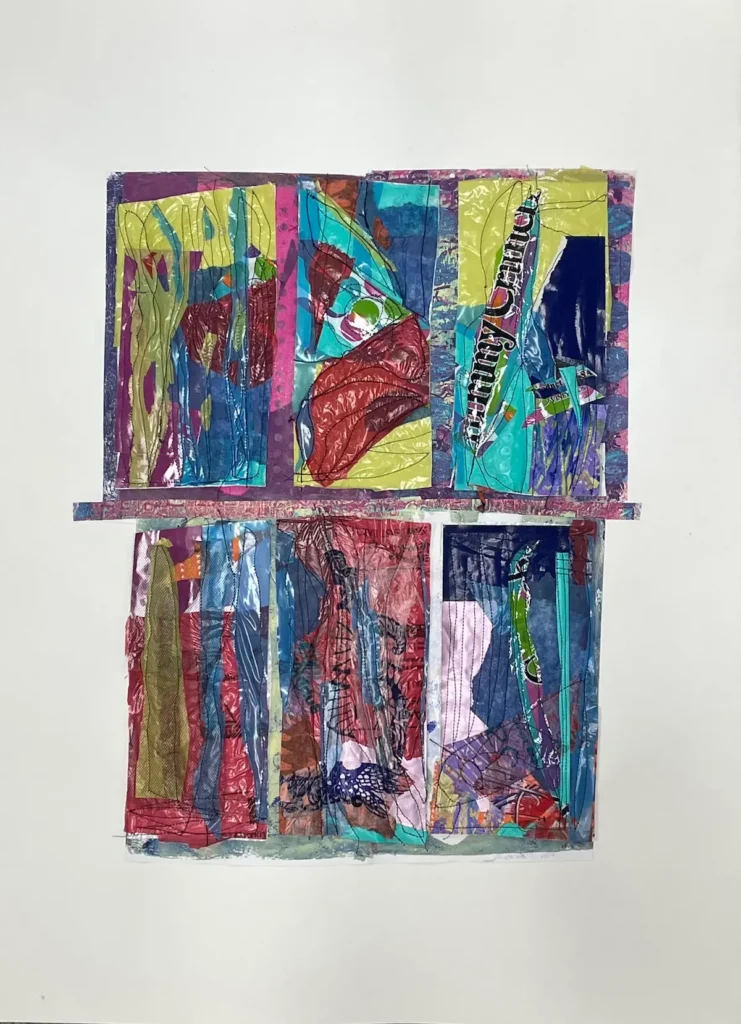
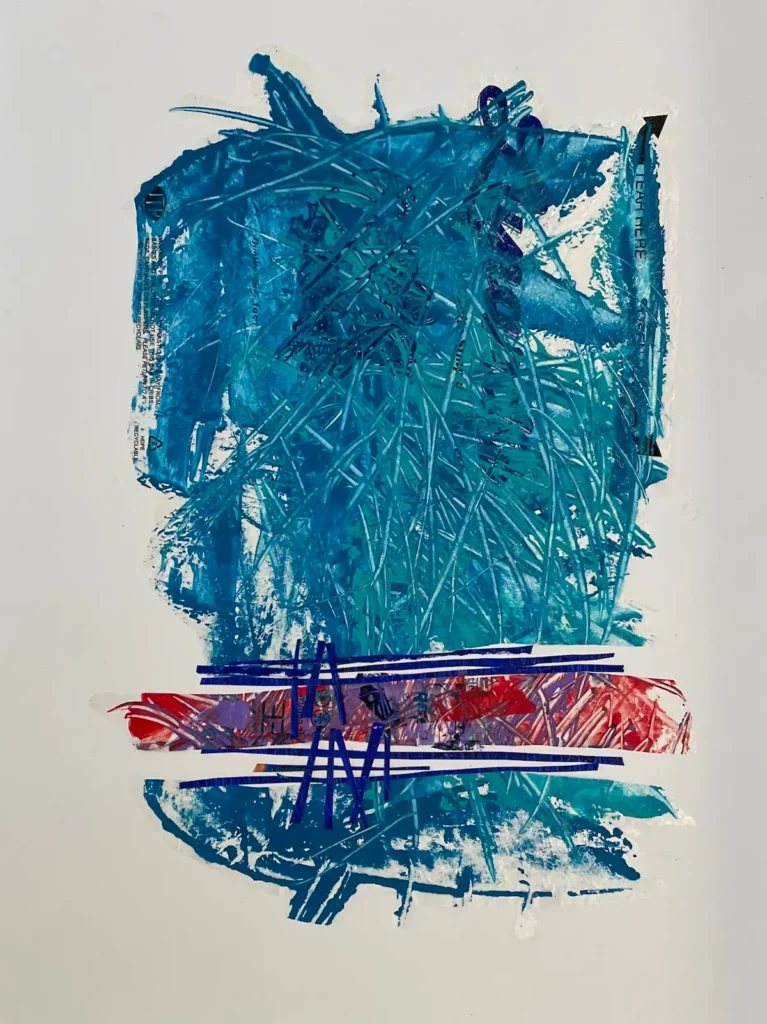
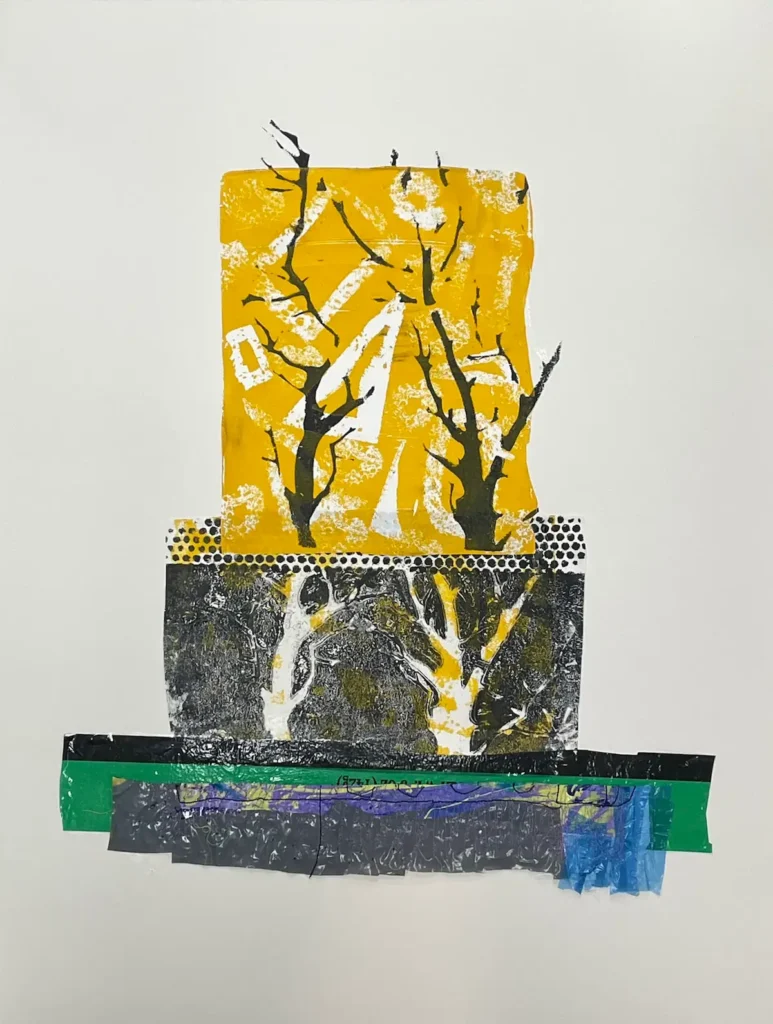
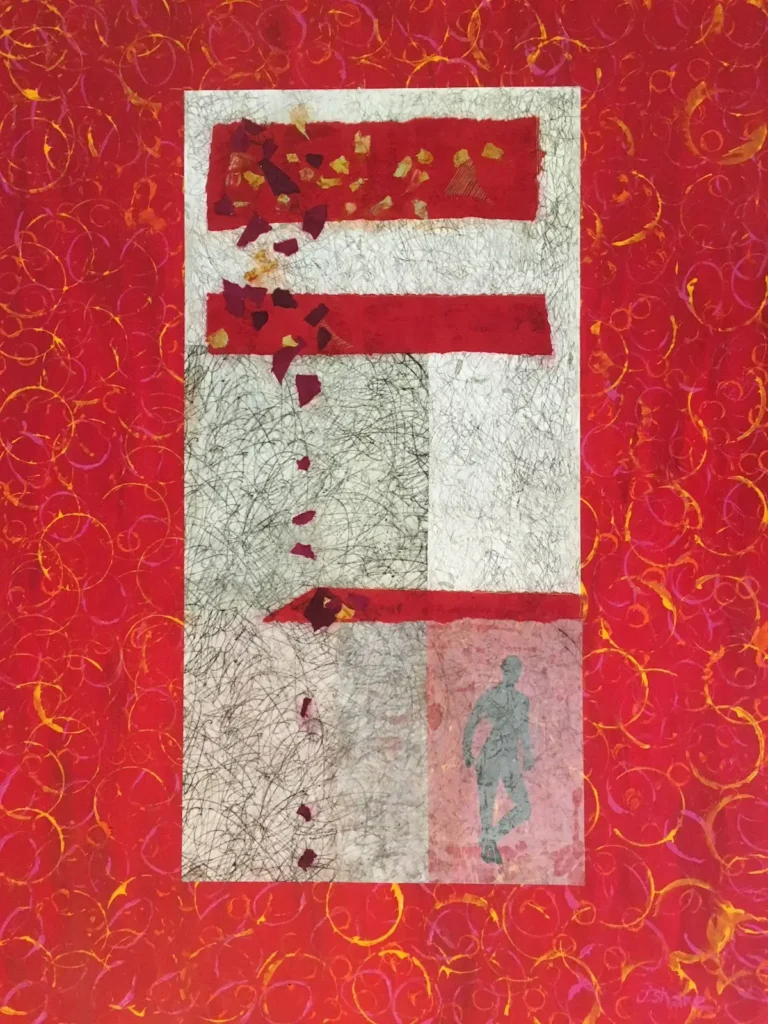
I usually work abstractly focusing on shape, color, texture and design.
For many years, I used the human figure as my vehicle for exploration. My figures were always colorful and purposely generic in terms of race, color, and gender to show the commonality between people.
I explored many techniques from painting, printmaking, collage, and sculpture in multiple series of humanity. Over time, my work became less focused on figures and more non-objective in subject and design.
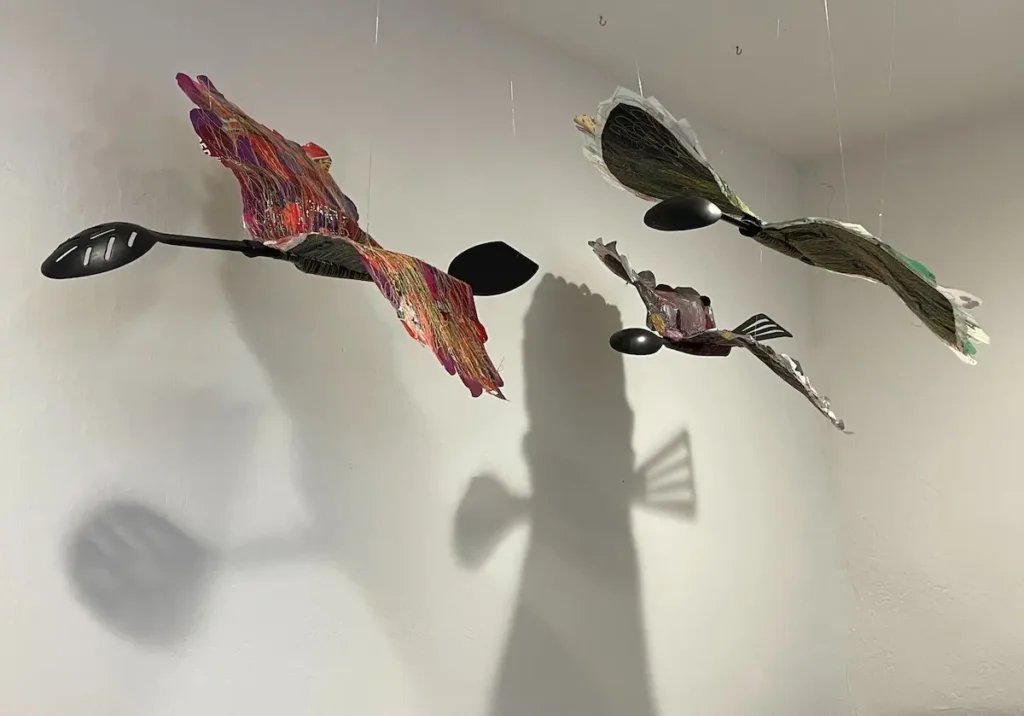
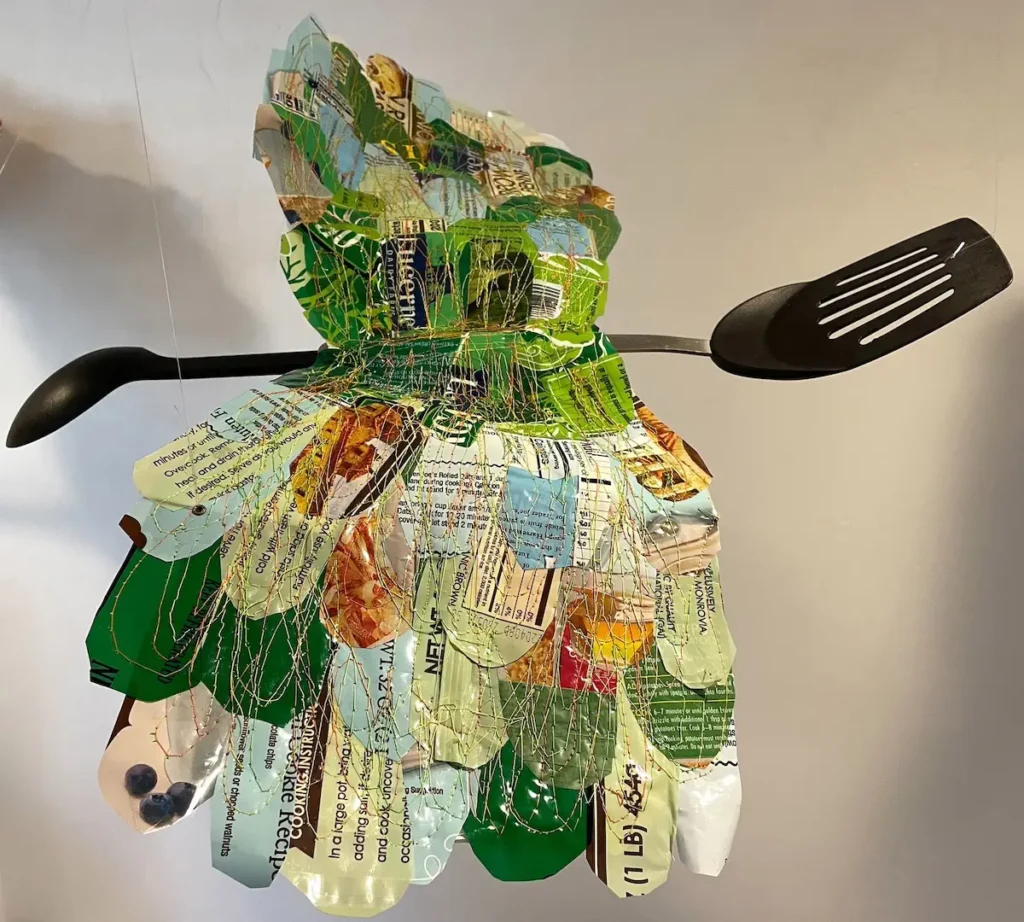
Inspiration can come from everyday life, travel, and personal experiences. How do you capture an idea when something catches your attention, and what helps you turn that first spark into a piece of art?
My thinking and art has progressed over the years especially after visiting places rich in art and culture.
After trips to Mexico I experimented with paper mache using torn and discarded materials. From Ghana I learned to used indigenous plants for stamped dying, and beading as augmentation to designs. Travel through Japan instilled the quiet beauty of simple lines and patterns.
I never know what will catch my eye, and how it will influence my artmaking. I think just being open, taking in the depth of nature and the creativity of humanity beyond museum walls, allows me to grow as an artist.
Describe your creative space.
Over the years, I have had various studio spaces. I have rented large spaces outside of my home, had a studio built as a separate space in my home, and now I am working in a two-car garage at my home that has been converted into a studio. The garage is no longer functional to house cars as we sealed the door and added heating and cooling, and large windows that overlook a garden-space allowing for natural light and a peaceful view.
The outside garden includes sculptures I made from found materials. It is colorful, whimsical, and full of plants surrounding our glass bottle wall, large knitting needles and other sculptures that I created utilizing repurposed materials.
Studio space can have a big effect on the way an artist works. How is your studio organized, and do you prefer a tidy workspace or one where materials are spread out and ready to use?
This is an interesting question, as I am organized in some ways, and a complete mess in others.
My studio has lots of shelving and flat file space as well as work tables and, at one time, easels. My shelves and drawers are labeled, and materials are organized by type.
When I am working on a series, or even an individual piece, my studio gets very messy, and when I’m done, the massive clean-up begins before I start a new project.
In addition to my studio, I have taken over a bedroom in the house, and it has now become my sewing room, or studio number 2.
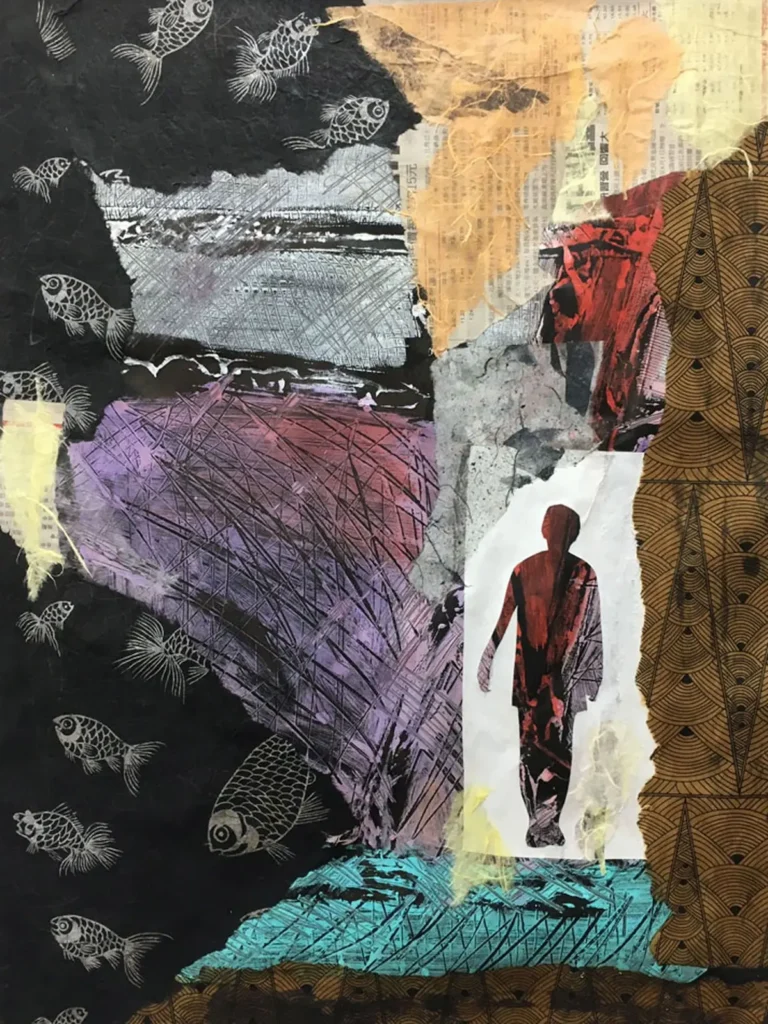
A wide range of materials finds its way into your artwork, from fabric and paper to thread, beads, plastic, and natural objects. How do you choose which materials belong in a particular piece?
I have always been attracted to multiple materials and surfaces. My work tends to have a sense of collage, not in the literal definition but in the combination of mediums.
Since I am a “material hoarder,” I add media to my work as I go. I often start with a simple sketch, idea, or concept. I keep a sketchbook and jot down colors, shapes, ideas, and then I’m off and running. I use my large table space as well as the studio floor to create, move, and manipulate materials from my stash to create my work.
Each piece (or series) seems to have its own path, and sometimes the materials themselves allow me to change the way the work develops.
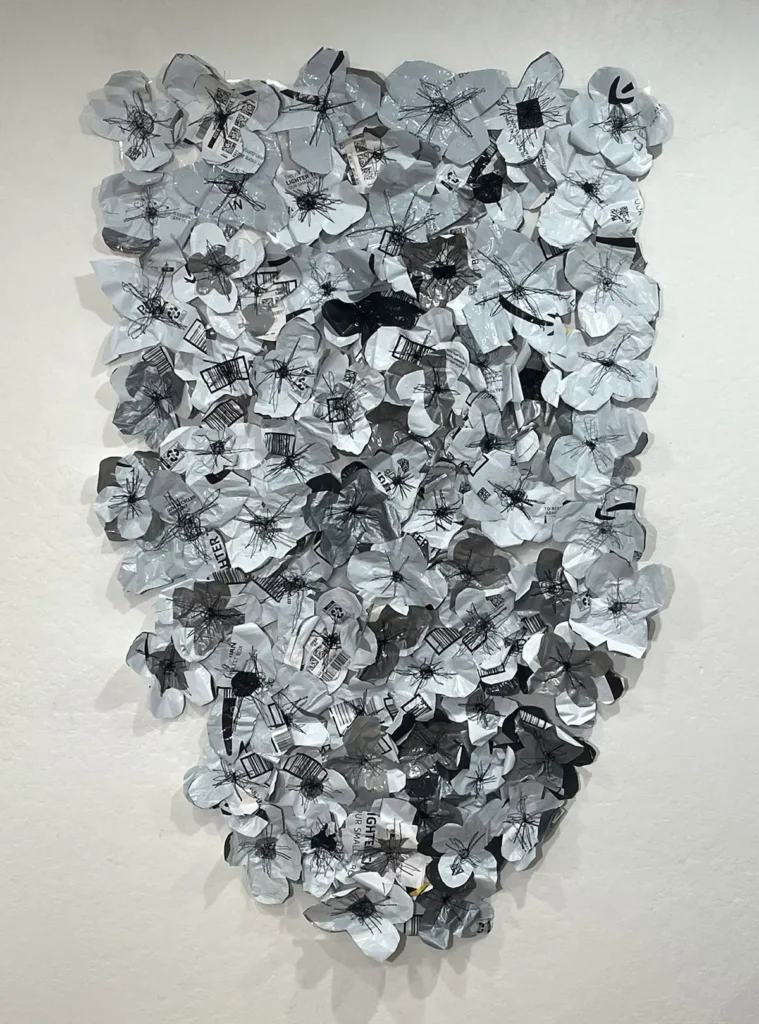
Experimenting can lead to wonderful discoveries, but it can also bring frustration. What do you do when a piece isn’t working the way you hoped?
I used to say to myself, “If it doesn’t work, just add feathers.”
I hit stumbling blocks on almost all pieces, that is part of being creative – finding solutions to problems. I may have an amazing design planned out, but sometimes things are a little off.
I like the experimentation of trying a different approach on a piece. I often work in a series to try variations on a design or concept, and when I’m done working it out, the series is complete.
There have been many times when I’ll put a piece away and come back to it days or weeks later. There are pieces I have let go of to avoid frustration, cut them up, shelved them, and move on.
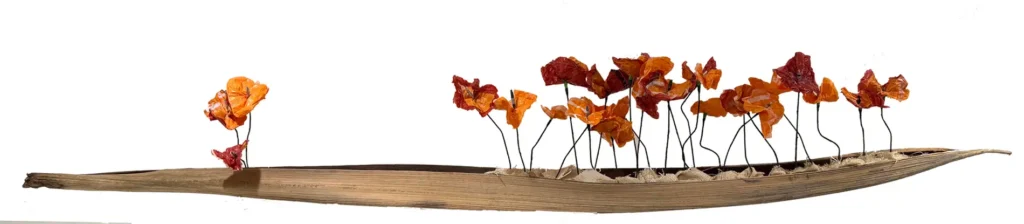
Sustainability and the idea of renewal are becoming important parts of your practice. Has working with found and recycled materials changed the way you think about art, waste, or the world around you?
As I have been working and creating over many years, I started to become very aware of our environment, the climate changes and what humans are doing to the world.
I began looking at art in new ways, and on a trip to South Africa, I saw the work of Ghanaian artist El Anatusi who makes monumental hanging artwork from thousands of folded, and crumpled pieces of aluminum bottle caps, sourced from recycling stations, and bound together with wire. His work is magnificent, and opened my eyes to an entire world of art outside of the mainstream.
For years, I worked with discarded materials, fabric, beads, newspaper (made into paper mache). I never put the connection together that I, in my small way had already begun working with non-traditional and repurposed materials.
I was at a juncture in my own art-making process where the figurative and abstract work I was creating became stymied. I needed a fresh outlook, and the concept of using recycled, discarded, repurposed materials has changed my art and focus.
Many artists find it hard to let go of a style or technique they know well. How do you keep yourself open to change and new ways of working?
Change has always been part of my process.
I always think outside of the box and have never been afraid to experiment. This doesn’t mean that I haven’t been frustrated – but I do trudge on.
I often told students, for every successful artist, and every piece they see on a museum wall, there were tons of experiments and unsuccessful pieces created before the “masterpiece” came about.
Experimentation is key to my art-making process; working in a series lets me expand a concept. I work on an idea, continually expanding and changing each piece until I am finished exploring the concept, and can begin a new project and work it through – one series at a time.
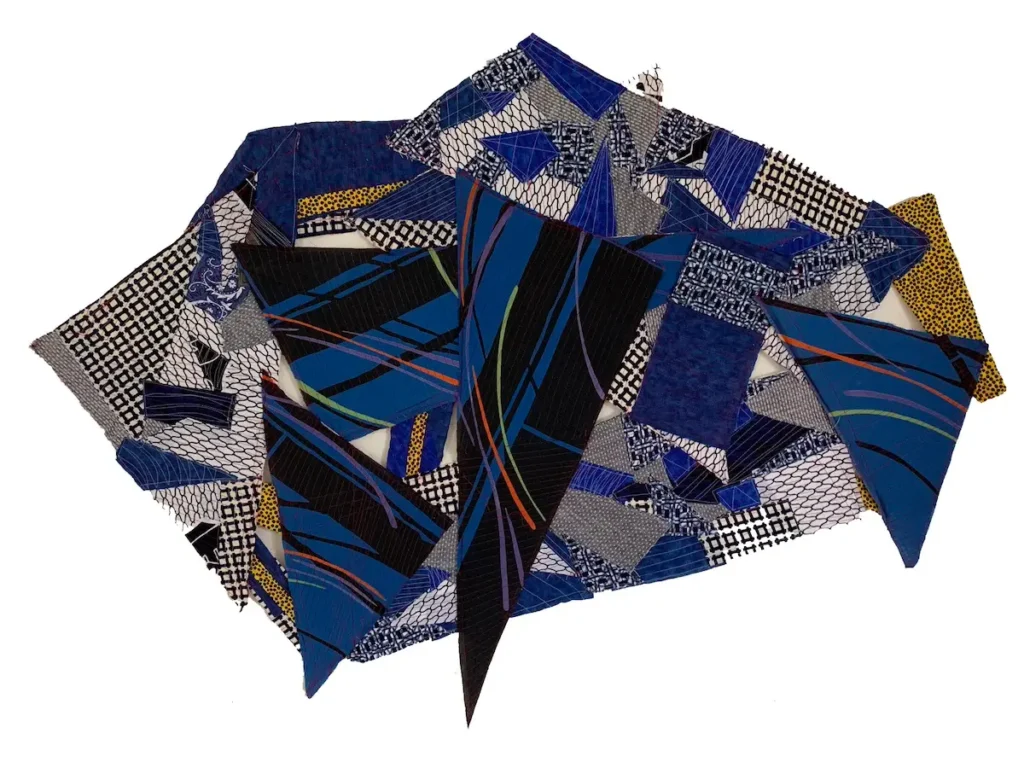
Are there new materials, techniques, or ideas that you are excited to explore next? Is there a direction your work seems to be taking you?
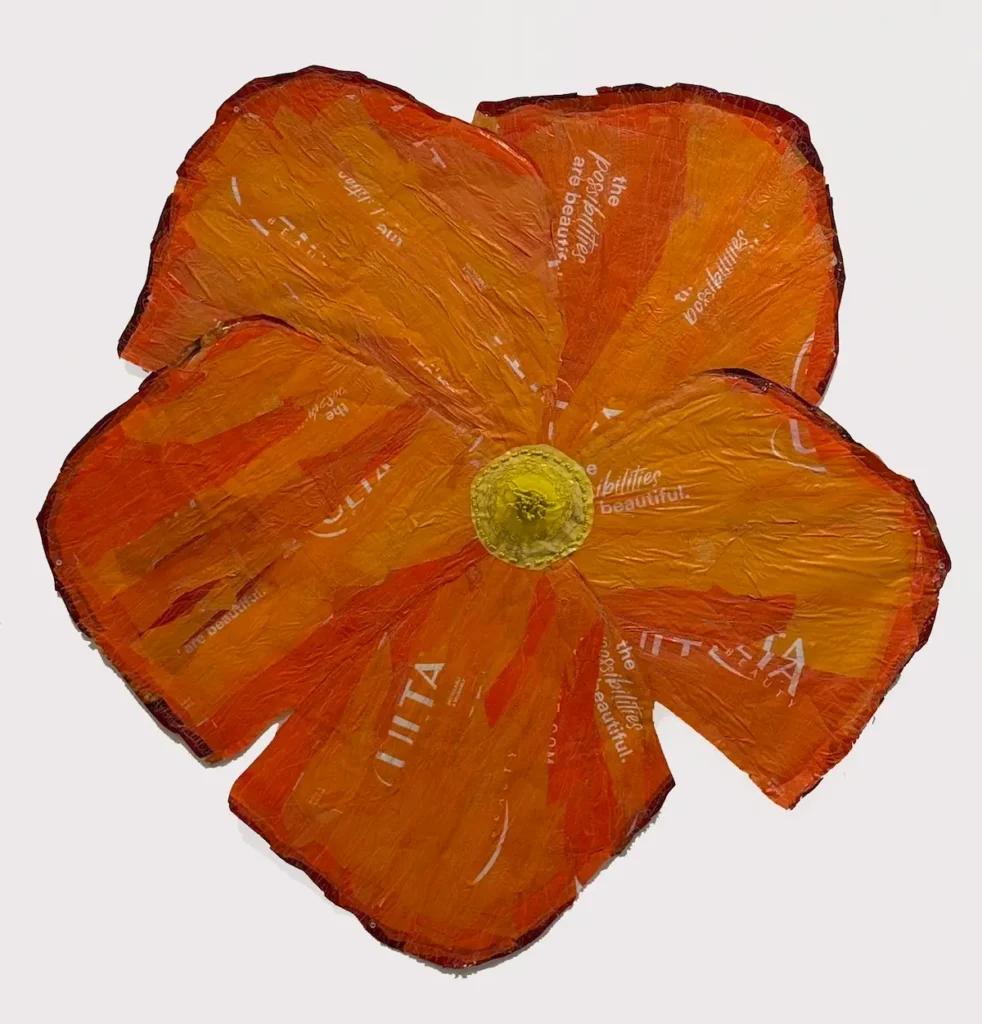
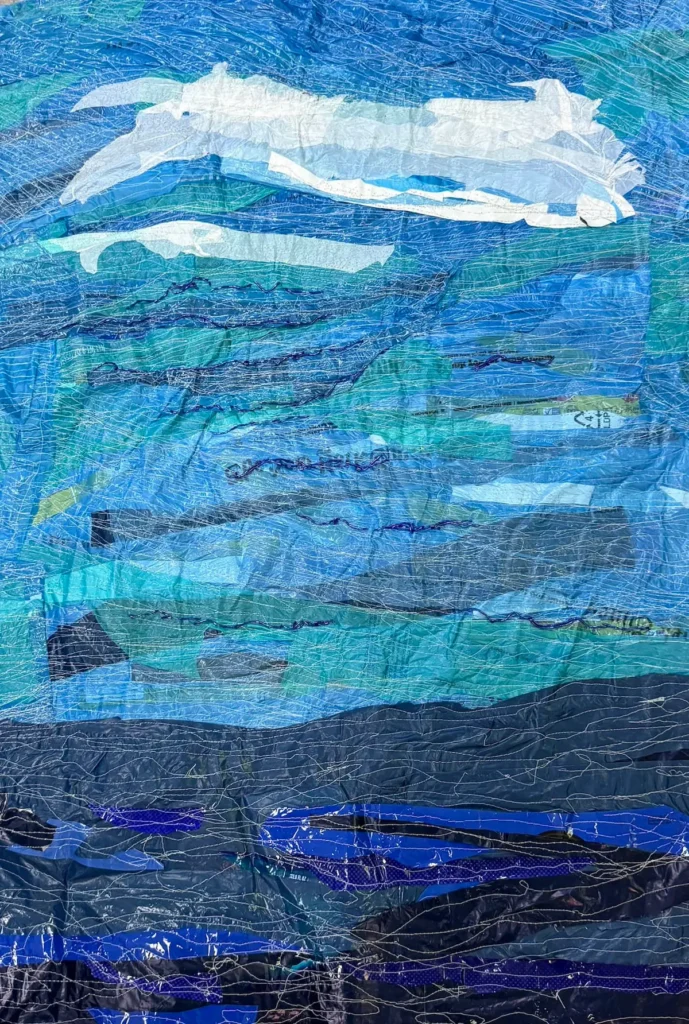
I am completely immersed in the utilization of repurposed material, basically using trash to create art.
I have been using my sewing machine a lot more, as a form of glue, to attach plastics and other disposable materials. The thread is a linear element that ties pieces together and serves a design purpose as well. I make art out of items that would normally end up in the landfill. Since there are so many types of disposable materials available, I have an unlimited supply of media to choose from.
Where can people see your work?
My website: https://joanishare.com/
Instagram: https://www.instagram.com/joani.share/
ArtsyShark: https://www.artsyshark.com/2026/07/28/featured-artist-joani-share/
Rapid-Fire Fun:
- Favorite color combination?
- As the musician Harry Chapin said, “There are so many colors in the rainbow
So many colors in the morning sun
So many colors in the flower and I see every one”
- As the musician Harry Chapin said, “There are so many colors in the rainbow
- Favorite place you’ve traveled for inspiration? Too many places from Japan to Africa, South and Central America, Europe – probably the next trip wherever that will be – including beaches, mountains and flowering spaces.
- Three words that describe your art? Colorful, Inventive, Powerful
Interview posted November 2026
Explore more mixed media inspiration on Create Whimsy.