

Jenny Bolhofner found herself looking for a creative outlet and discovered felt food tutorials. Creating art with layers of felt and hand stitching, she manipulates the fibers and layers textures, colors and details until everything is just right. “Making all things felt, one stitch at a time.”

How did you get started designing felt art? Always an artist, or was there a “moment”?
My parents will be the first to tell you that I have always been into art. As a kid I remember going with my dad to pottery classes, and spending summers drawing anything I could dream up. I continued my passion for art beyond high school, graduating with a BFA in Printmaking and Drawing from Murray State University.
My work with felt didn’t happen until years later, during a major transition in my life. Shortly after my oldest daughter Olive was born, I quit my job to become a stay at home mom. While it was rewarding in its own way, I found myself craving a creative outlet that was outside the realms of motherhood. One afternoon during an especially long nursing session, I found myself trapped in the rocking chair, scrolling on my phone. I came across a blog featuring felt food tutorials. Like most creatives who have never attempted something but spend five minutes watching a tutorial, I thought, “I could do that.” I gave it a shot and the rest, as they say, is history.
What do you do differently? What is your signature that makes your work stand out as yours?
As an Amazon Associate I earn from qualifying purchases. Read more about our affiliate linking policy.
With so many felt artists and embroiderers out there now, it is difficult to say what exactly sets me apart. There have been a few pivotal pieces that have gained more recognition as being my “signature.”

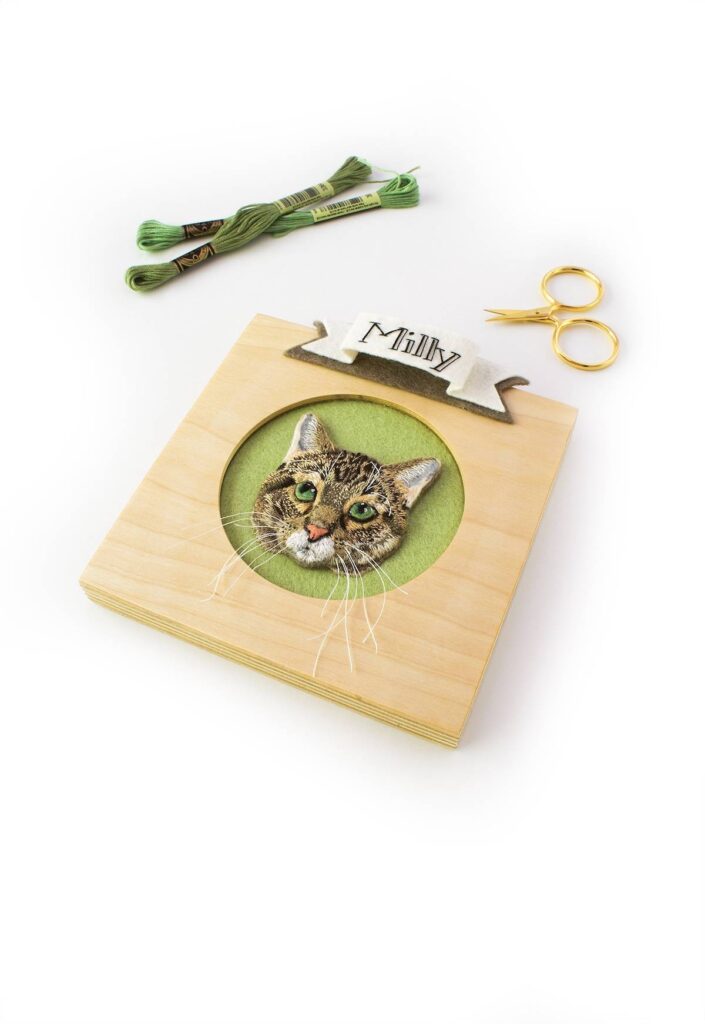
One of those is my pet portraits. While felt appliqué is not a novel technique, the extent to which I have used it is unique. I create pet portraits by stacking a dozen or more layers of felt, working from large pieces in the background, to more meticulous pieces on top. Then I embroider details over those layers. The finished effect is more sculptural than traditional felt or embroidery work alone.

I’ve also become kind of infamous for transforming old nutcrackers. A strange thing to become known for, and certainly never anything I ever dreamed of before, but there it is. The key for me is using only thrifted or discarded nutcrackers. I find a thrill in taking something that most people would overlook or consider to be junk, and giving it new life. Some of my more noted nutcrackers have been Ruth Bader Ginsburg, The Queen of Hearts and Marie Antoinette. It’s interesting to see the controversy that these upcycled dolls have stirred up, and the conversations they have spurred.

Crustless sandwiches. Tell us more about how they came about.
When it comes to signature work, I’d be remiss if I didn’t mention my crustless sandwiches. It all started as a joke honestly.
Every time I posted a reel where I was blanket stitching a round ornament, someone would comment that the edges looked a lot like a Smucker’s Uncrustables Sandwich. After several reels of this, I thought, “Why not give the people what they want?”. I posted a clip where I stitched a crustless sandwich, and I was floored by the response.
Not only were people asking to buy them, I was flooded with messages from people saying how the crustless sandwiches were meaningful to them or their significant other. They really seemed to strike a nostalgic chord with people!

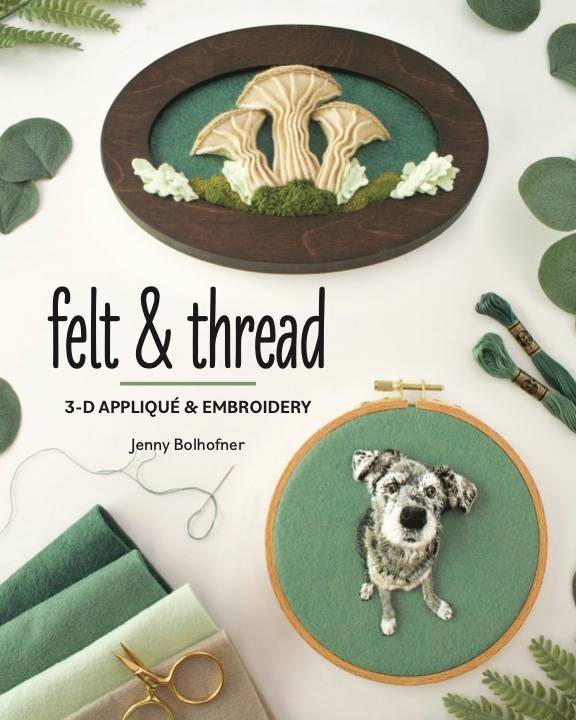
Congratulations on your new book, Felt & Thread! What inspired you to turn your techniques and creative process into a book?
Thank you! I’d like to say that the idea was all my own, but honestly, if it hadn’t been for my editor Madison, I wouldn’t have written a book at all.
She sought me out and encouraged me to share my portrait process- something that I definitely never thought I would be able to reproduce in written form.
Madison reached out to me around the time my custom portrait requests were taking off, and I realized it just wasn’t physically possible for me to keep up with demand. She opened my eyes to the opportunity to share my techniques and methods so that other people could create their own portraits.
Being a self-taught fiber artist myself, I liked the idea that maybe my book could be inspirational for someone else starting out on their creative journey.
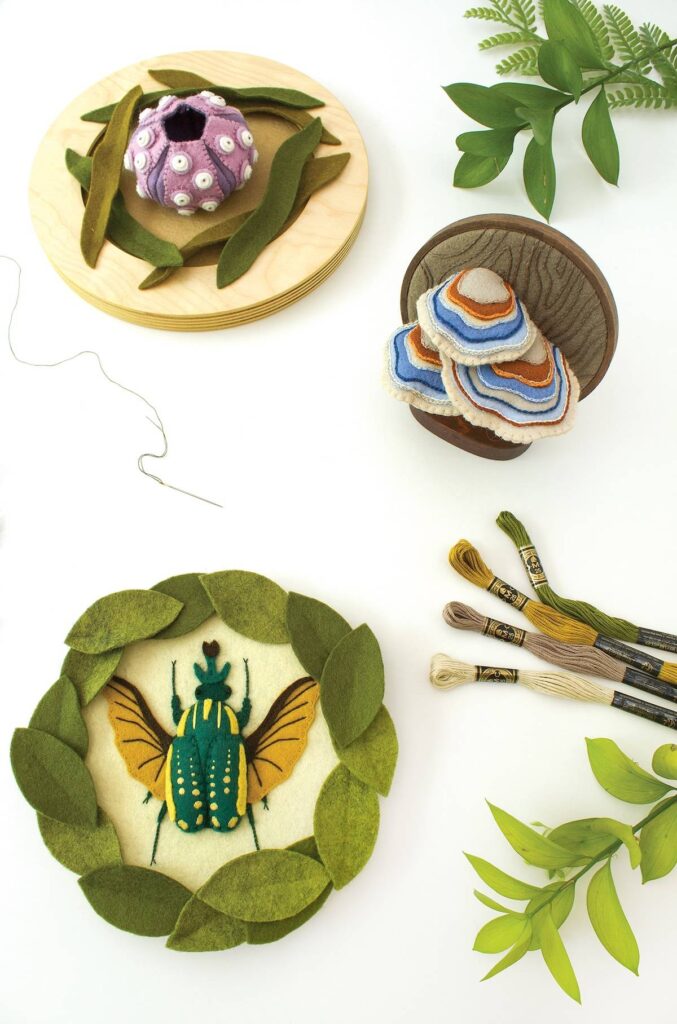
What was it like translating a hands-on, tactile art form into written instructions and photographs?
If I’m being honest, it was one of the hardest things I have ever done. I am by no means a natural writer, plus technical writing presents its own sort of challenges for sure.
When I stitch on my own, I tend to just dive into the project rather than giving any thought to a step-by-step process or having all of my supplies planned out in advance. But my editor was patient with me and helped guide me. She encouraged me to use my own voice, but also knew when to step in and simplify certain steps or elaborate on others.
Outside of the mentally challenging part of writing this book, I also went through a lot of emotional challenges behind the scenes.
One of the biggest of which was my grandma becoming very sick while I was working on my manuscript. I was driving back and forth several hours a week to help my Mom care for her. It was stressful and heartbreaking, but I was so thankful for the time I had with her at the end. She had lived with my Mom and me when I was growing up and had always been creative, dabbling in cross-stitching, watercolor, and miniatures.
A few days before she passed, I was able to tell her that I was dedicating the book to her, and seeing her smile in that moment meant so much to me.
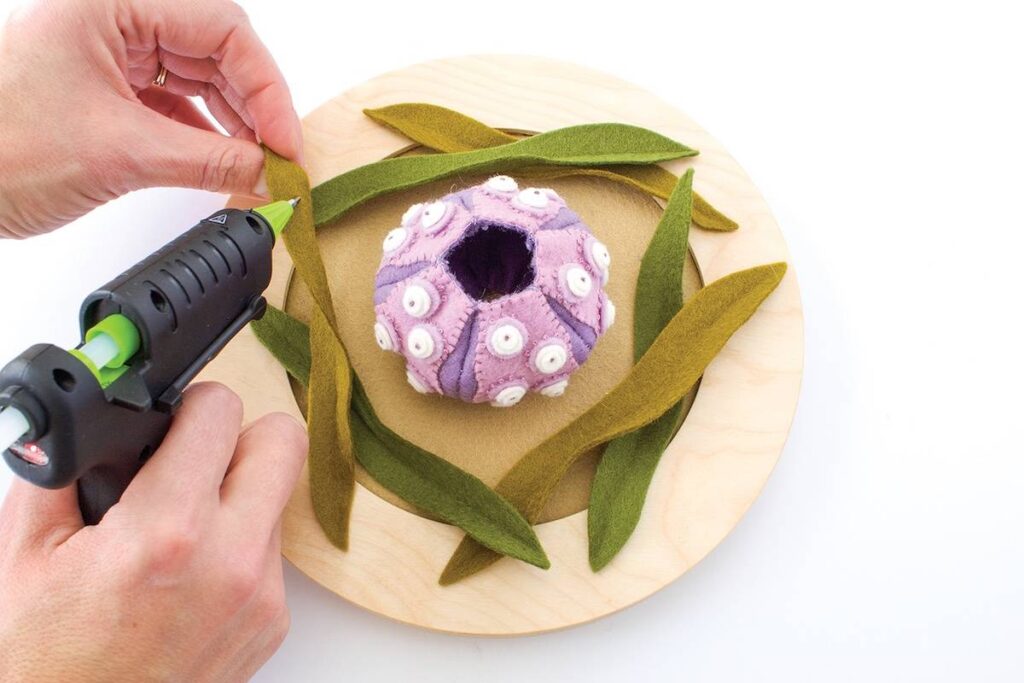
Your work combines felt appliqué, thread painting, and embroidery in a unique way. How did this style develop, and what do you enjoy most about working with these techniques together?
This was definitely something I developed slowly. When I first started to work with felt and embroidery, I was layering maybe two pieces of felt at a time and adding minimal embroidery detail on top.
But over time, I began to look at the world around me more three-dimensionally, almost like a Magic Eye puzzle. Soon, I was challenging myself to stack more and more layers of felt and overlay even more embroidery to give my work depth.
There is something so satisfying about using these techniques together.
The felt layers are the groundwork- the part of the process that gives a piece physical elevation. Once the felt foundation is set, I can go back in with embroidery to add texture, shading, and contrast.
This brings a piece to life and gives it emotional depth. Each technique is valuable in its own way and contributes to the overall realness of the piece.
For someone who has never worked with felt appliqué or thread painting before, what project in the book would you recommend starting with, and why?
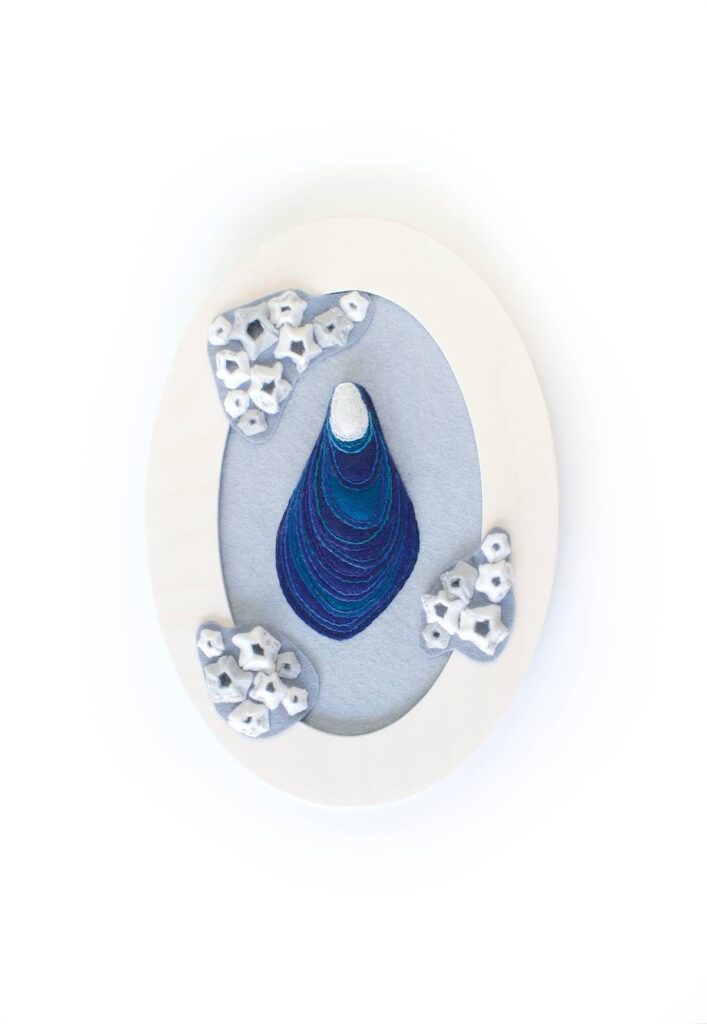
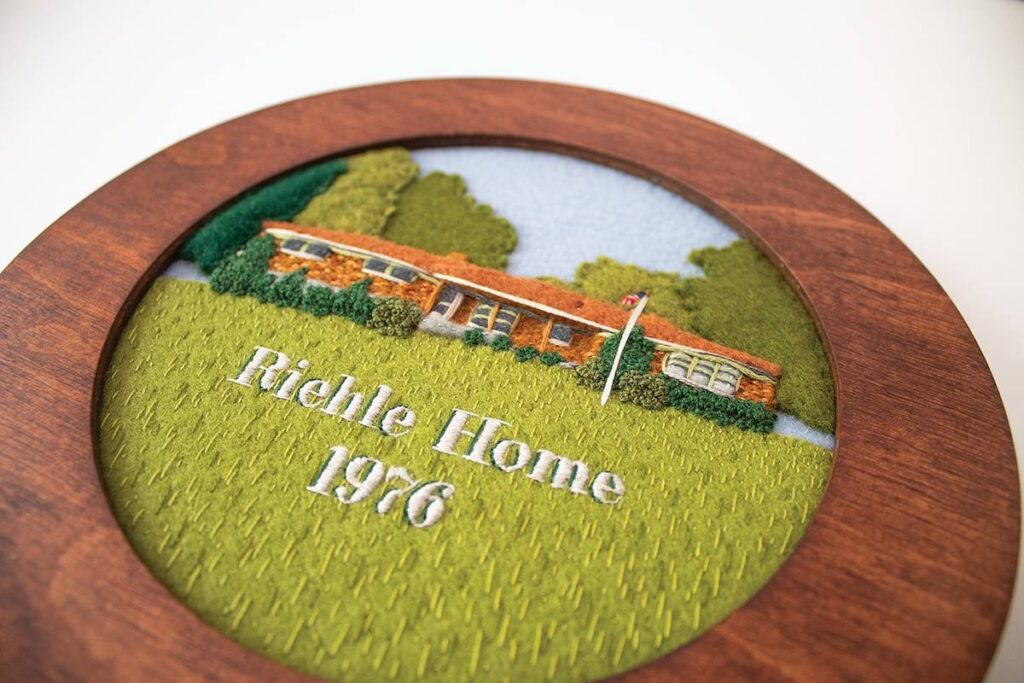
I would probably start with one of my Ocean Projects, such as the Blue Mussel or the Sea Urchin. Both projects use only a few basic stitches and have simpler techniques, but are still very dimensional. I think they give the look of intricacy without being as complicated, technique-wise, as my house or pet portraits.
Looking back at your earlier work, how has your artistic voice evolved, and what do you hope readers take away from Felt & Thread beyond the technical skills?
I think in many ways, my style and artistic perspective have remained the same over the years. I’m still intrigued by nature, capturing memories, and telling stories through my artwork. I still like to push the boundaries of felt and thread.
Only now I feel like I’m becoming more confident in my process and, in turn, want to encourage others that they can experiment beyond the traditional realms of fiber art too.
I am most hoping that readers feel less intimidation and more inspiration when they read my book. Felt & Thread includes 10 step-by-step projects that readers can follow along with and gain confidence in techniques and skills.
But I also explain how they can turn their own photos and memories into a work of art, which I hope motivates readers to explore the possibilities with felt and embroidery. It’s important to me that I share my process with a creative community that has inspired and supported me for many years.
Do you plan your work out ahead of time, or do you just dive in with your materials and start playing?
Every time I start a new piece, I plan it out in my sketchbook.
I like to research ideas and draw out assembly concepts and color schemes before I just dive in. Also, because most of my work is custom made, keeping a sketchbook allows me to share a visual with customers before stitching. That way they can edit as they see fit before I start the more labor intensive parts of making. Plus I love to have all of my sketchbooks to look back on and take bits and pieces from past projects. It helps to have a hard copy of things that have worked well or that I may have already created in the past.

How do you manage your creative time? Do you schedule start and stop times? Or work only when inspired?
Sometimes I envy 9-5 jobs because there are set hours and no domestic distractions like a sink full of dishes or dryer buzzers. Working from home often means I just work around the chores and errands that need to be completed. Most of the time I work when my other to-do list is done and the rest of the household is sleeping. I also sneak in stitching during movie nights, car line pickups, and sports practices.

Do you have a dedicated space for creating? If so, what does it look like?
A lot of people are surprised when I tell them that my workspace is a 6’ x 6’ corner in the front room of our house with a bookcase off to the side. It may not be particularly Instagram pretty, but it’s cozy and serves me well for what I need. I store most of my felt and thread in plastic storage drawers by color. I also organize my markers, pens and pencils by color in cups. I find such joy in having everything laid out in clusters of colors.
While working in such a tight space has its challenges, like always having to keep fairly tidy even in the midst of big projects, I also think they can be advantageous. I am literally able to reach anything I need at any given moment, and still remain in my chair. It makes my work space feel more like a command center than a desk!

How often do you start a new project? Do you work actively on more than one project at a time?
Sometimes I wish that I was the type of person who could focus on just one project at a time, but usually I have multiple pieces going at once. While that may seem counter productive to some, it actually helps me to focus.
There are many times when I have a labor intensive project on my docket and I need to balance it with something that is more mindless and less time consuming. I find that that helps me feel like I have at least accomplished something while I still have a bigger project in the works. I guess that all stems back to the satisfaction of crossing off to do lists and needing some sense of accomplishment to keep working. Plus, sometimes going back and forth between projects allows me to step away and come back with fresh eyes to see something in a new way.

Can you tell us about the inspiration and process of one of your works? How does a new work come about?
Most of my work is custom ordered, so I don’t have a huge margin for inspiration on some projects where the customer has a particular vision in mind. However, when I am transforming nutcrackers, I really get to let my imagination and inspiration run wild. Usually I first look at a nutcracker and see if there is a trait that sticks out to me more than others. Maybe the hat or the sword reminds me of a certain famous figure. Maybe the color scheme inspires me to create a particular character. In the case of my first nutcracker transformation, I was struck by the figure’s red, black, white and gold color scheme. It reminded me of one of my favorite book characters growing up- The Queen of Hearts from Alice in Wonderland. The rest kind of fell in place as I got to work.
First I sketched up details I wanted to include and things that inspired me from the original nutcracker that I wanted to carry through the transformation. I wanted to try to incorporate as much from the original figure as possible, so I made a flamingo croquet mallet out of the nutcracker sword. I covered up the original hat with a giant heart shape of curly red felt hair. And I kept the original paint for many of the parts because they were already the same color scheme I was going for.

Which part of the design process is your favorite? Which part is a challenge for you?
One of my favorite parts of my design process is the actual cutting and arranging of felt pieces. It’s when all the hard work of my sketching and planning really comes to life.
The stitching part that follows is usually my methodic and tranquil time. It is when I have any sort of engineering involved in my work that I find myself being challenged. For example, this happens whenever it’s time to assemble all of the pieces of a mobile. It is a true feat of careful construction and aerodynamics to ensure that everything is balanced perfectly. Even though I have made dozens of mobiles, I kind of panic when it comes to the hanging part because there is so much fiddling to make not only make sure it’s not lopsided, but make sure it flows well as a cohesive piece.
Another part of my work that is a challenge for me is all of the admin work that goes on in the background. I am a one woman show which means I am in charge of answering emails, ordering supplies, packing and shipping orders, posting to social media and updating my website. All of that can often feel boring or tedious, but I try to balance it out. I often reward myself with a creative task for every admin task completed.
Tell us more about how social media influences your work and creativity. (I’m a ‘no fancy nails’ kinda person, too!)
I was recently on a discussion panel and someone asked me how social media affected my work and how it compared or differed from critiques/feedback I got as a college student. I’d say one of the biggest differences is the fact that social media is open to everyone. Which in turns means being exposed to negative opinions from anyone with access to the internet- people who may not understand how something is made, or even respect the art process in general.
While I’d say 99% of my interactions are positive, I do get the random comments that basically say “I don’t like your work”. Or even better, someone will point out something entirely unrelated to my work, like the fact that my hands would look better with a manicure (obviously missing the entire point of my reel).
While rejection is a normal part of life, and critiques in college prepared me for this, it is hard when social media rejection is often just criticism without any constructive feedback. At least in college if someone expressed their dislike for my art, they backed it up with advice on how to improve my technique or how to do more research on my concepts. It provided a starting point for me to improve my art, whereas the blatant expression of disapproval for my work on social media can just feel useless. Wouldn’t it just be easier to scroll past than to take time out of your day to ridicule art with nothing constructive to say?
Now that being said, that is only 1% of my social media interactions. I have amazing followers who constantly encourage me and often inspire me to try new projects. They often have the best suggestions and also influence me as far as what I should focus on. Like when I made an ornament and everyone thought it looked like an Uncrustables Sandwich, I decided to try making one. It was then I realized there was a lucrative business there and ended up making a whole product line!

How has your work evolved over the years?
Over the years Olive This Felt has changed quite a bit. I started out stitching strictly felt food and play toys. Now I mostly make ornaments, mobiles and portraits. But I do still stand by my tagline “Making all things felt, one stitch at a time.” Everything I make is still completely hand stitched by me and felt based.
My customers have been the reason for all of my shifts and subsequent successes. I am a total creature of habit and comfort. If I find something I can make well, I keep working on that.
Over the years, I got more and more requests for custom items- portraits, ornaments, mobiles. At first I would panic. I didn’t know what I was doing. But after each completed project, I gained more confidence and the desire to keep trying new things.
I still face challenges and or specific requests like “Can you make my daughter a princess tooth pillow with the colors blue, black and green?” The key is I try. Every time I try. And because of that, my business has grown and evolved. It may sound cheesy, but I often think about how if I had turned down custom requests or shied away from the challenges, I wouldn’t be where I am today.

What kinds of creative projects are your favorites?
My favorite creative projects to date are definitely nutcracker transformations. It’s wild to admit that because even a year ago, I was totally creeped out by nutcrackers! But I am fascinated with the idea of transformation and enjoy the challenge of altering something that is already made (I mean who doesn’t like a good before and after?) Nutcrackers are also my favorite because I get to combine so many different art techniques and mediums in a single project.

What is the best piece of advice you received on your creative journey?
The best advice I ever got was “Don’t forget to charge for your experience.” A lot of artists factor supply cost and labor into pricing their artwork, but they may overlook their artistic knowledge or expertise.
I am not the same artist that I was when I started out almost ten years ago. My stitching is more proficient. I have learned to manipulate felt in more impressive ways. And I need to charge accordingly for that.
I am still working on realizing my own worth because, let’s be honest, it is hard to judge how much to charge for handmade items. Especially when everything I make is a luxury item in the sense that no one needs a felt portrait or ornament, but we all need food and housing.

What do you do to keep yourself motivated and interested in your work?
It can be such a challenge to continually stay motivated with my work. Especially when we live in a country that prides itself in working until burnout.
I find I go through seasons where I am more excited to work than other times. It helps if I can sprinkle in some fun projects (like a couple of nutcrackers) between some more repetitive orders or meticulous portraits. I also stay motivated by all of the amazing makers I follow on Instagram. I sort of feel this sense of accountability to continue to show up and keep creating.

How do you know when a piece or project is finished and needs no additional work?
I am definitely an over-thinker and over-worker. Which is why I work with felt and thread, and not with a medium like watercolor! I like to manipulate the fibers and layer textures, colors and details until I feel like everything is just right. I suppose you could say that my zeal for reworking and continually making additions, stems back to my printmaking days in college, when layering was key.


Where can people see your work?
You can find a portfolio of my work as well as any patterns and products for sale on my website: www.olivethisfelt.com
Follow me on Instagram @olivethisfelt to see photos of current projects, watch process reels and also get a sprinkling of maker humor.
Also, readers can feel free to contact me via email with any questions: olivethisfelt@gmail.com
Interview posted May 2024, updated June 2026
Browse through more hand embroidery projects and inspiration on Create Whimsy.