
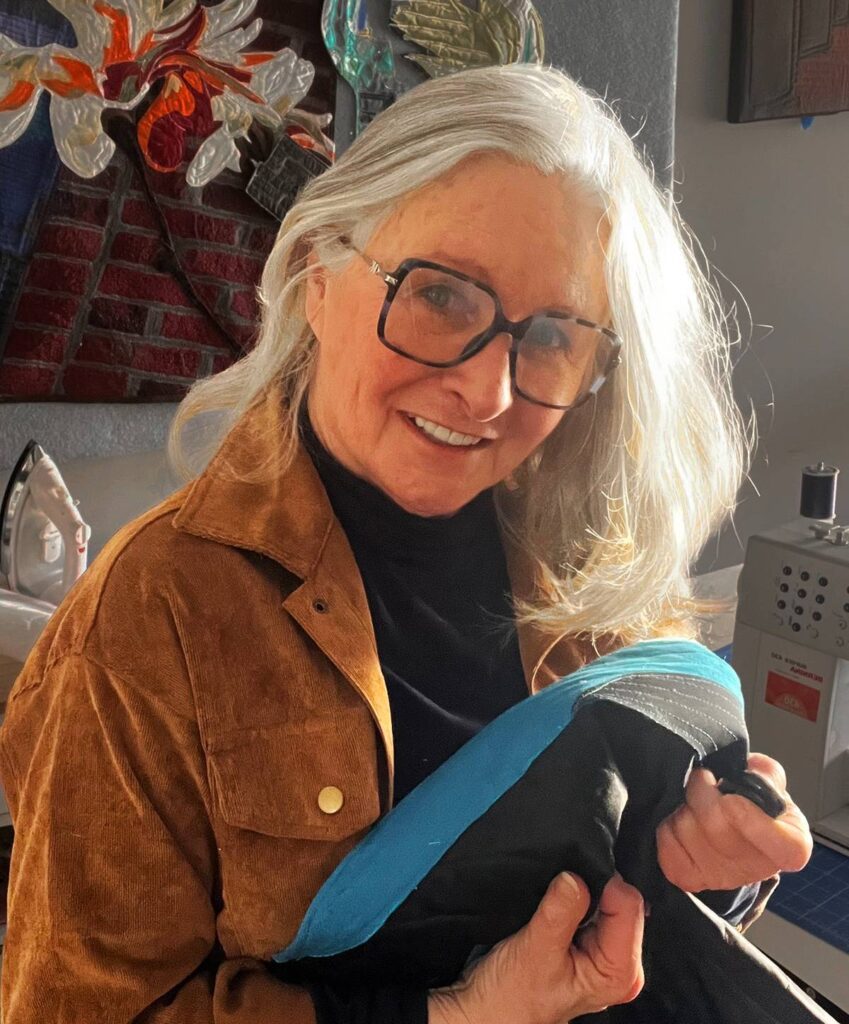
Jayne Bentley Gaskins turns everyday moments into powerful art using fabric and photographs. Her work is thoughtful, bold, and full of feeling. In this interview, she shares how curiosity, research, and life experiences shape every piece she creates.
Can you take us back to the beginning? What are some of your earliest memories of making art or creative things?
It must have been when, at the age of 5, my grandmother taught me to both knit and crochet. Most importantly she insisted I try to make something without a pattern using only the rudimentary stitches she’d taught me.
I’m sure I made a colossal mess, but it was an invaluable lesson in building on limited knowledge and expanding beyond the predetermined.
Was there a moment when you realized that art would always be part of your life?
As an Amazon Associate I earn from qualifying purchases. Read more about our affiliate linking policy.
Not really. It’s always been an integral part of who I am, so I just took it for granted.
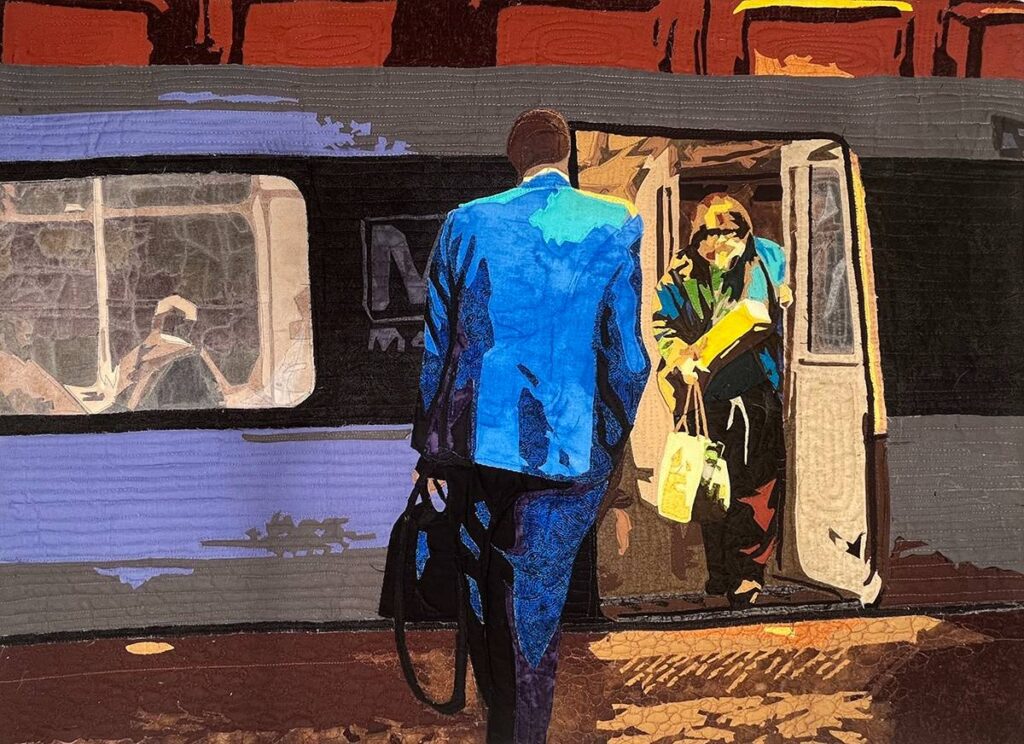
Two men of drastically different walks of life enter and exit a subway car. There but for fortune, either could trade places. We never know what life has in store for us at the next stop or at the end of the line.
You earned degrees in graphic design, marketing, and management before becoming a full-time artist. How did those experiences shape the artist you are today?
Actually, I was initially a full-time art director in the ad industry. After a few years as a starving artist, I returned to school for an MBA and didn’t become a full-time exhibiting artist until I retired from the Centers for Disease Control.
The art education taught me basic design skills, while the business education encouraged me to explore a wide variety of perspectives without judgment, dig for a deeper understanding, and then create a meaningful, goal-driven message.
I firmly believe a solid concept is as vital to a strong work of art as a strong composition, and I often spend as much time researching my topic as I do executing it.
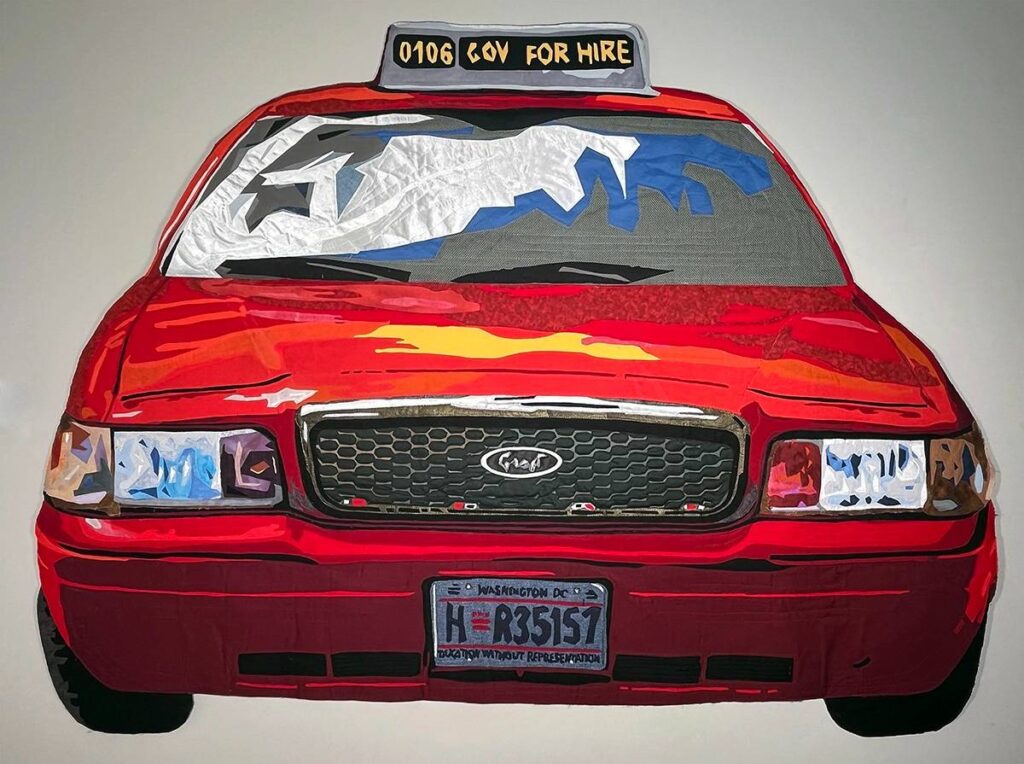
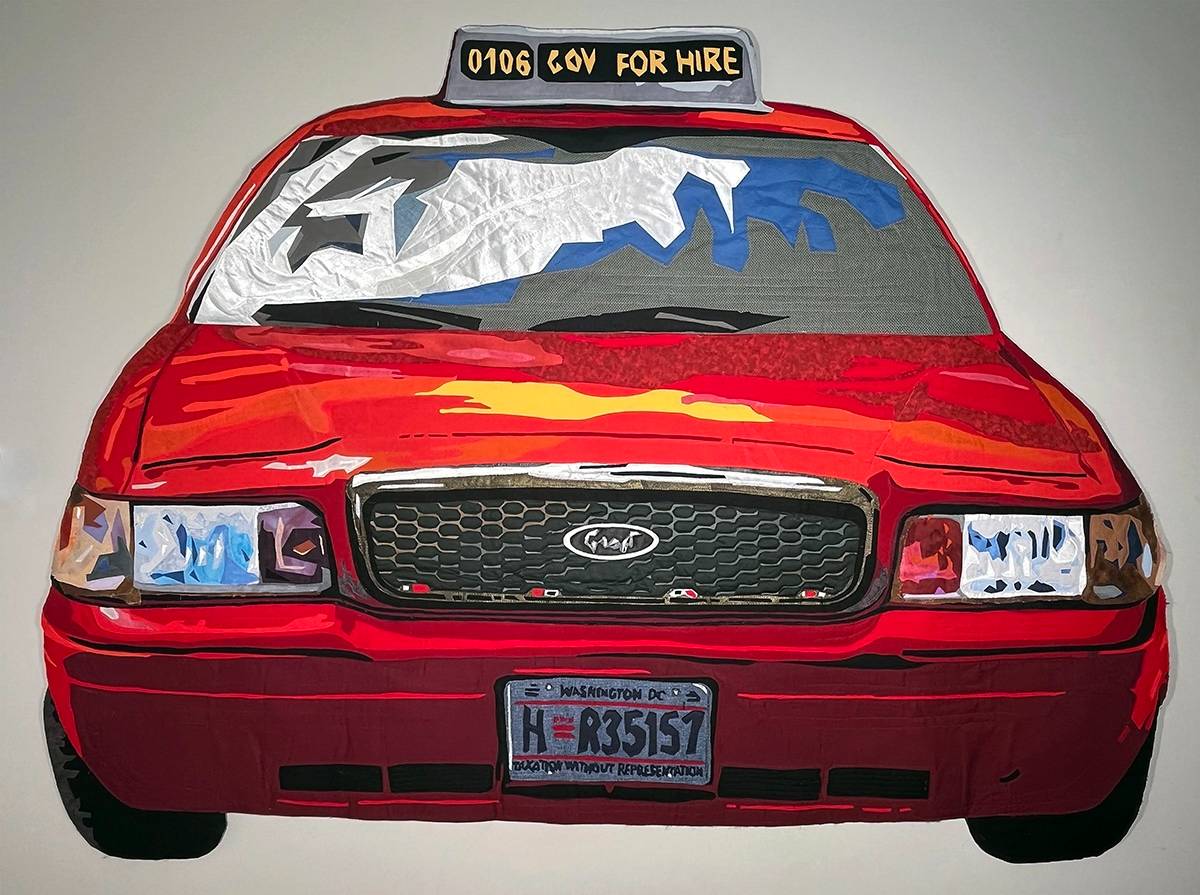
This Washington DC taxi (they’re red in DC) represents the US government’s becoming a plutocracy where elected representatives can easily be bought and often leave office millionaires with little regard for the people they serve.
Looking back, what surprised you most about becoming a professional artist?
As a female graphic designer in the early 70s, I was naively unprepared for the glass ceiling.
Today, I’m amazed at the lack of knowledge, even among well-educated people. No, it’s not a hobby. And no, talent doesn’t mean some deity guides my hands through the creation.
My art requires a huge sacrifice of time researching and composing before I touch the first scrap of cloth. And no, I really don’t want to hear about your granny’s bedspreads.
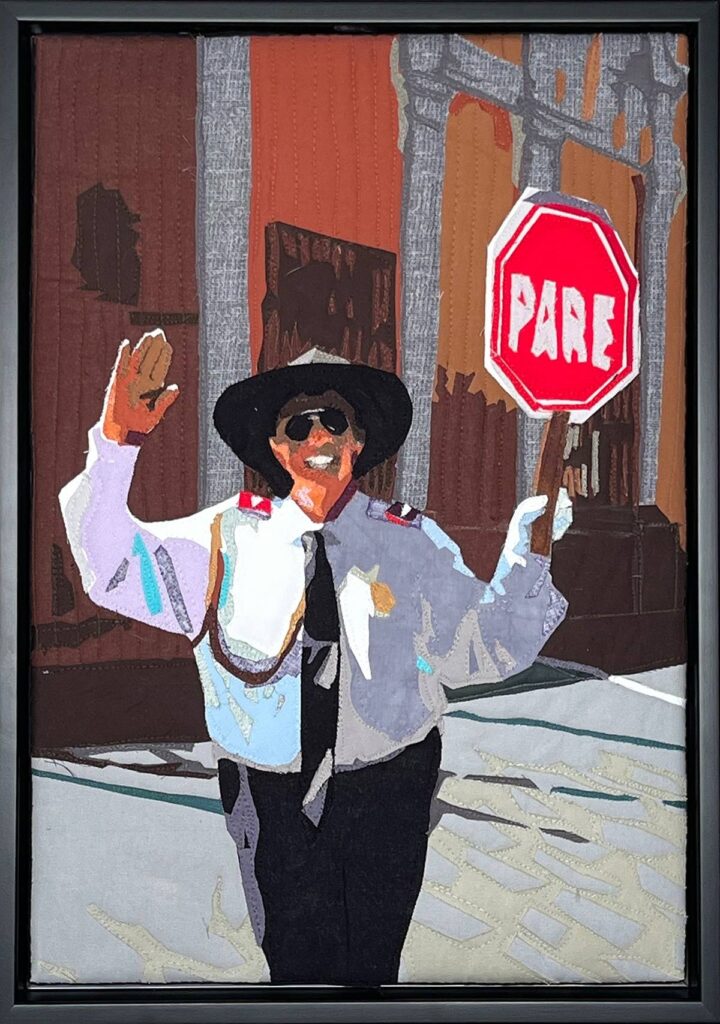
Every city in every country has its own traffic headaches. Lima is no exception, but at least this traffic control officer handles it with a smile.
What first drew you to fiber as an artistic medium?
I was going through an especially difficult period in my life and knew I had to do something creative to get through it. Some of my happiest moments had been creating Halloween costumes for my sons so I started playing with bits of cloth.
A friend suggested I explore Studio Art Quilt Associates (SAQA), and I’m embarrassed my response was that I don’t make bedspreads, but I’ve come a very long way since then and have SAQA to thank for that.
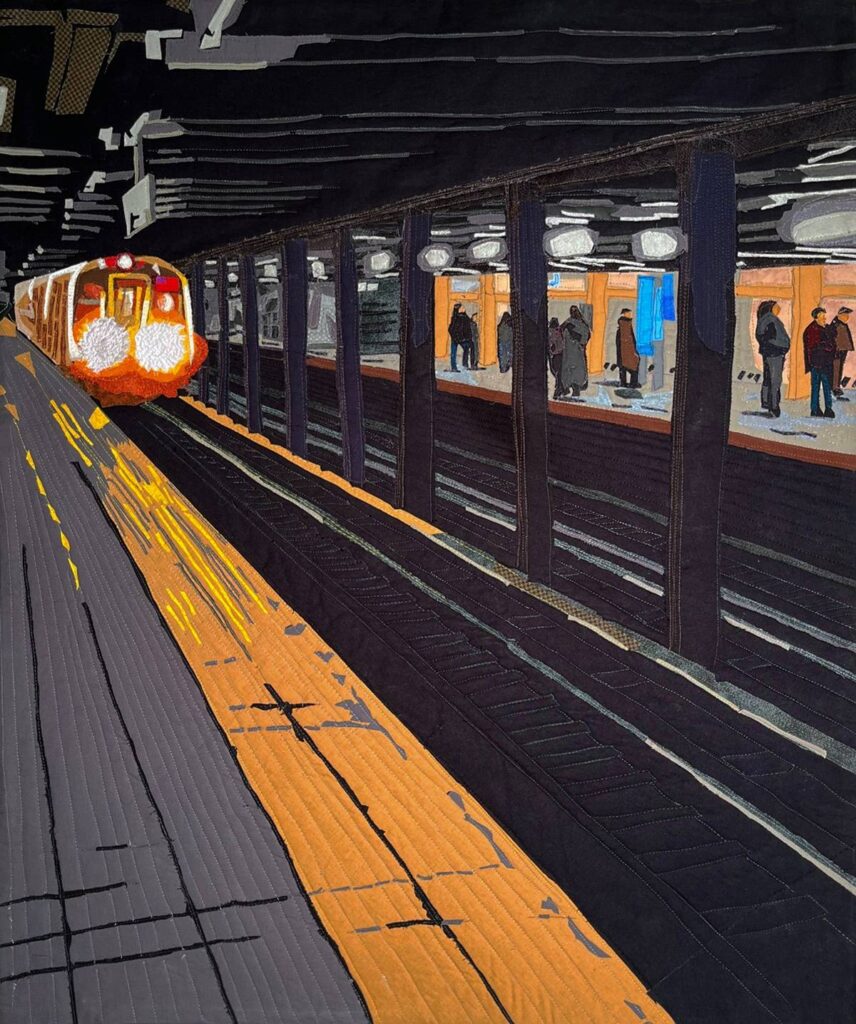
A subway train arrives in a dark station. Passengers step forward in anticipation, each with their own agenda and personal destinations in mind, and life rolls on.
You’ve referred to some of your work as “fiberography.” How did that concept develop over time?
I used that term a very long time ago when I printed my photographs on cloth, thread-painted over them, and then stuffed some areas to create a heavy trapunto-like relief effect.
Photographs weren’t used much in art quilts back then, and some people turned their noses up at them. I coined the term to show that photography is an art, and so is fiber art, so combining them is just another form of art.
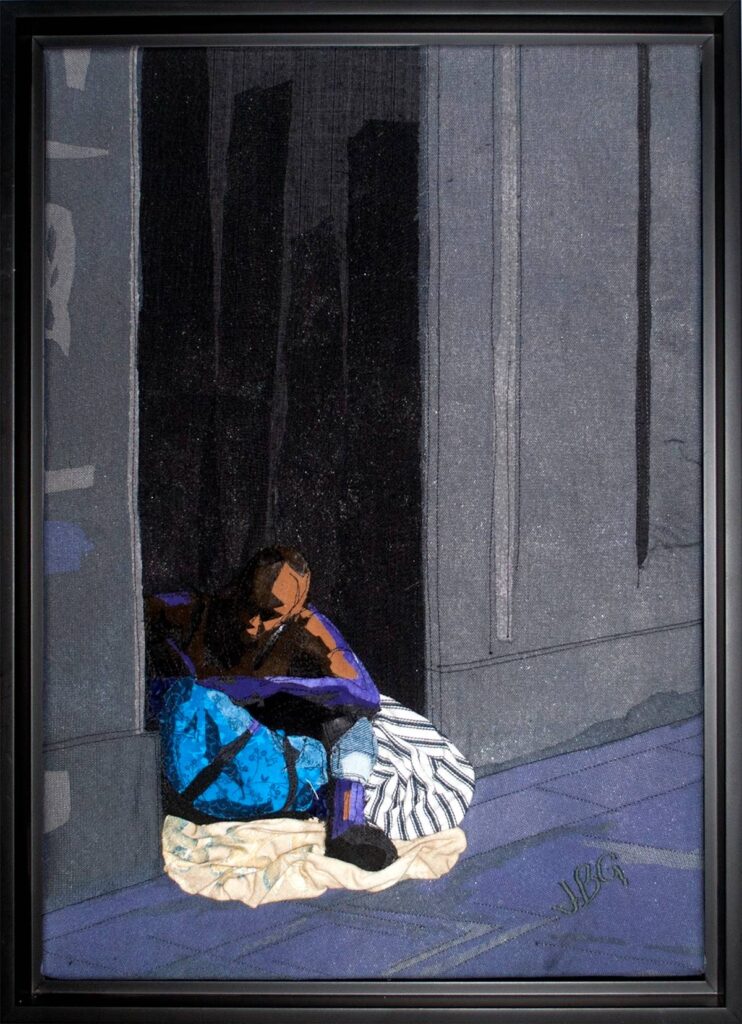
Race and income are among the greatest divides in the US today. Regrettably, the two go hand in hand. If you’re a person of color, you’re far more likely to be homeless. African Americans, for example, make up only 13% of the general population, but account for 21% of those living in poverty and 40% of the homeless population.
Do you remember the first piece where you felt you had truly found your artistic voice?
No because I’ve never gone looking for my voice. It found me.
When you immerse yourself so deeply in your work that you and the artwork become one, part of your inner self is displayed for the world to see. That’s your real voice, and yes, it can be scary.
Your work often explores city life, people, and everyday experiences. What catches your attention when you’re out in the world?
I try to be open to all life around me with no preconceived ideas. If something reaches out to me, I shoot it with my phone camera and file it away.
But if I can’t stop thinking about it, I figure it wants to be part of my art, so I open myself to whatever it has to say.
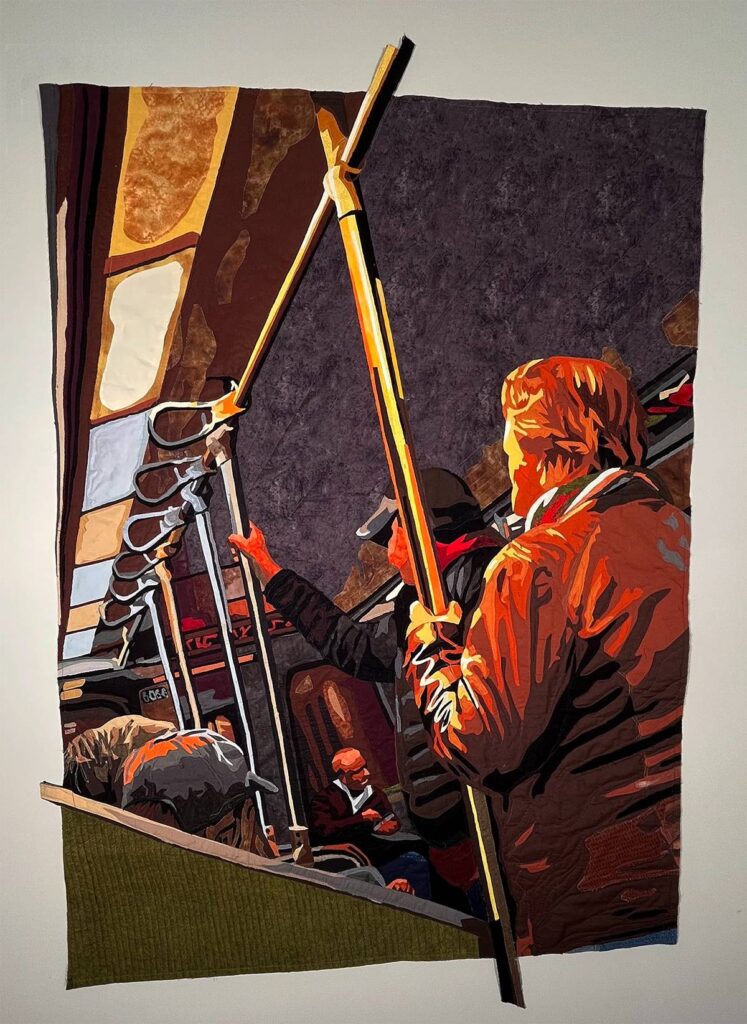
Much of our time is consumed planning where we’re going or reminiscing about where we’ve been, but real life only exists while we’re in transit.
Describe your creative space.
Which one? I develop my concepts and designs on my computer, and that space is well organized. However, my studio, where I execute the designs, can only be described as controlled chaos.
Can you walk us through the journey of a typical piece from idea to finished artwork?
All my art begins with a photograph.
I bring it into Photoshop and manipulate it until a concept emerges. Next, I spend days to weeks researching it like crazy. The more I learn, the deeper the concept grows. Backgrounds are replaced, new images inserted, and the whole thing simplified multiple times to capture a core emotion. I then print this at the size of the final piece and use that as a template.
My studio then becomes a riot of color as I audition colors and textures with light reflections to settle on a color palette. These pieces are laboriously cut out (always with raw edges) and fused together.
The objective is not to recreate but rather to enhance the feeling. In the final step, batting is added, and I quilt over it to secure the cloth and add linear elements.
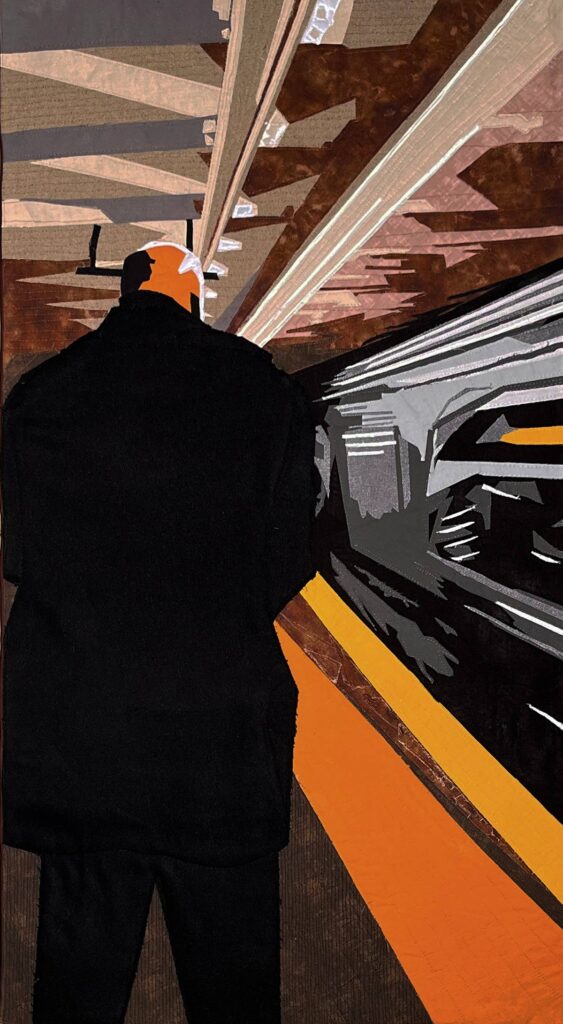
Alone, on a cold winter day, a man patiently waits for his transport to work. Trains roar by him and the station seems alive, but he is perfectly still.
Do your pieces usually end up looking the way you imagined, or do they tend to surprise you along the way?
The final result looks nothing like the original photograph because the objective is not to recreate, but rather to unearth what lies beneath.
How do you decide when a piece is finished?
Is it ever? I’ve never created a piece I didn’t later want to “improve”. Yeah, I have trouble letting go.
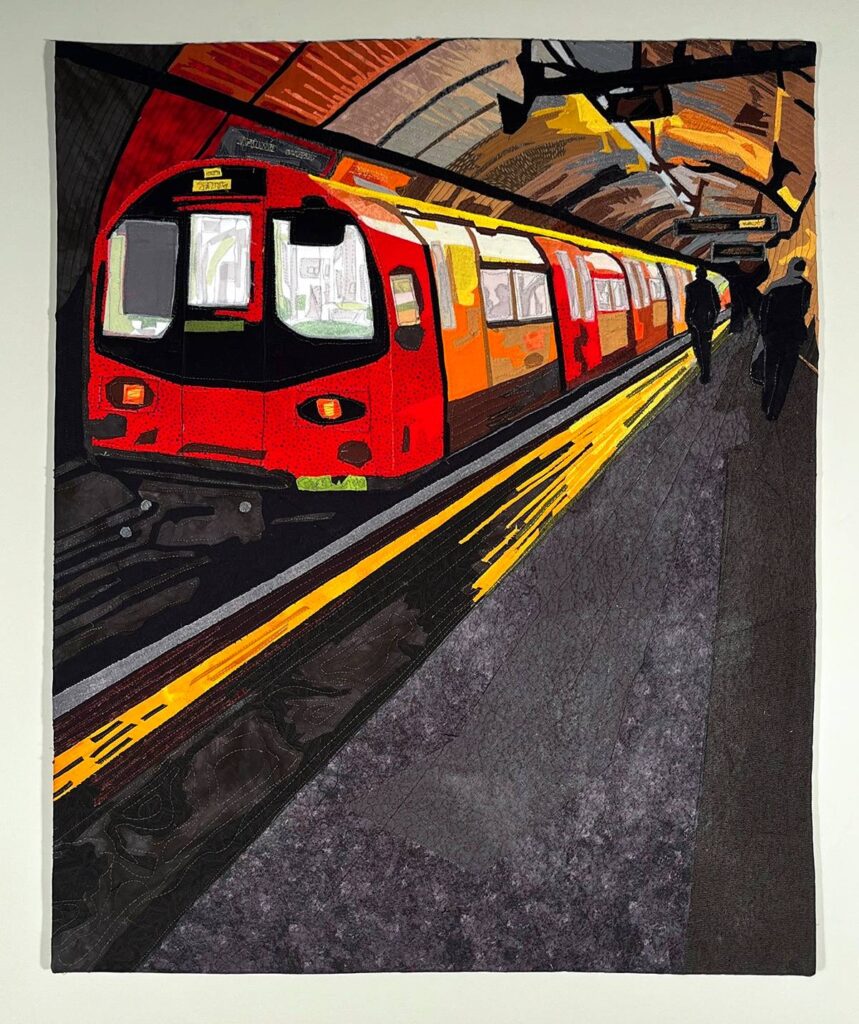
Life is full of missed opportunities like this departing train in the London Tube, but there will always be more we never dreamed existed. We just have to explore different tracks and be open to them when they arrive.
How do you push through periods of doubt or creative uncertainty?
All artists have those. I give it a rest until that awful gnawing compulsion inside me to create something won’t subside. Then I’m back in the game making something new.
What have you learned from exhibiting your work around the world?
Art is a universal language, and a translation of an artist statement is unnecessary.
All viewers, whether influenced by culture, religion, politics, or any of a thousand personal attributes, are going to see something different in any artwork. As long as mine leads them on their own mental journey, I’ve succeeded.
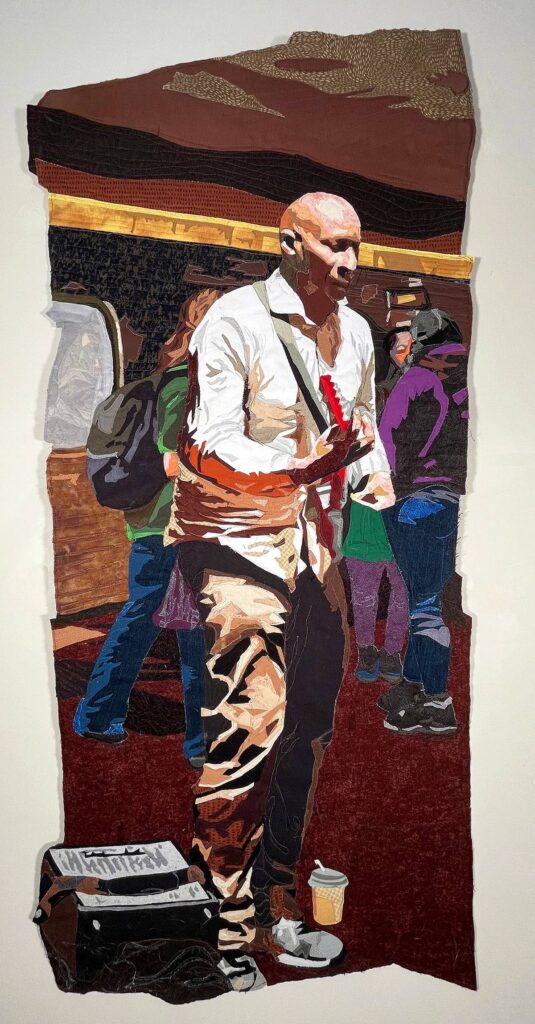
He didn’t know performing in the Washington DC Metro subway was illegal. He only knew he had a voice and an instrument and wanted to share the joy he felt when playing. His dedication to his art and his face as he was lost in the music stayed with me long afterwards.
What role does curiosity play in your life?
It’s the cornerstone of my existence.
After all these years of creating, what still excites you about walking into the studio?
Possibilities. When you leave yourself open to “What if?” magic happens.
Where can people see your work?
My website is the easiest for most – www.jaynegaskins.com . One of my favorite pieces will be on display at the VA MOCA museum September 11, 2026 – March 7, 2027, in VA Beach, Virginia, and another will be shown in the Ceres Gallery in NYC, NY, June 23 – July 18, 2026.
Rapid-Fire Fun
A place you’d love to visit for artistic inspiration? Anywhere. Life is beautiful everywhere.
One material you always reach for? My computer
A creative habit that keeps you grounded? Research
A color you’re especially drawn to right now? They’re all beautiful. It’s not the color; it’s what it’s next to.
What’s bringing you joy these days? Life, and especially my dog.
Interview posted June 2026
Explore more art quilts on Create Whimsy.