
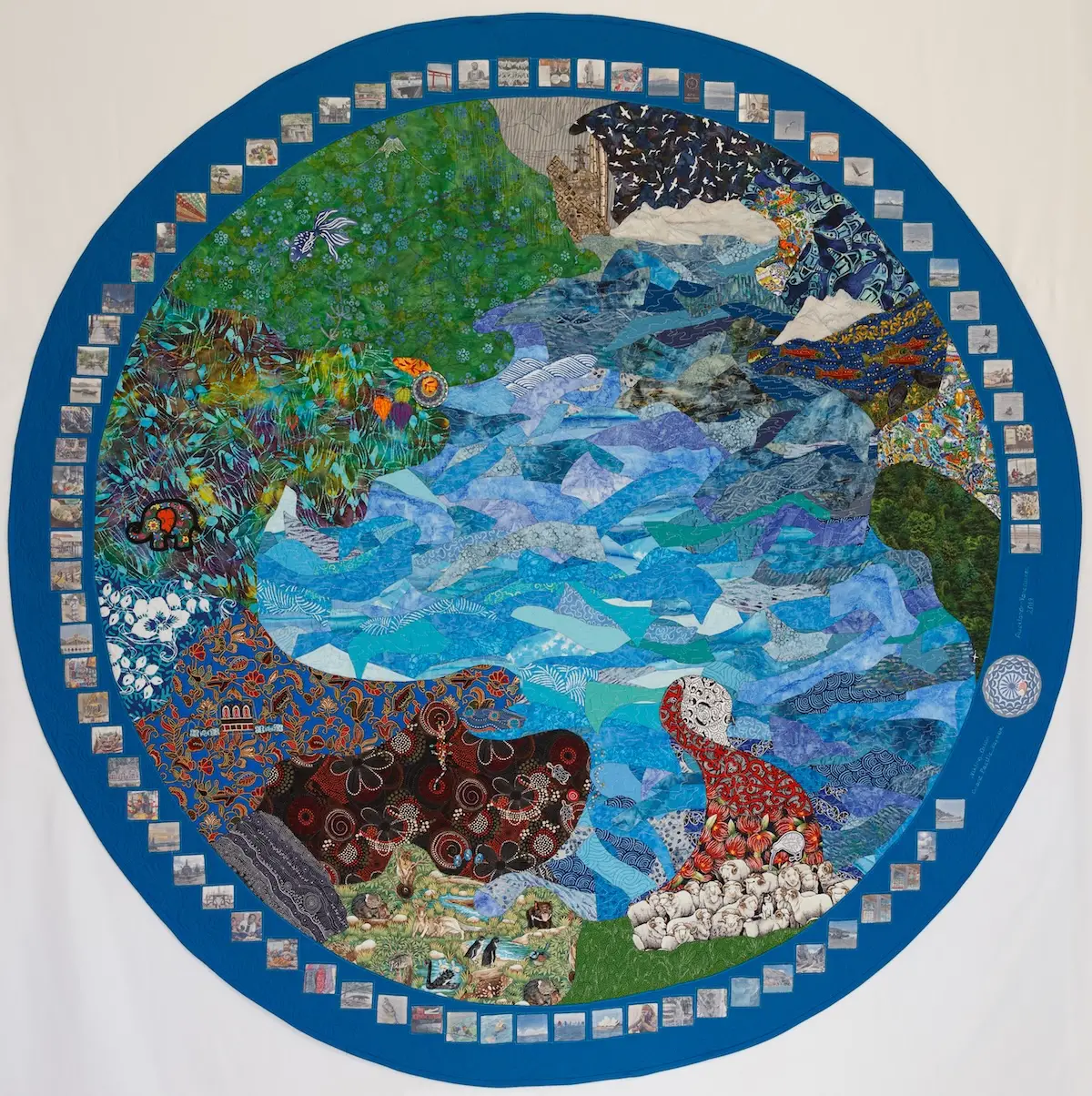
Candace Hackett Shively finds stories everywhere, from old blue jean pockets to big world events. Her art quilts mix thoughtful ideas with humor, color, and heart, showing how fabric can start conversations and help us see the world in new ways.
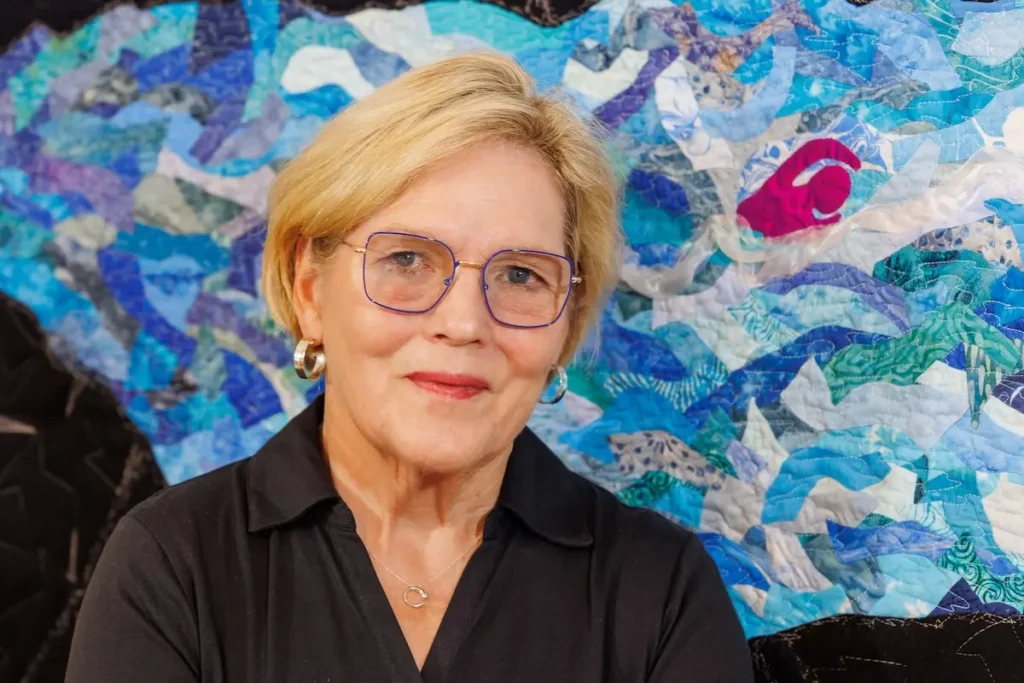
Your first quilt was in 1977. What was going on in your life back then, and what made you want to try it?
We were coming off the USA Bicentennial, so quilts were everywhere. I was a teacher with schools closed for a full week during the 1977 energy crisis.
With little money but loads of clothing and home dec fabric leftovers, I made my first 30 quilt blocks using everything you are NOT supposed to use: blends, corduroy, mismatched weights, drapery fabric, etc.
I used fabric store coupons to buy sashing, backing, and really lousy polyester batting for this HUGE quilt (what a fool I was). I machine quilted it- poorly.
As an Amazon Associate I earn from qualifying purchases. Read more about our affiliate linking policy.
My goal was to make something to hang on a very large wall in our small house. The blast of color on our wall was a success and was used for many years.
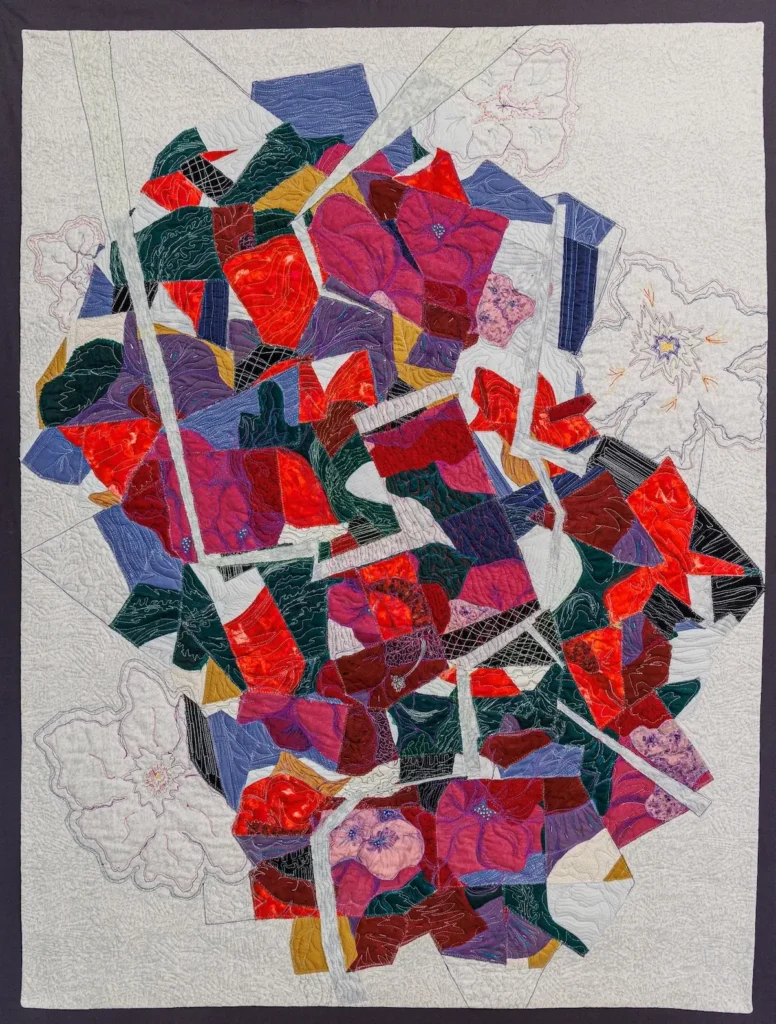
You say you’ve “played with fabric for over 50 years.” When did you stop calling it a hobby and start calling yourself an artist?
I don’t think sewing or artwork was ever just a “hobby” in my mind.
For years, sewing was a joyful necessity. I made my own clothes and got really good at it. Fabric stores and art supply stores were my dream places! I always did artwork on the side…. My school and college notebooks were filled with very interesting margins. But art was mostly for me.
I viewed myself as an artist but never said it aloud until I was an undergrad. I had some great art profs for the many classes I took for an unofficial art minor. My public declaration as an artist was my grad exhibit for an interdisciplinary Master of Humanities, a solo show of art quilts with accompanying writings. The Harrisburg, PA Sunday newspaper did a profile on me, and the secret was out.
After that, my family and day job in education/educational technology kept me very busy and ate much of my time until I finally retired and could devote more time to artwork.
Now I immerse myself in my studio and enjoy learning with fellow artists, especially fellow members of Studio Art Quilt Associates. (SAQA).
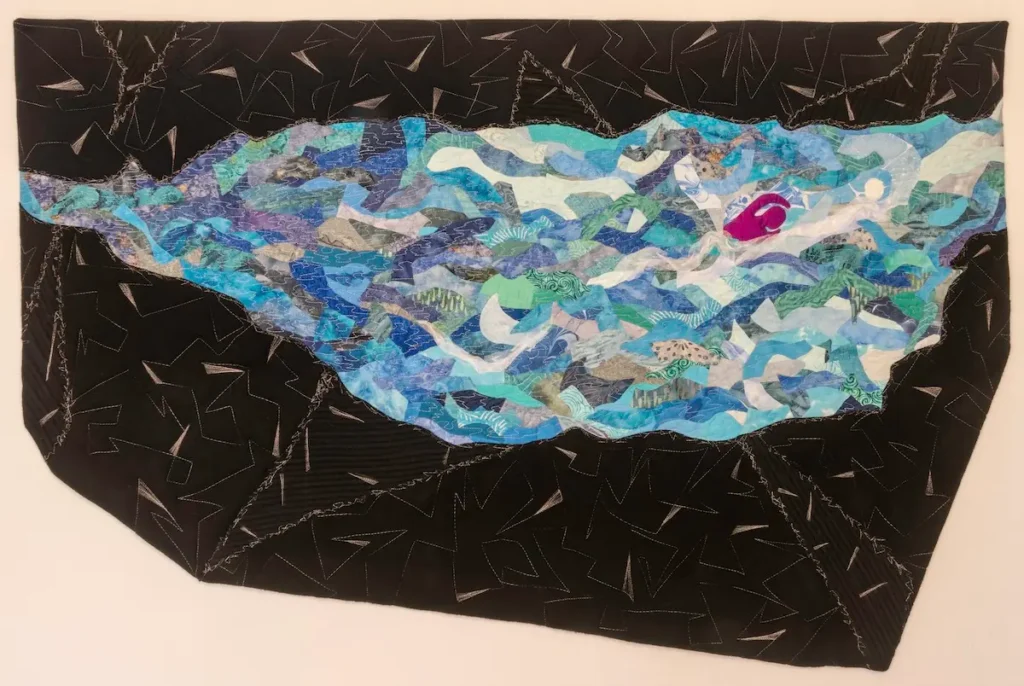
Looking back, is there anything you’re glad you didn’t know when you started, because it might have scared you off?
I knew little about the broader world of exhibiting artwork. I’m getting better, but there is so much to learn.
If I had known how much a “no thank you” from a juried exhibit call would sting, I might have feared it more. I have now received enough rejections that the sting does not last quite as long, and I have a plan for what I will do next: submit the work elsewhere.
I have also learned to wince — but analyze what’s not so great about a piece or why it wasn’t a good fit for that exhibit.
You studied English and writing before art quilts. How does being a writer shape the way you build a quilt?
This question is HUGE for me…. I see writing and creating artwork as very much alike.
Both are a PROCESS… a gradual, iterative movement forward. It starts with the messy spewing of ideas onto a keyboard or design wall…followed by constant revisiting and reshaping of the ideas.
The process circles back and evolves: adding, subtracting, moving, setting aside the “precious” bits that no longer belong, risking a share with a trusted feedback person or small group, walking past it or re-opening the computer file after a bit of a break… turning it upside down/sideways (or moving chunks of writing around).
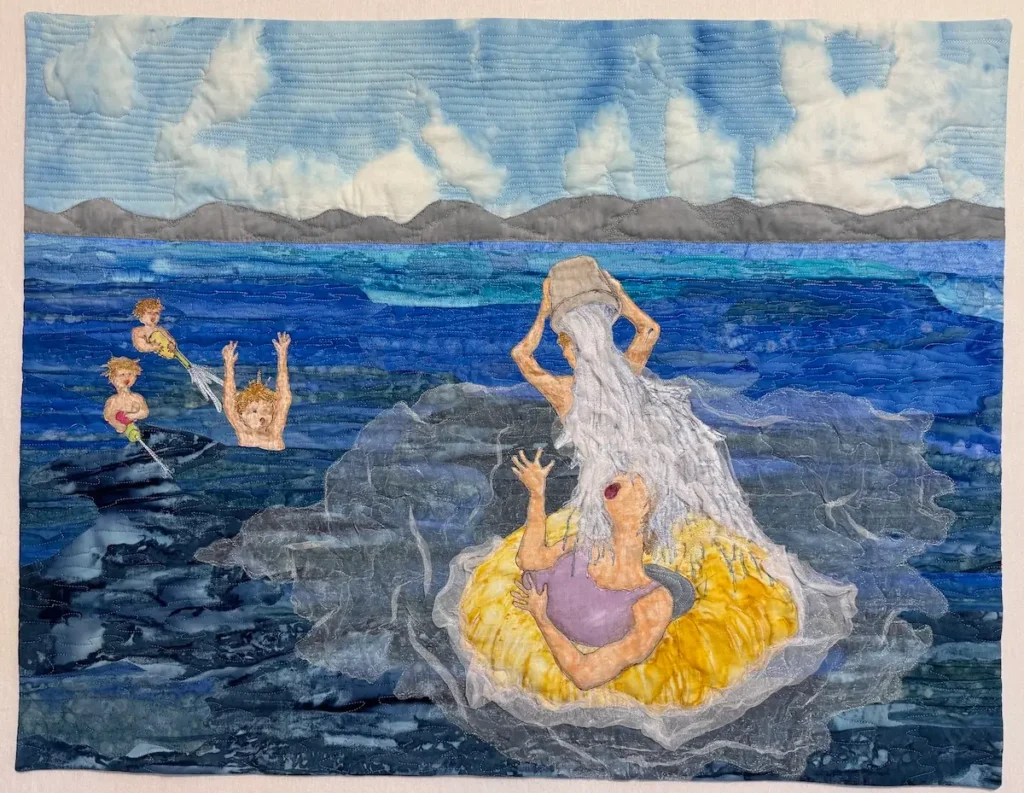
Letting it steep or incubate is A MUST. Welcoming the ideas that appear in my head while in water– a swim, a shower, a rainstorm.
New thoughts end up as small notes in my studio or phone. Often these ideas are words or phrases that haunt me or offer a new direction for a quilt.
Pivoting to incorporate new ideas mid-process adds richness in both writing and artwork.
Your work moves between world events, family memories, and quiet personal moments. Where do most of your ideas start?
My ideas begin as kernels in my head, often a word or phrase or a visceral reaction to something I observe in the world or in my own life. Some words hang around on sticky notes or snippets of paper- or even a note on my phone. Others return over and over like earworms of a song I cannot tune out.
As a news junky, I definitely react to events or trends in the world. But I also observe and ponder when traveling, as with my series of works about human-made and natural-made structures.
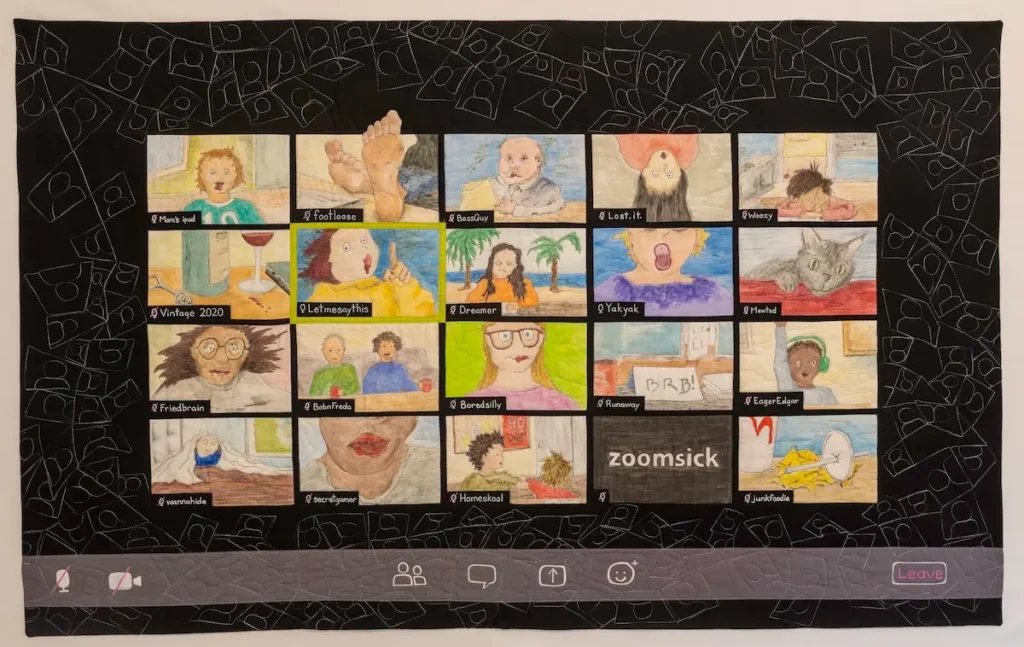
What moves my work from a kernel to the actual start of a piece is its insistence. To balance my darker frustrations with the news, I explore lighthearted vignettes of shared experiences, such as feeling Zoomsick during COVID or humming the Back Pocket Blues.
Tell us about Back Pocket Blues. What made an old pair of jeans’ pockets feel like they deserved a whole quilt?
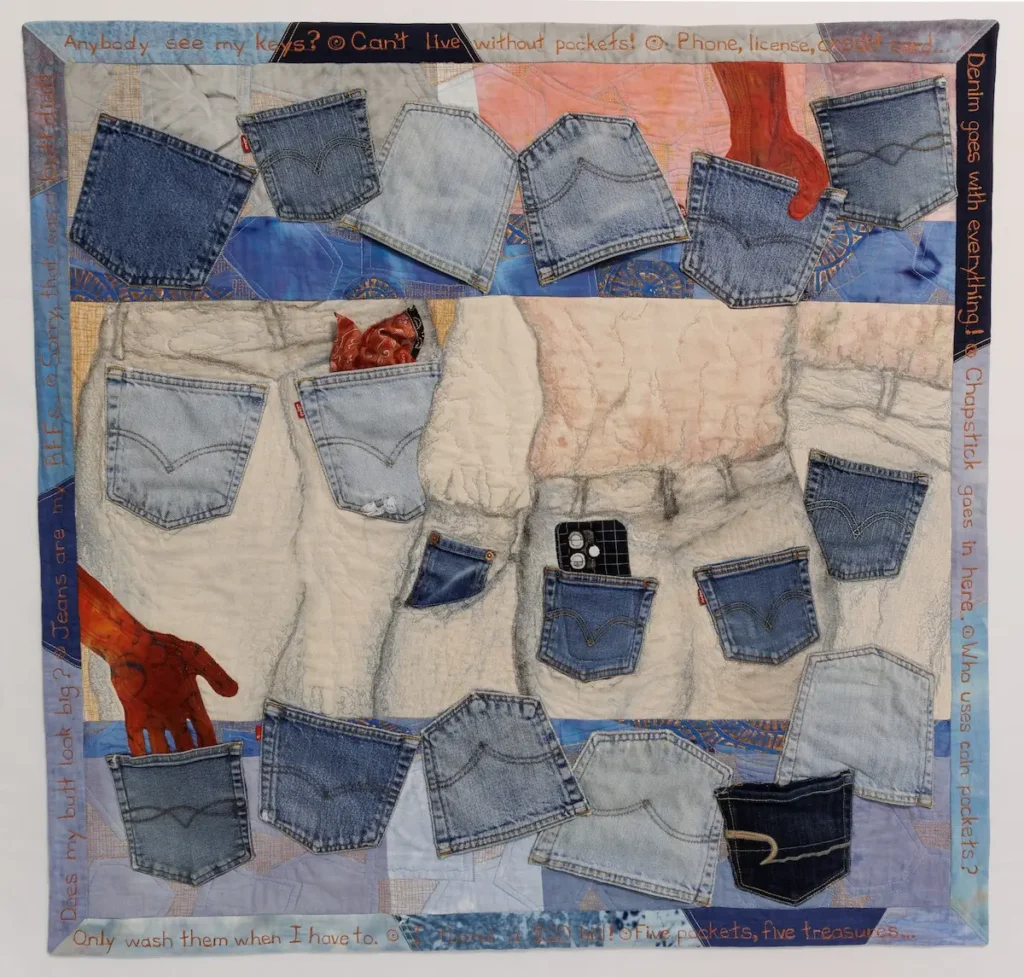
For years, I joked that when I retired from my day job as a teacher, I’d wear nothing but blue jeans and sweatshirts.
When a stack of blue jean pockets appeared at a materials swap in my SAQA small group, I grabbed them. I was especially in love with one pocket that had a wonderful hole. The pockets came at a time when I needed a more universal, positive, “shared experience” piece: I would document the way we feel about our blue jean pockets.
I reveled in playing and arranging pockets. I loved making a drawing—and then an Inktense painting– of the backsides hosting some of the pockets. Of course, I made hands to slip inside a couple. And a phone.
The things we say about our jeans popped in my head as I worked. The idea of actually including those words in a border came late in the process. Back Pocket Blues speaks to all of us, and we chuckle. https://makinloud.wordpress.com/2026/01/27/back-pocket-blues/
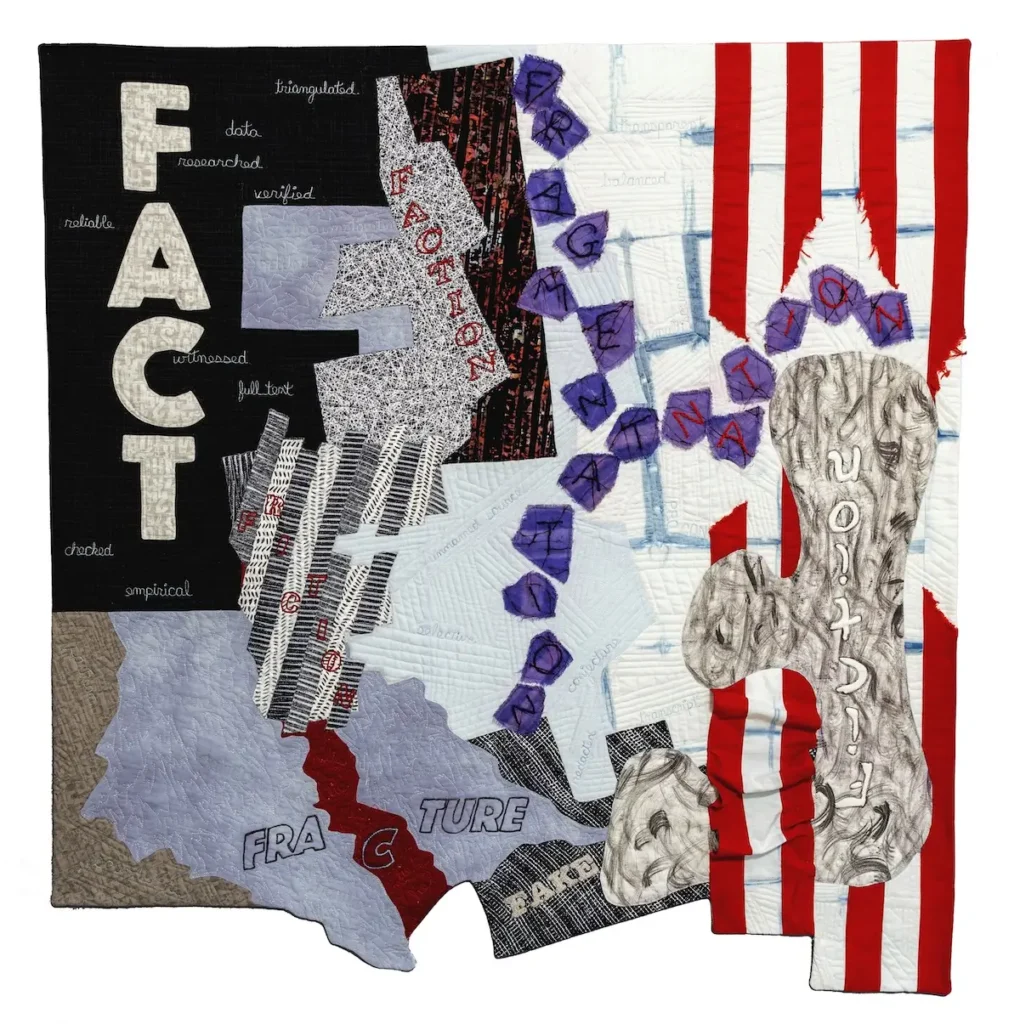
Pieces like Unprecedented and F-words take on big political moments. What pulls you toward making art about the news?
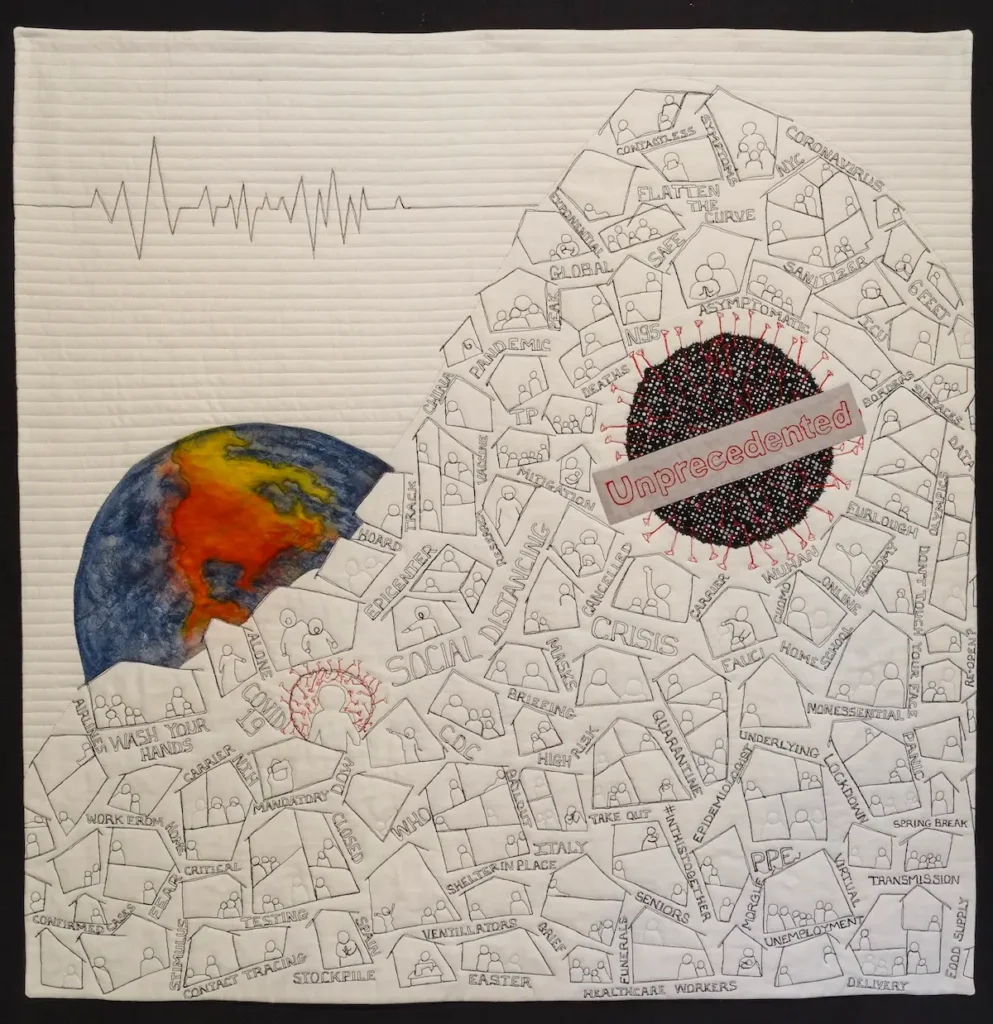
All my more political or news-related works come from a nagging reaction in my gut that bursts out of me. Unprecedented erupted during spring, 2020, as I wrote down the words I kept hearing on the news. As the Coronavirus (not yet named Covid 19) took over our world and so many people were dying, I was compelled to record a visual primary source of the times. I sensed that years from now, people will want to learn what it was like from an eyewitness. (https://makinloud.wordpress.com/2020/06/17/unprecedented/)
More often than simply documenting, however, my political pieces begin as thoughts I silently yell at the news. As words steep, the idea for a piece emerges. I want to spark dialog among those who view my work but may rarely listen to each other. I’ve been lucky enough to talk with viewers at exhibits where some of my more political pieces are hanging, and I thrilled at those conversations, even when we were not in agreement. THAT is why I made the work, and people seem to appreciate it. I wrote a blog post about one such experience: https://makinloud.wordpress.com/2018/09/15/resistance-and-dialog/
You’ve said you “remember colors,” almost like it’s automatic. Can you explain what that’s like for you?
My best analogy is that it must be like people who have perfect pitch. When I see a color and stop to really absorb it, I almost feel it.
Hours or days later— sometimes longer– when I am far from that color sample, I can pick up another swatch and just know that it will match. At the least, I can say it is a near-match — perhaps a bit more green ….
I first realized this capability when I would go to thread racks at the back of the fabric store to match fabric my mother had with her at the front checkout. More often than not, I was spot on. When I am out shopping but want to match clothing at home in my closet or fabric to a work-in-progress in my studio, I usually can. It works best if I don’t think about it.
For a long time, I thought everyone could do this. [I will note that my ready-for-surgery cataracts are messing me up, and I look forward to seeing colors accurately again very soon!]
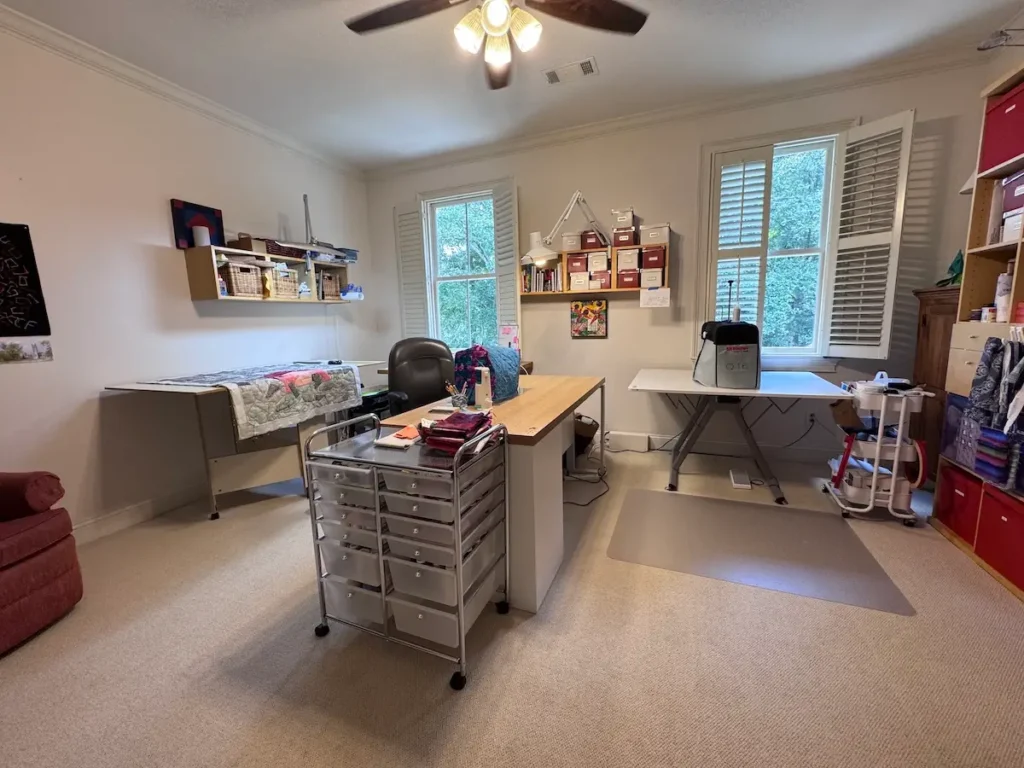
Describe your creative space.
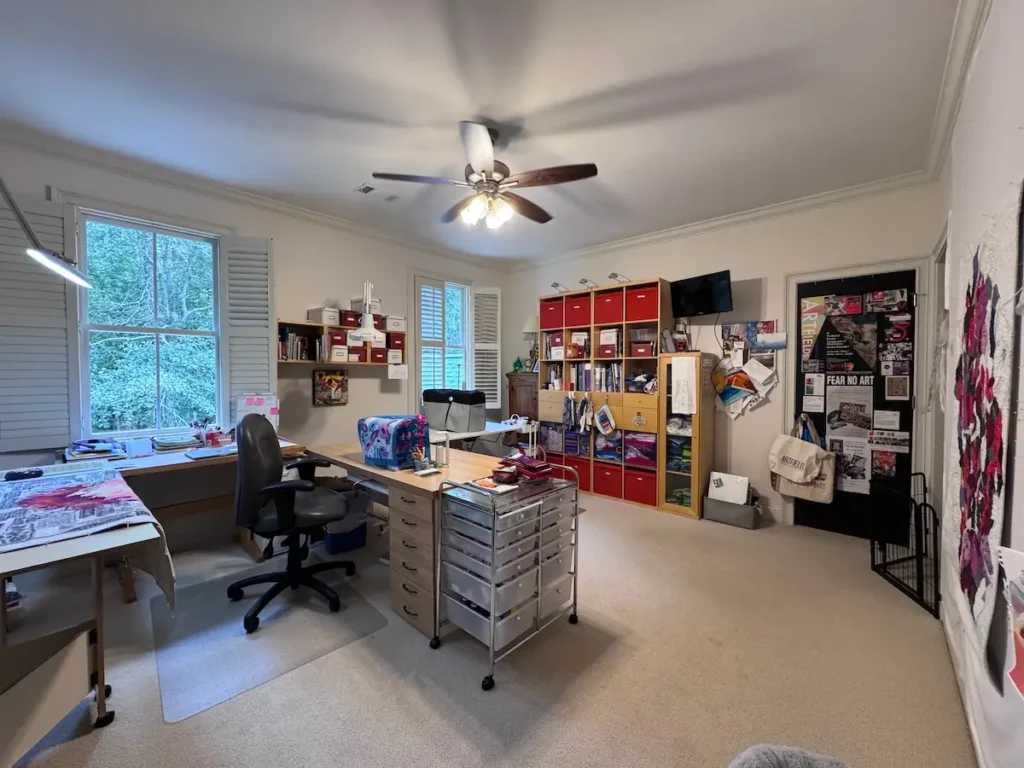
I am fortunate since we retired and moved to have a large extra bedroom as my studio – about 16 foot square. It has TWO walk in closets! I am a secret slob, so no one gets to look in those closets. My design wall is large, about seven feet wide and eight feet high, though no design wall is ever large enough. I have a cutting/work table, a writing/catch-all table, a large table that surrounds my Bernina 770QE, and another with my sitdown Bernina Q16. A great rolling chair and a couple of small rolling carts move into useful spots. A small armchair for visitors is often piled with stuff but easily cleared when needed. I have a lot of IKEA storage cubbies and shelves with boxes and baskets. I also have a big basket for test quilt sandwiches and other throw-aways. I sometimes dig through that for ideas.
I love the great daylight I get from two large, south-facing windows, filtered by trees so the Georgia sun does not cause problems. Plantation shutters help if it gets too bright. Mid-project, there are piles of fabrics on my cutting table and often on the floor. Since I often compose on the design wall using nothing but scissors, things get messy! I have a quasi-system for my fabric stash, but this evolves with time. Much of it is in one of those closets. I move my ironing board around, sometimes using it to keep fabrics handy by the design wall.
I have a ritual of cleaning up and putting things away when I finish a piece. This also clears space for a photo session. If I have more than one piece actively in progress, one of them is usually stacked in unused space on my cutting table or on my “visitor” chair.
You used Derwent Inktense pencils and blocks to paint the backdrop for Back Pocket Blues. How do you decide when to paint on fabric versus piece it together?
I’m not a traditional “piecer.” Been there, done that, and don’t like it anymore.
I make my own montage-style compositions from cut fabric, turning edges under and blind-hem stitching using MonoPoly thread. I rarely do fused, raw-edge work. It’s just not “me.”
When I want to create a representational, detailed image on fabric, especially with small details, I use fabric paints like Derwent or sometimes acrylic markers. I might make a thumbnail sketch on paper in my own informal style using pencil or pen/ink. If this is full size, I can trace it on fabric in permanent ink then paint as I did in Zoomsick. If it’s simpler to draw directly fabric, I use Derwent or other media to make it permanent — as I did in Back Pocket Blues. See the Zoomsick process here: https://makinloud.wordpress.com/2021/07/27/recognize-anyone/
When an idea first hits you, what’s the very first thing you do — sketch it, write about it, or just start cutting fabric?
Often the first thing I do is jot down words/phrases so I don’t “lose” an idea.
After that, it depends. Sometimes that list sits for a long time. I almost never make a full-size drawing or “plan” for a piece. If I do a sketch, it is a small one in a sketchbook. Then I start harvesting possible fabrics from my stash and start cutting. Sometimes I skip the sketch altogether or make one a little further down the road, after the fabrics have helped me refine my ideas.
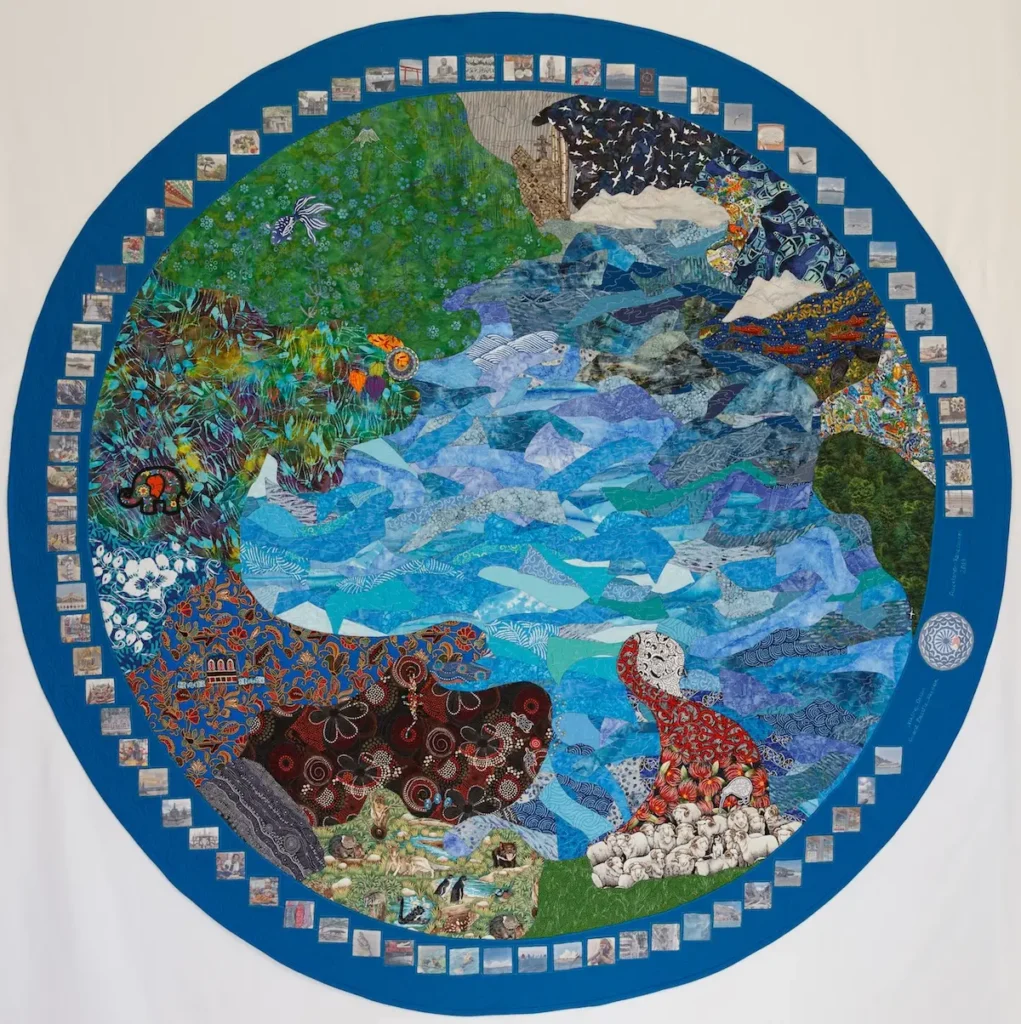
I waste a lot of fabric as I cut to compose, but it works for me. After creating the rough layout on my design wall, I montage the pieces (edges turned under). The one time I did make a full-size sketch was a very rough one on foundation muslin for my 70” diameter Grand Pacific Voyage quilt. I needed the circle for boundaries and helpful guidelines to roughly place the “land masses.” See pictures of this piece in progress: https://makinloud.wordpress.com/2021/03/22/grand-pacific-voyage/
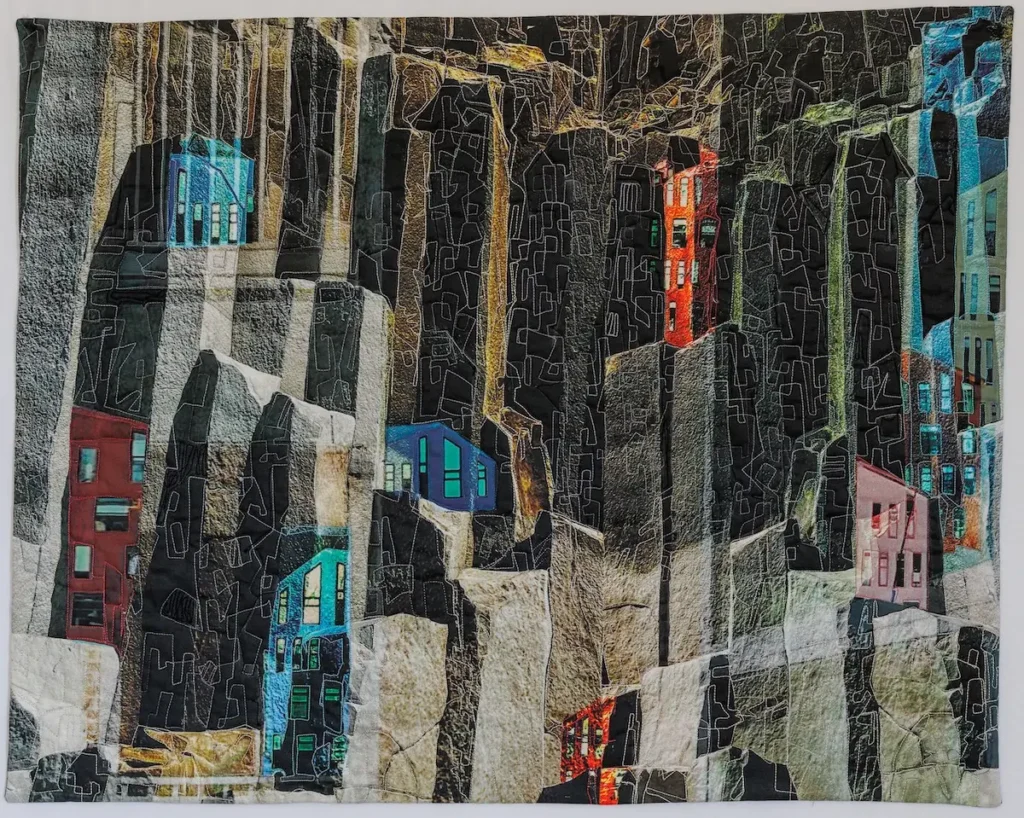
My more recent series of Structures is a complete deviation from the cut or sketch processes. For these, my “design wall” is a Photoshop composition using my own photos raw material. I then have it printed onto fabric for further work. The digital-composition-to-print process feels to me like steps beyond composing with scissors. I have infinite tools to create a very rich composition, far beyond a paste-up.
Do you write an Artist Statement before you start a piece, or only after it’s finished?
I always write the statement after a piece is complete.
My ideas evolve so much while creating it would be impossible to do it sooner. The bits of ideas I have collected while a work is incubating and in progress provide the raw material for the statement.
I have an artist friend who enthusiastically responds to my works in progress or those newly completed. Her questions and reactions help me articulate the ideas I have not yet said out loud. I quickly write down what comes out of my mouth! (Thank you, Emma!)
You have said that narrowing a lifetime of work down to just twelve “milestone” pieces for a talk was harder than you expected. What did that process teach you about your own work?
I learned that it is important to stop and think deliberately about my work retrospectively. Only through this process did I begin to see trends that had been there all along.
I also learned how to talk about my work more broadly rather than as separate stories. I recommend that every artist who wants to keep growing – or who feels stuck—try to “distill” their work to a dozen pieces and see what happens. Retrospective is powerful.
https://makinloud.wordpress.com/2024/03/18/in-retrospect/
What is one piece of advice you would give someone who wants to try quilting but feels too intimidated to start?
This is a tough question. Learning to make art quilts is really two parallel yet intersecting paths. You need some basic techniques, at least enough to begin what might be in your head.
For technique, I do not recommend buying a specific list of fabrics to make a specific pattern by a specific set of steps. B-O-R-I-N-G. Maybe do this ONCE using YouTube or a local class to teach you very basic techniques using leftover fabrics. Don’t waste a lot of money.
Tip: quilters ALWAYS have leftovers they are trying to get rid of! And DO NOT start with a king-size bed quilt!
Most importantly, you need to ignore the fear and give yourself time and permission to play.
Set aside a protected TIME where your artwork comes first. Make mistakes, and, yes, waste materials.
Know that you can always use a messy failure as a dog bed or paint rag. Toss it in a basket under your table to use for testing your machine tension or to cut up into something else.
If you have no idea where to start, take a look at YouTube for idea videos that get you excited. Ask yourself “What if”?” a LOT.
Do not set a goal of a specific, detailed product when you start out. (No holiday gift deadlines!)
You don’t have to go it alone. Hang around some other artists who are a little further down the path and plan some fabric play dates. If you provide the chocolate, they’ll come.
Share what you’re trying. They’ll probably help.
Join SAQA!
Celebrate your accomplishments, no matter how small. And take pictures along the way. The next one will always be better!
As a longtime teacher of creativity itself, what do you think stops most people from finishing a creative project? (or even starting?)
I suspect that people stop before it is done because it isn’t turning out as they expected. The sad thing is that they may not have allowed themselves to consider adjusting the expectations to allow for new ideas that might be even better, more unique, or a bit surprising.
Creativity includes, among other skills, FLUENCY (the ability to generate lots and lots of ideas) and FLEXIBILITY (the ability to put something to a different use or consider it a different way, such as upside down).
If either of these skills is in short supply, or if a maker has a very rigid idea of “success,” the process grinds to a halt at the first obstacle. Cut it up and try again!
Any advice for someone who wants to build a body of work instead of just one-off projects?
I’ve been guilty of simply doing a series of random projects at times, but taking the time to look at a completed work and delve more deeply into an aspect you LIKE about it will lead you to refine your path a bit.
The “choose a dozen” retrospective mentioned above is another way to develop more of a plan for where you want to go next.
How do you decide which quilts to send out into the world for exhibits and which ones stay close to home?
I submit to calls where my work seems the best fit. From there, it’s who chooses me. Sometimes I try a new venue because it’s in a place I want to visit. Most often, I go for exhibits I respect or have heard about from other artists. Some pieces remain at home because they are “classics” from an earlier point in my art career or too personal to be meaningful to others.
Where can people see your work?
See work at my blog https://makinloud.wordpress.com, which I try to keep updated, and at fine art and art quilt/fiber art exhibits – usually east of the Mississippi due to shipping costs. I love to participate in SAQA regional exhibits such as Artists Celebrate Independence, which is currently traveling in Pennsylvania, and SAQA virtual exhibits https://www.saqa.com/art/online-galleries/virtual-gallery-program. I have some favorite juried exhibits where I frequently submit. My blog includes a list of exhibits where I have been so far. https://makinloud.wordpress.com/about/exhibits-etc/
https://www.instagram.com/chshively
Rapid-fire fun:
- Favorite tool in your studio? My two Berninas, Scissors! One favorite kind of mechanical pencil.
- Quilt you’re proudest of? Whatever I finished most recently! Leaders of the pack beyond that are Build Up, Unprecedented, Back Pocket Blues, F-Words, Zoomsick.
- Dream place to see your work exhibited? Constitution Center in Philly for my more political pieces; bucket list places: Quilt National, a SAQA GLOBAL exhibit, ANY museum, Visions. Anywhere people will walk by every day and stop to ponder.
- Hand stitching or machine stitching? MACHINE!
- One word for your quilts? Thought-provoking
All images in this article are by David W. Shively.
Interview posted August 2026
Explore more art quilts on Create Whimsy.