
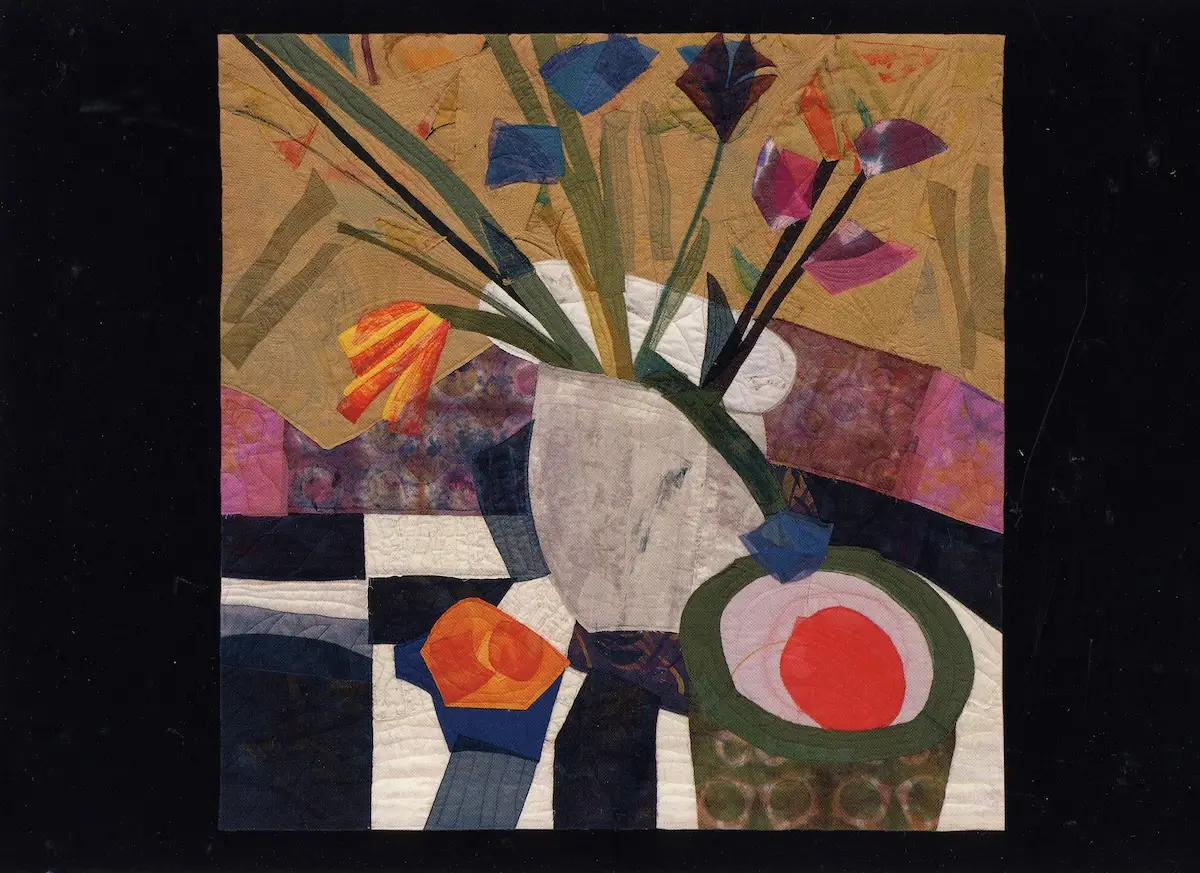
Dominie Nash has spent decades letting fabric, dye, and stitch lead the way. In this thoughtful conversation, she shares how quilting became her creative language, how her process has evolved, and what keeps her showing up to the studio day after day. It’s an honest look at persistence, curiosity, and listening closely to the work itself.
Tell us how you first discovered textile art and quilt-making.
In the late 1960s I met a group of women who were part of a crafts cooperative in a farmers market. I had small children and was looking for something to do after leaving my previous field. I had done a lot of sewing and knitting and submitted some of my children’s clothing for consignment, eventually becoming a member of the coop.
Through the group i met people who were weavers, quilters, and creative stitchers, and was inspired to take my first weaving class. I pursued weaving and also taught myself batik along with some friends. After seeing and reading about some non-traditional quilts, particularly those made on the West Coast and shown in books by Jean Ray Laury and others, I started making some using my batik fabrics.
I went back and forth between weaving (concentrating on ikat and painted warps) and quilting for about 15 years, when I got my first outside studio and decided to concentrate on quilting and surface design. I had also joined an exhibiting art quilt group, New Image, a few years earlier.
As an Amazon Associate I earn from qualifying purchases. Read more about our affiliate linking policy.
What drew you to fabrics and thread instead of paint or canvases?
I have always been intimidated by using paints and brushes on a blank canvas. I was not a success in the few art classes I took in school (representative drawing was rewarded, not my strong suit!), but I made a lot of my own clothing, so textile crafts seemed a logical choice when I decided to try to do art more seriously.
Was there a particular moment when you realized, “Yes—this is what I’m going to do”?
I didn’t know how I was going to do it, but I was feeling the need to make a commitment after giving up my academic studies. It just evolved gradually from that point until I was spending more and more time doing fiber art and finding a community of peers and mentors who encouraged me
What kept you motivated in those early years (especially when things didn’t go smoothly)?
I told myself that if I gave up the only thing to do would be to return to social work or graduate school—that was a strong motivation to continue! Also the rejection and failures were hard but I really loved the process no matter the outcome
Who or what inspires your work—people, places, nature, other artists?
Nature, contemporary art, and folk art.
What quilt-making traditions did you look at and decide to depart from? What quilt rules do you ignore?
The first quilts i saw in person were in a show of a fabulous collection of traditional quilts in an art museum, which were certainly art.
I started using traditional patterns but always wanted to restructure them, changing color arrangements, sizes of blocks, etc. Also, precise piecing was definitely not in my skill set! Nothing was ever flat or square.
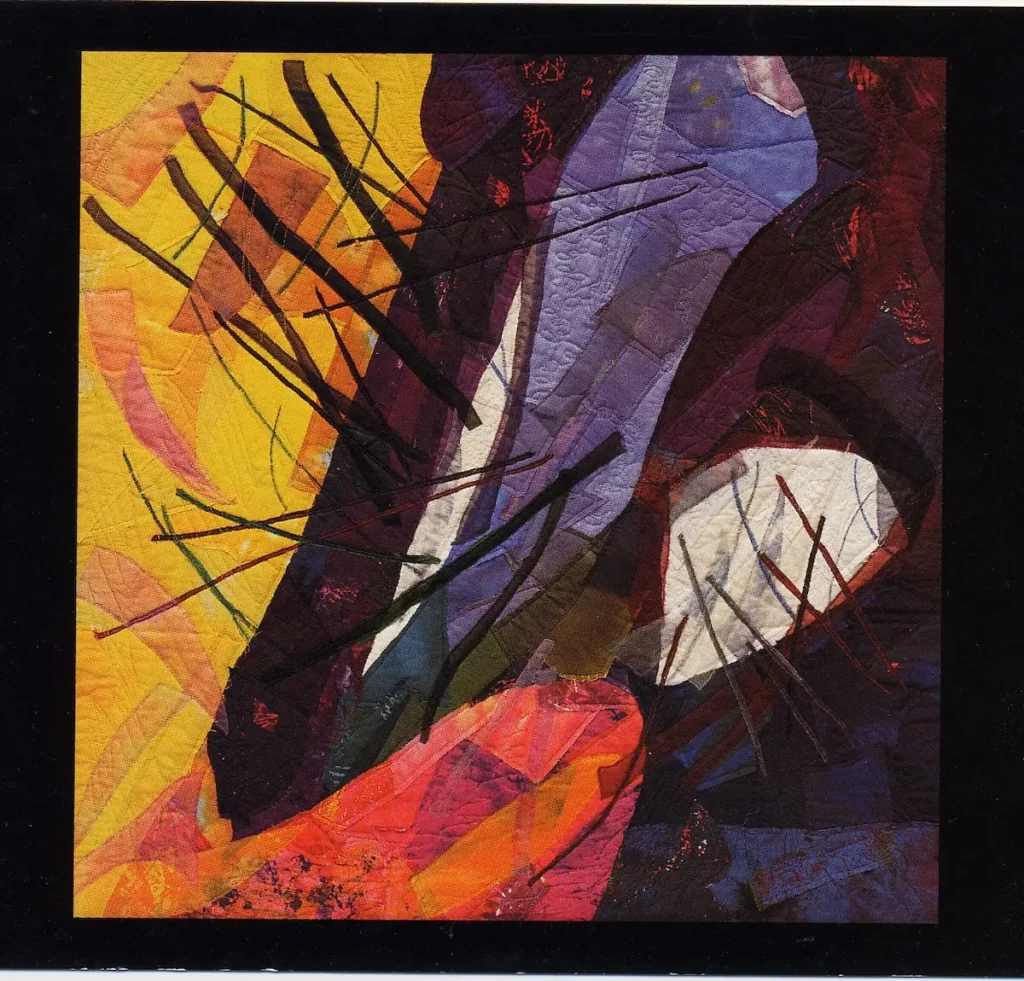
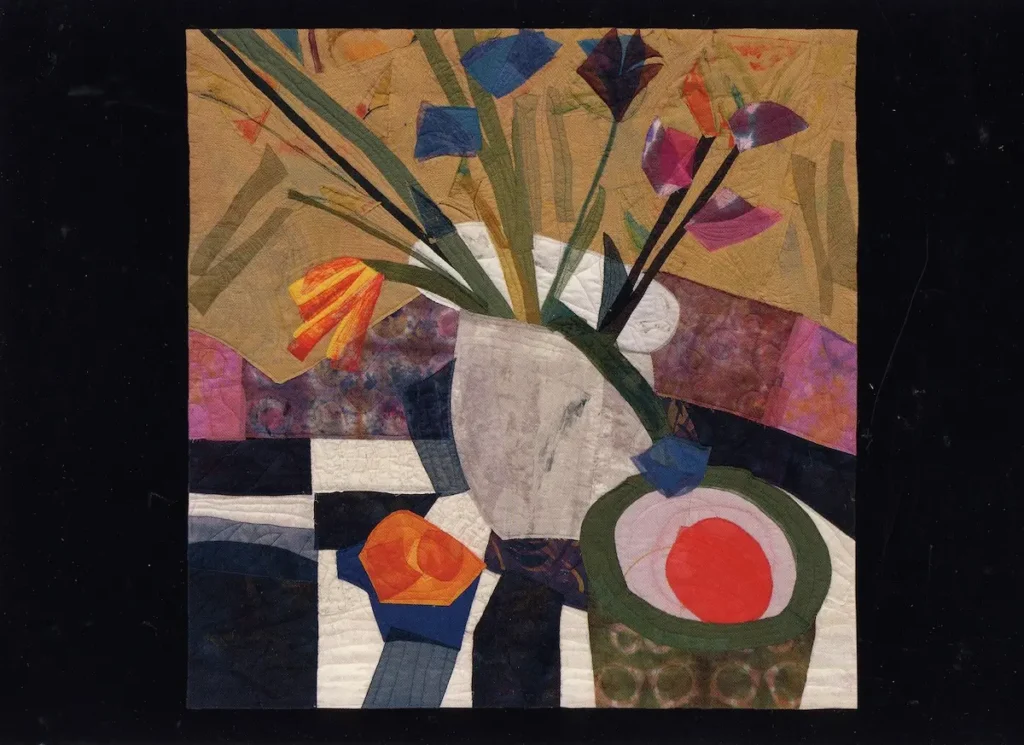
I decided I didn’t have to follow those rules and developed my own method of designing and making quilts, which worked for me technically and also gave me a lot of freedom. I still basically use these methods: instead of making a quilt top, I baste together backing and batting and collage the elements of the composition by machine, using a raw-edge overlapping appliqué technique. At every step, I’m sewing through all the layers.
How do you balance what you love (textures, layers, fabrics) with your desire to try something new?
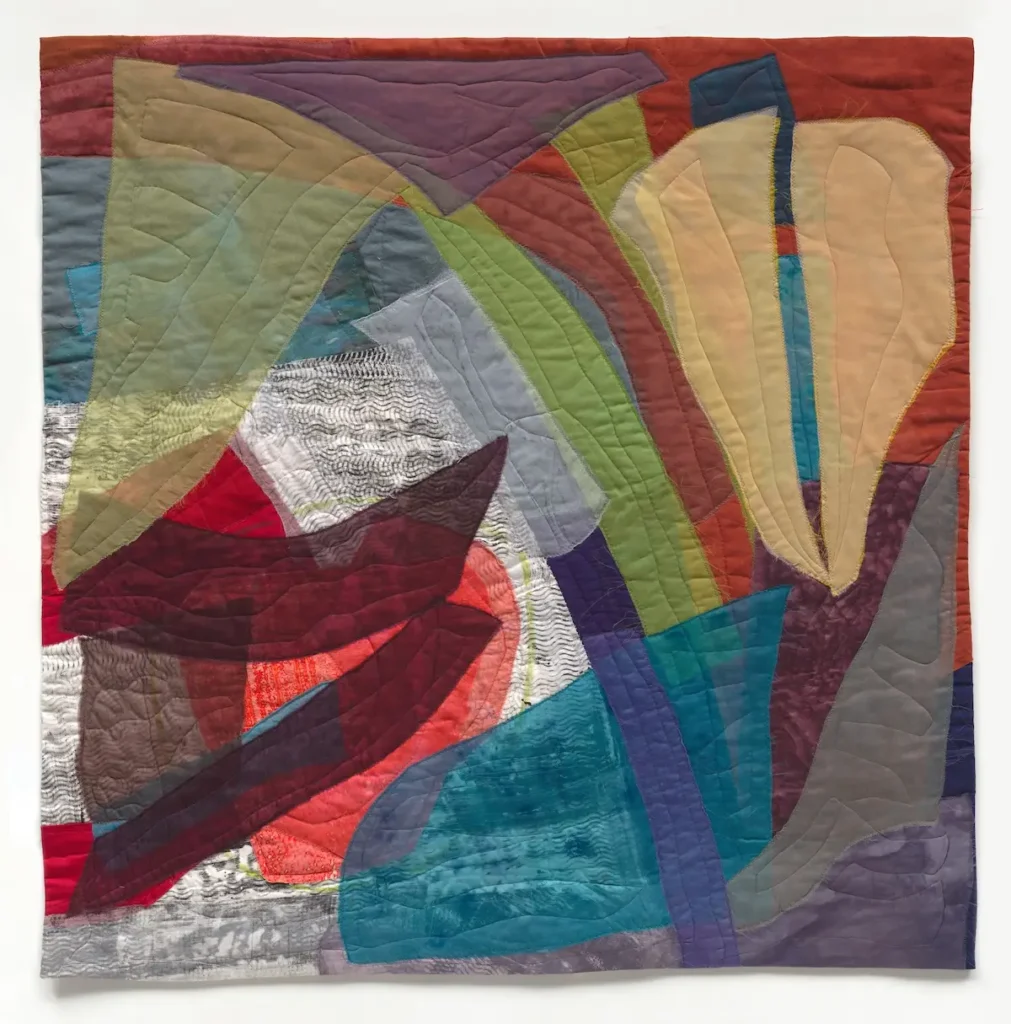
I keep thinking I should try something completely new, but there is always something different to learn and try using the things I love to do—a new printing technique in particular, hand stitching, etc
Have your influences changed over the decades? What used to excite you that maybe doesn’t anymore? What new things capture your attention now?
Although I love to see other artists’ textile artwork, I find that over time I look more at paintings, prints, photography, or ethnic textiles as inspiration. It separates technique from design, color, composition to get to the essence.
Describe your creative space.
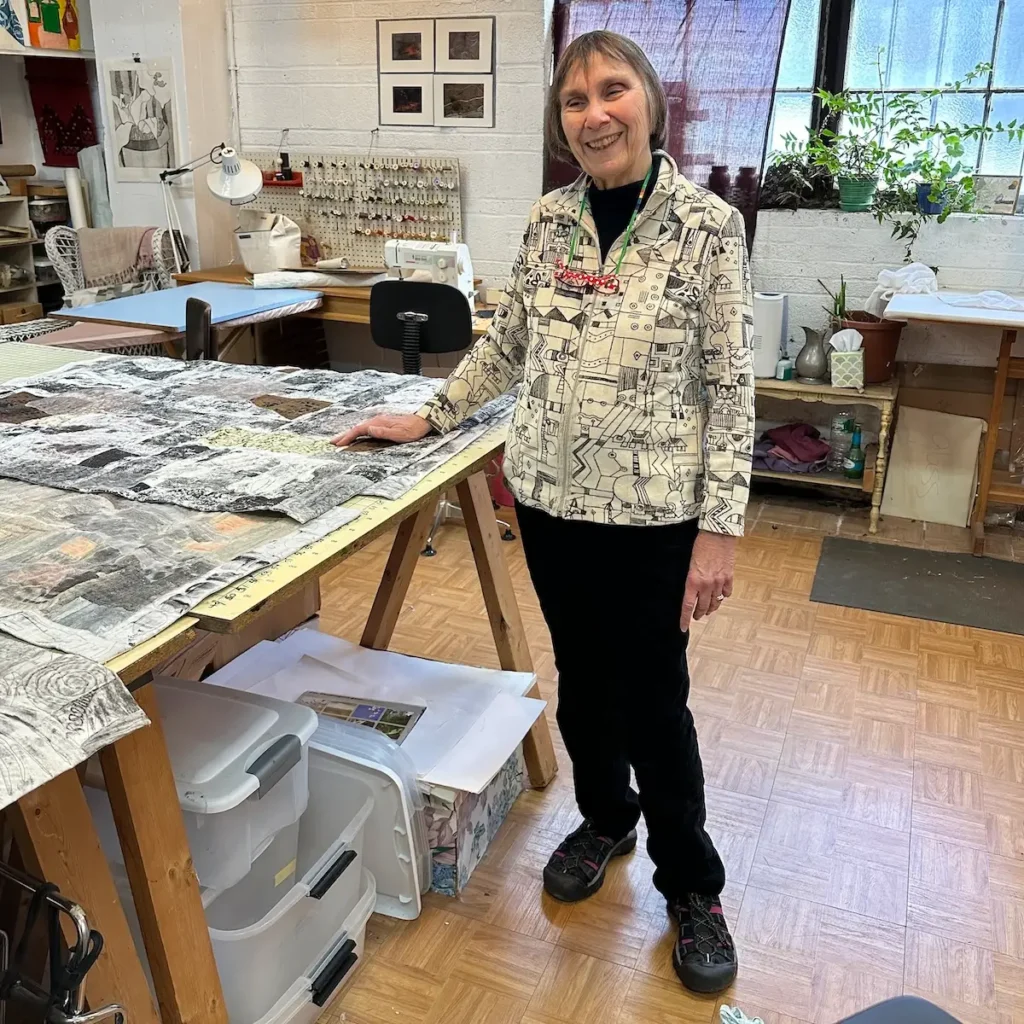
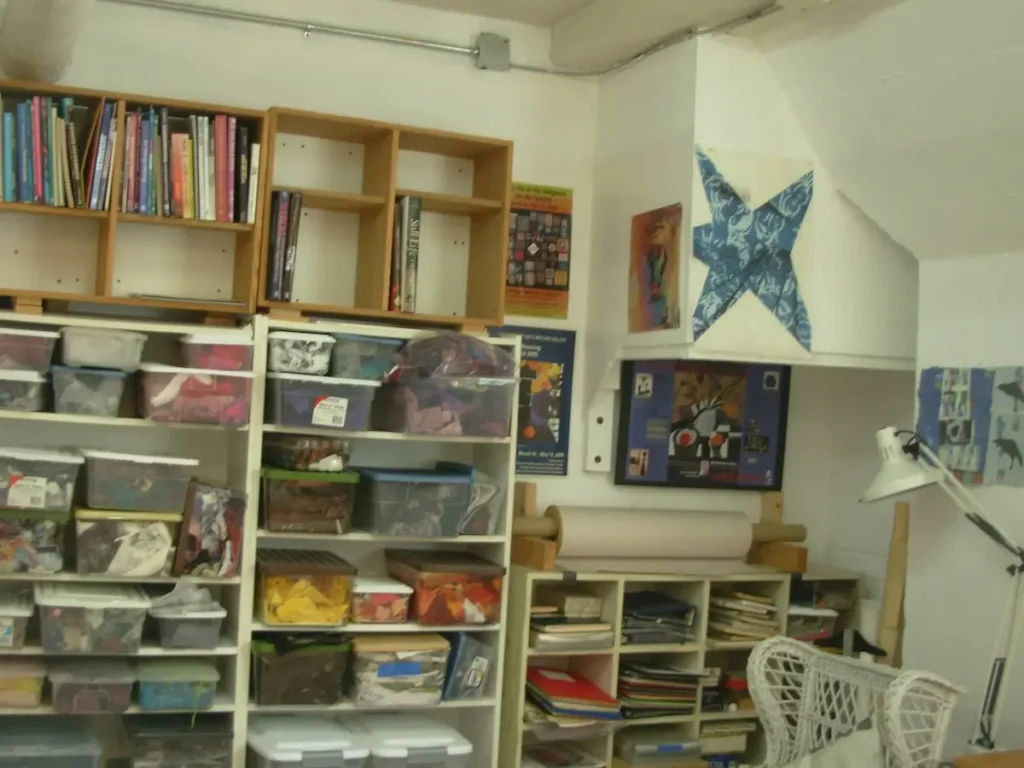
I’m fortunate to work in a 500 sq ft space, plus a storage room and some common space with a sink, shared with my suitemates in an artists’ coop in an old industrial building in Washington, DC.
There is some diffused natural light, high ceilings, and room for an 8×8 ft cutting/ printing table. It’s about a half-hour drive from my home, and I try to get there every day, often working on the weekends to make up for days when I have to be away for appointments and meetings.
It’s important to be there as often as possible to keep up the flow and provide enough time to get things done. One of my favorite quotes says it all: I go to the studio every day because one day I may go and the Angel will be there. What if I don’t go, and the Angel comes? (Phillip Guston)
When you look at your studio at the end of a day, is it messy, tidy, or somewhere in between? How does that reflect your process?
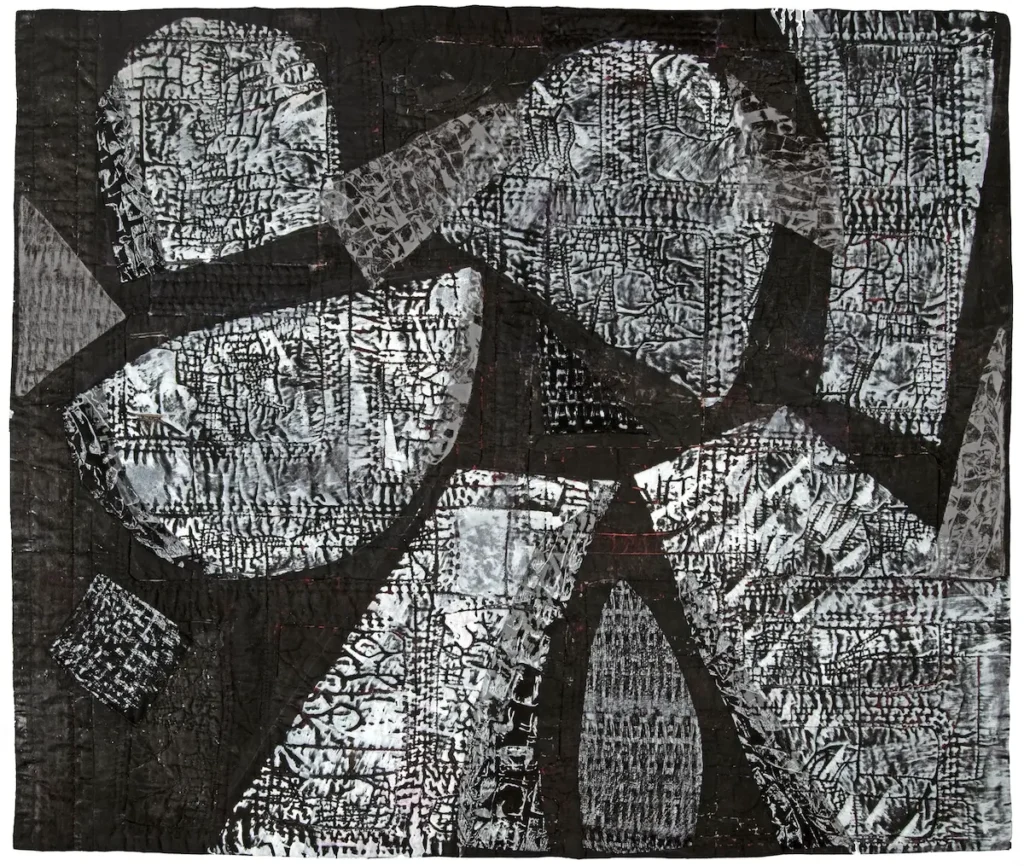
Mostly messy, especially when I’m printing. I’m usually going back and forth between various parts of the process, using every available surface, plus wall and floor. Every once in a while, the mess is overwhelming, and I put some things away so I can continue to be productive.
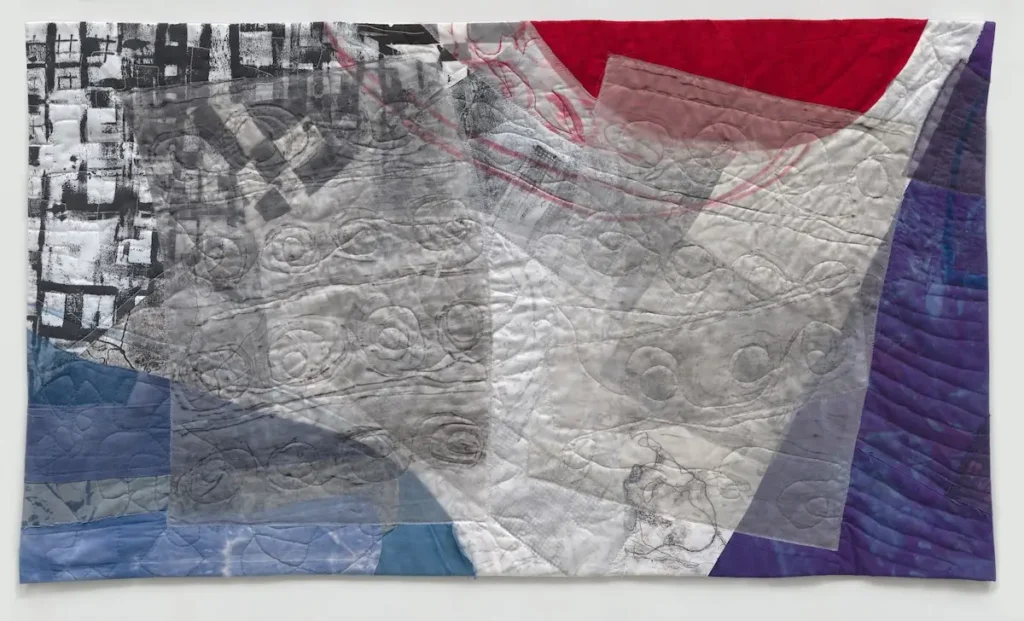
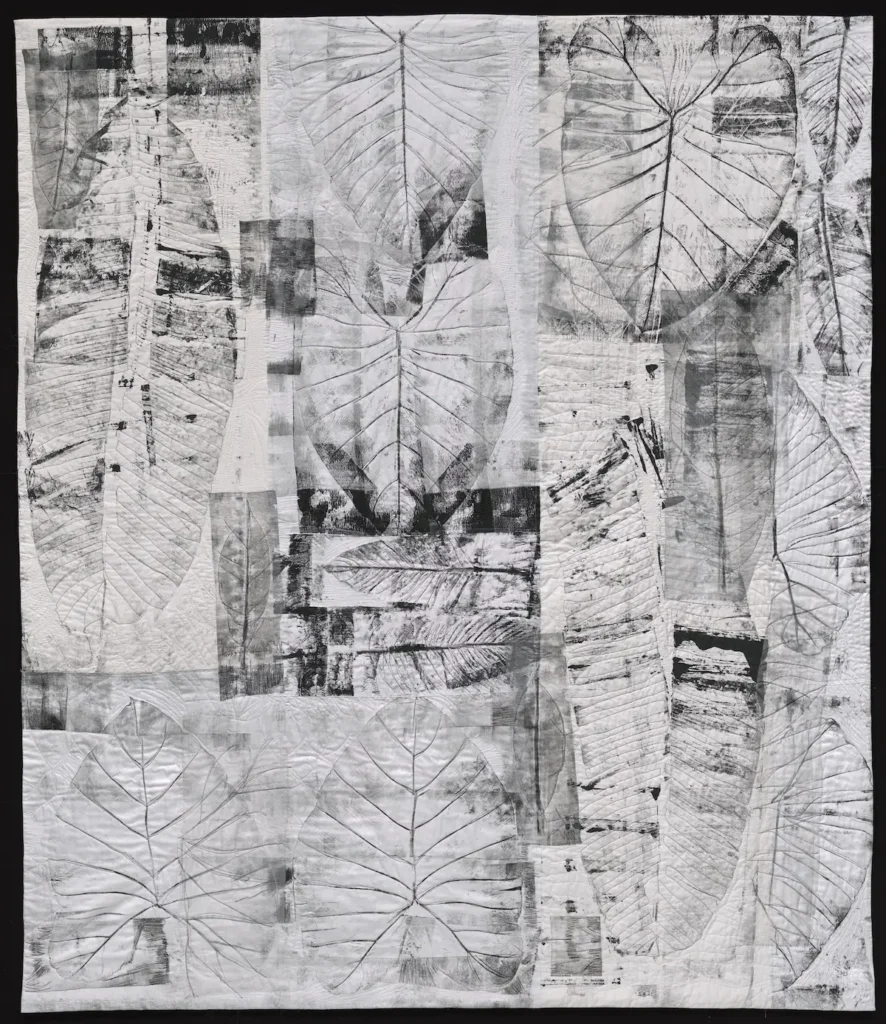
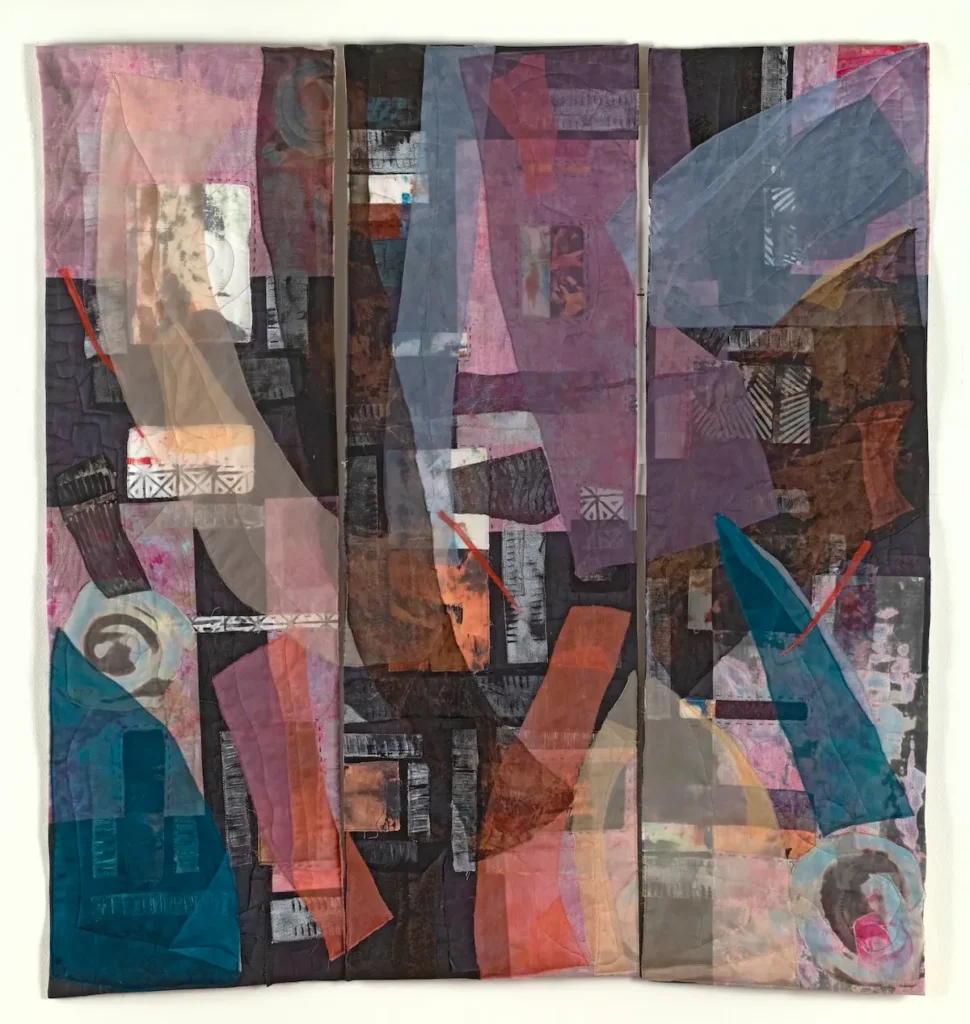
You use a lot of different techniques in your work – immersion dyeing, screen-, mono- and ink-printing, resist, discharge, machine stitching, embroidery, layers of organza, and more. How do you decide which techniques will be used for a specific piece?
There is a certain look to each of these techniques, so when I’m thinking about a new piece, I usually know what effect will work to bring my ideas to life.
I have a lot of fabric that I’ve made over the years, so I can usually go through the boxes and find something that seems right, or if nothing fits my vision, I’ll start printing again (which is my favorite part of the process)
How much planning do you do before you begin a piece, versus diving in and discovering as you go?
Usually, the latter, starting with particular fabrics and seeing how they work together, but sometimes I do start with a sketch or collage as the basis of a composition.
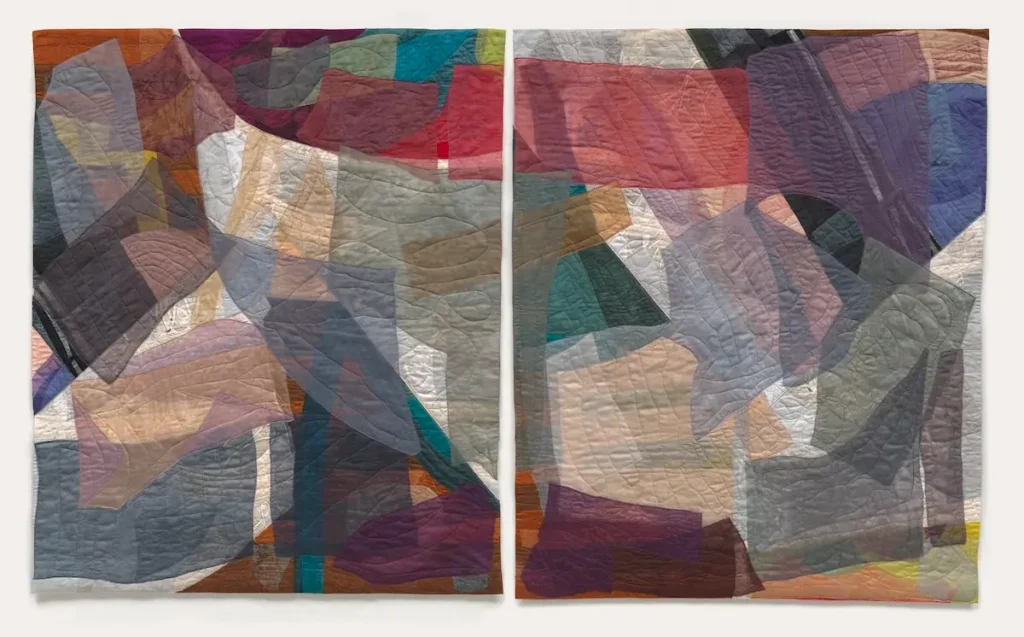
In general, I don’t like themes or challenges. Even then, my choice of color/fabric is pretty spontaneous. My most recent work involves working with older pieces and transforming them into something new, so I’m starting with a specific structure to work with: cutting them apart and rearranging, changing the surface with paint or another layer of fabric, etc.
There are some built-in limitations, but sometimes the transformations are amazing. I’ve done this a number of times over the years as a way of redeeming my failures or false steps and ending up with something more in tune with my current ideas. (I often scratch my head and ask why on earth I thought the original piece was a good idea.)
When a piece isn’t working, how do you recognize it, and what do you do?
That is so hard. It should be obvious when something isn’t working, but it can be really hard.
Sometimes the piece sits on the wall for long periods of time. When I really can’t decide, my studio mates are called in, and they are kind but honest, suggesting things to try or giving a thumbs down. I really listen to their ideas and opinions as they are coming from different media and points of view, and a fresh eye is helpful.
If a piece is unredeemable, it ends up under the table (I call it my pile of shame) until it becomes a makeover or fabrics are taken apart to use again somewhere else. Another favorite quote: You must kill all your darlings (William Faulkner)
Has there been a time when the materials “spoke back” at you? When the fabric or dye pushed you in a direction you didn’t expect?
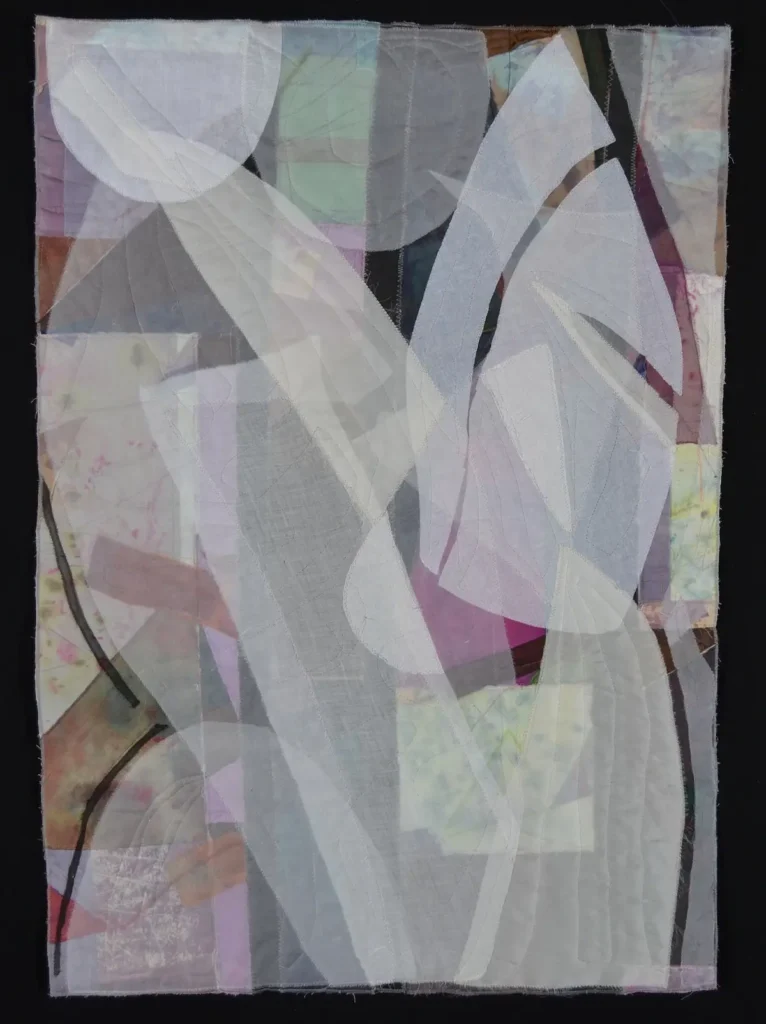
Yes, since some of the techniques I use are unpredictable, and the unexpected results can definitely generate ideas.
How do you deal with “creative blocks” or lulls in inspiration?
It makes me very anxious and frustrated, but I keep telling myself that this has happened before and I will someday make another piece and enjoy the process again.
I give this advice to other artists but have trouble following it myself—and I’ve been working at this for so many years!
How do you stay curious and engaged after decades of making?
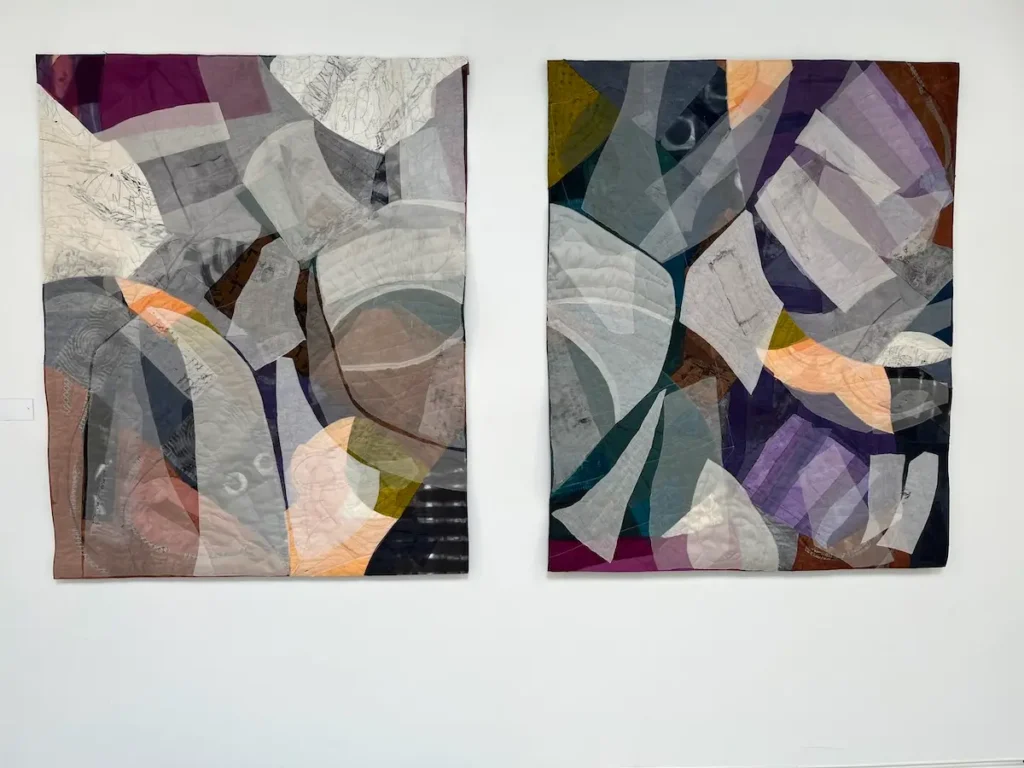
Art is endless, and even during a lull, I know that this is what I love to do, and I can’t imagine doing anything else.
I go to a lot of museums and exhibits of local artists and always find something to challenge or surprise me—It may take a while, but the motivation is there.
What do you love most about being a full-time art quilter? On the flip side: what do you find most challenging about making art as a career?
It is a great privilege to be able to do this, to watch a piece evolve or try a new technique with no judgment (except in my own mind or when a juror rejects my work)
Rejection is a hard thing to deal with, even after all these years, and the field is more competitive, but I’ve become more rational about it and don’t accept it as determining my or my work’s worth. And acceptance doesn’t either. Basically, I have to make my own decision about whether I have done what I set out to do and am growing and improving.
I’m fortunate that I don’t have to make a living with my art, so I don’t need to compromise, though of course I care whether my work gets out into the world (at least on a local level).
Where can people see your work?
I have a website: http:// dominienash.com and an Instagram @dominiemaria and Facebook https://www.facebook.com/dominie.nash which I try to keep up to date with new work and information about exhibitions.
I apply for solo shows (usually in my local area. I have one coming up in February in Frederick, MD) and enter a lot of juried shows, particularly all-media and textile shows—not quilt shows so much these days, where my work doesn’t always seem to fit.
I exhibit with several groups as well: New Image Artists (newimageartistquilts.com) in the DC area where I live, and Quilt Art, a Europe-based group (quiltart.eu), which sends traveling exhibitions all over Europe and other places in the world, accompanied by beautifully designed catalogs.
Interview posted January 2025
Browse through more mixed media inspiration on Create Whimsy.