
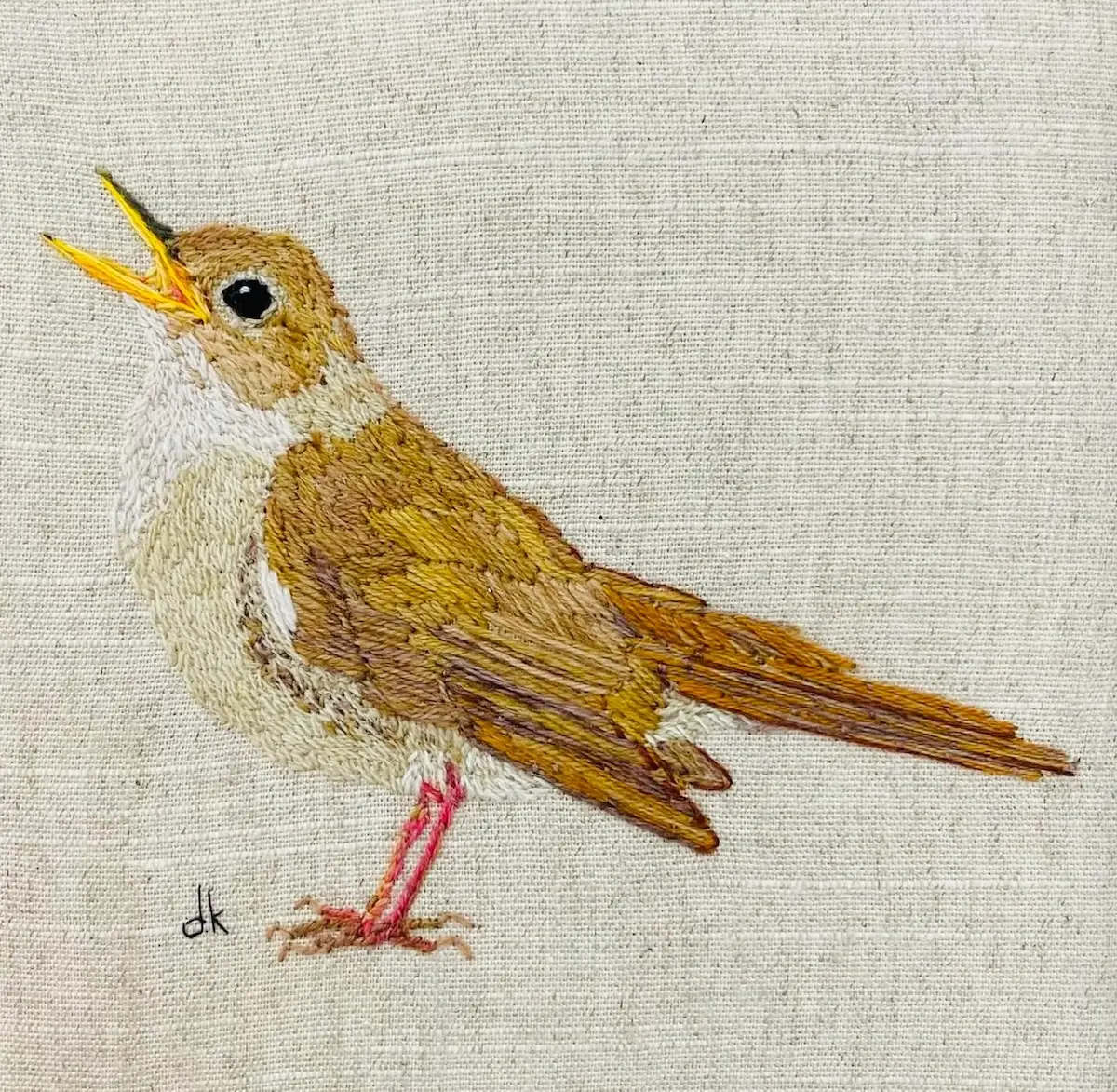
Deborah Kemball has followed a fascinating creative path, from machine-pieced quilts made at lightning speed to richly textured hand appliqué inspired by historic chintz fabrics. After completing the quilt designs she had long imagined, she turned her attention to embroidery, where palm trees and birds now fill her stitching world. In this interview, Deborah shares the story of her evolving creative life, her intuitive design process, and why curiosity and experimentation have guided every stage of her work.
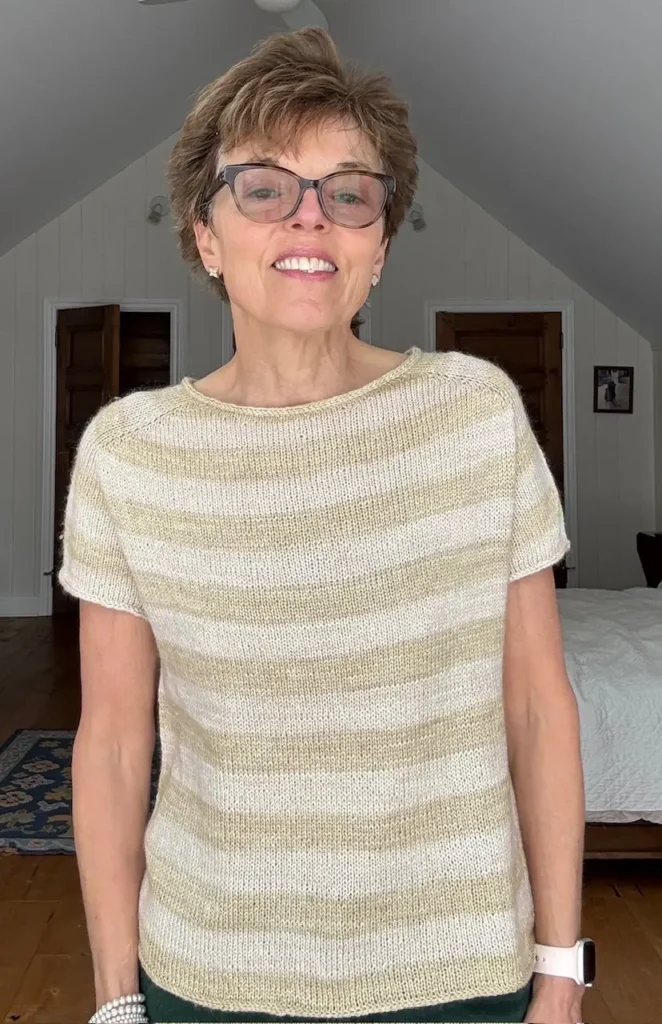
Do you remember the first quilt or textile project that made you think, “I want to keep doing this”?
I think I was naturally creative and interested in textiles from a very early age.
I can remember in great detail the delight I took in making a rag doll at school, aged seven. I was lucky to have the example of a mother and grandmother who made all their own clothes and home furnishings.
My mother taught me to use a sewing machine as a young girl, and I was stitching favourite skirts, zippers, buttonholes, and all, by the age of 11 on her Singer sewing machine.
As an Amazon Associate I earn from qualifying purchases. Read more about our affiliate linking policy.
My granny taught me to knit with great patience. I consider these early lessons from both my mum and granny one of the very best gifts they bestowed upon me.
How did sewing and quilting first enter your life? Was it something you learned from family or discovered on your own?
In my twenties and thirties, I loved tapestry and cross stitch, and then around the birth of our third son in 1993, I passed the window of a quilt store in Eindhoven, Netherlands. It was love at first sight; I had never seen such beautiful patchwork quilts in my life.
Totally smitten, I started to produce machine-pieced patchworks at an impressive rate.
I was lucky to spend some time in Costa Rica in the late 1990s, where I could buy flawed American quilting fabric by the kilo for mere cents. I felt able to experiment and fail at no great monetary cost, and although I fell out of love with machine piecing by the turn of the millennium, I regard this period as important, when I learnt about colour, value, and balance.
I am more or less completely self-taught. We lived abroad in many countries as a family before the dawn of the internet, and so one had to be fairly autodidactic.
I did have a handful of books on our travels, and the patchwork book that was my bible was Simply Stars by Alex Anderson. I stitched nearly all of the quilts.
You are known for handwork. What made you fall in love with stitching by hand instead of using a machine?
By the end of our period in Costa Rica, I was piecing and hand quilting a king-size quilt every three weeks, an astonishing rate by any measure. But it seemed no matter how hard I tried to be accurate, my seams never aligned. The stress of it would find me hunched over my sewing machine with gritted teeth, a splitting headache, and stressed to the core.
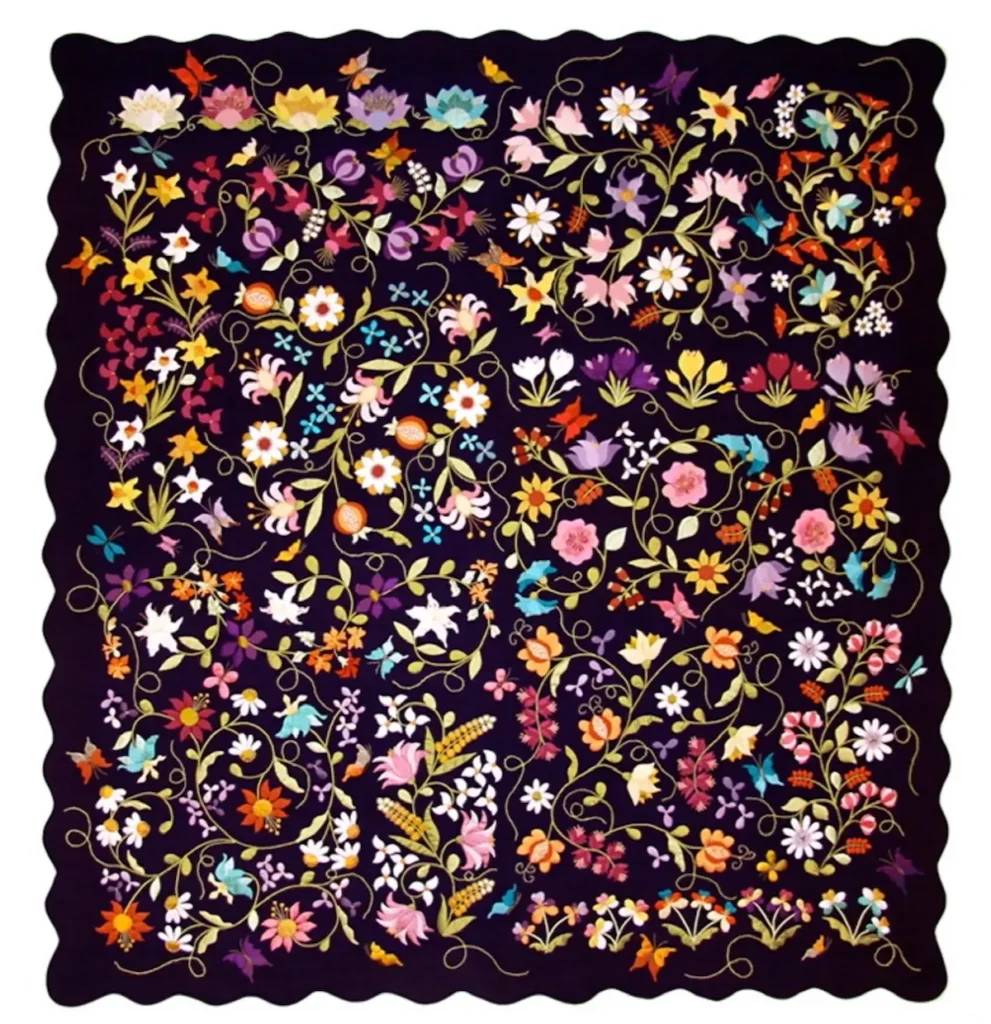
About this time, I decided to hand quilt a wholecloth quilt, my own design with hand turned scalloped edges, and that was it, I knew my machine piecing days were over, and I’d found what I loved to do most.
I think I was quite surprised because I like pretty instant gratification, but I found my applique quilts didn’t take as long as you would imagine, most taking a couple of months.
I started to dabble in appliqué using the concepts of my early tapestry designs, and I think, as a result of my ignorance of the aspired perfection of appliqué and how it should be done, my methods were very quick and easy to achieve with no special equipment or tools.
I also had no idea that the resulting loft in my motifs was not the norm and in ignorance, I particularly liked the added texture and was not discouraged.
This loft comes about because of my large seam allowances for needle turn applique, and the texture of my quilts has become one of my signatures. The only equipment that I used was freezer paper and the same needle, a #9 for everything from quilting to appliqué.
Antique textiles are often mentioned as an influence in your work. What first captured your attention about them?
I think I probably first saw classic floral chintzes in the homes of my family as a child.
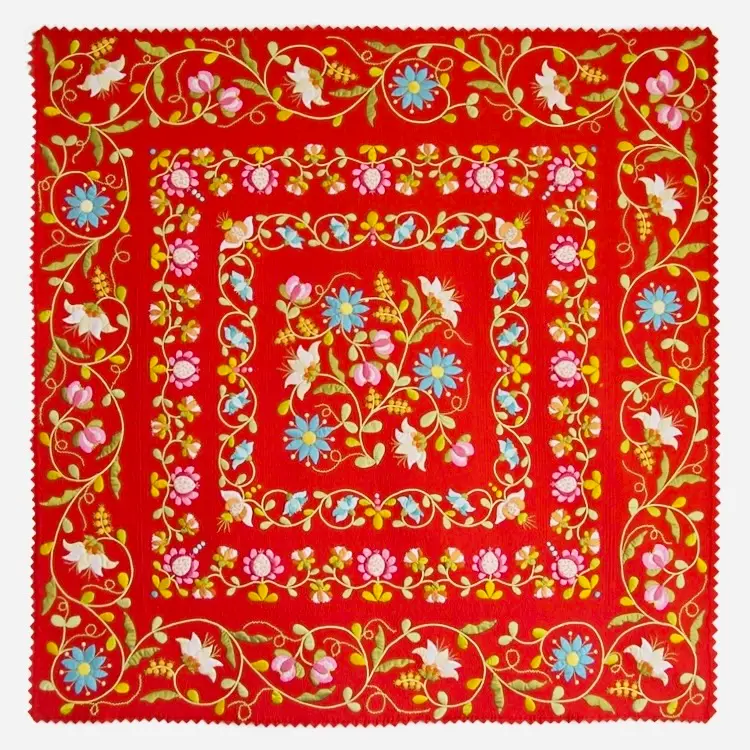
I had always been drawn to the fluidity of chintz designs, their blowsy flowers, the lyricism of their stems and greenery in arabesques and delicious swirls. This, combined with the inspiration of the gorgeous colours of 18th and 19th century European chintzes imported from India, makes it unsurprising that a few years later, I found myself replicating this style in my appliqué quilts.
I was also very influenced by the silk designs of 18th-century Britain, most especially the work of Anna Maria Garthwaite (1688-1763), whose beautiful illustrations in her sketchbooks really spoke to me and whose work I had come across in the V&A museum in London.
Do you design directly onto fabric, or do you work through drawings first?
I always had a very clear idea in my head of the design I had in mind for a quilt, and I worked directly onto the wholecloth background fabric, which was frequently red.
Red is not only a favourite colour of mine, but I found it worked as a surprising neutral and worked with a whole kaleidoscope of colours.
I am very old school and have never used anything more sophisticated than a pencil and paper, which I would use to draw flowers onto freezer paper to use for appliqué, and I never drew the design out ahead of time.
My technique was always the same. I would always place the stem on the background first, and I found with experience that this was the most important thing of all.
In this example, Jeweled Garden, I appliquéd the stem all over the background (knowing that I could cut into it if needed later), and once that was done, I slowly filled the quilt up with motifs – for example, all of the large blue flowers first, and then the pink, then the berries, etc. In this way, I could slowly fill it up, keeping everything in balance. I would usually know intuitively when to stop.
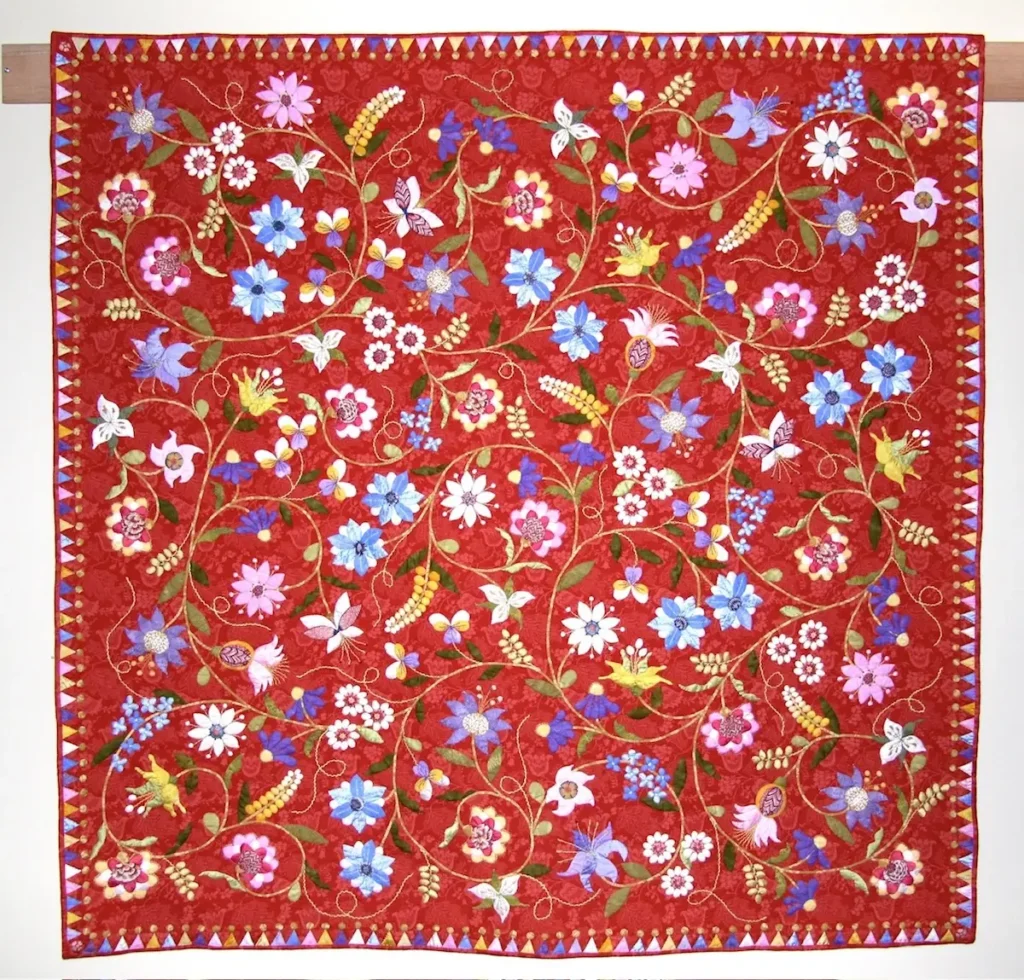
Many of my quilts have a sawtooth border, which were machine stitched (foundation pieced for accuracy), but apart from that, everything, the applique, the embroidery, the beading and quilting are by hand.
Tell us how your creative journey has evolved.
I loved these quilts I made over a several-year period, which were lucky enough to win many international awards and facilitated a book deal with C&T books.
I was delighted to demystify my work in both my books and workshops. I’m not a perfectionist, and I feel this is probably the biggest obstacle that stops people from trying appliqué.
My quilting was a full-time job. I would stitch from morning to evening, and the absorption of the process of watching a design come to life at times would consume me.
I loved what I did and was lucky enough to have a supportive family that got used to being covered in threads and to finding needles in surprising places.
Then, out of the blue, I realised that all the designs I had had in my head were complete, just as I wanted them to be, and I knew that was it, I wouldn’t make any more.
No one believed me at the time, but I knew that was it – the passionate love affair was over. I had enjoyed more than a decade of quilting pleasure, had books and pattern packs published, won prestigious awards, learned a lot, but that was it. My last appliqué quilt was made in 2014.
I did realise that wasn’t the end of my creativity which is such a huge part of me, and that I would always be fiddling around with needle and thread, something or other.
I was always knitting anyway, dabbled in painting and basic wool applique, but it was Covid that really made the difference. A friend showed me her Sue Spargo Circle Sampler that she made during the lockdown, and I was smitten.
Tell us more about how you discovered your new love for embroidery.
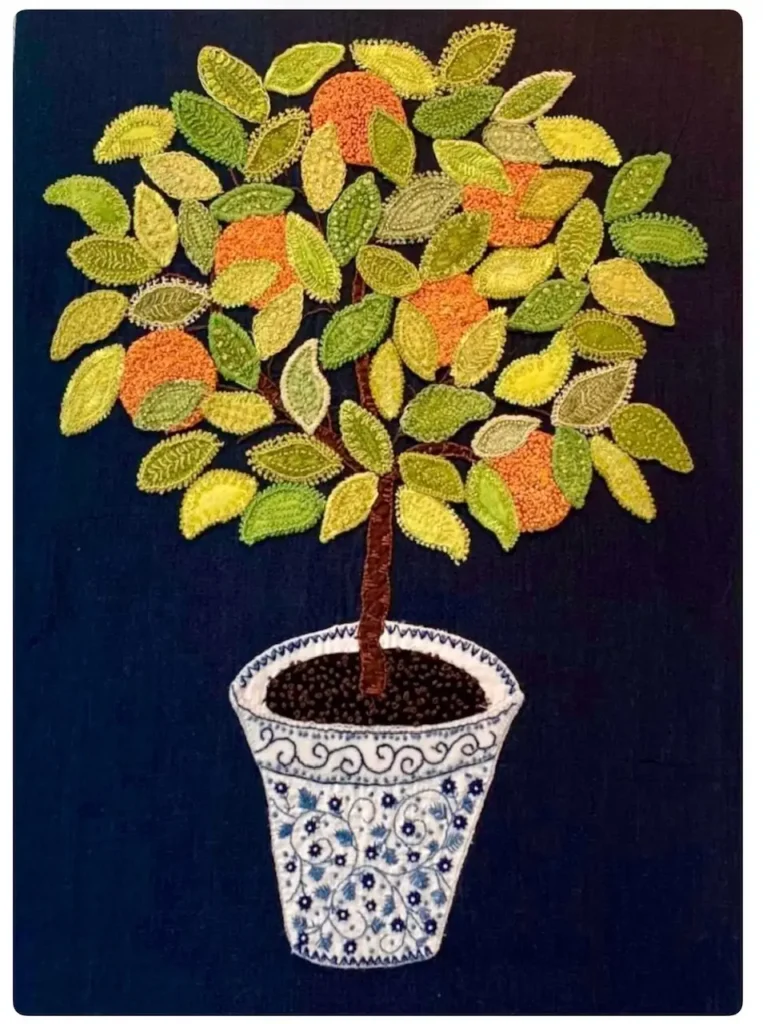
Always self-taught and a very basic embroiderer, as soon as I saw the wealth of stitches and breadth of colours of thread, I knew this was something I wanted to learn.
I then completed quite a few heavily embroidered pieces with what I had learnt from Sue Spargo’s embroidery book. I became very comfortable drawing with needle and thread, and the next jump to palm trees (an obsession) and birds was pretty logical.
Always a passionate knitter, I have a vast number of sock yarns which, it transpired, make perfect embroidery threads when split into individual strands. Over the past couple of years, I have been embroidering palm trees in every which way. I am completely obsessed with palm trees, and their shape and elegant fronds make them a delight to embroider. I have embroidered cushions, pictures, and a larger palm tree sampler.
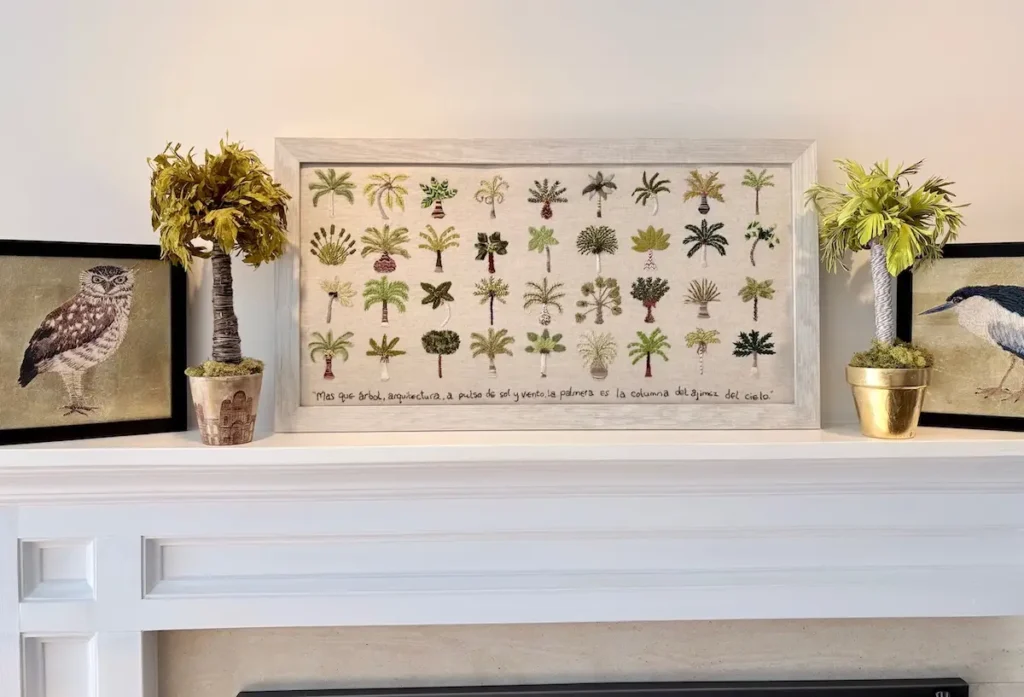
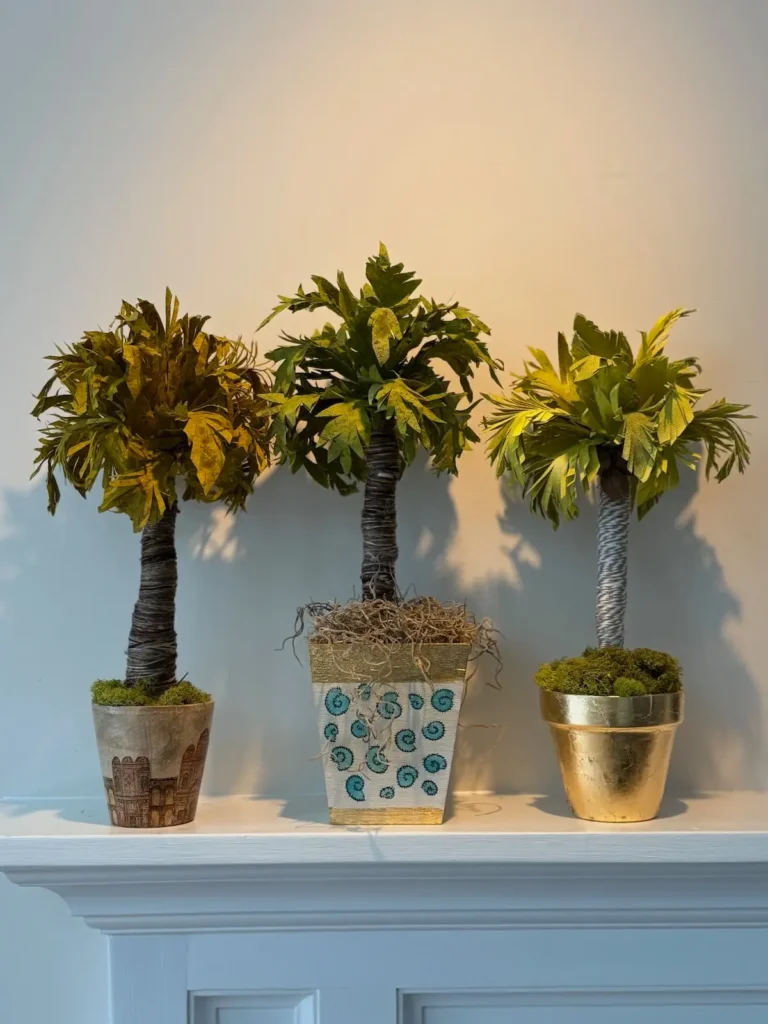
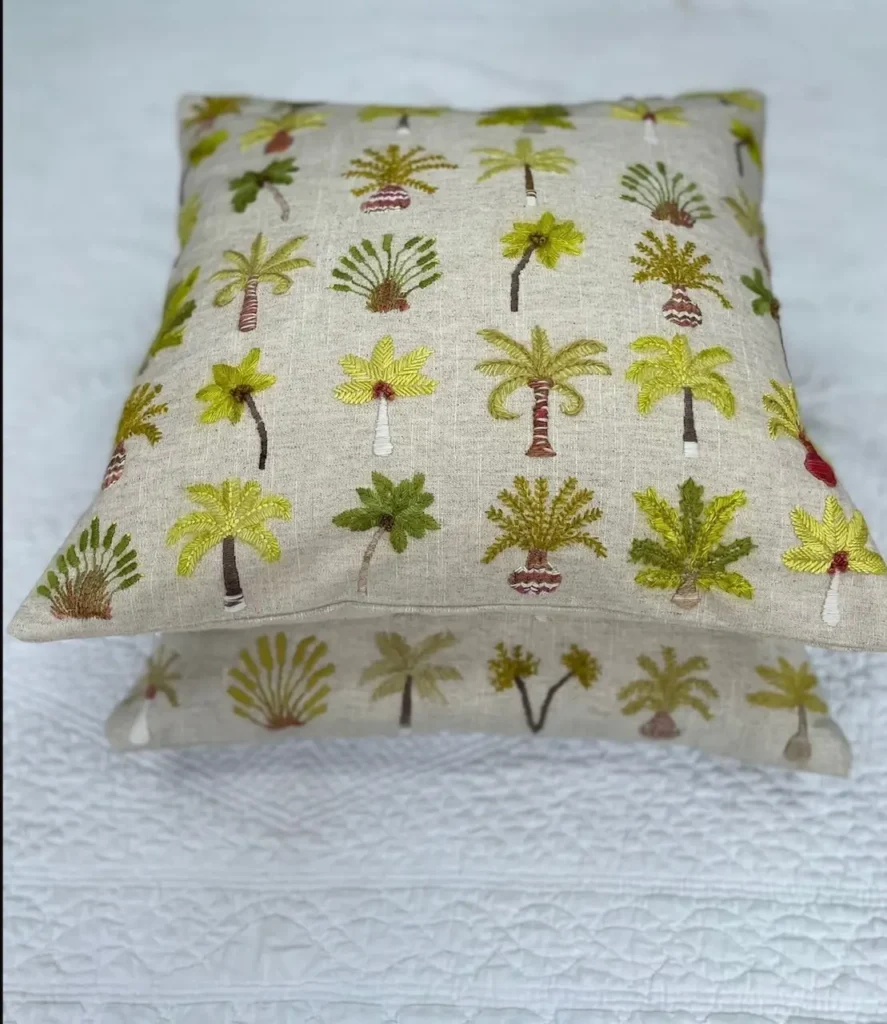
How did your current passion for embroidering birds come about?
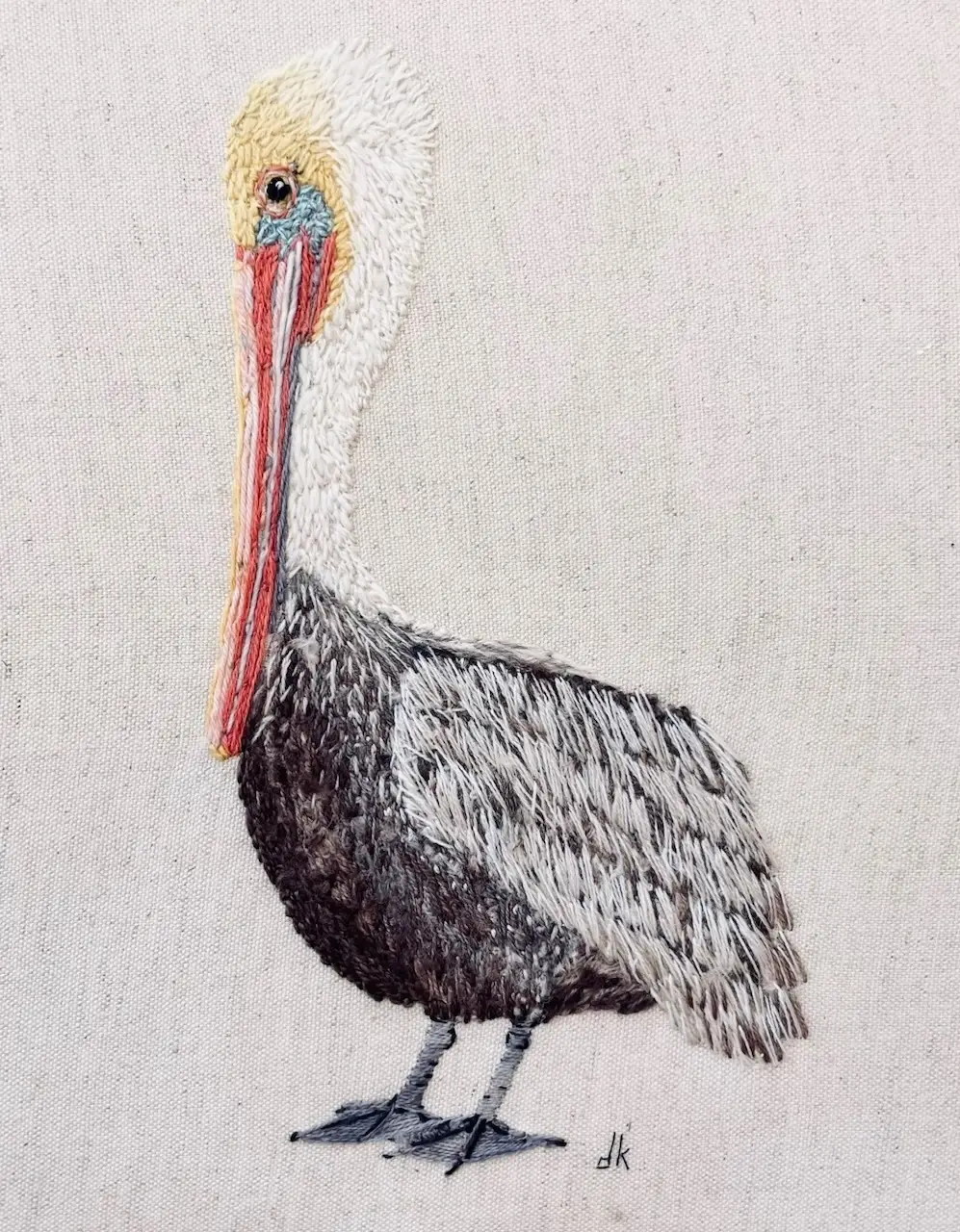
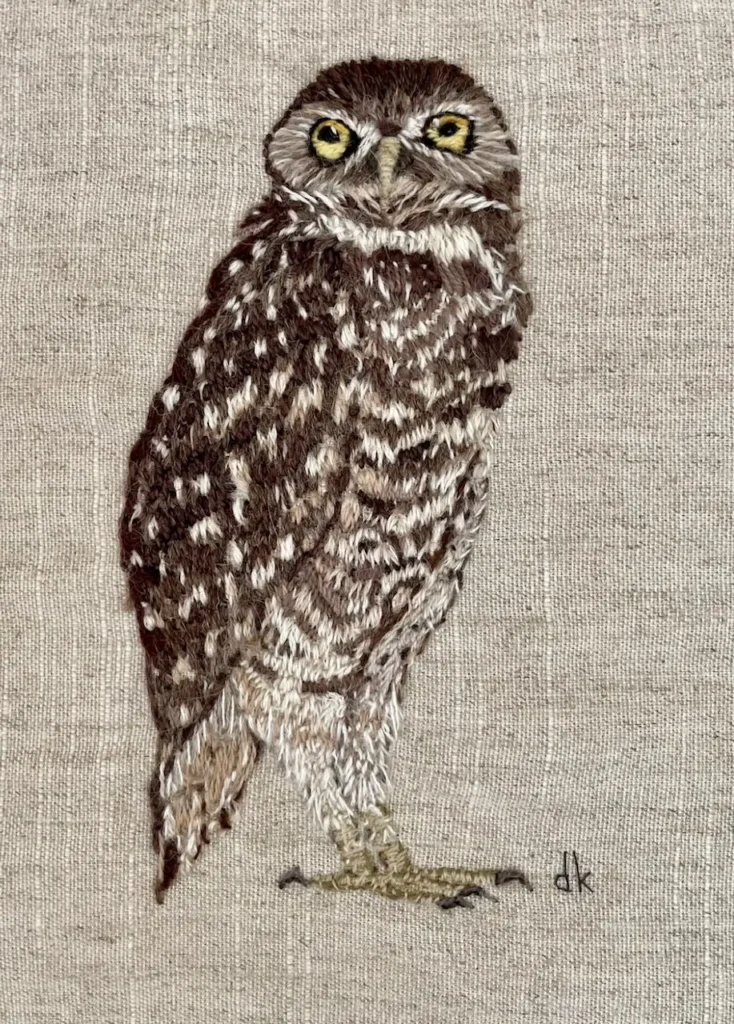
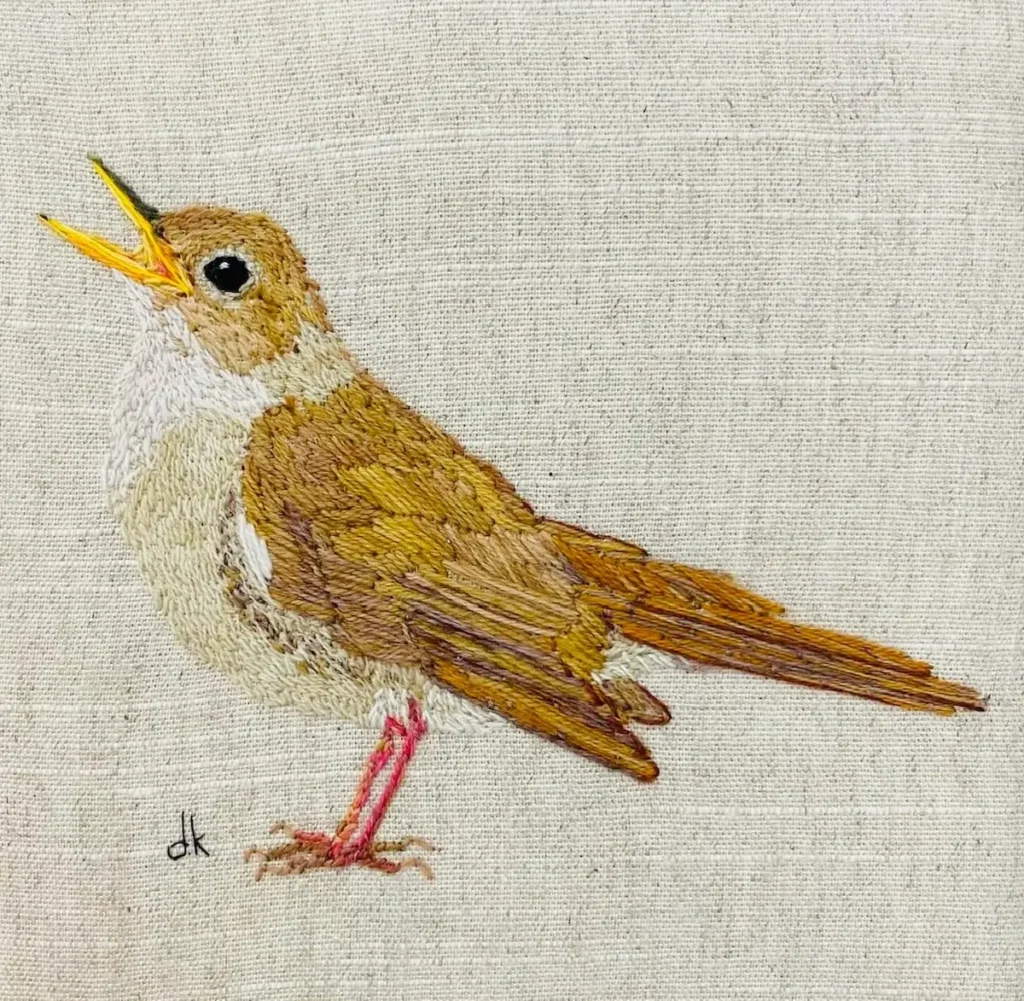
However, birds are what have taken over my life now, and my main focus is to try to build a collection of a number of embroidered birds for exhibition and sale to raise money for their protection.
Nearly all of my embroideries are on a linen cotton background, 8” square. I draw the very basic shape of the bird on the background and then literally just fill it in.
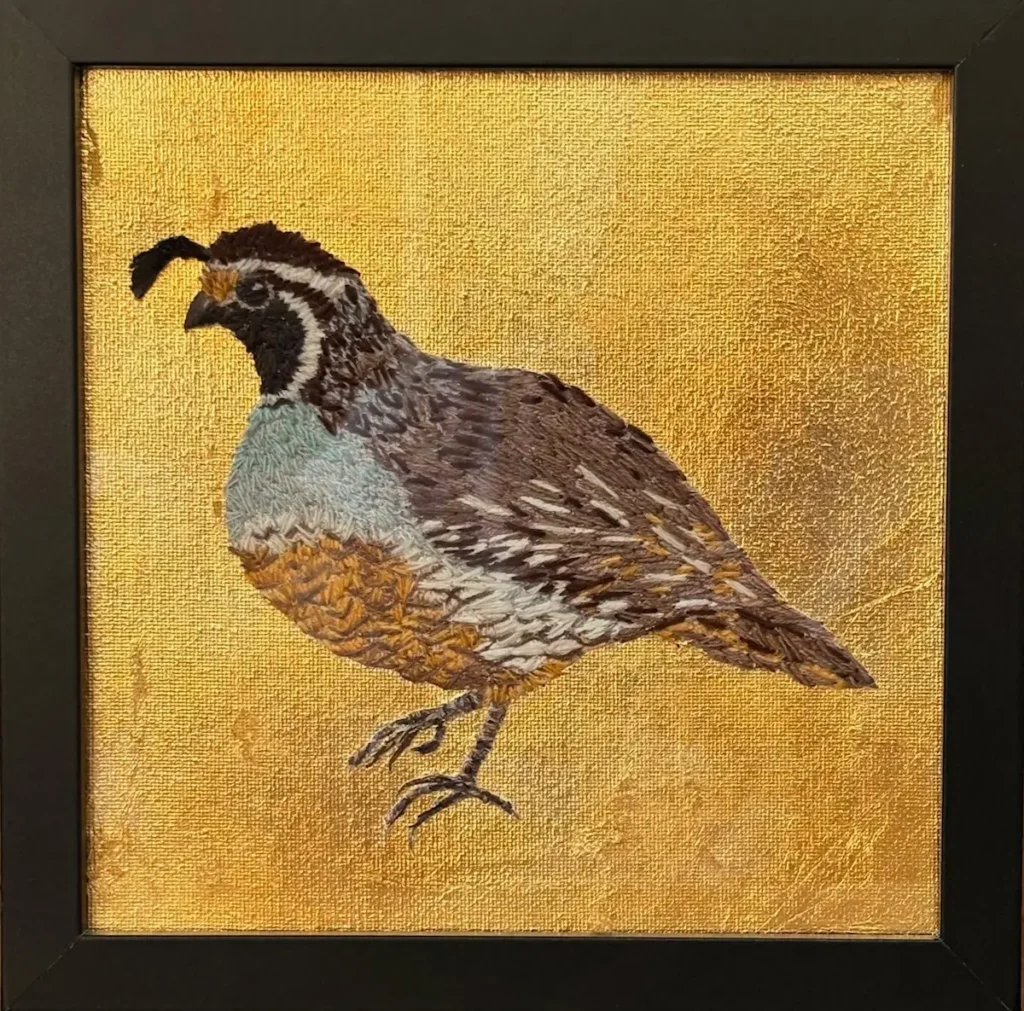
I learnt early on that the direction of their feathers is important for realism, but that the embroidery process itself is very forgiving.
If I don’t like the way something looks, I just stitch on top of it (which I have found adds an authentic bulk) or cut the stitches out (which can add an interesting fluff).
I love stitching these birds, and I often stitch their eyes early on, which gives them a real sense of life. I had the surreal experience with one of my birds that was watching me whilst I stitched it.
What have you learned from your creative journey?
I am now in my sixties, and in retrospect, I can see that nothing learned is ever wasted.
Even when it seemed that I was just playing around, I realise I learnt so much for future chapters in my creative life. I feel this gives me permission to fiddle around with ideas and new concepts in the knowledge that nothing is a waste of time, not least the sheer pleasure I get from colour and texture.
Rapid Fire Fun:
Early morning stitching or late night creativity? Daytime stitching!
One tool you can’t live without? Scissors
Favorite color combination right now? All colours, all times, all combinations. Most of all, I like to make colour combinations work.
A place that always sparks creative ideas? Nature is my inspiration, no question
Where can people see your work?
www.deborahkemball.com
deborahkemball3@instagram.com
Interview posted March 2026
Browse through more hand embroidery inspiration and projects on Create Whimsy.