
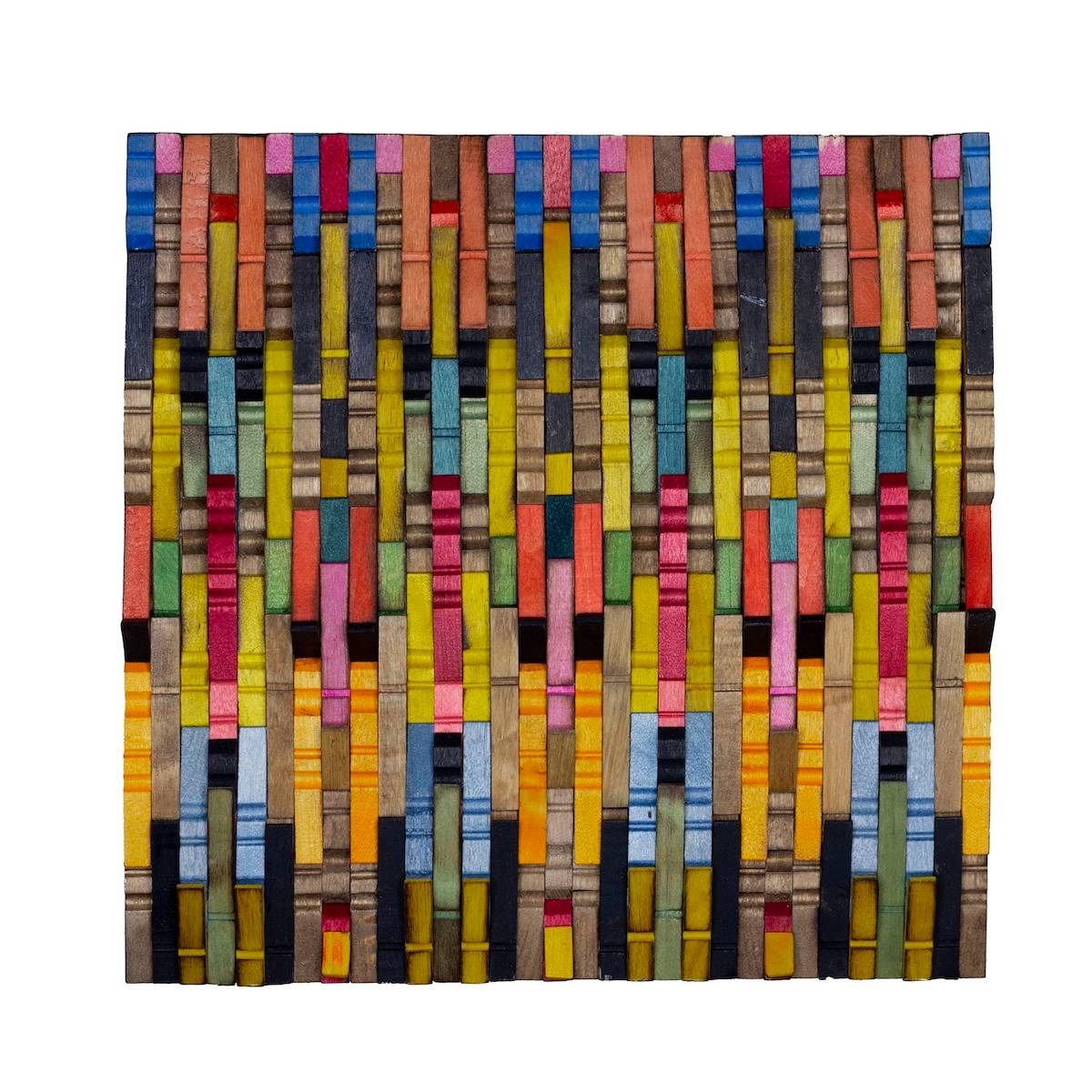
Davis Choun sees art where others might not even look twice. A simple clothespin becomes color, pattern, and rhythm in his hands. Using thousands of small pieces, he builds bold works that feel both planned and full of surprise. His art is about process, patience, and letting materials lead the way—one pin at a time.
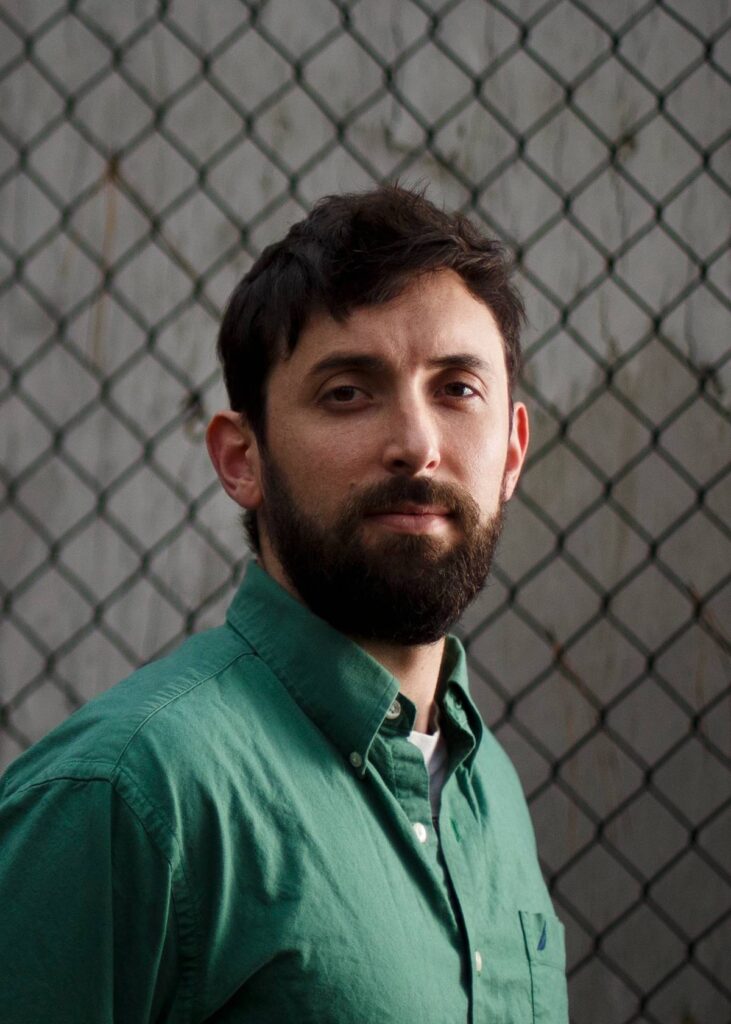
Can you take us back to the very beginning—what first pulled you toward making art?
A few things pulled me towards art making. There were a couple of people I knew growing up, not very close to me, who were artists, and I took an interest in that.
I found a deep curiosity in school towards art making that started in a CAD class. I would finish my CAD work quickly so I could make patterns and designs for the remainder of class.
My childhood home was quite rural, with my friends being ~20 minute drive from me. Because of that, I’d often spend time at home making things with materials I found interesting, like using latex paint on an old t-shirt and wearing it to school.
As an Amazon Associate I earn from qualifying purchases. Read more about our affiliate linking policy.
You started experimenting with clothespins early on—what made you pick them up in the first place?
I first picked up clothespins when we had a self-driven assignment in my high school art class.
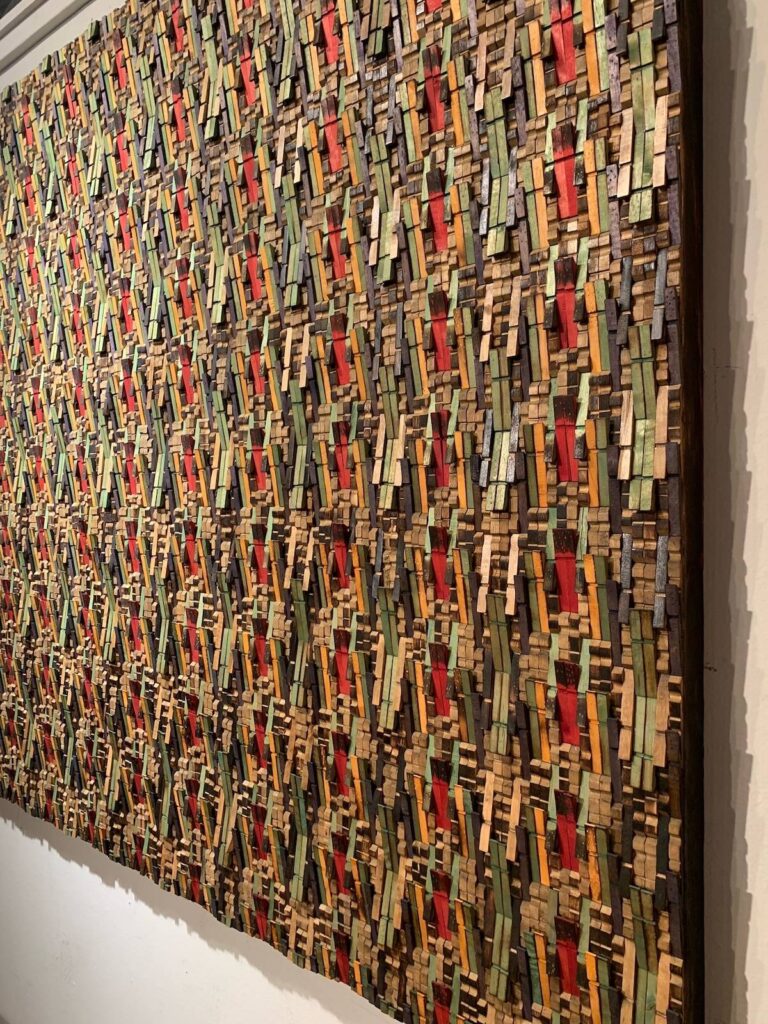
I saw an artist sometime before in a magazine, and she used 10,000 clothespins to make a wearable sculpture. I had a basket of them at home and decided to remove the spring, paint the wood pieces random colors, and glue them to a 48 x 24” panel. I already had a preference for combining pre-existing objects or items rather than traditional art-making methods.
What kept you coming back to that material instead of moving on to something else?
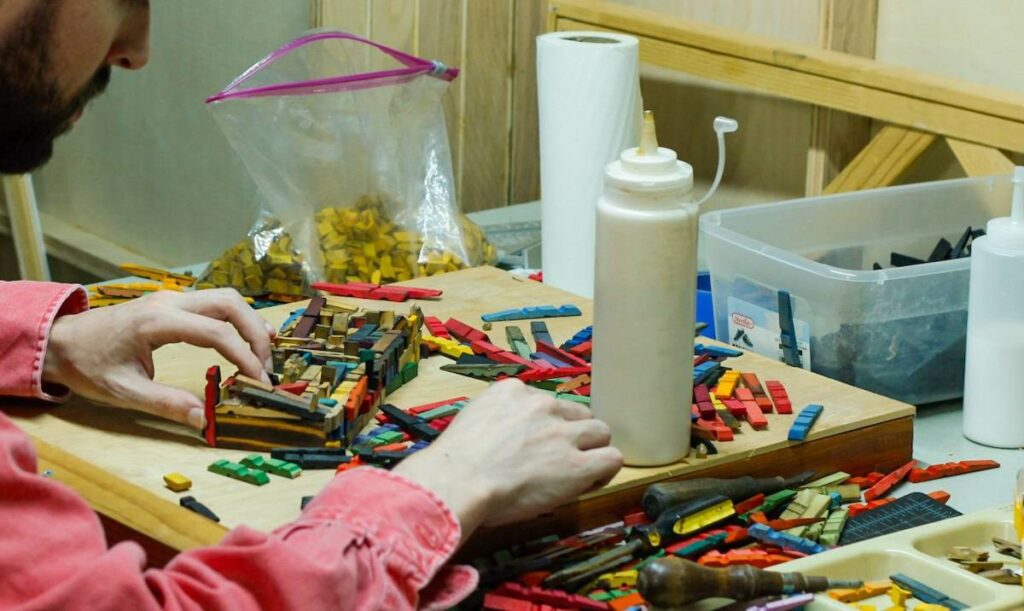
I have worked with other items here and there. Wooden chopsticks are my 2nd most used material. But the features in the small wooden pieces of a clothespin are very unique and interesting to me. They provide variation in their usefulness.
How did your time studying art and design shape the way you think about your work today?
My time at NC State was very freeing. I was able to create a wide breadth of experiences to build on through a variety of classes, from sculpture to surface embellishment and fiber manipulation. I was introduced to an environment of near-endless resources and knowledgeable professors providing constant inspiration.
I learned about modernism through the Bauhaus and its influence on art and design. The college provided me with a space to play, which may not have had its value recognized at the time.
Your work has a strong sense of pattern and rhythm—where does that visual language come from?
I find music to be a good start. Especially something that I find catchy and repetitive. It can put my brain in a state where it wants to make its own patterns, and I do not know how to play an instrument, so I turn to pieces of wood that I’ve dyed different colors.
Multiculturalism is a large inspiration as well.
What catches your eye in the world that other people might overlook?
The simplest answer would be clothespins.
How do you stay inspired when you’re in between ideas or projects?
In my experience, inspiration is the hardest thing to hold on to, more so now than ever. My ideas are grand, but I am on an indefinite journey to acquire a space that meets the necessary requirements to act on those ideas.
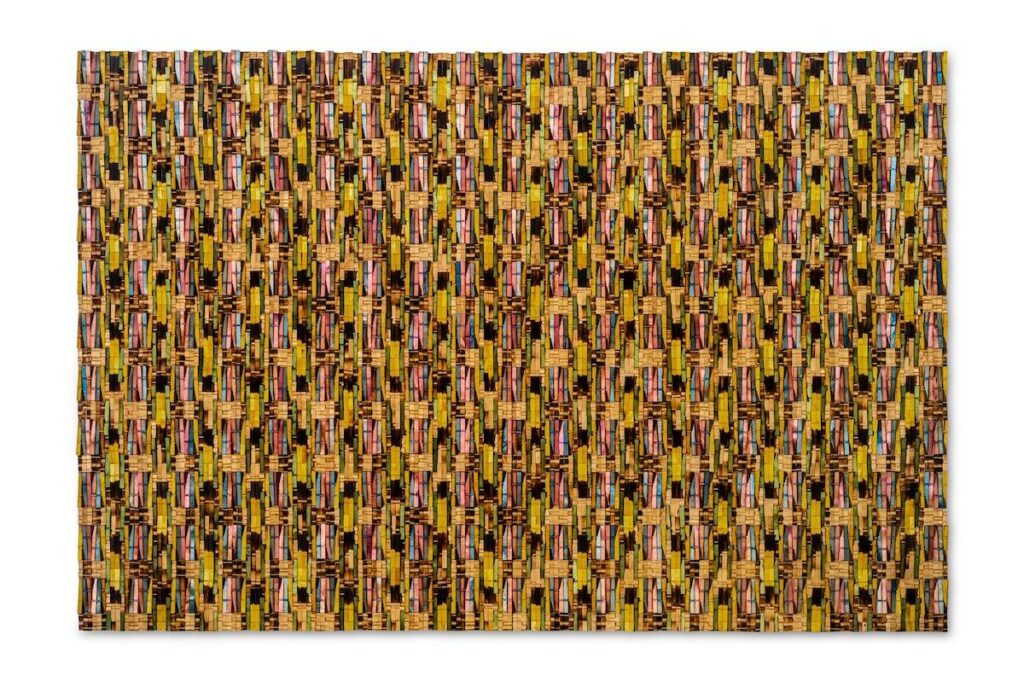
Describe your creative space.
My current creative space is a small extra bedroom in my apartment. I also have a small half-shed area outside that I put together.
You’ve worked in both shared and home studio spaces—how does your environment affect your work?
Yes, my environment certainly restricts my output.
I spend a good amount of time figuring out how to rig a space for what I need, whether it’s inside or outside.
I dream of a space where I can fully create the pieces that I have in my head. Currently, I have been working on smaller pieces rather than my preferred large panels.
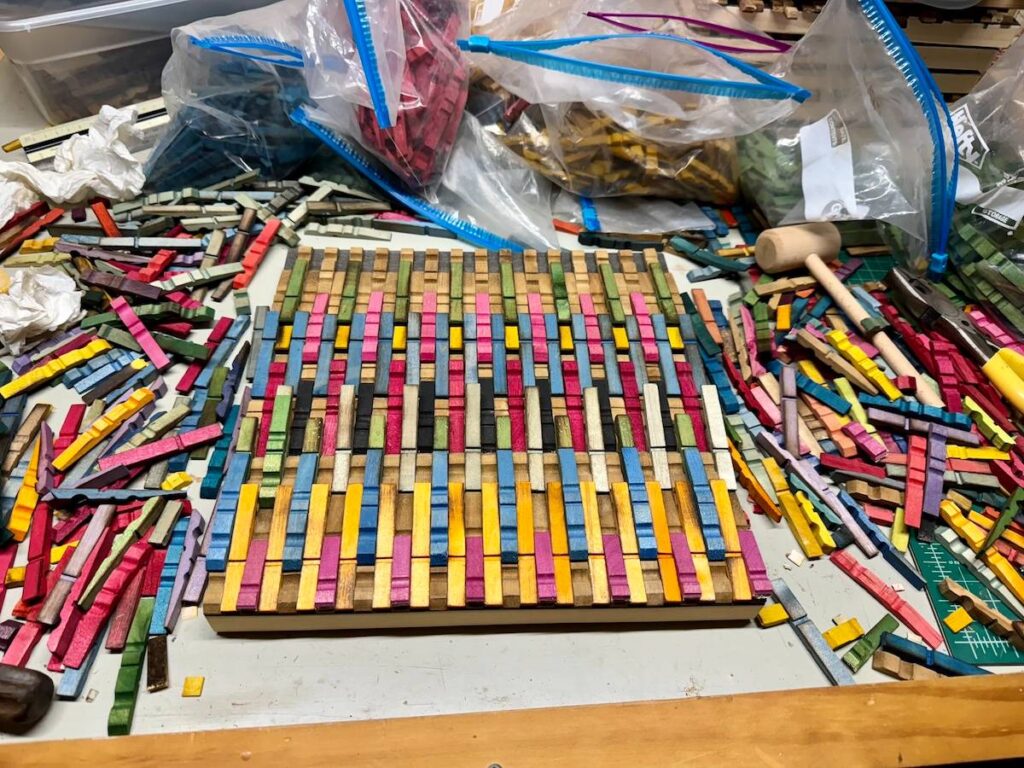
Your pieces can include thousands of individual elements—how do you stay organized?
Staying organized can be difficult but certain items I’ve obtained can be quite useful.
Mesh laundry bags for dyed clothespins were a game-changer for me. As well as getting a large sheet pan rack, often seen in commercial kitchens, for my sheet pans, which I sometimes use for burning and staining.
One of the more important decisions I make is to dye more pins than you think. Extra pins come in handy.
When you begin a new piece, do you start with a clear plan or let it evolve as you go?
When starting a new piece, it can be either.
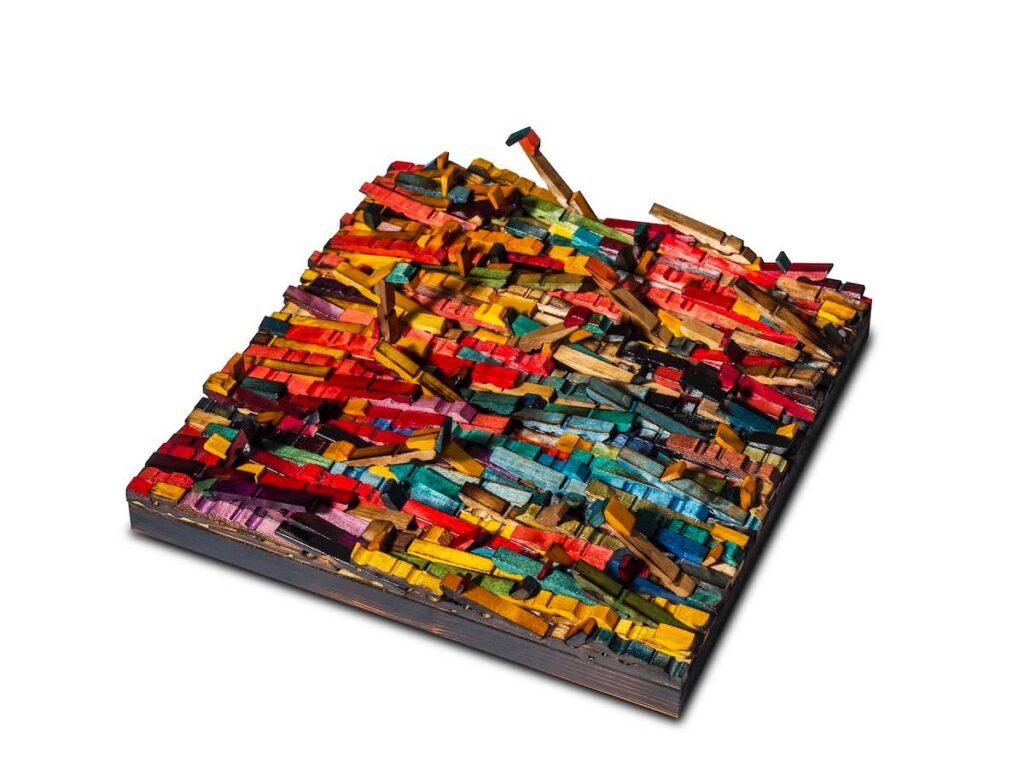
I mostly create patterned structures with the pins, however in the past year or two, I have tried some other variations.
One variation was to just improvise and do what I feel. Personally, I prefer the patterned structures and their visual impact on a larger scale, but I have many different directions I’d like to take them.
There have been times where I started with a clear plan and then scrapped it at the last minute and did something else. I will take the liberty to go a different direction if it feels right.
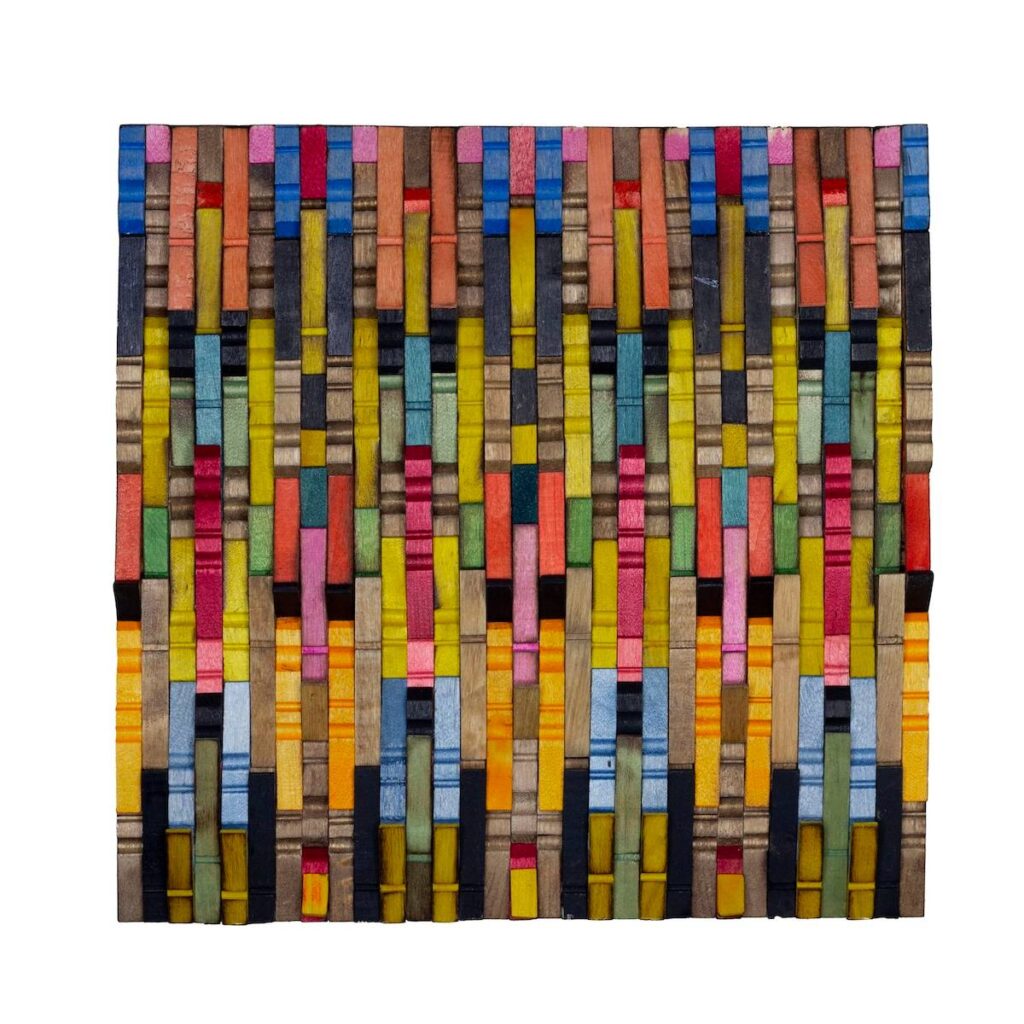
Working with fire and dye introduces unpredictability—how do you balance control and surprise?
I trust the process to balance the control and surprise. Its purpose is to do all of the work.
At the center of my process is the idea that the pins are all processed in the same way and therefore are the same. I consider them the same because they were all treated the same (dyed, stained, burned, etc.) Because of this logic, I allow a wide range of visual likeness amongst the pieces.
Have you had moments where something didn’t work—and led to something better?
I do have moments like this, but they are occasional and often insignificant in the grand scheme of things. Most of the issues that arise are manageable, some more than others.
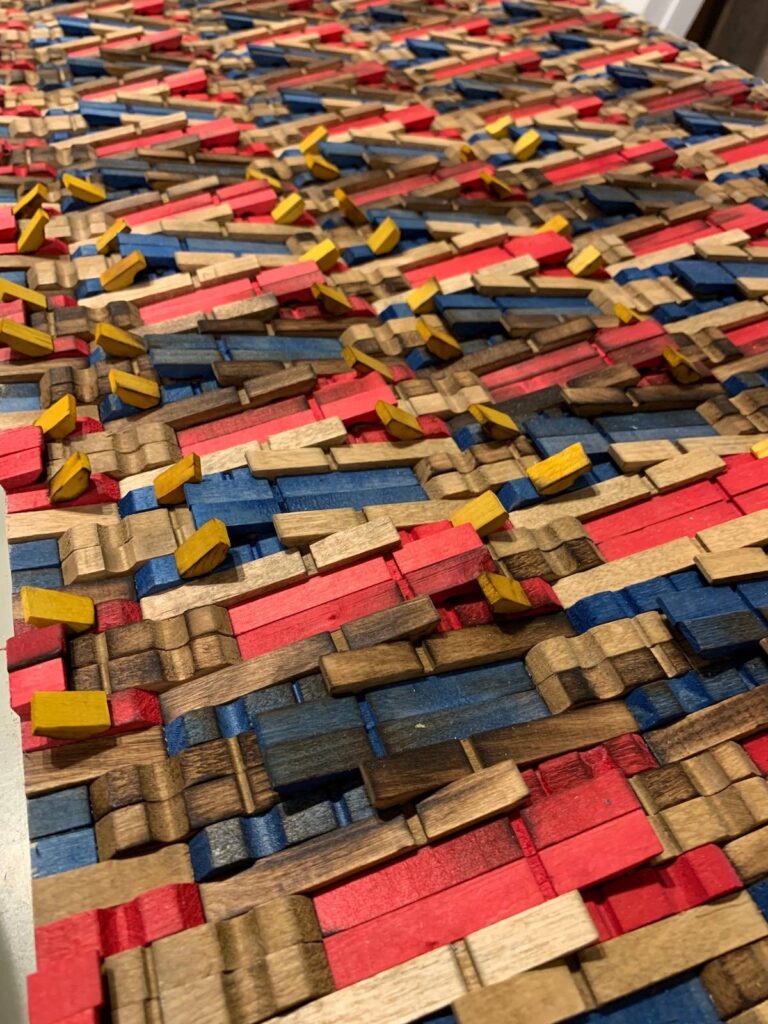
Your work often feels both structured and organic—what ideas are you exploring through that balance?
My work loosely explores ideas of control/chance, unsung materials, material transformation, etc. My process is the part I am most interested in.
The work created through the process is often post-conceptualized rather than preconceived. Unintended visual connections can arise, and they are welcome because they are still a product of the process.
What do you hope people feel or notice when they stand in front of your work?
I enjoy my work at different distances. I like that it changes and more details emerge. I hope people notice something different at each interval.
What has surprised you most about building a life as an artist?
Going through design school at NC State, I did not have a clear idea of what I would do after I graduated. While I find it hard to blame myself, it would have been nice to have a goal of some sort. Life as an artist is unfortunately, more than just creating your work.
How do you balance the creative side with the business side of your work?
This is a current struggle of mine. I spend most days managing a unique art gallery that specializes in historic North Carolinian art, contemporary art, and a few other niche areas. My personal creative time is limited but it is always at an idle. Whether it’s my home studio or day job, I am always artistically stimulated, even if not by directly creating.
Looking back, what would you tell your younger self at the beginning of this journey?
Honestly, probably nothing. Or maybe I would tell myself, “You’re gonna be a visual artist, so start thinking about that now.”
Where can people see your work?
Everyone can see my work at Gallery C in Raleigh, North Carolina, (https://galleryc.net/the-artists/) or at DavisChoun.com.
Instagram: @davischoun
Rapid Fire Fun:
Favorite color right now? Black
One material you’d love to explore next? Tar, again
Biggest time-saver in your process? Industrial kitchen tools (nothing crazy)
A tool you love using? Linesman pliers
One word to describe your work? Secondary
One word to describe your process? Primary
Interview posted June 2026
Explore more mixed media projects and inspiration on Create Whimsy.