
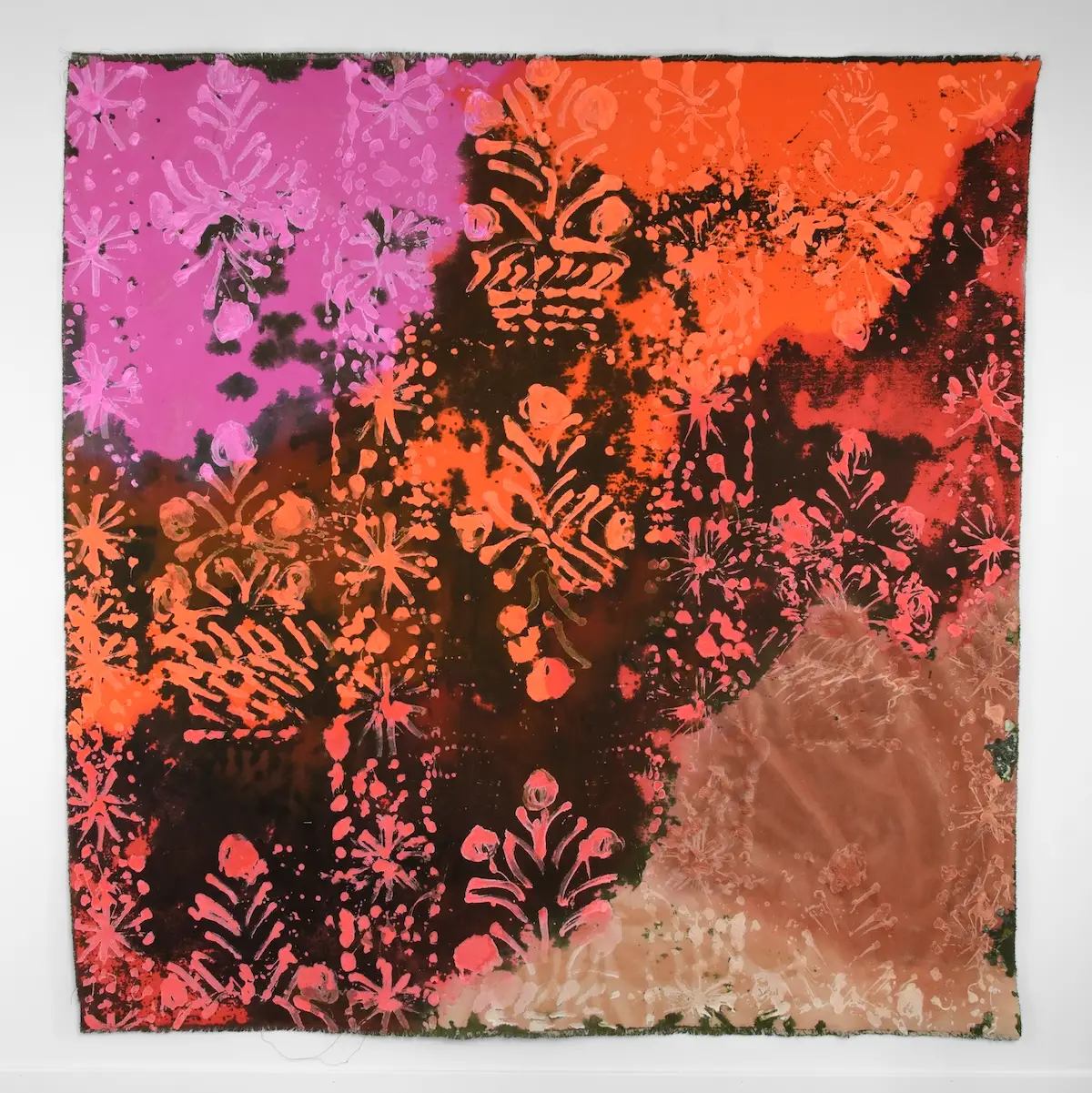
Colleen McCubbin Stepanic has known she was an artist since childhood, and her work carries that lifelong curiosity straight into the studio. In this interview, she talks about cutting up paintings, sewing canvases together, embracing failure, and using layers as both a process and a metaphor for lived experience.

When did you first realize you wanted to be an artist? Was there a moment or a memory that sparked it?
I decided I wanted to be an artist when I was eight years old.
What led you to study art formally (BFA, then MFA)? What was that experience like for you?
Most of my experience of what an artist did came from looking at books, so at some point I decided I wanted to be an illustrator.
As an Amazon Associate I earn from qualifying purchases. Read more about our affiliate linking policy.
When I got to college and took my first painting class, I realized that I didn’t want to be an illustrator; I wanted to be a painter.
I finished my degree in Visual Communication Design at the University of Dayton in Ohio. From my sophomore year, I filled all of my leftover credits with independent study painting classes. Then, when I did my MFA at the Tyler School of Art, my focus was painting.
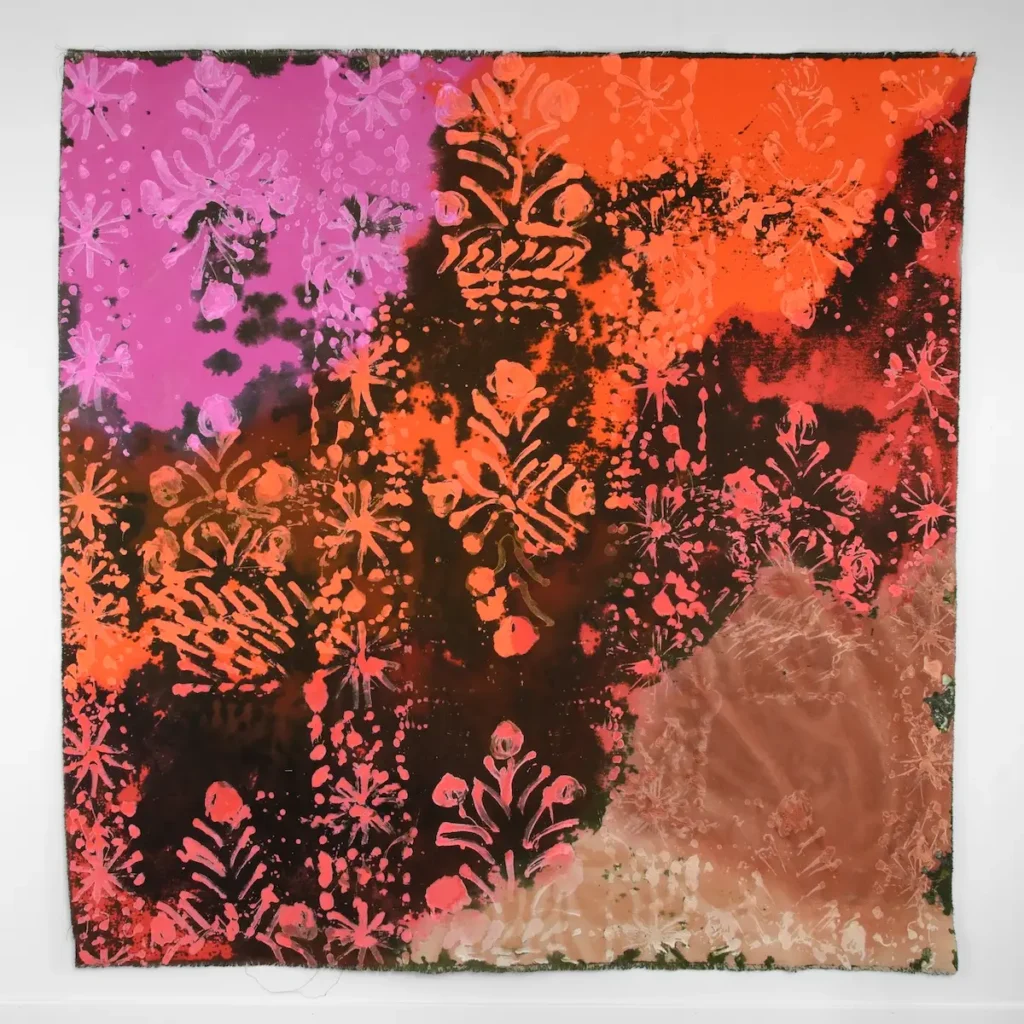
Acrylic and Gesso on Canvas,
84″ x 84″, 2023
When you first began making art, what kinds of work were you doing (painting, drawing, installation, etc.)?
As a child, I did everything I could. Lots of crafts, knitting, sewing, latch hook rugs, and tons of drawings. I used to fantasize that I would learn every craft in the world.
Learning new ways of making things is very exciting for me. Photography was also very important. My dad took great photographs, and they were handled reverently at home. It was very important not to touch the surface of the photos or leave any fingerprints. When I was ten, my dad gave me his father’s camera.
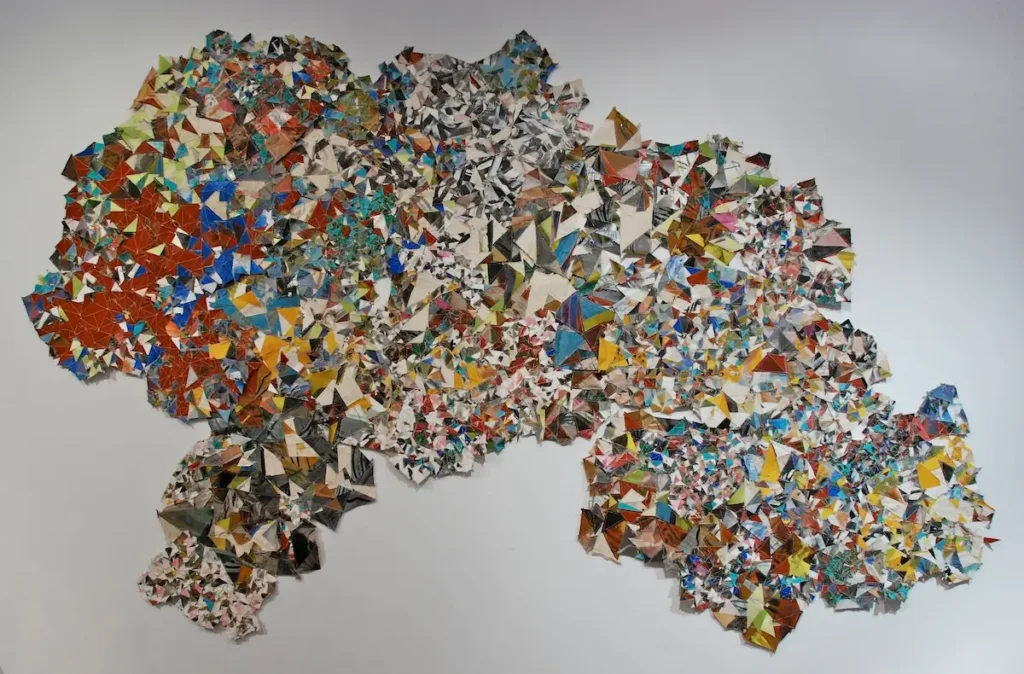
Acrylic, Oil, Linen, Canvas, Thread, Nails; Dimensions Variable,
Current image 108″ x 120″, 2012
Over time, you shifted to cutting up paintings, layering, and sewing fragments into three-dimensional forms. What prompted that shift?
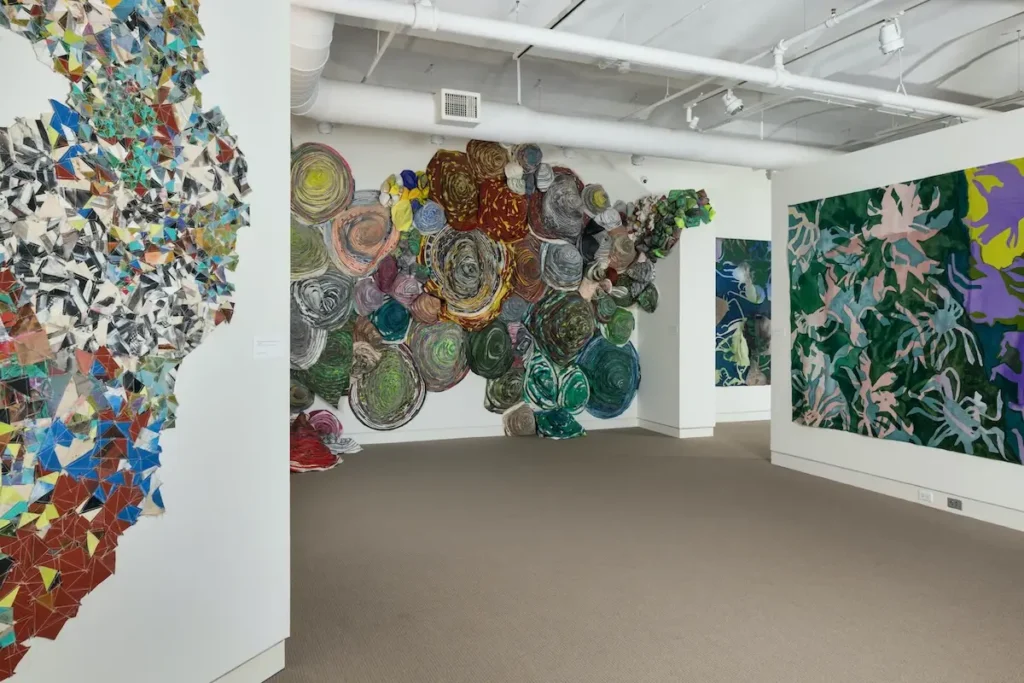
After graduate school, layering became a very important part of my painting. I have a philosophy that either a painting is done, or it’s raw material. If it’s “raw material,” I will paint new things over what I painted before.
When I do that, I make every decision based upon the new thing I’m painting. Except for the first decision, which is always going to be affected by what’s already on the canvas. After that, if I’m painting a tree over what yesterday was a painting of people, then the tree must go where it needs to go even if it’s inconvenient (for example, right over a face).
It is a very important way of working for me because it allows me to make new discoveries in my work. Around 2008, I wondered why it was only the imagery that was layered and not the surface.
That’s when I started cutting and initially gluing my canvases together. I was using matte medium to glue, and one day I ran out and didn’t have $50 to buy a new gallon. I decided to sew the canvas together. It was immediately better.
I loved the movement the sewn work has that the glued work didn’t have. I used my household Husqvarna to sew through canvas and paint. It lasted two years, and then I had to move to a Consew industrial walking foot machine.
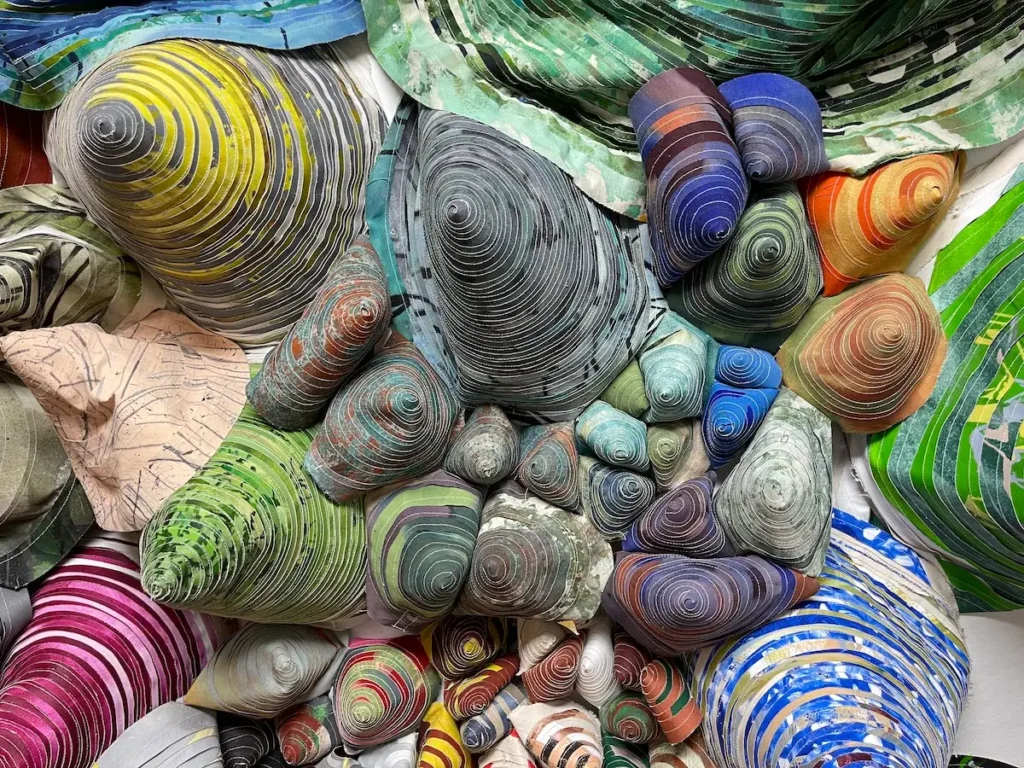
Acrylic, Oil, Linen, Canvas, Thread,
Variable size, 2023
What role do memory, time, and personal experience play in your work? How do you think about “layers” in a metaphorical sense?
Memory, time, and personal experience are all critical to my work.
I’m a very visual thinker, and I love metaphors. One of the things I was searching for when I started cutting up my work was a way of making internal feelings and experiences external.
I wanted to create something that expressed the way I felt. Geology/ geological processes felt like something I could use as a metaphor for my personal experience.
I love rocks, and when I first started cutting my paintings, I used rock formations to help me make decisions in the studio. I visited Canyon de Chelly a few times, and the de Chelly sandstone really gripped my imagination.
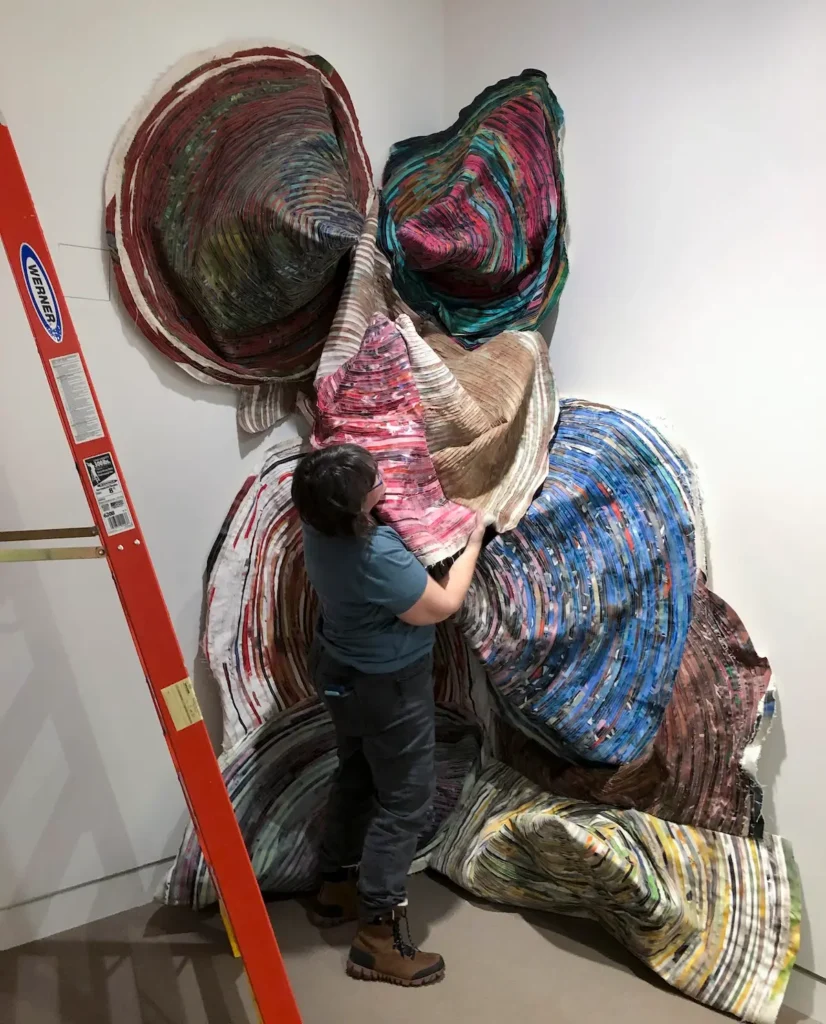
In the studio, I drew a spiral on the back of a canvas, cut it, and sewed it back together. It was meant to imitate the layering of the sandstone.
I was also interested in the spiral because I had researched symbols throughout history and cultures. The spiral (for example) shows up repeatedly as a symbol with significant meaning to different human cultures. I’m not terribly concerned with the different meanings each group assigned to the spiral, but I think it’s important that it’s a form that repeatedly resonated significantly with humans.
The canyon was important to me in another way. From the start, I imagined building a piece that enveloped or overwhelmed the viewer the way the canyon does. It took me ten years to accomplish it and complete my work “Peak.”
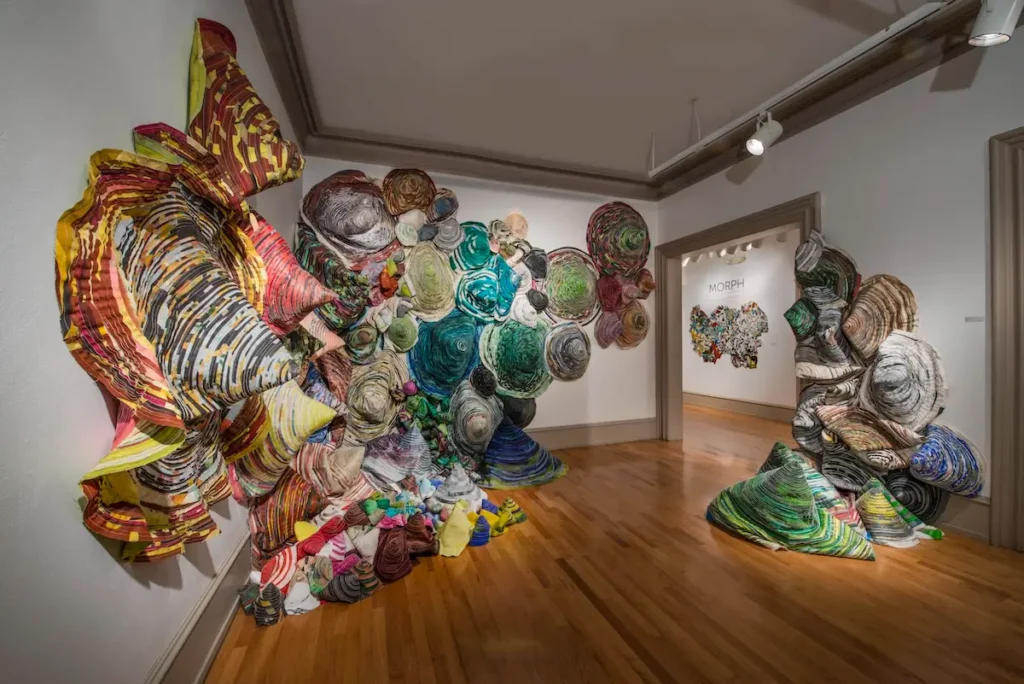
Installation at Maine Line Art Center, Haverford, PA, 2019
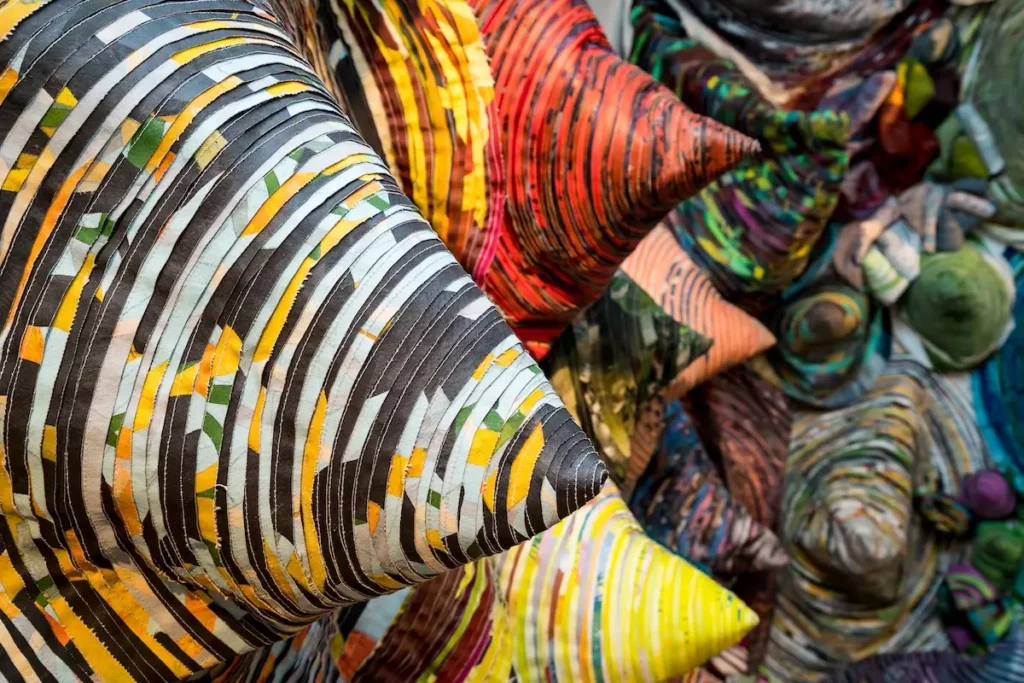
Acrylic, Oil, Linen, Canvas, Thread,
Variable size, 2019
How has motherhood, teaching, or “being many things at once” influenced your art over the years?
When I stopped teaching in 2020, I had this incredible sensation of getting my brain back to myself.
I spent a lot of years trying to be a mom, an artist, and an educator all at the same time, and it was really difficult. I often felt like I was failing at all three.
One time, someone asked me what you needed to be an artist, and I said you need to be willing to fail a lot. I think that sensation of failing and trying again, slogging through it, is really important to my work.
A lot of the time I use processes that ensure failure. Things like trying to do detailed drawings with clunky supplies, or working with fluid paint that completely alters what you do.
Being a mother was something I loved and never stops making my life better.
Working with students was great. For one thing, it made me look at everything in the museum because I might need to share it with a student sometime. This means that I looked at a lot of work that I might have otherwise ignored.
I think that added a lot of value to my studio practice. I still do it even though I’m no longer teaching. But then I also still see a playground and think of my daughter, who is 29 and just got her doctorate in Chemistry.
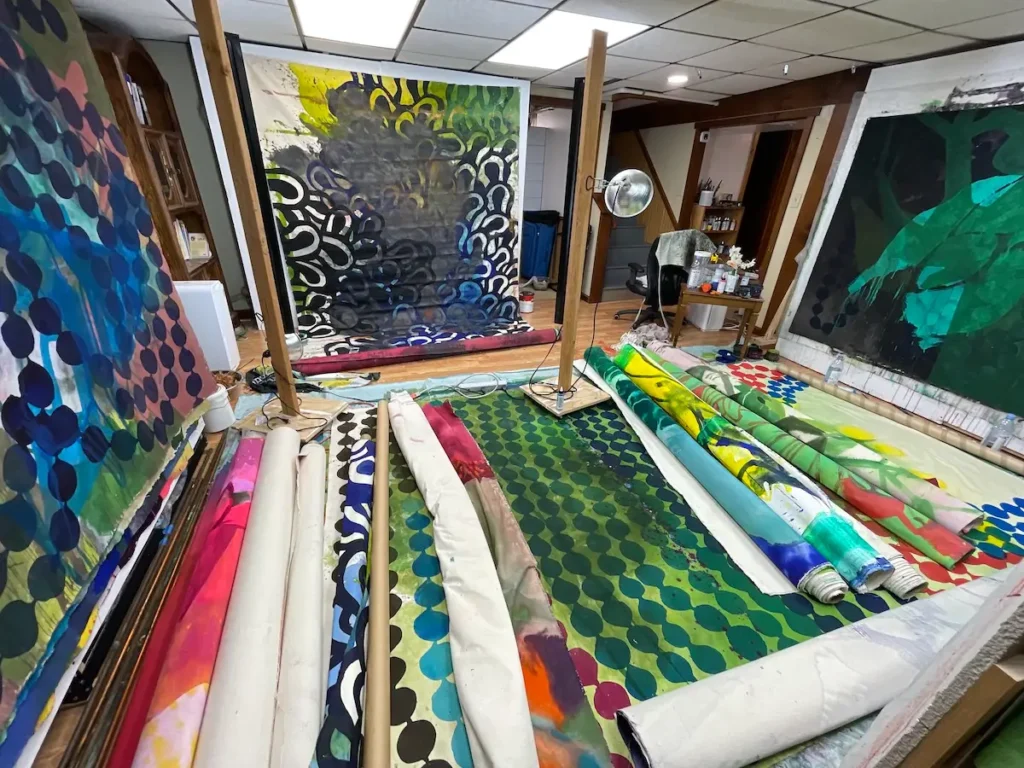
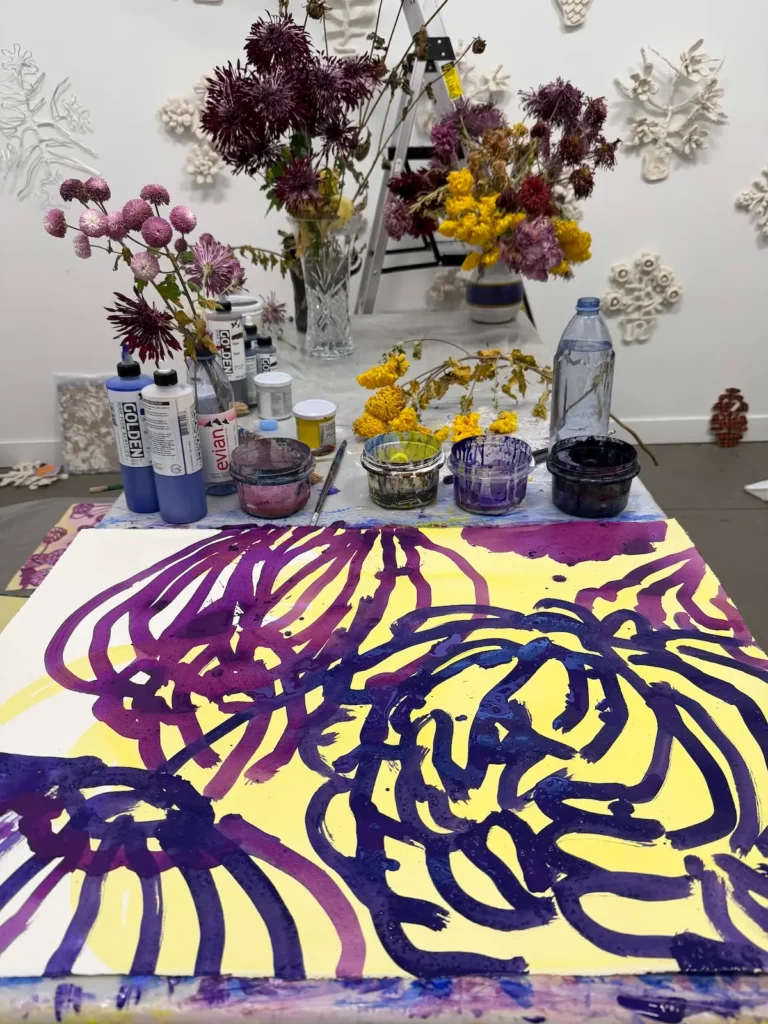
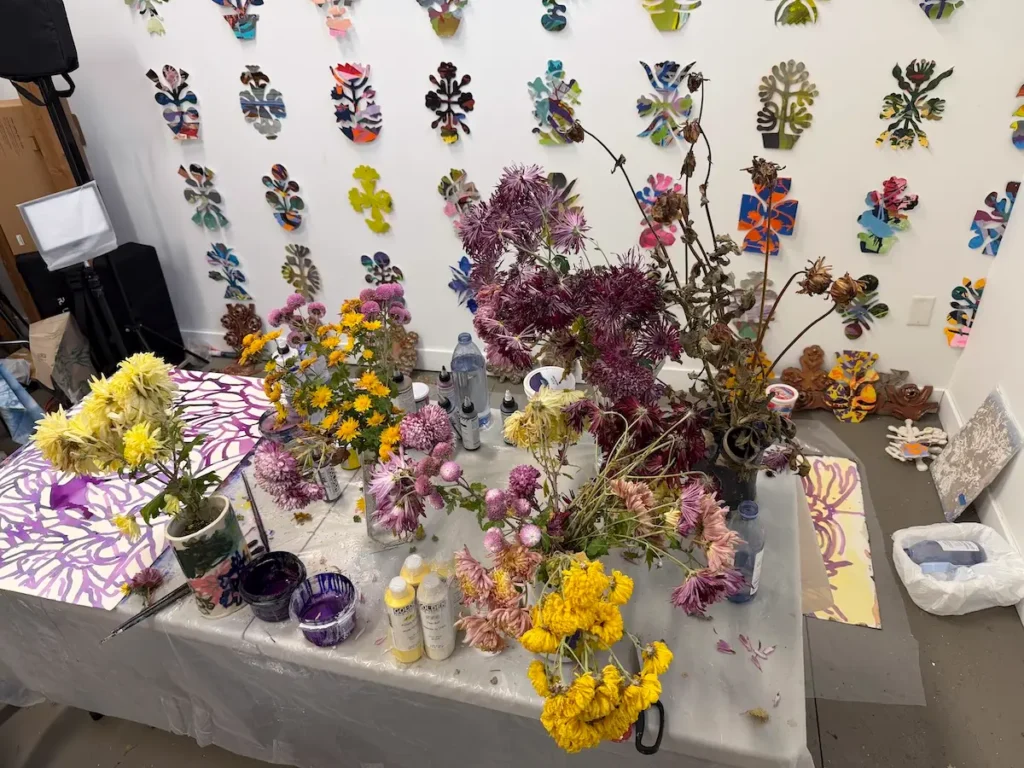
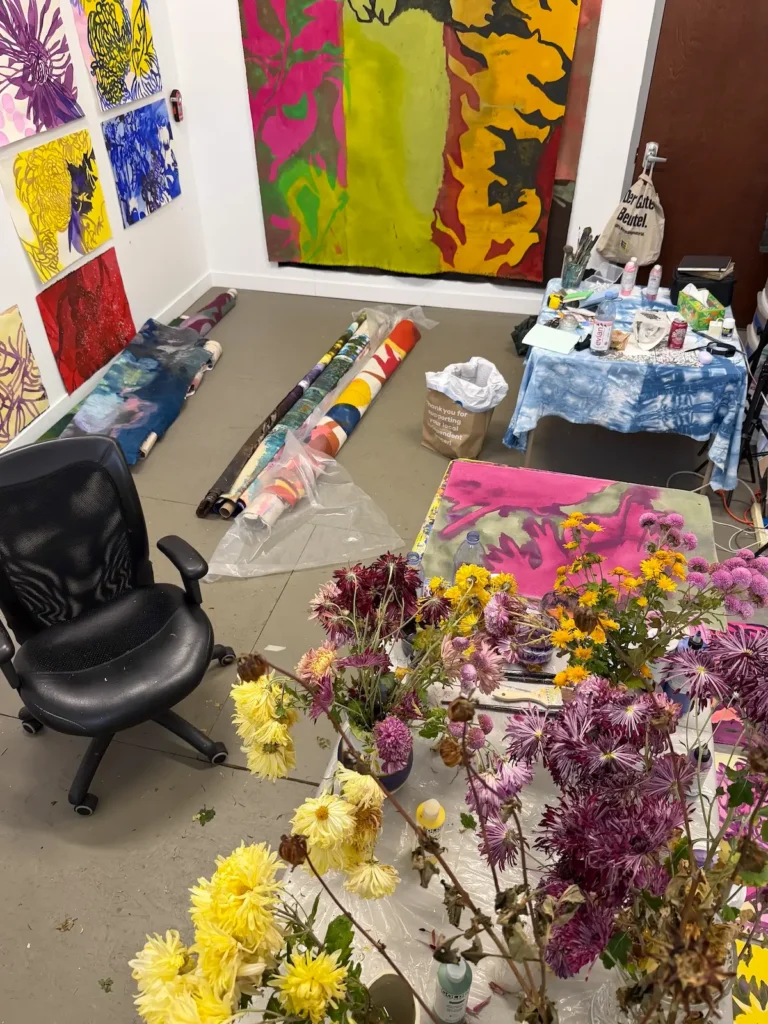
Describe your creative space. Is it chaotic, neat, full of paintings and scraps, or calm and minimal?
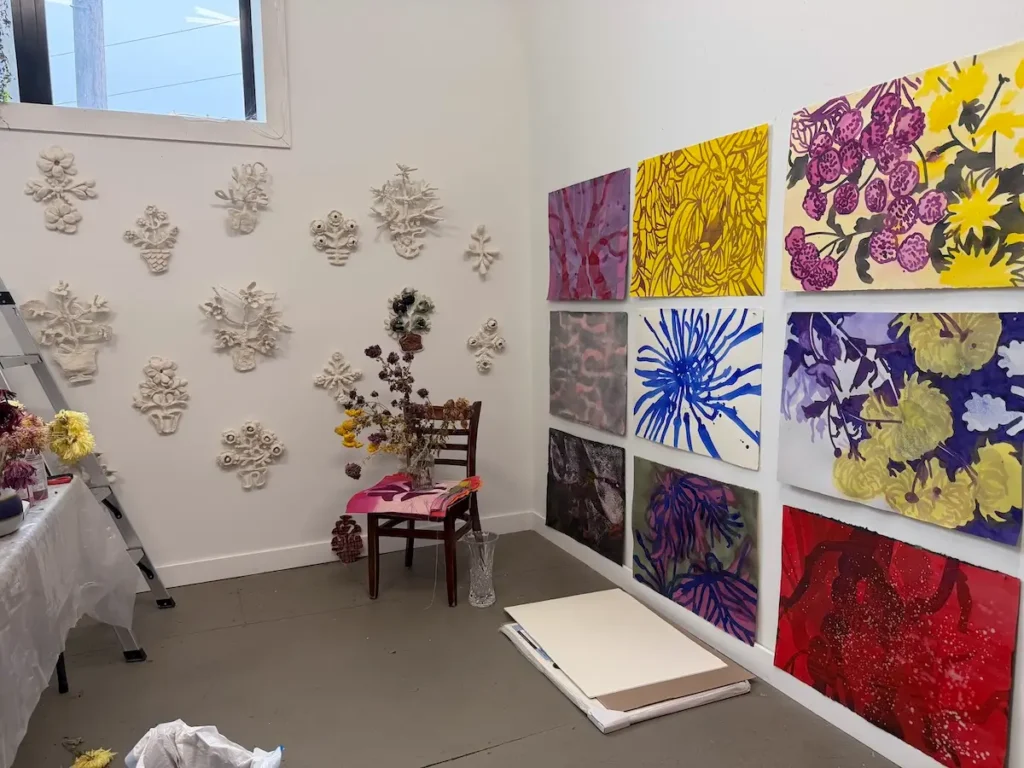
My creative spaces get messy very quickly.
From 2019-2024, I worked from home, and my husband frequently complained that the entire house was my studio. I joked that I would clear a space on the couch for him and say, “Sit here. Don’t touch anything.” He told another artist about this situation, and the artist told him, “So you are living inside her brain.”
What materials do you work with most often (canvas, fabric, thread, acrylic, etc.) — and why do you choose them?
Acrylic and canvas are what I use the most.
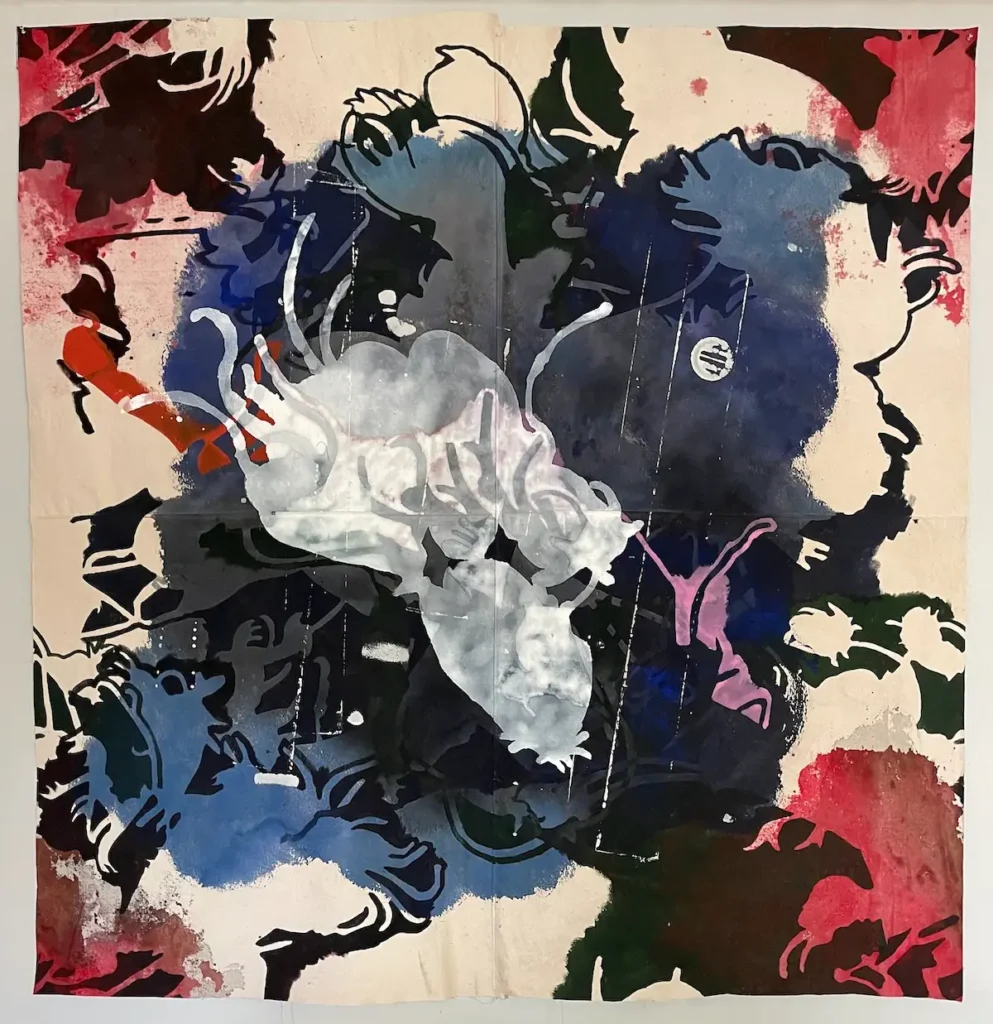
Acrylic, Thread, Canvas,
76″ x 80″, 2022
How do you decide when a piece should stay “flat” (like a painting) vs. become sculptural or three-dimensional?
It varies.
Sometimes I decide based on whether I like the painting. If I’m in the middle of building a 3D installation, no painting is safe.
I’ve had many conversations with myself that went like this. “I like that painting. But I need a big painting to cut. But I like that painting. Are you going to show it? No.” and then it gets cut.
I’ve made some paintings on wood, and I think it’s just the paintings trying to protect themselves.
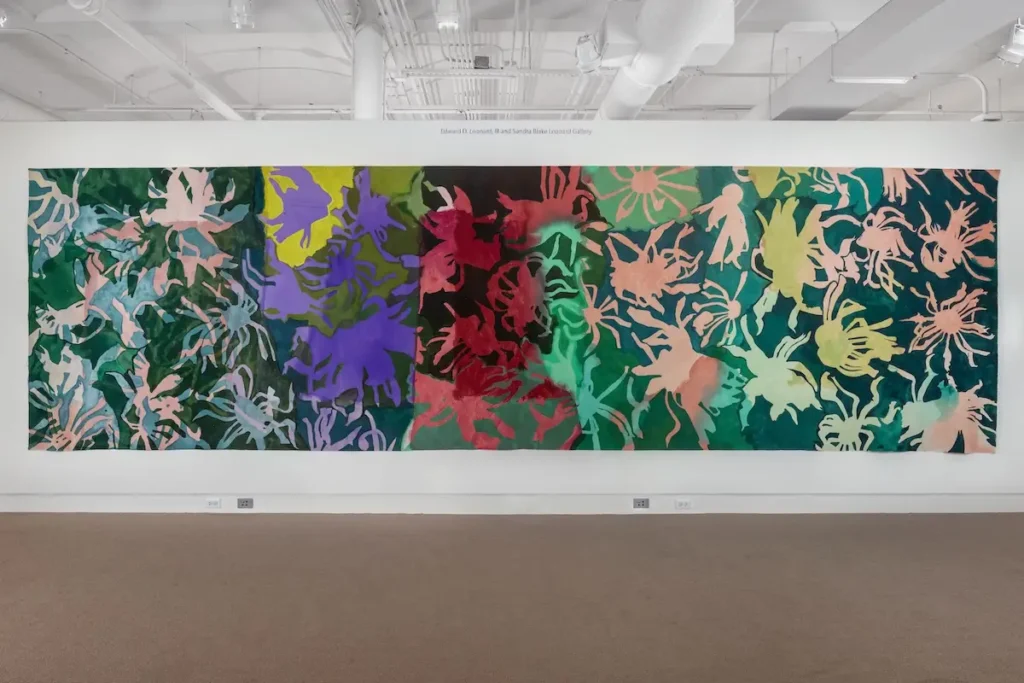
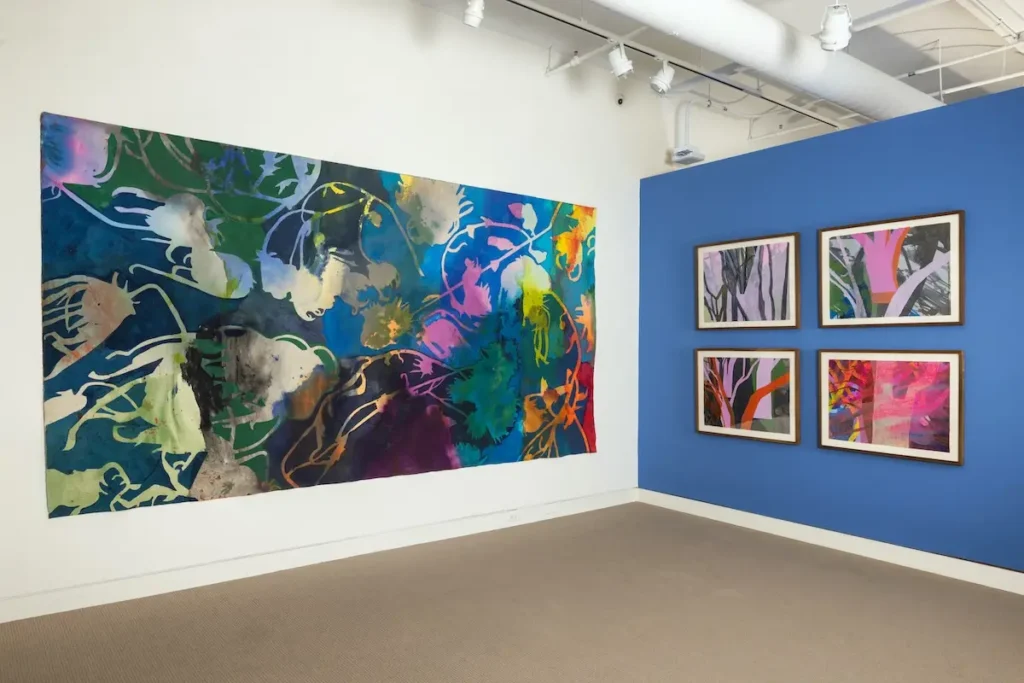
Acrylic on Canvas,
83″ x 285″, 2021
How do you balance intuition and intention? Letting feeling guide you vs. planning the structure or composition?
My process is very intuitive. I do like to work with repetitive processes, so intention figures into setting up the system. Most of my sewn works involve doing the same thing 50 times or more.I find planning beyond that stifles my work.
When you begin a new piece, what’s the first thing you do? Is it about mood, emotion, memory, or just experimenting?
I usually start with a lot of false starts. Working in the studio, trying stuff, until something clicks and I get excited about what I’m doing.
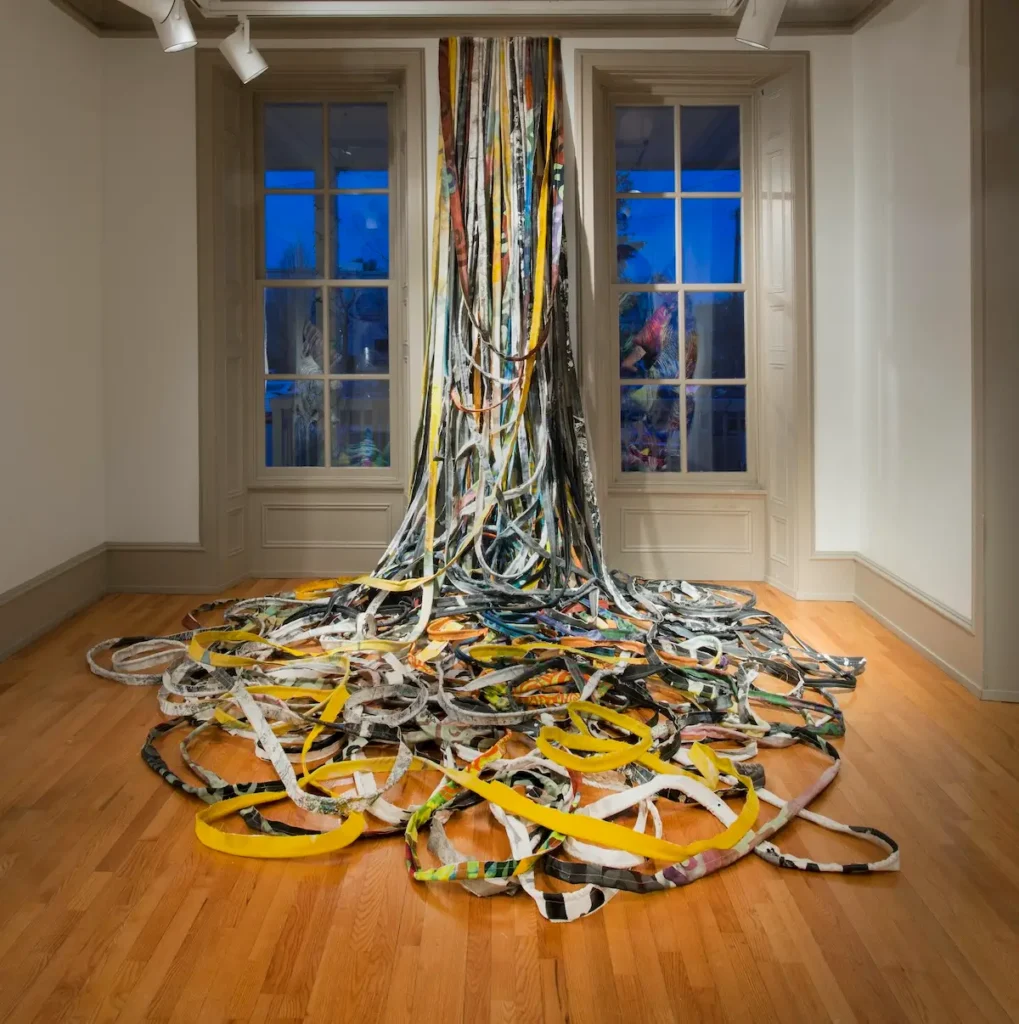
Acrylic, Oil, Canvas, Linen, Rope, Thread;
120″ x 240″ x 240″, 2019
When a work doesn’t turn out as you hoped, how do you respond? Do you rework, start over, or walk away?
I make things, look at them, sometimes for a long time, and then decide to do more or not. If it’s not good then I’ll put it back in the studio as a raw material for later. I don’t throw anything away. There’s always something else I can do with the material.
How has working in a smaller, shared home studio (especially with family around) changed your process or workflow?
I love working at home because I can get into the studio before I’ve even gotten dressed. But because our house is small and I make big work it got to be overwhelming and frustrating. Last year I got a new studio with 14’ ceilings and it’s exciting to be working in a new space.
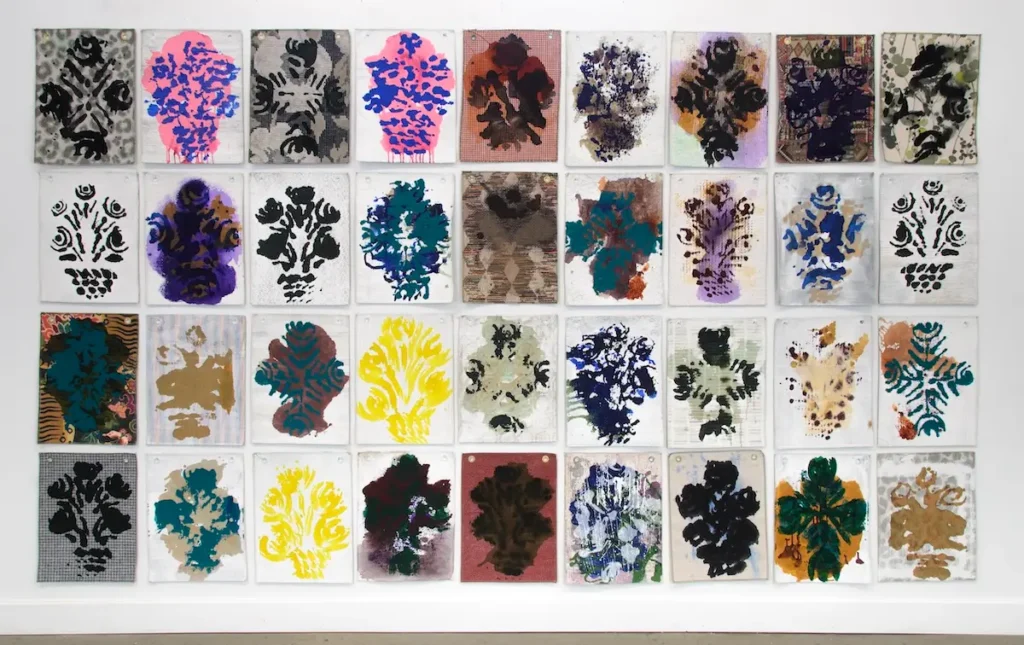
Acrylic on Polyester Fabric Samples with Grommets,
72″ x 123″, 2024
How do you know when a piece is “done”? What signals in your gut or mind tell you it’s time to stop layering, cutting, sewing, shaping?
I hang things up and look at them. Looking at them everyday until I make up my mind. The simple answer is they are done when I don’t want to work on them anymore. After that it’s just a question of if it’s good or not. I don’t “fix” things.
What advice would you give to artists who feel “stuck” in traditional painting or 2D work but want to experiment outside their comfort zone?
It’s important to explore the things you’re excited about, even if it doesn’t make sense to anyone else. Have fun and play. I used to tell myself if it’s not a masterpiece, I can’t ruin it. That takes a lot of the pressure off and leads to surprising and cool things happening.
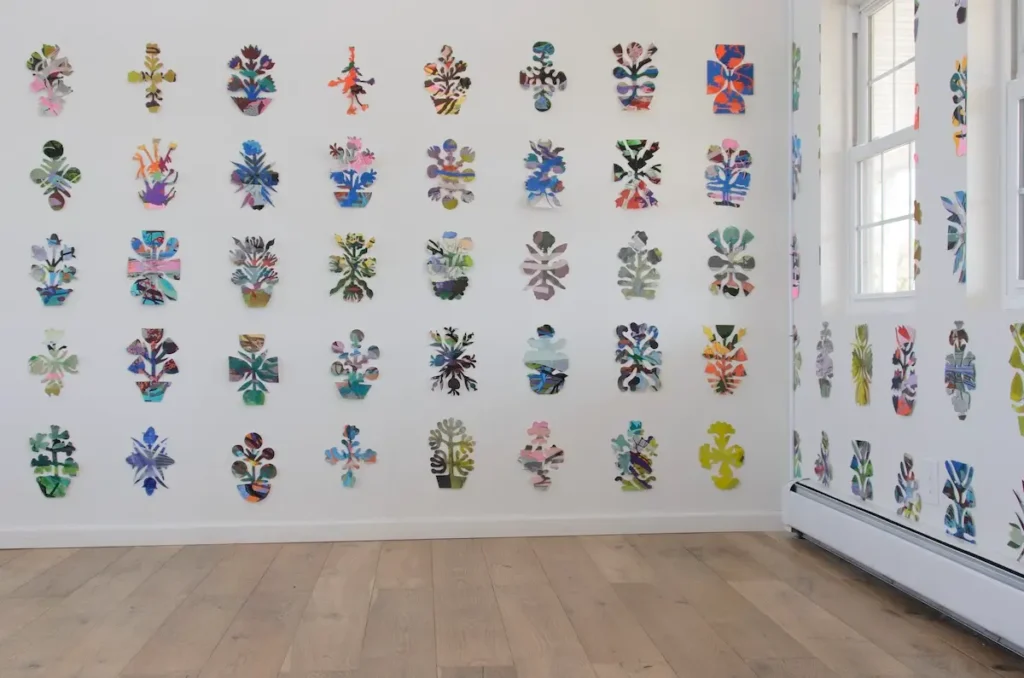
Acrylic on Paper, 2025
How important is “play,” experimentation, and even “destruction” in becoming a better maker?
Critical.
What’s one thing you wish someone had told you when you started making art — that you only understand now?
Honestly the most important thing anyone told me that I hope everyone hears is “Keep making your work. Don’t let anyone stop you.”
Rapid-Fire Fun
What’s your favorite time of day to work in the studio? I’m a morning person.
A favorite word or phrase that describes your art? Energetic
Favorite material or tool right now? Golden High Flow Acrylic
Where can people see your work?
https://www.colleenmccubbinstepanic.com
Interview posted January 2025
Browse through more inspiring interviews on Create Whimsy