
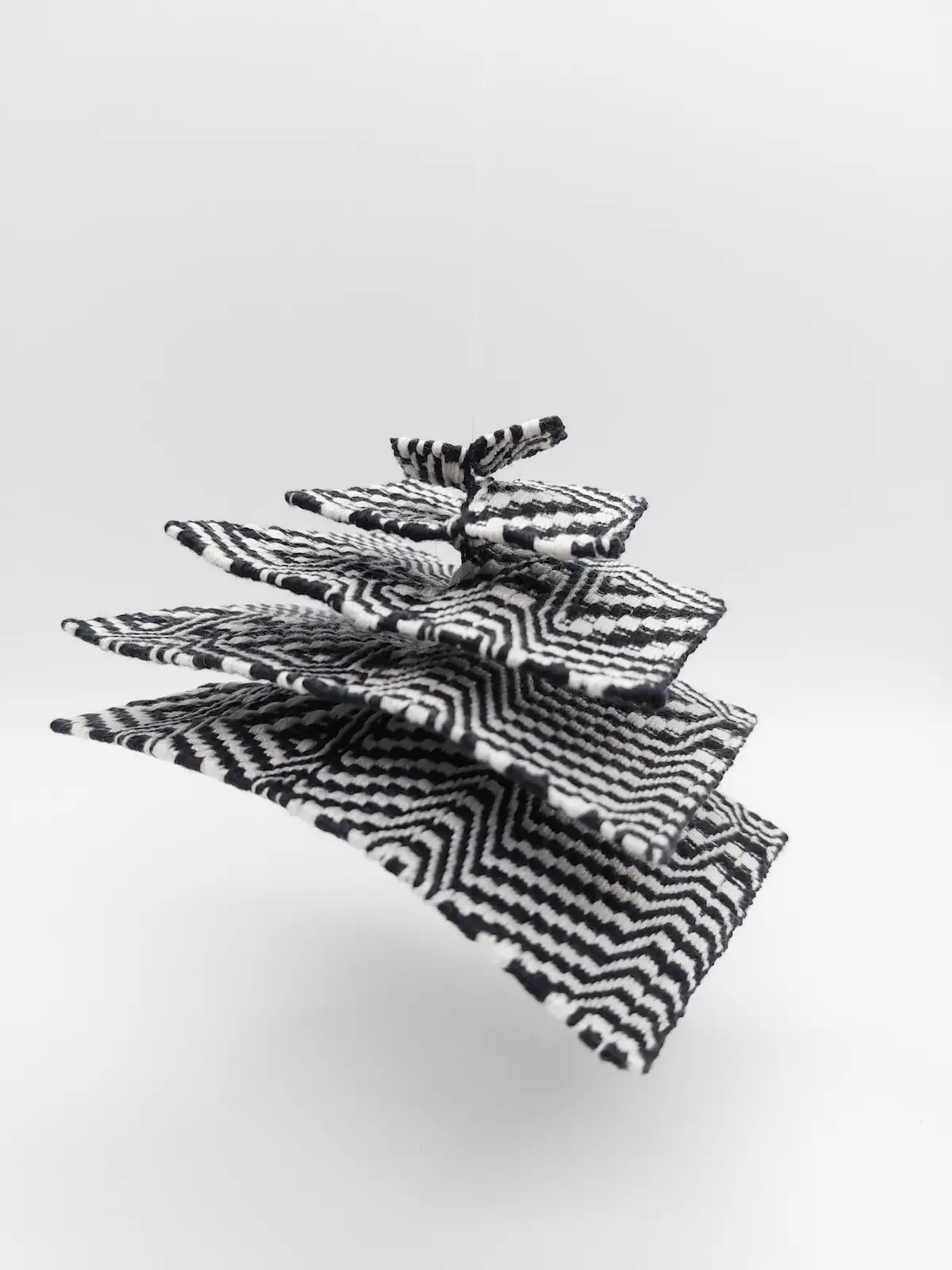
Vanina Bujalter has been surrounded by textiles, looms and ideas since she was a child. Inspired by her mother and guided by a love of learning, she blends traditional weaving techniques with research, color, texture and experimentation. Her work shows just how many possibilities can grow from a simple loom and a curious mind.

You grew up surrounded by your mother Mimí’s textiles, looms, threads and books. What is one early memory from her studio that has stayed with you?
One of my most precious memories is watching my mother teach in her studio. I remember seeing her students sitting around a large table, each one weaving on a small frame, surrounded by their yarns and all the tools and materials they needed. That image has stayed with me throughout my life.
I think it was one of the things that encouraged me to start weaving myself. At first, I would simply put a warp on a frame and weave in whatever way I felt like, without really knowing what I was doing. I was completely attracted to the materials and to the possibilities they seemed to contain.
I also remember taking my mother’s books and textile catalogues and spending a lot of time looking at the photographs and reading about textiles. And, of course, watching my mother weave and work on her own pieces was an enormous source of inspiration. Her studio was a place where I could see, touch and discover textiles in so many different ways.
As an Amazon Associate I earn from qualifying purchases. Read more about our affiliate linking policy.
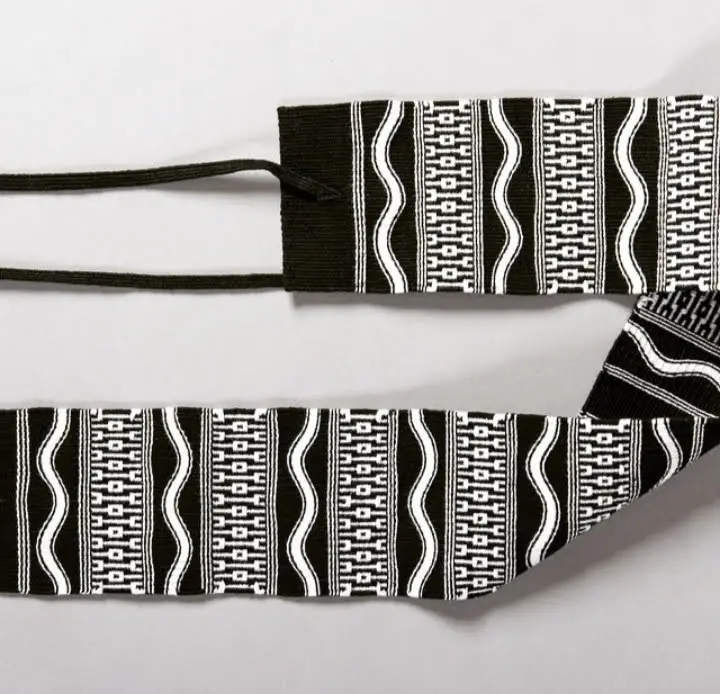
You began studying textiles with your mother when you were just 15. What did you love about weaving at that age?
When I was fifteen, I told my mother that I wanted to begin making the same sampler that her students were working on. It included a series of exercises, beginning with the simplest techniques and gradually becoming more complex. So I began working on a frame loom, and my mother and I chose a color palette together, mostly violets and oranges, that I absolutely loved.
What I enjoyed most was seeing the result of each exercise as it developed: watching the design appear, discovering what the structure could do, and already imagining what I might be able to create later with the techniques I was learning.
The techniques I learned at first were classical techniques, and the training was very rigorous. Later I would move on to modern techniques and, eventually, to what were then called experimental techniques. Looking back, I think that progression gave me a very strong technical foundation while also opening the door to experimentation and my own way of working.

Was there a moment when weaving stopped feeling like something you were learning from your mother and started feeling like something that was truly yours?
I don’t think there was one single moment when weaving became truly mine. It happened gradually, and, it happened first through teaching rather than through creating my own pieces.
When I was eighteen, my mother offered me the opportunity to teach at the Museo José Hernández in Buenos Aires. She felt that I was completely ready to do it, and I began teaching there. It was a wonderful experience and a real success. I developed a program that lasted four to five years, based on the structure and teaching methods of my mother’s school, but with my own approach.
I began developing new exercises and expanding the range of techniques I taught. Although I was not yet making my own pieces, I realized that I had something of my own to contribute to this art through teaching. My classes became very popular, and I am especially happy to know that some of the people I taught later went on to receive important recognition for their own work.
Looking back, I think that was an important first step toward finding my own voice in textiles.

You studied psychology at the University of Buenos Aires. Did studying psychology change the way you think about making, creativity or people?
Studying psychology was actually a path that developed completely in parallel with my work in textiles. I studied Psychology at the University of Buenos Aires, a career I genuinely enjoyed, and I would not say that it directly changed the way I think about making or creativity.
What it did give me was the opportunity to be actively involved in an academic environment, and that became a very important part of my education and personal formation. Being part of university life, studying, researching and engaging with academic work gave me a different kind of knowledge and way of thinking, which I value very much.
Both were important parts of my formation, even though they developed independently.
You have been teaching textile techniques since 1982. What has teaching others taught you about your own creative process?
What teaching has given me is an enormous sense of satisfaction through the exchange with my students. As a teacher, I try to bring out the best in each person. I teach the techniques thoroughly and with rigor, but at the same time I encourage each student to make their own contribution, to experiment and to create.
The techniques I teach are always a starting point. Seeing what a student can develop on their own from what they have learned with me moves me, and I see it as a true gift. I think it is one of the most wonderful things that can happen to a teacher: to see something you have taught transformed into something that becomes truly their own expression.
For me, teaching and my own creative work are two different paths.

You have written about how studying textile history opened your eyes to the many possibilities of weaving. What is it about textile history that continues to pull you in?
What continues to inspire me is precisely the fact that research never ends. There is always something new to discover, whether it is a technique, a structure, a way of constructing a textile, or the way a particular culture developed its own textile language. And every new discovery makes me want to experiment, explore different designs and try new techniques.
For me, research and practice are always connected. What I discover through study often becomes a starting point for experimentation in my own work.
Your work connects Argentine and European textile traditions with ideas from Andean and Mapuche textiles. What draws you to these different textile languages?
My work began with a foundation in classical textile techniques, particularly those rooted in the European tradition, and over the years my study and research have led me to discover many other technical possibilities.
I am attracted to traditional textile techniques and to the textile traditions of communities from different regions of the world. I have studied and learned some of these techniques, although I have not necessarily applied them extensively in my own pieces.
What fascinates me is the richness and diversity I find in these textile languages: the use of color, the fineness of the textiles, warp-faced structures, and the designs that reflect the symbolism and cultural identity of different communities.

When you study an old textile or traditional technique, how do you decide what to preserve and what you want to change?
When I study an old textile or a traditional technique, I first try to understand how the piece was made and decipher the technique behind it. Once I understand it, I can apply the technique, modify it, or combine it with other techniques that I know.
The technique becomes a new possibility within my own practice, but the final design is always my own creation.
Describe your creative space.
My workspace contains everything I need for weaving, studying, preparing materials, designing and developing new ideas.
I have two floor looms, one with four shafts and another with eight shafts. I also have many small frame looms with nails, which I use for some of my textile jewelry pieces and tridimensional pieces, as well as rigid heddle looms.
I have a wide variety of materials and a precious textile library. I try to find and acquire as much bibliography as I can, because books and research are an important part of my practice.
It is a space where I can move between making, studying, designing and experimenting, depending on what I am working on.

What materials are always within reach in your studio?
Always within reach are paper, graph paper and colored pencils for designing and developing ideas, along with books and textile references. Of course, there is also always a variety of yarns and other materials ready for weaving and experimentation.
You often begin with a fairly simple loom, yet the finished pieces can be wonderfully complex. What does your loom allow you to do that you could not achieve by hand alone?
The loom is not simply a tool; it is the means through which I can create the textiles I imagine. The structures and techniques of weaving cannot be achieved by hand alone.
For weaving, you need a loom: a simple one or a complex one.
You have explored new materials and the fusion of different techniques for many years. What makes you want to put an unexpected material into a woven piece?
Sometimes the use of a new material begins simply with discovering it. Finding an unusual material can lead me to imagine a particular piece and to think about what I could create with it.
Other times, the process works in the opposite direction: I have a design in mind and I look for a material with specific qualities, such as a particular shine, texture or visual effect.
I enjoy this dialogue between the material and the design. Sometimes the material inspires the piece, and sometimes the piece leads me to search for the right material.

Your work has moved beyond flat woven cloth into three-dimensional forms. What first made you want to see what weaving could do in space?
Three-dimensional weaving techniques are an area that has interested me for many years. I learned these techniques from my mother, Mimí Bujalter, who in turn learned them from the Argentine textile artist Luis Negrotti, who created and developed them.
What fascinated me about these techniques was the way they allow a woven surface to move from a flat plane into space. This is what distinguishes them from other approaches to three-dimensional or spatial textiles: the three-dimensional form grows directly out of the woven plane and can remain connected to a flat base, which can even be displayed hanging on a wall.
I have continued to study these techniques, and I now teach them in my workshops, which has also allowed me to share and help preserve the knowledge of their origin. I have made pieces using these techniques, and I am still exploring whether three-dimensional weaving will become a more important part of my own work. But my pieces have not evolved specifically toward three-dimensional forms yet.
When you create a three-dimensional woven piece, do you think about it first as a textile or as a sculpture?
I always think of it as a textile first. Then, depending on the design, I decide whether it will become a spatial piece or a piece that can be presented on a wall.
Although I mainly teach and research these techniques rather than focusing my own work on three-dimensional pieces, whenever I create one, I still see it as a textile first, even when it takes on a three-dimensional form.

What fascinates you most about 3D weaving: the mathematics of the structure, the physical form, the movement of the materials, the surprise of the finished piece, or something else?
What fascinates me most is that all of these aspects are connected. I particularly enjoy the mathematics and calculations involved in planning the structure and developing a piece using these techniques. At the same time, the surprise of seeing the finished piece is also very appealing.
The forms that can be obtained, the movement of the woven structure, and everything that the technique makes possible are all fascinating aspects to study, explore and research. There are so many possibilities that, for me, the possibilities are almost infinite.
What is something you understand about your work now that you could not have understood when you were younger?
I have evolved technically and continually worked to perfect my skills, but I am still learning and inventing as I go. I have many more tools and possibilities now than I did when I was younger. The foundations were given to me by my mother, and since then I have devoted a great deal of time to studying textile techniques, exploring them and finding ways to give them my own twist.
Over the years, I have also developed my own way of working and a distinctive style. Today, when someone sees one of my pieces, they can recognize that I made it. I value that very much, because finding your own identity is an important part of developing as a textile artist, as a weaver.
When you think about the future of weaving, what excites you most?
What excites me most about the future of weaving is the hope that new generations will continue to weave. There is so much within the field of textile art that does not necessarily involve weaving, and I believe that weaving is a fundamental part of this discipline.
I would love to see weaving continue to develop and find new languages and new possibilities, while preserving the knowledge and richness of its traditions. The possibility of exploring these new directions with the help of new technologies is also very exciting to me.
I hope that weaving will continue to evolve, without losing the knowledge and technical foundations that make it what it is.
Where can people see your work?
People can see my work on my social media, Instagram and Facebook, and on my blog. There is also quite a lot of material about my work available through Google and Google Arts & Culture.
My blog includes information about my work and CV, while my social media gives a more current view of what I am working on.
@vaninabujalter / Vanina Bujalter Textiles (on Facebook) / vbtextiles.blogspot.com
Rapid Fire Fun
- Favorite thing about your loom? It allows me to transform materials into handwoven textile art.
- Color or texture? Both.
- Old technique or new technique? Both.
- What is one word you would use to describe weaving? Creation.
Interview posted September 2026
Explore more weaving inspiration on Create Whimsy.