
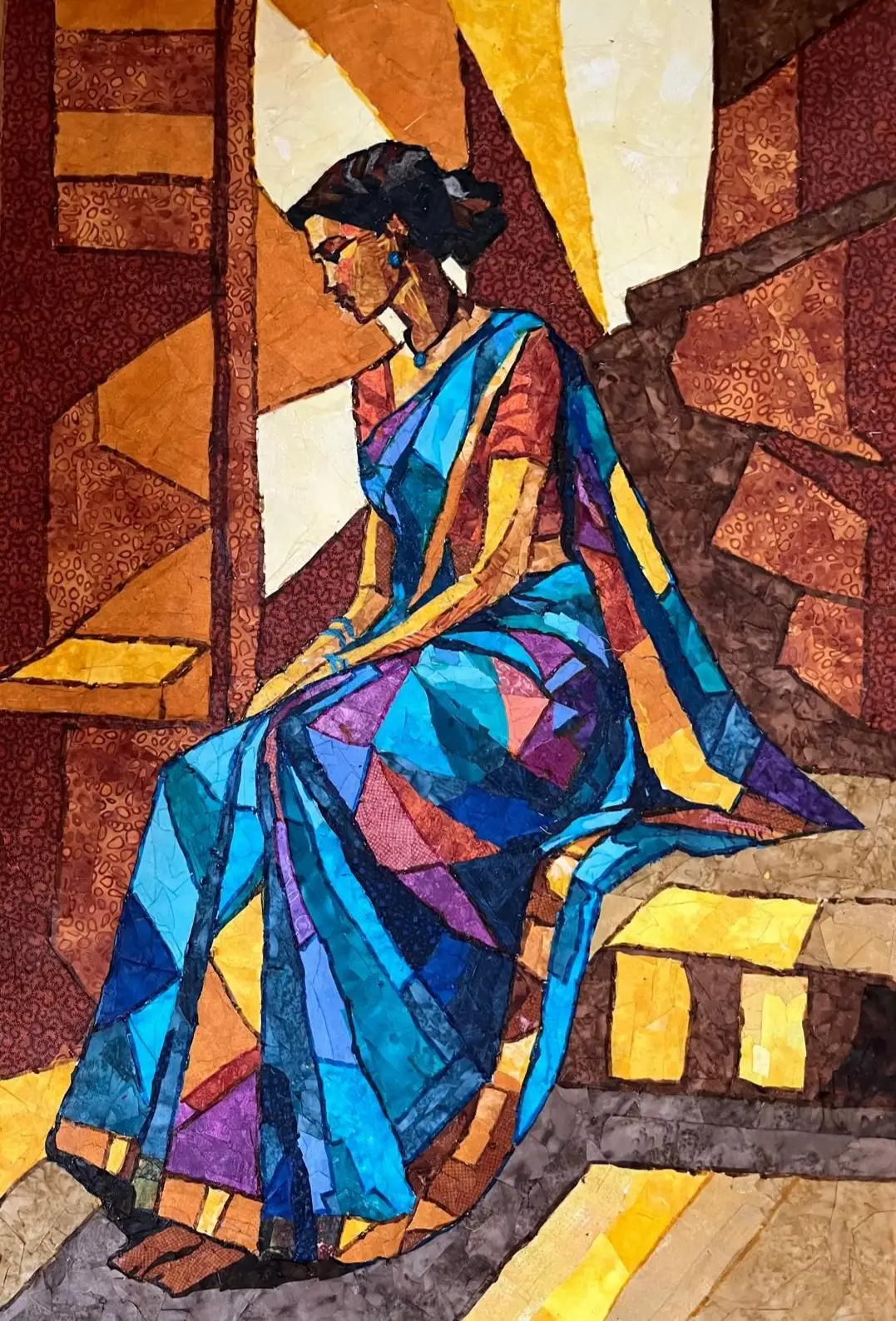
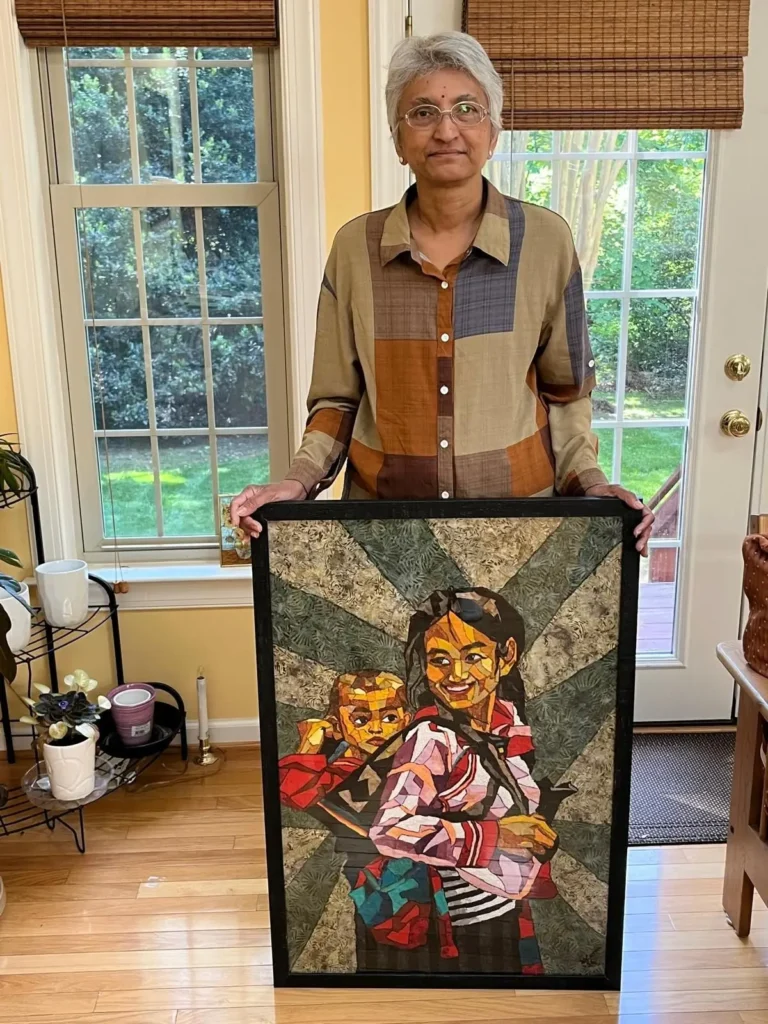
Mihira Karra brings together fabric, color, culture, and stories to create portraits filled with meaning. Inspired by the strong women in her family and the many places she has lived and worked, her art celebrates people, their lives, and the details that make them unique. Most of all, Mihira wants her work to bring joy.
Do you remember the first time you realized you loved to draw or make art? What do you remember about that moment?
It was when I watched my cousin, my oldest cousin, who was living with us at the time. I was about six or seven.
This was in a small town outside of Calcutta, a railway colony, because my father worked for the railways. I had no idea he could draw or that he was interested in art. There was a book, now considered controversial: Uncle Tom’s Cabin. We had a comic version of it; we had lots of comics, so I read a lot of classics through those. The cover was this beautiful head of an African American man. He took that and not only sketched it out, he had nothing, just a pencil and a piece of paper, not even good art paper, he found it lying in the house.
We used to have coal stoves back then, before gas, so he took coal from there and used it like charcoal, turned it into this beautiful piece, then set it with rice starch (we had rice every day anyway) and sprayed the whole thing. I was so fascinated I asked him to teach me. He said, “I don’t have to teach you anything, just pick up a pencil and start copying things.”
As an Amazon Associate I earn from qualifying purchases. Read more about our affiliate linking policy.
So I started with simple things, cartoons and all that. Then in school, once I realized I liked to do it and could copy well, another girl in my class, also a born artist, and I were the two doing all the posters whenever there was a topic. That got me a lot of practice, not just drawing but writing neatly too.
My first medium was pencil. Just pencil, regular writing pencil, graphite, not even good art pencils like a soft H or 2B. Later, maybe when I was 10 or 12, my grandmother brought me oil pastels, and I became very fond of those.
You grew up in India and moved around because of your father’s work. How did seeing different parts of India shape the way you see people, clothing, color, and culture?
That’s why you see such a variety in what I do.
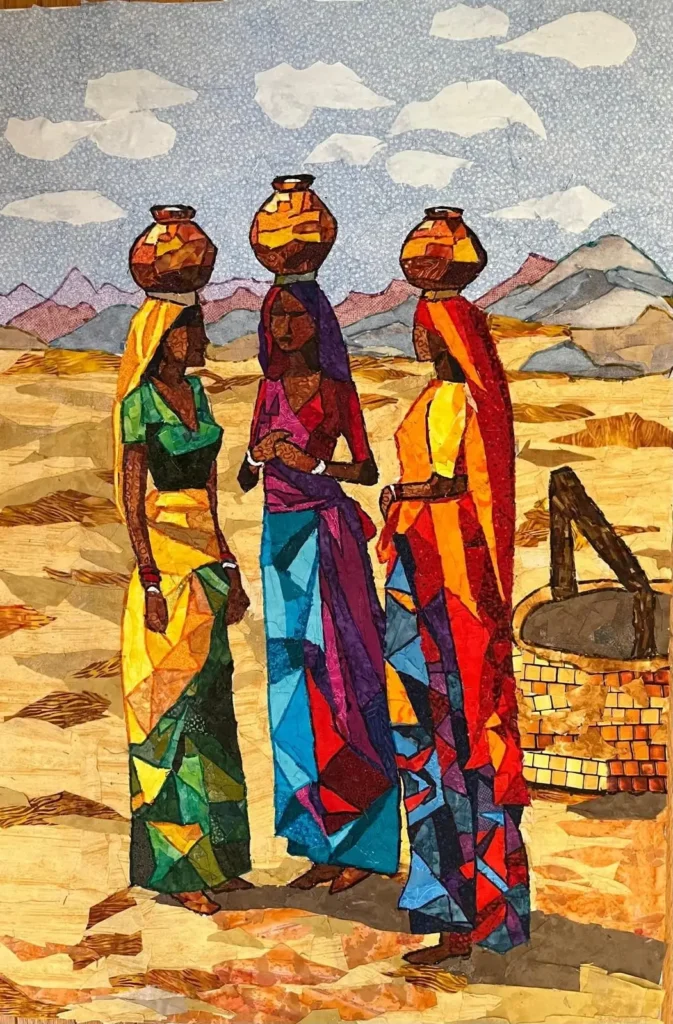
Bengal influenced me the most, even though we moved around, it was mostly within Bengal and eastern UP. Living there, the Bengal influence is why my signature piece is the woman with the conch, warding off evil, it has a lot of meaning. The symbolism, the Dhunuchi dance to the goddess, all of that Bengal influence is heavy in my work. UP gave me the women with pots and Rajasthan.
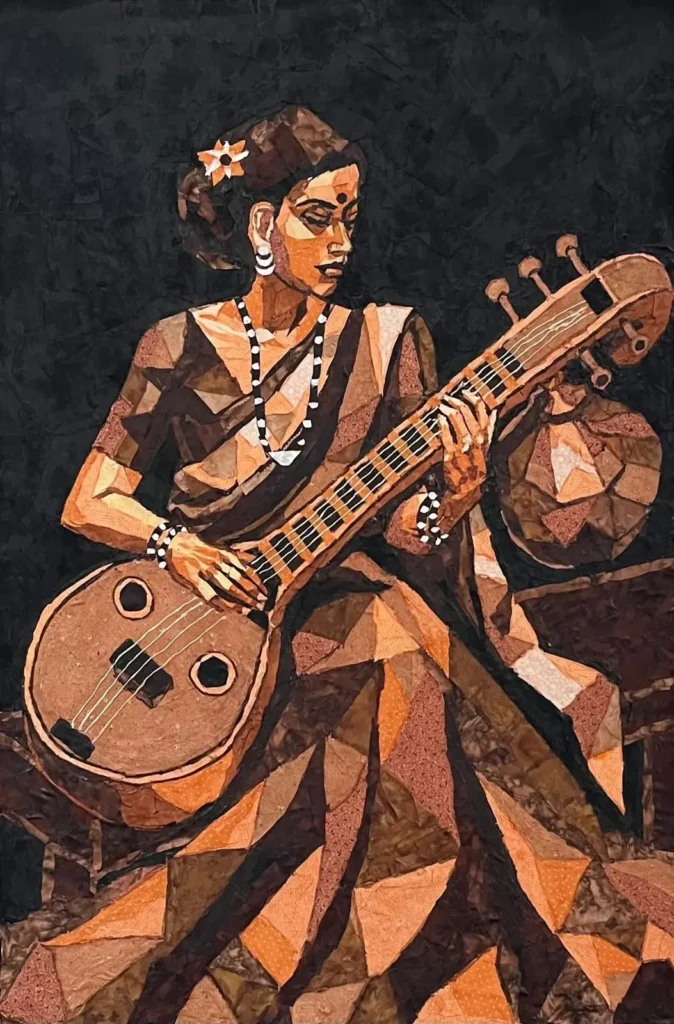
And South India, too, because I’m originally South Indian, we went every summer to my grandparents’ village, and the way my cousins and I dressed, my cousin playing the veena, all of that has influenced me long-term. Interestingly, after coming to this country I got much closer to my father’s side of the family because many of them are here, and my mother tongue actually improved from talking to them, even though I still can’t read or write it.
At the time we kept changing schools and friends and I used to hate it, but it got me to see different cultures in a very real way, I didn’t see much of the historical sites, but I lived the culture, so appreciation for different cuisines and cultures was almost automatic. Bengali food is my favorite, especially the fish, luckily my brother married a Bengali woman who’s also a great cook.
You have spoken about strong women in your family, including your grandmother, who became an engineer at a time when that was unusual for women. How have the women in your family influenced the subjects you choose to create?
My grandmother became a widow at 18, and luckily her father was a forward-thinking professor of engineering who, because she was so good at math, persuaded the governor to let her into college after seeing her mark sheets. That’s how she became an engineer, so she could stand on her own two feet.
My grandmother was always independent, and she’s the one who pushed me to be independent, to study, to apply to the US. She went to England and to the US for a Women Engineers conference and other workshops, but she preferred the US any day, England in the 1960s was very racist. The US wasn’t perfect either, but even in a short visit she saw the difference, when she went to the conference here they invited her to their homes; in England, nothing like that, very standoffish.
She passed away at 60, just before I got admitted into the US. For very practical reasons, she told me to keep art as a hobby, because I wanted to go to art school, and she said, “Getting jobs is difficult, look at my situation, you have to be able to earn.”
That way, I was far ahead of my cousins, because almost none of them in my generation studied to actually work, they studied to attract more educated grooms, not for employment. My whole focus was always employment, apart from being interested in the sciences.
My grandmother also pushed her niece, my aunt, to get more educated. She became a professor of German literature and women’s studies, a renaissance woman with huge influence on me, and she lives right near me.
My mother wanted to be a doctor but my grandmother couldn’t afford to send her to school; my father worked for my great-uncle (my grandmother’s brother) and she found him to be a very nice man, that’s how the marriage was arranged. Later in life, thanks to my father, she did her bachelor’s in education and taught until she was 86.
My paternal grandmother only got to fifth grade, her father passed away, but she was a voracious reader and a very strong woman who made sure all her sons were educated, though she couldn’t afford to educate the daughters beyond seventh or eighth grade.
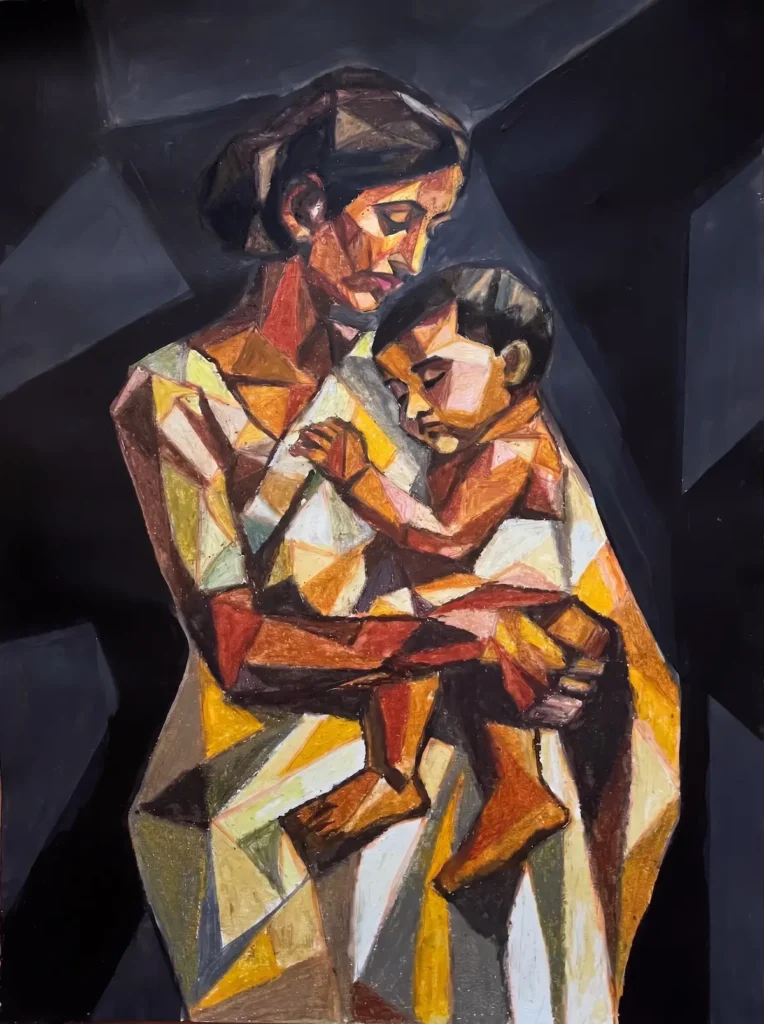
Both grandmothers were very strong women. Essentially, if you notice, most of the political portraits I’ve done are of women, I haven’t done many Indian women except my grandmother, my mother, and my aunt, the subjects here just don’t call to me the same way since I’m not living there.
My subjects are almost always women and the tough lives they lead, but shown in a beautiful way, not depressing, because when you’re hanging something, art is also meant to be displayed. The women with pots, yes, they’re working hard, it’s not an easy life, but it’s still pretty. The theme is definitely feminist; the treatment is more art-pleasant. That’s all.
You studied science and built a career in international development before returning to art. What did your life outside the art world teach you that you now bring into your studio?
Almost everything, the whole influence of Africa is thanks to my work. Without it I would never have traveled there, never understood how similar these issues are across the world. I traveled in Latin America too, but it was already more advanced than South Asia and Africa in many ways.
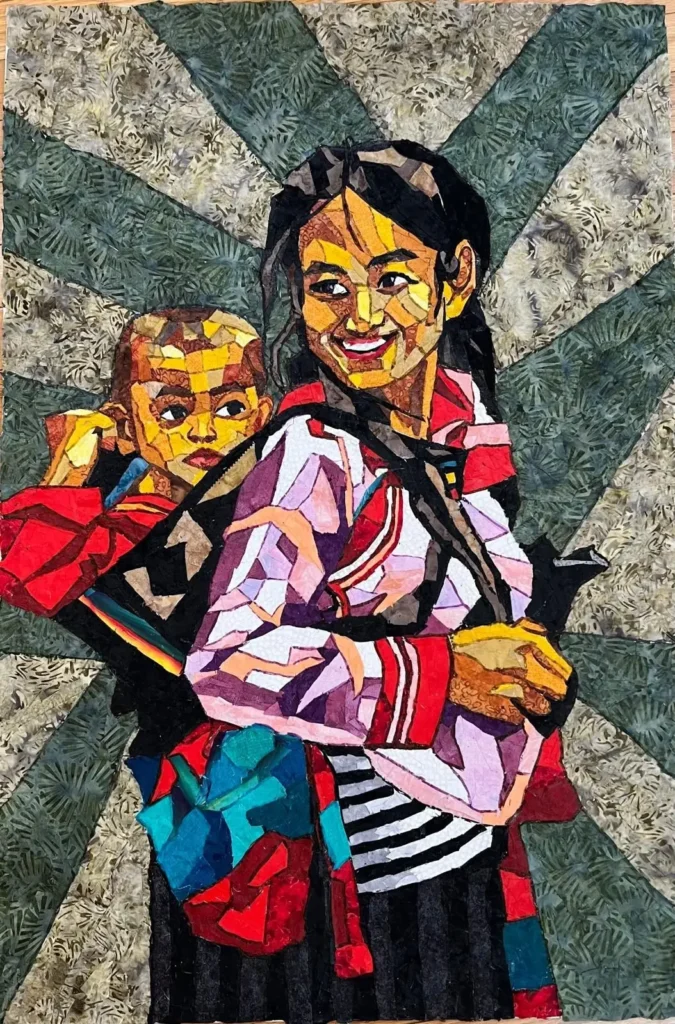
West Africa especially was beautiful, the cultures, the colors, the traditional clothing worn especially at big meetings. Getting back to the themes again: women and hard work, women and children, I’ve used photographs from friends and from Mahesh’s photographs for some of my pieces.
All the political portraits are because of my work, those people influenced how we worked, so it was a homage to them, mainly for what they did, how they supported women’s development around the world and in this country. My politics was very influenced by my work; I got to see the effects firsthand, on lives, both the best of what that work could do and, later, the harder parts.
Looking back, do you think the artist in you ever really went away, or was she simply waiting for you to have time for her again?
It got dormant, but not completely gone.
When my kids were young I still sewed all their Halloween costumes, painted them, and did a few sketches of them, which my sister-in-law and brother still have.
I wish I’d taken classes then and kept at it. But honestly, that difficult stretch was the silver lining, it truly woke me up to do what I love. And this has been the saving grace ever since, and it echoes something I did earlier in my career too, I made so many gifts for my division and coworkers, giving away a lot of free pieces because I wanted to bring some joy to the workplace.
What was it about fabric collage that made you think, “Yes, this is the medium for me”?
It was by chance.
During a difficult stretch, a friend told us about a weekend workshop taught by a fabric artist. My friend isn’t an artist herself, but she’d taken it and said it was such fun, because it advertised “no talent needed.” My other friend and I had wanted to do it earlier, but had to postpone. As soon as we were able, we finally went, and I’m so glad we did, because that teacher passed away a couple of years later.
It was a weekend in her studio, and that’s when I got curious, I’d never even been to a fabric store before, I can’t sew, never thought I’d enter one. But when I came back I said, this medium is really interesting, you can use it like paint. That’s how I started, in 2013. It was the most well-spent money, we spent close to $1,000 on the stay and everything, but it was the best $1,000 I’ve ever spent.
Your first love was portraiture, but fabric gave you a completely different way to create a face. How did working with fabric change the way you look at a person?
It was by chance, actually.
Unlike paint, I found that fabric came with so many patterns and themes built in. One day, while doing plain portraits of my family in black and white fabrics, I noticed that the NCAA, the National College Athletic Association, makes fabrics for each university, mascots, colors, symbols.
Between my husband and me we had four universities to choose from, so I used NCAA fabrics to do my self-portrait. My brother saw it and loved it, he said, “This is very interesting, you have to do this kind of stuff where you’re telling a story.”
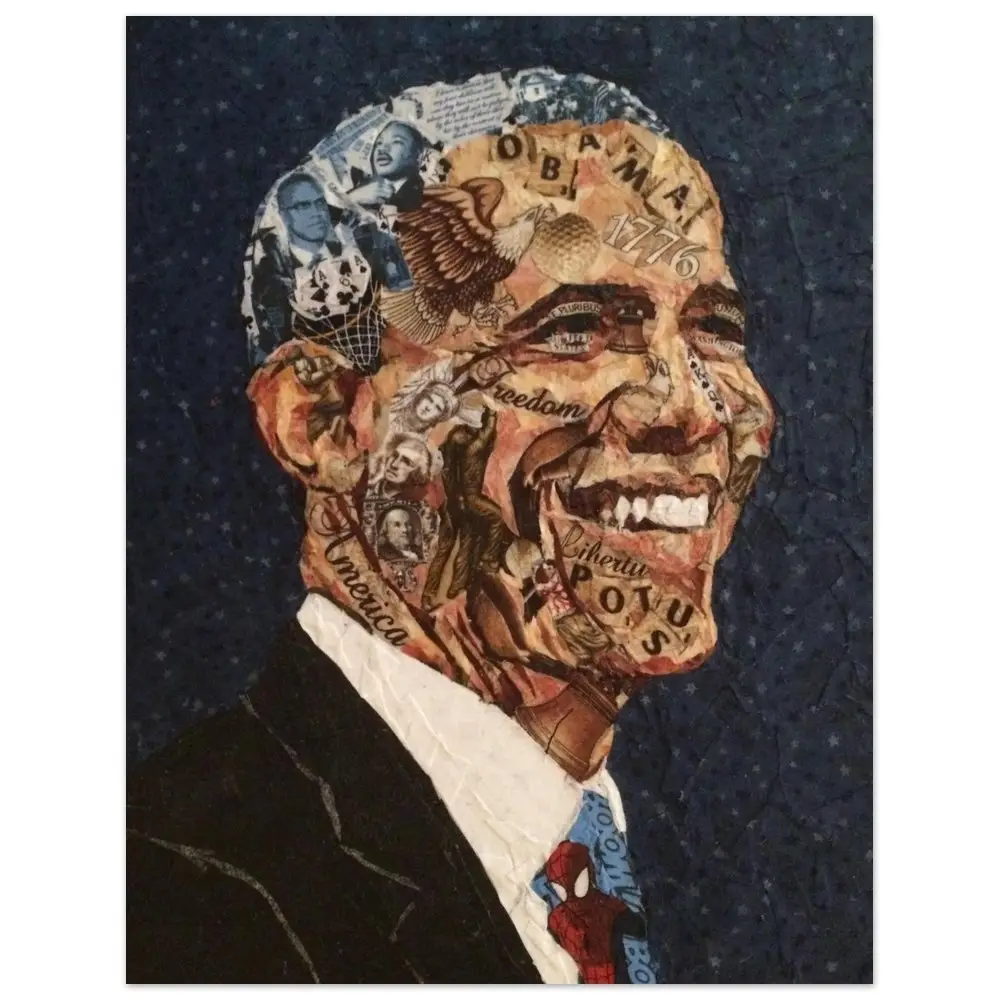
Right after that I did Obama, because I’d also found a site by chance, googling, called Spoonflower, that had fabrics with African American history themes on them. I still didn’t know then that you could create your own PDF and get it printed, that came later, since Spoonflower does that too. But whatever fabrics I found, I used, and I found everything I needed for Obama and did it.
Yes, it changed how I see a face, because apart from the story, I had to figure out how to fit the fabric in and still see the features and the shading. The biggest lesson was that not everything has to be exact to make a face look good, you can shift the shading a little as long as you keep a few main points, bringing it down to those few key points to get the resemblance.
That’s also how I discovered collage art, I had no idea people did collage with paper and all kinds of materials. Googling fabric led me to googling other artists, and from there to a fun collage workshop, and eventually to mixed media, and back to pastels, and later a charcoal class I thought would be tough but turned out wonderful.
About two or three years ago my cousin told me about an Indian teacher doing online watercolor classes, so I started that too. By chance, I’d also taken a beginner painting class during COVID, sat in as an auditor without even paying, and years later that same teacher showed up with a group from GMU and recognized me, “I’ve seen you before.” “Yes, you were my teacher, and you got me to paint.”
Your work has changed quite a bit over the years. When you look at your earlier pieces beside your newer work, what changes make you happiest?
The storytelling within the face, I thoroughly enjoy that and still think it’s unique.
I’ve done so many commissions that way, and I love it, because I’m a researcher by training and at heart, finding out more about the person, what makes them happy, what makes them special, not just what the world already knows but what it doesn’t.
People ask me why there’s a turtle in Colin Kaepernick’s portrait, because he has a pet turtle. Or Obama’s tie full of comic characters, because he collects comics, who knew.
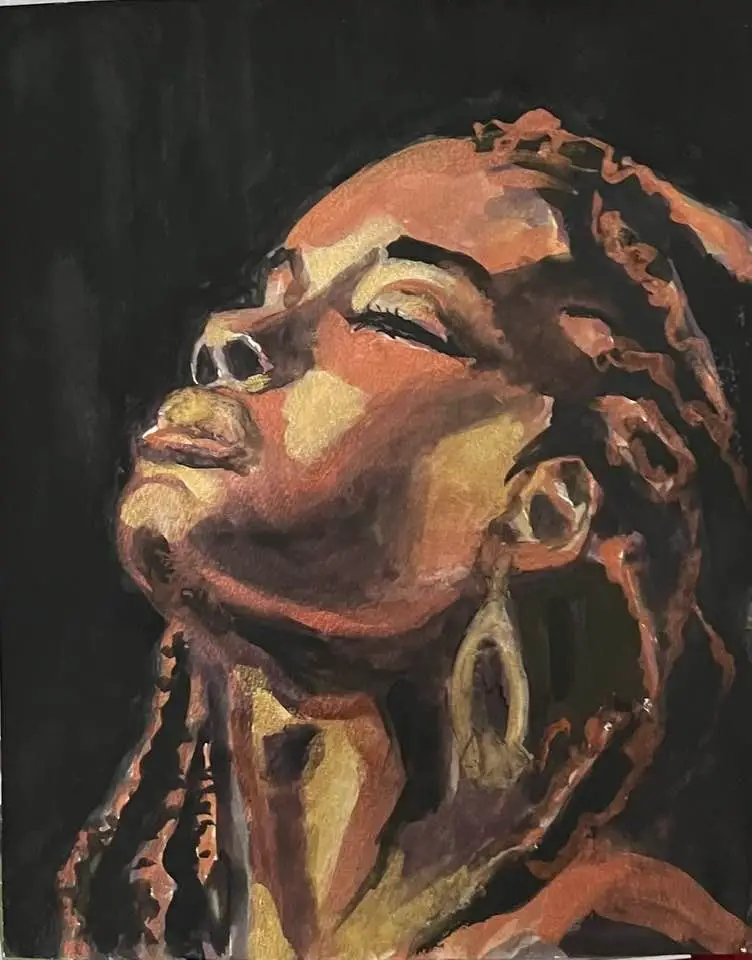
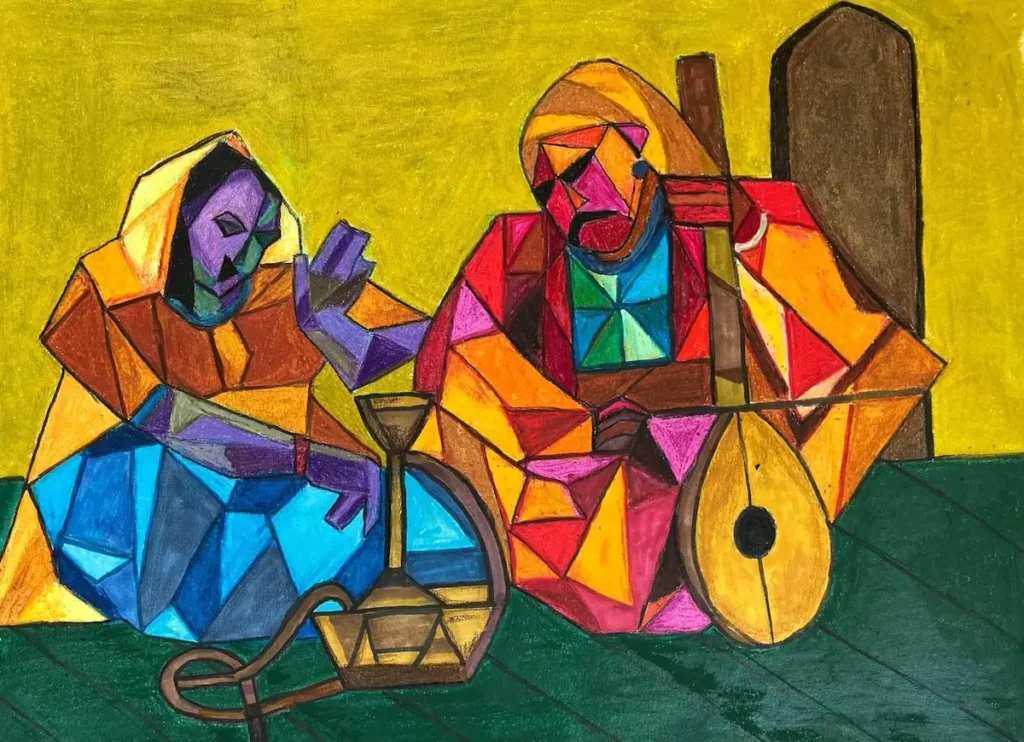
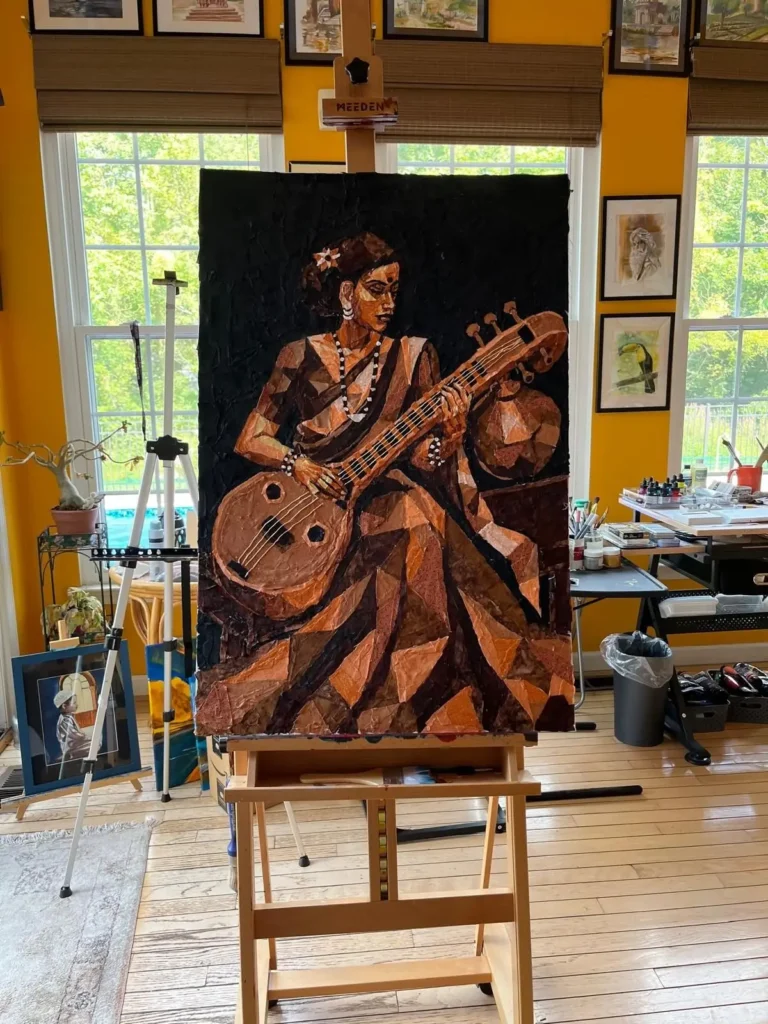
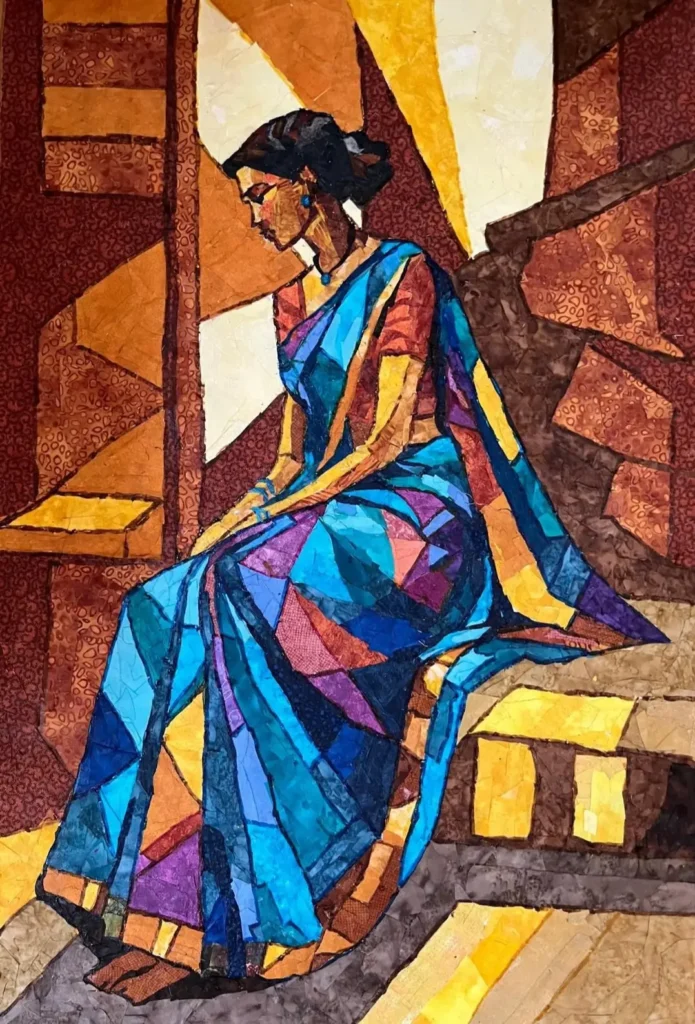
Bringing out the unexpected is really fun. And I’m genuinely enjoying the geometry now, it lets me do more with fabric, since you’re not chasing exact shading, you’re giving an impression. ChatGPT has actually helped me a lot with that, creating source material out of ordinary photographs or from scratch, like I did with the woman with the veena. I went from exact portraits, mainly for resemblance, to the story, and doing mixed media using paper and everything, and now I’m trying to go more abstract, though pure abstract still isn’t natural for me, I like to keep it recognizable in some form. Right now I’m going through a geometric phase, it’s not like the cubists breaking things up completely, it’s still using geometry but staying a figurative, recognizable piece.
Describe your creative space.
It’s a mess, that’s the first word for it, and the GMU visitors thoroughly enjoyed hearing that.
I’ve taken over the whole house. But I do have roughly separate spaces for different mediums.
Fabric has to be kept separate so it doesn’t get stained, it’s all sitting in boxes on nice shelves, a mess inside but color-coded in a way, and I mostly work with it in the sunroom, or wherever there’s natural light.
Watercolors take a lot less space and aren’t as messy, so I do those in my bedroom, just sitting and watching TV while waiting for layers to dry.
Pastels I do at the dining table, with natural light, but I store them in boxes in the sunroom too. Downstairs in the basement is where all the real mess lives, frames, extra paper, extra canvas, and that’s also where I do charcoal, because I’ve got a tarpaulin laid out on the ground since charcoal really stains. Charcoal, acrylics, anything messy goes downstairs.
My family says I’ve taken over the whole house, partly because my finished pieces are lying around everywhere too.
How do you choose the fabrics for a particular person or scene? Do you begin with the color, the pattern, the texture, or the story?
Over the years I’ve built up a big collection, but I take a picture of what I want to do to the fabric store and keep looking for colors, usually patterns, not plain fabric. Sometimes a single multi-colored fabric works for several parts, so I cut out different pieces from it.
Now I have such a collection that I can do most pieces without buying anything new, I mostly only go out when I want an exact thing for an idea I already have. For a commission with specific themes, I do have to buy, or create my own print, do a PDF and get it printed.
Do you have a favorite type of fabric to work with, or is the “right” fabric different for every artwork?
It’s all 100% cotton, I prefer the thicker ones because they cover the drawing lines better. More recently I’ve also used thread, for the veena piece, and cotton lace, broken up for a different effect, and wool to do lines. That’s about it. Colors and patterns are what really make the difference, since it’s all cotton underneath.
What happens in your studio when something goes wrong? Do you have a favorite way of stepping back, solving the problem, and moving forward?
Fabric is extremely forgiving, I can pull it off or add to it, so correcting something there is easy. I haven’t thrown out a single fabric piece; I’ve either repurposed or corrected every one.
Watercolor is different, if it goes wrong I either abandon it or push through to finish it. I went through all my old practice stacks, dumped most, kept the ones that looked halfway decent, and finally framed a few, once I hung them up, I realized people actually noticed them.
Acrylics I didn’t like, I just need to gesso over the canvas and reuse it, though I’m too lazy and haven’t done that yet.
You often create portraits of people who have made an impact on the world. What makes you choose one person over another?
It’s all connected to what we were doing at work, and people I admired, really tied to people who influenced women’s lives and children’s lives across the world, justice, equity, those kinds of themes we worked on our whole careers. That’s what makes me select those people.
Commissions are different, I’ll do anyone the client is interested in, whether they want a plain portrait or the whole story woven in.
You have said that you like to include a person’s interests and history within the portrait. How do you decide which pieces of their story belong in the artwork?
I look for things about them online, or if it’s a commission, I ask the family what the person’s interests are, what the university or the people commissioning it love most about them.
I select far more images than I actually use. Once I’ve settled on the color scheme, I sometimes shift the colors on those selected images and get them printed on fabric, or on paper if I’m doing mixed media, matching the color scheme I want, especially where there are big areas of dark and light in the face.
I plan a bit ahead for which pieces go where, but I draw the eyes, nose, and mouth first and keep those as plain as possible. For the surrounding areas, I prioritize what has to be there, family, if it matters to them, a Nobel Prize, something important, and then fit the more fun details in wherever they work with the shading.
Your work can also speak about social issues and people whose stories deserve attention. How do you balance making something beautiful with saying something important?
Any image can be made to look beautiful, it’s all within the context of where it is put.
There may be an image of a person getting hurt, though I haven’t done that, but if you put it within a frame where everything else is nice, you’ll see the story without the whole thing reading as unpleasant. It’s what’s around it too; it’s which context it’s put in. And there’s absolutely no trade-off, you can do both.
When you look at a dancer or horse, what catches your eye first: movement, shape, expression, color, or something you cannot quite put into words?
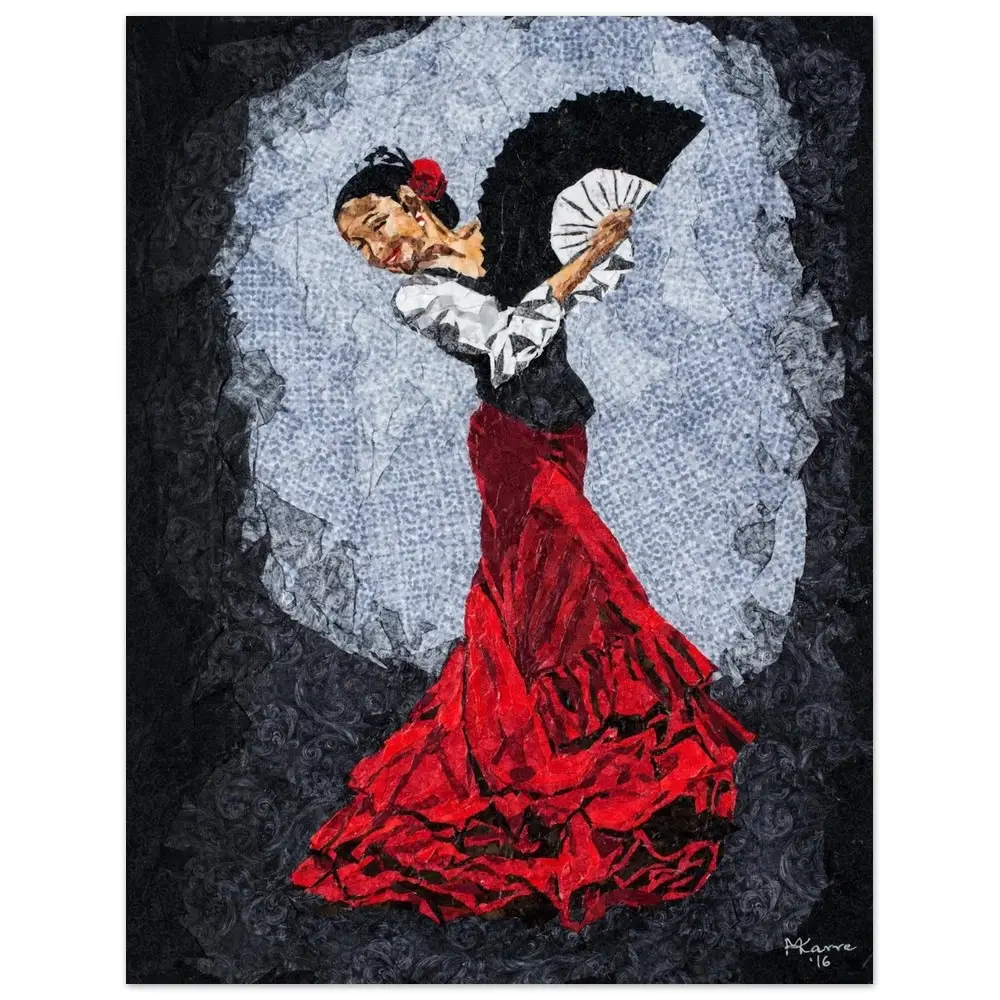
The movement. With flamenco and things like that, it’s also the posture that shows strength, not just the beauty. It’s the very strong feeling you get when you see a dancer.
You have recently explored charcoal, acrylic, paper, paint, and other materials. What made you want to step outside the fabric and pencils that had become such an important part of your work?
Fabric is very versatile and forgiving, with a lot of texture, which is why it’s a favorite, but combining it with other things makes it really interesting, and I’m beginning to enjoy that a lot.
Part of the reason I stayed mostly with fabric is that you see plenty of collage artists, but very few use fabric, they use a lot of repurposed wood and paint and so on, and fabric tends to be the realm of quilters, which is a totally different way of working. That’s why what I do is more unique.
For someone who has spent years putting creativity aside because of work, family, or other responsibilities, what would you say to the person who wonders if it is too late to begin again?
It’s never too late. I’ve seen artists who started in their 70s and 80s doing incredible work.
One of the most famous is Grandma Moses, an older African American woman who spent all her years taking care of family and kids, and only became famous in her 80s. She lived to 100, and her paintings are priceless and world-famous now.
There’s no age bar. All my cousins were an inspiration too, doctors, engineers, none of them professional artists, who started after retirement and are doing amazing work, still learning.
Where can people see your work?
On my website, mihirakarra.com, and on my Facebook and Instagram pages.
Rapid Fire Fun
- Messy studio or tidy studio? Messy.
- A favorite fabric? Cotton.
- India or Spain for artistic inspiration? India.
- Dancer or horse? Dancer.
- The one word you hope someone feels when they see your work? Joy.
Interview posted September 2026
Browse through more collage inspiration on Create Whimsy.