
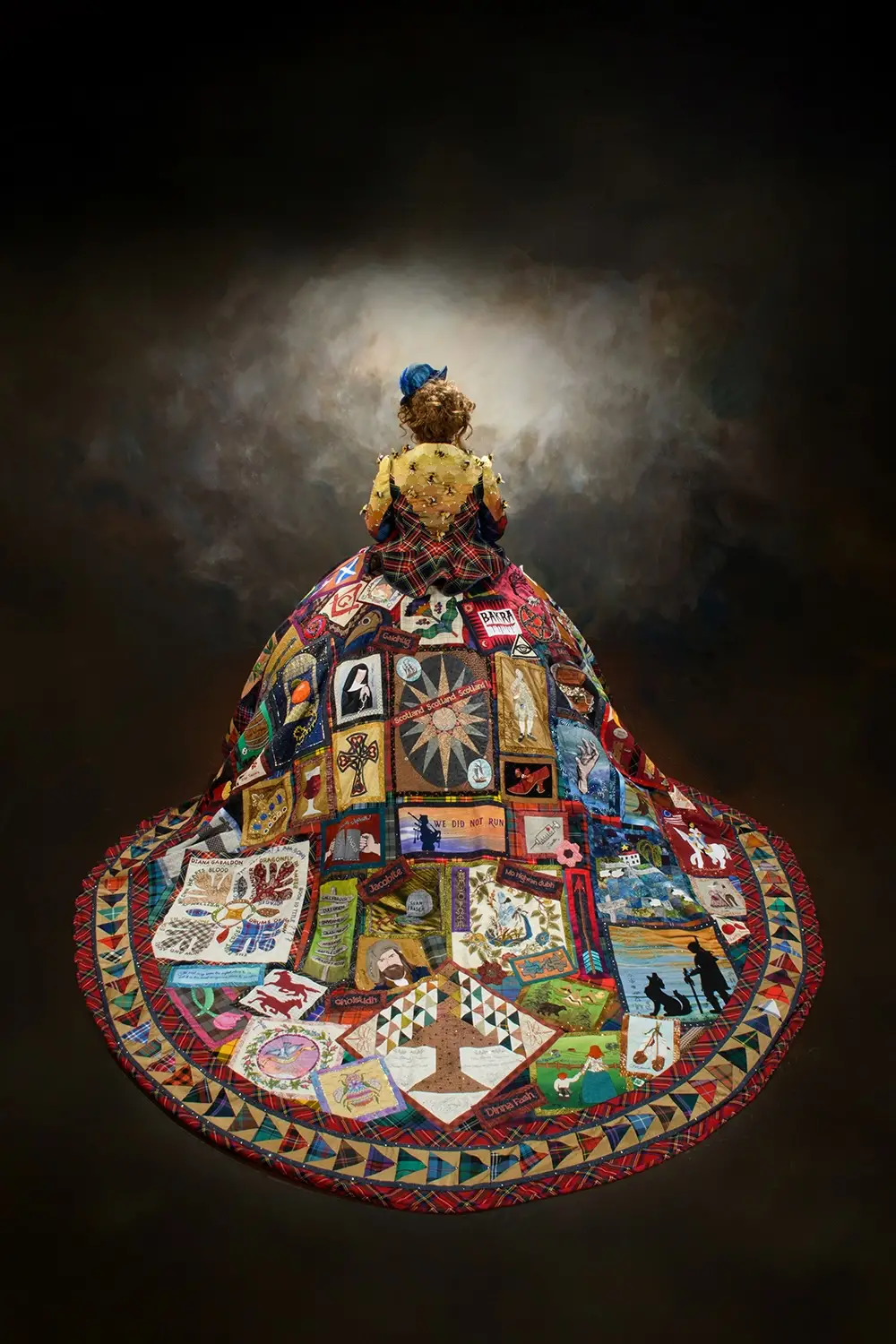
Teri Biglands brings together quilting, embroidery, costume making, and a love of history to create amazing works of wearable art. Her curiosity keeps her learning new skills, solving creative puzzles, and turning stories she loves into fabric, thread, and beautifully detailed costumes.
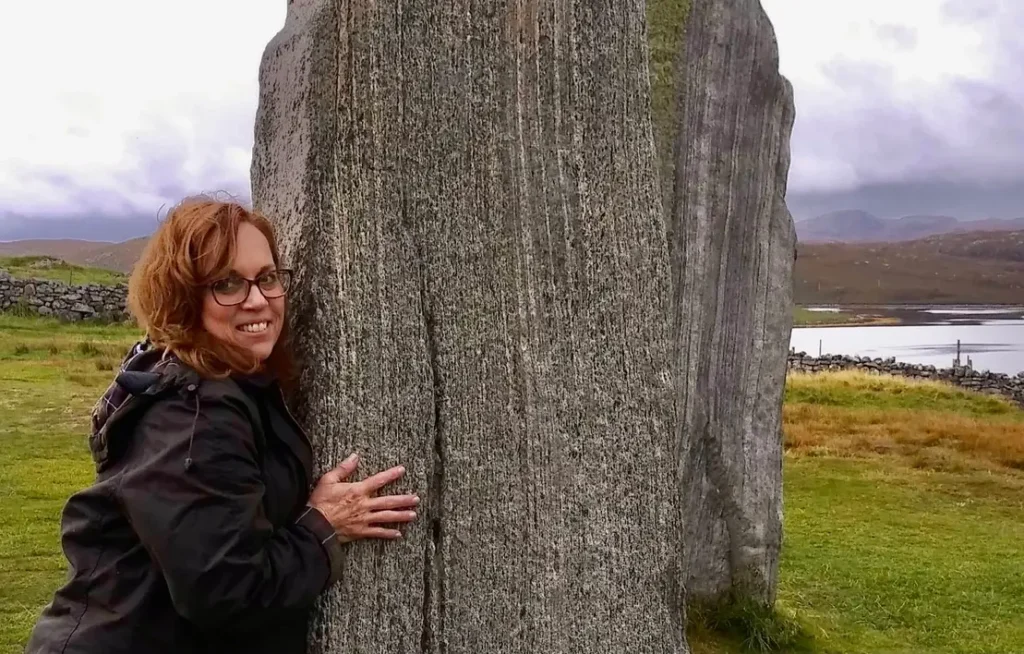
You’ve been sewing for most of your life. What are some of your earliest memories of making things?
In Girl Scouts, we learned embroidery using plastic canvas and yarn. This is my first memory of being introduced to something new and exciting.
Drawing and sketching were a favorite pastime in high school. Taking a required Home Economics class in high school exposed me to cutting a pattern and sewing with a machine; we made aprons.
I am not really sure exactly why, but I remember in my teens picking up Macrame. Reading instruction sheets and teaching myself to make hangers for ceramic pots. Thinking back now, this must be when I decided it wasn’t so hard to teach myself something, because later came crewel, cross-stitch, silk embroidery, quilts, and costumes. Working with my hands seems to be something I really enjoy.
When did quilting first become part of your creative journey?
My first exposure to learning quilting came as a new military bride at our first base assignment in Arizona back in 1982. One of the other wives who was originally from Carolina asked if there was any interest in learning and taught a beginning quilting class at the local rec center on base to a handful of people. She taught us the basics the old-fashioned way before rotary cutters. Making templates and cutting fabric by hand, tracing the templates with pencil and adding in seam allowances for hand piecing, sandwiching the quilt with batting, hand quilting, and binding. That was my first quilt, and I still have it!
As an Amazon Associate I earn from qualifying purchases. Read more about our affiliate linking policy.
To this day, I still use this same quilt technique, and that is my favorite way to make a quilt, especially one with curved piecing. Before learning quilting,I had previously done crewel embroidery and cross stitch. All that went on the back burner as quilting became all-consuming.
You spent many years creating custom draperies before focusing on quilts and costumes. How did those experiences shape the maker you are today?
Early on, I learned that I was the world’s worst quilt student. Oftentimes I would get called out by the quilt instructor for being on the wrong step. I realized then that my brain worked differently. I could see in my mind how to get from A to Z and maybe didn’t need that many steps to get there. Because of that experience, much of what I know is self-taught.
In fact, later in life, when I was asked to teach an embroidery or quilt class, I was very careful in my word choices. I would say at the beginning of my class that I would show them the way that I do things but that it wasn’t the only way; they were free to use whatever technique they preferred. I encouraged students to take what I taught and change it to a way they enjoyed creating.
Fast forward to when we moved to Georgia in 1991 and bought our home; I needed window treatments. So I started visiting model homes and sneaking a look at window treatment construction techniques.
I liked the process of “trying to figure it out”. I also bought a miter saw to cut my wood for valances. This led to making drapes for friends and eventually owning my own business for 25 years and working with various interior designers. Oftentimes, designers would bring in a magazine picture or a simple sketch and ask if I could make that.
Commercial drapery patterns were a good starting point, but I was constantly modifying those patterns to suit the designer’s vision or even drafting my own patterns completely. Oftentimes, I would make a sample before cutting into expensive designer fabrics. Later, when I began making costumes, I used the very same skills that I taught myself with drapery making to make my costumes.
Many people know you as both a quilter and a costume artist. How did those two creative worlds come together?
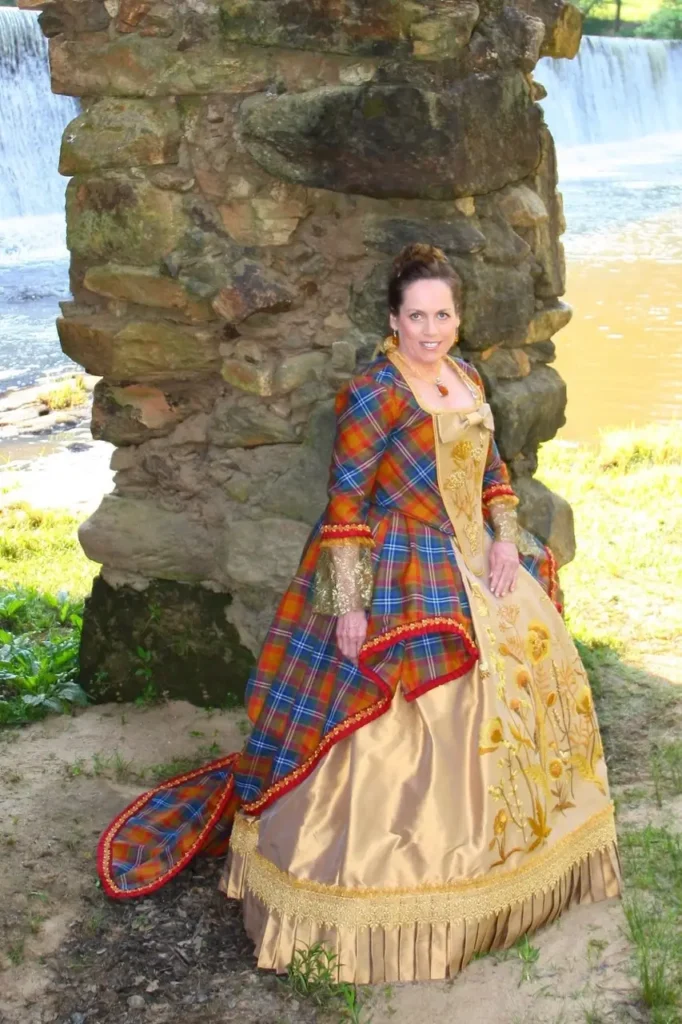
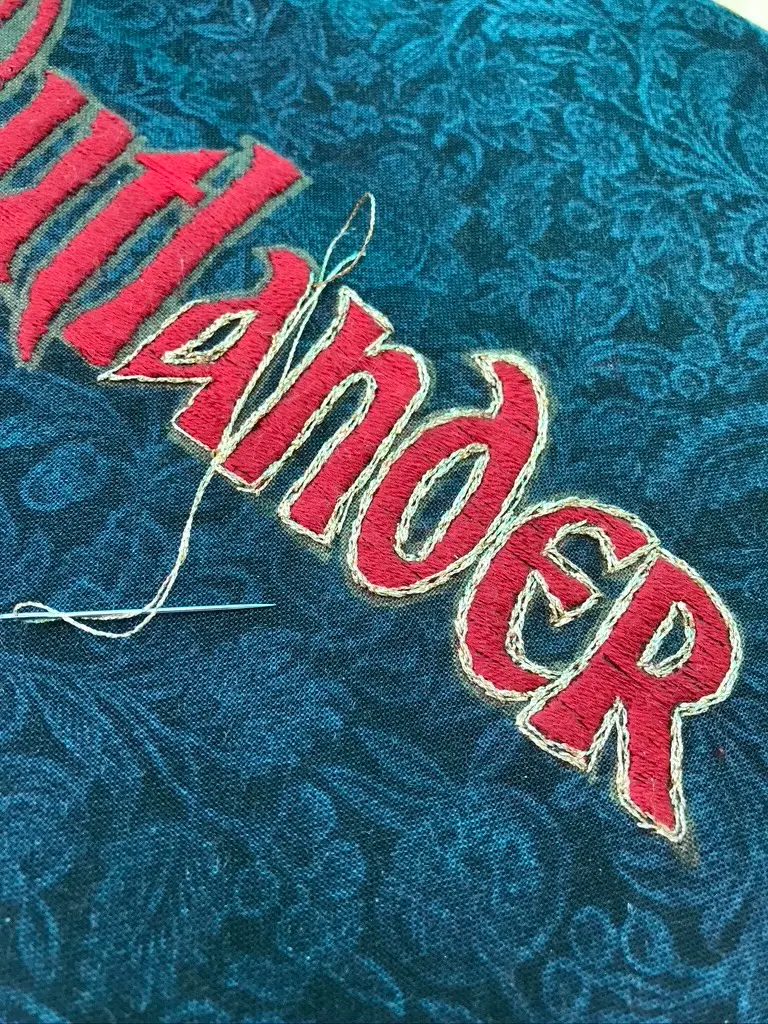
When I made my first Outlander-inspired gown, I made a Twitter account and posted pictures of the front and back of my gown with the caption “Look what Droughtlander made me do”. (a term Outlander fans coined for the long break between seasons). The post was receiving hundreds of thousands of views and shares, with one person stating that my dress was the most looked-at gown on Twitter.
Terry Dressbach (Outlander costume designer) jumped in when people were asking the value and compared my gown to the cost of gowns on the TV series, saying the costs were astronomical! I also have a keepsake notebook that I recorded hundreds of comments that people posted.
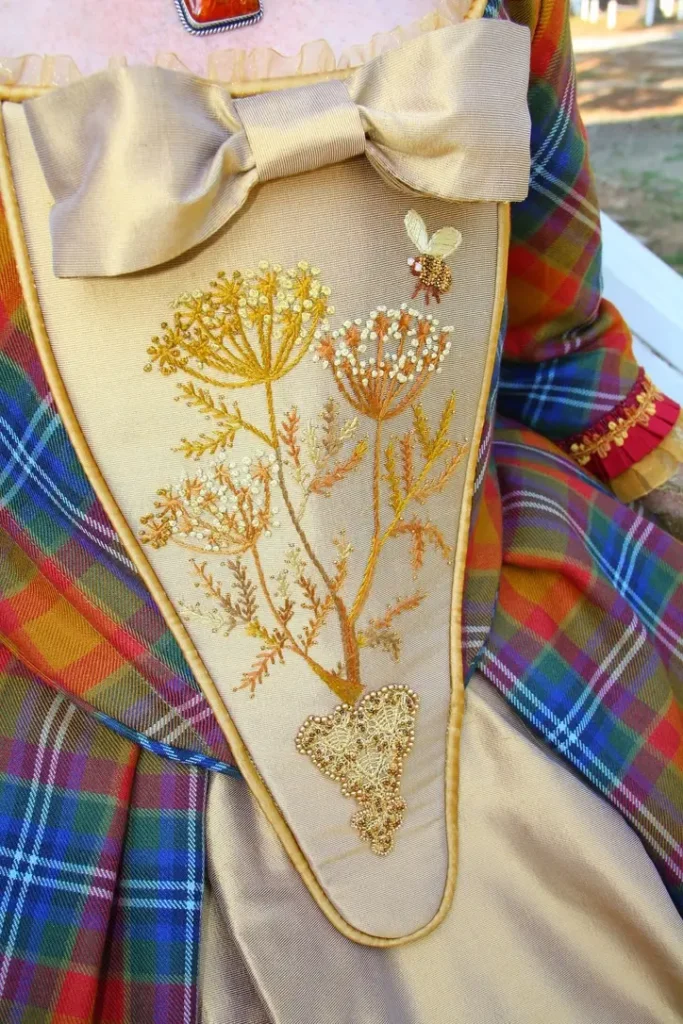
Author Diana Gabaldon commented “exquisite workmanship”, and I nearly fainted. I literally started jumping around the house. Not in my wildest dreams did I think there would be such a reaction and love for the dress, with people wanting the TV show to use my gown.
Many of the comments kept telling me to wear the gown and compete in Comic Cons. This was the first time I had ever heard of Comic Cons, so of course I started researching. Comic Con is a convention (con for short) that focuses on comic books and related forms of pop culture and entertainment, including movies, TV shows, and video games. It is a very creative and energetic environment.
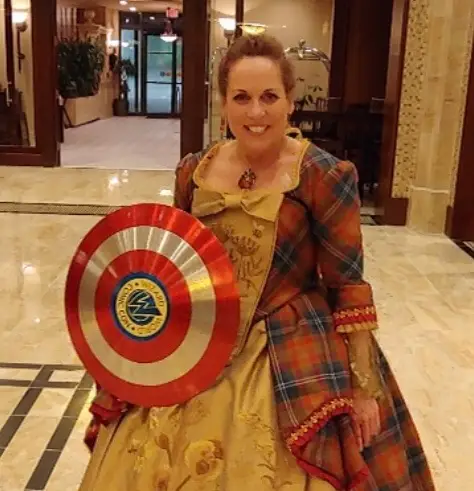
The closest Comic Con that had some of the Outlander cast attending, including Diana herself, was Wizard World in New Orleans in 2019. I wore my Tartan and embroidered silk gown, competed in the competition, and won Best of Show. My prize was an amazing Captain America Shield. If you’ve ever been in my sewing room, I make you pose with it. One day I need to post those photos because they are so fun.
I had this Aha! moment that I could bring my skillset to the competitive Comic Con World.
My first gown had a ton of silk hand embroidery that people were fascinated by. I had my own niche as a quilter and embroiderer. There was no age discrimination either, as I was 59 yrs old at the time of my first win. Judges loved new and innovative creativity, so there were no limits to one’s imagination or interpretation.
I had found a place that would let me share my art. A place where I could enjoy others’ art as well. A stage to compete on, which fulfilled my competitive nature. I have met so many talented artists along the way and am better for it. Most of the people are half my age. I say the same thing all the time, “If I had been that talented in my 20’s and 30s, who knows what turn my life would have taken”. I am constantly amazed at the age and skill level of show contestants. After my first Comic Con experience and subsequent competition win, I was hooked. I especially love the extremely talented cosplayers that I have met at the annual New York Comic Con.
When attending my first Comic Con, it became immediately clear that your real name was different than your social media name. This is when I came up with Kylander Kouture. There is a story about how this name came about. At the time, I was following Outlander actor Scott Kyle, Ross from Outlander, who had a huge fan base that called themselves “Kylanders”. He was so popular with the fans that he even created and sold merchandise with the most beautiful tartan. I contacted him as he was ending that chapter and asked if I could purchase the rest of the tartan bolt. The Kilt Studio in Bathgate shipped me the last 20 yards. That dress ended up weighing 15 pounds!
Your costumes often include quilt blocks, piecing, embroidery, and hand quilting. What made you realize quilts could become wearable art?
This is actually a great question, and the answer has a few layers. To begin, in the early days of competitive quilting shows, the shows would often include a wearable art competition. Anything from full ensembles to jackets, dresses, etc. In that regard, I have always seen quilts or quilt techniques as wearable art. This category of competition is slowly making a comeback in the quilt world. In New Zealand, WOW is a world-renowned wearable art experience, where an annual design competition culminates in a spectacular show. Next-level wearable art with huge prizes awarded.
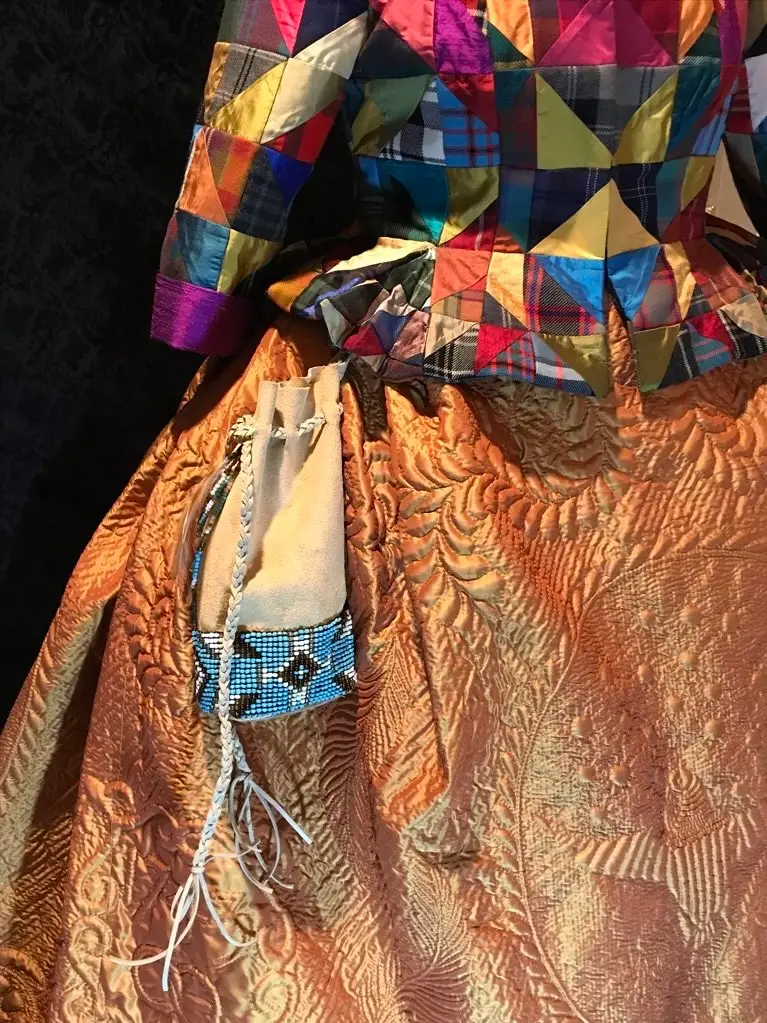
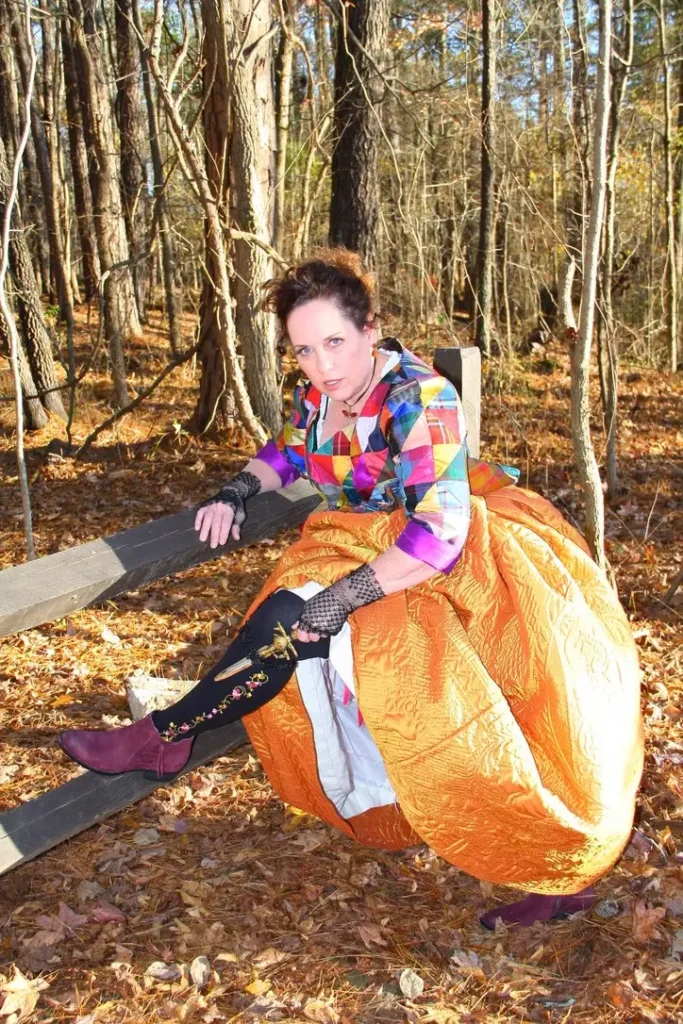
Some background to the next part is that I started reading the Outlander books by Diana Gabaldon in 1992. In 2014, the first episodes of the Outlander TV Series based on the books first aired, bringing all of the beloved characters to life. I really took notice of the costuming. It was palpable how much love, care, and attention not to mention hard work, Designer Terry Dresbach took to bring the Outlander books to life. The details were absolutely incredible. When my quilt friend Phyllis said to me one day, “You know they have Outlander conventions, right? Where people dress up in costumes.“ I did not know about the conventions till then, but almost immediately started dreaming about what I could design and make to wear. I purchased a McCall’s historical-looking dress pattern. My dress really came to life with my leftover silk drapery and upholstery fabrics.
Sewists have a language all their own, just as quilters do. I had to read and reread that pattern off and on for a week till I could finally understand it. I had also read in a blog that if you can find one pattern and make it fit you, then you can design anything from that single pattern. For two more of my costumes, I did just that: modifications from the original.
Your work is inspired by history, literature, and beautiful garments. What draws you to telling stories through fabric?
Back in 1981, graduating from college, I was one class shy of being a double major, that being Art History. I graduated with a Journalism degree and a minor in Art History.
I am not sure if it was being a military brat and living abroad in Germany and Turkey that was the reason, but I have always been inspired by art history. If I am traveling, there is always a mandatory Museum visit involved.
The Dutch Masters Exhibit was a memorable exhibition. The clothing and lace of the time were painted so incredibly detailed. In real life, under the candlelight of the day, it must have looked magnificent, like walking pieces of art.
When I started making historically inspired clothing, I realized early on that the underpinnings or understructure were just as important as the outer garment. For my first costume, I began studying and teaching myself how to make a set of period 18th-century stays. Lots of trial and error involved using historically accurate reproduction patterns.
I learned to make toiles of everything I made. Never realizing how short I was till I finished my first set of stays and they were 5” too long! Each of my costumes has its own set of underpinnings coinciding with that era of dress. This consists of stays or corset, chemise, bum rolls, hip pockets, rump pad, steel cage, and lots of petticoats. I drafted patterns for my reticules (ladies’ handbags) and made several variations for each costume. Making sure to draft each style of reticule to fit my cell phone for Comic Cons.
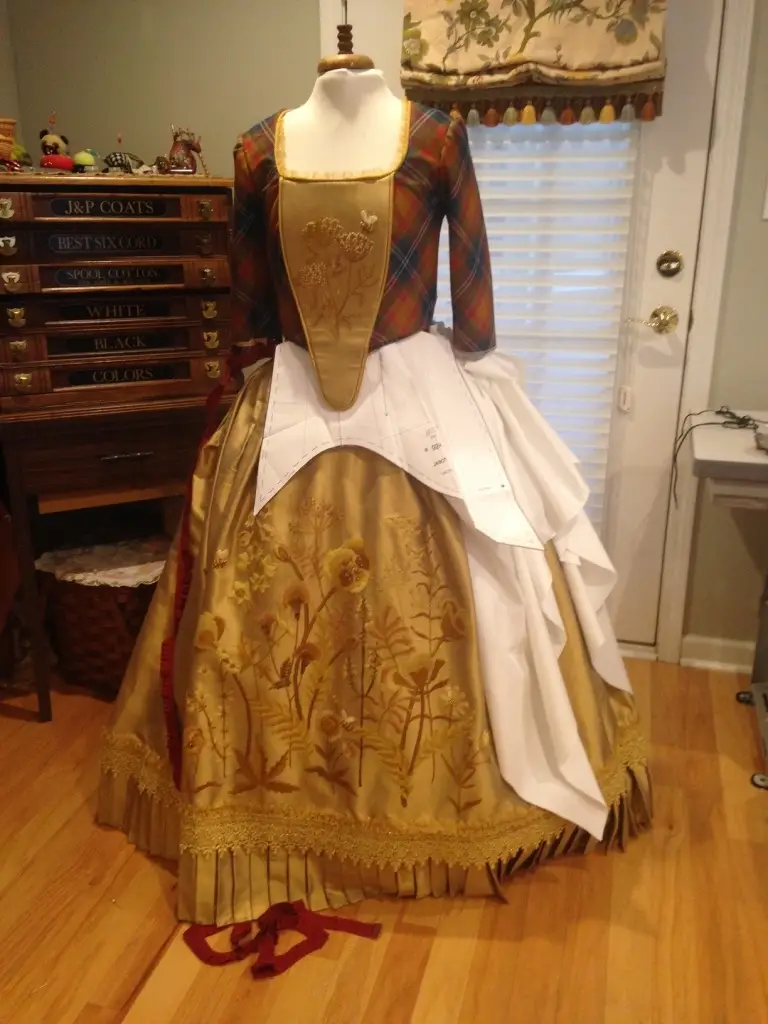
When I am choosing fabrics for a project, I will most times land on the one that feels right and is going to give me the result or feeling that I want to achieve. I was really inspired by the embroidered clothing from Outlander. For my first major gown, I knew that I wanted to mix textures of fabric, so I chose to combine Scottish wool tartan with a gold shantung silk.
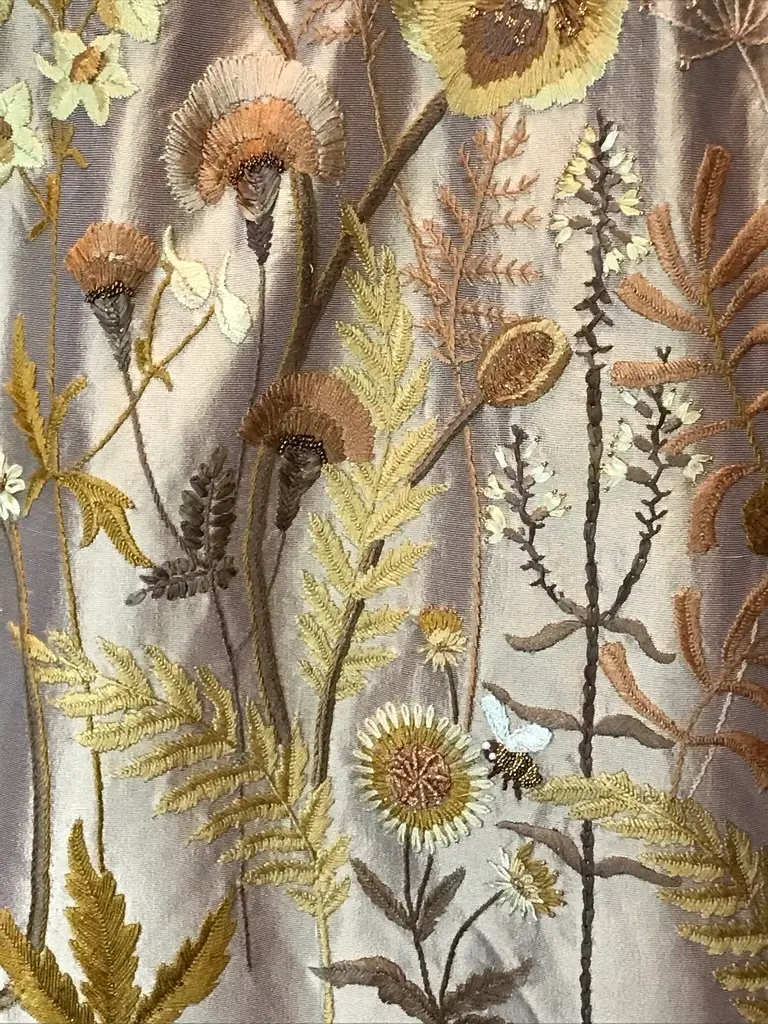
For the gold silk, I wanted to do a tone-on-tone embroidery. At the specialty needlework store, I started laying down skeins of silk floss till I had the color palette that felt exactly right. I was very pleased with the end results. When people see me in the gown, the first thing they want to do is touch the embroidery, so that tells me others like it as well.
Where do your best ideas usually begin?
In my dreams. I am being absolutely serious. I am constantly thinking of my next project and usually have several ideas swimming around in my head. I even solve sewing problems in my sleep, waking up excited to get down to my sewing studio and get to work. My biggest inspiration is other artists and their work. An artist to me can be anyone who inspires ideas, whether it be a style of tile or even a book author.
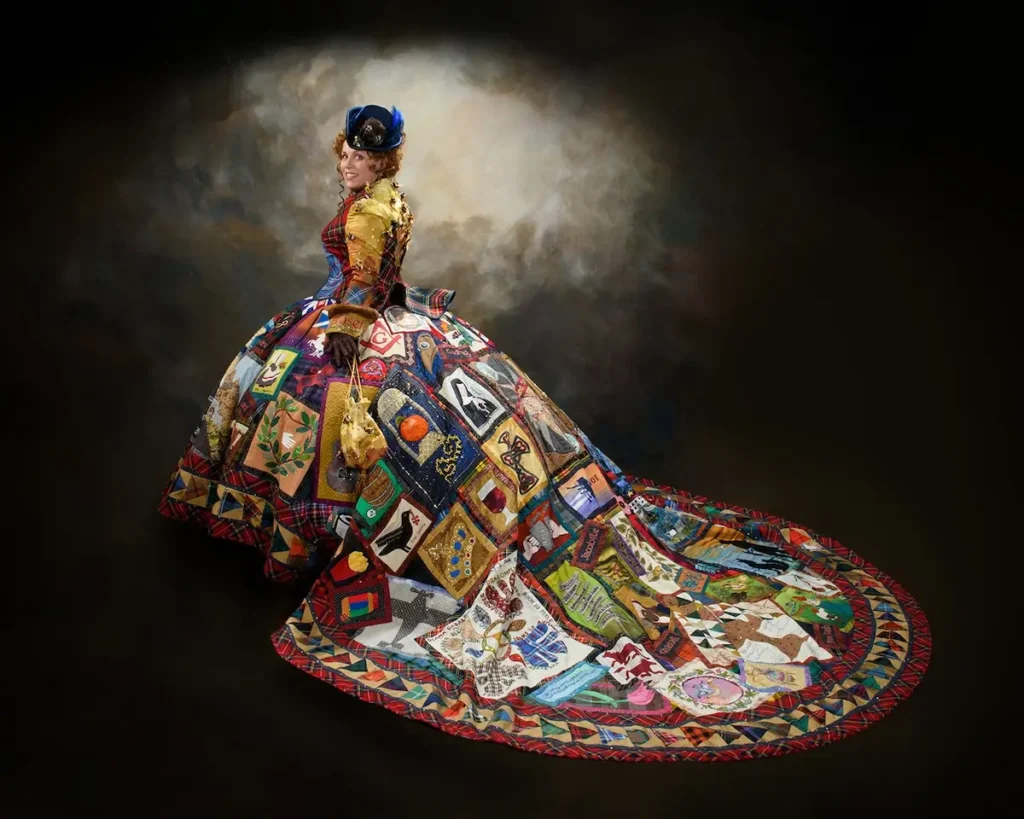
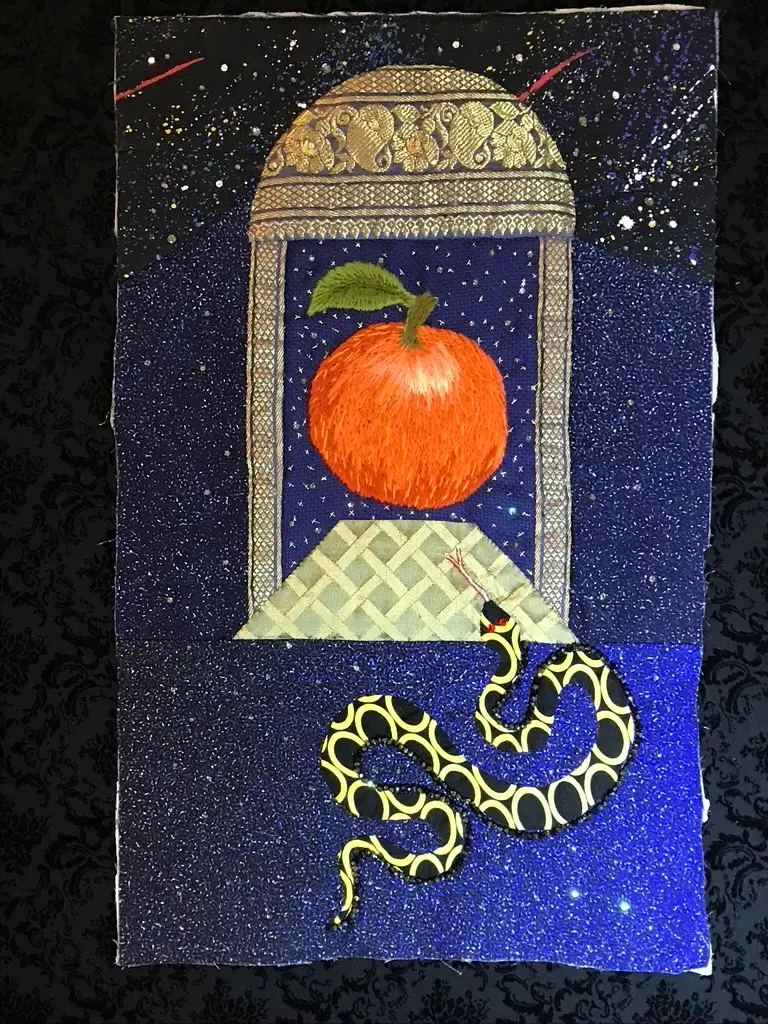
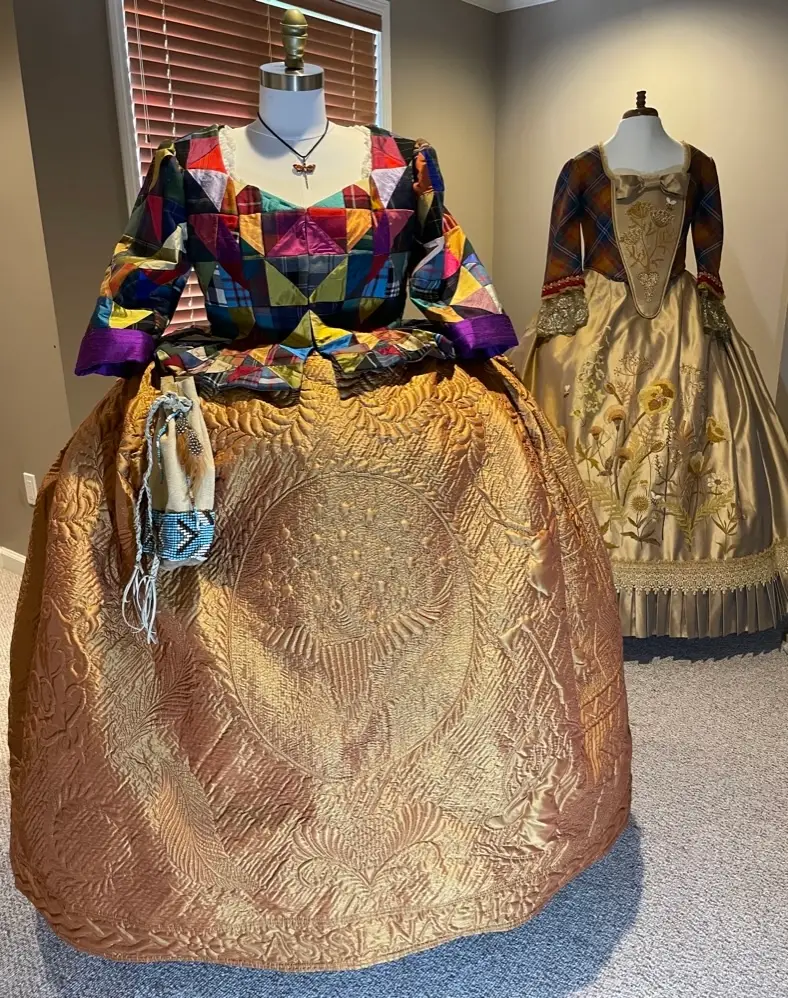
For my Outlander Story Patchwork Gown, which took 3 years to complete, ideas were a constant in my daily life. The focus from the beginning was to literally wear my favorite book, Outlander. I even kept a notebook near my bed for when I woke up in the middle of the night with an idea, so I could scribble it down. The Outlander books have so many dramatic and interesting story lines. It was very hard to narrow down how I could communicate a character or scene with fabric to make it instantly recognizable to Outlander fans. One of my favorite blocks is The Star Chamber. The set design by Jon Gary Steele was otherworldly, in which he depicted the hidden room of King Louis’, and I really wanted to capture the essence of his design.
How much research do you do before you ever cut into fabric?
My quilting library is full of books with quilt images of quilts from our past.
Learning quilt history and the history of quilt fabrics has been a hobby of mine. I love taking a pattern from the past and putting a new spin on it to bring it back to life.
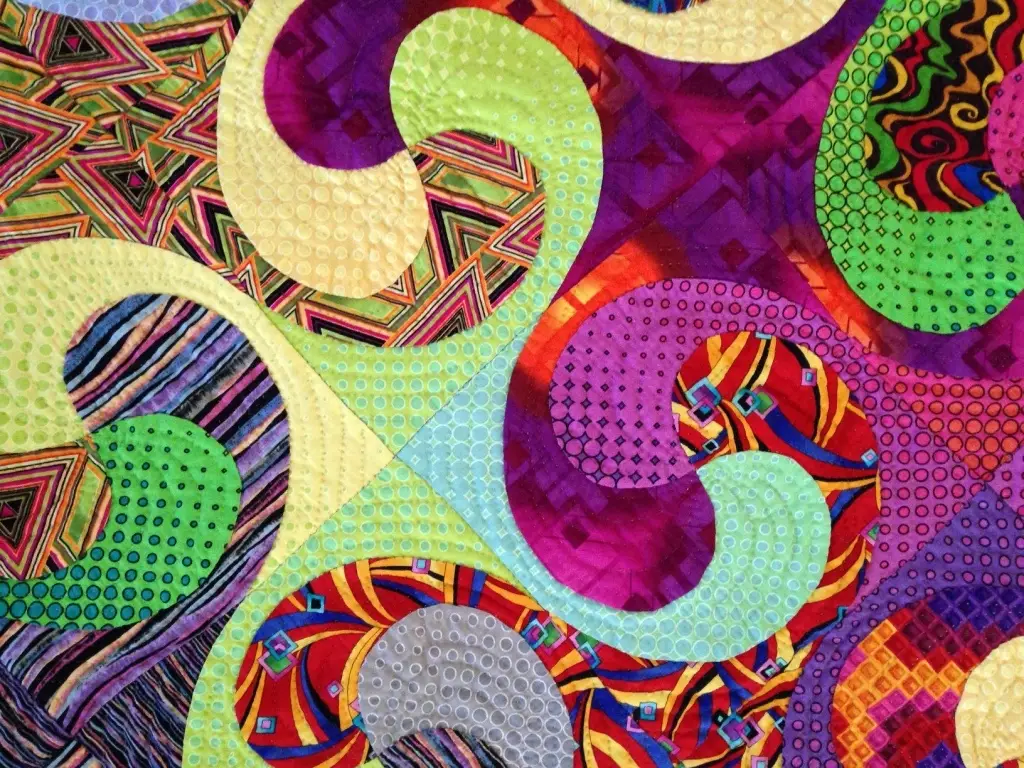
My quilt Twist and Shout is made from fat quarters and is based on the Swirl Block from the 1920’s. I have done several quilt variations with this block. The last one being Cairn, in which quilter and blogger Alex Anderson stated, “How did she do that?” Which thrilled me, as that is just the reaction that I wanted with that quilt.
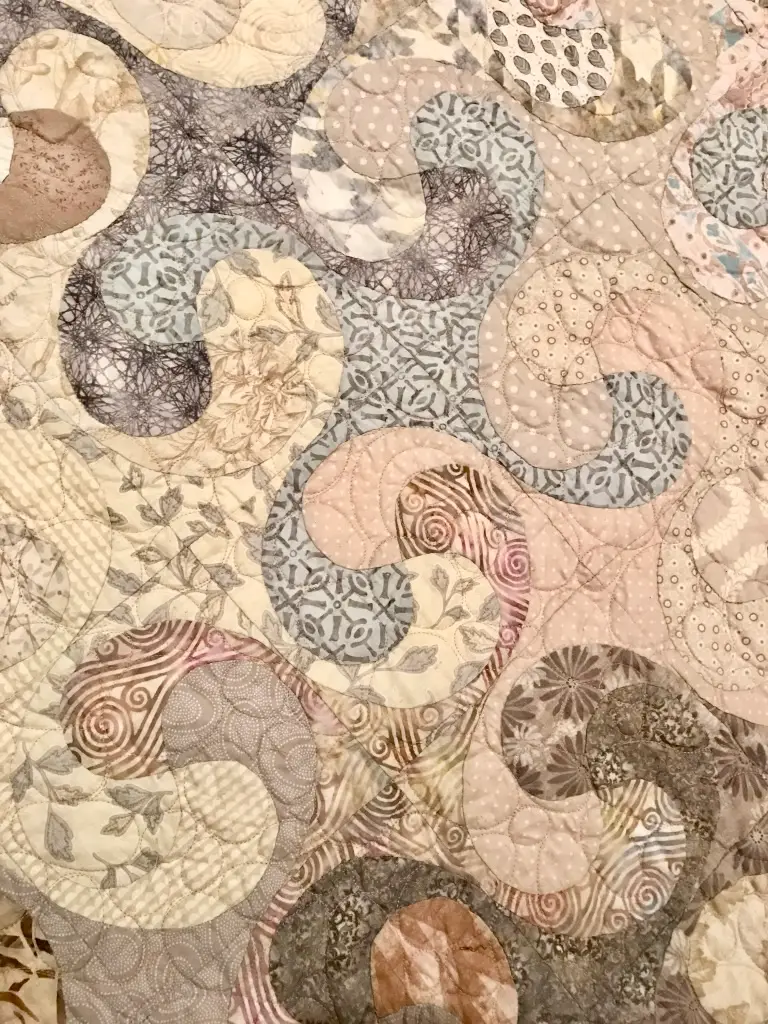
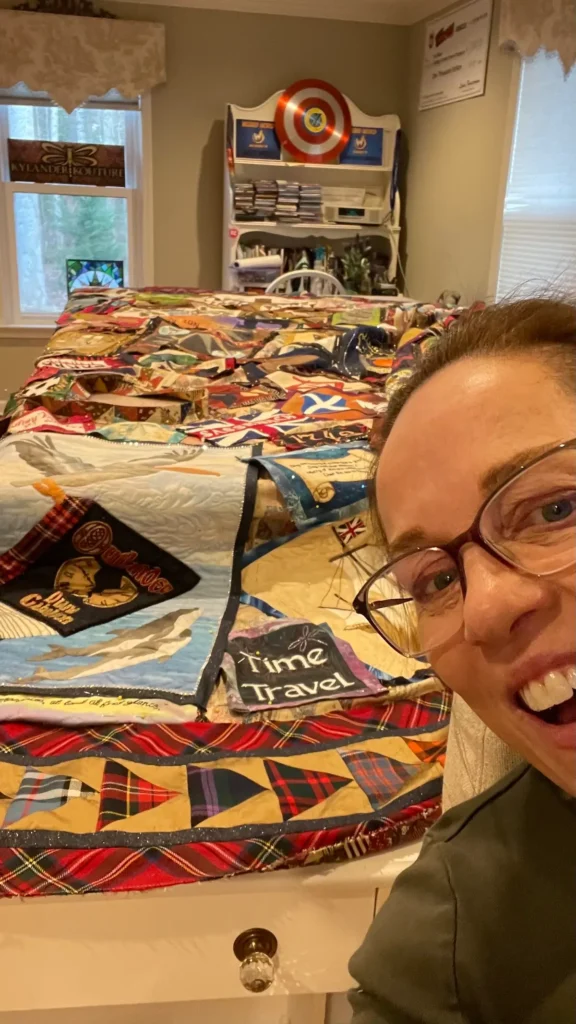
For my costumes, I do a tremendous amount of research. When I snapped a photo of my large cutting table full to the brim with sketches, fabrics, threads, and image ideas and emailed it to author Diana Gabaldon, she responded, amazed at the amount of research I was doing. There are separate boxes that I store all my ideas and research for each costume I have completed.
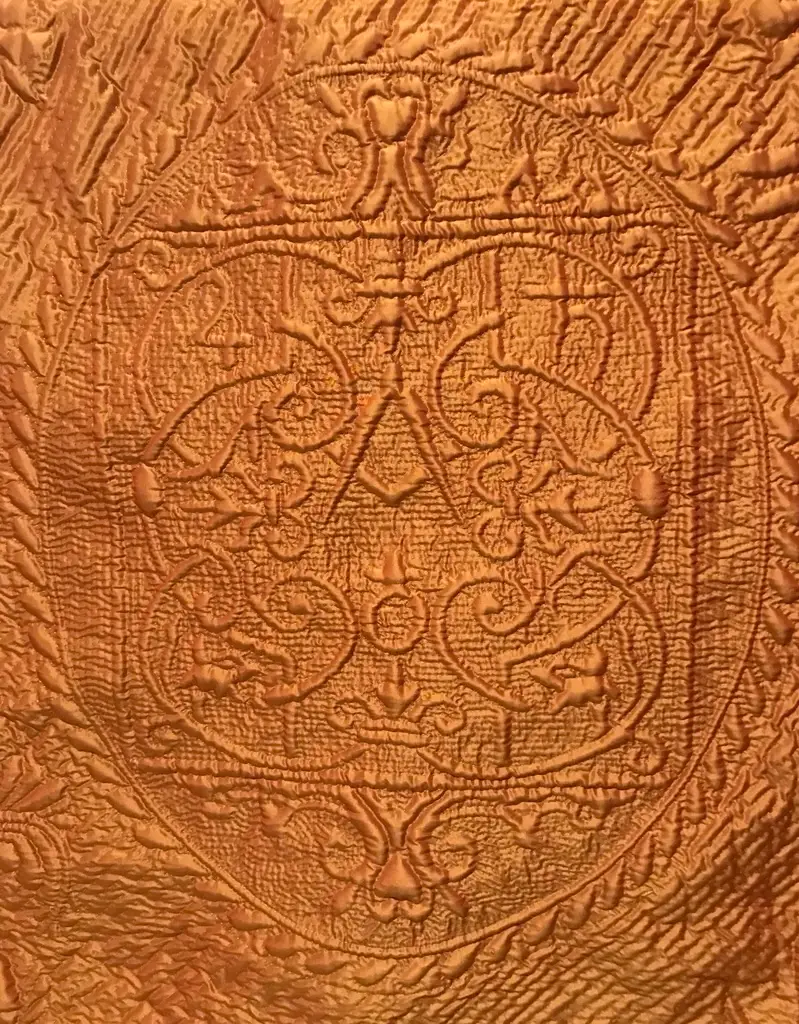
There is a whole community of “HA” (historically accurate) out there. I hesitate to use that term and use historically inspired or historically adequate. Although I would say that my trapunto (stuffed) and quilted silk petticoat could be compared to any in a Museum and is historically accurate, as I studied many samples, including a petticoat from the DAR.
I have the original design paper pattern that I drew featuring hand-drawn images from the Outlander Books, which I later hand-quilted with silk thread. The pattern is a whopping 35” high X 135” long. To me, the pattern is as important as the finished silk petticoat. If you look closely at the hand-quilted petticoat, you will see a quilted image inspired not only by the books but by the TV show as well. The wrought iron Print Shop Sign designed by Jon Gary Steele is really striking. Before the trapunto work, the image looked flat, but after it looked amazing and 3-dimensional.
Historical clothing is full of amazing details. What are some of your favorite discoveries while researching old garments?
While antiquing with a friend, I came across this large armoire. I opened up the large doors and pulled open a drawer full of antique clothing pieces. I bought the whole contents and later was so glad that I did!
There were so many times that I examined and referenced the clothing construction of those pieces when making my own. Seeing the clothing construction up close was tremendously helpful.
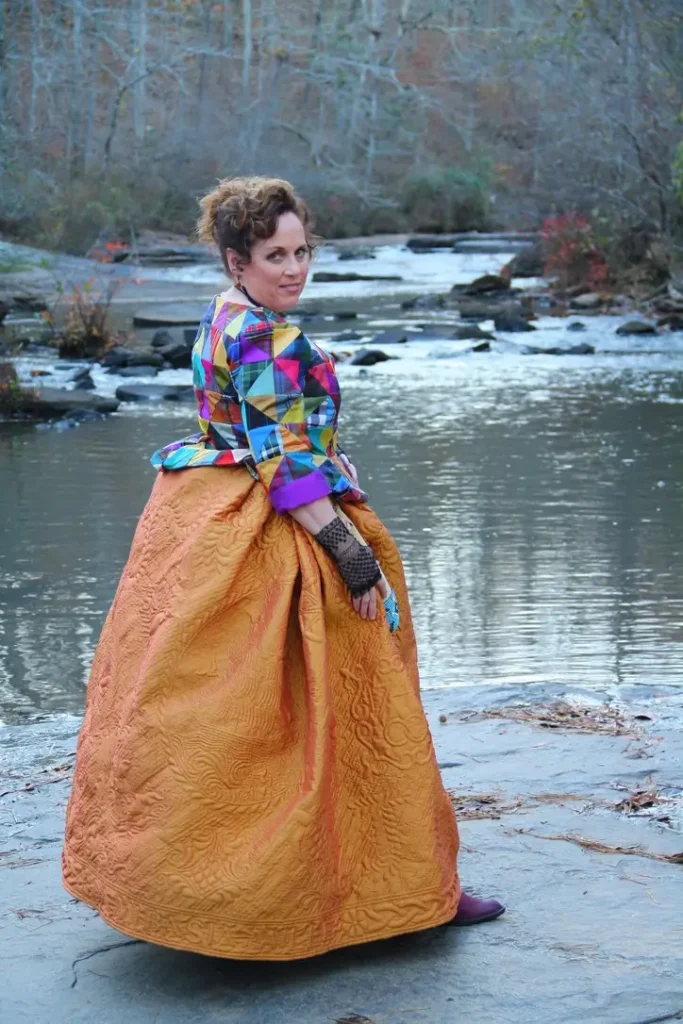
Especially for the tops or jackets. I had always wondered how the closure on a top looked so perfectly straight. A lot of hand-tacked hook-and-eye closures that’s how. One special technique I learned from studying the clothing was that there was an extra loose fabric piece underneath the main bodice with hook-and-eye closures! This inner layer closure was the stability of pulling that allowed for the outer bodice to remain perfectly in place. I actually use this technique on all my jackets and bodices.
Researching the stays and corsets was really interesting to me. The garments of the day most definitely outwardly reflected what one was wearing underneath. Structure was the base. This is the reason each of my silhouettes has its own corset.
Can you describe your studio? What would we notice first if we walked in?
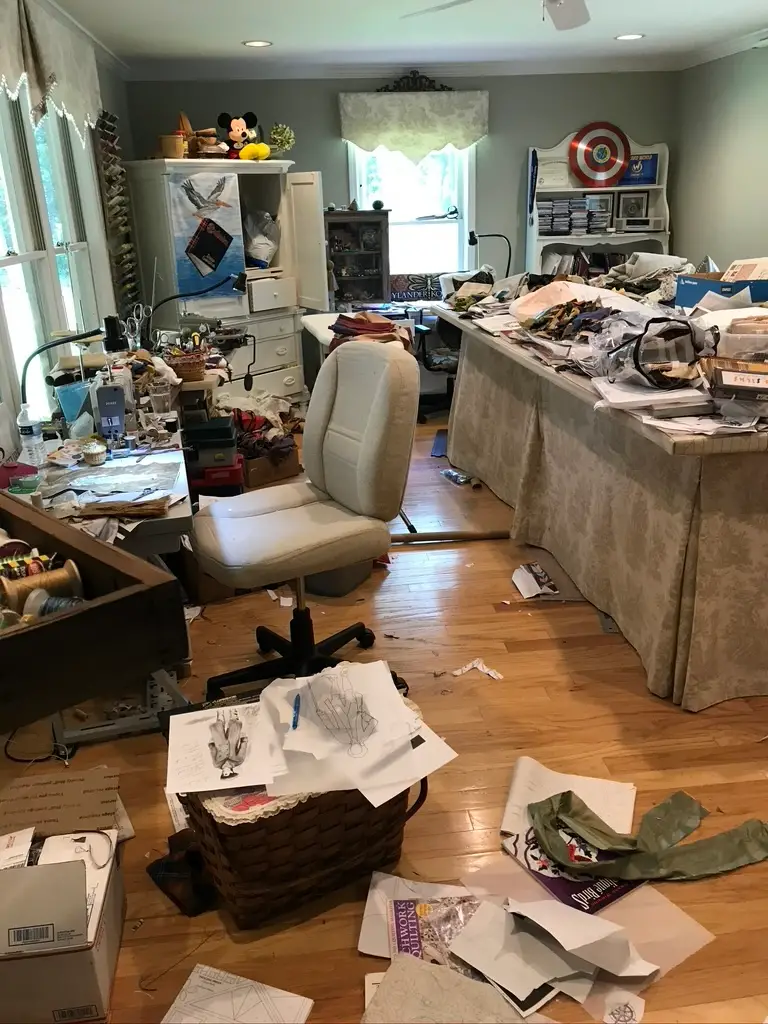
My friend fondly named my sewing studio “The Bat Cave,” and we laugh about that. Most days you will find me there. My studio is on the terrace level of my home and is quite large, measuring .13’ X 50’.
The first thing you would notice when you enter my sewing studio is all the windows. Seven windows in the main area and very little wall space. The main room holds 4 sewing machines with their stands and a large 60’ X 12’ cutting table in the center.
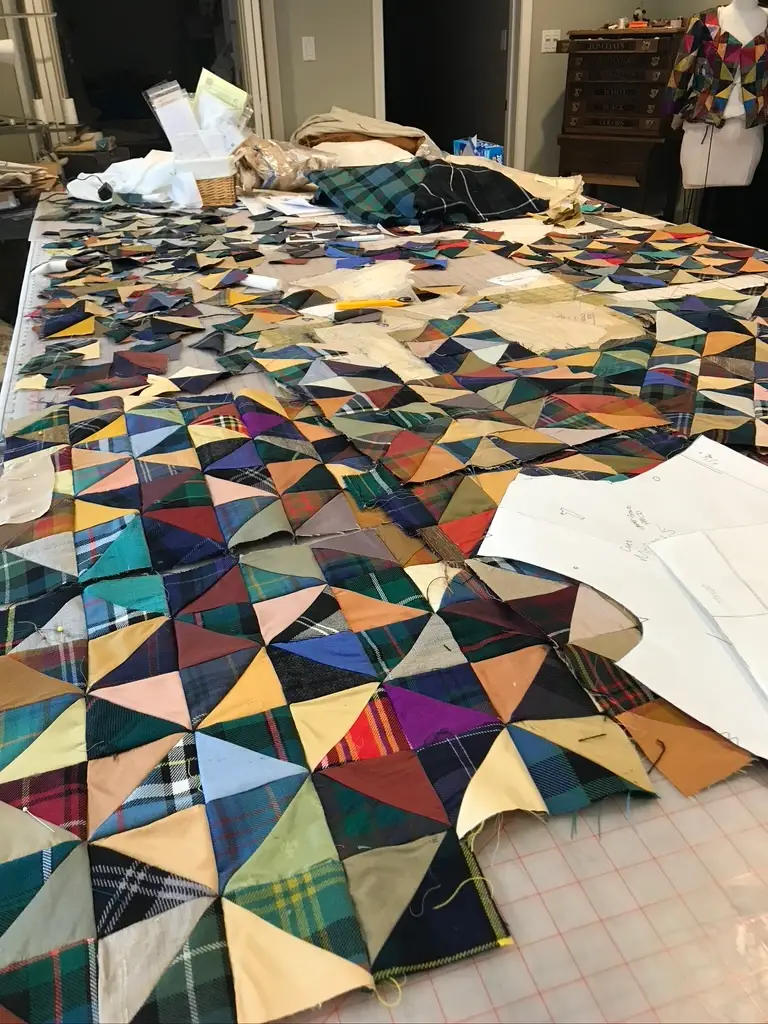
The cutting table has been repurposed; it used to be a mechanics table. It is solid metal.With storage underneath and is on casters. I figured out a way to modify the top with a wood base and wrapped that in a strong duck fabric with padding underneath. I also made a decorative skirt to mount around the table to hide my storage.
As well as using my cutting mats on top, I can also use this same table for pressing. I also have a very large storage closet with bins and shelves for easy access, and also a space to store and display some of my costumes and dress forms.
Are you someone who works on one project at a time, or do several creations grow together?
I am, for the most part, that person who works on one project at a time. That being said, though, there always seem to be several project ideas floating around in my head at all times. Embracing the process is very rewarding to me. Firstly, thinking of an idea and then going through all the steps in my mind on what it is going to take to execute my project.
Every ambitious project has moments that don’t go as planned. How do you work through creative roadblocks?
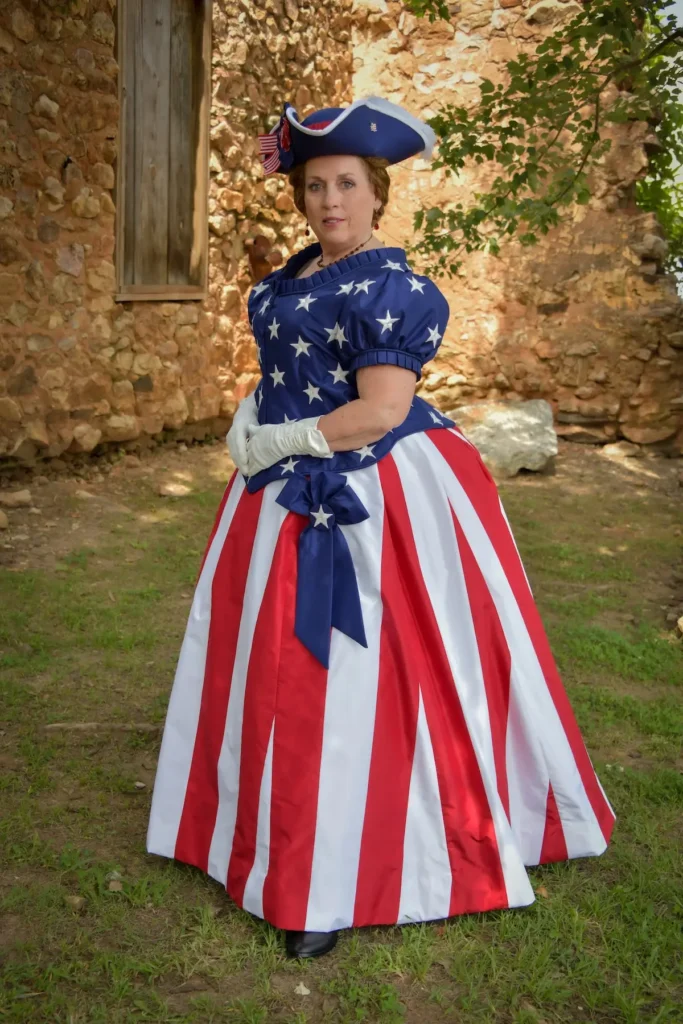
My last costume, “Miss Liberty,” is the perfect example of things going wrong. I made six toile versions of the jacket patterning before I was happy with the fit. Even then, I knew I would still have to wing it with the front closure at the very end. This was a little nerve-wracking because the final jacket was put together after most of the star embroidery was completed, so I could not make a mistake.
Historical reproduction patterns are not easy to interpret the sizing. Women had completely different physical shapes at that time. I was using the Victorian era of dress as my inspiration, and most historical clothing has a tiny waist and broad shoulder appearance.
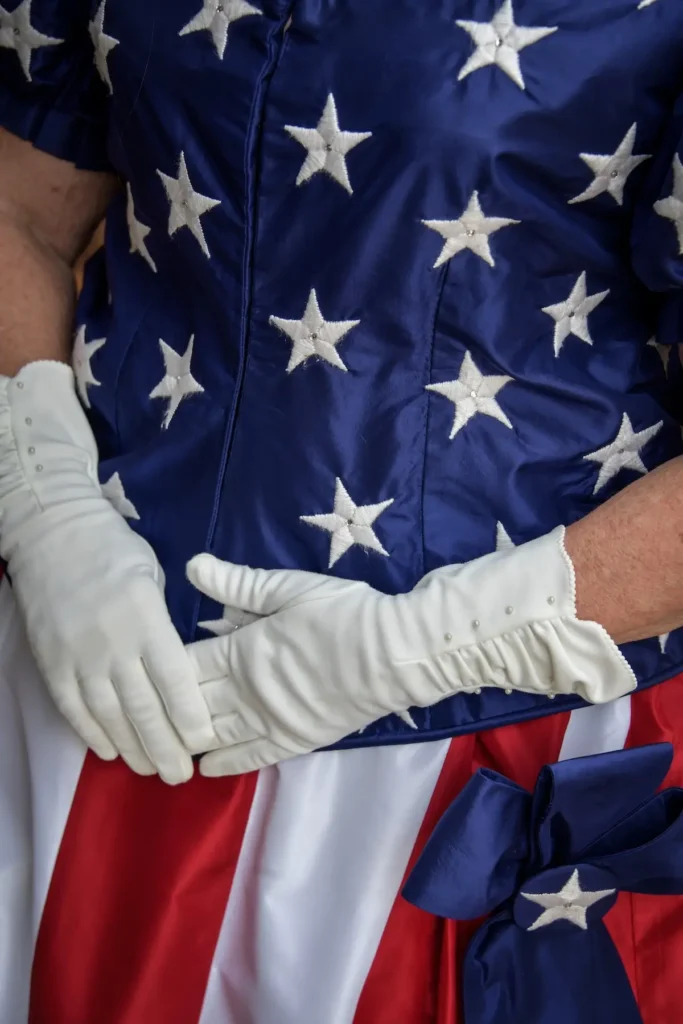
Using my intuition, I oversized the jacket a bit, knowing the embroidery would shrink it a bit. I also added hidden boning in the seam areas on the inside. This extra structure made the fit of the jacket look authentic to the time. Referring to antique clothing in my collection was immensely helpful in solving the jacket fit.
Once I had completed the months of hand quilting with silk thread on my silk petticoat, I was so disappointed at how flat it looked. There was so much intricate quilting that looked very blah. Thinking over several days, now what? It came to me to start researching an age-old technique of trapunto and boutis (French term). I ordered cotton roving of various widths and started experimenting with a small section, and the quilting really came to life. I was so excited and spent another 250 hours doing trapunto.
Your work includes incredible hand embroidery and quilting. How do you decide when a piece has enough detail and when to stop adding more?
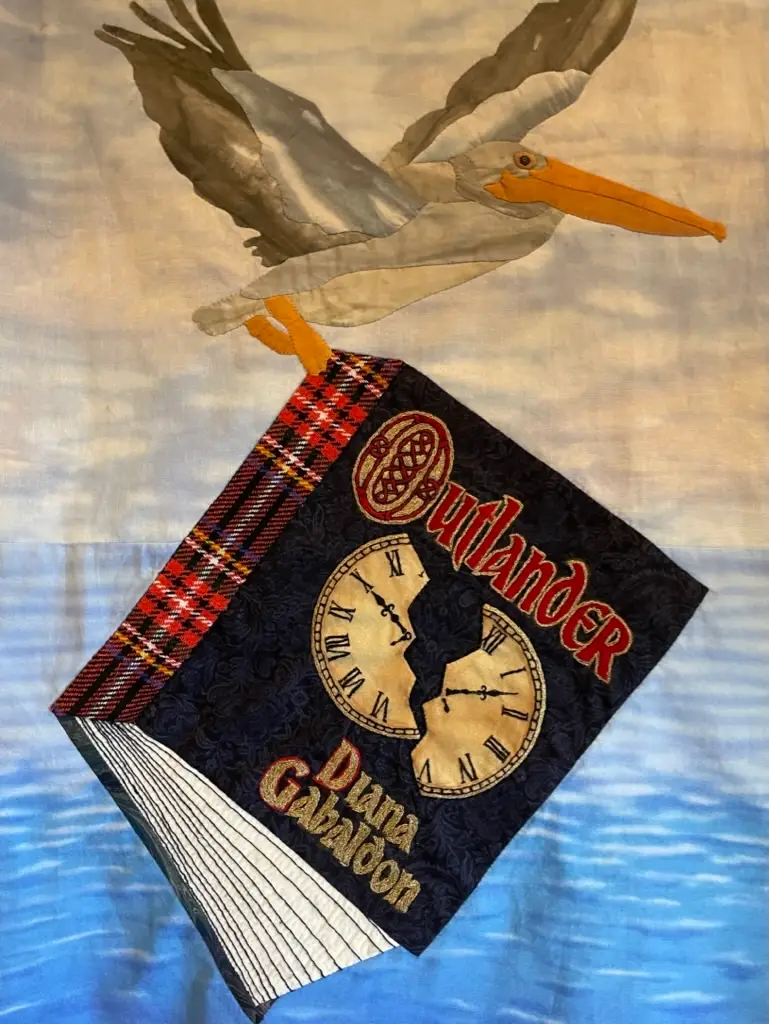
I am usually my own worst critic. I will finish when it “feels right”. Although on my Outlander Story Patchwork costume, I was so proud of how the Book Block turned out and showed my husband. He said, “It needs something in the middle of the book”. At first I was disappointed in his reaction and gave it some thought and slept on it. The next morning I knew what it needed: a broken clock to symbolize the time travel element of the story!
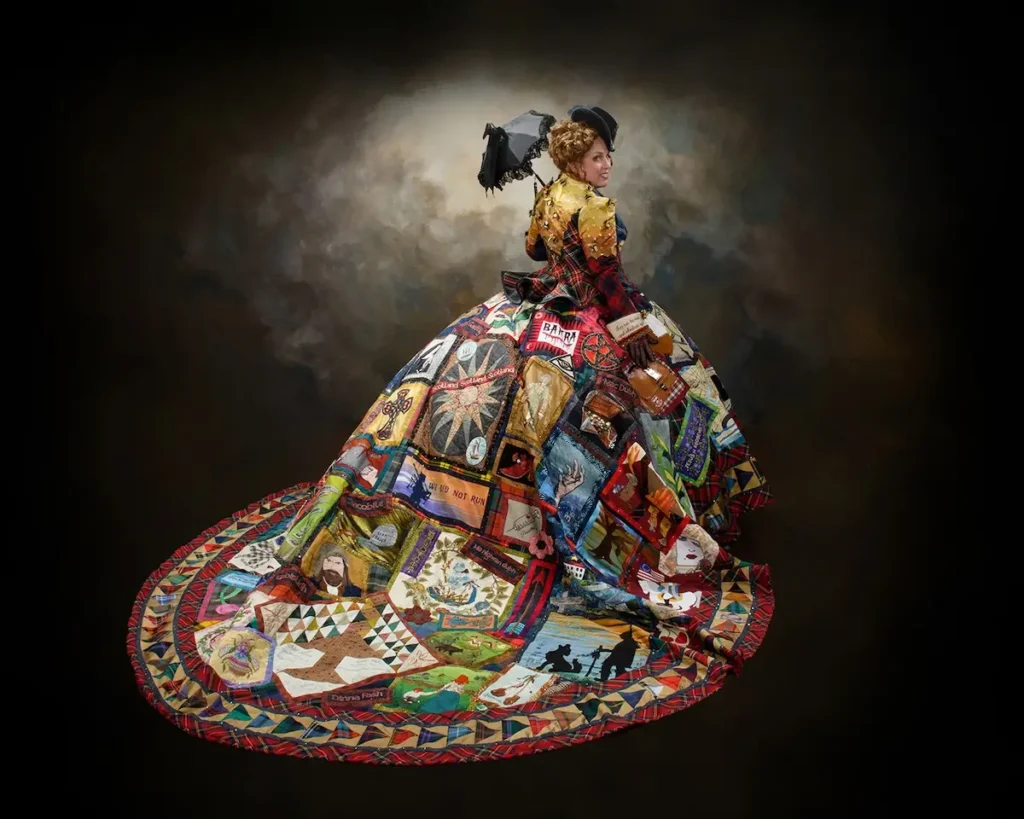
There was a tremendous amount of research and thought that went into my Outlander Story Patchwork Costume. I wanted the costume to be as dramatic as the Outlander books were to me.
Deciding early in the project to focus on the early books (as there are 9 now) and the characters that held meaning to me. The challenge was how to put words into fabric. This was something I never tried to do before. I landed on the idea of individual blocks; there are 100 finished blocks, all hand embroidered or hand appliquéd.
The blocks were then hand stitched to a base skirt. With each project, I always like to challenge myself with something new. Most of the embroidery is done with a single silk thread, very fine hand embroidery almost like thread painting. Not all the blocks I made would fit. I still ache over the 100 hours I spent on an historical reproduction eagle block using needle turn appliqué that did not make the cut. It was just too large.
You’ve recreated historical techniques and even made your own fabrics when you couldn’t find exactly what you wanted. How much do you enjoy solving those kinds of creative puzzles?
Something I learned from my drapery my making days was learning to make fabric “grow”. Leaning on my quilt background, where it can be common to seam a piece of fabric that was too small to make a larger piece. Oftentimes in a quilt, it is almost impossible to find this seam after all the quilting is finished.
When making draperies, if I was short on fabric because of a pattern repeat issue for drapery panels,I knew I could seam an unmatched piece in the bottom hem to make the piece longer and no one would ever know, because the fronts all looked the same.
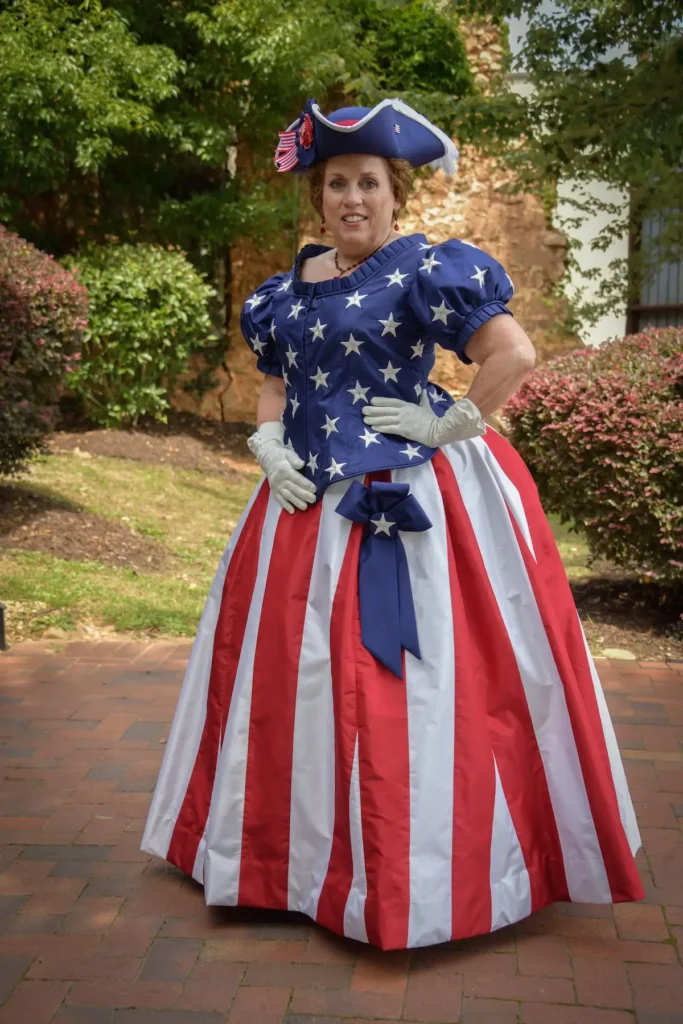
For another drapery job in particular, I was asked to cut strips of contrasting silk fabrics, seam them together, and make them into drapery panels. Essentially a custom fabric. When it came time to make “Miss Liberty,” I used this same technique because I already knew the secret to making it look custom. I always stabilize my silk fabrics with commercial-grade stabilizer made specifically for silks before cutting and seaming.
Challenging myself to try something new on each and every project is what keeps me moving forward. I find it so interesting to read about or study something and then make it my own.
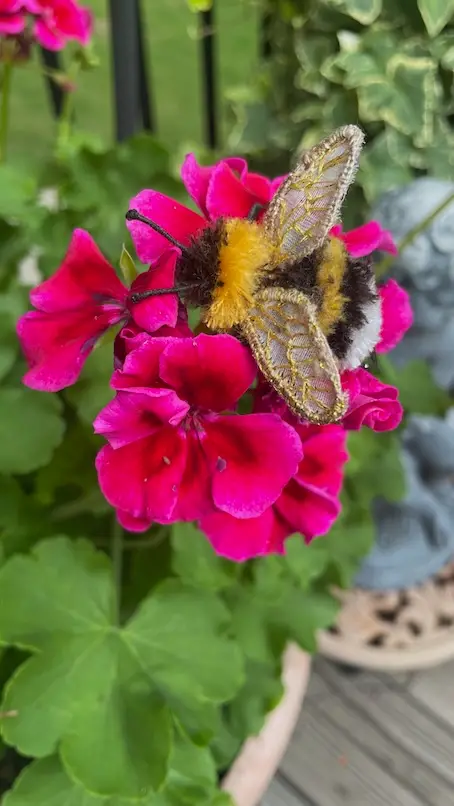
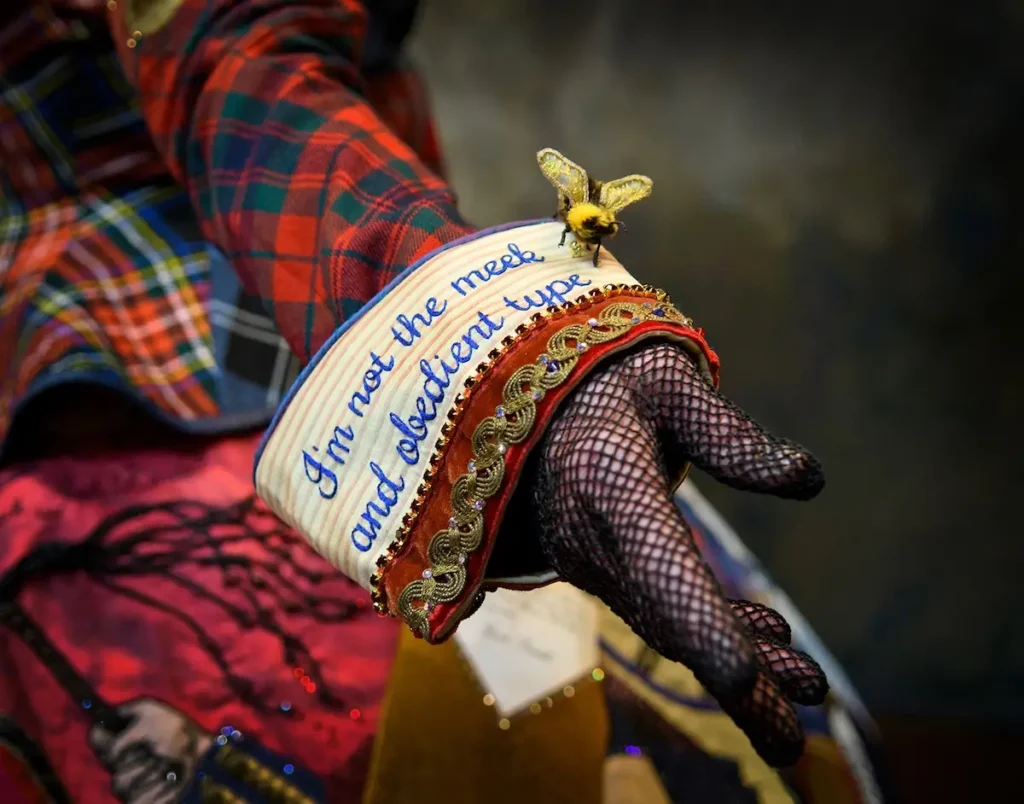
It is never too late to stop learning. Figuring things out on your own can be very daunting and challenging, but also equally as rewarding. I had never heard of or even tried stump work embroidery before. When the idea came to me to play off of the title of the Outlander book “Go Tell the Bees That I am Gone”, I knew I had to teach myself how to embroider 3 Dimensional Bees. I embroidered and attached 60 of them. Even though I competed in Comic Con and did not win, it was heartwarming to hear the judges during interviews talk about my embroidered bees.
When someone sees one of your gowns for the first time, what do you hope they feel?
After one of my Comic Con competitions, the awards had been announced, and I was still on stage getting my photo taken when a judge came up to me and said, “You won for needlework in New York last year, didn’t you? … I recognized your sewing .” That to me was probably the biggest compliment I’ve ever received. I had my own style of sewing, and someone recognized my work!
What advice would you give someone who wants to combine different creative passions instead of choosing just one?
I will always remember what needle turn appliqué instructor Mary Stori said at my quilt guild, and that was “Learn one technique and perfect it. Then move on to the next.” This really stuck with me through the years.
When I am asked for advice at Comic Con about how I made my costumes, I say the same thing Mary did, but I also add, “If you do this, when the time comes that you want to create an original costume yourself, then you will have a whole arsenal of skills under your belt.” Go ahead and try something; you might just be amazed at yourself and what you can accomplish.
What has sewing taught you about patience, perseverance, or yourself?
That I am my own worst critic. I will take something apart as many times as needed until I get that feeling that I’ve done my best.
Sometimes I succeed, and sometimes things aren’t quite what I had hoped, but that’s okay; it’s all part of my sewing adventure.
I started my Outlander Patchwork Story Costume at the beginning of COVID. I had a general idea of what I wanted. At the time, I never realized that this would be a 3-year project.
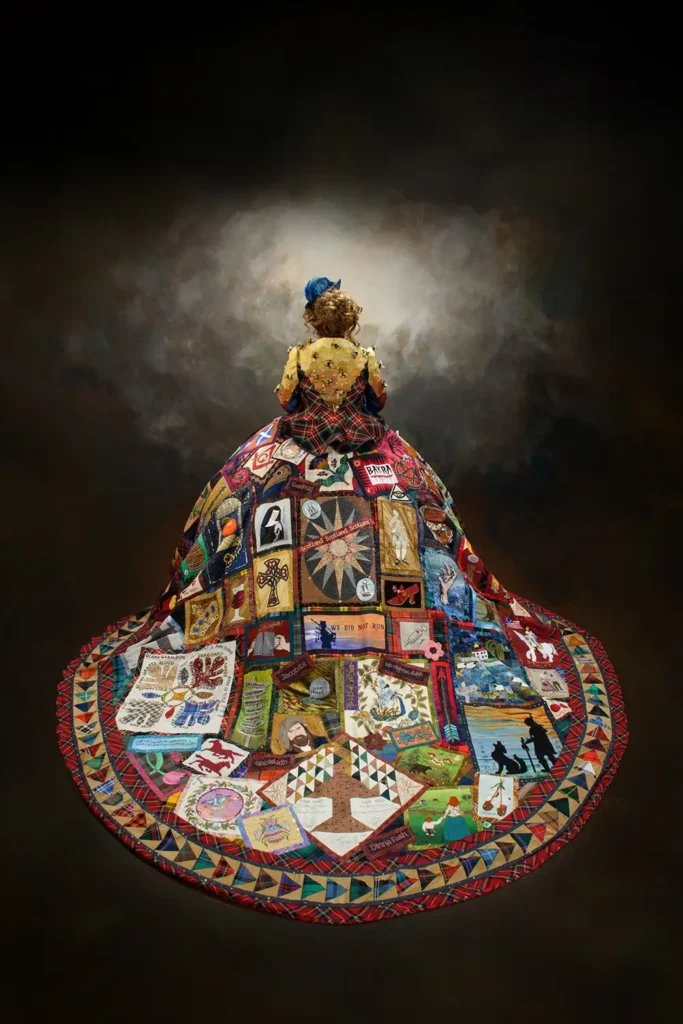
Thousands of hours of embroidery and applique. Early on, I realized my original idea of a scrappy homespun-look skirt was not going to work; the dress had to be bigger and more dramatic, just like the books. I had to pivot and focus on individual blocks, each highlighting the story or character and executing them, whether it be embroidery, appliqué, or both. That took years.
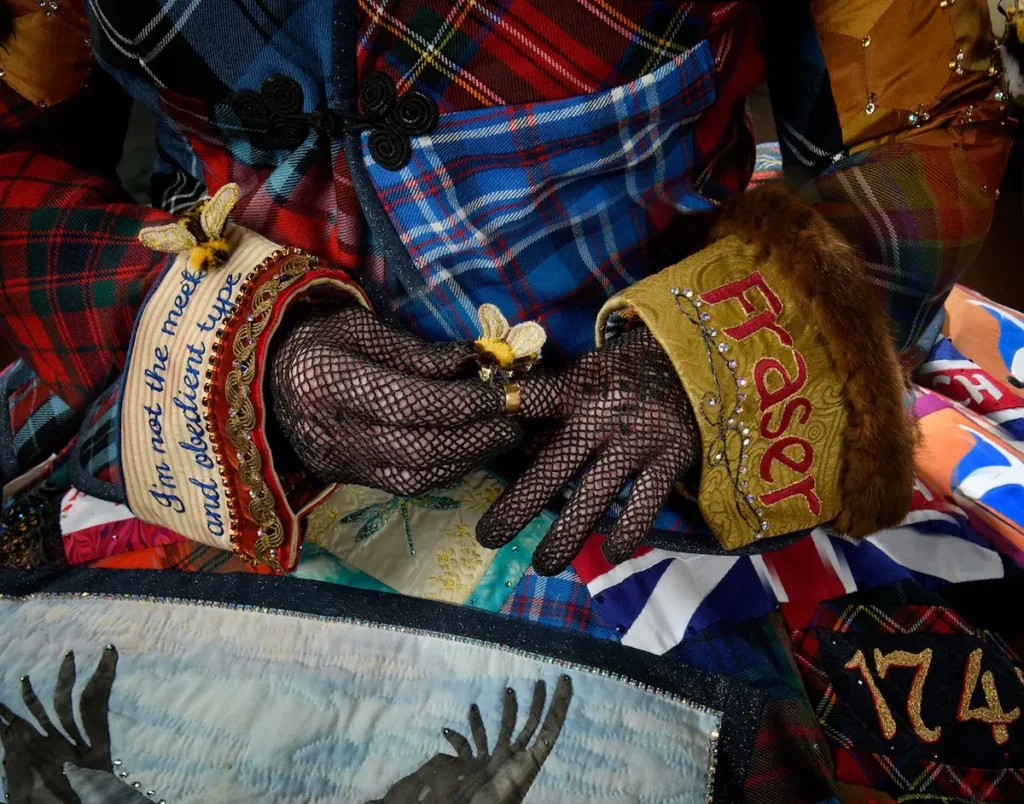
Once all the blocks were completed, I thought to myself, “What now?” How was I going to get all 100 blocks onto a skirt and in a logical way that would match the progression of the Outlander story? This was an epic project for me, and one of my favorites. I look at the costume, and I think back to 1992 when I read my first Outlander book and the path that I was now on. Turning a book, which I consider art and inspiration, into wearable fabric art.
Where can people see your work?
I recently had a Museum exhibit of my costumes and quilts at The Southeastern Quilt and Textile Museum in Carrollton, GA. Who knows what the future holds; keeping my fingers crossed for another exhibit. Meanwhile, you can find me here:
https://www.facebook.com/kylanderkouture/
https://www.facebook.com/teri.biglands
https://www.instagram.com/kylander_kouture/
https://www.threads.com/@kylander_kouture
Rapid-Fire Fun
- Hand stitching or machine stitching? Hand
- One word that describes your creative style? Precise
- One fabric you can’t resist buying? Hand-dyed
- Favorite tool in your studio? Omnigrid Rulers
- What are you dreaming of next? The Lucy Boston Quilt design has always intrigued me. I do have a ton of Scottish tartan remnants . Maybe I will get started on my “Lucy Goes to Scotland” quilt. Then again there is this one costume…..
Interview posted August 2026
Explore more garment making inspiration on Create Whimsy.