
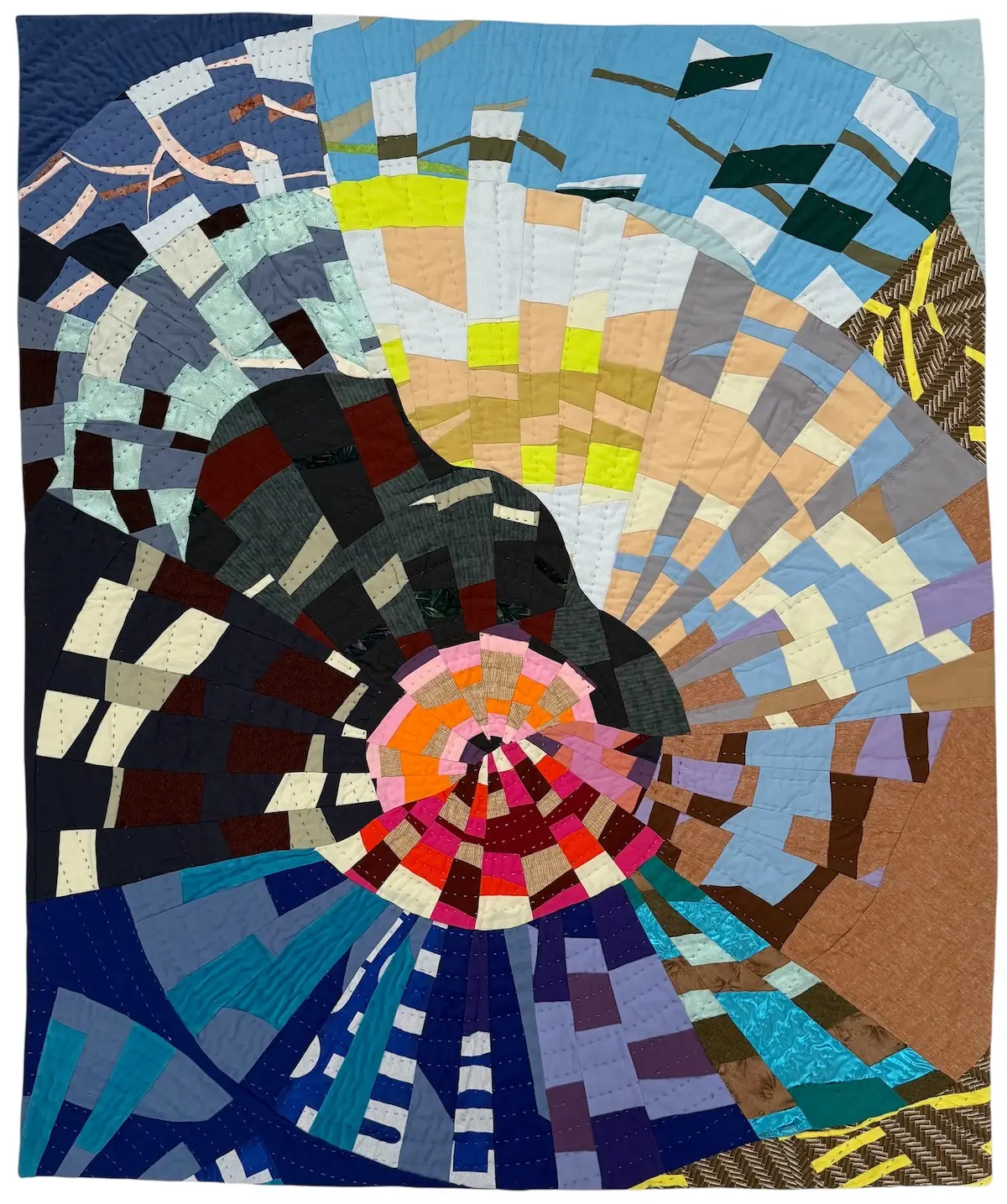
Amanda Milz brings quilts to life in surprising ways, turning colorful fabric into one-of-a-kind art and clothing with heart. Inspired by memories, secondhand treasures, and a love of improv quilting, she creates joyful pieces that celebrate creativity, sustainability, and the beauty of making something entirely your own.
You work across both quilts and upcycled garments—what came first for you: quilting or reworking clothing?
I began quilting during the pandemic, after dragging my hand-me-down sewing machine out of storage to make cloth masks when there was a mask shortage.
I majored in painting in college and always loved the imagery of quilts, both traditional blocks and the vibrant colors and patterns of textiles, and had even included quilt imagery in my painting.
I had always wanted to make a quilt, and I figured there was no time like the present. I taught myself how to sew quilt blocks by watching videos and following online tutorials. I totally fell in love with quilting; it was such a source of softness and comfort during the pandemic, not to mention it was the only realm in my life during that time in which I could have a little sense of control.
As an Amazon Associate I earn from qualifying purchases. Read more about our affiliate linking policy.
Once I started, I never stopped, and it wasn’t until years later that I began applying some of my quilt patches to clothing.
Do you remember the first piece where those two worlds collided? What did it look like?
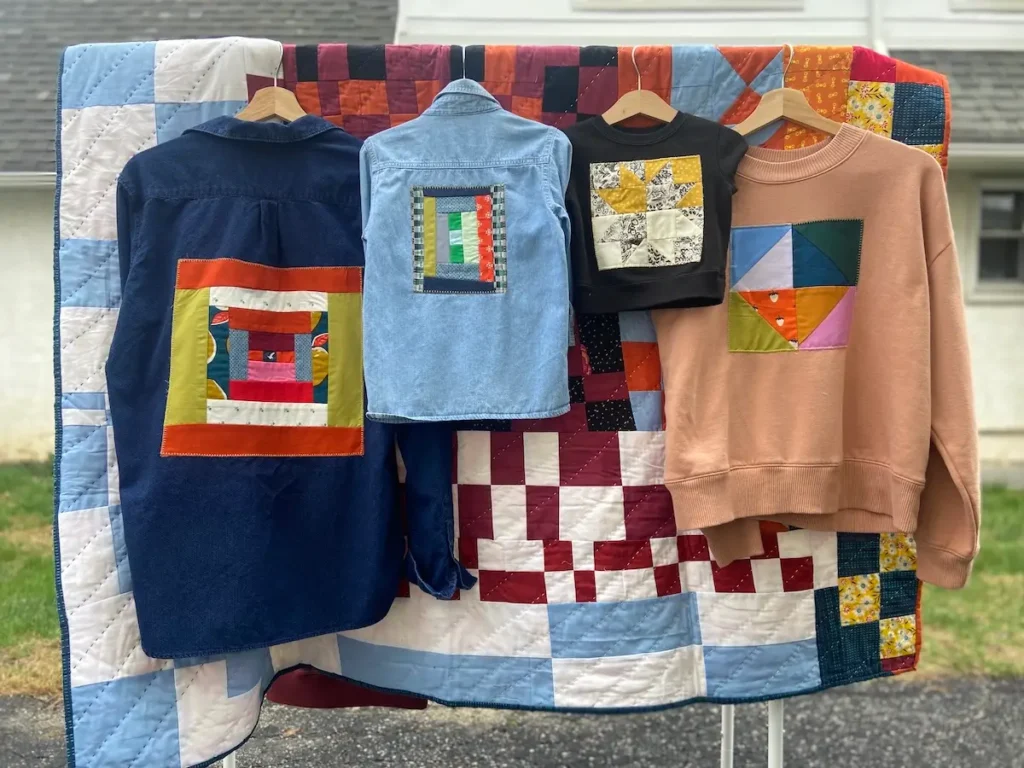
My first upcycled garment was a sweatshirt that I made for myself, using two log-cabin patches appliqued on the sides, which has become one of my most popular designs.
I was bored in the wintertime, and just tried it on a lark and found that I enjoyed both the process and the outcome. There is something that is very satisfying about sewing up one quilt block, appliqueing it to a garment, and having a finished product in a fraction of the time that it takes to complete a whole quilt.
I really enjoy both processes, and I find that having some projects that are instantly gratifying and some that are a slow, methodical process is a great balance for me personally as an artist. The faster projects help me to stay experimental and playful, while the slower projects allow me to dive deeper.
What drew you to improv quilting instead of more traditional patterns?
I have never been very good at measuring!
I love the freedom involved with making improv quilts, there is no expectation of every corner meeting up, or a right or wrong way to put it together. I enjoy the way in which improv allows me to express myself and accept and embrace imperfections, both in my art and in life.
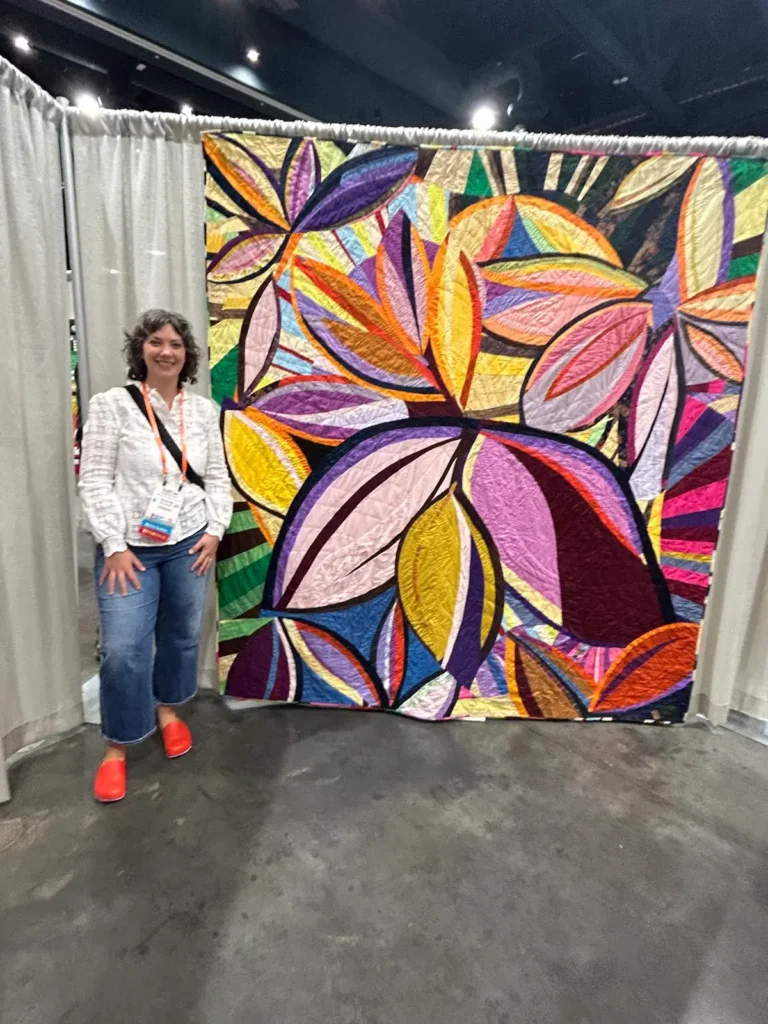
Coming from a fine art background, I consider each quilt to be a piece of artwork and want each piece to be unique and irreplicable, because each quilt is really an expression of what I was thinking about or going through at that point in my life, they are deeply personal.
How did your style evolve from your earliest quilts to the work you’re making now?
I have been fortunate to learn from many quilting teachers and in community with other quilters, and have learned a lot from hearing how others approach quilting.
My earlier quilts had a lot of straight lines and squares, and I now find myself being drawn to curves and spiraling shapes. I love to create movement with diagonal and curved lines and bring in a sense of light by varying the values of my fabric choices.
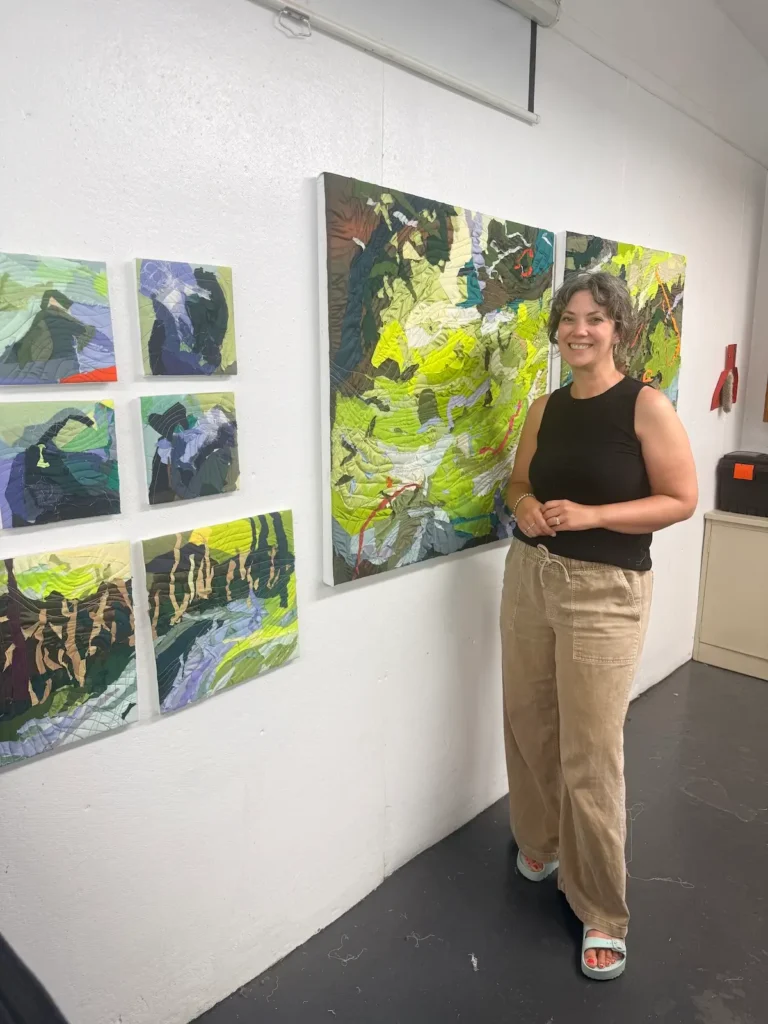
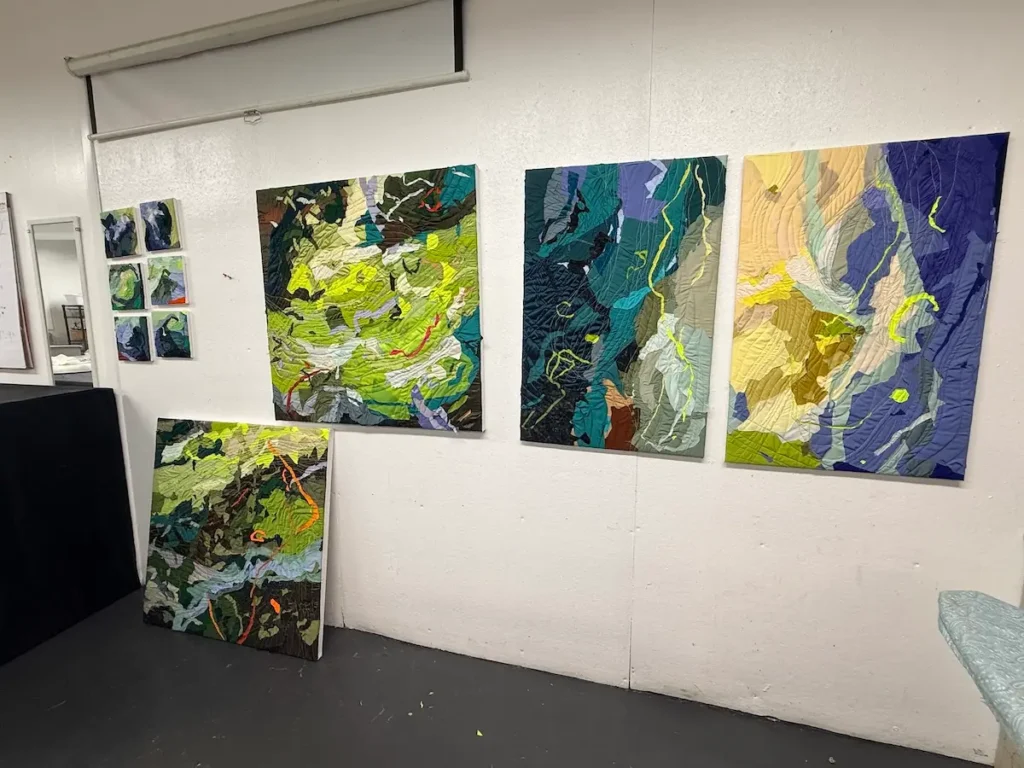
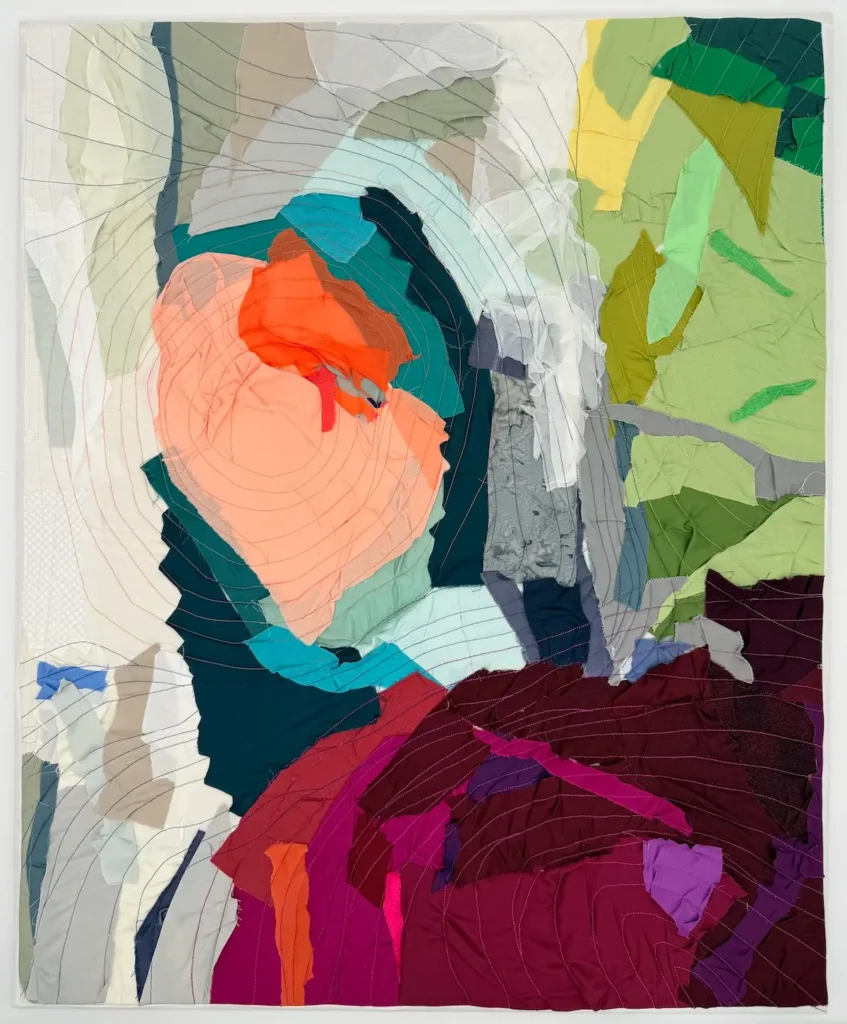
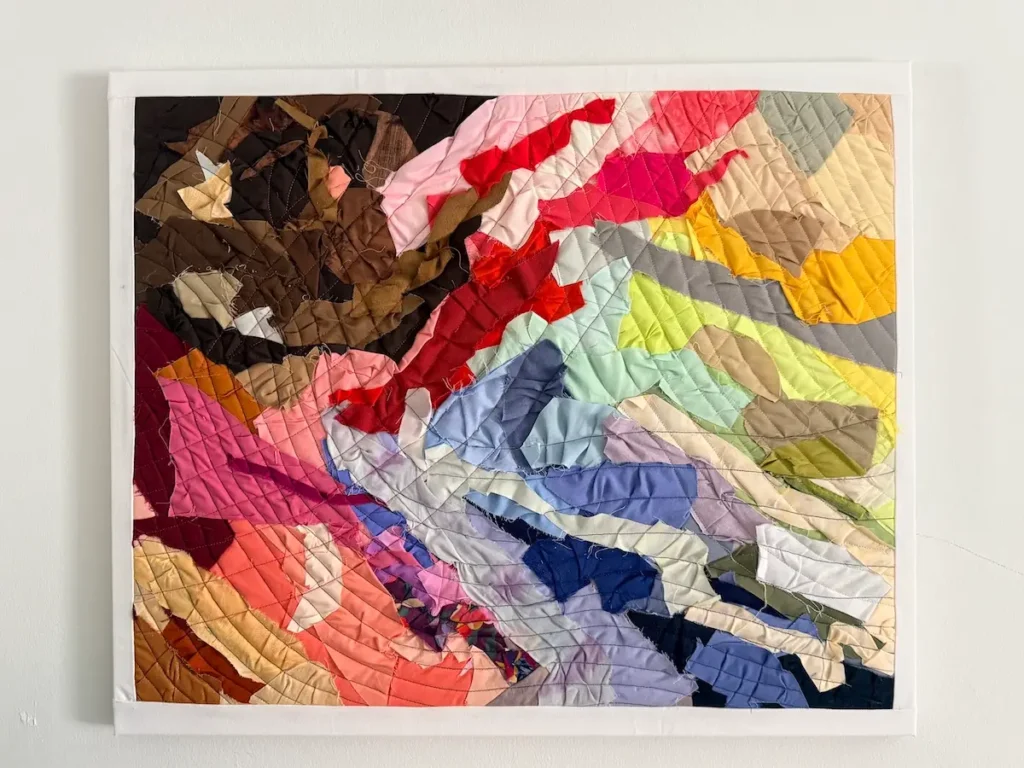
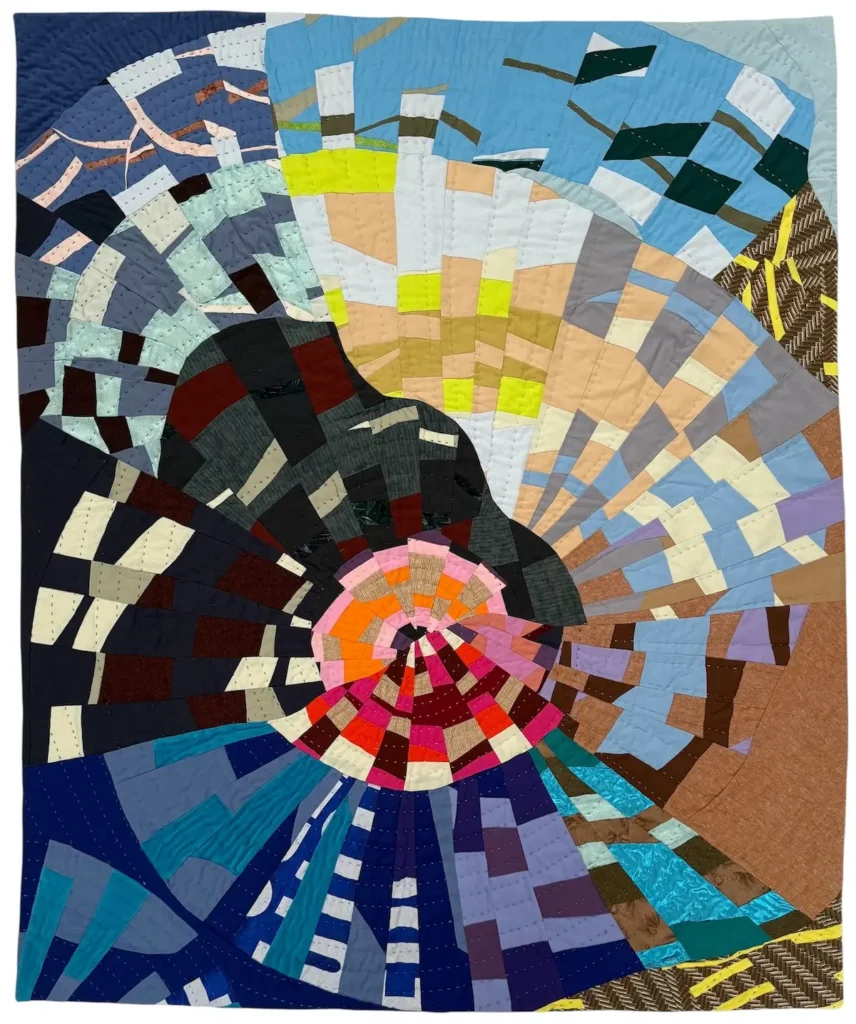
My most recent work has departed from the traditional pieced quilt format. I have been creating stitched fabric collages, in which pieces of fabric are cut out almost like individual brushstrokes, arranged and then quilted down, with the raw edges exposed.
With these newer works, I feel like I am coming full circle to my painting background. I enjoy the freedom and expressiveness of the stitched collages, they are very direct, and the sense of texture and tactile nature of using fabric really comes through.
Your upcycled garments feel like wearable quilts—what sparked your interest in transforming clothing this way?
I like to think of the garments as wearable art.
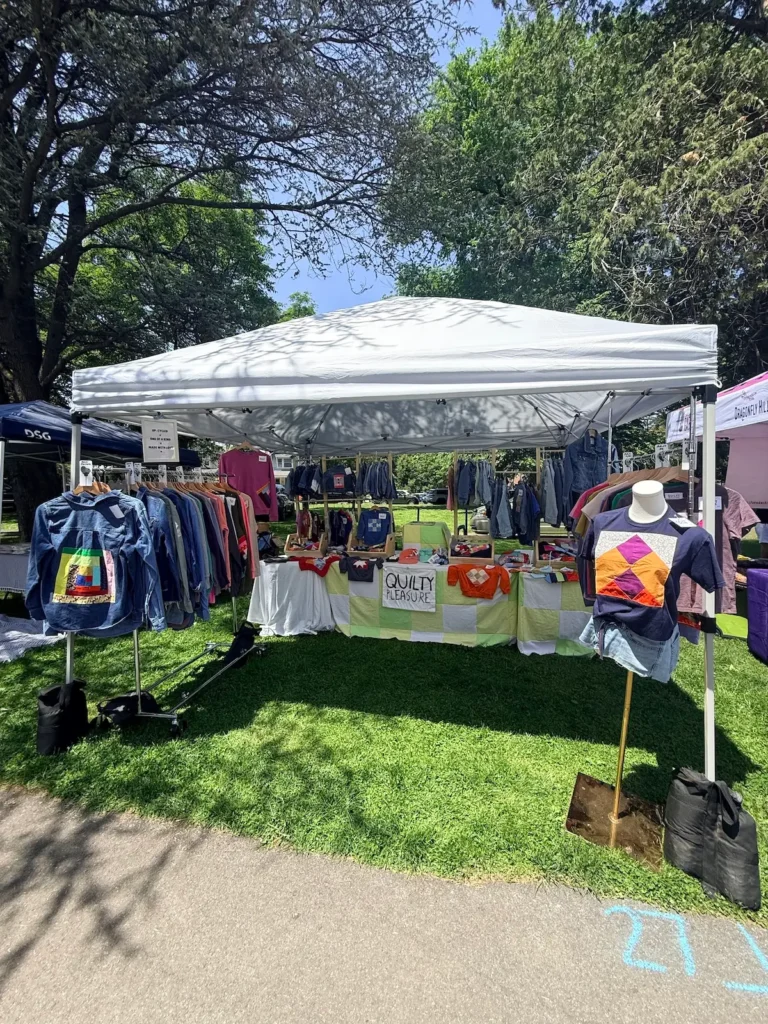
In this time of mass-produced, worldwide, instant availability of everything, I think people crave something that feels handmade and unique, which my upcycled garments are. There are no two that are exactly alike, so the experience of shopping for my garments is finding the one that feels like the just-right fit, and shoppers have to consider each piece individually.
One of my favorite moments is when a customer finds a piece and their eyes light up, they try it on and realize that everything else that they’re wearing already matches, and you can just see that it was meant to be theirs!
Where do you usually source the garments and textiles you work with? Thrift stores, donations, your own closet?
I source from thrift stores, primarily Goodwill because their pricing is consistent and their mission aligns with my values.
One of the challenges as a business person working with upcycled goods is ensuring that my profit margins make sense in proportion to my materials expenses, so having consistent pricing for materials really helps with that.
What do you look for when choosing a piece to upcycle?
I make sure that the garments that I source are free of visible stains or damage, and I ask myself if I would be willing to wear or gift the garment.
My favorite pieces to find are ones that have logos or text that make them less likely to be bought at the thrift store, but that I can easily cover up with one of my patches. I like to feel that I am saving the piece from going to the landfill or being shipped overseas, and I am extending the usable lifespan of the garment.
I feel passionately that the world does not need any new stuff! It is hard to source all things sustainably as modern consumers, but even if we can start sourcing some percentage of what we consume second-hand, that can make a huge difference. It doesn’t have to be all or nothing. I also source a large percentage of my fabric for quilting second-hand, and it is amazing how much is out there.
Describe your creative space.
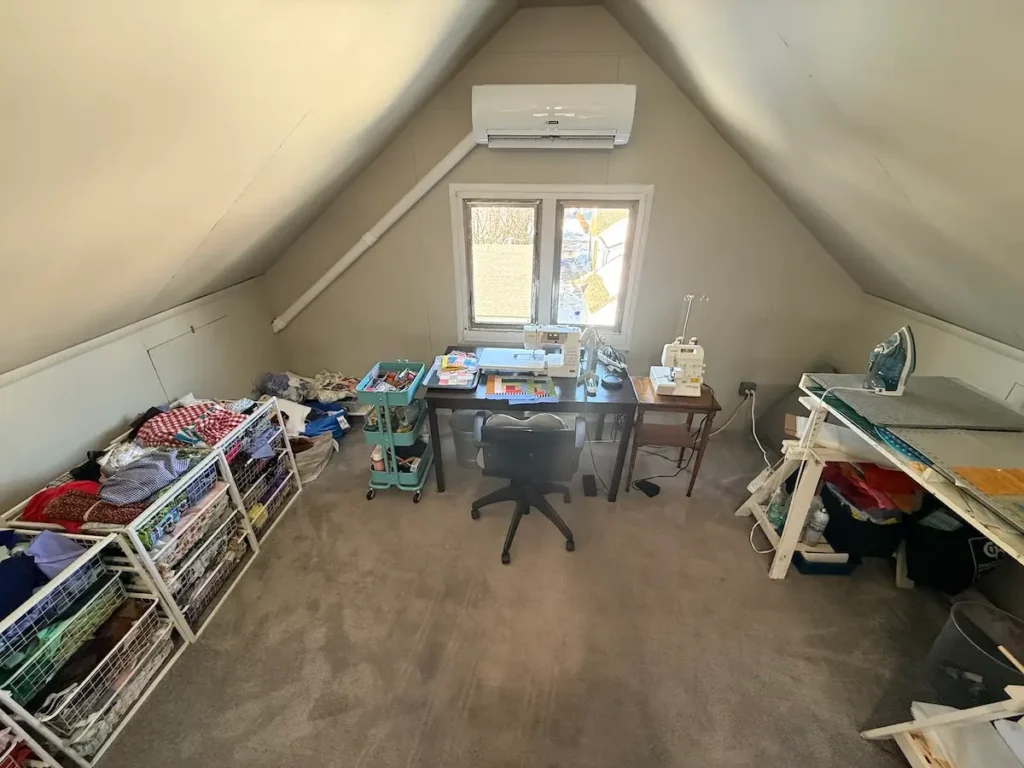
For the past few years, I have been working out of my attic studio in my home.
I am very lucky to have a separate space where I can close the door, and no one else in my house has to deal with the mess in my studio or touch any of my stuff.
I recently signed a lease for a studio in an arts building in downtown Philadelphia and am excited to move in in the fall. That space will be a lot smaller, but I am so excited to be around other artists and arts organizations and have that connection to the city. So it will be interesting to see how my studio practice evolves as my physical studio space changes.
How do you organize your fabric and garment stash—curated piles or joyful chaos?
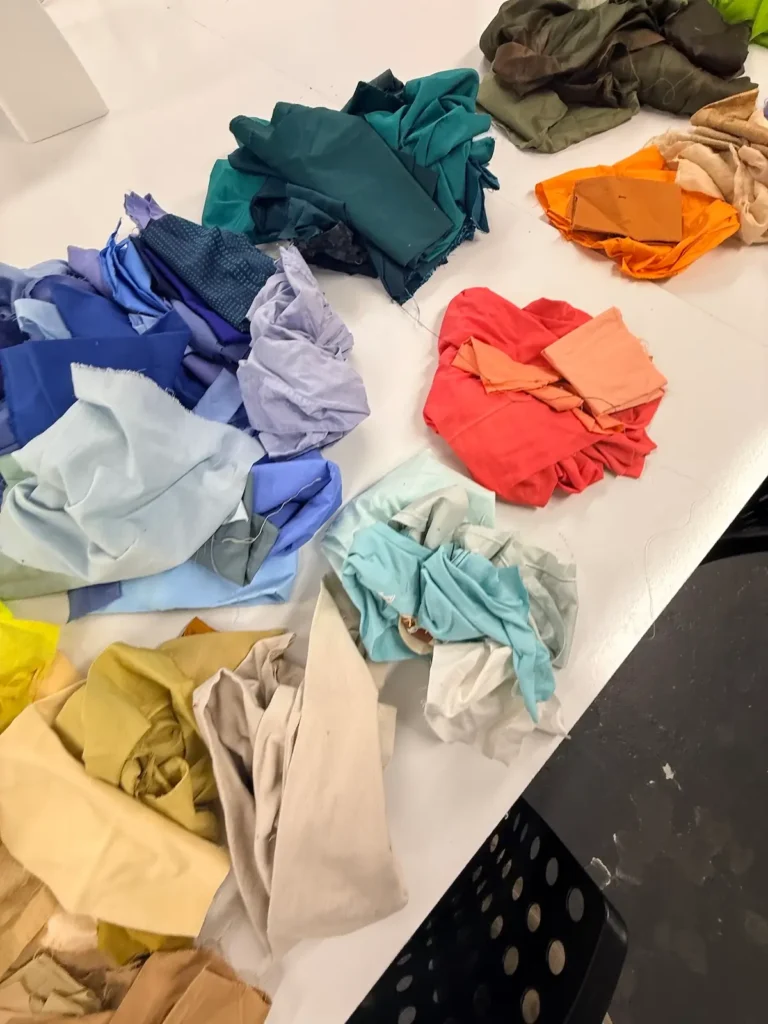
I vacillate constantly between organization and chaos, it is a part of the creative process for me. Sometimes I organize fabric by color, but more often than not, they get jumbled, and I like seeing the random combinations that it sometimes produces.
When things are too organized, it eliminates the coincidences and randomness that can be inspiring.
Do you work on quilts and garments at the same time, or in separate seasons?
The two practices are pretty distinctive to me, and I go through phases of working on them. If I know I have a lot of markets coming up, I’ll work on garments for a month, and then put them aside to focus on quilts. I have most of my markets in the spring and fall, and the winter and summer are usually slower, so my work shifts with the seasons as well. I find that having the two practices really creates a balance for me.
Currently, I am working on a lot of my new collage stretched canvas pieces for some art markets in the fall, so it will be interesting to see how my practice shifts with some of these new pieces.
How do you begin an improv quilt—color first, shape, or something else?
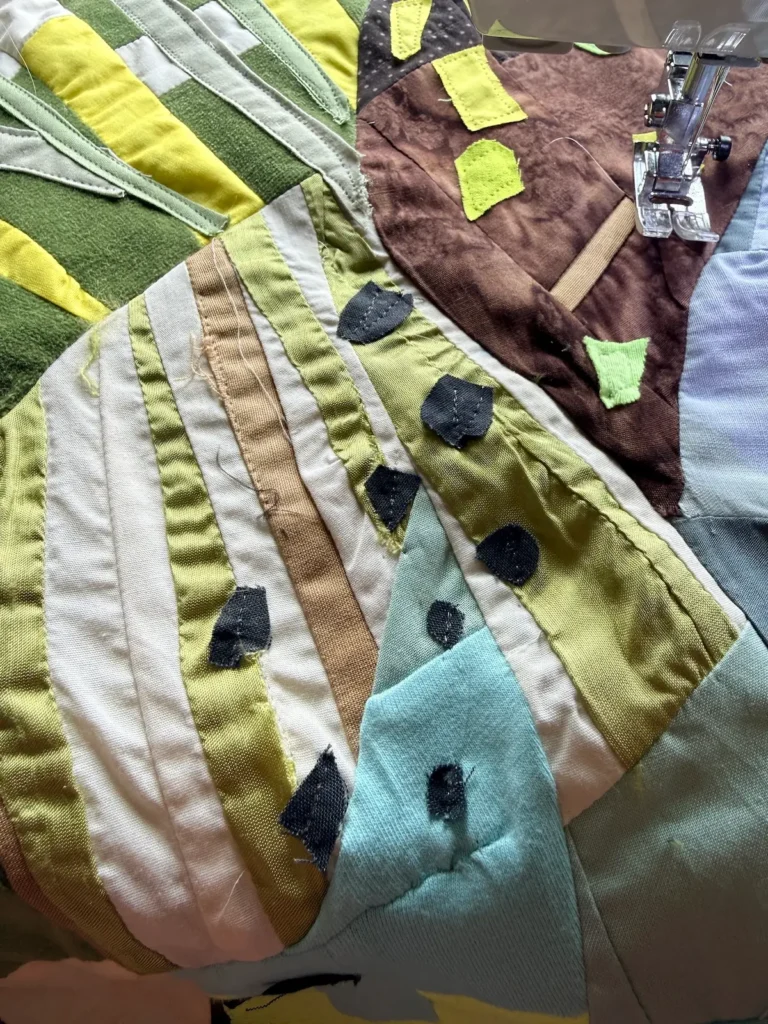
I begin my pieces based on memories, often using specific colors, forms and shapes from the memory, and let the narrative of the memory drive the composition. Because I do not have a composition planned out ahead of time, I create pieces that become building blocks that then give structure to the composition.
I believe that there is a conversation between me and the piece, and the quilt reveals itself to me in collaboration.
Do you ever feel limited by working with secondhand materials, or does it open more doors?
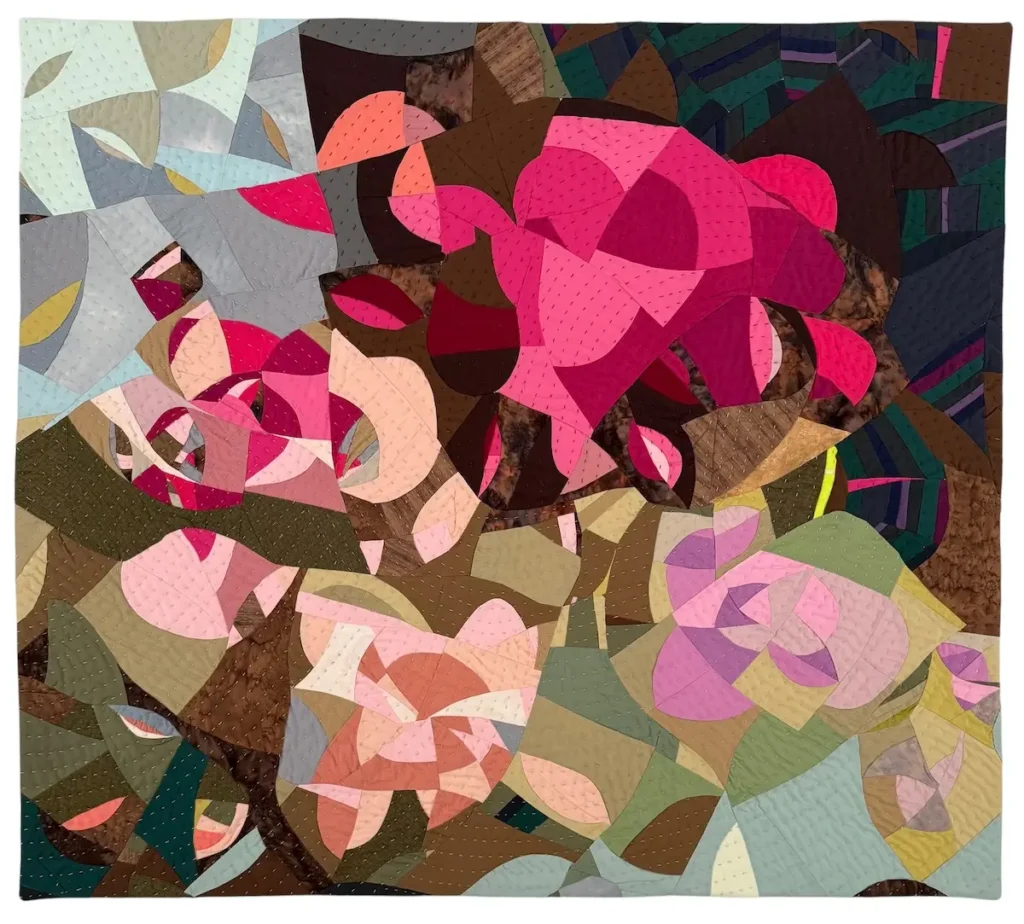
I think that working with secondhand materials gives me a level of freedom that I would not have otherwise.
The fabrics that I work with come with a little bit of history and life in them, and I love finding the connection between a garment and a quilted patch that fits just right on it. Using secondhand materials does create some limitations, but I find those to be helpful with my creative practice, and they help me to avoid falling into indecision paralysis.
How do you balance creating one-of-a-kind pieces with running a business?
The one-of-a-kind nature of my artwork is really at the heart of my business.
As an artist, I know that I would not be as engaged with making the same thing over and over, and I want to continue to enjoy my business so that I can keep creating for a long time. Although it is not always the easiest to keep up with in terms of inventory and website updates, I think it is a case of turning a liability into an asset.
My customers are looking for something that is truly one-of-a-kind and handcrafted by an artist. Because every piece is unique, it invites people to take their time and consider each piece to find the one that speaks to them, and creates a sense of urgency to purchase it because once it’s gone, it’s gone.
What keeps you excited to keep experimenting and trying new things?
I am so inspired by the world around me all the time.
I am constantly looking at color combinations, considering new shapes, and noticing new patterns. I think of themes for my work from reading books, listening to podcasts, and in conversation with others.
I always have a million thoughts swirling around in my head, and sewing is my creative outlet where I can get them all out.
I purposely build in times of art-making with community like sewing retreats, workshops, teaching and community outreach, as well as a lot of alone time in the studio. I really enjoy the energy of both and having a balance between the two.
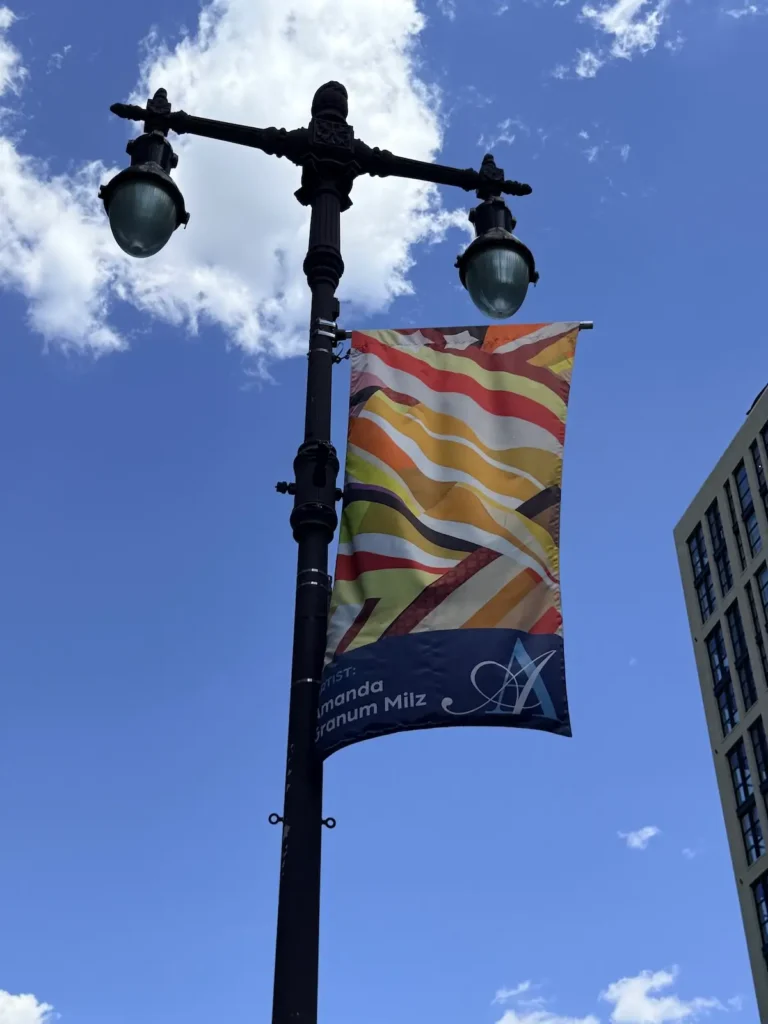
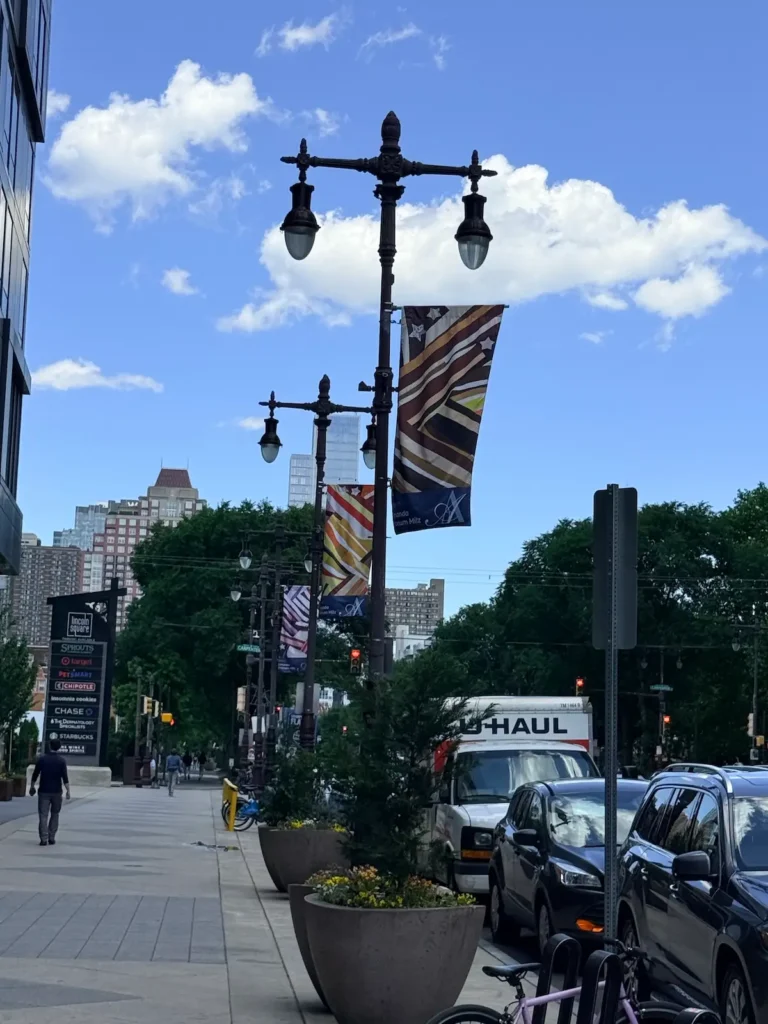
I currently have some of my work displayed on light pole banners in downtown Philadelphia through the AVE2.0 Avenue of the Arts revitalization project. The title of my piece is “How Many Colors is the American Flag?,” and it is a reinterpretation of the American flag to create a more expansive view of patriotism.
The banners are printed with images of my improv quilts, and this application of my work is very intriguing to me. I can imagine some interesting outdoor applications of my work, or fabrics printed with my designs used for different applications. Those pieces, as well as working with my canvas stitched pieces, are opening up the way that I think of quilt applications and helping grow the way that my artwork can reach a bigger audience.
What advice would you give to someone just starting quilting?
Just try it out!
Don’t worry about whatever you might imagine “the rules” being and just do some experimenting.
Go to the thrift shop and buy some old sheets or men’s button-down shirts and just try cutting and sewing some simple shapes. The internet is a great resource for researching questions as they come up. If you are interested in improv, I highly recommend Sherri Lynn Wood’s book “The Improv Handbook for Modern Quilters: A Guide to Creating, Quilting and Living Courageously.” She is an amazing improv quilter, and she gives really clear directions with beautiful photography to explain improv techniques.
Where can people see your work?
You can follow along on my Instagram account @amandamilzquilts
My art pieces are viewable at www.amandamilz.com and my upcycled garments at www.quiltypleasure.blogspot.com
If you are in downtown Philadelphia, you can see some of my banners on Broad St at the corner of Washington Ave for the next year!
Rapid-Fire Fun:
- Biggest creative indulgence? My Janome sewing machine. It felt like a huge investment at the time but it has been worth every penny.
- Favorite garment to upcycle? Baby jean jackets, there’s nothing cuter!
- One word for your style? Joyful.
- What’s next on your cutting table? Some new quilted collage pieces inspired by the ocean.
- What’s bringing you joy right now? Playing catch with my nine-year-old son at the beach.
Interview posted August 2026
Explore more modern quilt projects and inspiration on Create Whimsy.