
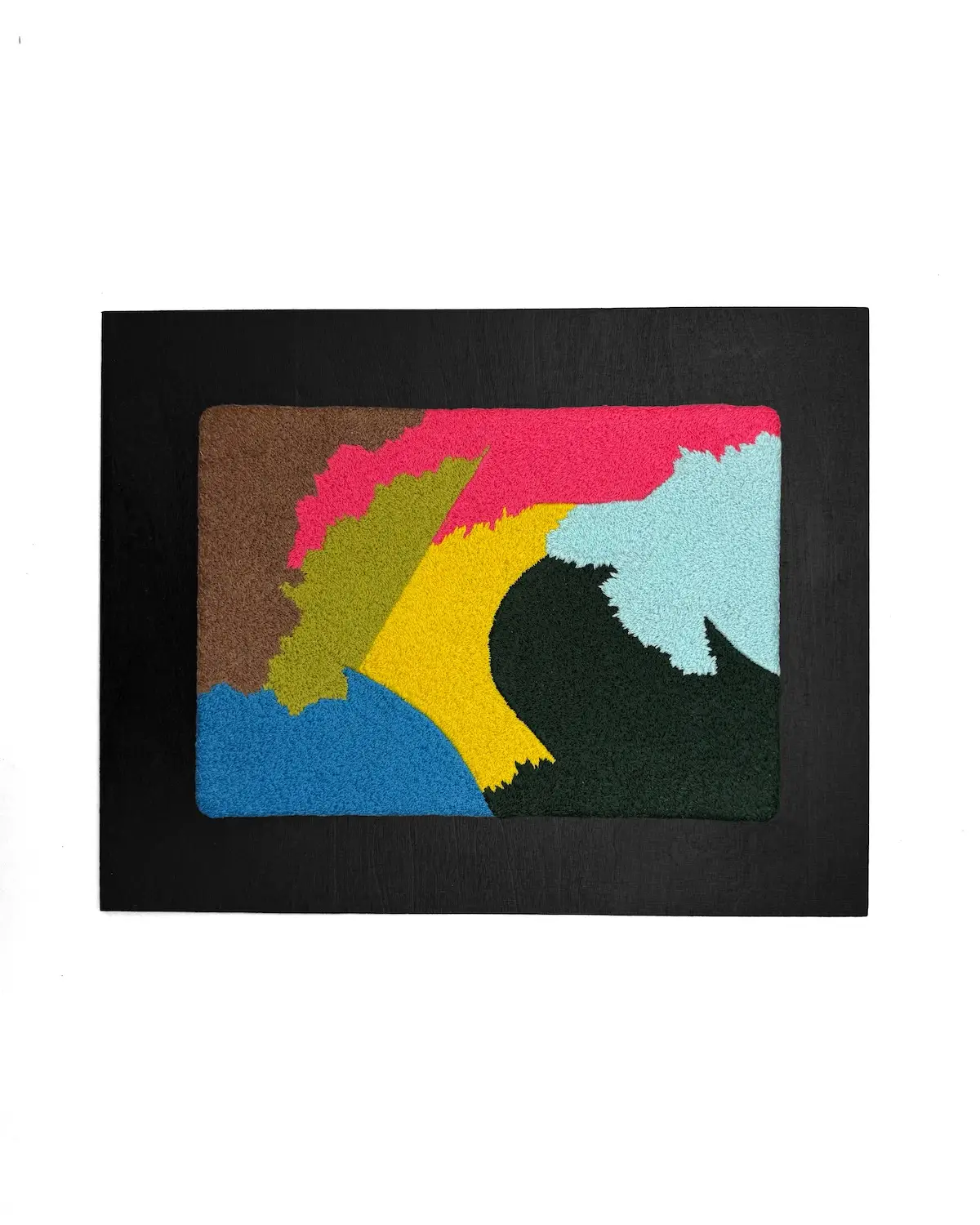
Meet textile artist JPR Stitch (aka Dr. Jack Roberts) and discover how stitching, balance, and daily practice shaped his unique art. In this interview, he shares how years in the art world, a daily creative practice, and trusting his own instincts led him to develop a distinctive artistic voice that is both thoughtful and deeply personal.
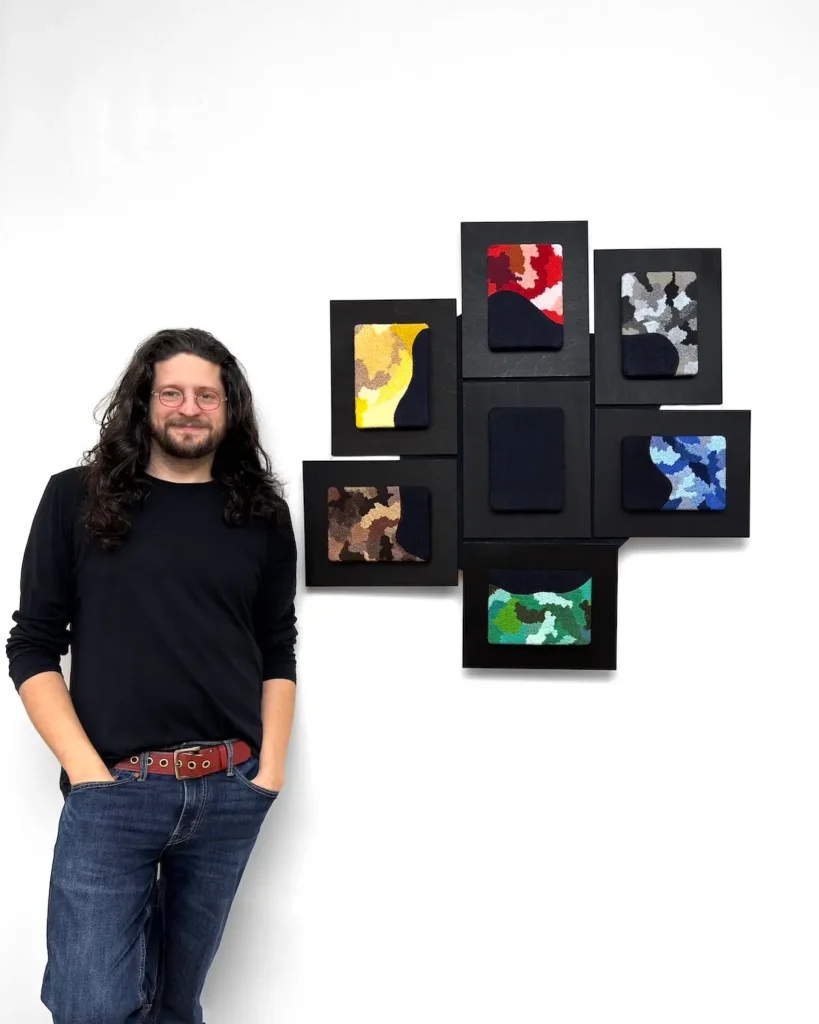
What gave you the confidence to make your own artwork the centre of your career and was there a moment when you realized stitching could become fine art instead of just a craft?
I created art during my degree, but at the time I was also working as an art dealer exhibiting the work of other artists at art fairs and curating exhibitions. When I completed my degree, my studies naturally moved into the none-making side of the arts.
My master’s degree was in Museum Management, and my PhD examined the artist-dealer relationship within the high-end art world. I was still operating as an art dealer and was working with museums as a cultural consultant – I was heavily involved in the arts, but I wasn’t making much art. At the time, I was busy juggling a portfolio career within the arts.
Since finishing my undergraduate degree, where I made art, I had tried to keep making, but this was sporadic, spending some time making on the occasional weekend, holiday, or evening. I could go three months and not really create anything. My art at the time was very complicated and interlinked with the value of art (and my PhD research). I was making on occasion but not really enjoying it and not really sharing it.
As an Amazon Associate I earn from qualifying purchases. Read more about our affiliate linking policy.
During COVID, I decided that I needed to switch my life around. I felt like I wanted to make art, I felt like I needed that within my life, but the busyness of life and work didn’t seem to allow for this.
I took a step back from many of the work commitments, I was still art dealing in the background, but this didn’t take too much time. I had cleared my time but was left with the quandary of what to make, the art I had been creating wasn’t fulfilling me. After a while of thinking, I decided I was going to be an oil painter, painting landscapes… I purchased the boards, paints, brushes and did nothing… it just didn’t feel right.
After about three months of creating not much at all, I was on a walking holiday, thinking about my art and I had the epiphany of ‘just sew’ that is your natural happy place – sew and see what happens.
When I got home, that is what I did, I cut a rectangle of fabric, picked a thread and started to sew. It was perfect, hours seemed to drift away, happiness arrived, I was calm, happy, and contented. For context, I was proficient at machine embroidery I had done huge amounts of it on my degree and had taught many courses in it so the process was very natural to me.
I started to sew, experimenting with what felt right and allowing the creative flow to guide me.
How it all started wasn’t therefore about having the confidence to make art the centre of my career or having the confidence to use a ‘craft’ as a way to create fine art. It came from me trying to find balance within my life and trying to find a practice that brought calmness, joy and happiness to my life.
You have worked in museums, galleries, education, and research. How did those experiences shape the artist you are today?
Within my work and studies within the art world, I have been exposed to a huge amount of art, artists, galleries, exhibitions and museums. I think that this exposure to the art world gave me the confidence to follow my creative inclinations rather than doing the ‘done’ thing.
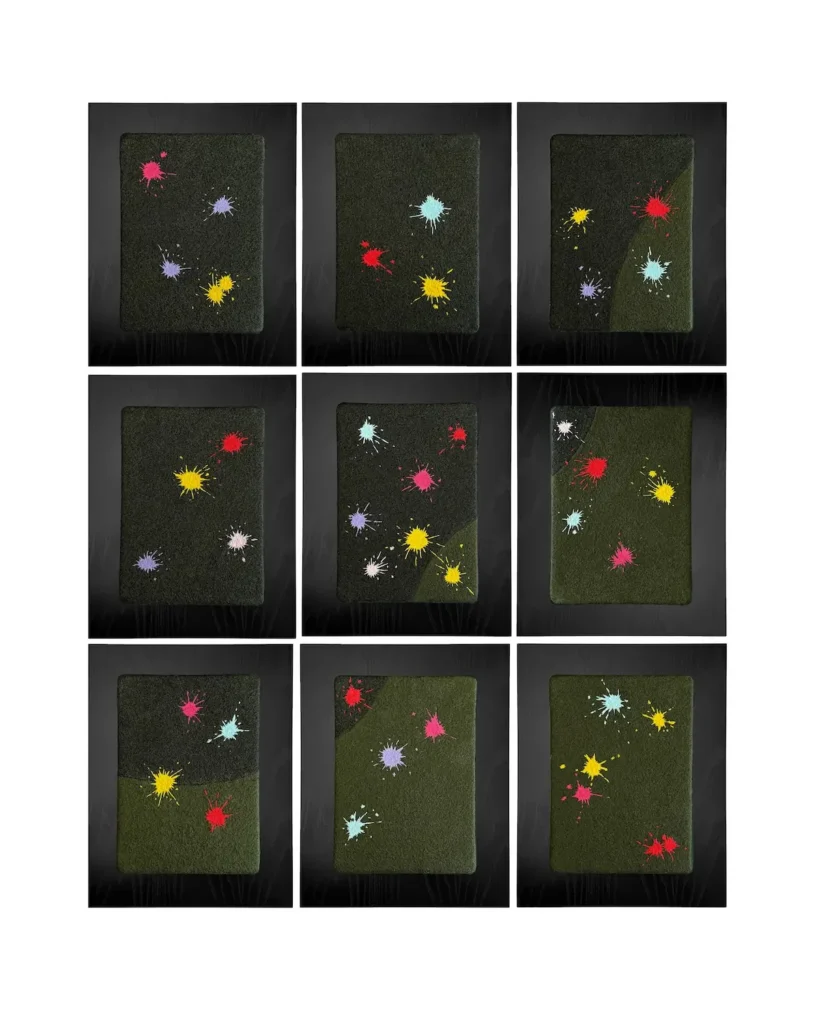
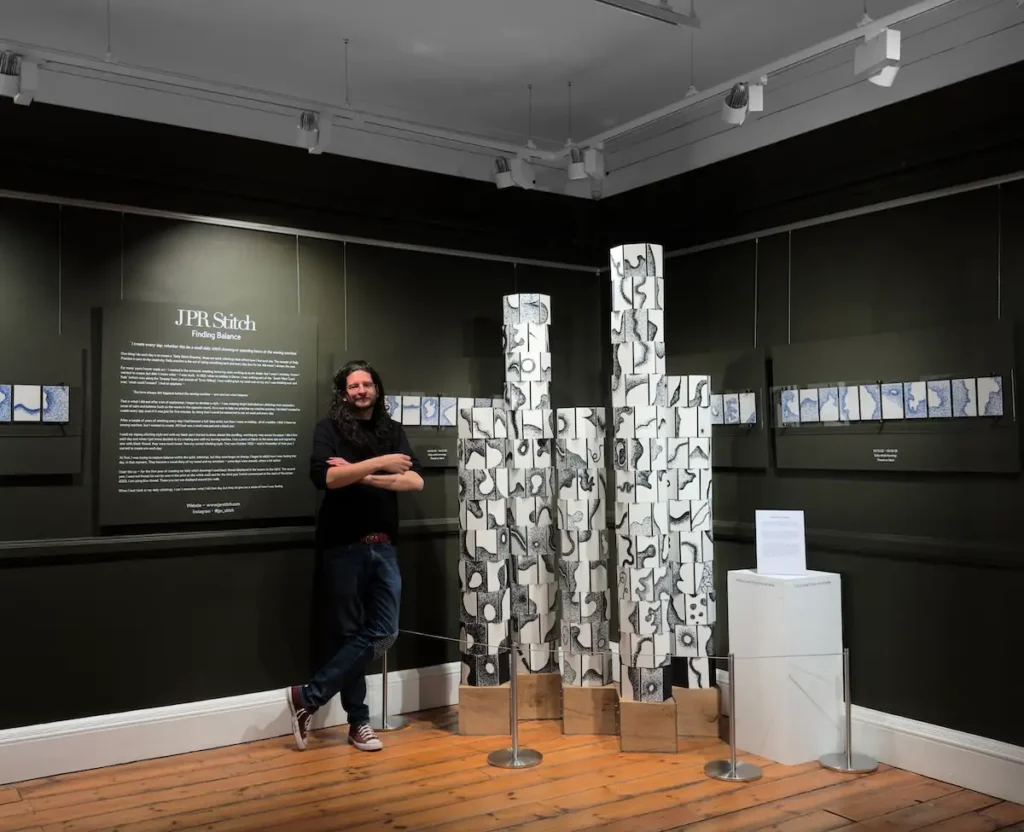
For example, after I had created a few stitchings, I was beginning to think about ways of displaying the stitchings. I think that my education and exposure to art was fundamental here as without it I think I would have just taken my work to my local framer and got it framed. There is nothing wrong with that at all, and it works for many artists, but for me there was something about the concepts behind what I was doing that I wanted to bring into the method of displaying my art.
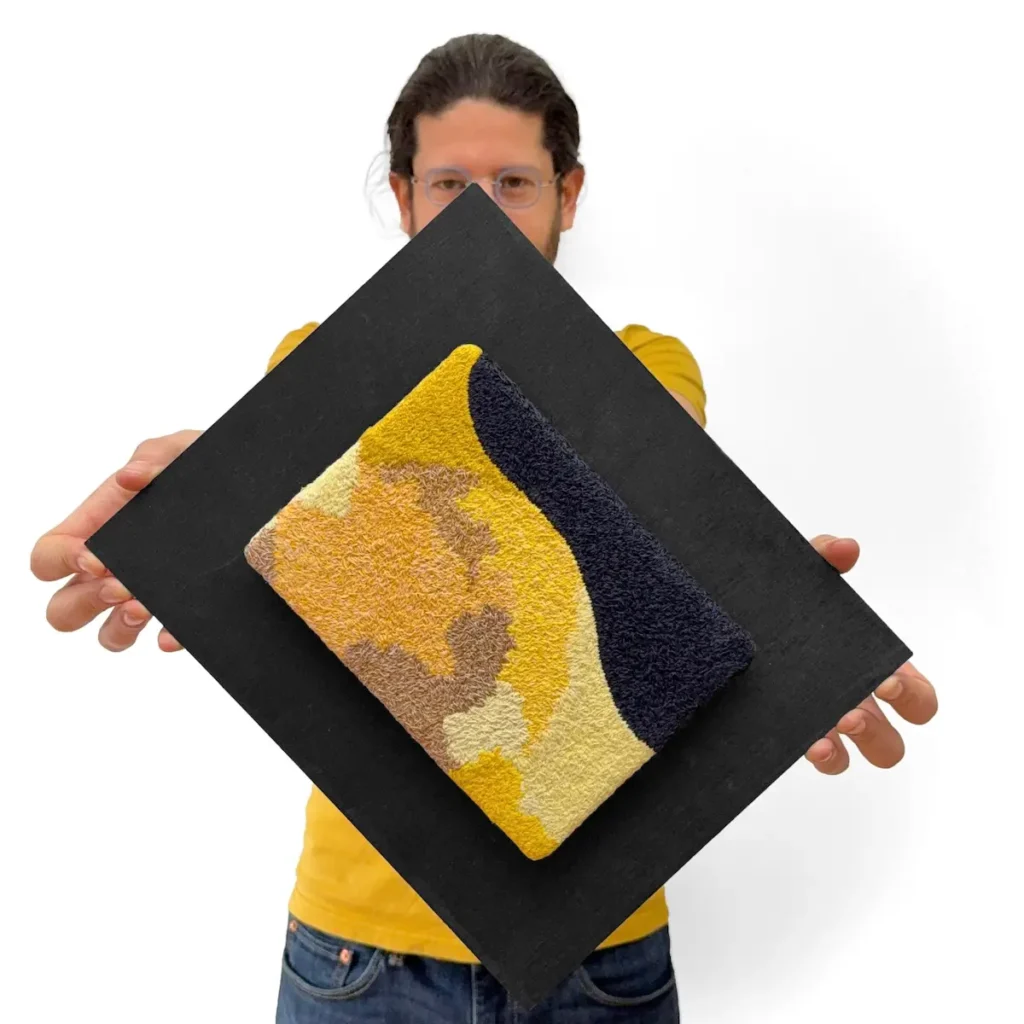
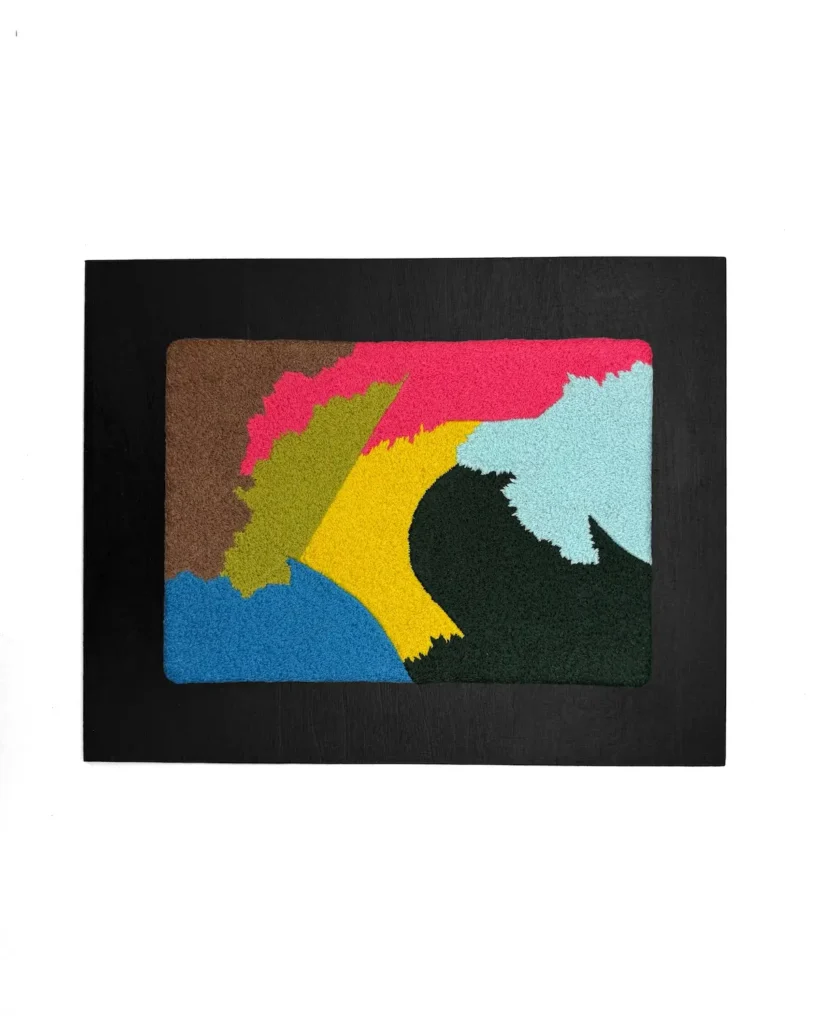
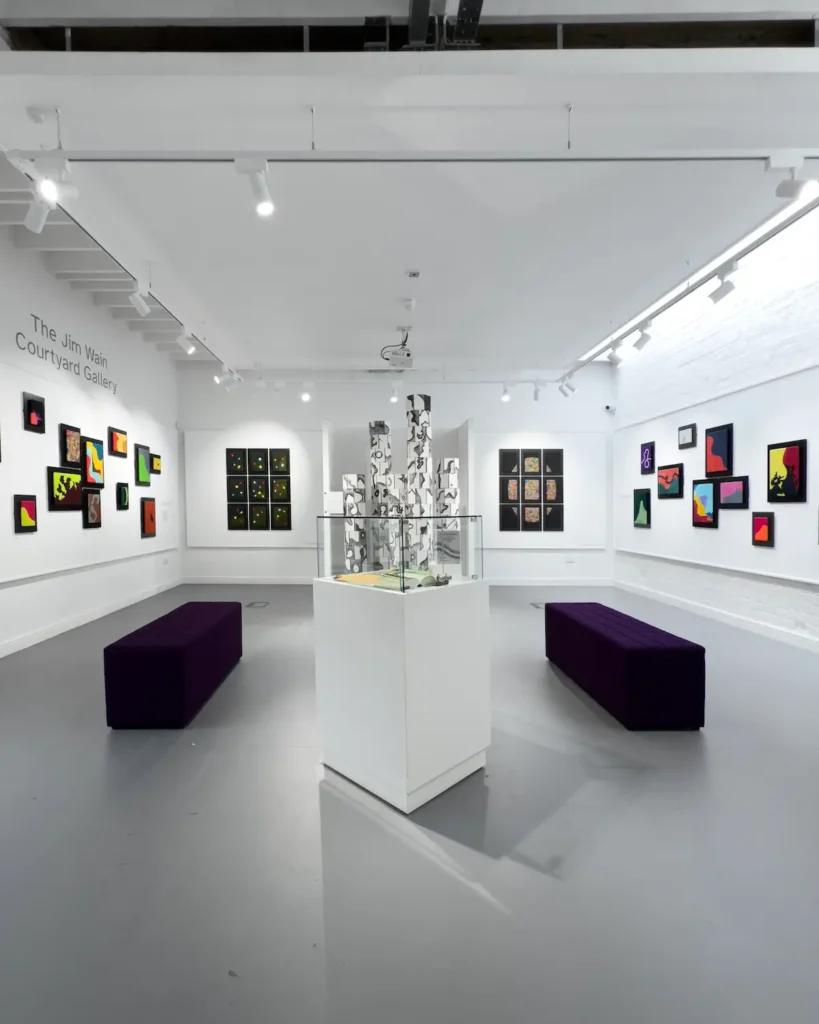
My art is about creating a sense of balance within the art and the viewer as they look into my art, because of this, I didn’t want any glass between the viewer and the art. I wanted my artworks to be projected off the wall, but I also wanted there to be some separation between the art and the wall, so that the art has the feeling that it is reaching out to the viewer which helps to pull your gaze into the art.
To achieve this, I experimented a lot with different ways of display that were all slightly unconventional. In the end I settled with my art being stretched onto a backboard to remove any wrinkles, this board is then float-mounted onto a larger board (the float-mounting pushes the artwork forward). The larger board is stained black which gives a border to the stitching and also separation between the art and the wall.
This method of display has become my signature style and I don’t think I would have achieved this without my work and studies within the artworld. I understood my concepts, I understood visual language so had ideas of how these concepts could be translated through the method of display and my exposure to art gave me confidence to follow my own direction rather than sticking to a more conventional path.
Your work is instantly recognizable. How did you discover this style instead of trying to copy what other artists were doing?
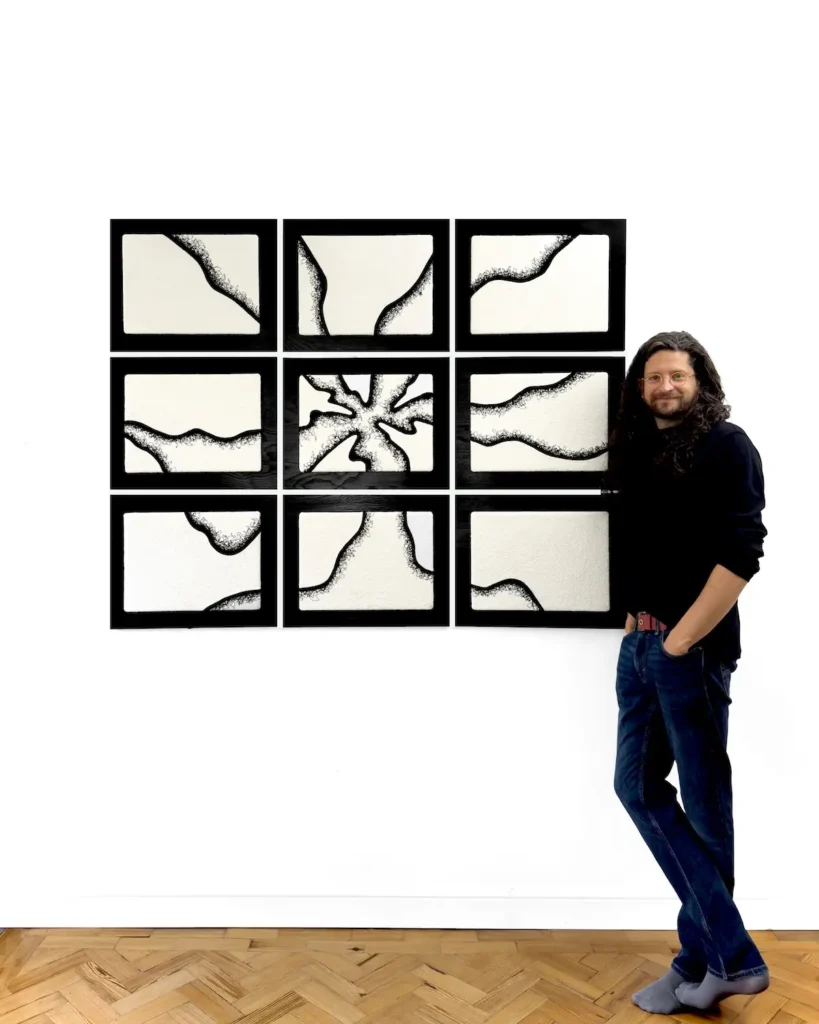
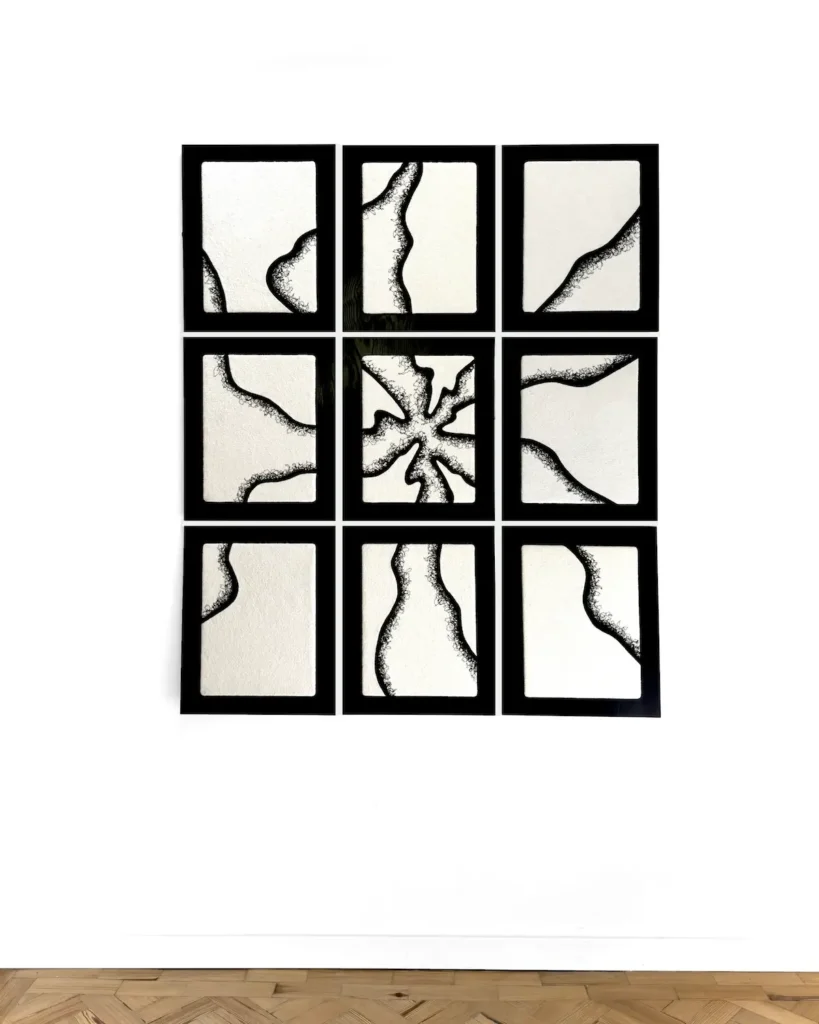
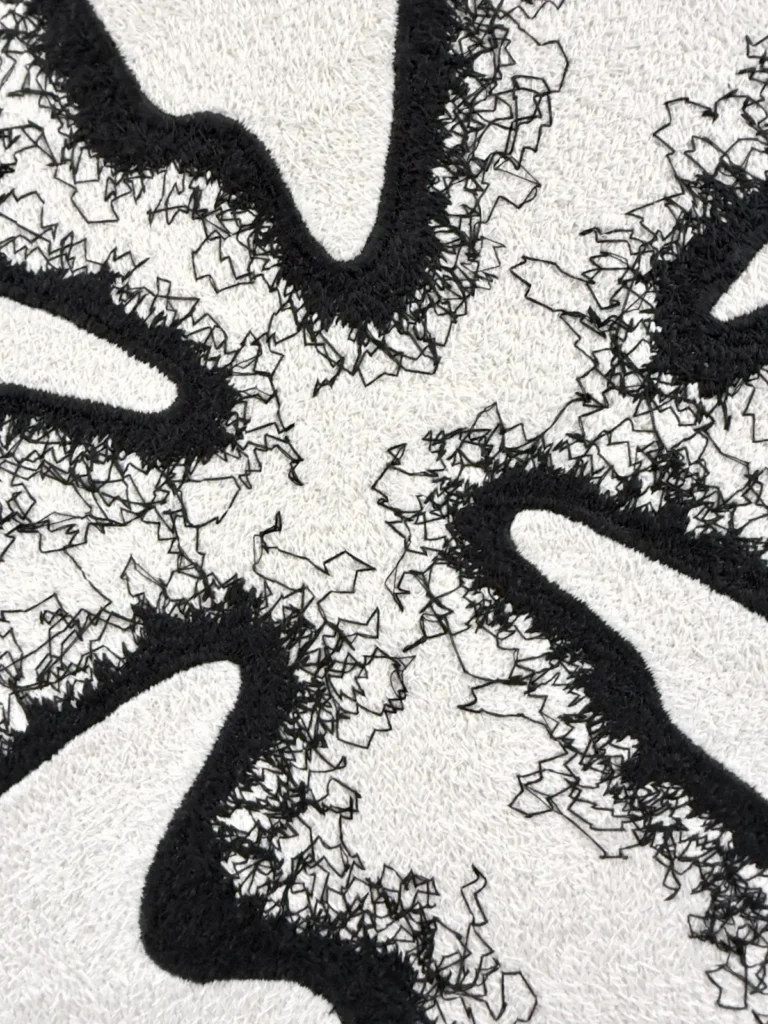
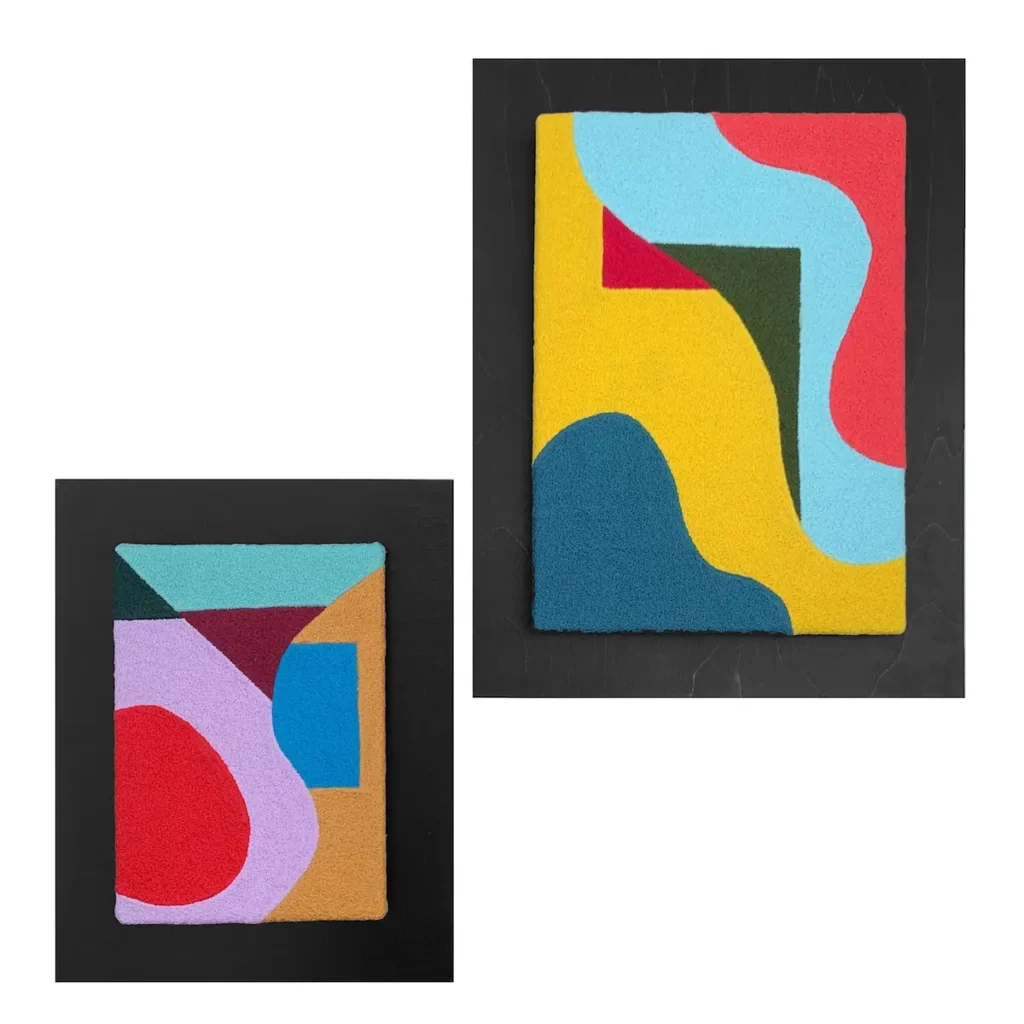
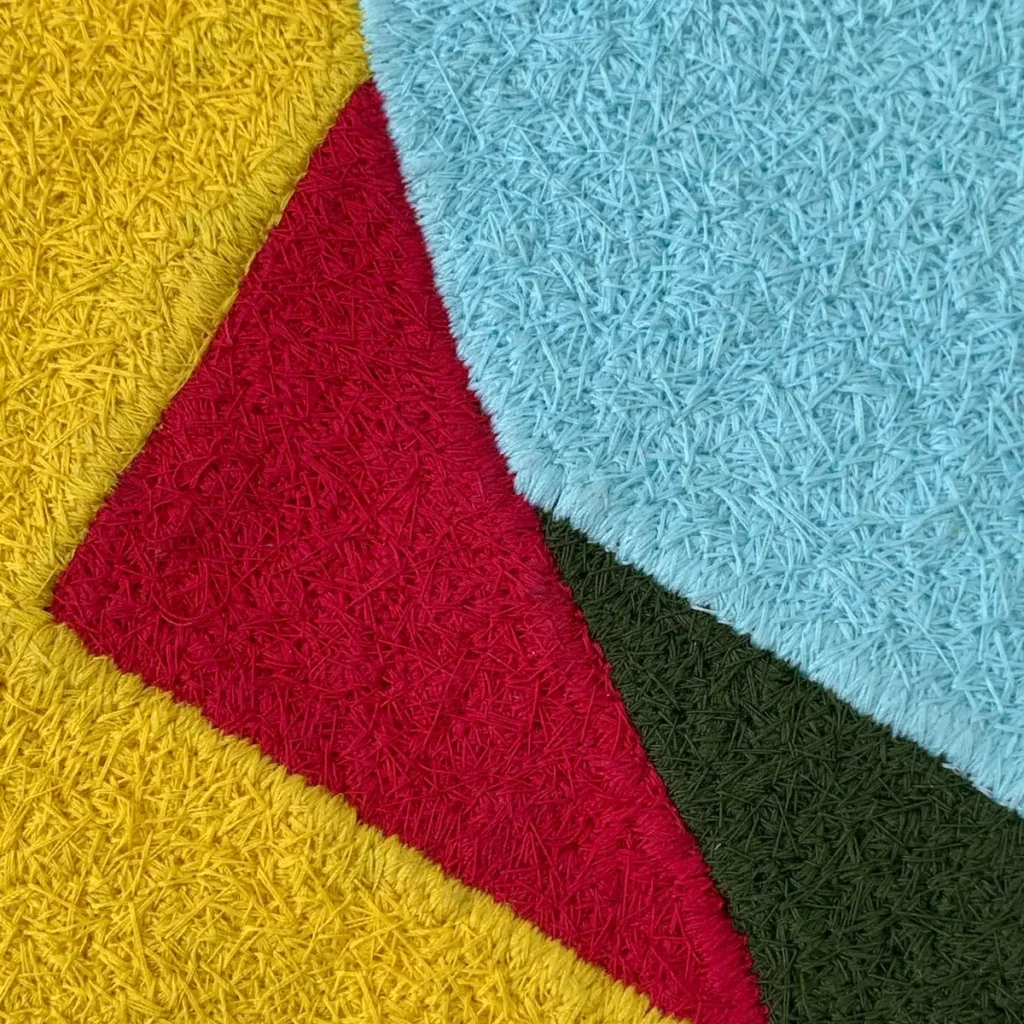
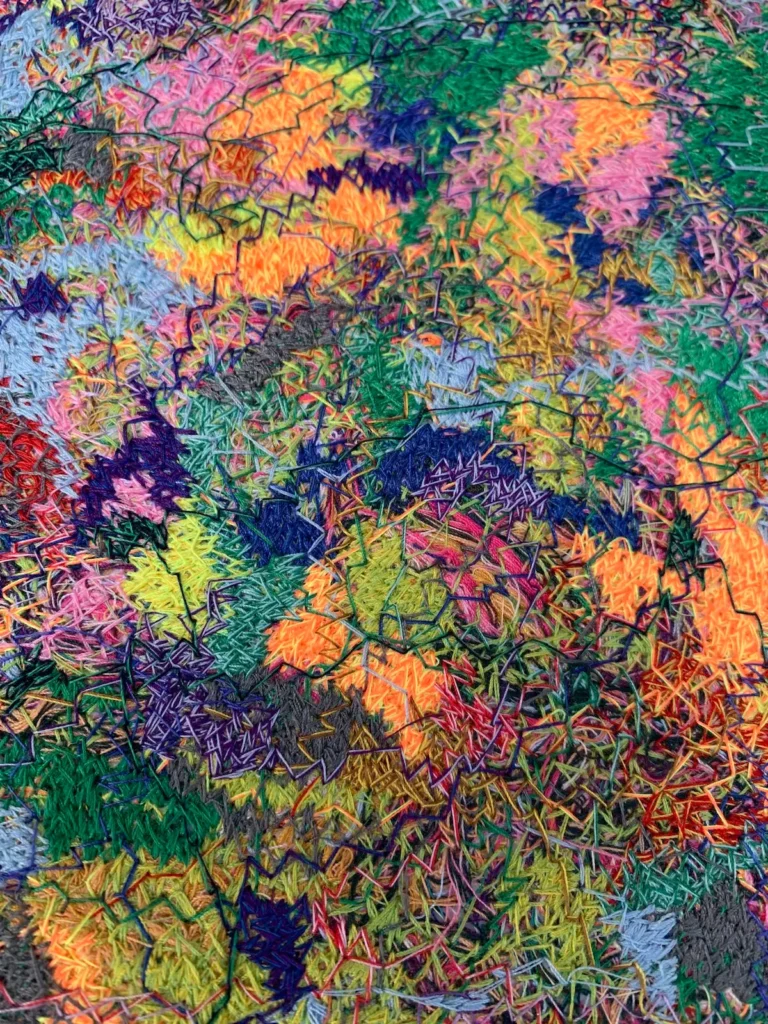
There certainly is recognisability to my work, some of this comes from the method of display as spoken about above – the stitchings are all stretched onto backboards to remove the distortion from the fabric and they are all then mounted onto a larger black stained board. This stays constant within all stitched works, which gives a degree of recognisability, but there is also recognisability within the stitchings themselves, they are all rectangular and created using only a zigzag stitch. Furthermore, I fully cover the fabric with stitch until there is no base fabric visible.
Due to the consistency within the stitching and the consistency within the method of displaying the work, I have created a recognisable style, but within this there is freedom, freedom within the stitching process to use line, colour, shapes, and pattern in whatever way feels right to me at the time.
Some stitchings are angular and geometric, others organic and flowing, some are bright and colourful, others black and white, but the consistency connects all of the works even when they visually look very different.
Finding this recognisable style was both natural but also took a lot of experimentation. Following what other artists have done wasn’t really helpful to me in finding my style, I wanted the art to feel balanced to me, feel calm and tranquil to me, so what others had done wasn’t a marker of success.
The stitching process is what felt right to me, I find stitching with a zigzag far more meditative than using a straight stitch so there was barely a decision, it is what I naturally wanted to do, it didn’t matter what process other artists used, that was the right process for me.
The mounting process took a lot of experimentation, but when I first saw my art mounted in that way, I felt an overwhelming sense of calm and balance, so I knew that was ‘right’.
Having an understanding of art, artists, and art history helped me as it gave me the confidence to follow my own creativity, but their work itself wasn’t the inspiration, knowing what I wanted from my art was my lead.
Your work feels both simple and incredibly complex at the same time. Was that balance something you planned or something you discovered?
This duality was something that I discovered – over time, I have become quite aware that there are a number of opposing elements within my work.
The art is simple from a distance but created from a complex web of stitches.
The art is soft, but when on display in museums, you are told not to touch it.
The art seems quiet and peaceful, but the making process and the noise of the machine is quite loud.
The colours I use are often opposing in some way (colour or shade). The line within the stitching creates a hard barrier that separates two or more opposing colours.
I found these dualities quite conflicting at first, not really understanding why my art had so many opposing elements, but as I started to interrogate my practice further, digging down on what it was about, the idea of balance emerged as the core concept within my art.
In trying to understand what balance was, I began to realise that balance is often reached at the equilibrium between two (or more) opposing elements, so for my art to have balance, there needs to be these opposing forces, and what I am trying to achieve is to find the equilibrium point within each artwork.
The art is not balanced if there is only one colour. The art is less balanced when there is no inflection point within the line. I am still exploring this idea of balance and dualities and trying to understand it further as I create.
Do you begin with a plan, or do you let the work tell you where it wants to go?
That very much depends on the type of piece that I am working on. For example, one-off individual stitchings never have a plan, I cut the fabric to the size I feel I want to work at, select a thread and start to stitch, moving across the fabric as I go filling it with stitch until there is no base fabric visible, when it feels ‘right’ I switch to another thread and keep going, I keep working the piece until I have reached a feeling of ‘balance’. For these pieces, when I start them, I have no idea how they will turn out.
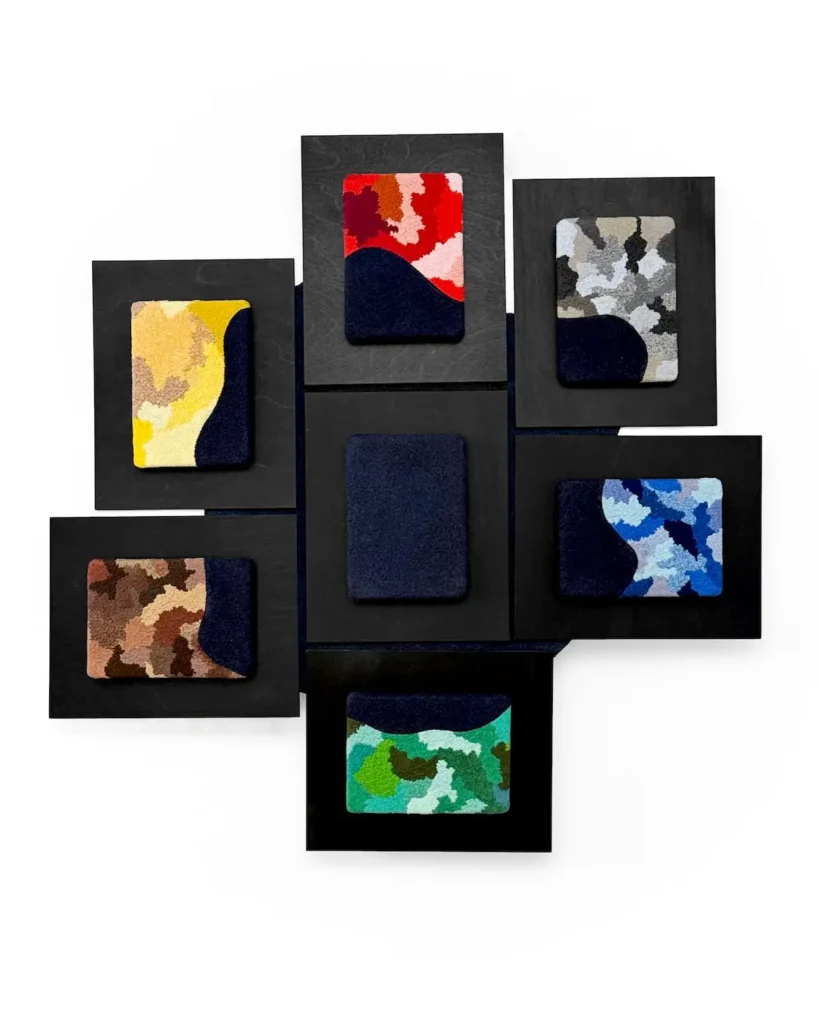
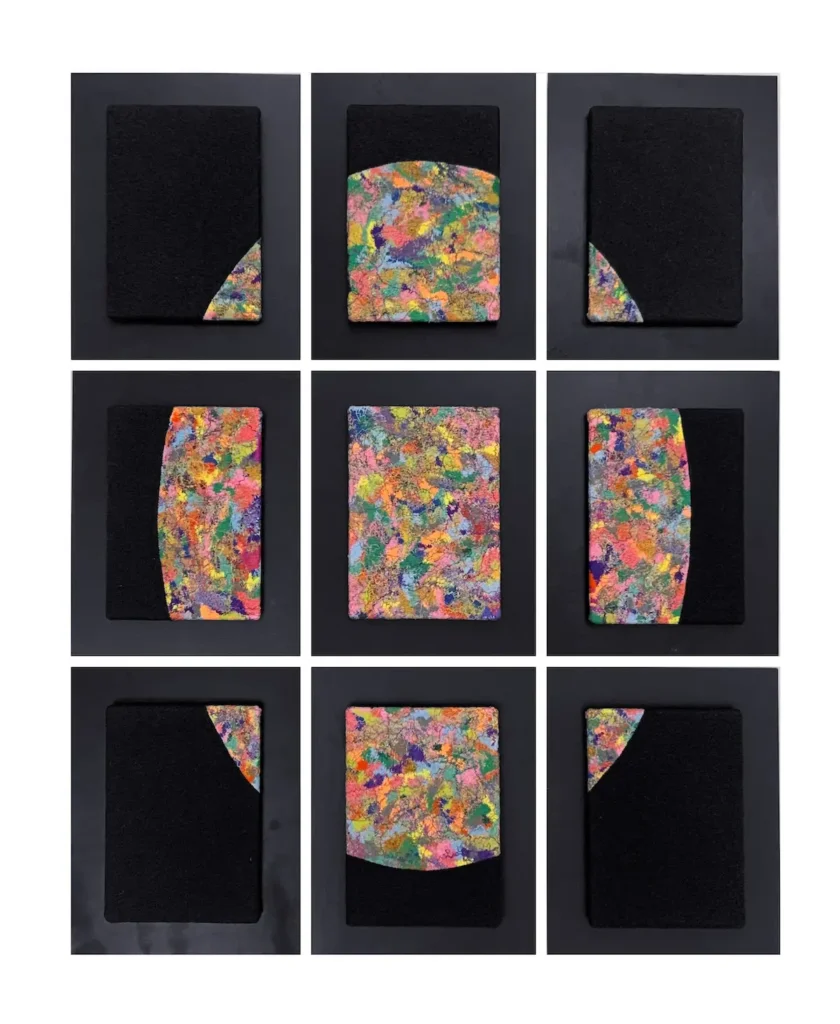
For large scale group artworks (what I call collection artworks) there needs more planning. Collection artworks emerged as a way for me to create larger scale artworks whilst still working on a small domestic sewing machine. I wanted to create larger pieces, but when working on a larger piece manoeuvring a large amount of thick embroidered fabric under the small opening of the sewing machine becomes a ‘fight’. As a solution, I began bringing together smaller artworks but that were connected through their design. These collections are usually made up of around 9-16 individual pieces that have a design that flows between the group of works – from a distance the design emerges and your brain fills in the gaps.
When I create these collection artworks, there needs planning to ensure that the design matches and flows – I do this to-scale on a large piece of paper, working the design out on the floor. But that being said, the initial idea for these large-scale pieces often comes out of creating a one-off individual stitching that has really inspired me and I feel has more to offer. The individual stitching is usually the central artwork within the collection and I then plan the other stitchings based on that first piece.
At what point do you know a piece is finished?
I used to think that it was when all of the fabric was fully covered in stitch and there was no base fabric left visible, but that really is not the case. Sometimes I hit that point and really feel unsatisfied with the piece so I take out my scalpel and start cutting it, patching in more fabric, restitching and reworking it cutting, patching and sewing over and over until the piece feels ‘balanced’.
Therefore, the piece is only finished when I feel that it captures a sense of balance. At one stage I tried to work out what ‘balance’ was for me, but I realised that it changes day by day depending on my mood, my experiences, my feelings, what’s going on in the outside world.
My practice helps me to personally find balance within my own life and as I stitch, I seek a state of balance within the colours, the composition, the lines. When I reach that state of balance within the work, I know it is complete. When I hit that point, I never go back to rework them – they have reached that state of balance and that is where they remain.
You title your work with the date it was finished. What does that simple choice mean to you?
This method of titling my work came out of me not really knowing how to title my art. When I was starting creating works in this style, I would finish a piece and put it to one side, titles didn’t come naturally to me, so I thought that I would live with them for a while to see if a title emerged. Whilst I was doing this, as a way to keep track of the stitchings, I put the date on the back of them. I never intended this to be the title, it was more of a reference code.
After a while, titles still weren’t forthcoming to me, so I reflected on my art, what it was about, and whether or not I wanted to direct people with a title. I realised that my art was a reflection of how I was feeling at the time of creation – the colour choices and the lines were all about me in the moment of creation, so by placing the date onto the artworks, this anchored them to the time in which they were created.
I also began to think that I didn’t want to direct people to look for things within the art – for example, if I called a piece the ‘night sky’ people would be looking at the work trying to see a night’s sky, when what I actually wanted them to do was to look in to the art and find their own connection – like looking at the clouds, we all see different things.
Therefore, the date became the perfect title for the works, it connects the piece to the time in which it was created and allows the viewer to seek their own connection to the piece.
What habit has made the biggest difference in your growth as an artist?
Without a doubt that would be ‘Daily Practice’. When I was trying to transition from a busy portfolio career in the art world to becoming an artist, the busyness of life and work kept seeping in and my creative practice kept being pushed out.
I decided, as a way to prioritise my art, that I needed to create each and every day. Even if it was just for five minutes, by connecting with my practice, I would keep it moving forward. That is how I started with daily practice. After a few months of this, I decided I needed to start to share my art, and social media seemed the natural place to build an audience, but sharing on social media didn’t come naturally to me, so I decided to again try and share every day.
I am convinced that without daily practice, I would not be where I am today. I would not have achieved what I have. It has been a core tool to help me to prioritise my art, and in the early days it was essential.
Now my art is my priority, and it comes first, with everything else being secondary. Even now, I still use daily practice – I still create every day, and September 2026 will mark five years of sharing on social media each day too.
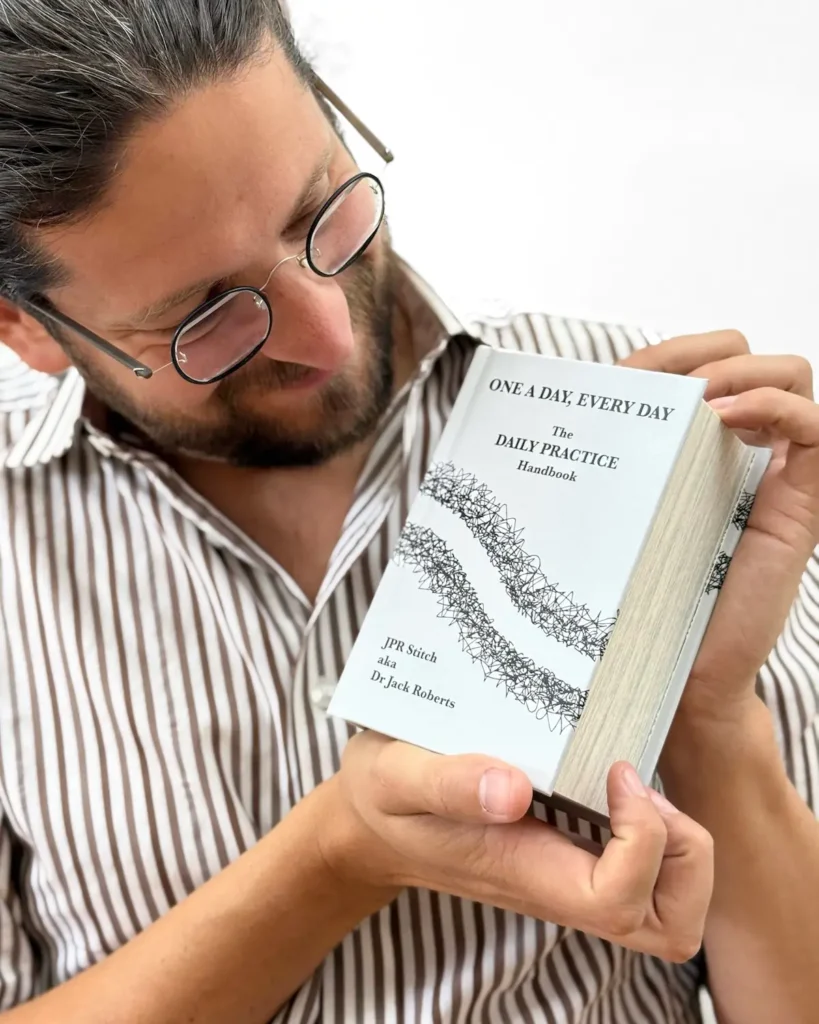
I am such a big believer in daily practice that I have even create a book to help others use daily practice to turn their ambitions into their realities – find out more here.
Can you describe your studio? What would we notice first if we walked in?
Well firstly, you wouldn’t recognise it as an artist’s studio, it’s my home. I have worked in artists’ studio buildings in the past but I found them (for me) quite uncreative places.
I think I need to feel ‘at home’ before I can truly allow myself to relax into the creative process, so working from home is the ideal place to work – it means my creativity can just flow.
Even when I was doing my art degree, I wouldn’t create from the university, I would go to the university studios, talk to people, think, research etc, but the creative process happened when I got home.
It took me a while to ‘own’ this, as I always felt that if you are a ‘proper’ artist, you had a studio usually in an old, rundown, cold and damp building, which just baffled me as to why I would want to leave my comfy home to go to somewhere like that…
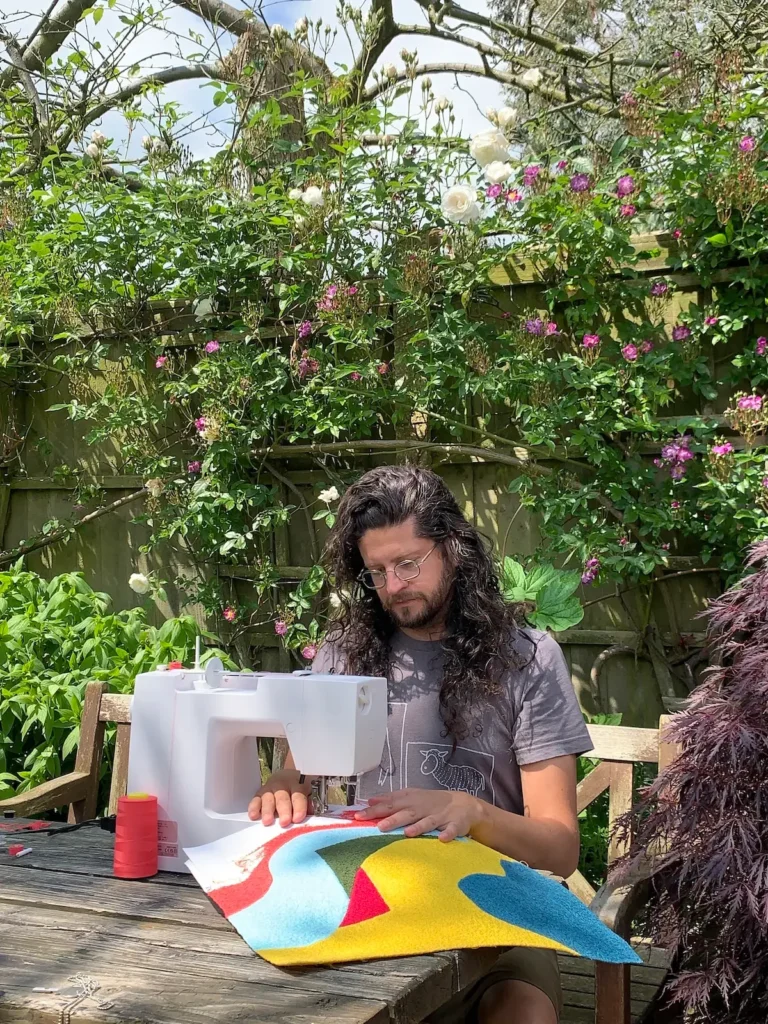
I don’t have a studio room at home, I work wherever I feel I want to that day, in the summer, I am working outside in the garden moving around either chasing the sun or shade depending how hot it is.
In the winter, I am working inside, sometimes downstairs in front of the fire, other times upstairs in one of the bedrooms. This is one of the reasons I like to work with a small domestic sewing machine – it’s portable. I can easily take it to the place where I feel like I want to be and work from there.
What advice would you give someone who feels stuck because they are waiting for the “perfect” idea?
Get out of your head, stop overthinking and create – start creating now.
The worst thing you can do is to stay in your head, overthink, and never make anything.
Start creating, and ideas will emerge, a style will develop, you will improve your process, keep making, keep learning, and your practice will develop.
If you do nothing but think, months will go by and nothing will have happened – I have been there… Daily practice was a perfect solution for me. It helped me to create each and every day.I continue to think, but creating is key. The perfect idea comes when there is both making and thinking. The perfect idea won’t come from just thinking alone.
Where can people see your work?
Social media is a good place to start, I use it as my daily diary. I share every day about what I am working on. You can find out what’s happening day by day but also scroll back through the archive to get a sense of me and my work.
If you want to see my work in person, the next place will be at Knit + Stitch 2026 in London (8th-11th October) and Harrogate (19th-22nd November). I will be exhibiting within the galleries area of the events, showcasing a cross section of my works and will also be there in person, so that is a great opportunity to come along, see the works and have a chat.
Rapid-Fire Fun
Right now, I’m inspired by… my past work… is that slightly arrogant… I don’t mean it to be. I am in the process of creating a book of my last five years’ worth of work, and the act of revisiting it all is filling me with inspiration, positivity, and the urge to create.
My happiest place is… sitting at my sewing machine in my garden, sewing in the sun surrounded by plants.
Every artist should… love what they do – for me, the point of being an artist is connecting to your deeper self, and that is something that not many people get the opportunity to do – so even when it’s hard, torturous or stressful, you need to put into context that it is a joy and privilege to be an artist.
Next, I’m excited to… keep making, it sounds odd, but having spent years not creating, it is a continuous joy to keep creating, following my creative flow and seeing where that takes me.
Links/contacts details –
Instagram – https://www.instagram.com/jpr_stitch/
Website – https://www.jprstitch.com/
Email – hello@jprstitch.com
Interview posted August 2026
Explore more inspiring interviews on Create Whimsy.