

Inspired by nature and the world around her, Sophie MacNeill creates amazingly detailed fiber art pieces with hand dyed fabrics. Stitching forces Sophie to slow down and look closely. Her work as a professional landscape architect is reflected in her fiber art. Just like the plants that grow in the garden, the “rootedness” of the stitching process allows an organic and wild form of growth.

How did you find yourself on an artist’s path? Always there? Lightbulb moment? Dragged kicking and screaming? Evolving?
I’ve always had what I’ve heard most accurately described as “hungry hands”. Creativity and art have been a part of my life since I was a young child.
I was always drawing, making things, and assuming creativity would be part of my future. However, despite getting a Fine Arts diploma in college, I really struggled with committing to art full-time. I decided to purse Environmental Design and then Landscape Architecture as a professional career. Part of this came from some deeply internalized ideas about success, purpose, financial security, and the idea of “usefulness”. At the time, I didn’t feel I had the personality or diligence to be an artist. It seemed to require a sort of entrepreneurial spirit that felt very inaccessible to me.
I was also super interested in landscapes and plants and wanted to explore that. It’s interesting to me, however, that certain impulses just never go away. Here I am today, wandering down three different by overlapping creative pathways as a landscape architect, horticulture instructor, and a practicing artist. It makes for a very busy but very fulfilling creative life.
As an Amazon Associate I earn from qualifying purchases. Read more about our affiliate linking policy.

What inspires you to create?
Nature and art. The places I feel most inspired are the outdoors, in gardens or forests, or anywhere natural processes are on display. Or in an art gallery!


Why stitching? How does that medium best express what you want to communicate through your art?
While I don’t describe myself as an “embroidery artist” (I never learned any real techniques of the craft), my work is undeniably informed by its history and process. I’ve always appreciated that the etymology of the word embroidery. It is from the French term for embellishment – a word suggesting superfluous decoration but with a fundamental purpose: to communicate, to imbue meaning, to tell stories. Similarly, I’ve always been interested in textiles as a medium for its ability to evoke ideas of domesticity, utility, and comfort.
My favourite thing about this medium is that it forces me to slow down and allows me to work with my hands in a very tactile way. There’s no way to speed up the process or take any short cuts. While my day job requires quick turnarounds and deadline-driven creativity, stitching gives me an opportunity to be expressive in a deliberately slow and thoughtful way.

Are there recurring themes in your work? What is it about a subject that inspires you to continue exploring it?
Themes of time and place at the intersection of ecology and craft have been the key recurring ideas in my work as an artist, landscape architect and teacher for many years. I’m forever inspired by ideas related to home and am fascinated by how we form relationships with the world around us, particularly plants and landscapes.
As we face constant reminders of the destruction associated with the myths of human exceptionalism, I believe the need to look closely at the more-than-human world around us is a matter of urgency. If my work could say one thing, it would be “slow down, look closely”.

What do you do differently? What is your signature that makes your work stand out as yours?
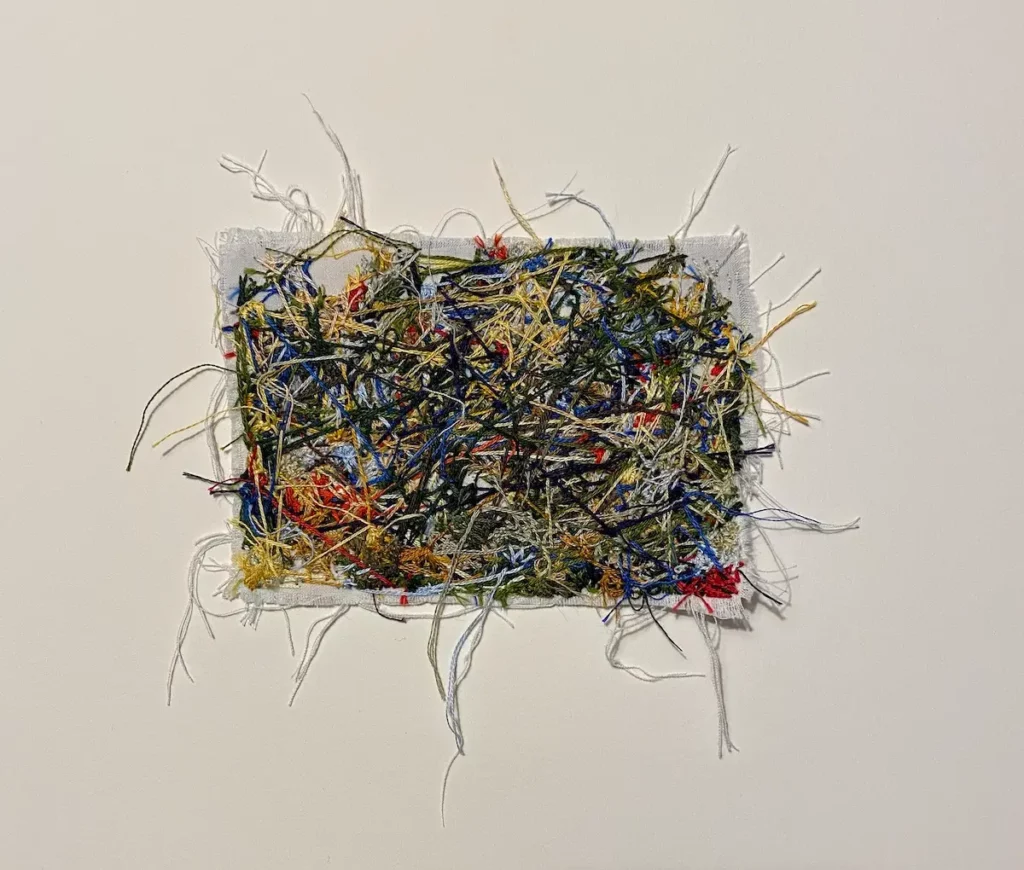
I use textiles and stitching to cultivate a form of slow expressionism, using the thread and needle as my primary tools. Found fabrics and natural colours are the ground that I work.
Embroidery, and related textile arts, are often misunderstood as craft that requires planning, precision and an understanding of complex techniques. I never learned the traditional craft of embroidery but did study fine arts. I use the thread and needle in a way that is more similar to using a paintbrush and paint.
The main difference is that with stitching, you are forced to slow waaaay down. You’re constrained by a linear process that many people wouldn’t equate with being “expressive”. I think the slowness and “rootedness” of the process allows an organic and wild form of growth, not unlike the growth of a garden.


How do you honor unceded territories in your work?
I recognize my decolonization journey is a continuous one. It takes consistent curiosity, learning, unlearning, and the willingness to not only face uncomfortable realizations but then to make meaningful actions that reflect the spirit of truth and reconciliation .
I’m still learning how my own work may honour the unceded territories that I live and work on. My commitment is to deepen my understanding of the local cultures and artists and amplifying their voices, whenever I’m able. I believe that my relationship with plants and landscape, which is the focus of much of my work, is deeply influenced by the Indigenous worldviews that I’ve been honoured to learn about.
Recognition of our place within a reciprocal system built on relations has been transformative for me.

When it comes to creating, are you more of a planner or an improviser?
Definitely an improviser! Planning is not my strong suit, which is one of the reasons I was drawn to this type of stitching.
While I totally appreciate the style of embroidery that follows laid out patterns, or similarly, a perfectly manicured garden, my style is not that. I’m messy, impulsive, but also very slow, which allows for a level of immediate intentionality.
My process requires slowing down and tuning into my instincts. I connect to the fabric, thread and the process.

Do you have a dedicated space for creating? If so, what does it look like?
Nope! My work space is mostly just my couch, or somewhere outside when it’s nice and warm out. It’s one of the things I love about stitching – you just need somewhere comfortable to sit and good light.

What are the indispensable tools and materials in your studio? How do they improve your work?
The thread and needle are my primary tools, typically supported by a suitable frame or hoop (depending on the size of the piece I’m working on).
I’m a fan of Q-Snap frames because they allow for so much adaptability, and are relatively light-weight. Beside the ground fabric – which is almost always found or salvaged from thrift stores, old sheets, flannel shirts, etc, I find stabilizer (such as fusible interfacing) essential for providing extra support for the ground and to prevent puckering.

What plays in the background while you work? Silence? Music, audiobooks, podcasts, movies? If so, what kind?
Depending on the project, mood but I usually have an audiobook, podcast or music in the background.
If the work has a particularly special meaning to me, I’m very careful about what I’m listening to, aware of the power it has to influence the tone of my work. I’ve also been trying to get more comfortable with silence – which is not something I’ve always been able to do.

Can you tell us about the inspiration and process of one of your works? How does a new work come about?
My latest work is a piece I started during my artist residency at McLoughlin Gardens on Vancouver Island. It’s called “Where I’m From” and is the most meaningful piece I’ve worked on.
I was honoured to be able to start the piece in the place where I spent my formative years. Everything I’m passionate about as a professional and artist is informed by the landscapes in which I grew up. It’s been 20 years since I officially left the valley and moved to the mainland. At the time I started the project it had been about 18 months since my mom passed away in this community we called home.
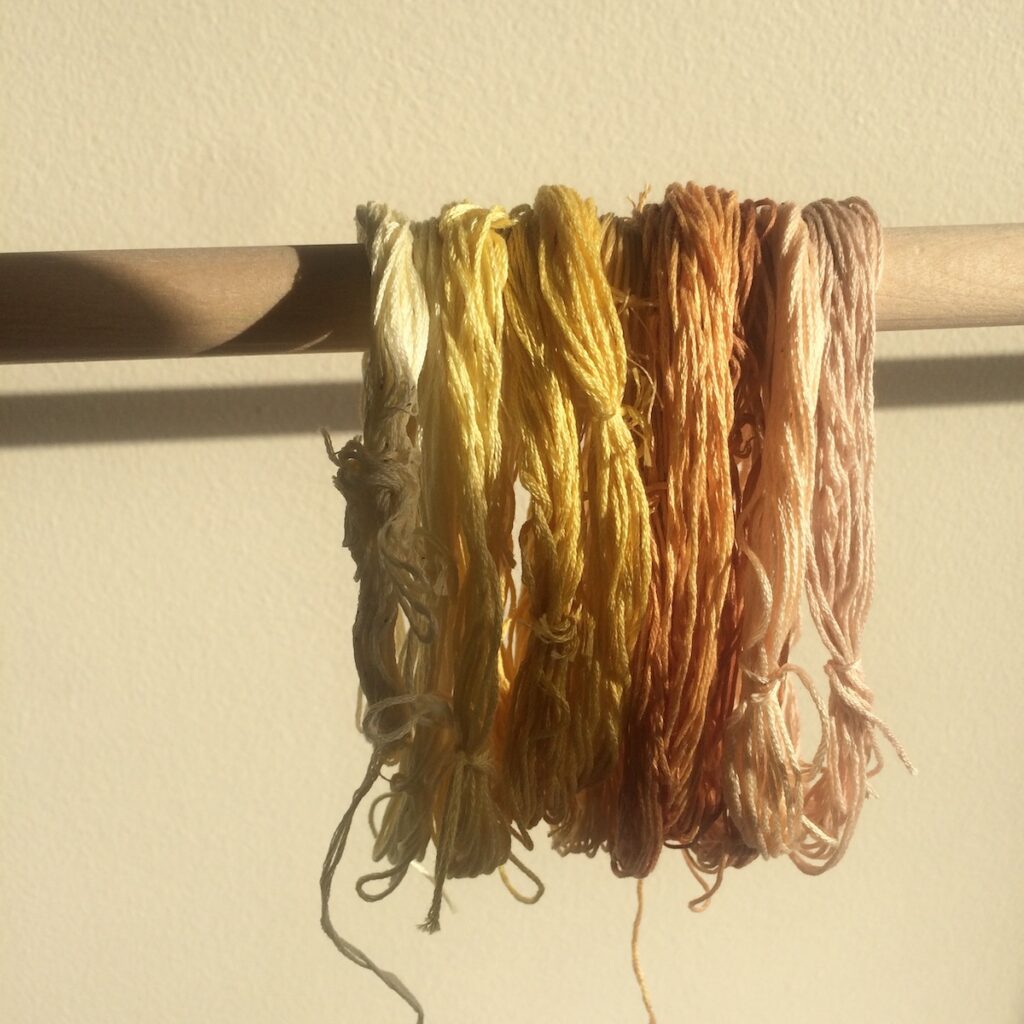
The project is an exploration of the themes of home, landscape and the threads that tie us to time, place and each other. I took advantage of the space provided by the McLoughlin Gardens and cabin to dye fabric that I sourced from my mother’s wardrobe. This fabric will represent “the ground” using natural dye that I harvested from the landscapes, including Oregon grape, hemlock and alder. I’m not sure what the final piece will look like. It’s been a slow, heartbreaking and heart-healing process that has allowed me to connect with my mom and explore more ideas of home.




What was the biggest challenge that you encountered on your creative journey? What did you learn from it?
I think one of the greatest challenges has been getting over my shyness of sharing my work. I’ve worked hard to recognize the insecure perfectionist in me. I’m learning to honour the ‘gift of imperfections’ and the vulnerability that comes from putting yourself and your work out there.
Instagram has been super validating and an incredible way for me to meet so many other artists and creators. I’m so grateful for the platform. However, it can definitely be hard on the ego. I don’t think it’s necessarily helpful to have such immediate and quantifiable response to everything you share.
It’s hard not to compare yourself to others or your past work. The new format that seems to require performance (reels and video content) for ‘exposure’. Finding a way to engage with others in a way that feels healthy and authentic to me continues to be a challenge I’m working through.
Do you think that creativity comes naturally to people, or do you think creativity is a skill that people can learn?
I think creativity is an inherent quality that everyone possesses. It’s a real shame that we’ve been led to believe it’s something you’re either gifted with or not.
I have a twin sister who would sometimes lament that she’s not “the creative one”, since that label was always assigned to me. She’s one of the most creative people I know, just in a different way. That being said, I do believe creativity is more of a compulsion for some people than others. It is something that needs nourishment, care and patience. To me, creativity often feels like the daughter of self care and work. It requires intention and time.

What do you learn about who you are through your creative endeavors?
One of the greatest lessons that stitching has taught me is that sometimes you have to slow down to speed up. I’ve learned how I can be incredibly impatient and focused on the outcome, rather than the process, both in life and art.
My creative endeavours have taught me to stay open and curious to the stories unfolding, and I that I can learn as I go. I don’t have to have it all figured out to start. In fact, that’s how I’ve always learned, just by diving in and staying mindful to the lessons that appear.

Tell us about your website. What do you hope people will gain by visiting?
My website is forever a work in progress, which I’m hoping to update in the next month. I hope it’s a place where people can get a better sense of what I do and why I do it. And also to connect with me, if they want.
I’ve recently done a huge studio purge and found a ton of pieces that I never really finished. I’m thinking of posting those for sale – there’s a huge range of sizes and phases – and am excited by the idea of other makers being able to do something with them. I’m also excited to use it as a space to share more content related to my work from the McLoughlin Gardens Residency.
Interview posted February 2023
Browse through more inspiring stitching projects and stories on Create Whimsy.