
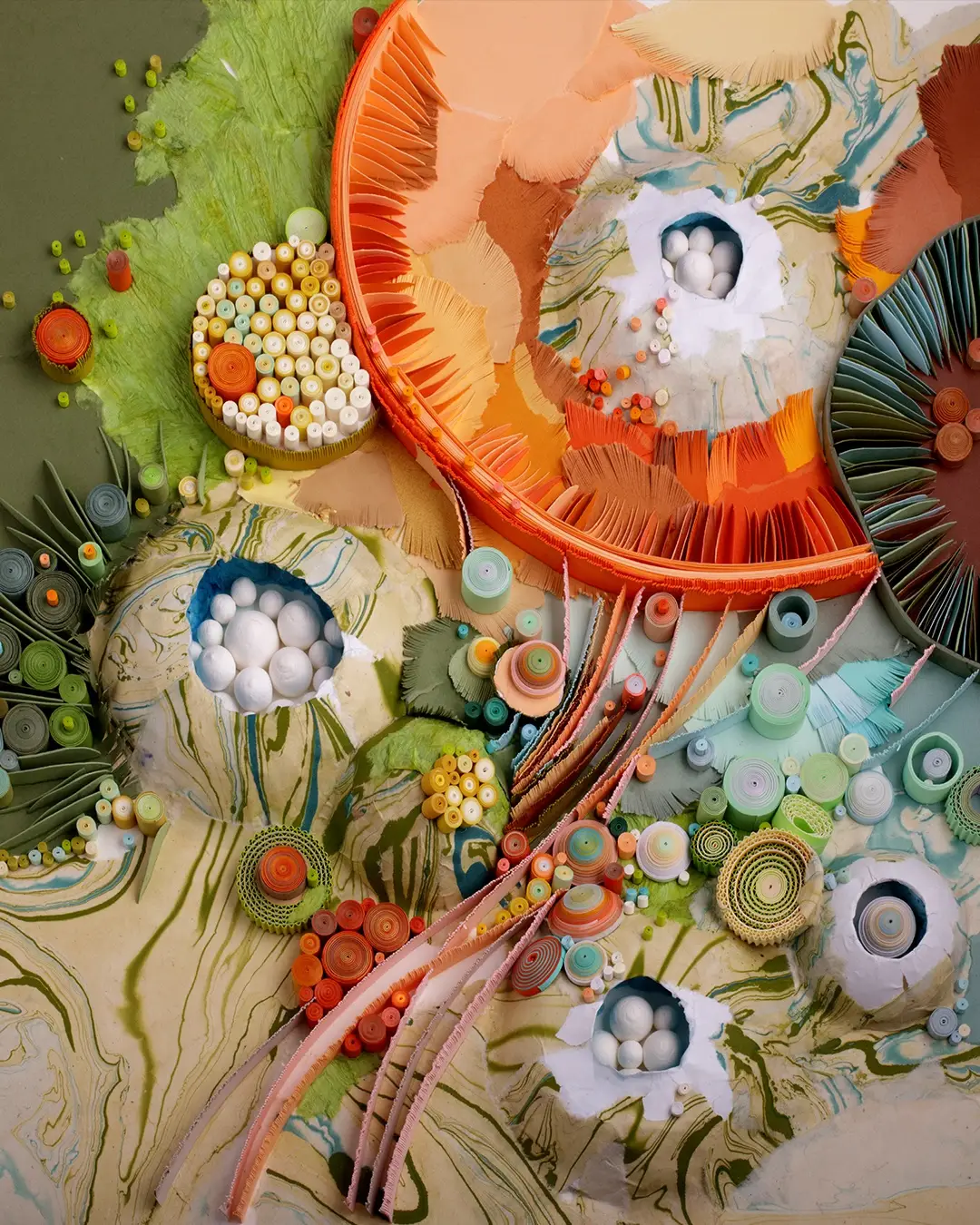
What’s in a name? In illustrator Yulia Brodskaya’s case, her name was instrumental in discovering her unique process of creating paper art. Reaching for a way to illustrate “Yulia” in a distinctive way, she saw the potential of paper as her signature expressive medium.

When was the first time that you remember realizing that you are a creative person?
My parents sent me to an art school when I was just about 6 years old, so I was head-deep involved in creative art practices long before I gained any conscious realisations; I grew up thinking that creativity is an integral part of life, that’s how it is supposed to be.
How long have you been creating paper art? How did you get started?
I always had a special fascination for paper as a material, but I studied Graphic Design and Illustration (I was advised that it is a good reliable option to make a living in the creative industries); I never thought that paper art would become my true passion.
As an Amazon Associate I earn from qualifying purchases. Read more about our affiliate linking policy.
About 10 years ago, I was mainly interested in creating hand-drawn illustrations, especially letterforms, and after working at them for a year or so I had put together a number of typographic designs good enough, in my opinion, to get me editorial commissions from magazines and newspapers.
My idea was to make a little self-promotional booklet featuring some of these designs and send it out to potential clients. The crucial thing that was missing was an eye-catching cover image that would make certain my booklet would be noticed. I decided that it had to be my name illustrated and featured on the cover. I created several hand-drawn versions of my name—Yulia— but none of them seemed to be good enough, so I discarded them.
At some point, somehow, the idea to cut a sheet of card into strips came to my mind, and I began gluing these strips edges down, repeating the letter outlines. As soon as the ‘Yulia’ paper design was ready, I realised that I’m onto something very exciting, I immediately dropped the illustrative booklet idea and instead immersed myself into this new world of paper.

How is your process of paper art different from traditional quilling? How is it like painting? What makes your work stand out as yours?
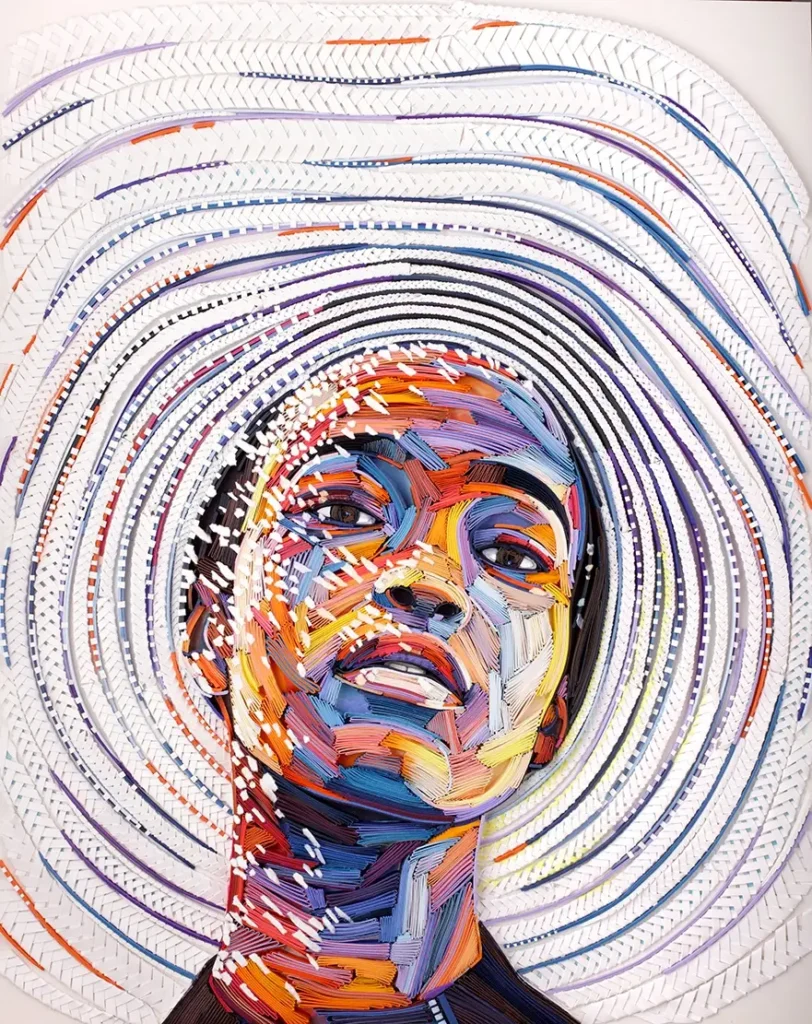
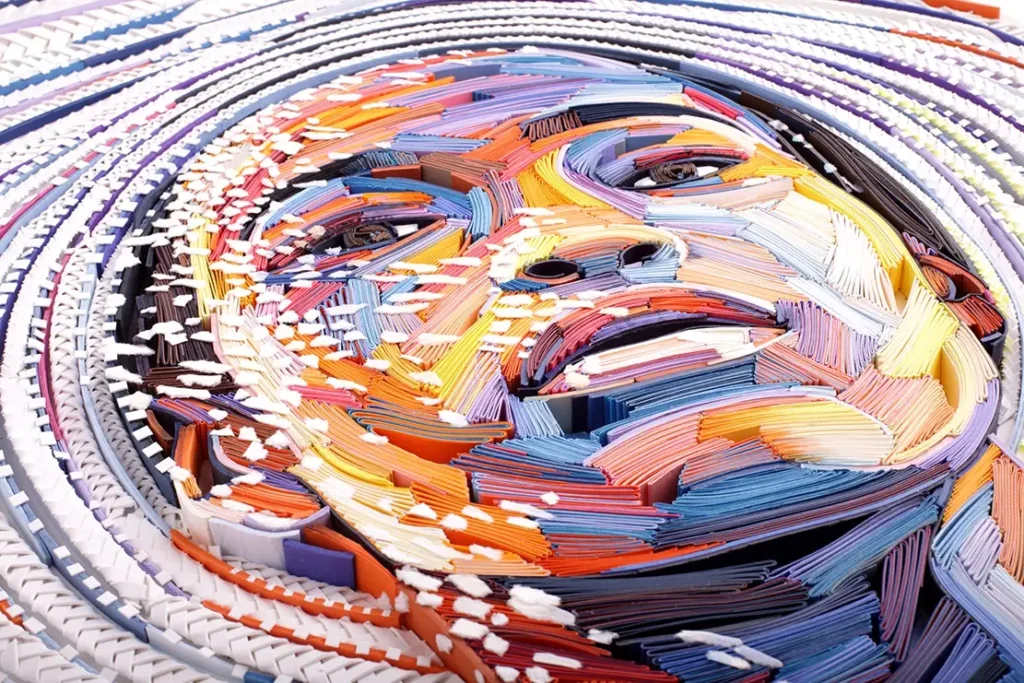
With my first paper artwork ‘Yulia’, I, unknowingly, invented Quilling from scratch for myself. (I never even heard the term Quilling before my work started to appear on the Internet). It turned out that my method is not really the same as traditional Quilling: the key difference is that I use heavy paper or card which I shape and manipulate any way I want to, as if I’m drawing or painting with paper strips (instead of rolling thin paper into basic shapes).

What is the most important takeaway you want readers to gain from your book, Painting with Paper: Painting on the Edge?
In my new book Painting with Paper: Paper on the Edge I share everything I’ve learned (and, of course, continue learning) about quilling and paper art. This is not a project-based book, but instead an insight into my creative process with practical tips on how to work with my methods in various ways of your own.
What I’m trying to encourage through sharing my experience and practical advice is creative freedom. We create in order to feel joy from making something beautiful with our own hands; this feeling of joy is many times stronger when you create art inspired by something that moves you deeply as a person. That’s why it is important not to get stuck and develop a habit of always needing somebody else to outline and plan every creative decision for you. The real unique creativity comes from inside when you find the courage and learn to make your own decisions (and, sometimes, mistakes), but ultimately create the art that is a unique expression of yourself rather than a replica of somebody else’s vision. This book will provide you with tools needed to advance your creative thinking and find your distinctive creative voice.


What inspires you? Are there recurring themes in your work? Do you do series work? How does that affect your approach?
Nature is my infinite source of inspiration whether I’m looking what to depict or just need a visual reference for choosing a colour palette.
My current interest lies in conveying a deeper emotional complexity in paper artworks. I feel a new urge in choosing my subject matter, so it feels that depicting just a beautiful flower, a pretty shell, or a decorative wave on its own is simply ‘not enough’… A human presence is needed to deepen the visual experience, the feel & emotional charge coming from the artwork, so I end up combining the natural motifs with human faces (ultimately, we all are part of nature).

Do you form an emotional connection with your subject matter?
There is no other way to create in my eyes… Even when I work on commercial projects (e.g. typography based), every colour or composition choice I make comes from the need to create the best design possible, with all elements balanced and in harmony.
Personal self-initiated projects evoke much deeper connection of course; I invest all my energy and care about every artwork I happen to work on at some particular moment.

When it comes to creating, are you more of a planner or an improviser? How do you make the leap from an idea in your head to the art you produce?
I balance both sides: in the beginning I create detailed sketches trying to plan ahead as much as possible, however once the actual paper work starts, an improviser side comes into the picture.
It is not possible to predict exactly how a 3D artwork will look, so I have to keep an open mind, observe the developing artwork, and adjust to its current state instead of pushing the initial plan forward no matter what.
Sketch is like a map that is always handy at times when you lose your way and need help to get back to the right path, but a map never shows you every single step that you have to take to reach your destination. Once you arrive, you will discover what your destination (=finished artwork) actually looks like.

Do you have a dedicated space for creating? If so, what does it look like?
Ten years ago, I started working on my kitchen/dining table (it was the only table in the rental flat where my husband and I used to live), so, daily, I would move paper artworks and materials aside to clear the space for plates and cutlery. Nowadays I have a nice and bright studio loft dedicated solely to my paper art, I enjoy it tremendously.
What are the indispensable tools and materials in your studio? How do they improve your work? What is your favorite lesser-known tool for your trade? Have you taken something designed for another use and repurposed it for your studio?
It is all about paper; I buy and collect paper from everywhere in search for as many colour varieties as possible, so most of the storage space contains full size sheets of paper, paper cut into strips (in most cases I cut paper by hand) and paper strips rolled into different circles. Instead of quilling tools I use a firm cocktail straw (to curl and shape paper) and wooden toothpicks to roll circles or coils, also there are many bottles of PVA glue in my studio.


Do you work actively on more than one project at a time?
Usually I prefer to fully complete one project before starting a new one. However I do work on multiple sketches at the same time, so I usually have several new ideas and projects already waiting for me to execute in paper while finishing a current artwork.
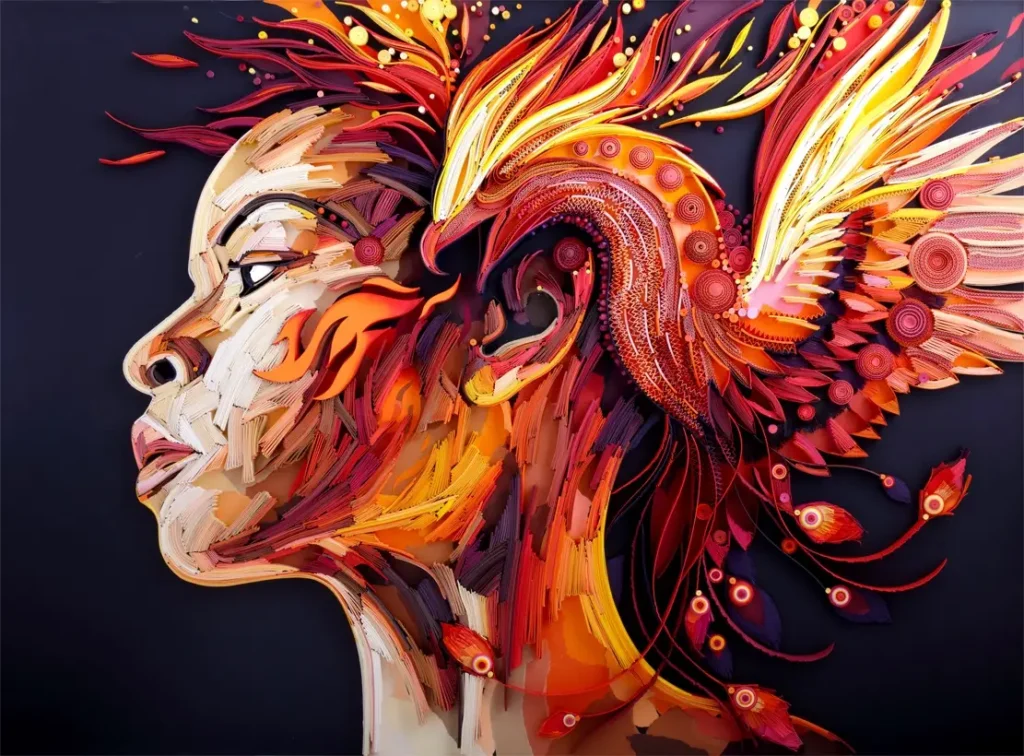
You have recently begun to incorporate thread and stitching into your paper-based practice. What sparked this addition?
To be honest, I sensed that embroidery would eventually become “the thing” not long after I discovered my own way of paper quilling and working with paper strips, about sixteen years ago.
While I was designing paper illustrations and lettering, I could often envision many of those ideas translated into thread instead. However, needles and thread never felt like my natural materials of choice, so I didn’t take any concrete steps toward realizing those imagined designs at the time.
I simply felt that embroidery held vast creative potential and that, sooner or later, it would experience a revival similar to the one papercraft was going through—one that I was very much a part of back then.
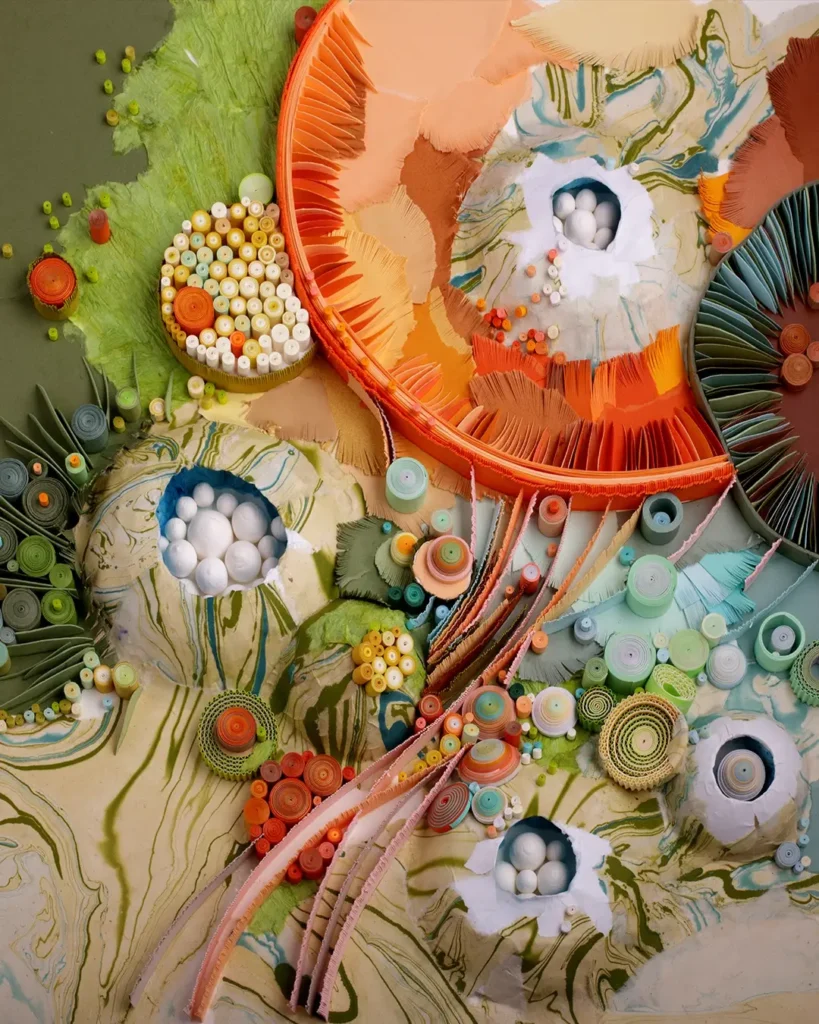
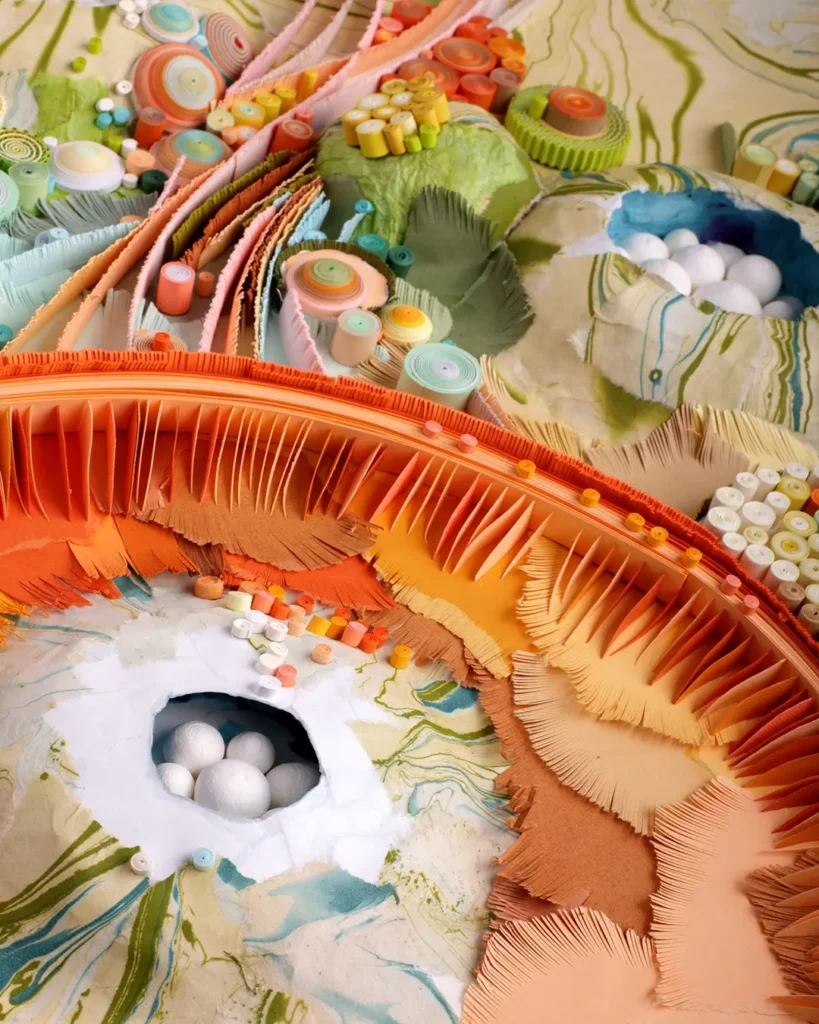
How does working with thread differ from quilling in terms of rhythm, patience, and physical engagement?
The material I pierce with a needle is still paper—albeit a heavy, 100% cotton paper that allows more flexibility than standard paper or card. I can cut it into thin strips, braid it, and manipulate it in ways that would be impossible with most papers, but it is still far removed from fabric in its properties.
Because of that, I don’t really “stitch” large areas in my designs. When I want to incorporate surfaces covered in thread, I just glue the threads down with PVA instead—a bit of a shortcut, perhaps, but one that feels very natural within a paper-based practice where I use glue for everything.
Has the introduction of stitching shifted your subject matter, narrative focus, or emotional tone in your artworks? If so, how?
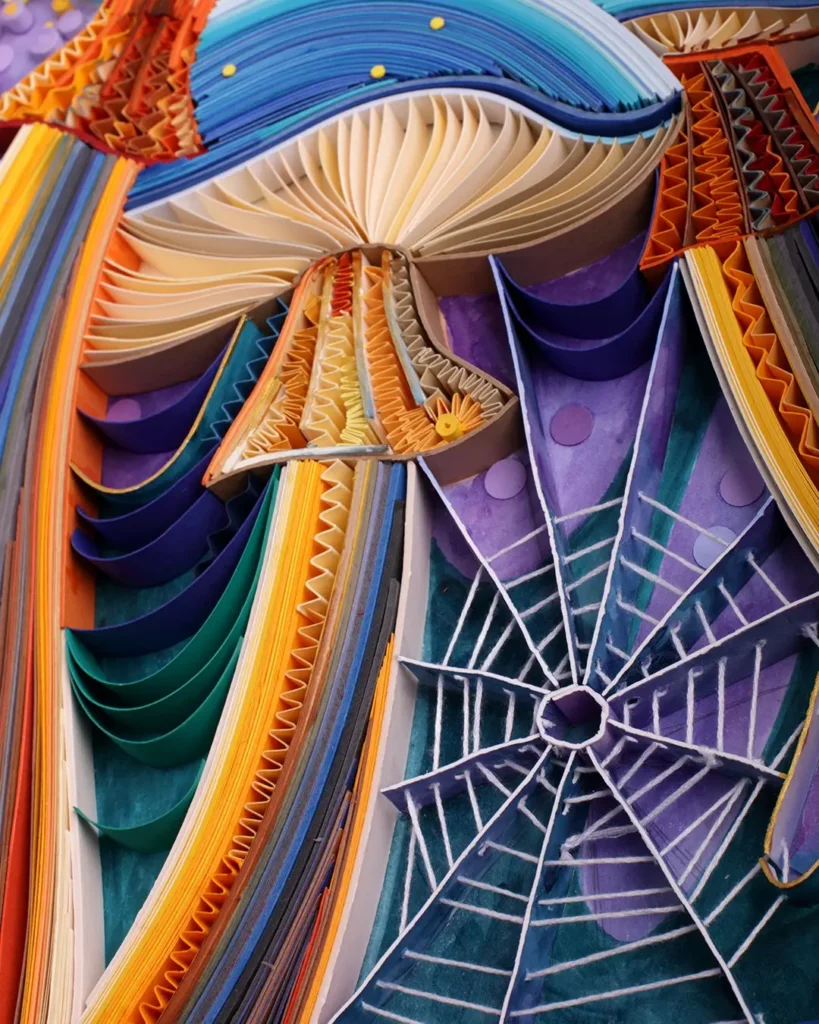
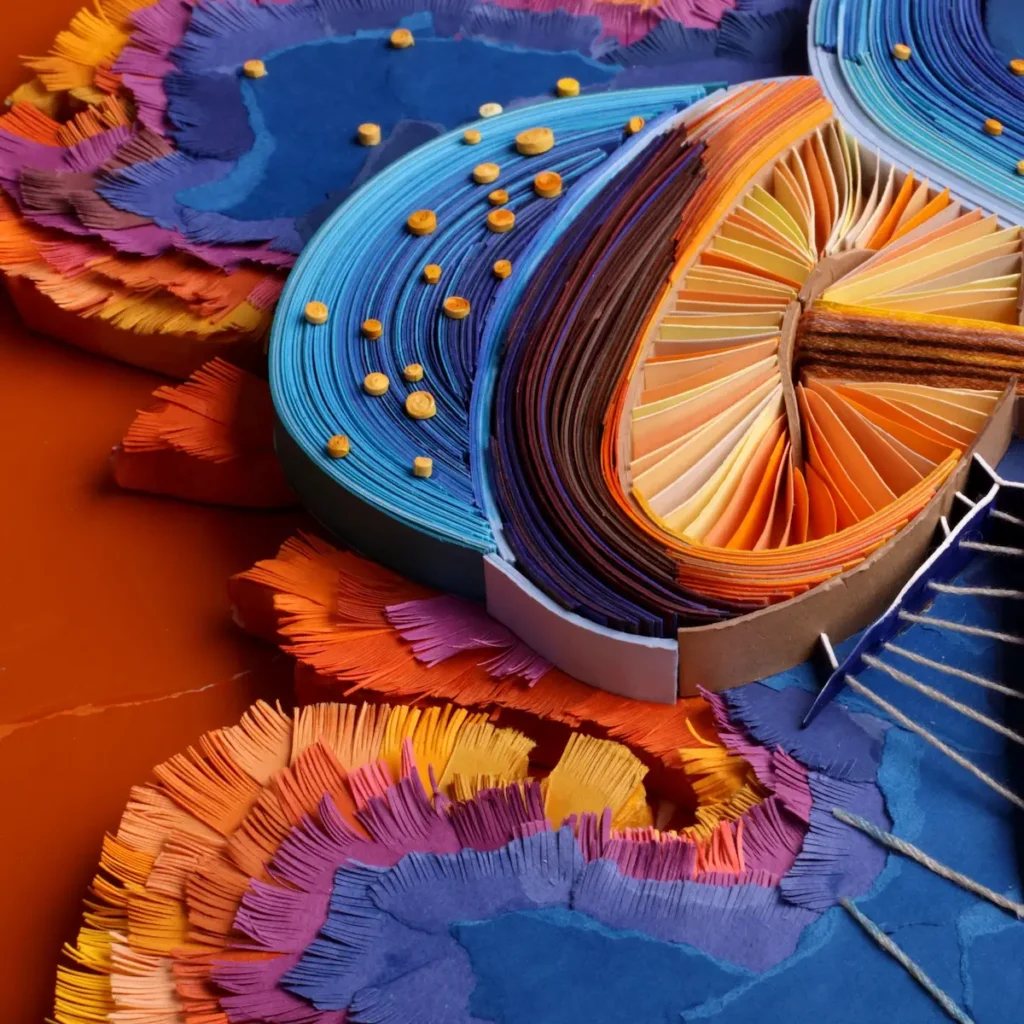
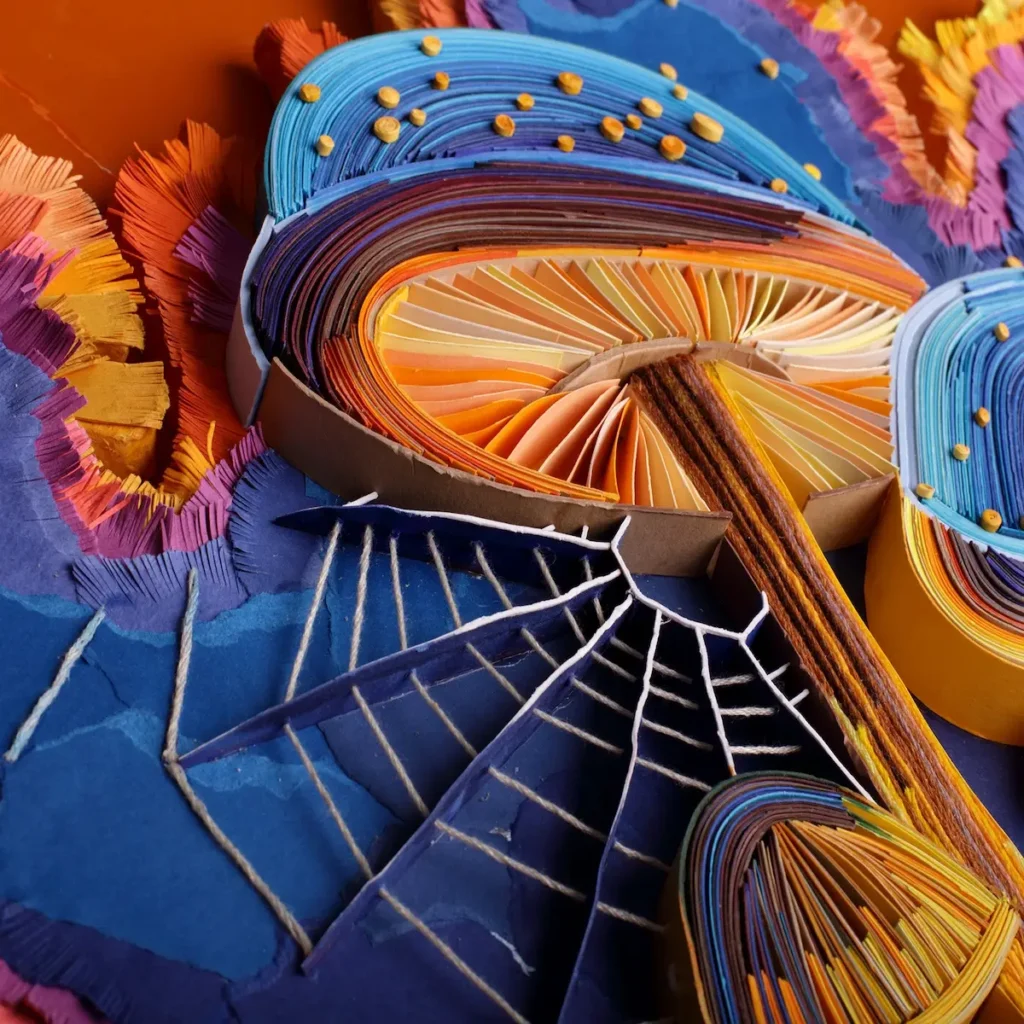
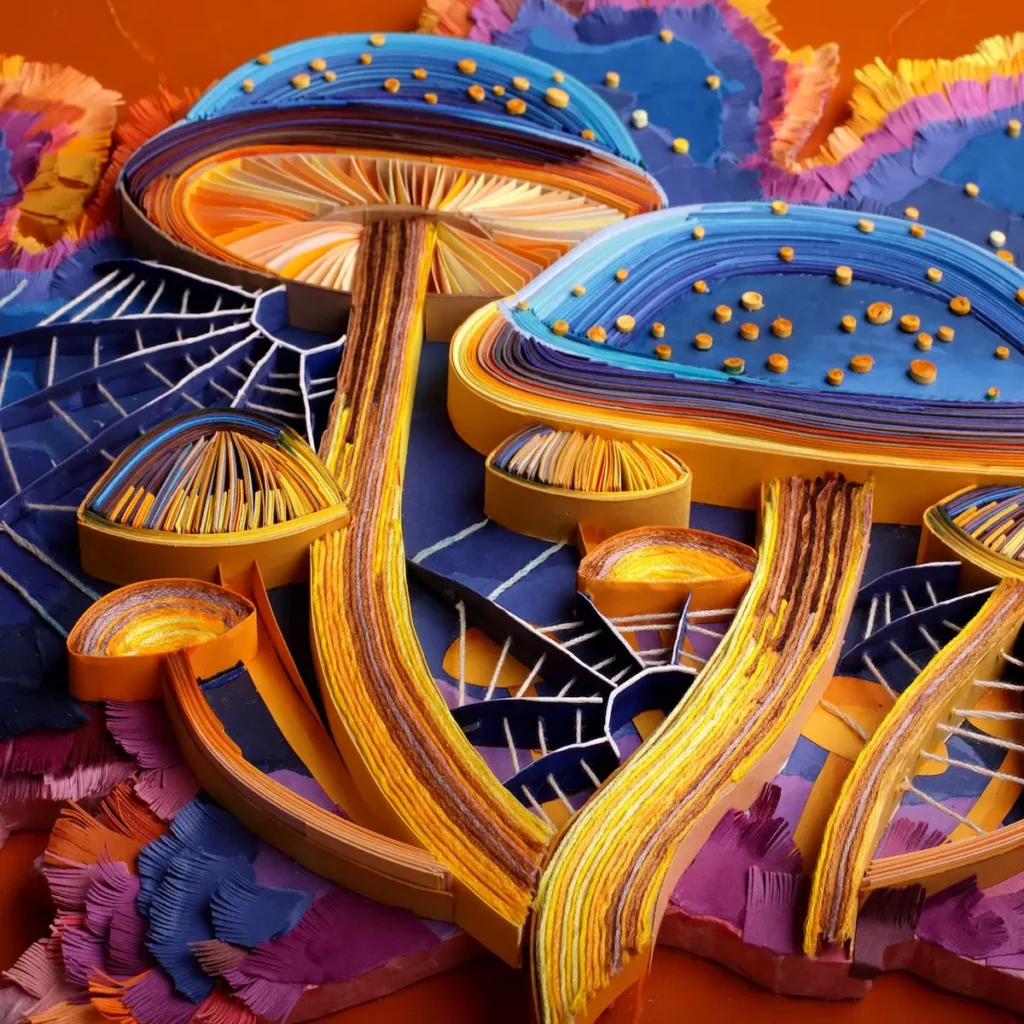
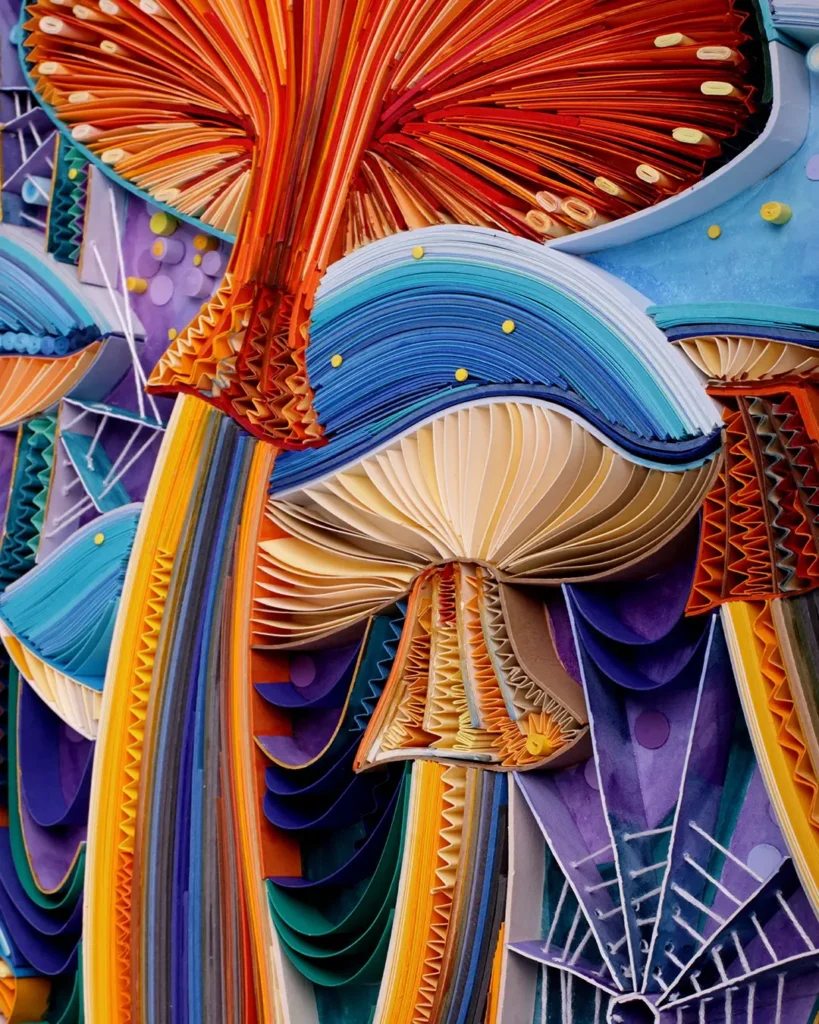
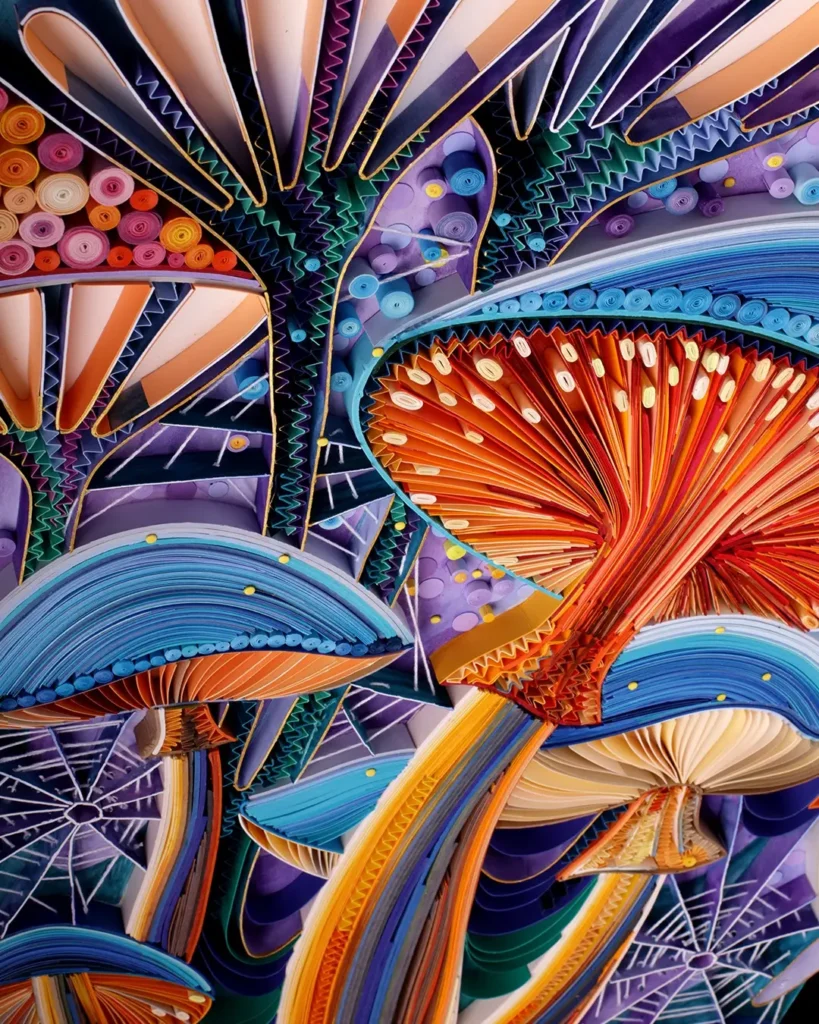
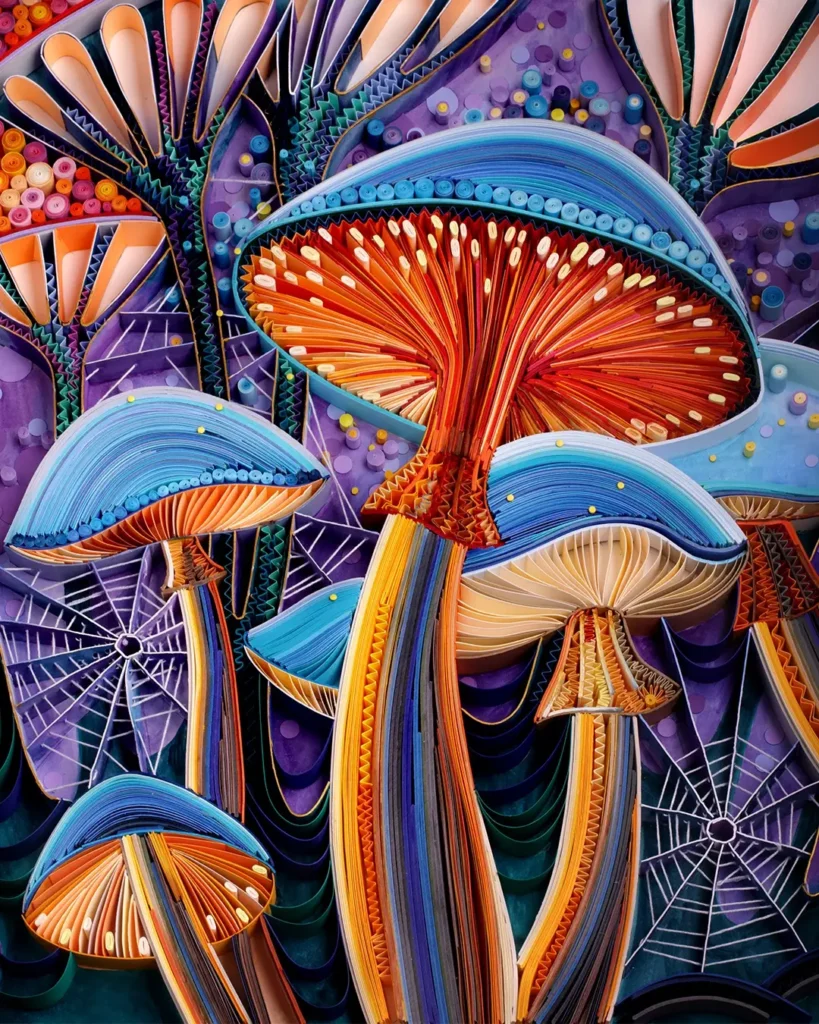
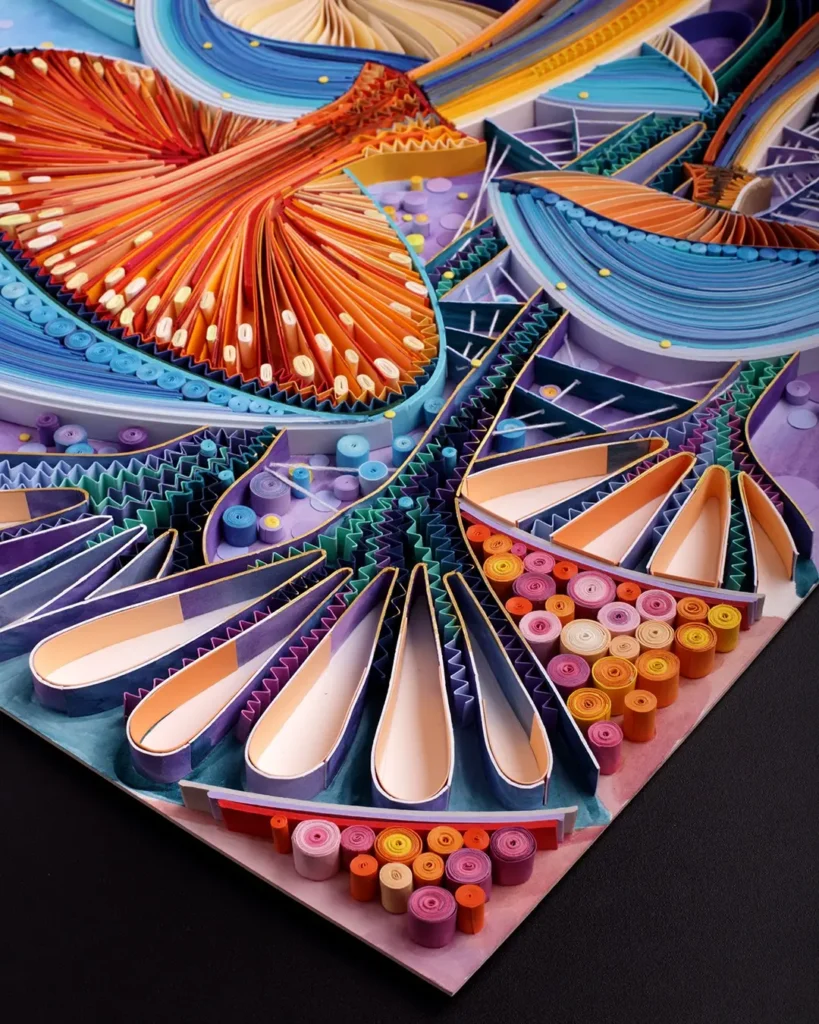
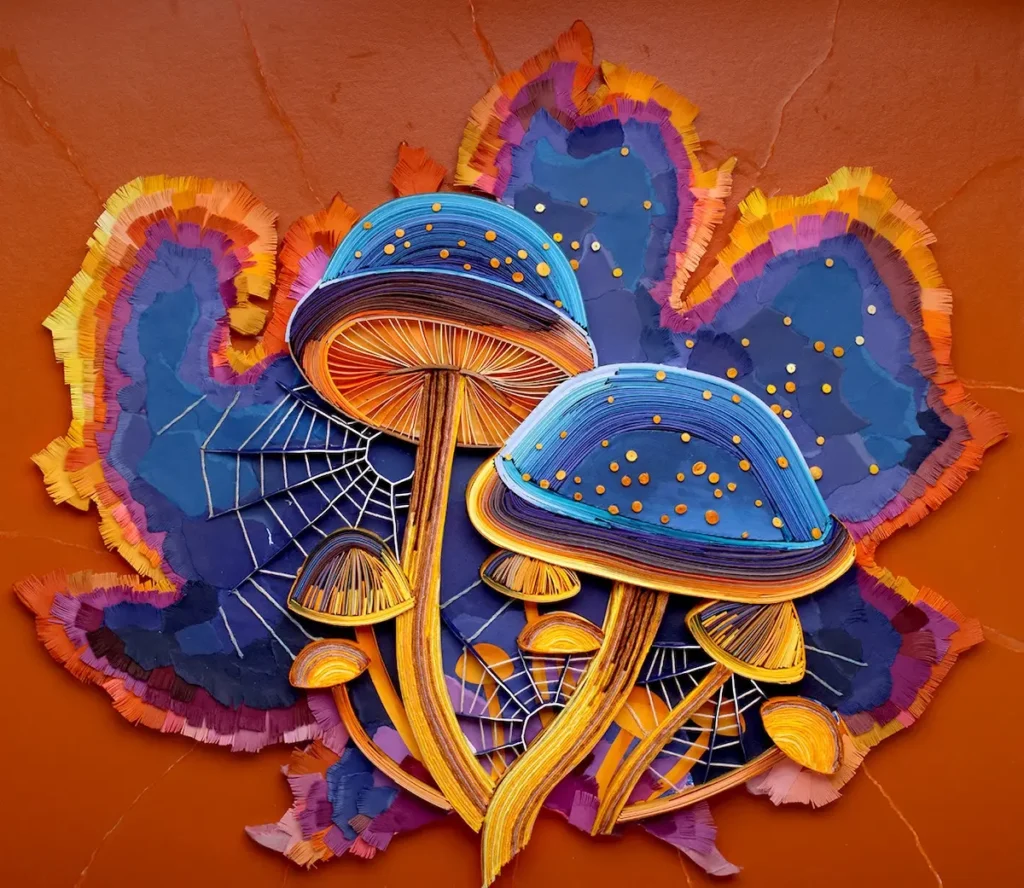
It has definitely introduced an element of whimsy. So far, I’ve only used threads in two artworks, both depicting fantasy forest-floor scenes with mushrooms.
The main element that pushed me toward thread was the spider web—I wanted it to feel more realistic than anything I could achieve using paper strips alone. Thread allowed me to capture that delicate, almost magical quality in a way that felt convincing and emotionally fitting for those scenes.
What challenges have you encountered while integrating threadwork with paper, and how have those shaped your creative decisions?
There were certainly technical challenges, especially when constructing the spider webs. I first glued a base structure of radiating paper strips and then attempted to spiral a thread through them to build the web. Very quickly, I realized I couldn’t get a needle through the narrow gaps between the edge-glued strips.
To solve this, I curved my needle to gain more flexibility—I believe shoemakers use curved needles for tight or enclosed spaces, so I borrowed that idea.
Even then, some areas remained inaccessible, which led me to develop a method of punching holes in the paper strips in advance. This allowed me to avoid piercing the heavy paper where precision and space were limited, and only pierce from scratch where the needle could move freely.
Another challenge was hiding the starting and finishing knots so they wouldn’t distract the eye. That forced me to plan the process very carefully and establish a clear order of operations. For example, I would outline the mushrooms with edge-glued strips, but delay filling them in until after the spider webs were complete, so I could later cover any threadwork I didn’t want to remain visible.
How has your view of surface versus structure evolved as you move from paper quills to stitched elements?
One thing I’ve come to appreciate through these experiments is how warm and comforting thread feels in comparison to paper. When I glue thread onto raised surfaces—such as mushroom stems built up with foam board underneath—it introduces a new type of texture that complements the paper textures I already work with. It adds a tactile softness that enhances the three-dimensional quality of the piece and makes the work especially pleasant to touch.
I see strong potential for thread as a supporting material within my signature “painting with paper” approach, where I imitate brushstrokes using tightly folded paper strips to bring painting into the third dimension.
I currently teach this method through an online course, and I’m in the process of developing the next-level course focused specifically on portrait work. I’m excited to continue exploring how thread and paper can be combined within this framework and to share the results of that exploration in the future.

How has your work changed over time? Tell us about a challenging piece. What were the obstacles and how did you get past them?
The evolution was substantial. Sometimes I can hardly believe it myself, but I can’t explain it here properly. The best way to understand my journey is to read my book. It also covers the challenges and obstacles that I had to (or still need to) overcome in my art practice.

Do you think that creativity is part of human nature or is it something that must be nurtured and learned?
I believe creativity is inherent in human beings, but gets obscured by all the superficial activity of the mind, daily worries and problems. We don’t need to learn creativity, but we need to learn how to access it within ourselves.
Over the years I learned that I can’t create and work productively when I’m stressed and consumed by something that is going on in my life; the only way is to put endless stream of thoughts aside and concentrate on the present moment of holding a strip of paper, feeling its texture, shaping it, gluing into place, then observing the art in progress – just looking and paying full attention to it… and so on and on, one little step at a time. Of course, thoughts will always creep in, but it is exactly like meditation: when you notice the mind gets absorbed into worries, you bring it back.
Once you learn to observe and pay full attention to the artwork, creativity starts to flow: all you do is look with a clear, open mind, and all of a sudden you get little ideas, you know what colour to use, where to place the next paper detail, and so on. With plenty of practice, this process becomes absolutely natural and truly joyful.

How do you deal with creativity blocks?
I don’t get creativity blocks anymore; once I learned to follow the process that I described above, they never came back. I do need breaks after working for a long time, but this a fatigue caused by prolonged concentration and physical tiredness rather than a true creative block.
Learn more about Yulia and her work.
Interview published December 2019, updated January 2026
Browse through more inspiring paper art on Create Whimsy.