
Theresa Benson didn’t set out to become “The AI Quilter.” A cranky customer once told her to find a hobby with a clear beginning, middle, and end, and that simple advice sent her down a colorful path into quilting. What started as uneven blocks and beginner mistakes slowly grew into something magical. Today, Theresa blends fabric, technology, and imagination in surprising ways, using artificial intelligence as a creative partner to help turn the ideas in her mind into bold, expressive quilts.
What first drew you to quilting? How does your background in electrical engineering and AI find its way into your artistic journey?
A cranky customer of mine, actually.
I was maybe a year out of college, in semiconductor technical sales, and I was at his office trying to sell him something. He started in on employees my age and said, “Theresa, get yourself a hobby with a clear beginning, middle, and end. Something you can keep growing with your whole life.”
His reasoning was pretty direct: for the last 18 years, you’ve gotten a gold star for everything. Graduated here, achieved there, constant feedback. That stops. If you’re good at your job, you get stuck doing the things you’re really good at, and you lose that feeling of moving from not knowing something through productive struggle and out the other side into mastery.
As an Amazon Associate I earn from qualifying purchases. Read more about our affiliate linking policy.
He did woodworking. Said there was something irreplaceable about starting with a chunk of raw wood and finishing with something real.
Around that same time, I discovered that it rains a lot in Portland, and that Portland has incredible fabric shops. I met someone roughly my age who quilted. I’d sewn as a child, so I thought… how hard could it be. (Insert all the laughter here.)
She and I would quilt together while watching the very first season of Survivor. My blocks were 5 inches, nothing lined up, and I could not figure out the quarter-inch seam to save my life, until someone finally told me there was a quarter-inch presser foot years later. But it was magical. It really was.
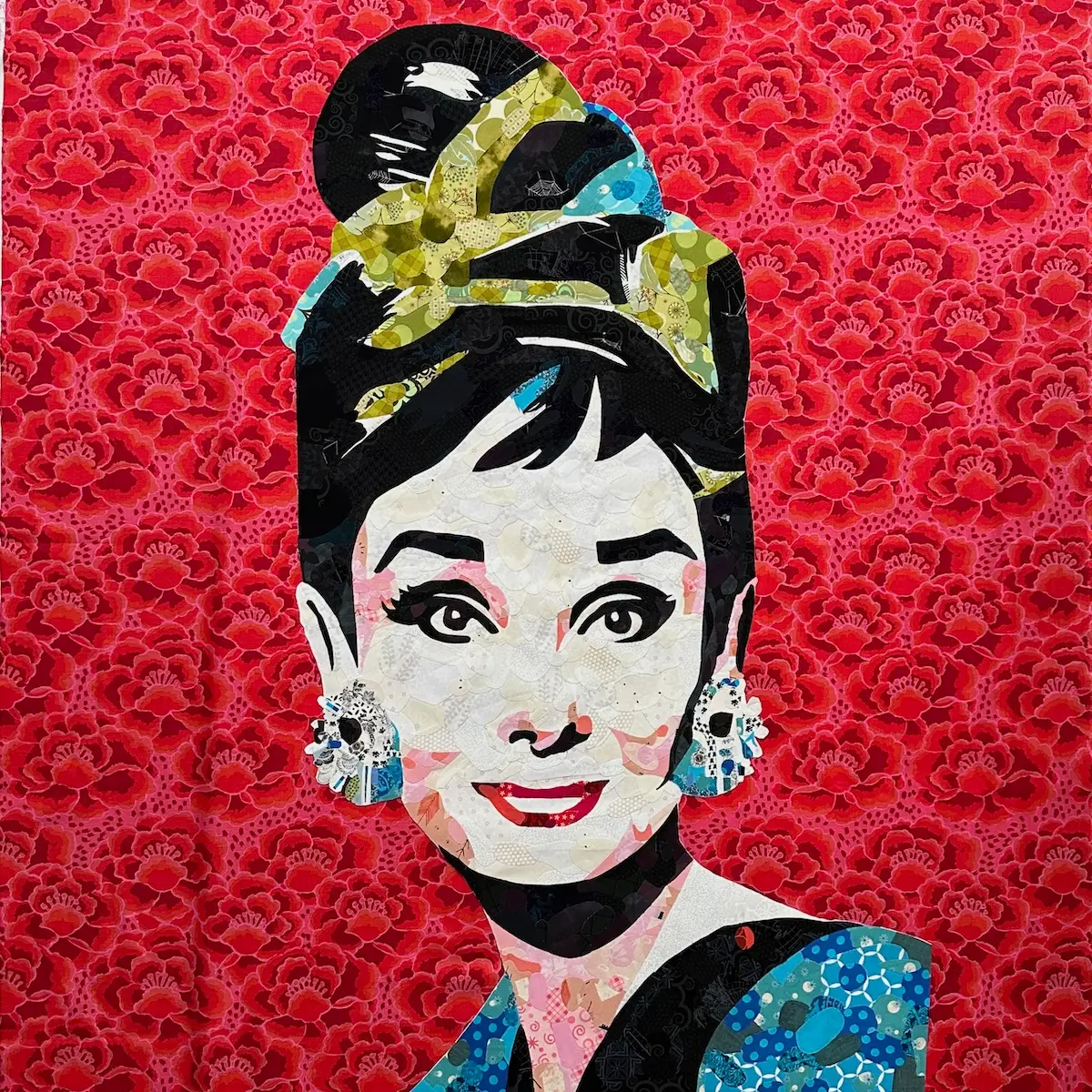
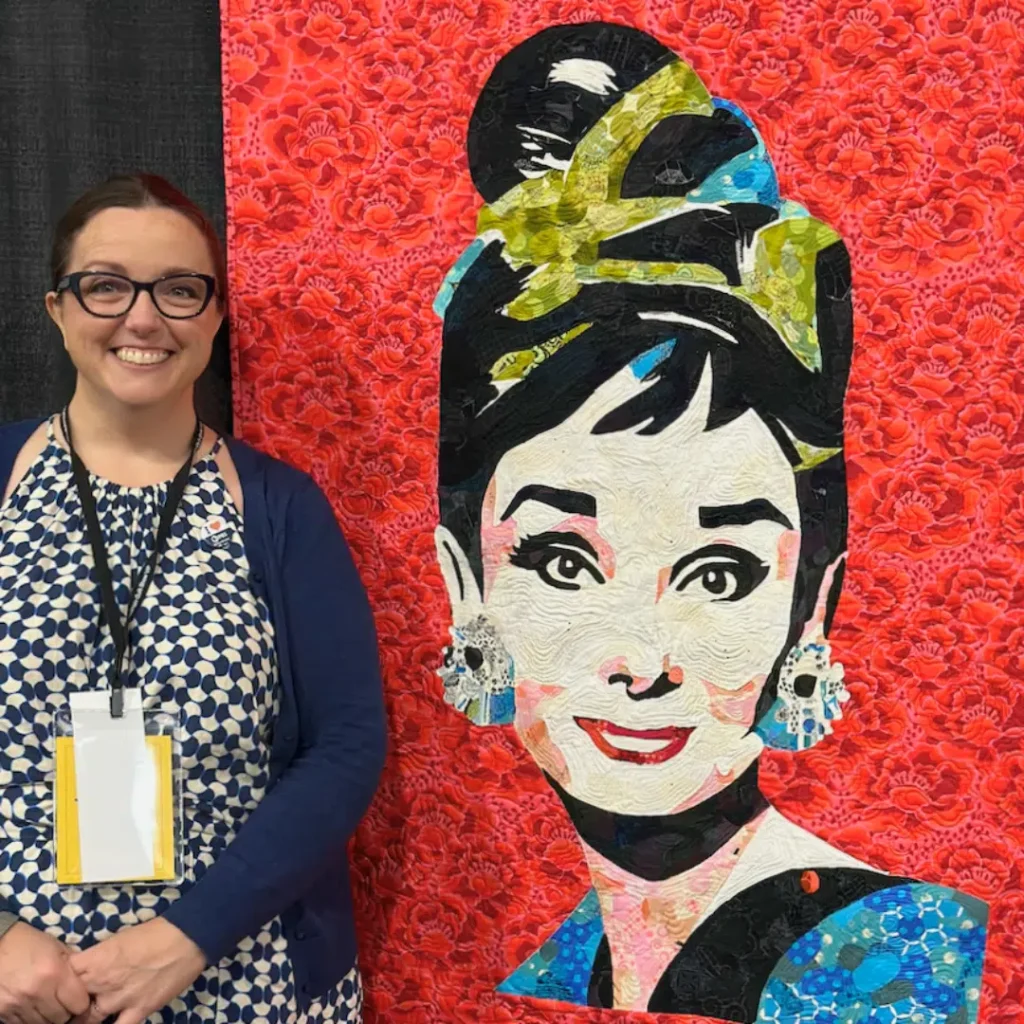
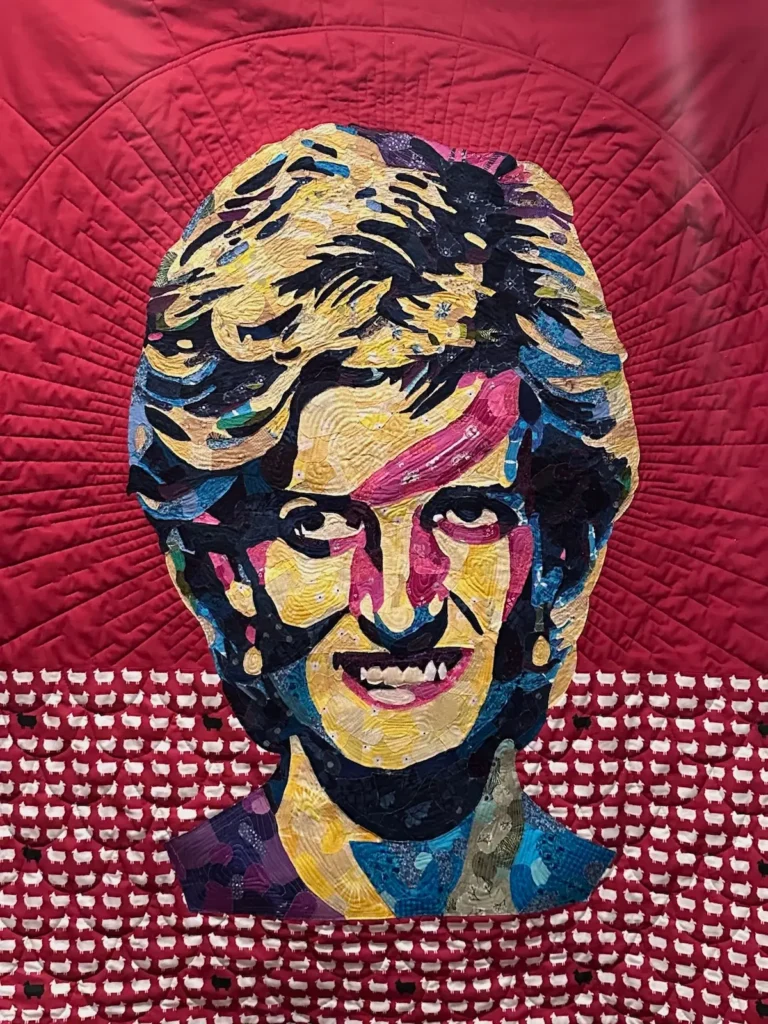
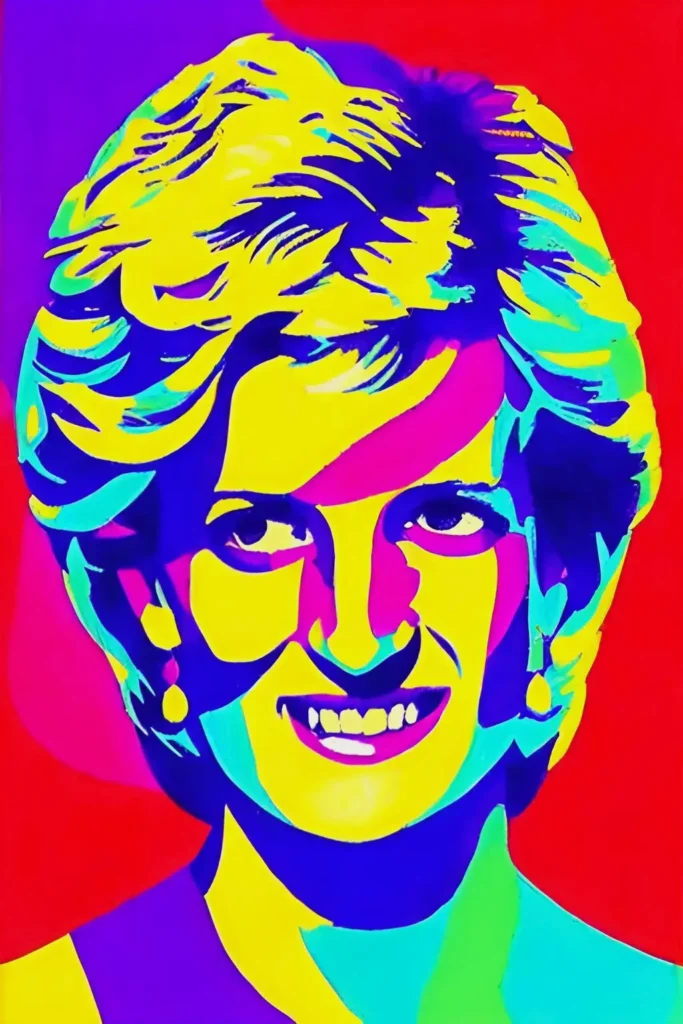
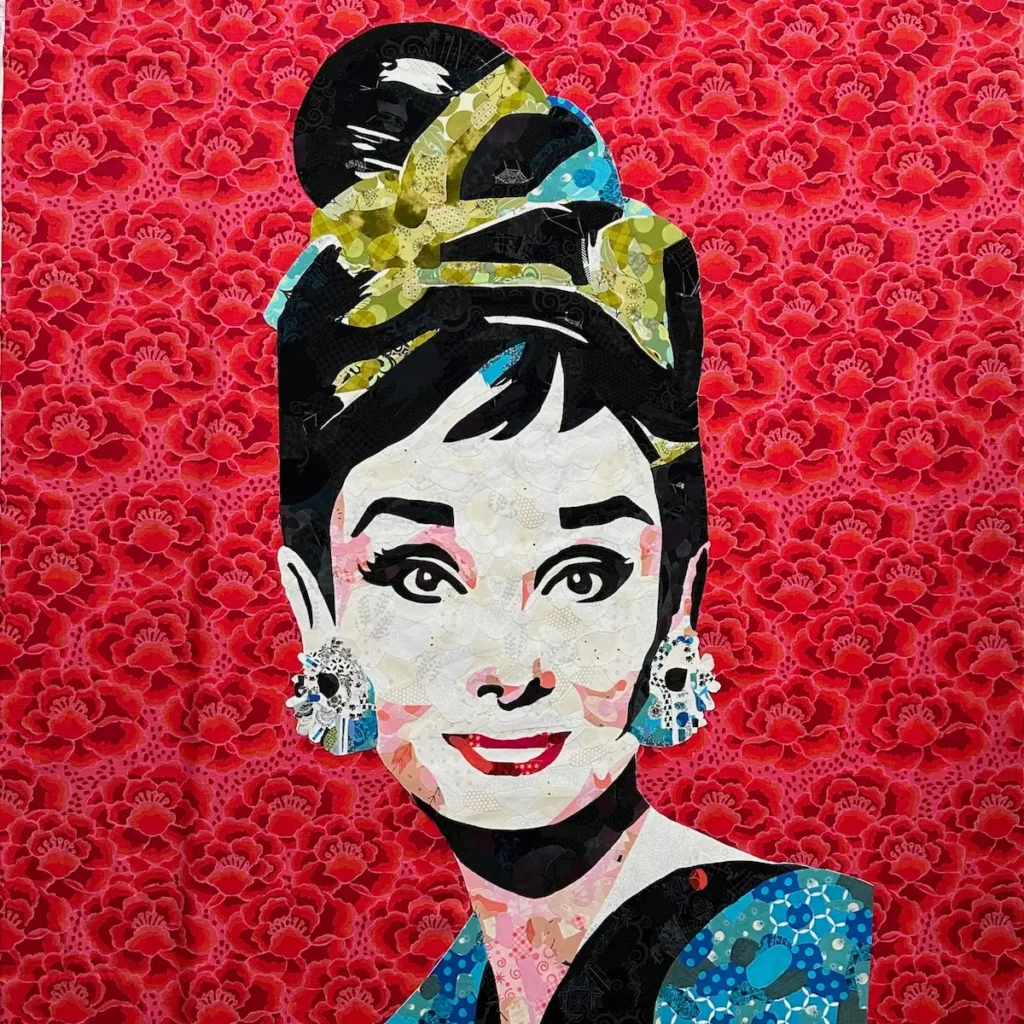
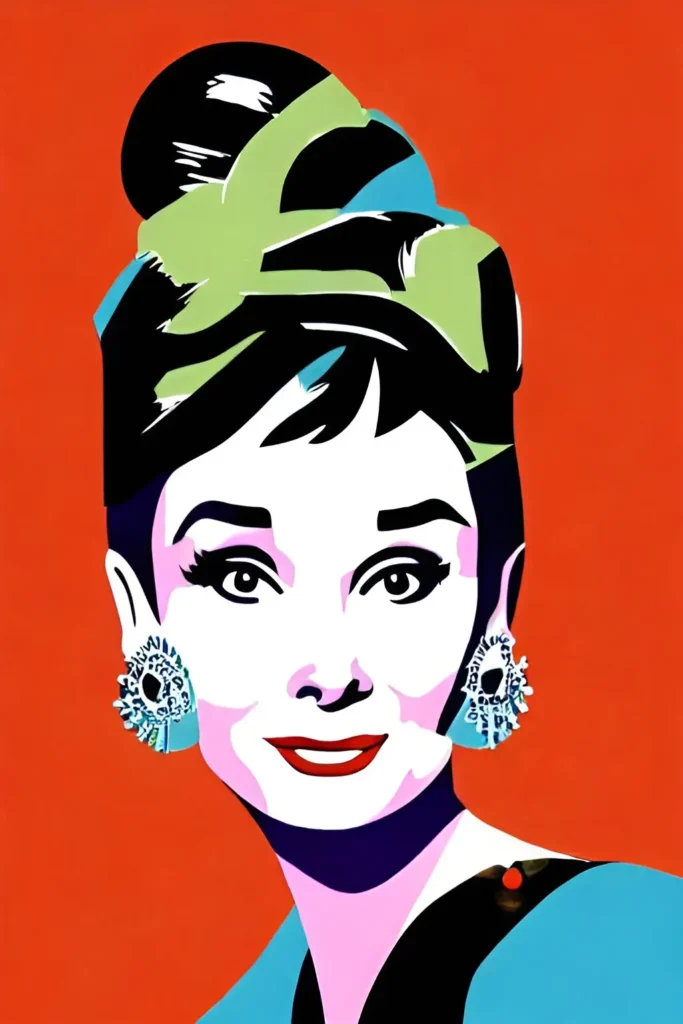
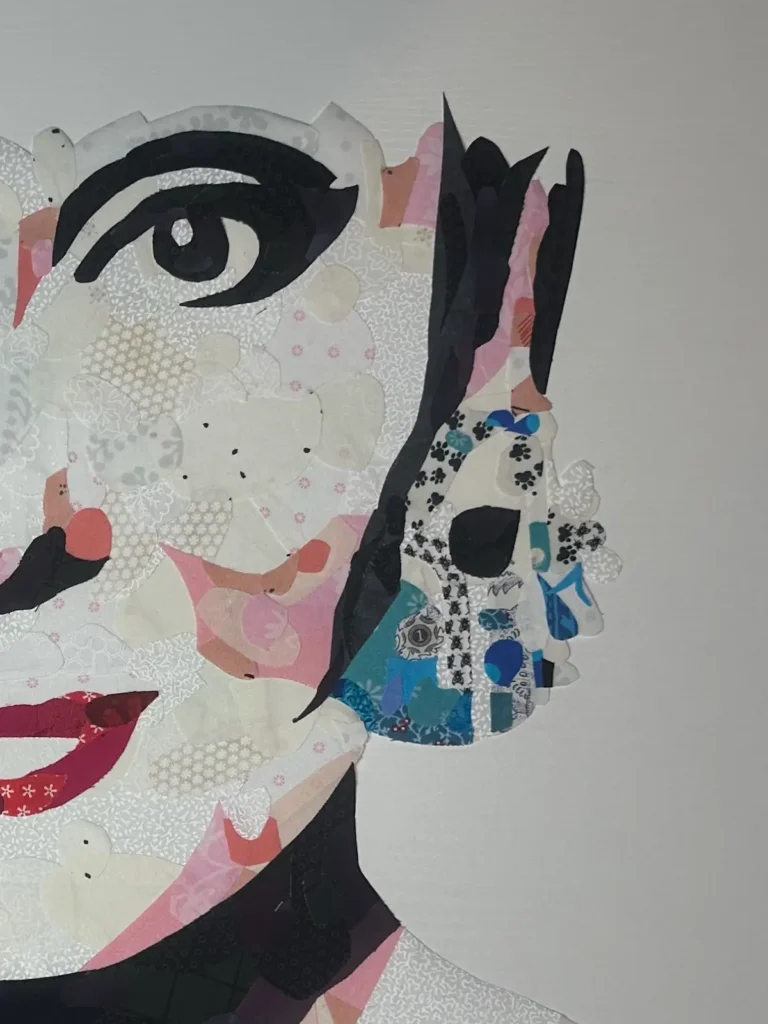
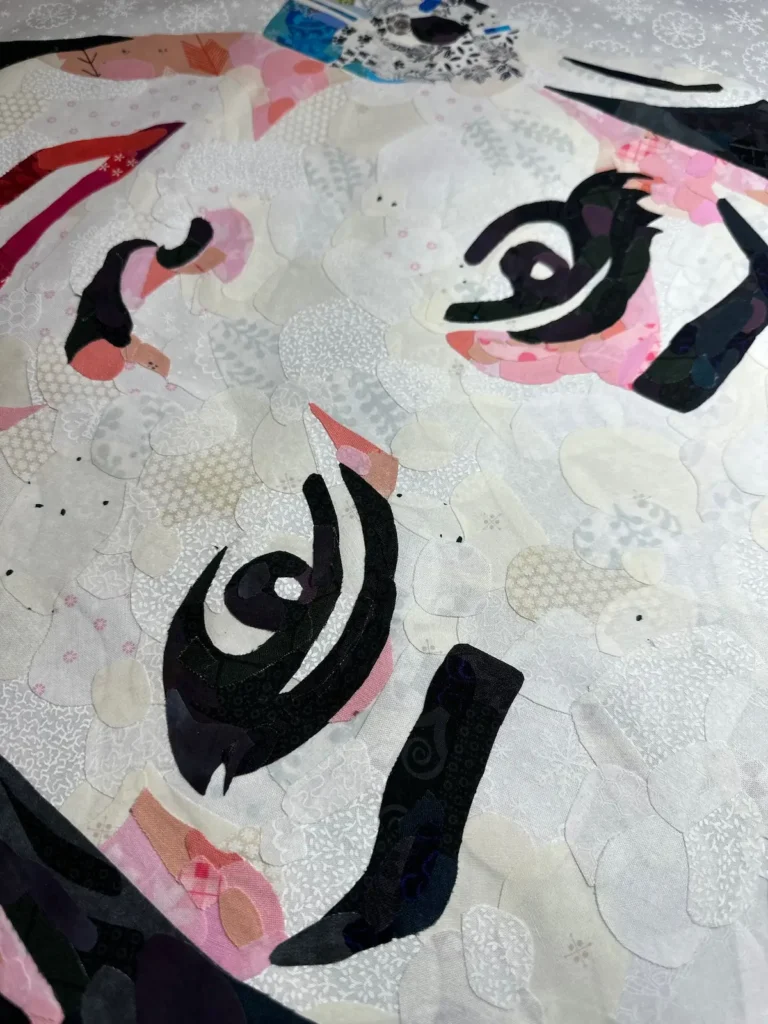
All these years later, what AI has done for me is let the ideas I’ve been carrying around in my head finally show up in fabric. A mashup of Princess Diana and David Bowie. An homage to Audrey Hepburn. Projects I wouldn’t have known how to start without a creative partner who could help me work through the design and color concepts first. That’s what AI is in my practice… not a replacement for the craft, but the thing that helped me finally see what was already there.
How did you come up with the name “The AI Quilter”?
Honestly, it’s pretty literal.
I have an electrical engineering background, I spent years working in the AI industry, and I’m a quilter. That’s just what I am.
I wish I had something wittier, but I spent all my cleverness on the name of my actual company, Radiant Meatball LLC, which is a much longer story. It tends to make people laugh, and I enjoy that.
For the brand, I figured the clearest name was the right one, since my whole thing is helping quilters and creatives at every level use technology like AI with confidence. The AI Quilter says exactly that.
Was there a moment when quilting and AI felt like they truly clicked for you?
I have always wanted to be an educator. If I’m being completely honest, I wanted to be a high school English teacher, not an electrical engineer. When other kids played house, I played school.
So throughout my semiconductor career, and later in marketing and leadership roles, I kept finding myself in the same position: the person helping others understand complex, systems-level concepts in plain language. That’s just where I land.
When generative AI started emerging, I did what I do… I went through the whole cycle. Not knowing anything, productive struggle, understanding, and eventually some mastery. And somewhere in that process I realized I could create images straight out of my imagination, in ways I had never been able to before, no matter how hard I’d tried.
That’s when it clicked. Because I thought… I can finally express the ideas that have been living in my head, in fabric. All I need is the design inspiration, which comes from the heart, and a way to communicate it to and through AI.
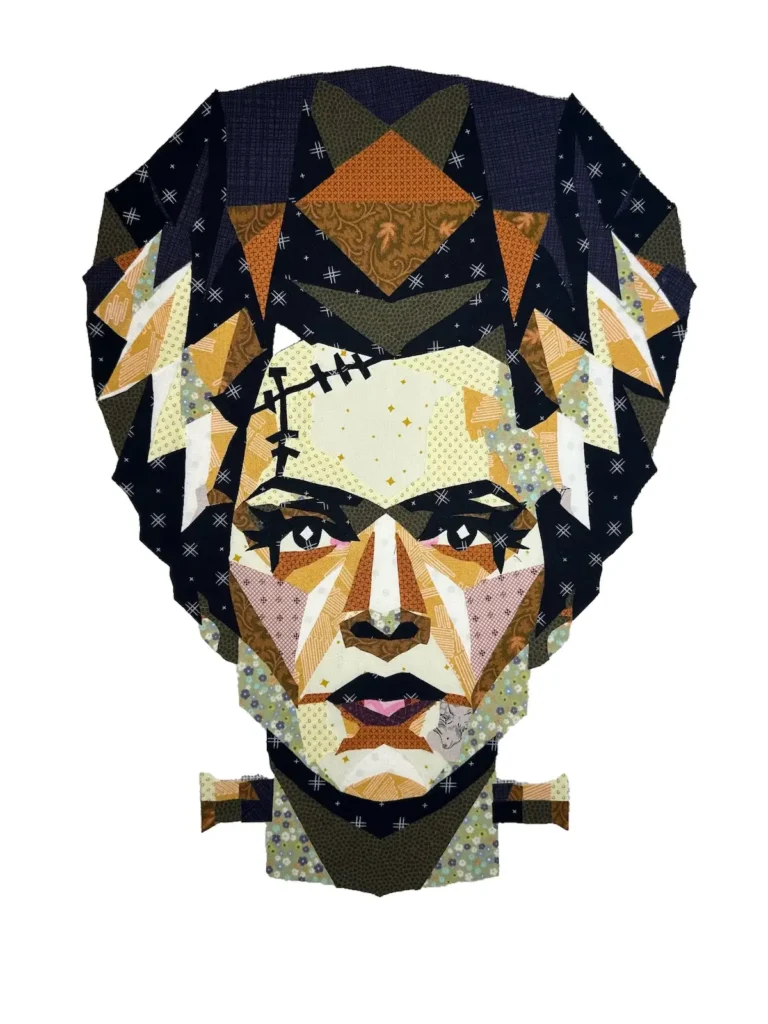
So I made the David Bowie and Princess Diana mashup quilt. And then I thought: I can’t keep this to myself. I’m an educator first. I have to share what I’ve figured out.
I started with patterns, because patterns solve one part of the problem. Then I realized patterns weren’t enough, so I wrote a book. Digital Muse: Bringing AI Into Your Creative Process gets into how I think about language when I’m talking to a computer, why that matters, and how to build a process that’s actually yours.
What brings me the most joy is watching someone break through the wall of believing they can’t learn something big and new. Especially something that feels as intimidating as artificial intelligence. That moment of breakthrough… I get to play even a tiny part in that, and it means everything.
Oh, and before any of that: my very first AI-generated images were a sidewalk made entirely of cookies, and then a peanut butter world. After that came Marge Simpson if she’d been alive during the reign of Marie Antoinette. I think that tells you most of what you need to know about my brain.
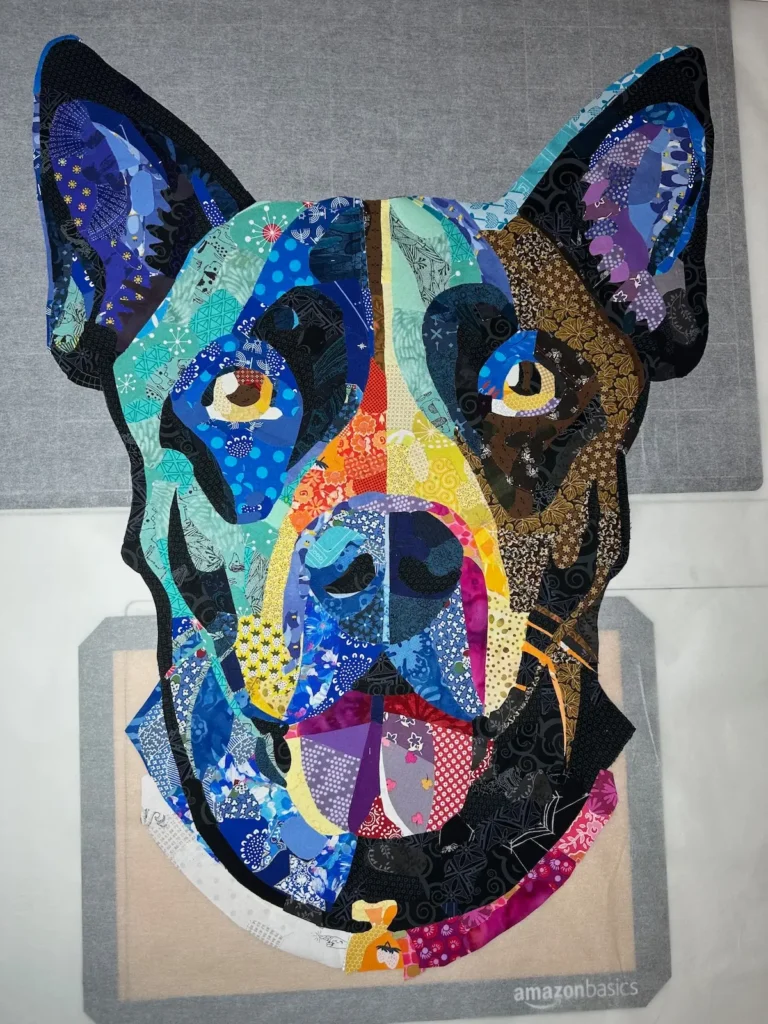
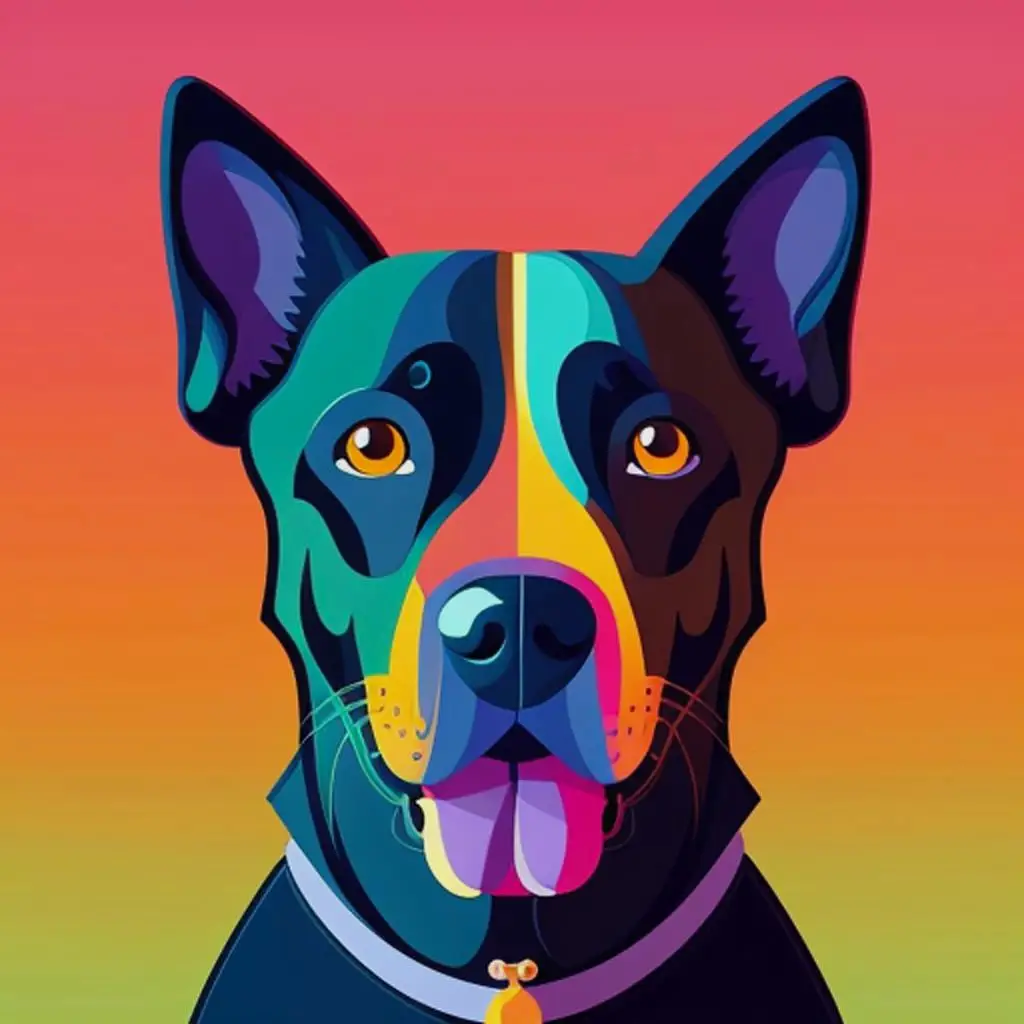
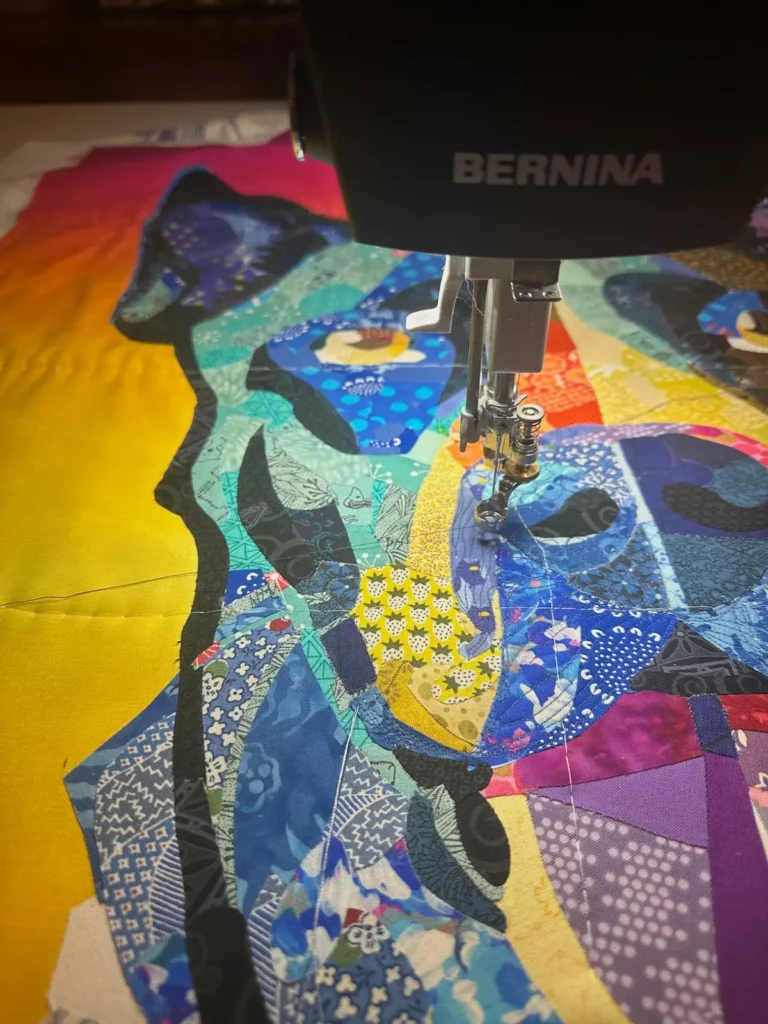
What’s your “commando appliqué” approach? How does it marry digital design with tactile fabric play?
It started with a series of mistakes, honestly.
When I first got into collage quilts, inspired by artists like Bisa Butler and quilters like Laura Heine and Emily Taylor, I walked into a vendor booth and came out with more stabilizer than I will ever use in my lifetime. I wasn’t bamboozled exactly… I just remembered from my very first job at a fabric store that appliqué required stabilizer, and this guy was really good at his job.
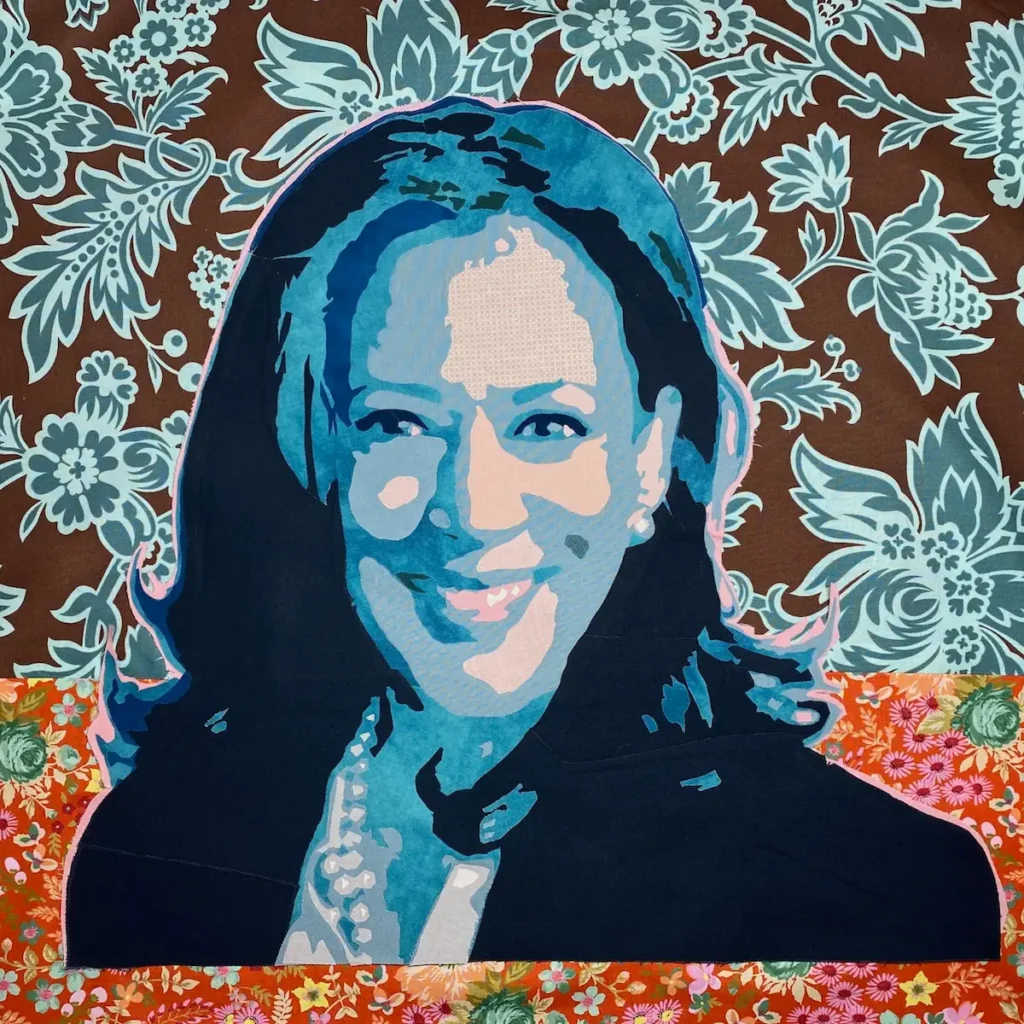
My first collage quilt was a portrait of Kamala Harris for Women’s History Month, the year after her election as Vice President. I learned a lot on that project, including that I was probably using about three times more stabilizer than I needed.
For the David Bowie/Princess Diana piece, I’d started exploring AI more seriously for design concepts, and I wanted to try a different approach. I bought Emily Taylor’s book, watched some videos, and then did what I do… I leapt before I looked. Specifically, I did not pay close enough attention to which fabric adhesive she was using. I had Heat’n Bond on hand, so I used that, working on parchment paper the way I’d seen her do it.
Here’s the thing about Heat’n Bond: when you apply heat, it bonds. Enthusiastically. Permanently. To whatever is nearby, including parchment paper. There will always be parchment paper somewhere inside that quilt. Always.
So I’d tried stabilizer. I’d tried parchment paper. Then I learned about Swedish pattern paper, which was better but still somewhat opaque, and I was struggling to see how my composition was coming together.
Then I took a class with Marina Landi and discovered Lite Steam-A-Seam 2. It’s a double-sided fusible that behaves like a sticker… tacky enough to reposition, but it won’t permanently bond until you apply heat. That distinction changed everything for me.
Around the same time, I got a silicone baking mat as a Christmas gift and had a small revelation: silicone handles heat, Lite Steam-A-Seam 2 doesn’t stick to it, and suddenly I had a nonstick work surface that needed no stabilizer, no parchment paper, no Swedish tracing paper. Just fabric, adhesive, and the design.
I was describing this to my quilt bee friends and said something like, “there’s literally nothing between my fabric and the art except the adhesive… it’s kind of like going commando.” We all laughed, and then I thought, well, that’s exactly what it is. Commando appliqué. No underlayers, no safety nets. Just the work.
Walk us through your digital design toolbox, from software to final image.
My toolbox is consistently changing, and I think that’s as it should be. As I learn more about the ethics of the people leading some of the top AI platforms, my choices evolve. I don’t want to be rigid about it. My compass needs room to move.
That said, I typically start in an image-generating platform. Right now I rotate between Adobe Firefly, Freepik, and Gemini depending on what I’m making. Over time I’ve developed prompt techniques that get images in a style that translates well into fabric… and that’s its own whole class that I teach.
From there, I’ll bring the image into Canva for quick editing, then into Procreate or Adobe Illustrator for heavier manual and detail work before printing. And because I’m a quilty nerd, I’ve also written custom scripts and extensions for Illustrator that speed up parts of my process considerably.
Once you’ve designed a motif digitally, how do you scale or refine it for the quilt layout?
Before I had Illustrator fully in my workflow, I used a free website called rasterbator.net. It lets you enlarge an image to almost any size and print it across multiple sheets from a home printer. It’s completely free and still genuinely useful if you’re just getting started and don’t want to invest in software yet. But now, I create vector images in Illustrator and those scale to virtually any size.
How do you convert that design into fabric-ready elements, specifically using Lite Steam-A-Seam?
A lot of this is still manual work, and I think that’s important to say out loud. I use AI as a tool in my creative process, but I don’t hand creativity over to it. The initial generated artwork is a starting point, not a finished design. From there, I do a lot of drawing, sketching, and editing directly in Procreate or Illustrator.
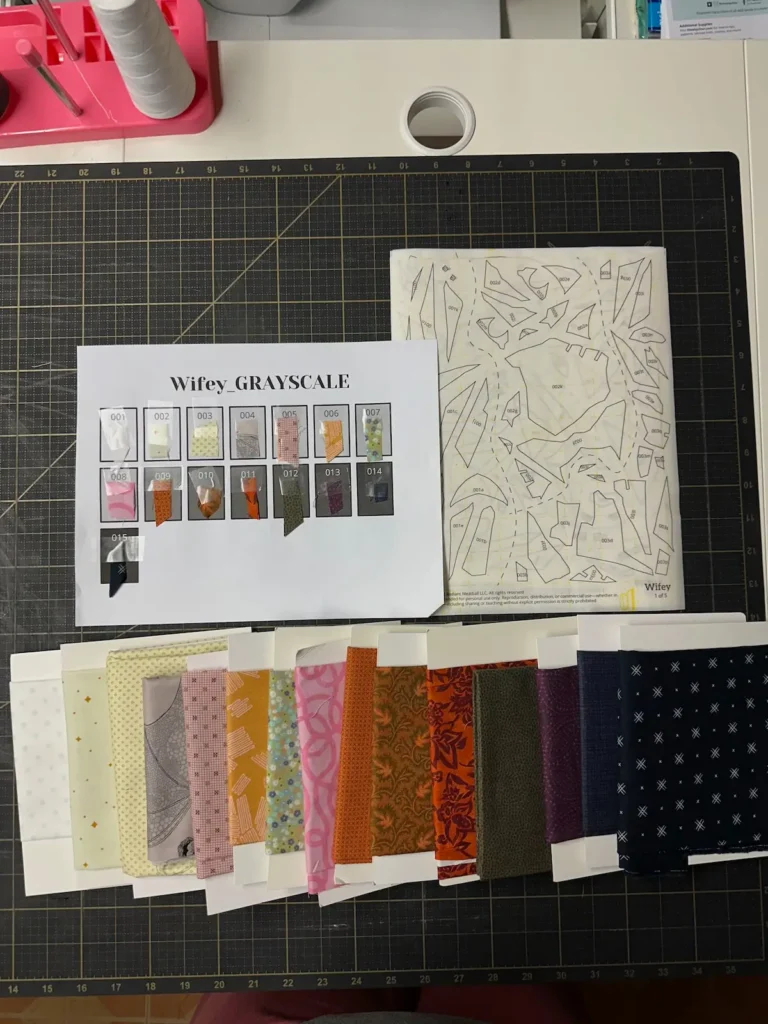
Once I’m happy with the design, I run a series of scripts to simplify the color palette and make the construction as approachable as possible for someone else to replicate. If it’s going into a pattern, I create a black and white version, label and number every piece (there can be hundreds in a single piece), reverse it, and organize everything into color groupings so the assembly makes sense.
Each pattern includes printed pieces on Lite Steam-A-Seam 2, ready to cut and fuse and organized by color. I also include what I call a paint palette with every pattern: one version in the colors of the design on the cover, and one in grayscale, so people can follow my color choices or use whatever fabric speaks to them.
And that, then keeps them, and me, quite organized. We start with a guided fabric pull, set up our ‘paint palette’, and we’re off to the races.
Describe your creative space.
For me, creativity doesn’t always start at the sewing machine. It starts at the keyboard.
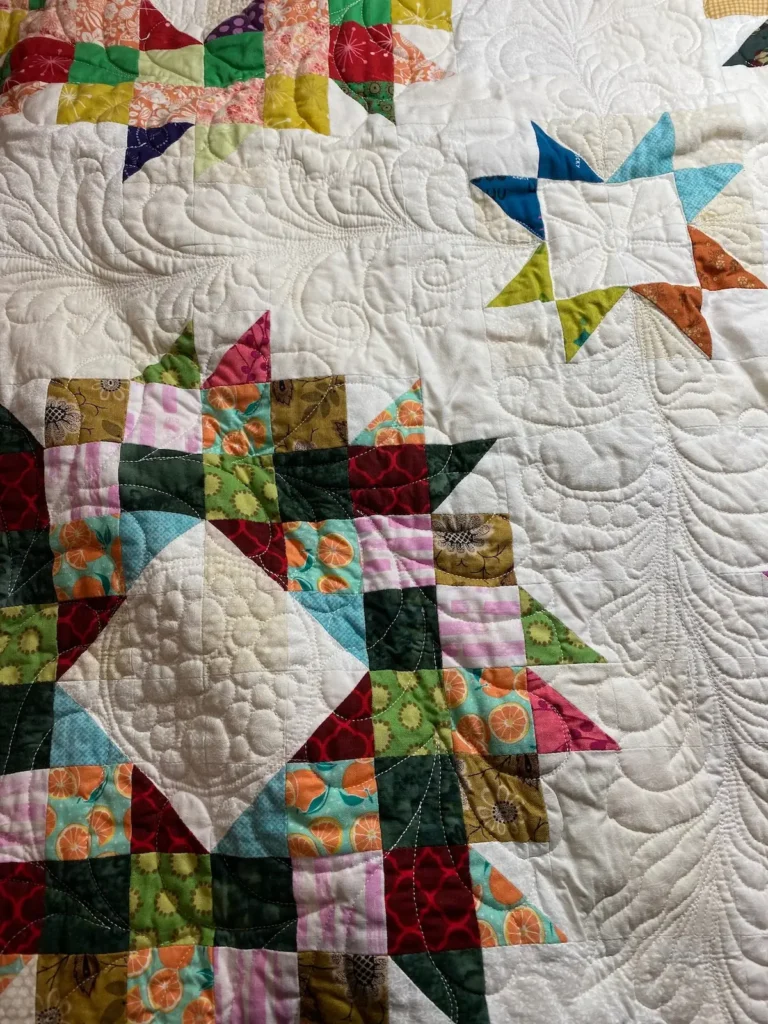
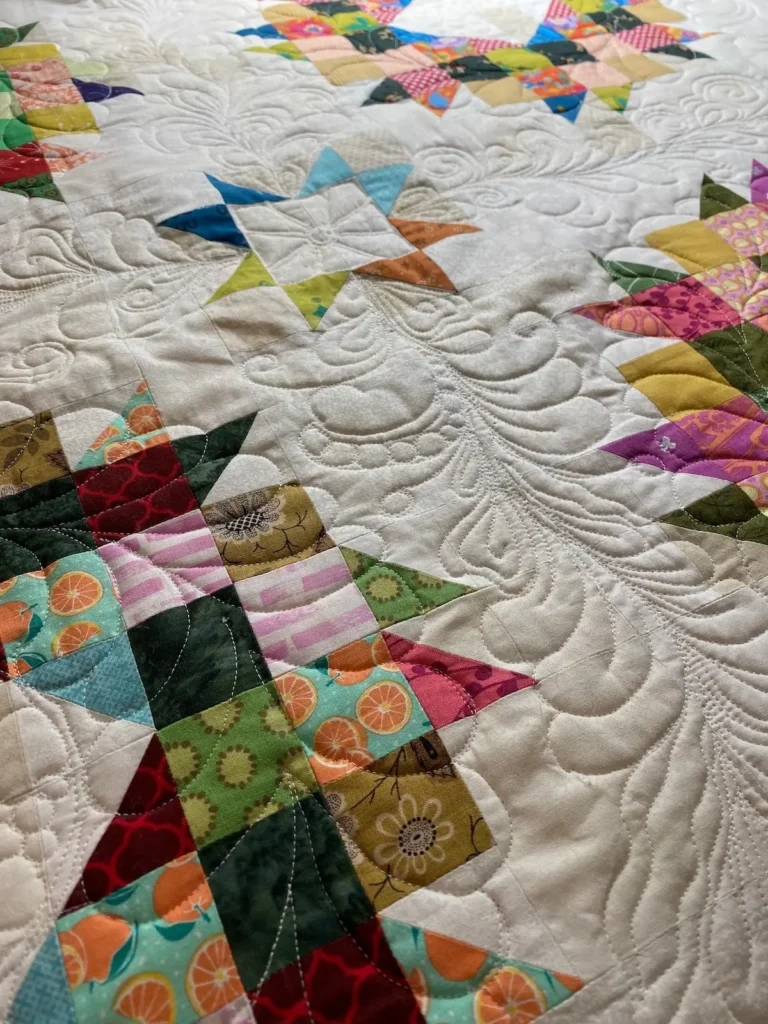
My office is upstairs, and that’s where the technical side of everything lives: multiple monitors, computers, printers, and a lot of partially-finished experiments. Cutting things up, printing things out, testing ideas. I find it genuinely fun to play with coding and automation up there. It scratches a very different creative itch than fabric does, and I need both.
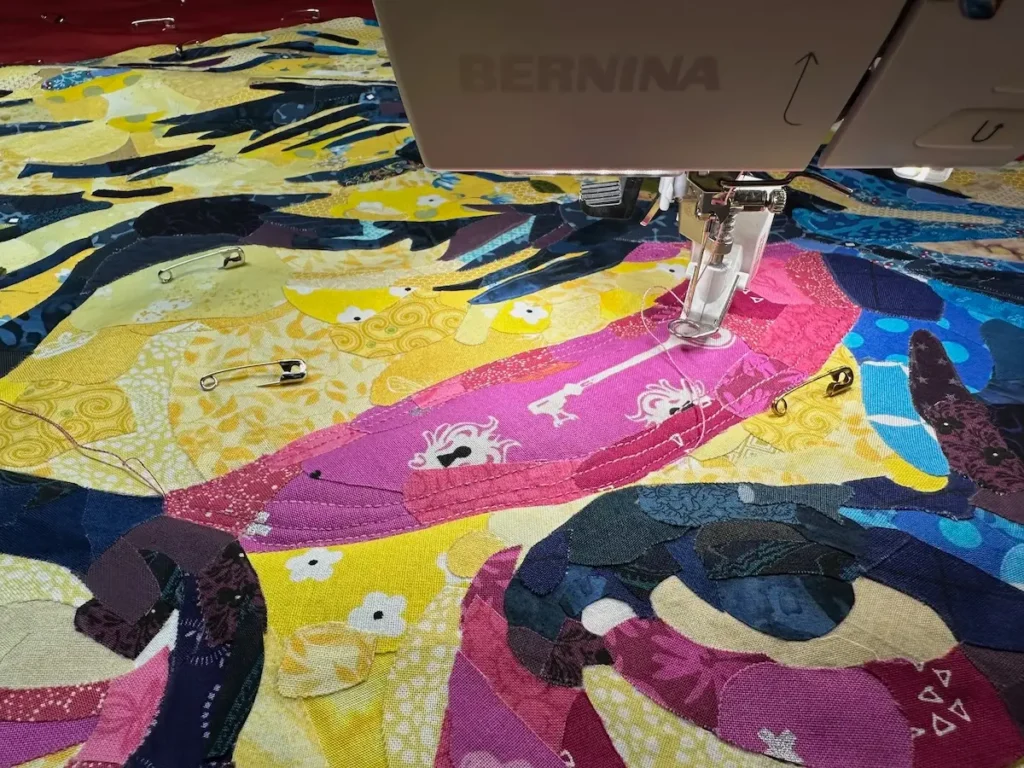
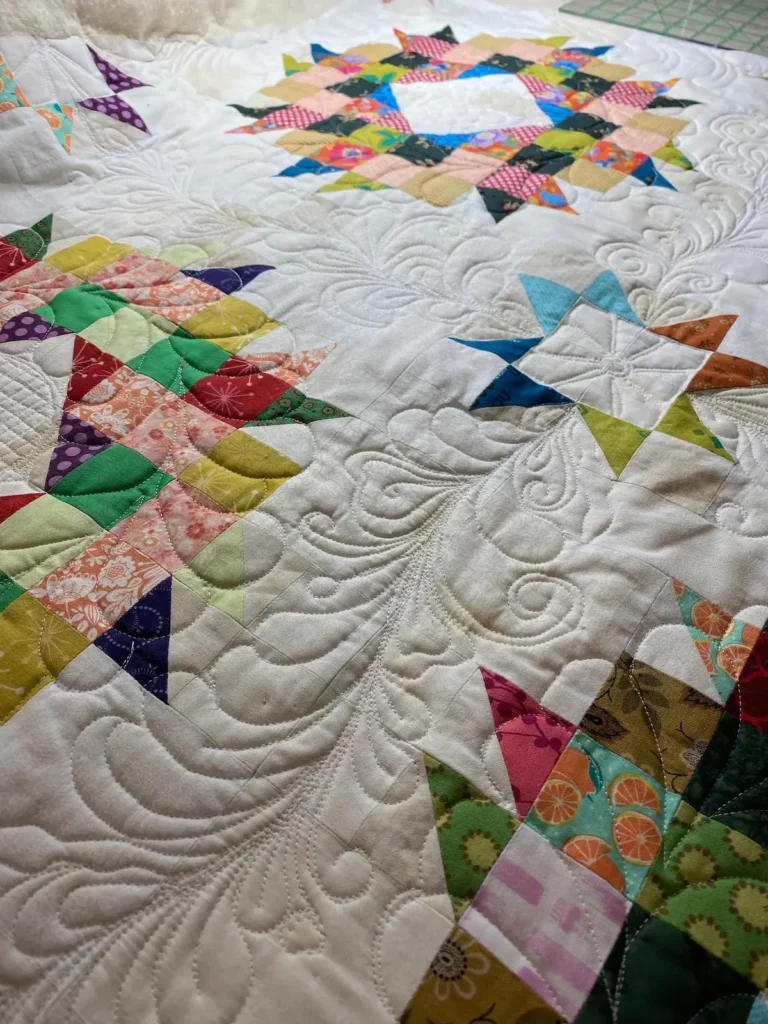
Once I have a design I’m excited about, I take it downstairs to my sewing space. I have a Bernina Q20 sit-down longarm and a Bernina 720, and all of my fabric is organized by color number. (That’s a whole other conversation, but I have a method for it that I teach alongside color theory. I’m fascinated with how humans relate to color). The short version: I organize my stash the same way an artist organizes their paints, so I can pull anything for any project with confidence. No digging, no second-guessing.
The space is also set up to record. I have overhead cameras and enough room to work and capture it at the same time, which matters since a lot of what I make ends up in reels, upcoming on-demand classes, and YouTube.
What does a typical day look like for The AI Quilter?
I’m also the owner and principal of a management and strategy consulting firm for small and medium businesses, so my days have two tracks running through them.
I get up early and do deep work in the mornings: client emails, strategy work, making sure the people I work with have what they need. I protect midday for quilting, hand work, or just letting my brain decompress. I get mentally tired around that time, and I’ve learned that creative work is actually how I recharge.
After dinner, my better half and I both tend to go to our respective creative spaces. He works in his, I work in mine. If I’m not sewing, I’m probably exploring some new idea around automation or AI, working on a new class, or following up with customers. It’s a lot of things running in parallel, but I’ve gotten good at knowing which mode I’m in at any given hour.
What’s the most important piece of creative advice you’d share with makers who feel stuck or intimidated?
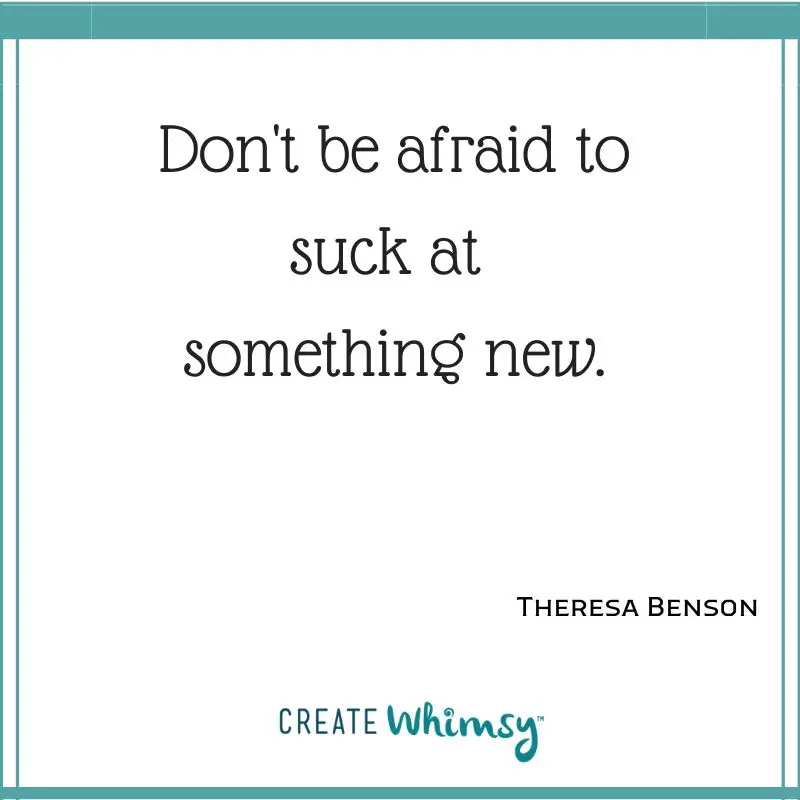
Don’t be afraid to suck at something new.
That’s it, really. We’ve spent so many years getting good at things that we’ve forgotten what it feels like to be a beginner. There’s this assumption that if you’re not immediately competent, you don’t belong. But the productive struggle… that’s where the learning actually happens. I talk about this with my students all the time. The discomfort of not knowing is not a sign you’re doing it wrong. It’s a sign you’re doing it.
What’s the biggest myth about AI and creativity you love busting?
That AI is slop. AI is a tool.
When people use it to replace their creativity instead of amplifying it, yes, the output is slop. But that’s a people problem, not a technology problem. I was deliberate when I titled my book Digital Muse: Bringing AI Into Your Creative Process because it’s about bringing AI into a process that already exists and belongs to you. Not handing your process over.
Think of it this way: a rotary cutter can’t stitch fabric for you. A sewing machine can’t do your pressing. Every tool has a job, and understanding where it fits is the whole game.
There’s a second myth worth naming, too: that AI is new. It’s been around for about 70 years. And most people who say they’d never use it are already using it three to five times a day without thinking about it.
https://theaiquilter.com/the-conscious-creatives-guide-ai-tools-that-wont-steal-your-soul
https://theaiquilter.com/i-would-never-use-ai-a-few-questions-worth-asking
https://theaiquilter.com/the-villainization-cycle-what-happens-when-creative-communities-let-fear-lead
Where can people see your work?
Instagram is the most active place, at @theaiquilter. My website is theaiquilter.com, where you can find my patterns, my book, and what I’m currently up to. My book, Digital Muse: Bringing AI Into Your Creative Process, was featured in McCall’s Quilting, and I had an article in Quilting Arts last year. The book is available through my website or on Amazon, which is handy if you’re outside the US. I also sell wholesale quilt patterns to shops, so if your local shop wants to carry them, that’s an option too.
Book https://bit.ly/TAQdigitalmuse
AI and the Environment https://theaiquilter.com/thirsty-intelligence-ais-environmental-cost
Advocacy and Legislative Awareness https://theaiquilter.com/water-runs-through-everything-we-build
Interview posted April 2026
Browse through more art quilt inspiration on Create Whimsy.