
Ruth Tabancay’s creative journey is anything but ordinary—what began with sewing clothes in childhood eventually led her from a career in medicine to a life immersed in art. In this interview, she shares how microscopes, motherhood, and an insatiable curiosity shape her unique practice.
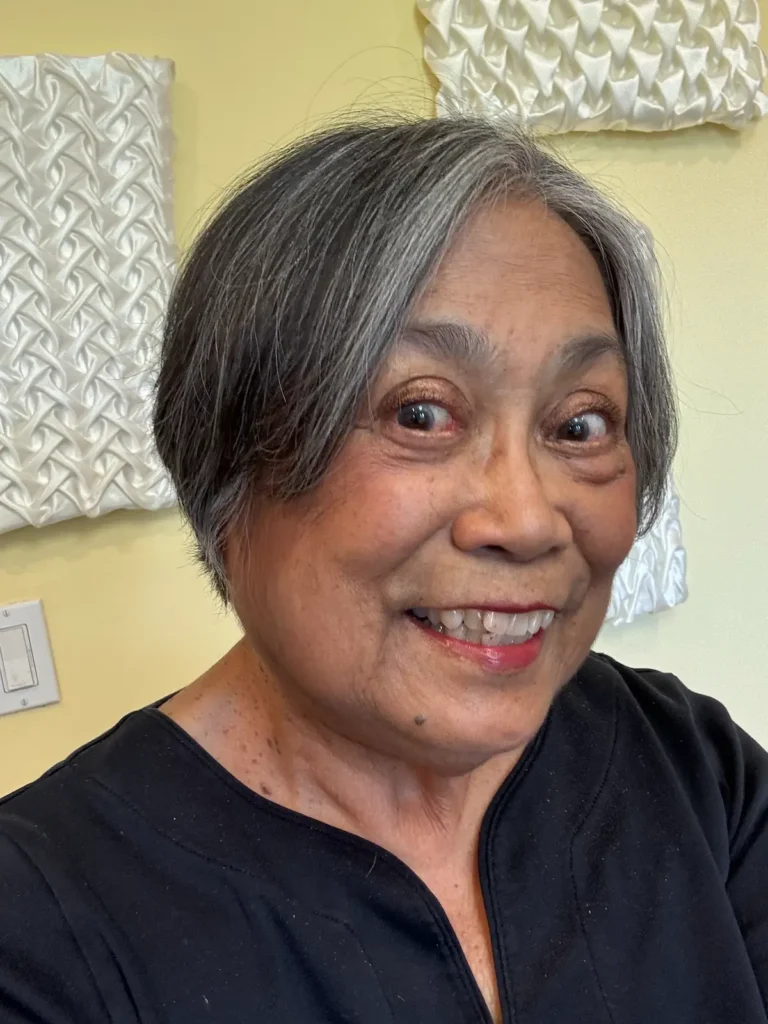
Tell us a little about your childhood and how it shaped your creative life.
In grade school and high school, I learned how to sew clothing and crochet. I found it very satisfying to make clothes for myself and my sisters, but I never saw being a maker as something I would make my life’s work around.
As a child of Filipino immigrant parents, there was the expectation that I would strive for a career in which I could support myself.
In college, I majored in Bacteriology, then worked for two years in hospital laboratories. I wanted more for my life’s work, though, so I went on to medical school, completed a residency in Pediatrics, and worked in private practice for eleven years.
As an Amazon Associate I earn from qualifying purchases. Read more about our affiliate linking policy.
Through all the years in school and while working, I continued to make clothes and crochet, and later learned knitting and quilting. I took classes, workshops, and joined quilting groups. I was back at my original love of textile techniques.
The more I crafted, the more I wanted to live a creative life. I wanted to make quilts from my own ideas, not copy from a pattern. At the same time, I wanted to devote more time to my three daughters. I made the decision to leave private practice and go to art school.
When did you feel that you became an artist rather than a hobbyist?
That point for me started when I learned to think conceptually about the art I’m making. In art school, particularly in my fiber sculpture classes, I learned that my work should convey a message.
Beyond the immediate visual appeal, there should be an interaction between the materials, technique, and the concept. This was an exciting way for me to think about art.
I majored in textiles and learned new techniques such as weaving, felting, basketry, and computerized Jacquard weaving. I used all kinds of materials but was drawn to working with upcycled objects like tea bags and seeds from trees.
By the time I was in my later years in art school, it was clear to me that my artwork was based on magnification. Years of looking through a microscope in college, laboratory work, and medical school taught me to appreciate the near-invisible.
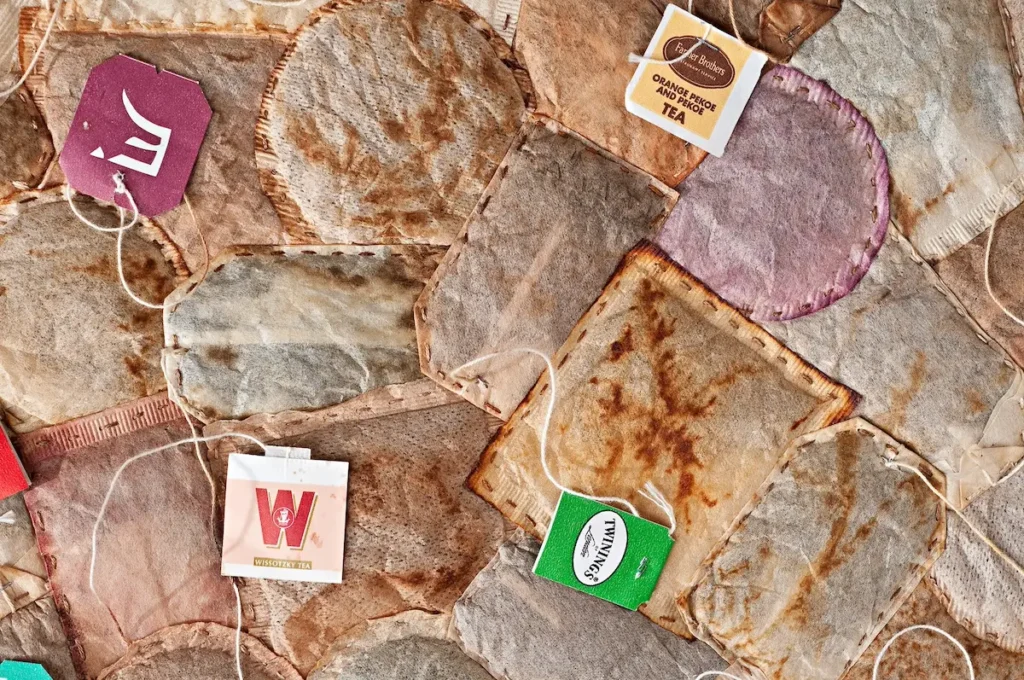
A surface of hand-stitched tea bags became a vast plane of squamous epithelium.
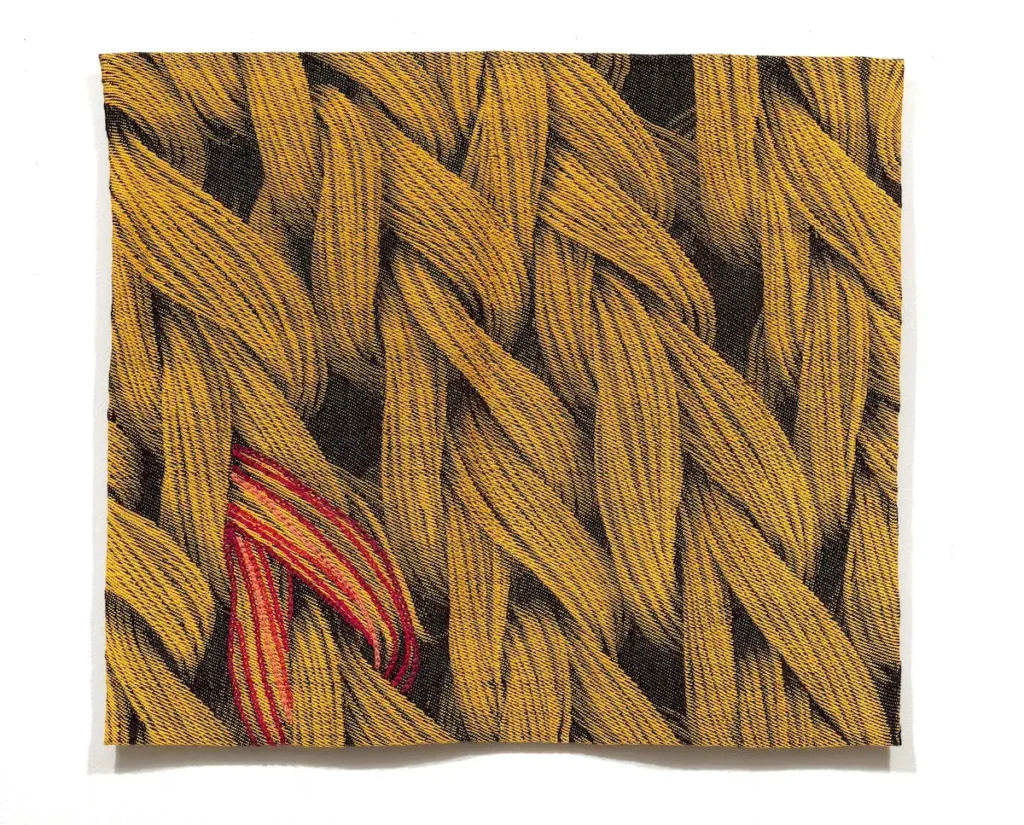
The imagery for my first Jacquard weavings drew from scanning electron microscope images of body tissues I found in an atlas. My first ideas for recreating bacteria in Petri dishes began in school, but I didn’t have an idea of how to execute that, so I put that idea on the back burner.
How did your work develop from there?
After graduating, I spent the next eleven years hand-stitching tea bags into quilts for bed shapes and the wall.
I became more involved with wet felting and made bed pieces that incorporated tea bags and liquidamber fruits (from the sweet gum tree). I organized a few multi-day sessions with two different friends’ computerized Jacquard looms.
By this time, I had permission to use the scanning electron microscope at University of California, Berkeley, and made micrographs of dozens of pieces of fabric to examine weave structure. These now became the basis my Jacquard weavings.
Skipping ahead to 2017, I was awarded the Lia Cook Jacquard Weaving Residency at California College of the Arts. Starting with manufactured fabric, using the Hitachi TM-1000 Scanning Electron Microscope to make new micrographs of fabric, processing the images with Photoshop, and hand weaving with the TC-1 computerized Jacquard loom was a completely mechanized process, and anyone could achieve similar results to what I was producing. For this body of work, to leave evidence of my hand on each piece and to make it my own, I hand-embroidered stitches on areas of each piece.
Going back to 2010, ten years after graduation, I felt I hadn’t moved very far from my art school days in terms of materials and concepts. Without the stimulation of teachers and other students I wasn’t coming up with new ideas.
I heard about a nine-month program in fiber arts at the University of Washington in Seattle. I decided to commit to it and made 26 overnight trips back and forth to Seattle over the nine months. Being surrounded by new teachers and new students gave me the stimulation I needed to jump-start my creative practice.
By the time I finished, I felt emboldened to apply for membership to a co-operative gallery, Mercury 20, in Oakland, California. With the opportunity to have a solo show once a year, I used that time and space as a lab to check out new concepts and materials and create art that wouldn’t be possible, or bound by limitations, in a traditional setting.
There was pressure to meet a deadline. Due dates are great for pushing work forward!
What kind of materials and techniques do you like to use?
I like exploring materials that no one else is using or ones that are uncommon.
When I started stitching tea bags, no one was doing it the way I was. An assignment in my fiber sculpture class was to take something you use every day and make an artwork with it. At the time, my then-teenaged daughter and I would snuggle in her comforters, drinking tea and doing geometry homework. As the tea bags accumulated on the windowsill, I came up with the idea to stitch them into a quilt.
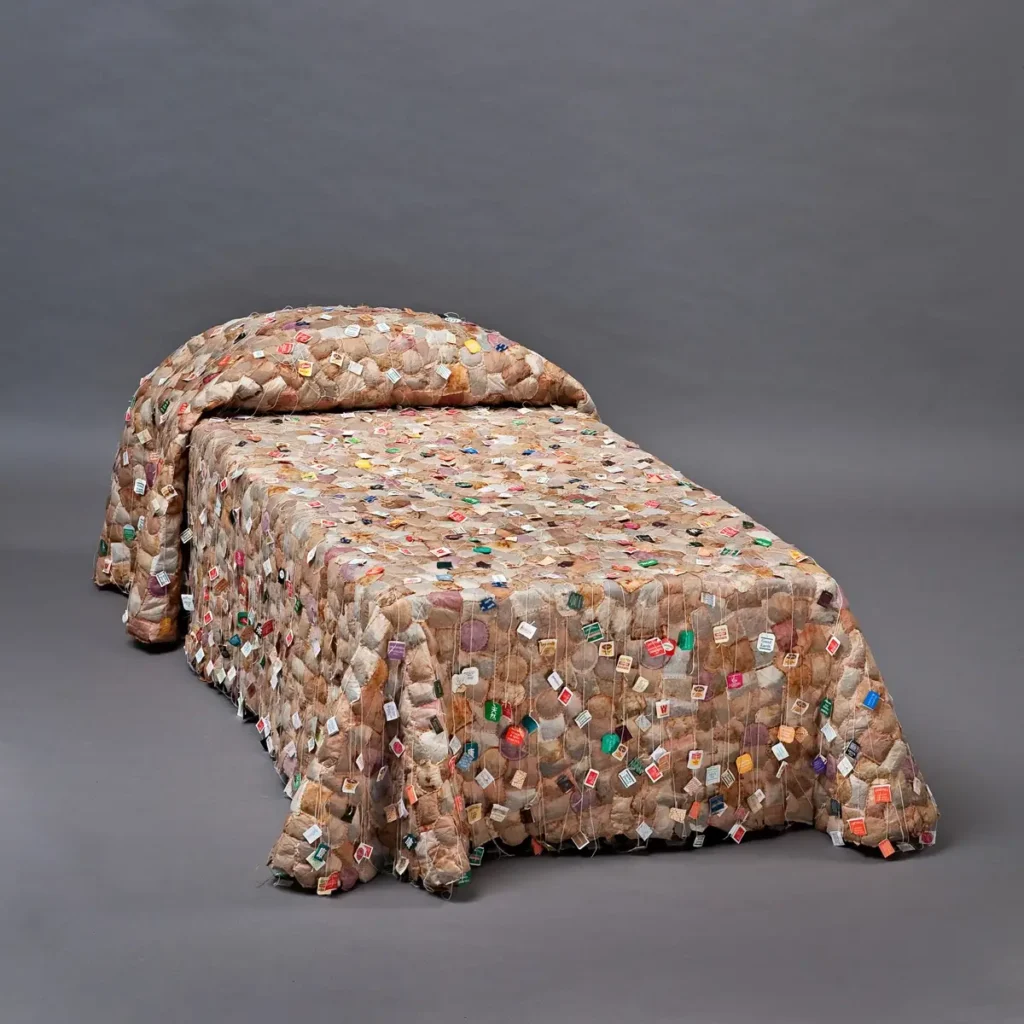
As I branched out into more tea bag works, a dozen or more people started saving their tea bags for me. I set aside the round ones, knowing they would be perfect for hexagon grid quilts. I’ve always been interested in geometric forms as a design element, particularly the hexagon.
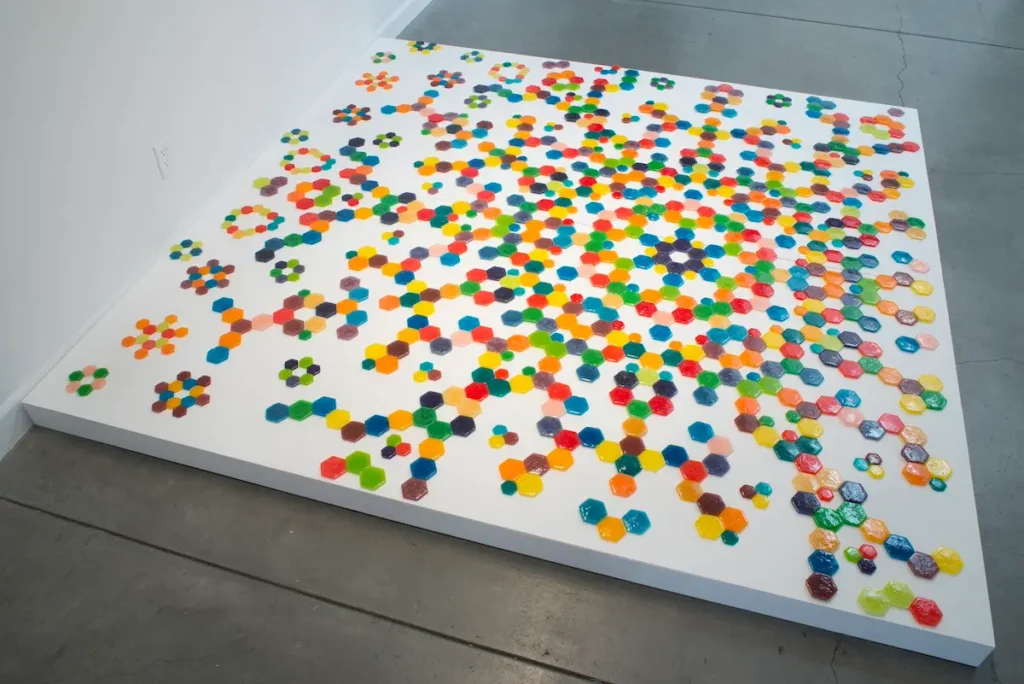
As I created these and stitched them down, I wished there were a way to work with the tea bag units so they could be rearranged at whim. I don’t know where the idea of using cast sugar came from, but I created hexagon-shaped cast sugar tiles colored with food coloring and then coated with polyurethane to preserve the sugar.
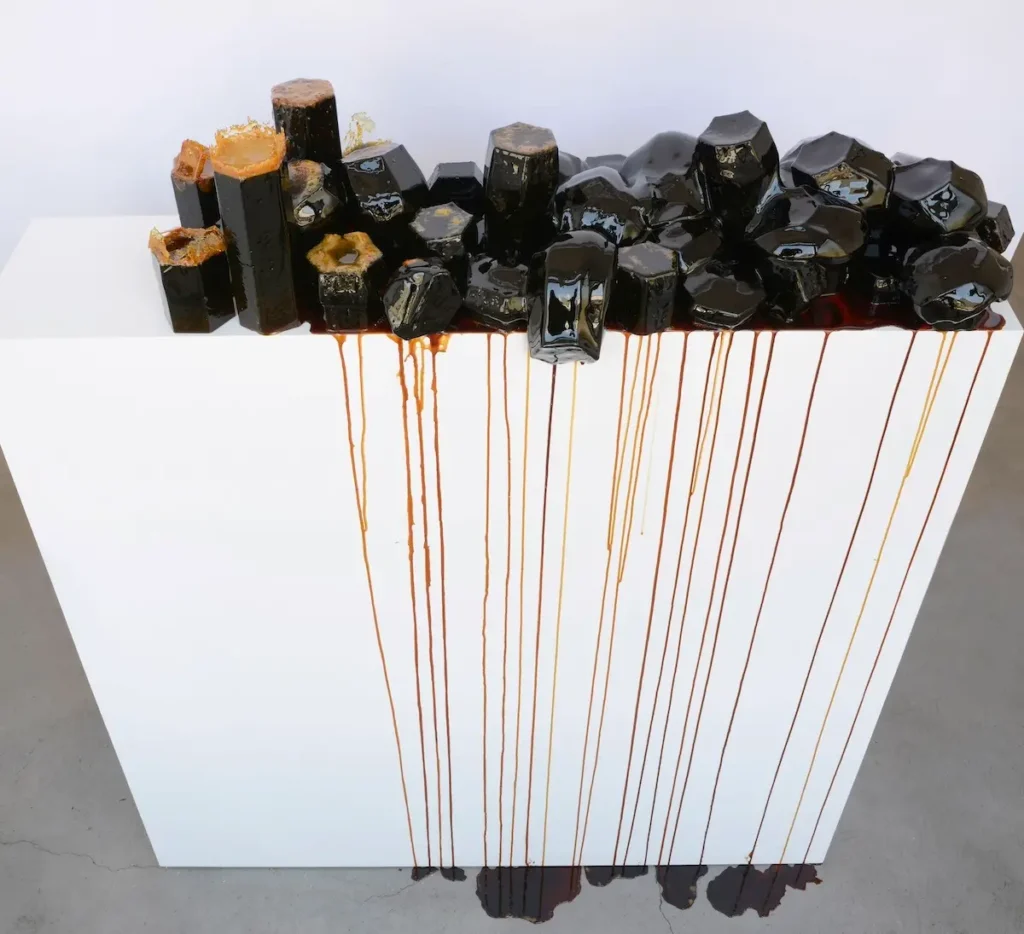
Once I got comfortable cooking sugar, I started experimenting with temperatures and cooking times. Eventually, I found I could mold burnt sugar, and those forms would slowly melt. I set up installations of burnt sugar pieces, adding new ones every few days, and let them liquify, down the pedestal to the floor. (See Basalt Causeway above)
I’d always been an avid recycler but an article about the Great Pacific Garbage Patch, the slowly swirling mass of plastic in the North Pacific Ocean, piqued my interest in how we dispose of plastic waste. Thinking backwards brought me to fossil fuels, which are used to make plastic but also are a major contributor to global warming, one aspect of climate change. My first works with plastic are based on this ocean phenomenon.
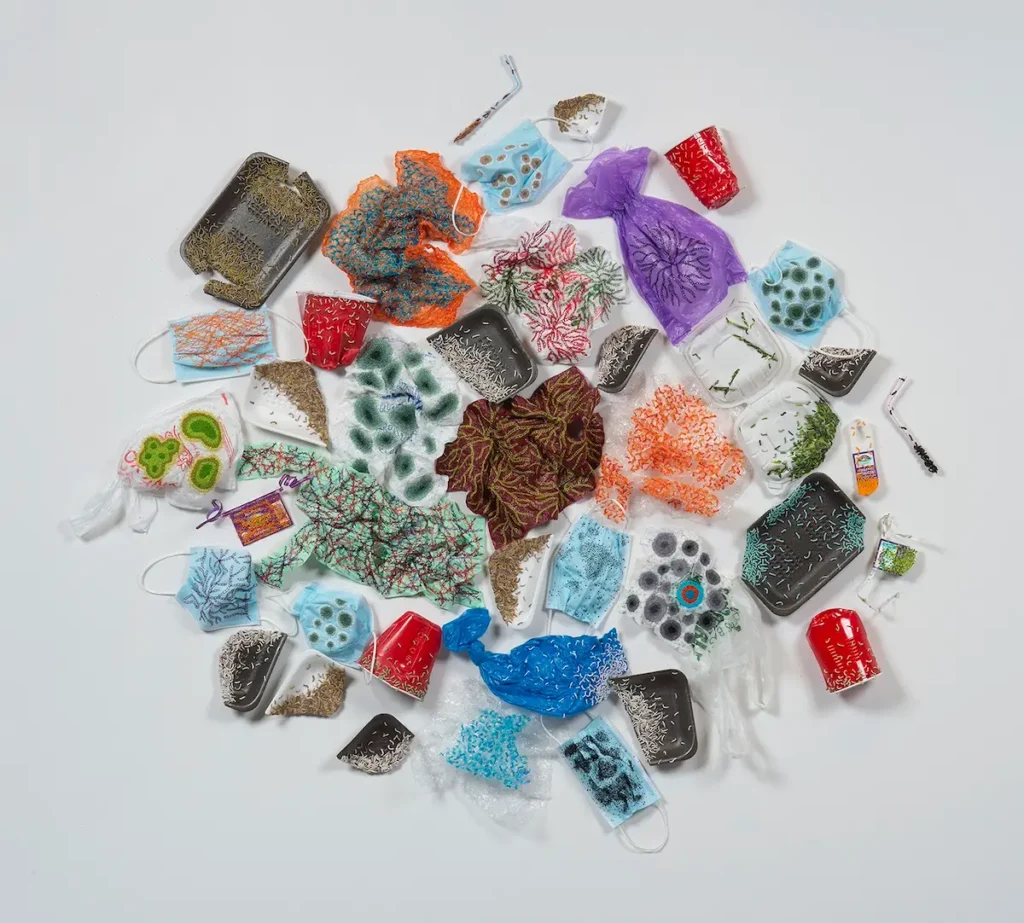
Massive amounts of plastic are clogging our planet. In response to a call for art for Earth Day, I started embroidering plastic bags and Styrofoam meat trays with stitches that looked like organisms digesting the plastic.
This was my hope and fantasy, then I found this was actually happening in research laboratories around the world. The larvae of the darkling beetle, Tenebrio molitor and Tenebrio obscurans, and the superworm Zophobas morio have been found to digest polystyrene. Other bacteria and fungi have been found to digest plastics such as polyethylene, polyester polyurethane, low density polyethylene (LDPE), nylon, and CD’s.
Eventually I embroidered on all kinds of single use plastic–styrofoam trays, bags, bubble wrap, party cups, straws, food labels, and face mask–with stitches resembling mealworm, fungal colonies, fungal structures, and bacteria. [Adapting to New Substrates 4.0]
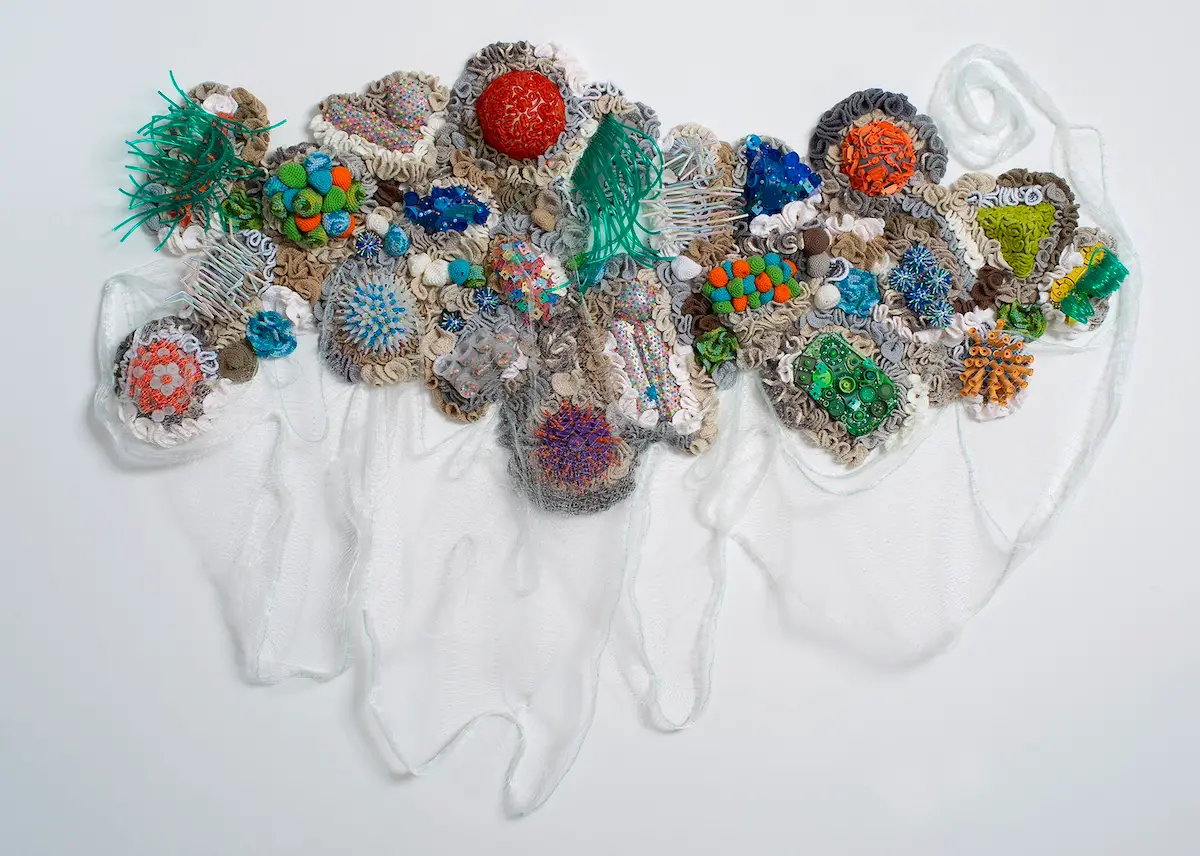
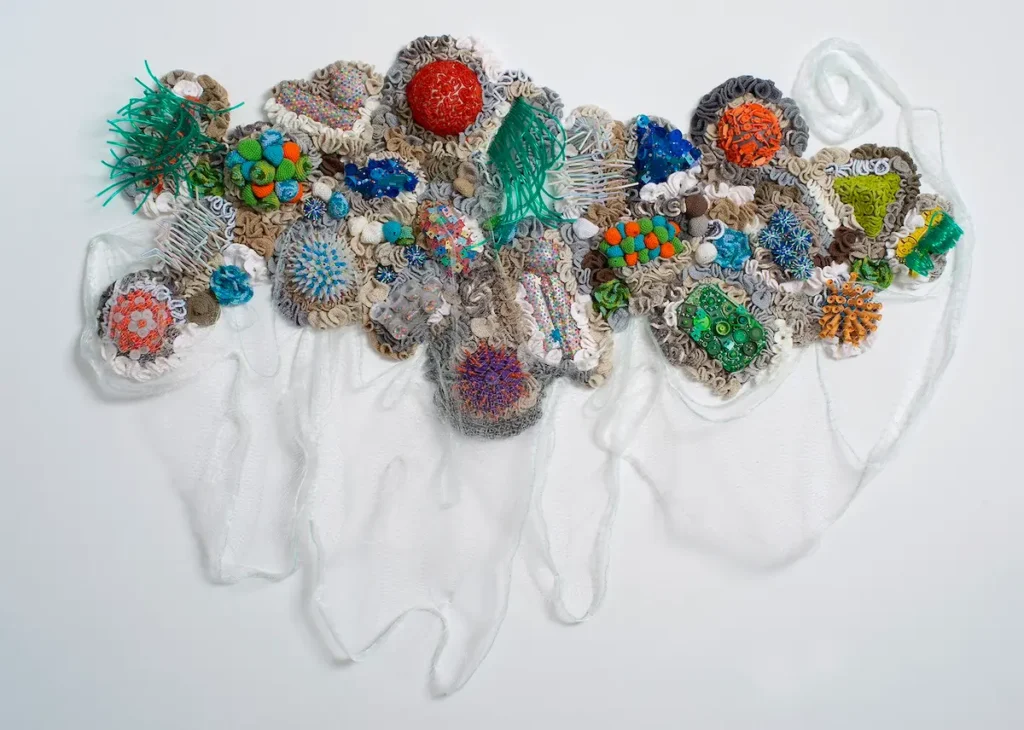
Reading about global warming, I became aware of the ecological disaster of bleaching of the coral reefs. I started collecting plastic discards from my home to use in creating a bleached coral reef.
My love of geometry going back to high school led me to discover hyperbolic geometry, an entirely different concept from Euclidean, or plane geometry. Hyperbolic geometry is characterized by a constant negative curvature and is present in living forms in nature such as cacti, sea lettuces, and in coral reefs.
For my first bleached coral reef, I crocheted the structure of the reef using hyperbolic crochet. I created reef ‘organisms’ from white plastic discards leftover from medical treatment necessitated by caring for myself after a lung transplant six years ago.
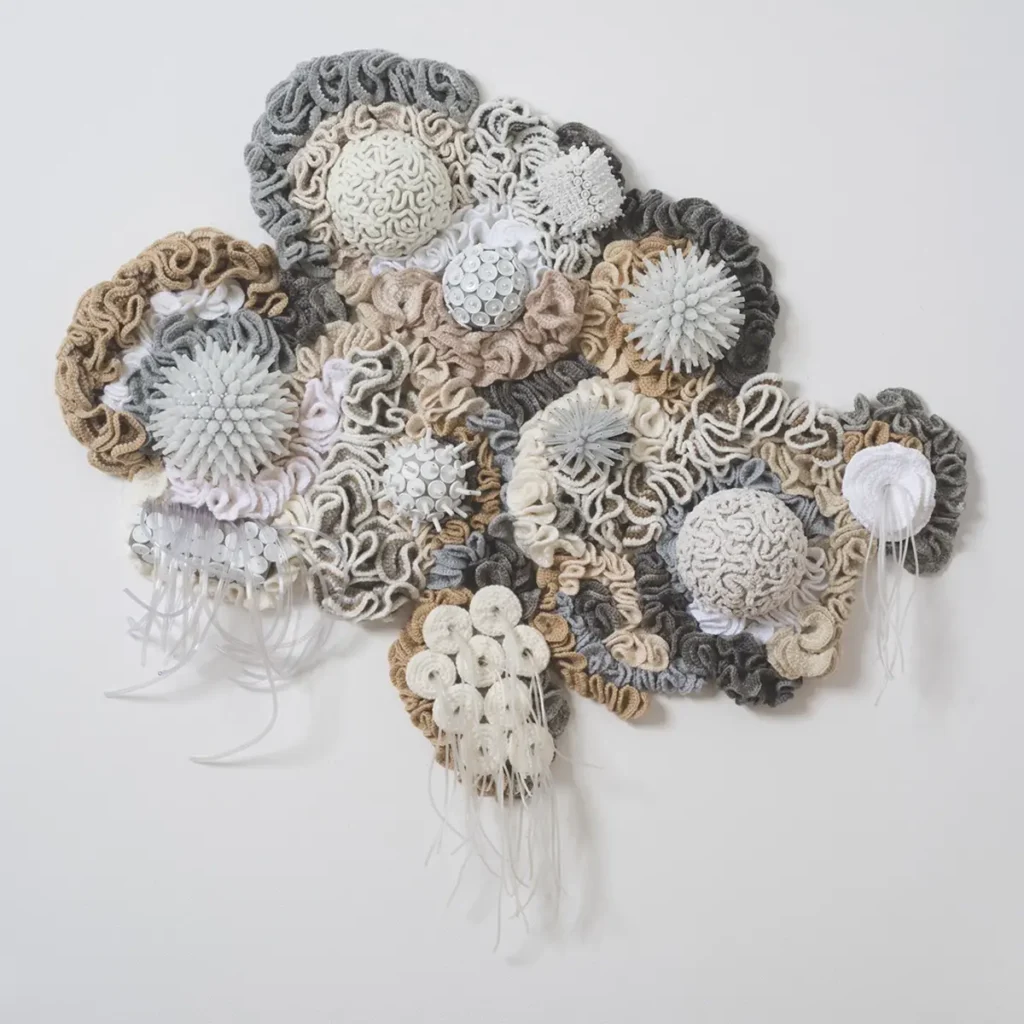
I depend on these plastics to survive, but I abhor that they are contributing to global warming. From that first coral reef work, the series has evolved to include reef organisms made of all colors of plastic to highlight human consumption and dependence on plastic.
How do you want people to experience your work?
I chose underlying concepts for all my work with ideas that have resonated with me personally throughout my life. This includes my own experience and my passion for the environment. At the same time, I want the viewer to work a little at putting the materials, techniques, and ideas together. In art school, we used to say about our work, “You don’t have to hit them over the head with it,” them being the viewer. I try for a degree of subtlety but at the same time give the viewer enough information to work with. I love looking at my work with a viewer when the light bulb goes off, when my idea, the materials, technique, and the finished piece come together.
What has stood out as the art that affects you most deeply?
I have what I call ‘golden moments’ in my art practice. These works are completely resolved in my mind in terms of the type of material and how they relate to my concept. Every question about the artwork is answered, each choice is deliberate but engages completely into my idea.
Though I strive for this in each work, I’ve made only a few qualify as a ‘golden moment.’ My tea bag bed, Extending the Useful Life, is one.
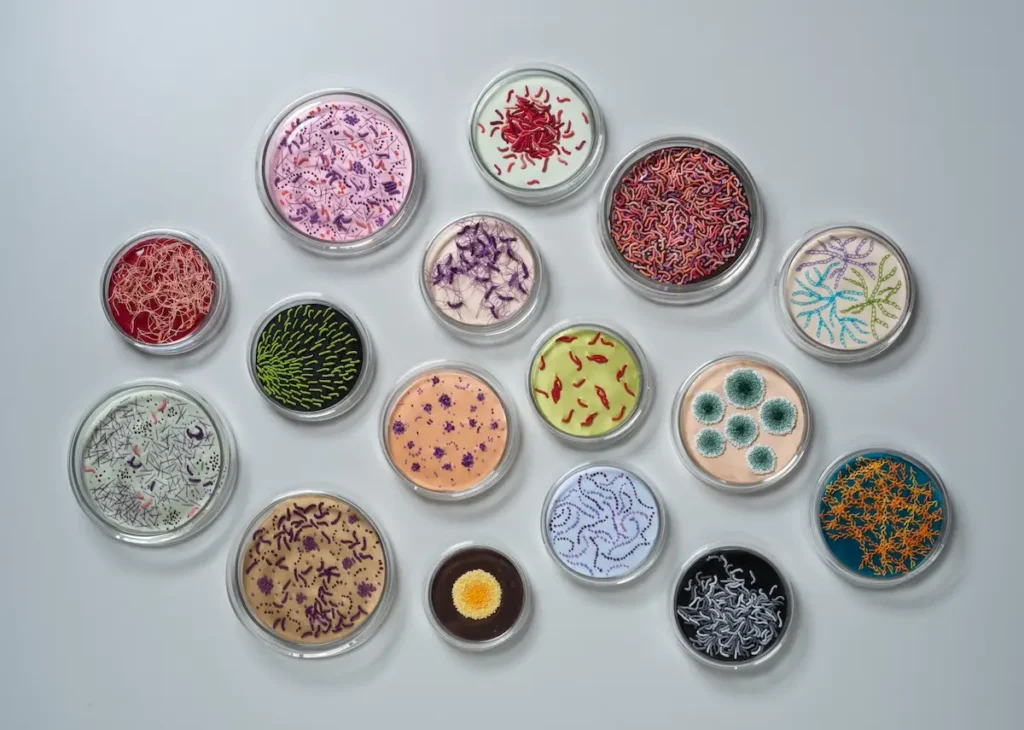
My series of embroidered bacteria and fungi in Petri dishes, What’s In You and On You: Normal Flora and Pathogens, is another as is my series depicting bleaching of the coral reefs.
My most recent artwork, Sutured, uses discarded disposable drapes from hospital operating rooms that I stitched with surgical instruments and suture. In each case, the material converses with the technique in a way that comes from me, with a reason for everything one sees.
Tell us about your current work?
The University of California San Francisco is a university dedicated exclusively to the health sciences and happens to be where I went to medical school and subsequently had my lung transplant.
I was fortunate to be selected for the University of California San Francisco Library Artist in Residence, June 2024-June 2025. The requirements of the AIR were to use the Library’s Special Collection and Archives to research my chosen topics. I wrote three news stories for the Library website and created an exhibition for the Library with artwork based on my research.
As I had been working on a series of bleaching of the coral reefs, I chose to research the fossil fuel industry and utilized the Fossil Fuel Industry Documents Archive of the Industrial Documents Library for my news story, Big Oil, Global Warming, and a Calculated Stitch. For that artwork, I used plastic that had been discarded from the UCSF Medical Center. See Plastic Reef above.
About halfway into the residency, I became unexpectedly drawn to a vintage suture set in the Health Sciences Artifacts of the Archives and Special Collections and decided to write about other historical medical instruments that I’d found in the collection for my news story, A Physician Views Health Sciences Artifacts through and Artist’s Lens.
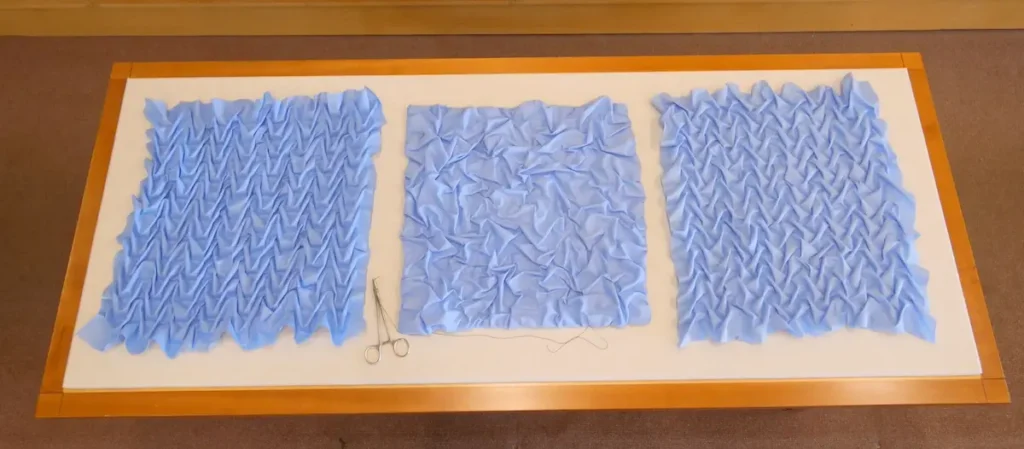
The art works that resulted from the research will be on view at the UCSF Parnassus Kalmanovitz Library to June 2026. To continue my bleaching of the coral reef series, I created a coral reef from crochet using discarded hospital plastic for reef ‘organisms.’
To highlight a regional species (regional to Northern California) affected by global warming, created a Monarch butterfly, also with crochet and operating room discards. Inspired by the vintage suture set, I created a textile surface using operating room surgical drapes and tools.
I have a great personal affection for UCSF. I graduated from Medical School there in 1979. When my lung disease was diagnosed, I had medical care through their Pulmonary Clinics, and had my lung transplant at UCSF in 2019. Now, in 2025, I am here in another capacity, Artist in Residence. I have a long history with this institution and I’m fortunate and thankful for that.
Website: https://www.ruthtabancay.com/
Instagram: https://www.instagram.com/ruth_tabancay/
Facebook: https://www.facebook.com/ruth.tabancay
Interview posted December 2025
Browse through more inspiring interviews on Create Whimsy.