
From her first stitches with a neighborhood quilting group to studying visual art full-time, Lee McLean has built a vibrant practice as a textile artist. She combines improv piecing, hand-dyed fabrics, and bold design choices to tell stories through color and texture.
How long have you been quilting and designing? How did you get started?
Over twenty-five years ago, I joined a group of neighbourhood women who got together weekly and who had quilting in common. A newbie, I was hooked by the fabrics, colours, geometry, precision (even the math!) and the results.
The urge to create my own designs built gradually. Inspired by attending conferences, I was attracted to the modern quilt movement, with quilts that didn’t conform to a grid and used negative space.
Informed by books by quilt artists, I started designing my own. After taking two online courses with art quilter Elizabeth Barton that focussed on design concepts, I was hungry for more skills to create good compositions for art quilts. This led to a big step in 2019 when I went back to college full-time for a year to study foundations of visual art and then another year to focus on my art practice.
As an Amazon Associate I earn from qualifying purchases. Read more about our affiliate linking policy.
Even though the pace of the first week made me wonder if I could keep up – eek! – going back to school was a great decision and I had a blast. It gave me language and tools to use to improve my designs as well as the confidence to call myself a textile artist.
Is there an overarching theme that connects all of your work? Do your pieces have stories to tell?
I think my objective is to communicate an emotion or express an idea, to see if I can visually represent my response to the subject and then share that with the viewer.
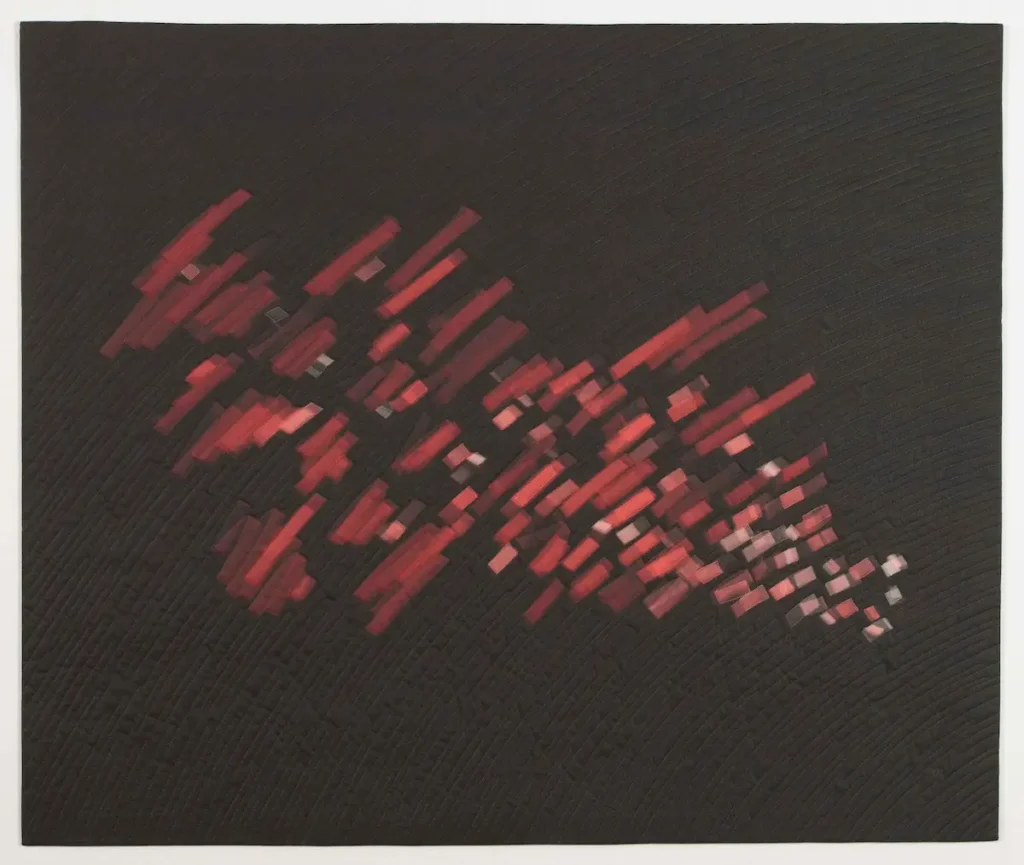
I may have a theme within a group of works. For example, my first series germinated in a hospital waiting room. As I watched the minutes tick by, it struck me how much of my life was being spent on managing my health, of all the associated wasted moments, and of how control is chipped away as we age. As I sat there waiting, I made notes about these feelings, imagining how they might be represented visually.
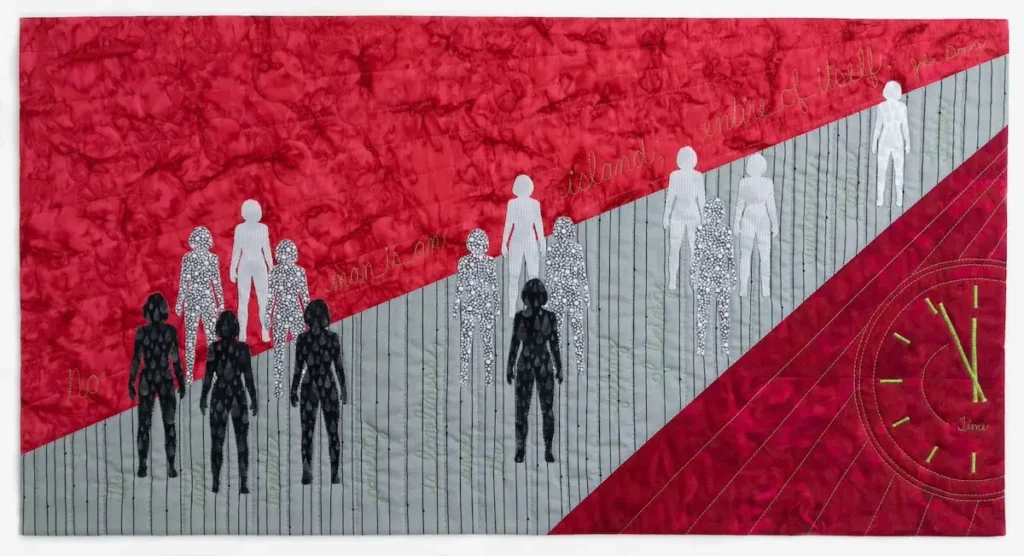
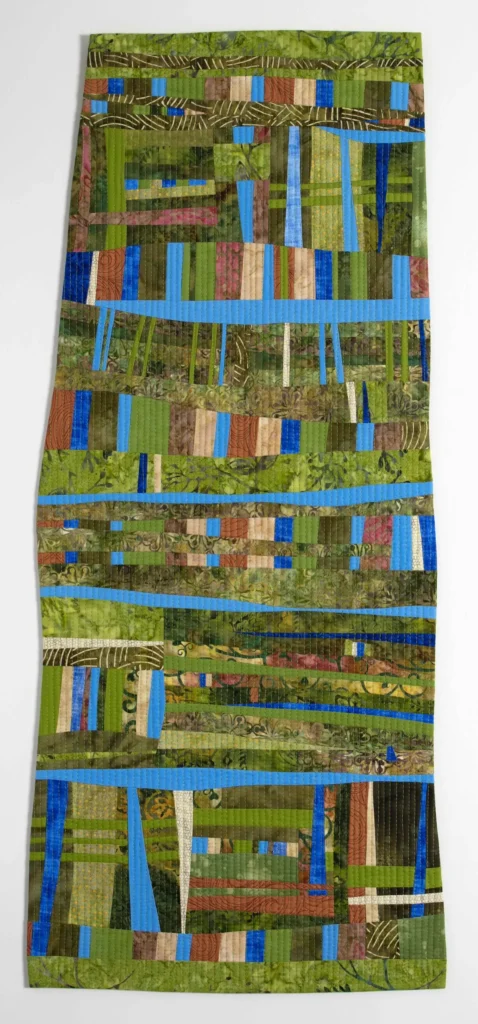
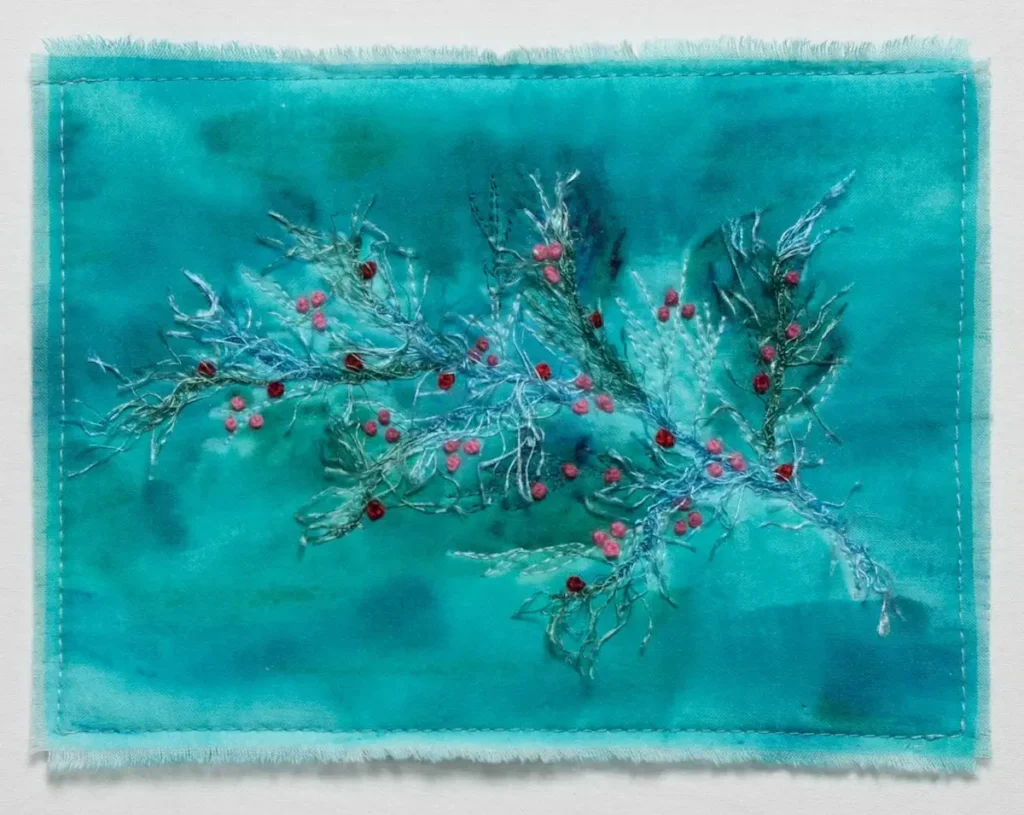
While my series on ageing explored serious issues like invisibility and loneliness, a group of landscapes were imaginary and whimsical, inspired by the fabric that I painted with thickened dyes and then stitched. Sometimes I’m moved by a photo I’ve taken or an event that has happened and want to share how that made me feel. I’m most satisfied when I think I achieved my objective of representing that feeling well.
What techniques are used to create your art?
Piecing, raw edge applique, surface embellishment, hand-dyeing, painting with thickened dyes, free-motion stitching, additional hand stitching, surface marks with paint – these techniques are all considered and used.
Digital design and printing also interest me. I’m interested in the marks on my work having meaning. I’ve been using thrums, the warp discards from weaving friends’ looms, to couch on the surface of my work. I like to feel their energy being extended and woven with mine.
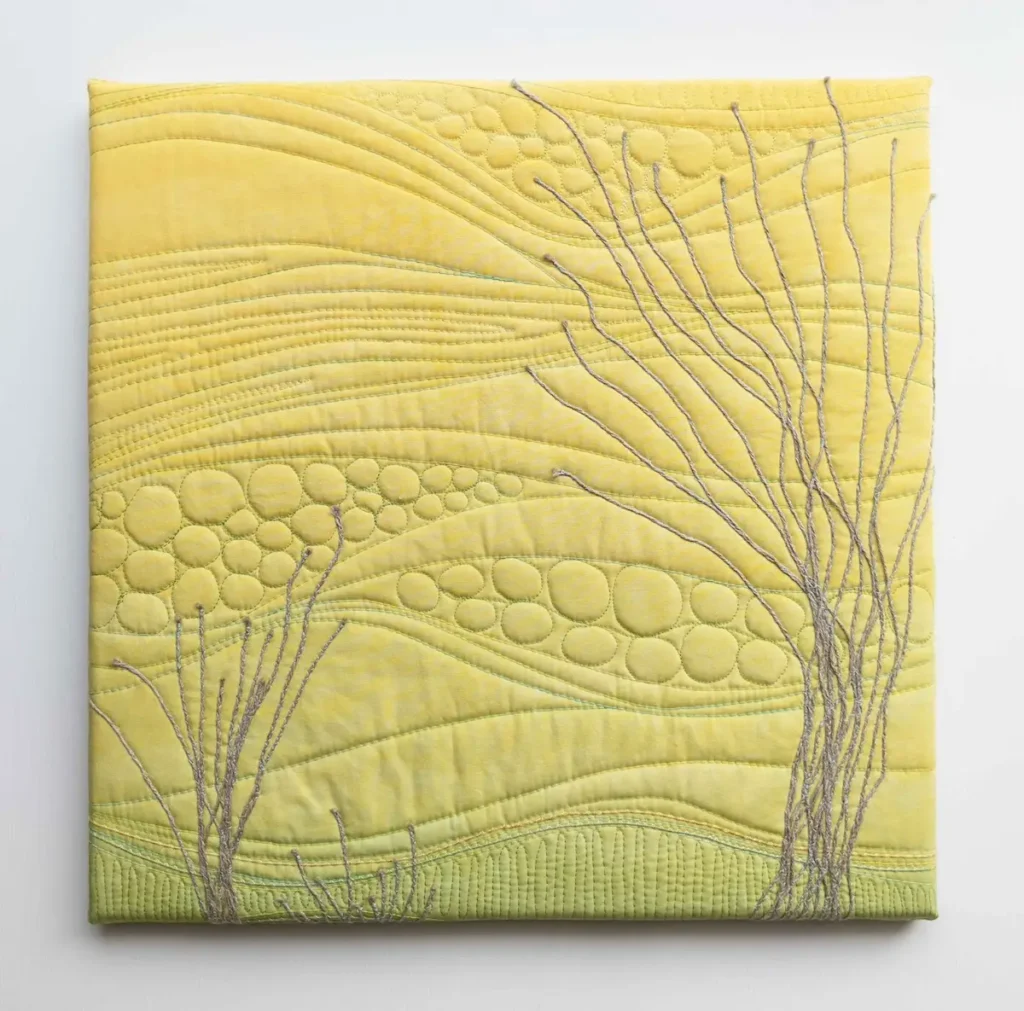
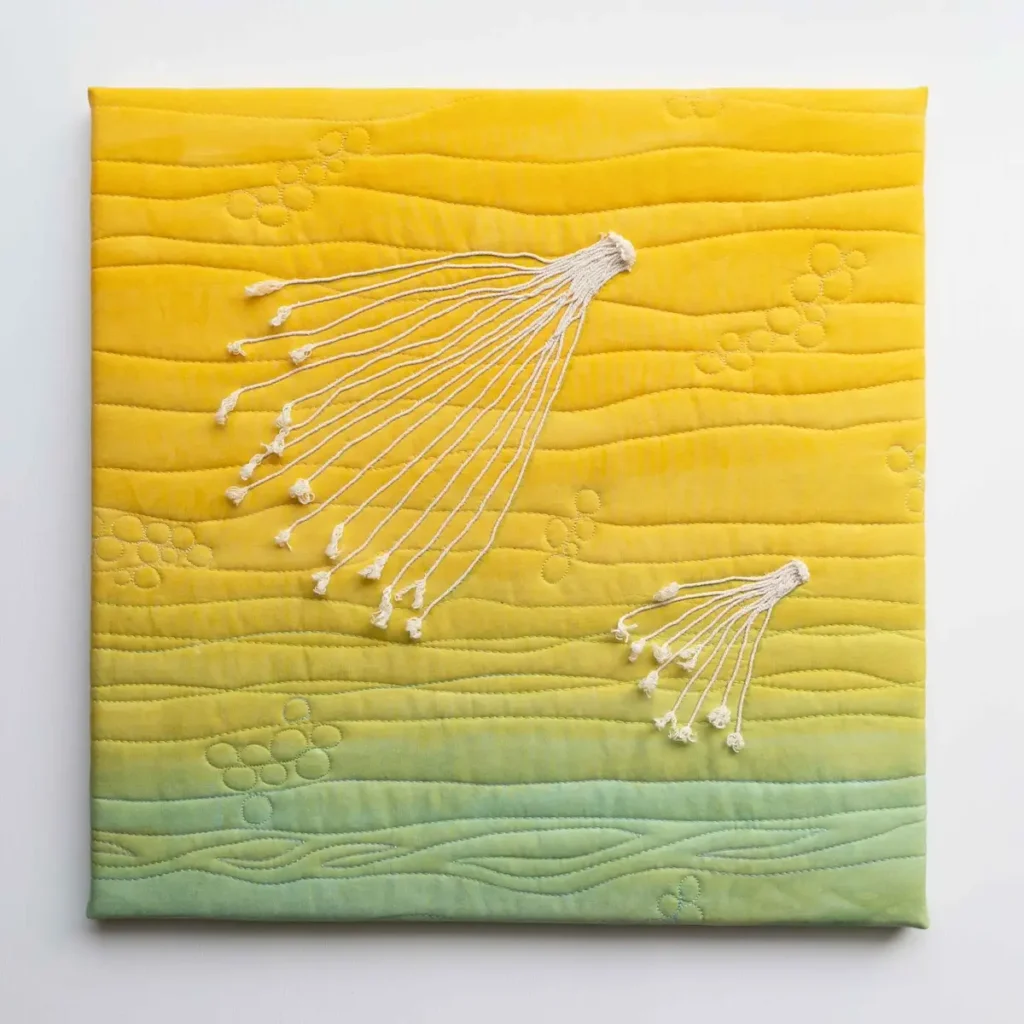
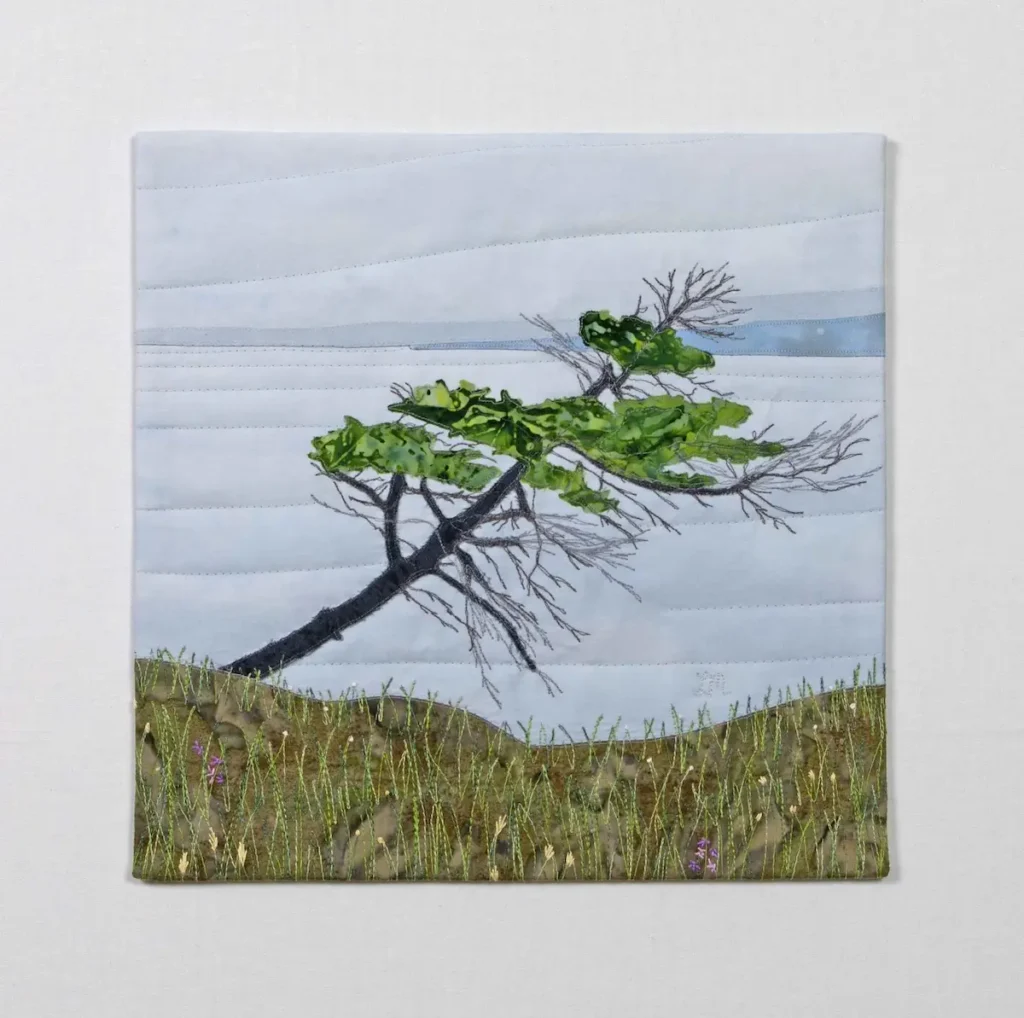
I think my style of work would be described as abstract representation or abstraction. I don’t enjoy the attention to fine detail required for realism, even if I so admire those who do it well. It’s just not for me.
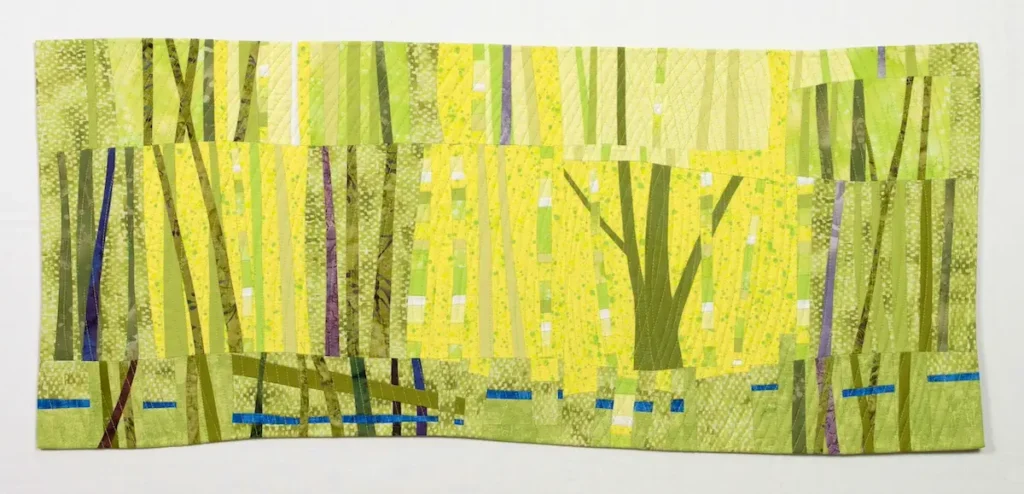
Most of the pieces that I’ve exhibited in recent calls for entry have been using improv piecing. Responding to a selected group of my hand-dyed or commercial fabrics, I cut pieces free-hand and see how they react to each other, playing with sewing sequences and patterns that interest me. Placing them on my design wall, I move these pieced units around, adding and subtracting as the work evolves.
This probably comes with experience, but I tell myself to trust the process when I’m in the ugly middle stage. There is always a sense of relief and excitement when I can feel the resolution happening.
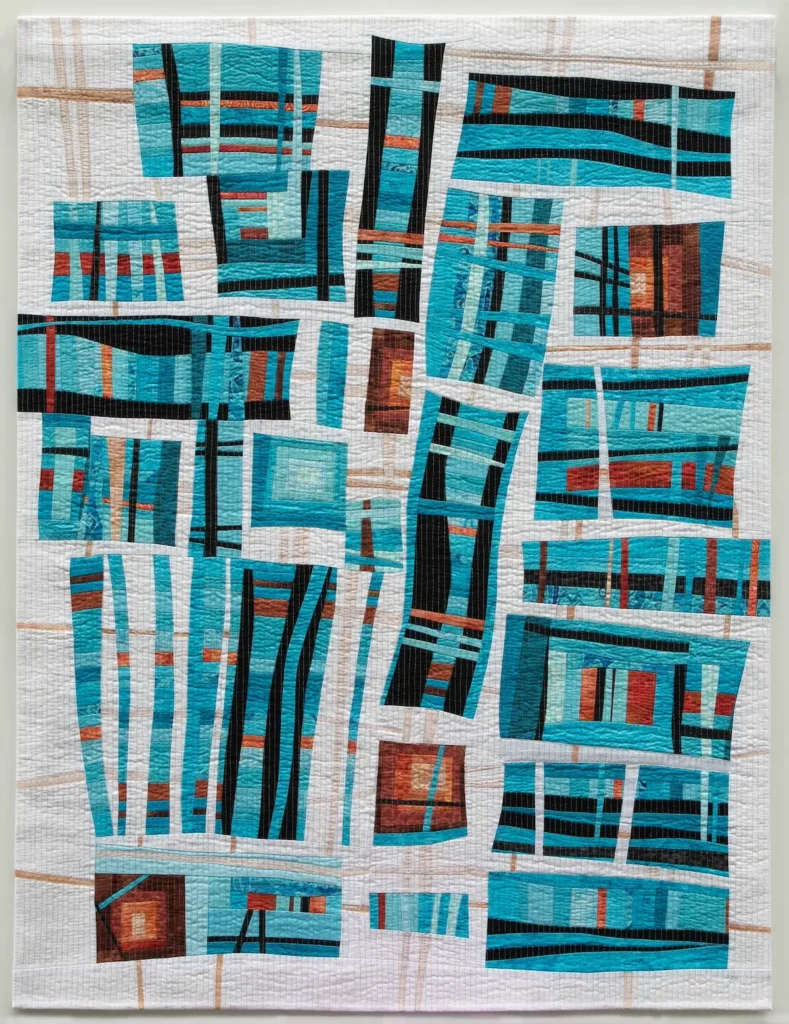
Other times I might create a composition sketch on my tablet and decide what techniques will best accomplish the design. My aesthetic is usually spare. I am more likely to remove something than to add something more. I think it is similar to wanting to find that one word or phrase with the right nuance of meaning rather than spewing out many sentences – that’s what I like to do in my textile art.
When it comes to creating, are you more of a planner or an improviser?
While I’m definitely a planner, I’m trying to be looser about taking risks, playing with fabric, and experimenting.
To enable risk-taking and not be overwhelmed, I might create some self-imposed boundaries, like a colour palette or a grouping of fabrics. I took this advice from Sherri Lynn Wood’s book “The Improv Handbook for Modern Quilters”. Jean Wells’ book “Intuitive Color and Design” has also been inspiring to me.
Do you use a sketchbook, journal, or technology to plan or keep track of ideas? How does that help your work develop?
While I do use a sketchbook to develop rough ideas for compositions, I am also a big user of my tablet to test options as my work is in progress. Because I like to make visual decisions visually, I’ll download a photo of the work in progress and use a drawing app to sketch on top of it to sample possible ways to advance the design.
For me, reducing it to a small scale on the tablet is equivalent to doing thumbnail sketches. I find this is especially helpful for making quilting decisions.
Do you have a dedicated space for creating? If so, what does it look like?
When renovation plans moved me out of my spot in a guest bedroom, I thought using a small finished area in our basement was temporary. But a free, used, drop-in sewing table changed my mind. It needed more space than the guest room with a bed allowed. Once I dropped my Juki into it, and managed quilting a twin-sized UFO, I never looked back.
Having a permanent spot and that large sewing table, surrounded by supplies and a nearby design wall, really amped up my design ability and productivity. No more putting everything away because guests are arriving!
I’d encourage any artist to see if they can claim a permanent spot, no matter how small. It can make a big difference.
Scraps. Saver? Or be done with them?
I have to save and use scraps. It would feel like betrayal of our quilting ancestors to treat them as disposable!
However, I have regifted some when I’ve realized they are no longer my taste or I’m just so tired of them, and they are consuming too much physical and mental space.
Working across many different media, how do you organize all of your creative supplies?
As my experimentation with surface design expands, this is a challenge! Storage creeping into other areas of my house is real. At the end of a project, I try to return things to their rightful place so I can quickly put my hands on them when I next need them.
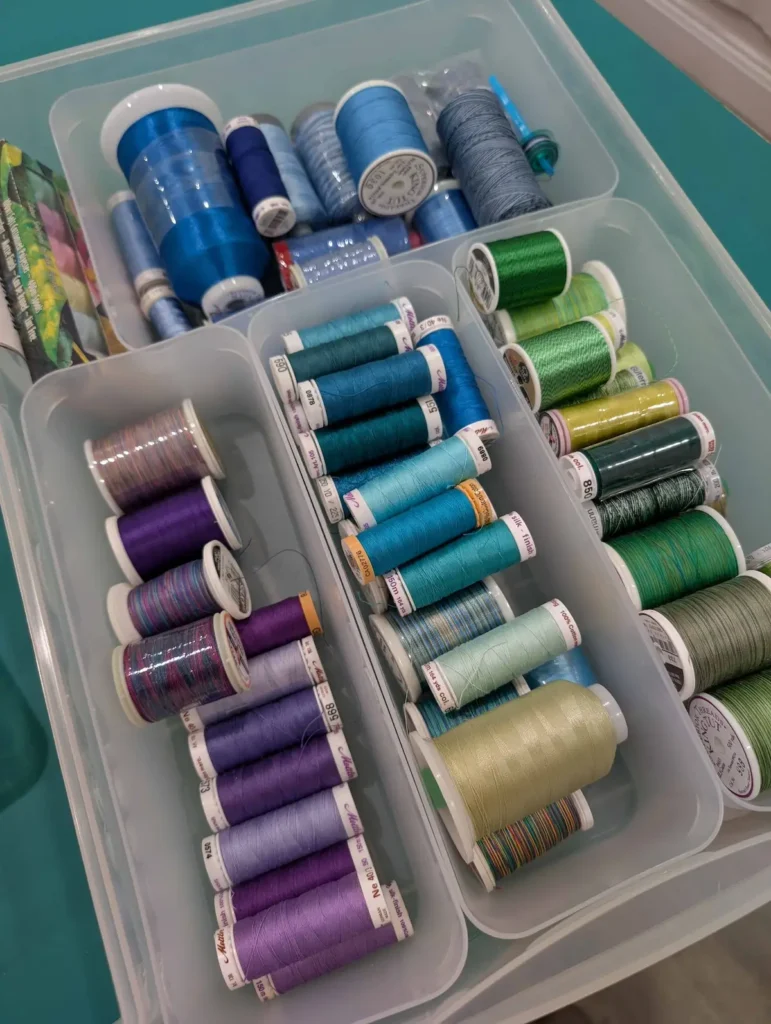
I do organize most fabrics and threads by colour families in drawers. I try to keep batting and supplies like fusibles and stabilizers tidy and close by on a shelf unit. While I see myself primarily as an art quilter, I do like to dye fabric and create unique surface designs, so I have storage bins of dyeing supplies and tools, and paints outside my studio.
I also have a photography area set up in our unfinished basement with a cloth backdrop, lights and a camera tripod. And, of course, there are my office supplies, business cards, and printed material at my desk, where my computer and printer live on another floor. See what I mean by creep?
Are you a “finisher”? How many UFOs do you think you have? Do you work actively on more than one project at a time?
Interesting questions. If a work is finished but isn’t taken all the way to being ready to hang on the wall – the decision not yet made if it will be faced, mounted in a frame, or stretched on a canvas – is that a UFO?
I tend to focus on one project until it gets to a stopping point. Usually, that point is when it is faced, signed, and prepared for hanging – fully done – which is very satisfying.
But that can also be when I get stuck on how to resolve an issue, possibly in design or construction. Or it could be that I need to figure out how to best present the work. Should I mount it on a canvas? Will it be part of a series that I’ll want to unify by how the work hangs with other pieces? I confess that pending deadlines can also put one project on the shelf in favour of another. There is nothing like a deadline to prod me into action!
All of this means that I usually have more than one design in progress at a time depending upon the situation. I prep small work for in-between times, when a concept for a larger work is gestating.
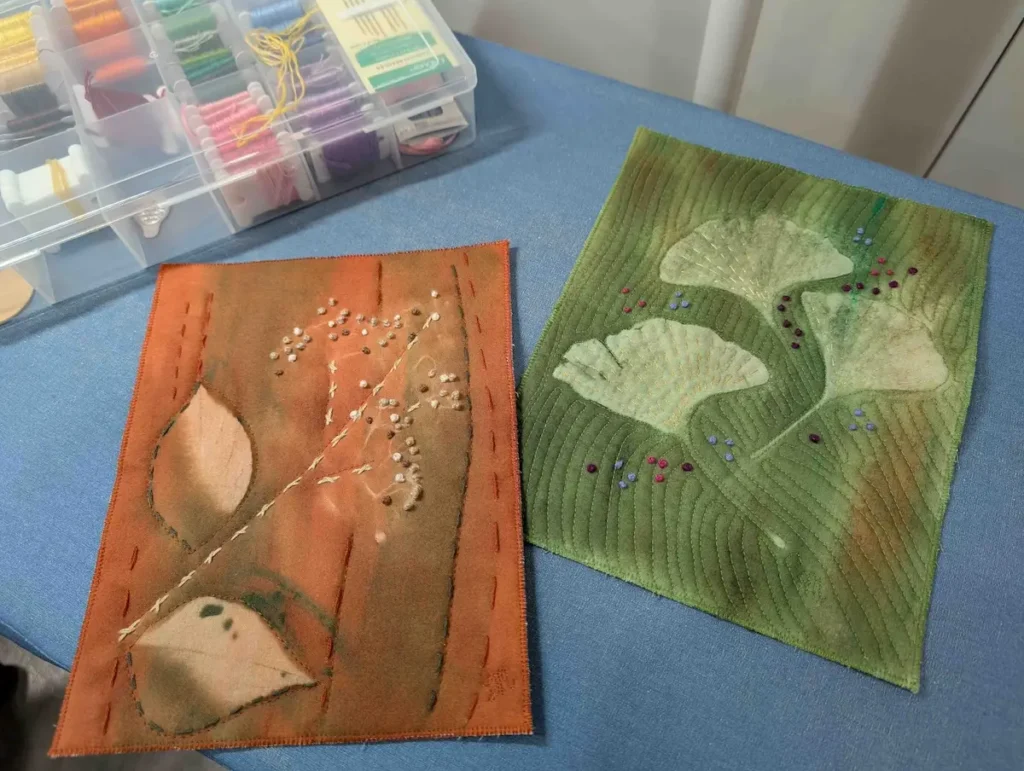
For example, I may layer and prepare to quilt a group of small sun and gelli prints, ready for hand or machine stitching. When the mood strikes me, having that step done removes a barrier to advancing that work. Is that a UFO or a work in progress?
Recently, I weeded out projects that I had no interest in taking further, either because I’d learned all that I wanted from them or that no longer interested me. Donating them freed up mental space. Life is short!
How do you manage your creative time? Do you schedule start and stop times? Or work only when inspired?
I try to spend time in my studio most days. Mornings are best for making design decisions so I try to protect that time if I’ve got some challenging things to accomplish However, if a project’s steps are clear, I might work morning, noon, and night on it. Seeing progress is addicting. At those times, I have to remind myself to take breaks to protect my body!
I think showing up in my studio is important, even if the only work that might happen is tidying up from the last project. Being with my materials and in my creative space inspires me.
Administrative tasks, like applying for exhibits and responding to opportunities, is necessary work but it can magically keep you at your computer for much longer periods than expected! I try to be conscious of this.
There are also periods when what is happening in the world, or in life, has sucked all the inspiration out of me. At those times, I go back to my traditional roots and sew simple blocks for a donation quilt. Sewing lovely quilt blocks, adding them to my design wall, still makes me feel good! When I sense my creative mojo returning, I’ll put the blocks away, knowing they will be there for the next lull.
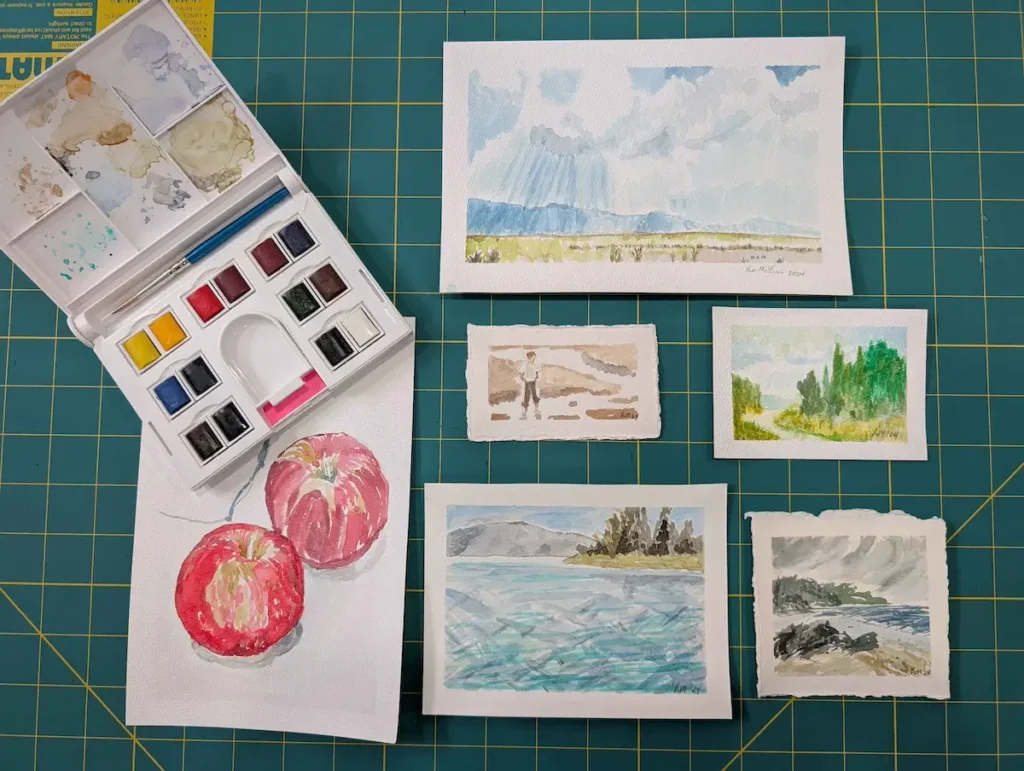
I also think about feeding my creative energy. I get out to local exhibits and galleries to be inspired by what other artists do. I like to consider how their artistic choices might apply to my own work. I listen to talks online. I pay attention to the world around me, snapping photos of textures, colours or scenes that speak to me. Plus, I take opportunities to do something out of my norm to stretch my art muscles, like a watercolour or block printing course, or a new technique.
I’m also a member and Atlantic Canada regional representative for SAQA – Studio Art Quilt Associates. My fellow art quilters are a huge source of inspiration and information.
Can you tell us about the inspiration and process of one of your works? How does a new work come about?
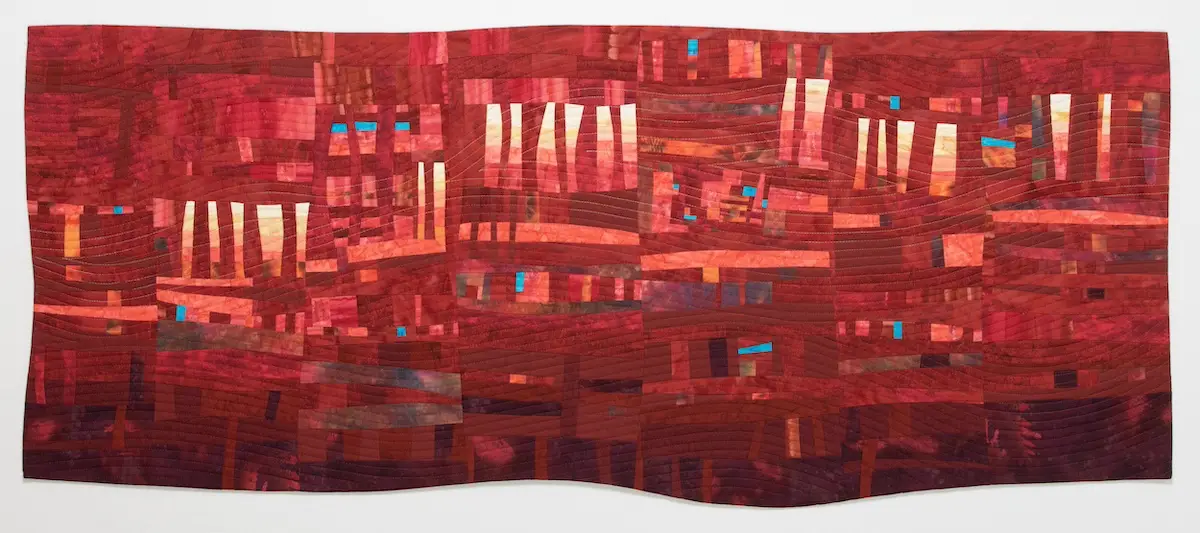
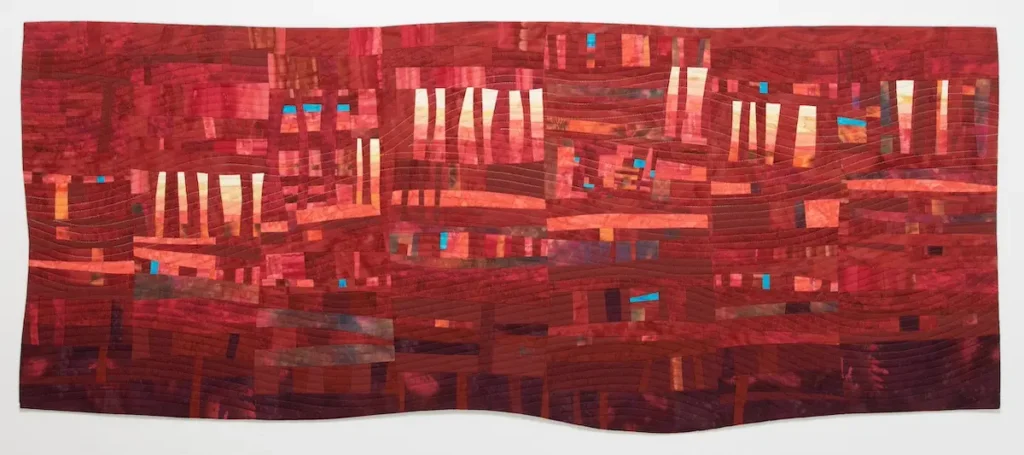
I designed “Eruption” as a response to SAQA’s (Studio Art Quilt Associates) call for entry, Primal Forces: Fire.
When I visited Iceland in 2019, I was fascinated with its unique geology and how it must feel living with constant volcanic activity. The reporting on the Grindavík eruption brought up memories of places I had visited. The drone video images, especially the night ones of active lava flows bubbling from a long open slash in the earth’s surface, were mesmerizing.
Inspired, I challenged myself to create an improvisationally pieced quilt that evoked the feeling of the earth splitting open, spilling out molten contents. Referring to multiple images that spoke to me, I pulled together both hand-dyed and commercial fabrics that represented the light and fire of molten and cooling lava. My intention was to create the sense of a lava field in an abstract way.
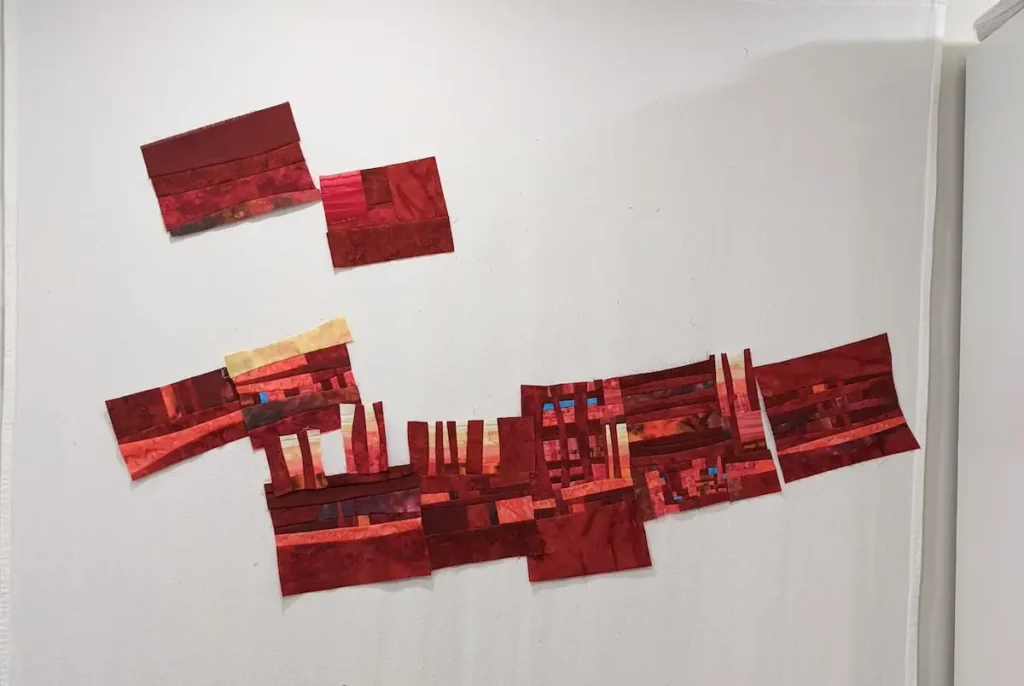
I made a conscious design decision to represent the terrible beauty of the eruption rather than focus on its destructive power, which of course is implied. I began to sew slices of fabrics together to create parts of a cooling lava field. On my design wall, I arranged the bright fire sections in an upward direction, to give a sense of flow, using a touch of blue to represent the hottest part of the fire.
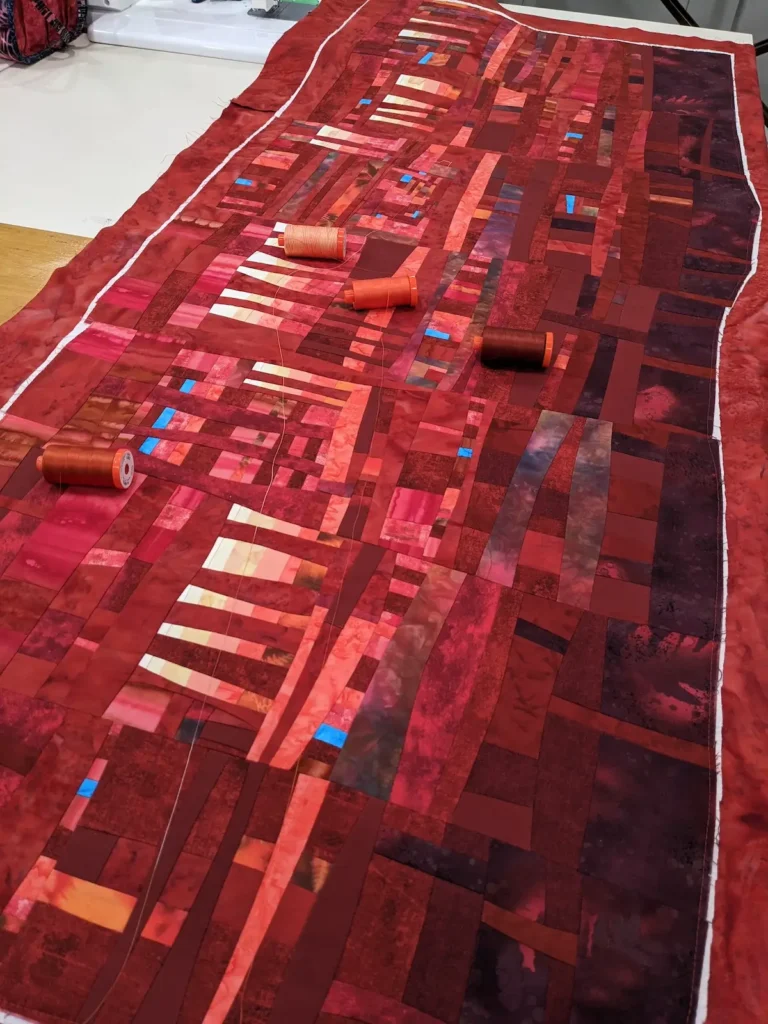
I made decisions about values and positions of fabrics to sew together, arranging them until I felt satisfied with the effect. Because I like my work to have impact from across the room, I take photos along the way to assess how it is going. I find that seeing it in a compact format somehow highlights problems that need resolving.
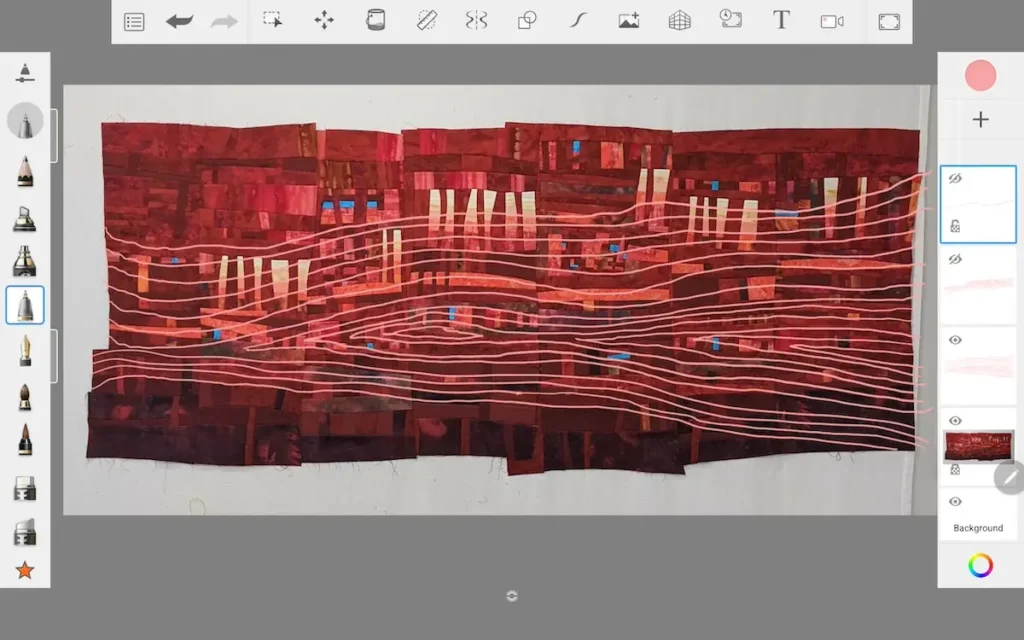
When I get to the stage where the quilting layer needs to be designed, I download a photo into a drawing app. I’ll study my work and draw quilting options that make sense with my concept. In “Eruption”, my quilting stitches had to support the piecing idea of moving lava, so I used gentle curves. “Eruption” is part of the exhibit that opens at the National Quilt Museum in Paducah, Kentucky, traveling until 2028.
Which part of the design process is your favorite? Which part is a challenge for you?
Because material is central to my work, choosing colours and fabrics to achieve the design are my favourite part of the process.
A lot of my designs are driven by a colour combination. I find choosing the right scale can be a challenge; what is the best size for this idea? What should the dimensions be? “Eruption” is 24” by 57” – I thought it needed that width to give a sense of the scale of the lava flow. In the end, the width of my design wall flannel is a hard limit!
What’s the best piece of advice you’ve received?
I have several things that have been very helpful.
The professional advice came from sculptor and ceramist Peter Powning in a talk to students – he encouraged us to apply for things and not do the jury’s work in advance by deciding that you won’t get in.
Also, don’t take a rejection personally – it may just be that the money ran out or there just wasn’t more room in the exhibit, or that the taste of this juror ran a different direction than yours.
The other was artistic advice. Don’t think you have to say or do everything perfectly in that one piece. You can say it better or differently in the next piece, and the next.
Where can people see your work?
I’ve got work in several group exhibits that are happening:
Primal Forces: Fire, Studio Art Quilt Associates global exhibition 2025-2028, National Quilt Museum, Paducah KY USA, Sept. 12 – Dec. 2, 2025; Lewis-Clark State College Center for Arts & History, Lewiston ID USA, Jan. 6 – Mar. 28, 2026
NBCCD Alumni Show, George Fry Gallery, Fredericton NB CA, Sept. 18 – Nov. 19, 2025
Navigating, Studio Art Quilt Associates Atlantic Canada region, Cape Breton Centre for Craft and Design, Sydney NS CA, Aug – Oct. 2025
Displacement, Connexion ARC Members show, UNB Arts Centre, Fredericton NB CA, Oct. 24 – Dec. 15, 2025
Renewal, Studio Art Quilt Associates Canadian regions exhibition, Bruce County Museum and Cultural Centre, Southampton ON CA, Jan. 10 – Apr. 19, 2026;
Also, an upcoming solo exhibition at Saint John Art Centre, Saint John NB CA, May 1- June 26, 2026. Always check out my website https://www.leemclean.ca/ or my Instagram account https://www.instagram.com/mclean.lee/
Interview posted September 2025
Browse through more inspiring art quilts on Create Whimsy.