

Holly Wong builds immersive worlds from tulle, thread, fire, and myth. Her work invites you to move through light, memory, and repair, where fragile materials reveal surprising strength. She shares how meditation, material play, and ancient stories guide her evolving practice.
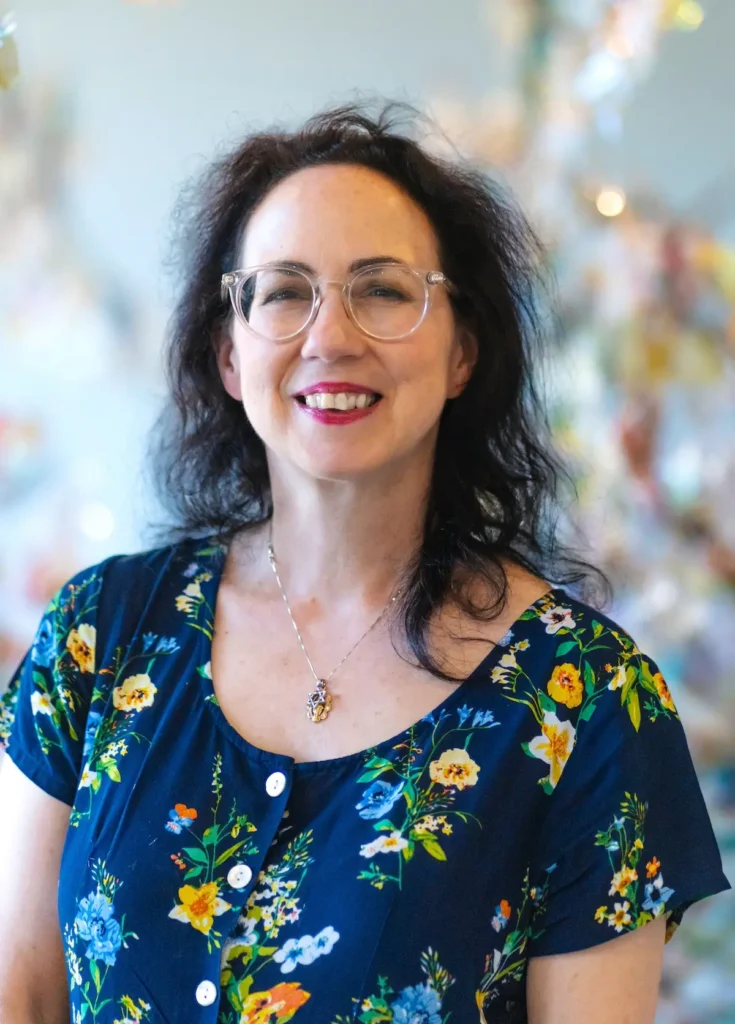
What were some early creative moments that shaped you?
Growing up, I learned the value of perseverance and transformation through difficulty.
My mother was a skilled seamstress who often made our clothes, and watching her transform fabric into something new planted early seeds.
My creative foundation really solidified through formal training—getting my MFA from San Francisco Art Institute gave me permission to experiment and push beyond traditional boundaries.
As an Amazon Associate I earn from qualifying purchases. Read more about our affiliate linking policy.
When did you begin moving from drawing and painting into larger, more experimental work?
Around 2018, I began integrating installation work as a part of my practice. I was craving something more experiential—I wanted viewers to walk through and around the work, not just look at it on a wall. That shift opened up everything.
The move to fiber and suspended sculptures felt natural because these materials embody the themes I’m drawn to: resilience, fragility, transformation. Thread and fabric have memory—they hold tension, they can be mended, they float.
What ideas or stories guide your work today?
My work centers on radical repair—the idea that we can transform challenging experiences into works of beauty through contemplative mending processes.
I draw heavily from Greek mythology, particularly the rivers of the underworld. My “Lethe’s Garden” series explores forgetting and renewal, while “Mnemosyne Rising” examines how we hold and honor memory. Both address healing and resilience. As a Soto Zen Buddhist practitioner, these themes of letting go and returning are central to my daily life and artistic practice.
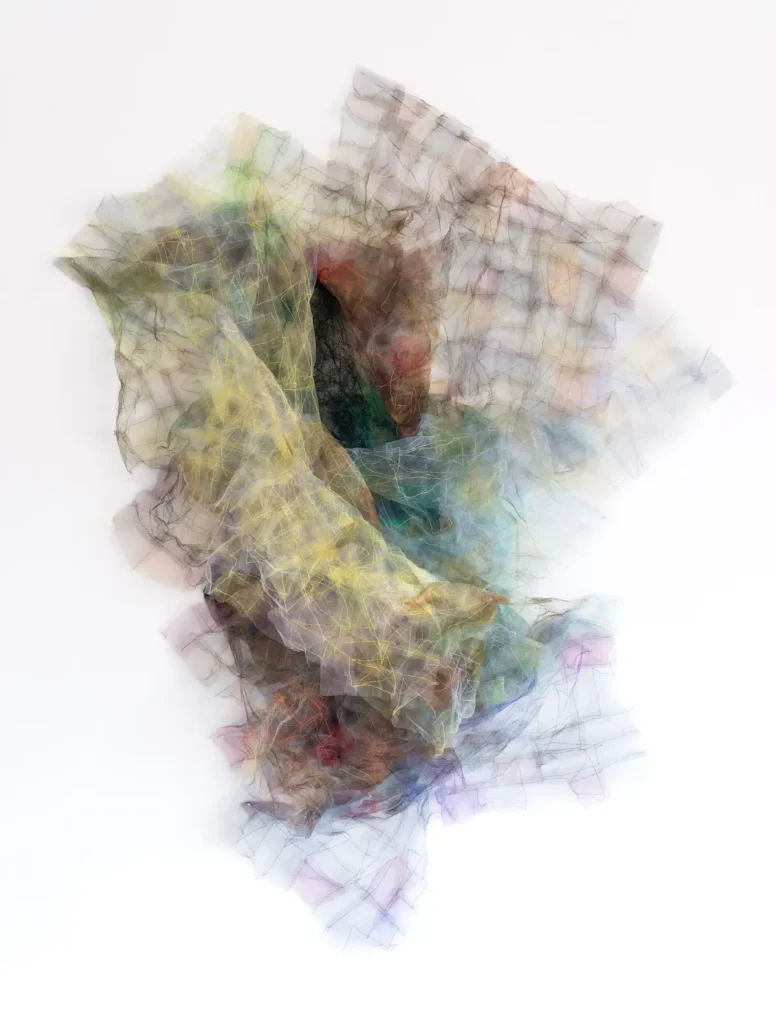
Your art often looks delicate but strong. Where does that mix come from?
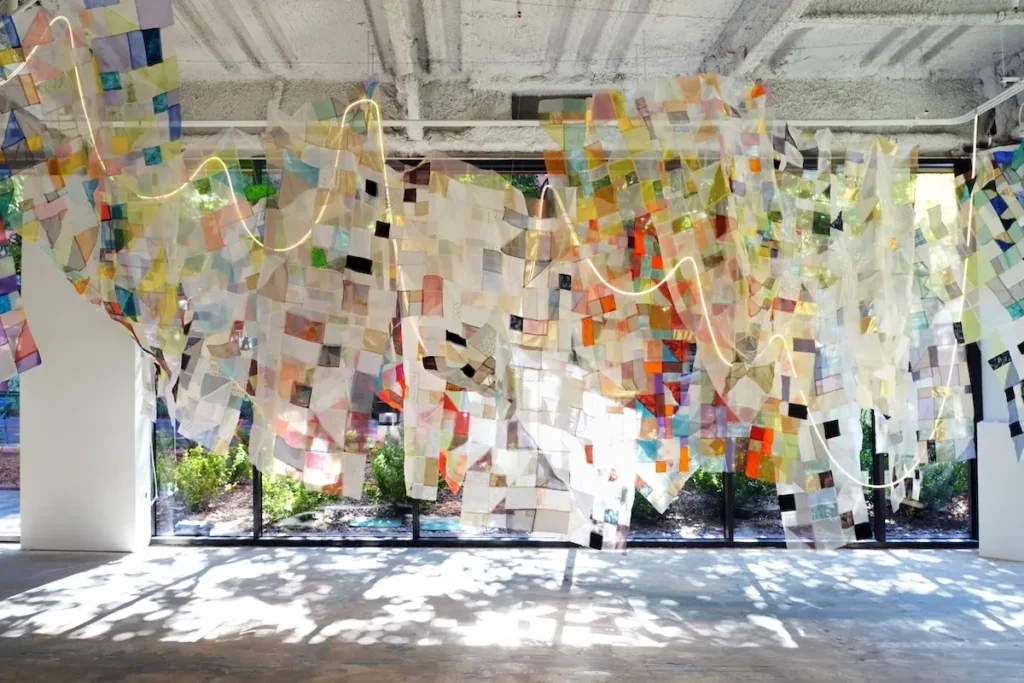
That tension comes from the materials themselves—polyester tulle and crinoline appear gossamer and fragile, but they’re actually quite strong. They can be burned, stitched, layered, and suspended under tension.
This mirrors the human experience: we’re vulnerable yet incredibly resilient. The delicacy invites people in, creates intimacy, while the underlying structure holds everything together. It’s about finding strength through vulnerability.
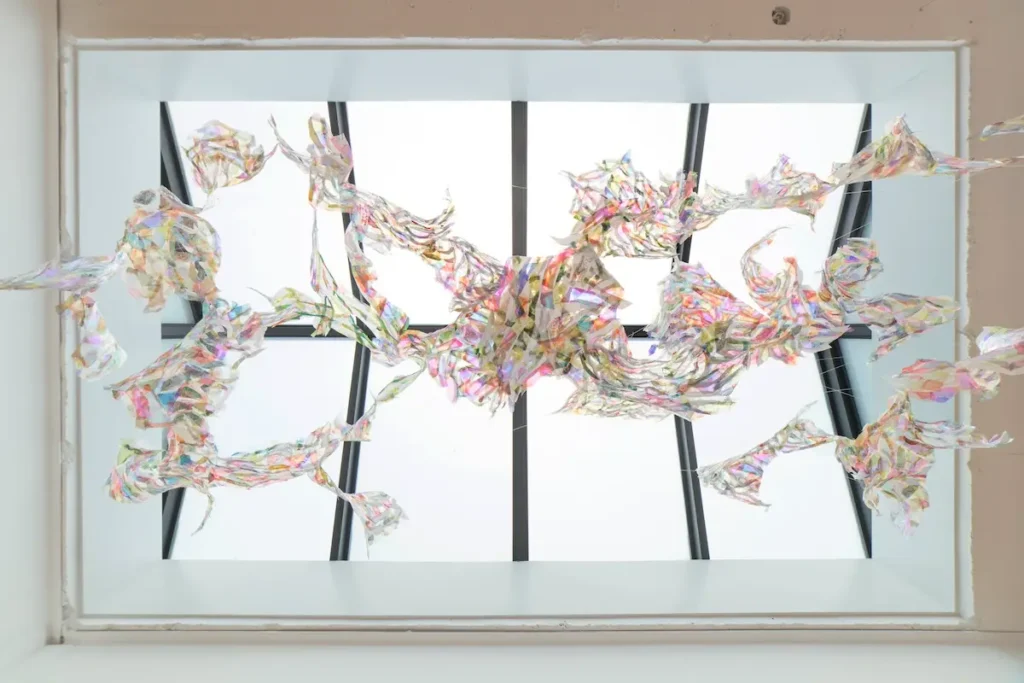
What inspires you to work with light, shadow, and transparency?
Light transforms everything. When light passes through transparent materials like tulle, organza, or dichroic film, it creates these ephemeral, shifting compositions.
The work becomes alive, responsive to changing conditions. Shadows double the imagery, creating ghostly presences. This aligns with my interest in memory and healing—how experiences aren’t fixed but shift based on perspective and time. The California Light and Space movement deeply influenced this aspect of my practice.
Where do you go or what do you do when you need a boost of inspiration?
I start each day at 3:00 am with meditation, which centers everything. Beyond that, I walk through my neighborhood, observing light on water, fog moving through trees.
Museums are essential—seeing how other artists solve problems or take risks refreshes my own thinking. Lately, I’ve found inspiration in Pattern and Decoration movement artists and second-wave feminist fiber work.
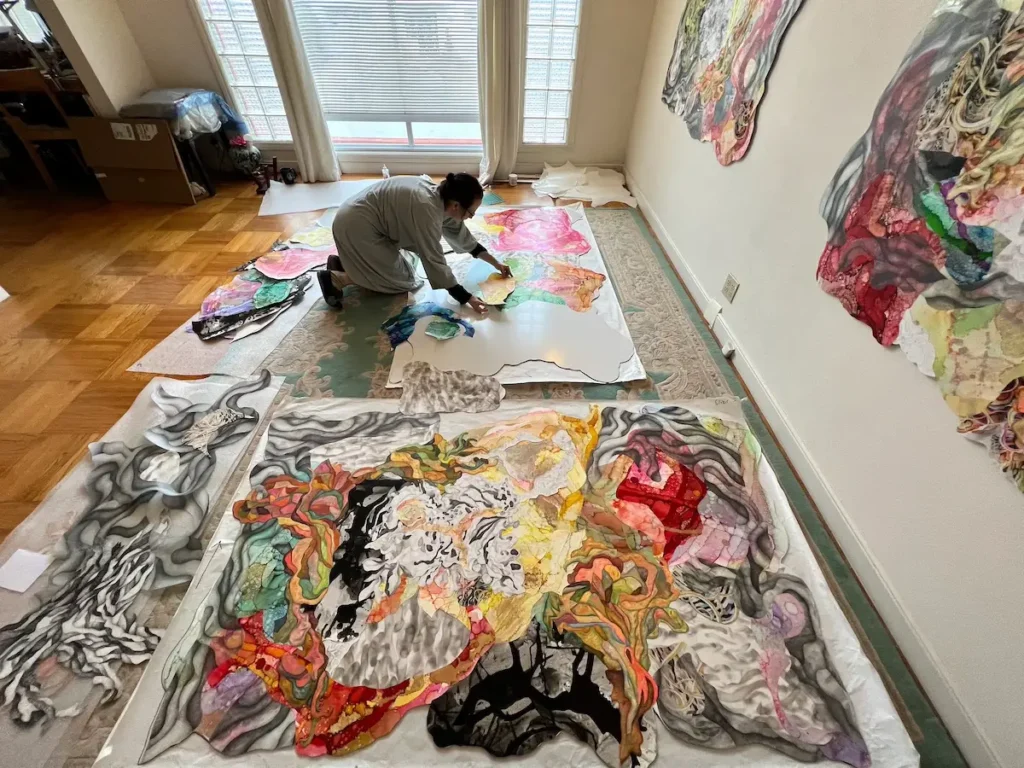
Describe your creative space.
My studio is my sanctuary—a dedicated space where I can leave large installations suspended and in-progress. I have areas for different processes: a sewing station, space for burning and heat-treating materials, walls for my collaged paintings, and enough ceiling height to suspend work at full scale.
Natural light is important for seeing color accurately, and I need room to step back and view pieces from multiple angles.
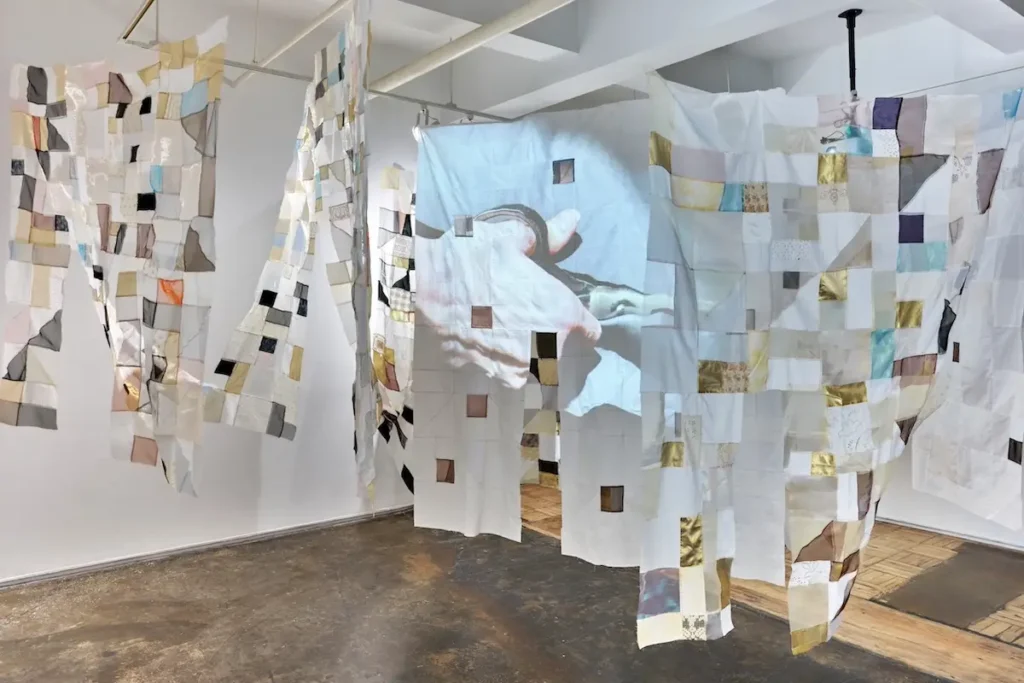
You use tulle, film, thread, drawing, paint, and even fire to create your work. What materials feel essential to your practice right now?
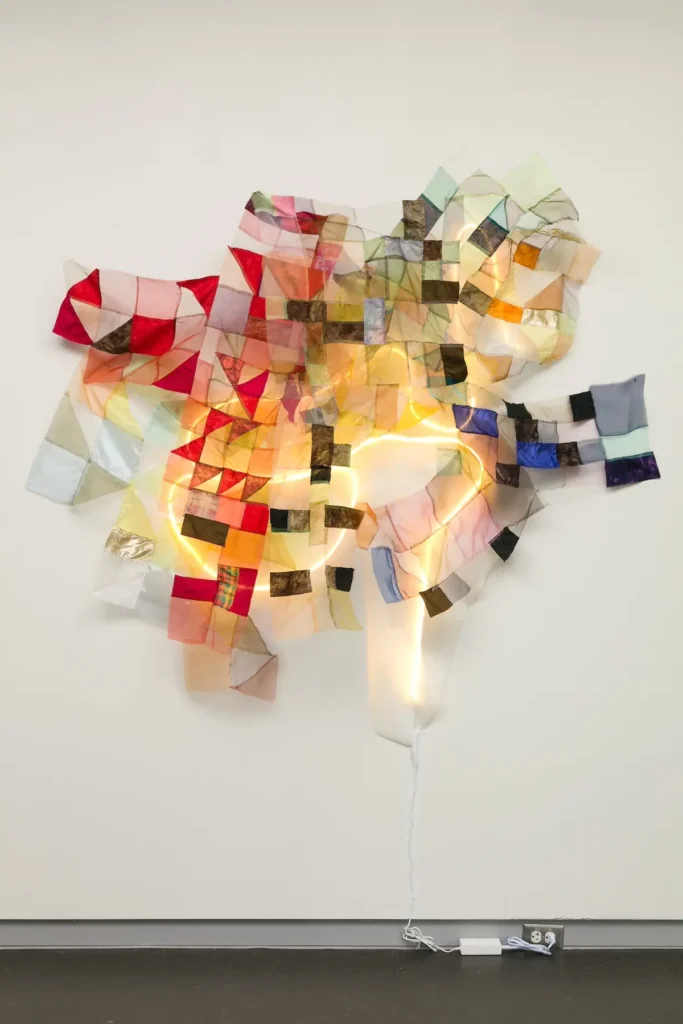
I’m increasingly excited about dichroic film, which creates rainbow effects with light. LED lighting and projection fabric are opening new territories, allowing me to incorporate video elements.
The combination of traditional craft materials with contemporary technology feels essential right now. And fire—using candle smoke to burn and smudge imagery is core to my drawing and painting process.
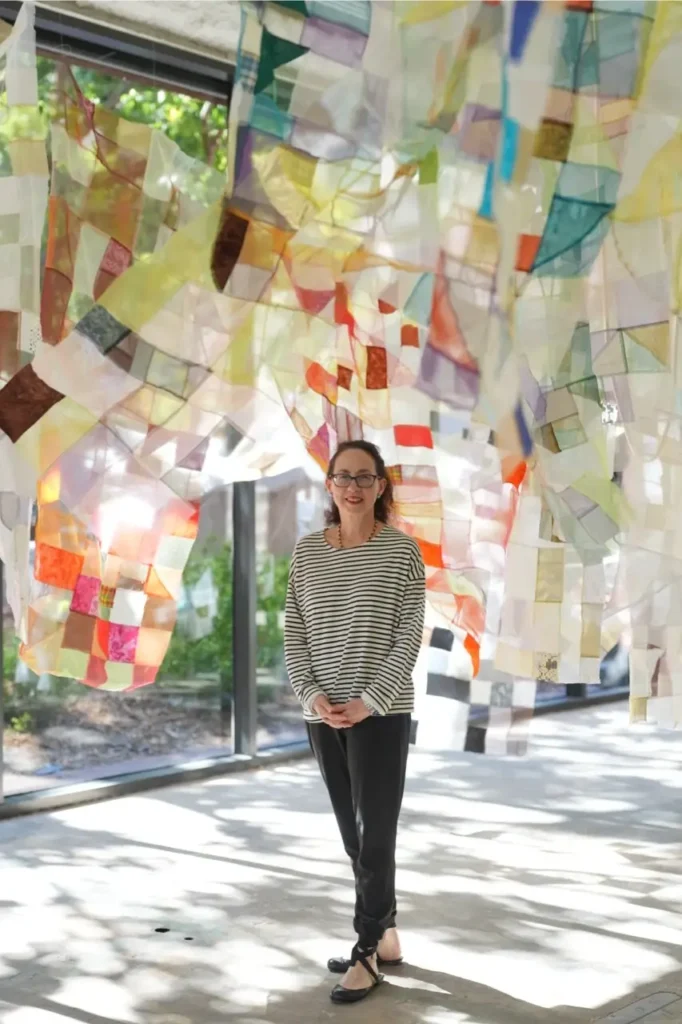
What do you love about building installations instead of working flat on a wall?
Installations create an immersive experience. Viewers become participants, walking through layered spaces where their movement changes what they see. The work shifts with air currents, creating a living quality.
There’s also something about claiming three-dimensional space that feels powerful, especially in the tradition of feminist fiber art. These pieces can’t be easily commodified—you have to be present with them. That feels important.
How do you choose the colors, textures, and layers for a new piece?
Color choices often come from the conceptual framework—deep blues and greens for ocean-themed “Thalassa” works, or monochromatic/smoke tones for memory pieces.
I layer intuitively, building up transparency until the density feels right. Sometimes it’s about obscuring and revealing, creating veils that shift as you move around them. Texture comes from varying materials—smooth organza against metallic threads catching light.
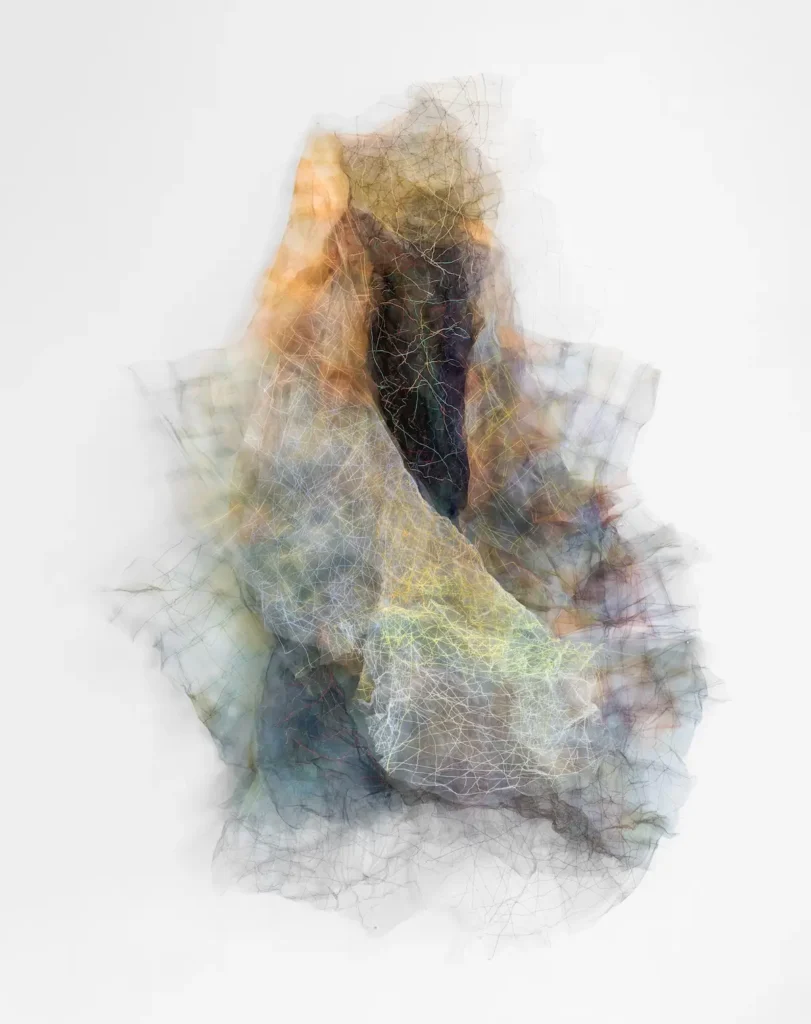
Can you walk us through how a piece begins — from first idea to finished work?
It usually starts with a concept rooted in mythology or personal narrative. I sketch compositionally but loosely—I’m not trying to predetermine everything. Then I begin gathering materials, dyeing fabric if needed.
The construction is contemplative: hand-stitching, building up layers. For installations, I work in sections that get assembled on-site. There’s always problem-solving with engineering—how to suspend forms, how to get fabric to hold a shape. The process can take months, working daily in my studio.
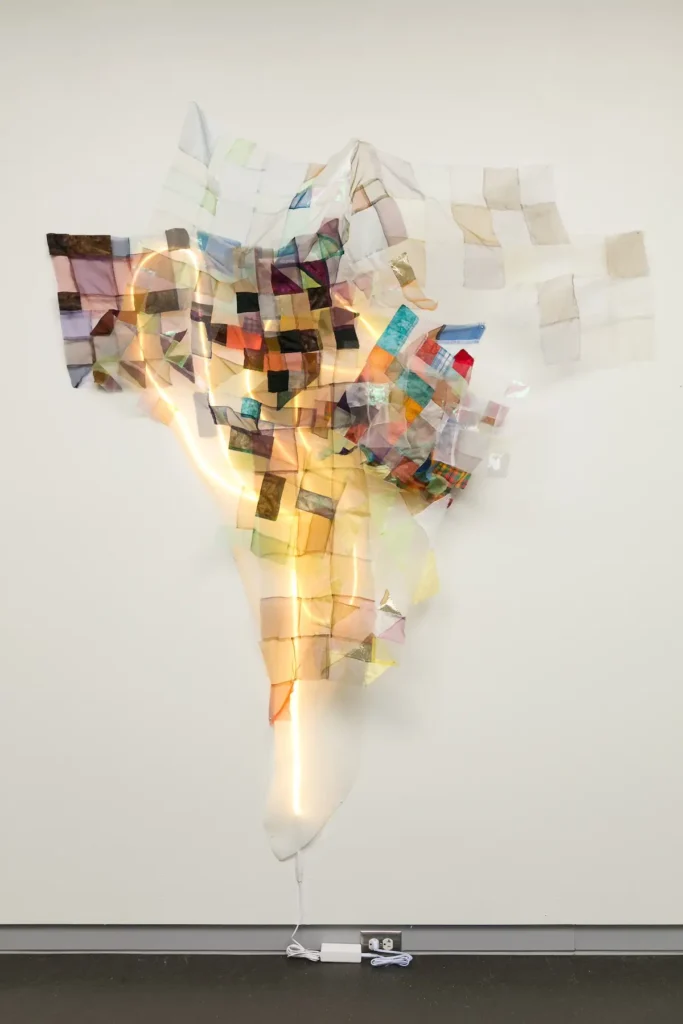
Do your projects start with sketches, or do you let the materials guide you?
Both. I start with conceptual sketches and rough compositional ideas, but the materials absolutely guide the final form.
Fabric behaves in particular ways—it flows, catches light, and holds tension. I have to respond to what it wants to do.
Some of my best discoveries happen when I’m problem-solving material challenges. That dialogue between intention and material reality is where the magic happens.
What challenges come up when you’re building work that hangs, floats, or shifts with the air?
Engineering is constantly challenging—figuring out weight distribution, how to suspend forms securely while keeping them visually light.
Each installation space has different considerations: ceiling structure, lighting conditions, traffic flow.
Shipping is complex—these pieces need to travel safely, then be reassembled. And because the work moves with air, I have to account for HVAC systems, doors opening and closing.
It’s part engineering, part problem-solving, part surrender to conditions I can’t control.
How do you decide when something is finished, especially when your pieces feel so open and alive?
This is always the hardest question.
Generally, I know it’s finished when adding anything more would diminish rather than enhance. There’s a moment when the layers achieve the right balance between transparency and opacity, when the composition feels resolved.
Sometimes I have to install the work to know it’s done—seeing it in space reveals what needs adjusting. I try to stop before I overwork it.
What advice would you give to someone who wants to explore unusual materials or installation art?
Start experimenting fearlessly. Buy small amounts of materials and just play with them—burn them, stitch them, layer them, see what they can do.
Don’t worry about making “finished” work at first. Taking workshops helps if you want to build larger suspended pieces—understanding weight, tension, and structure is crucial.
Look at lots of installation art to see how others solve spatial problems. And be patient—developing a material vocabulary takes time.
Where can people see your work?
Currently I am participating in several group shows: “Perfectly Lost” at Walker Fine Art Gallery in Denver through January 17th, “Future Forward” at ELLIO Fine Art Gallery in Houston through January 10th, and “Little Gems” at SLATE Contemporary in Oakland through December 31st. Also, I’m planning a solo exhibition at Rosemary Duffy Larson Gallery at Broward College in Florida opening February 19, 2026.
My website https://hollywongart.com/ has images of recent work and upcoming exhibitions, publications, and much more. Hope you can check it out!
Rapid-Fire: Favorite material right now: Dichroic film—the rainbow effects are mesmerizing.
Rapid-Fire: Morning or night maker: Definitely morning—I’m in the studio by 4 am after meditation.
Rapid-Fire: One word to describe your art: Transformative.
Rapid-Fire: What sparks joy for you today: Watching light move through suspended fabric in my studio.
Interview posted December 2025
Browse through more Bojagi and fiber art on Create Whimsy.