
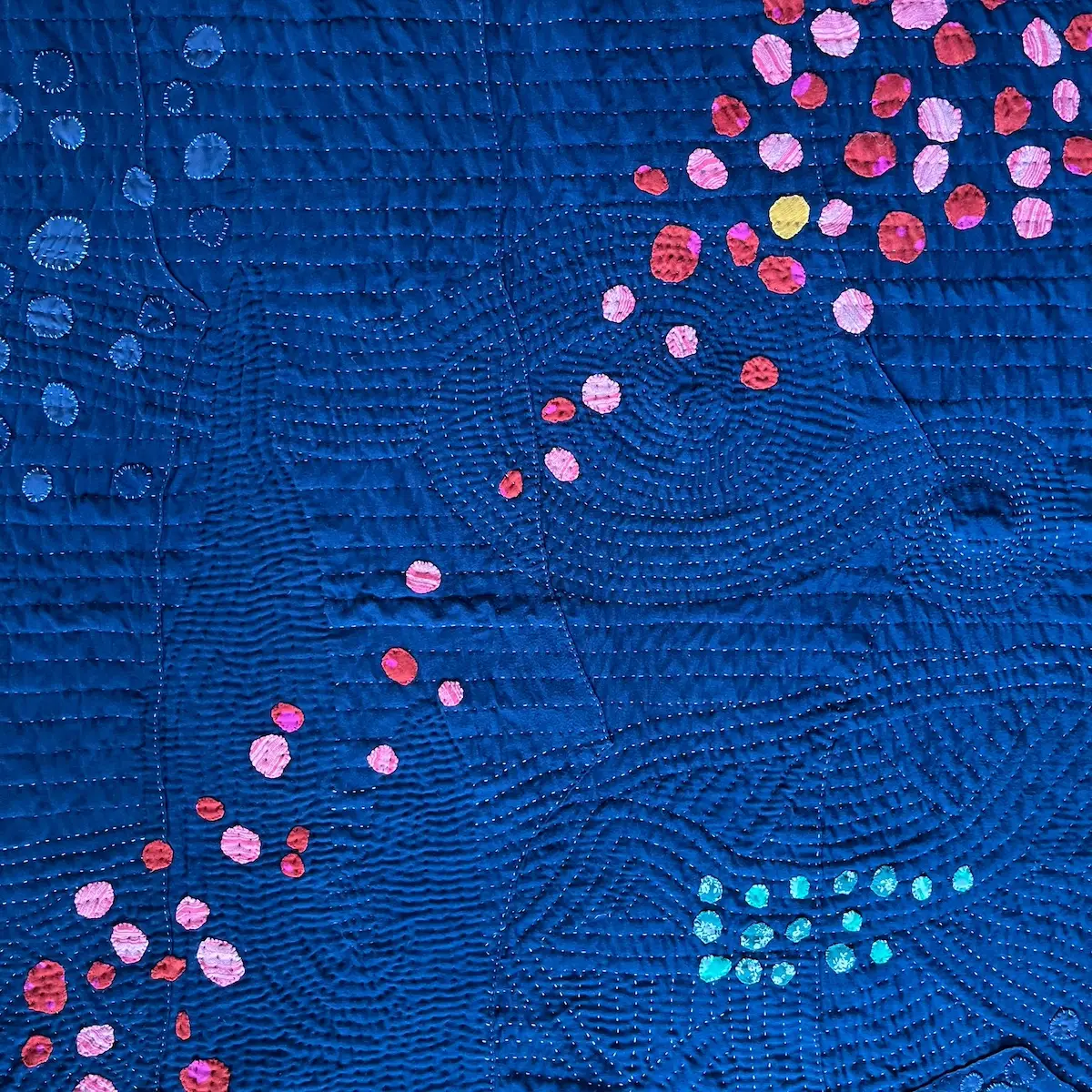
Every scrap of fabric has a story to tell, and Claire Voelkel-Sedlmeir is a patient listener. Through her quilts, she transforms everyday materials and sentimental keepsakes into art that carries memory forward. Her hand-stitching practice celebrates imperfection, emotion, and the quiet beauty of reuse.
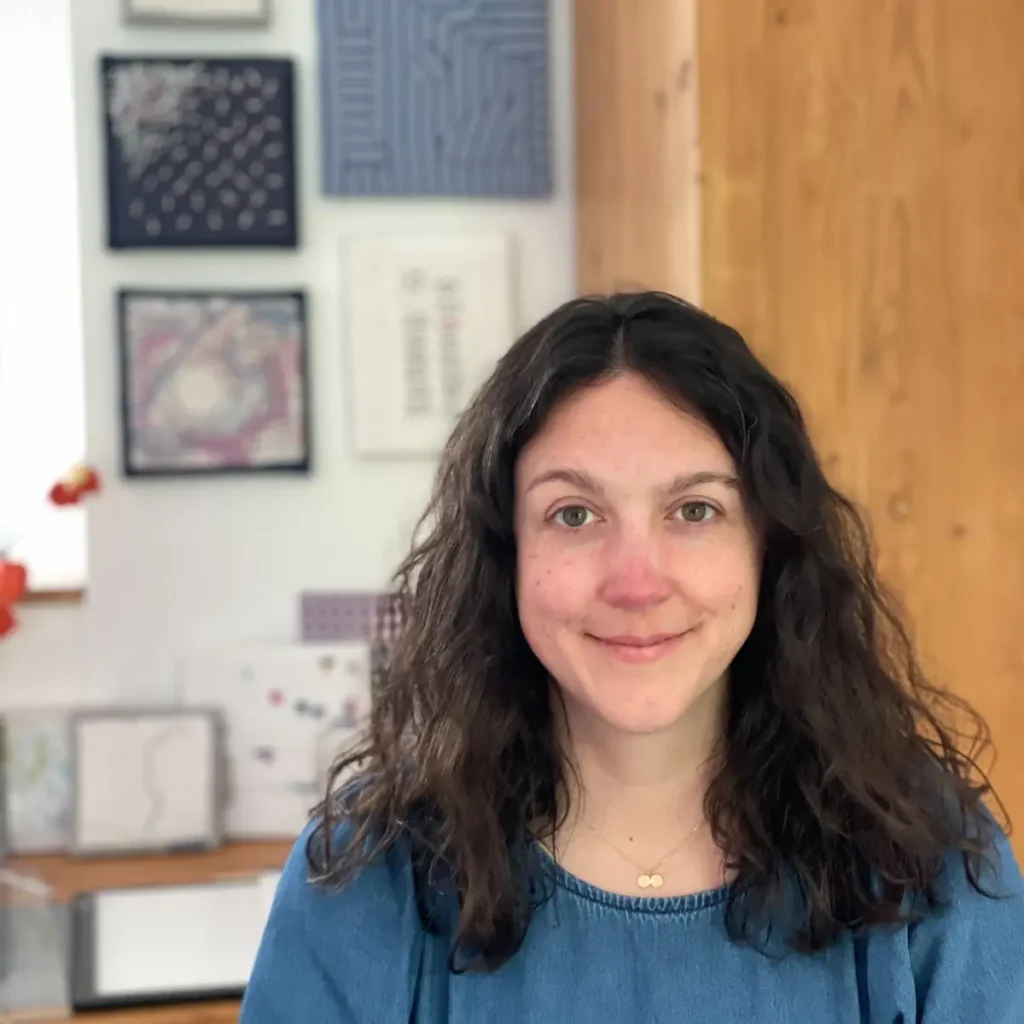
Who in your childhood encouraged your creativity?
I come from a long line of women who instinctively made things with their hands for the people they loved. My Portuguese great-grandmother crocheted intricate white tablecloths to fit huge, elaborate dinner tables.
I was famous in my elementary school for the sweaters my grandmother knitted for me, and my mom was always gathering with her friends to help create things for fundraising craft fairs.
Though I didn’t really sew, knit, or crochet as a child, having this model of creativity as an active part of life and a way to show love and care definitely made an impact on me.
As an Amazon Associate I earn from qualifying purchases. Read more about our affiliate linking policy.
Where do you go or what do you do when you need fresh inspiration?
Honestly, usually just my Instagram feed. I am overwhelmed by the talent you can see there at your fingertips and am so grateful for how accessible ‘looking at art’ has become.
Beyond that, I page through a treasured book of Gee’s Bend quilts https://www.soulsgrowndeep.org/gees-bend-quiltmakers , or work by Reiko Koga https://www.riekokoga.fr/ and Tilleke Schwarz https://www.tillekeschwarz.com/ always gets me inspired.
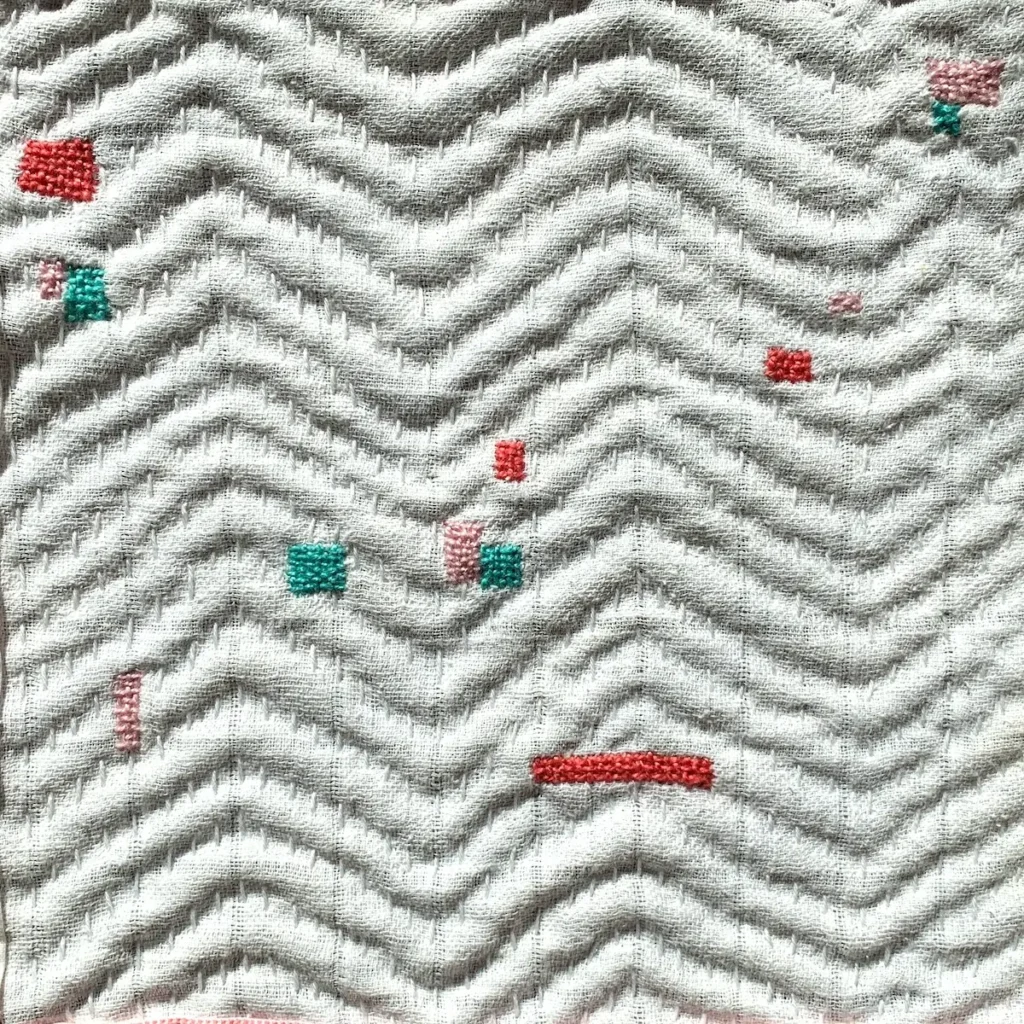
You mention working with fabrics that already carry stories — your father’s clothes, your children’s socks, even old diapers. Can you share a piece you made with one of these, and how you felt working with that memory-infused material?
My mother-in-law gave me a pile of my husband’s old diaper cloths, meant as rags that I could use for cleaning. Taking that cloth, full of holes and spots, and filling it with colorful mending really ignited a spark in me for seeing the beauty within discarded materials.
I recently made a quilt entirely from repurposed clothing, both of people I love and complete strangers from the goodwill bins. It felt infused with the souls of the people whose clothing I was stitching together. When working with those materials, I can’t help but think of all the adventures those clothes have lived through- they could have been worn on the best day of that person’s life, or their worst.
Weaving those stories together through thread feels like a great honor to me.
How do you decide which sentimental fabrics to use (versus letting them sit untouched)? When you stitch into a sentimental piece, how do you balance preserving its history with creating something new?
My practice of using sentimental fabrics actually started for purely mundane purposes- I wanted to attempt my first quilt (it was Heidi Parkes’ Story Quilt Top on creativebug) https://www.creativebug.com/classseries/single/story-quilt-top-a-daily-practice-in-hand-stitching and just scrounged what I had in the house- cutoffs from my son’s curtains and old clothes from everyone in the family.
There aren’t any fabric stores near where I live, so using what I had or thrifting used clothing came from pure necessity. Beyond that, I believe strongly in sustainability and reducing textile waste, so it feels completely natural to use fabric that already exists in the world.
To be honest, I don’t feel a lot of pressure to be precious with repurposed fabrics, even sentimental ones. I feel like, regardless of how I use them, stitching them into something that will be seen and appreciated rather than stuck in a box or thrown away, they have a greater history than they would have had otherwise. I often use my father’s or father-in-law’s shirts by cutting them up and reassembling them as a backing fabric for my quilts. They aren’t the highlight, but it brings me solace to feel them there.
The only fabrics I’m still feeling are too precious to use are my kids’ worn-out, mended, holey-kneed jeans. I look at them and can picture all the adventures they went on. They deserve a special project that I haven’t thought of yet.
Describe your creative space.
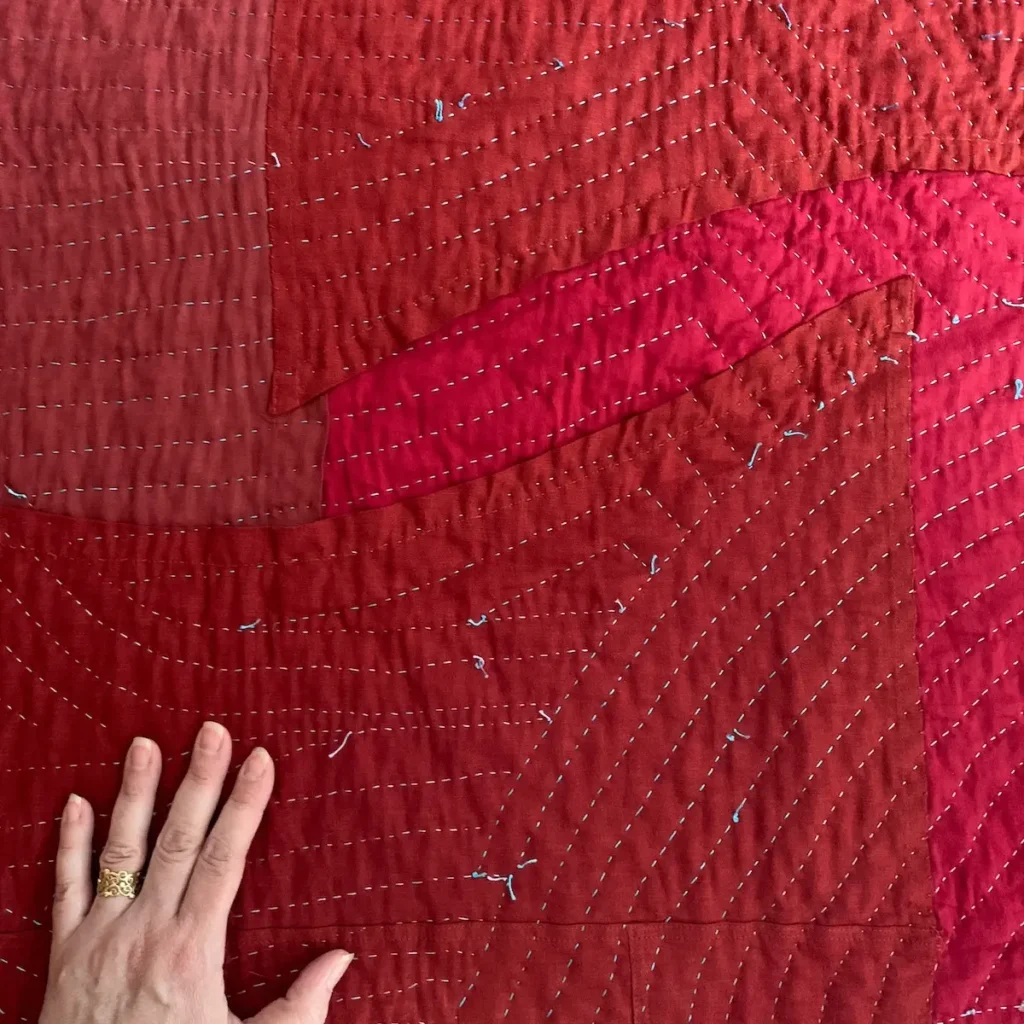
I am incredibly privileged to have a room on the top floor of our home as my creative space- I sit at my desk overlooking a huge walnut tree and watch my favorite pair of wood doves come and go every day.
Walk me through a typical studio day. What happens first?
I don’t have a typical ‘studio day’ per se, but just a few hours here and there when I can get them.
My three kids leave around 8 am, so I take a cup of coffee up to my studio soon afterwards, tending to freelance editing work, hatching ideas, and then doing laundry and getting groceries before the kids arrive home again at 11 or 1, depending on the day.
The stitching time usually comes only in the evenings once the kids are in bed. I need those quiet-house daytime moments for the ideas and the evenings for the actual working.
What tools or materials can you not imagine working without?
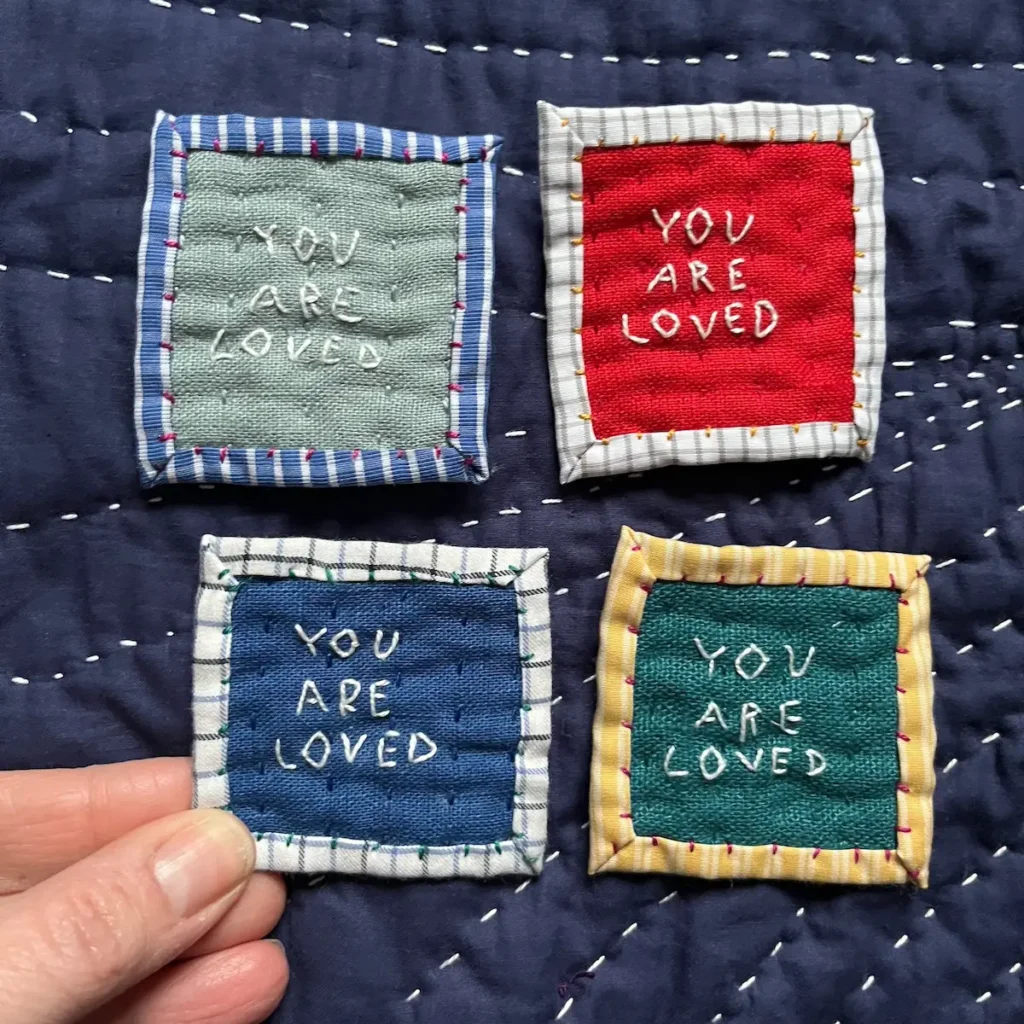
Nothing fancy- some perle cotton, a sharp milliners needle, my two leather thimbles that are so worn out they are starting to get holes, and whatever fabric I can get my hands on.
How do you take a small idea and turn it into a finished piece?
I don’t overthink, I just go for it.
I am a perfectionist in many other areas of my life, and it often slows me down or prevents me from starting.
I’m so grateful that in the stitching world, I’m the opposite- it’s the sphere in my life where I absolutely see the beauty in imperfection, wobbliness, mistakes, and flaws. That’s probably why I feel so at home here- it’s my safe space.
Do you plan each step or let the work evolve as you go?
I usually start with some sort of sketch or idea in mind, but I find that the best results happen when I let the work take me where it wants to go.
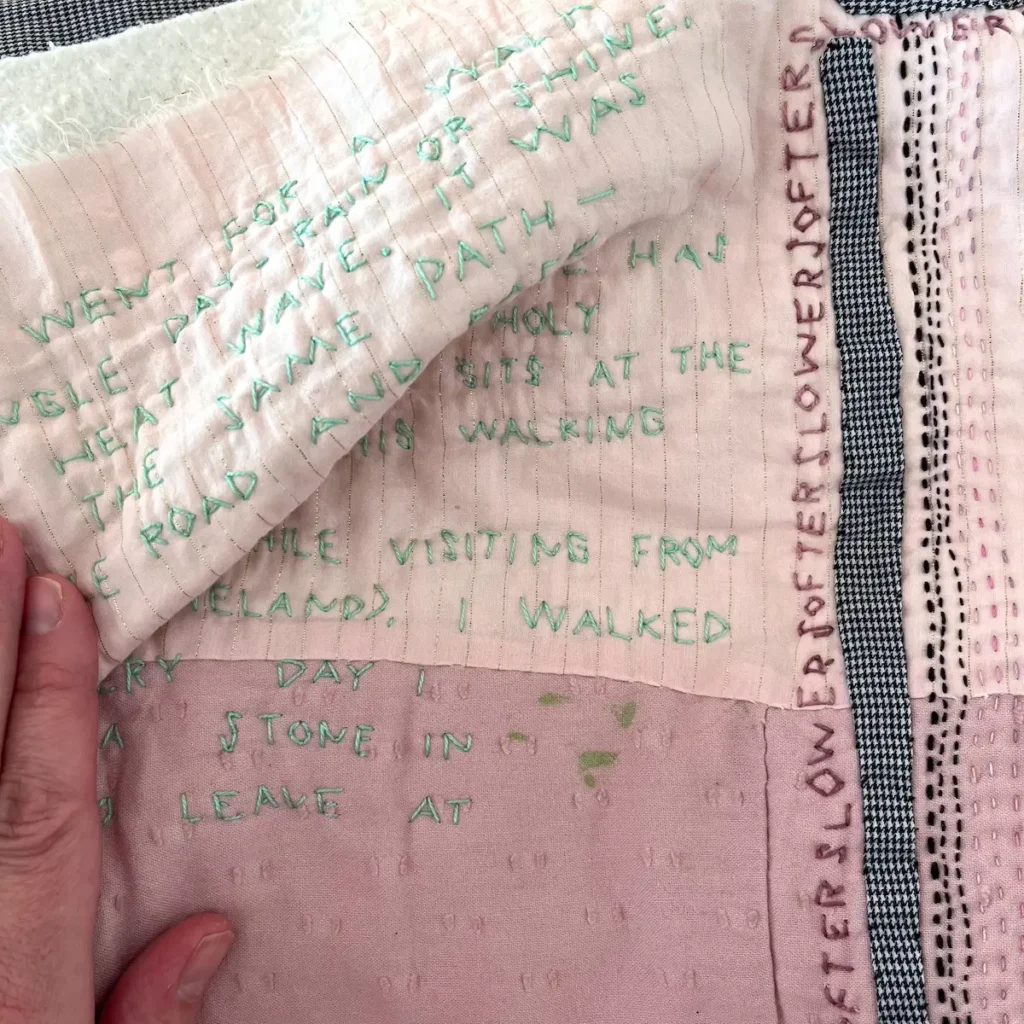
The quilt I am currently working on, for example, is a very personal piece which began about my father and the walks he took every day. I echoed those walks this summer, now to leave pebbles on his grave.
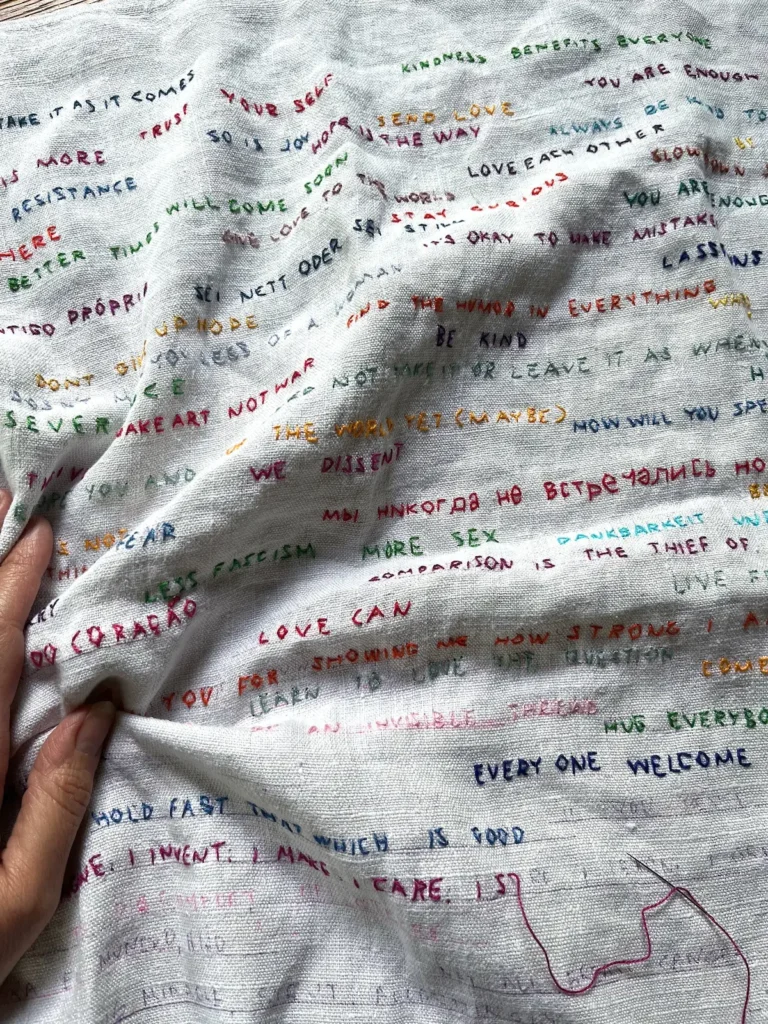
As I continued working on this quilt, I was surprised at how many feelings came up, how many layers unraveled about our relationship, and at my desire to document all those layers.
I began stitching text all over the piece, and in doing so, possibly discovered a new direction I’d like to go in in my future work. Being open to evolving is where the magic happens, I think.
When a piece isn’t working, how do you know when to abandon it or keep pushing?
Oh I am 100% team abandon!
If something is fighting you or not giving you joy, I absolutely support moving on.
That doesn’t mean I might not come back to that project at some point. Sometimes ideas just need time to germinate or some time away to be reconsidered. I always have multiple projects going that fulfill different moods or techniques- and a drawer full of things I’ve started and never finished.
Do you have a favorite moment in the making process? What is it?
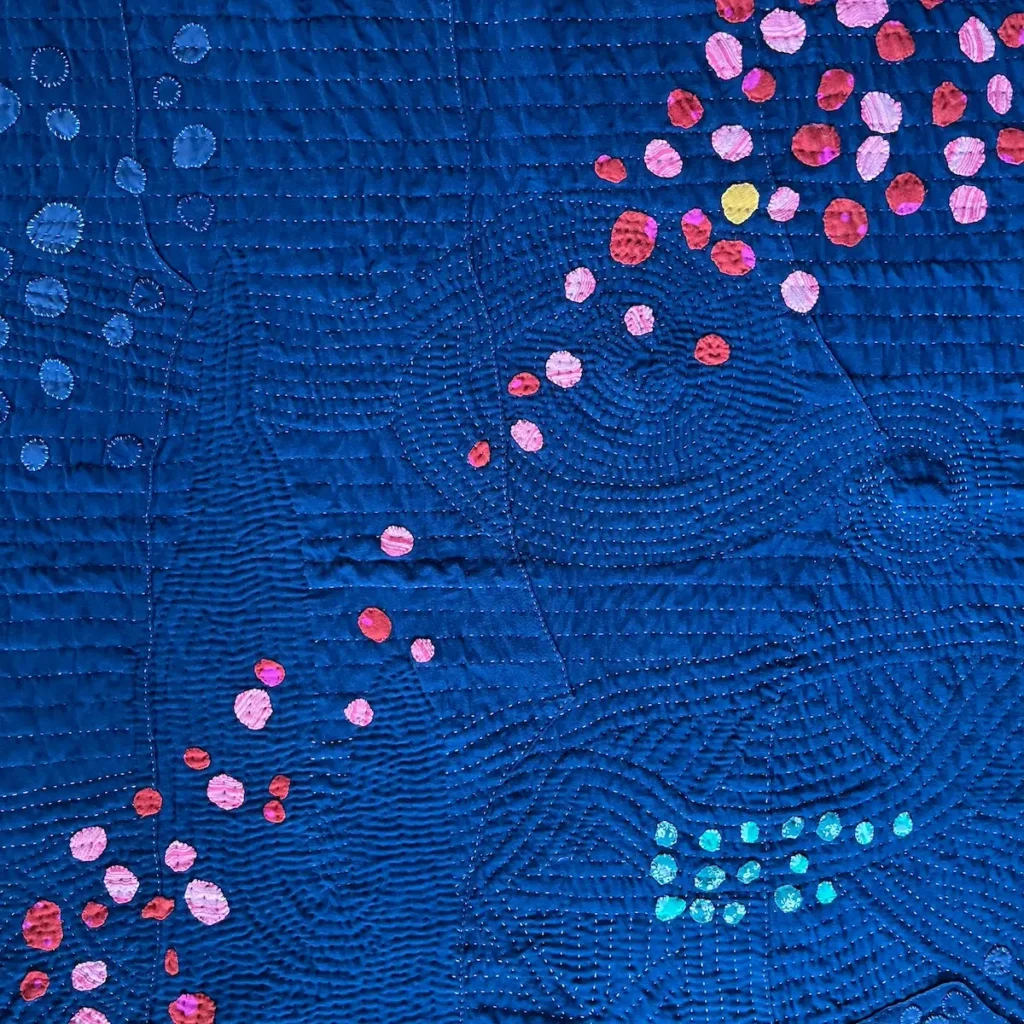
The idea hatching is my favorite part.
It was the same when I worked as a teacher- the lesson planning, coming up with the creative ways of engaging students, drawing the signs, making the material unique- always the best part. I have sketchbooks full of ideas which I am sure I’ll never get to, but I’m okay with that.
Have you ever made a gift where the emotional response surprised you (or the recipient)?
Last Christmas, I wanted to make something special for my mother-in-law since we lost my father-in-law very suddenly earlier in the year. I handmade her a quilt from his clothes, really having no clue how she’d react- if it was too soon, or if she would just pack it away and not know what to do with it.
My German family doesn’t have a quilt tradition, so I didn’t know if she’d appreciate it at all. She really surprised me at how touched she was- the quilt has been proudly draped across the couch every day since, and she mentions it every time I go to her house. I am so incredibly honored that it means something to her, especially as it was an emotional journey for me to make it.
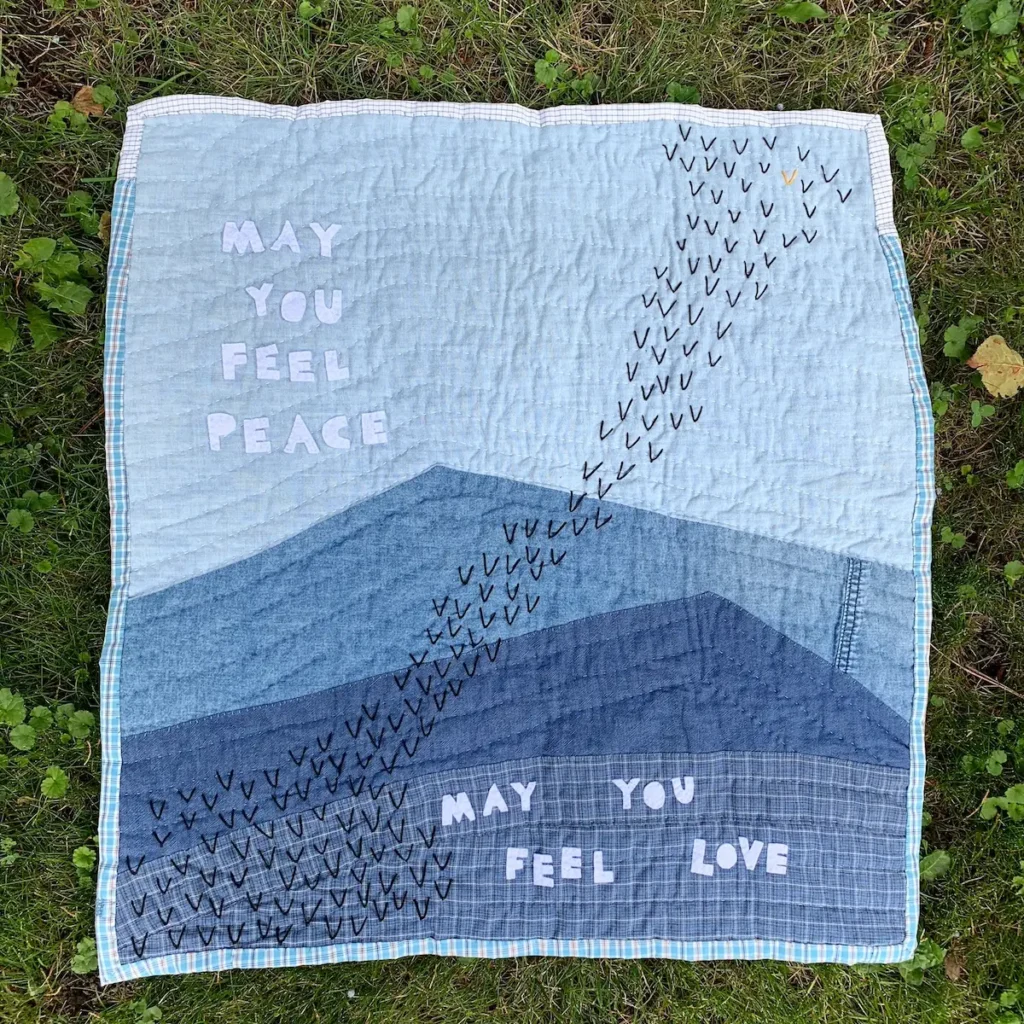
What’s one of the most meaningful gifts you’ve ever made, and why?
When my father was in his last months of hospice, I made a quilt to hang next to his bed that says, “May you feel love, may you feel peace.” Living an ocean away from him was so heartwrenching- I wanted to leave some token behind so that he would remember all the things I couldn’t tell him every day. In his last weeks, he often reached out to that quilt. I can only hope it gave him some solace.
How has your work changed in the last 5 years?
Five years ago, I was a non-practicing photographer and a pattern-following knitter, but I’d never sewn a quilt, embroidered one stitch, or discovered a world where you didn’t need to be tied to a pattern.
Thanks to the work and guidance of Ekta Kaul https://www.ektakaul.com/ and Heidi Parkes https://www.heidiparkes.com/, I discovered the textile world and haven’t looked back since. Being able to use stitch as a means of expression has absolutely changed my life- all for the better.

Looking back, what advice would you give your younger maker self?
I would probably just say trust yourself and your own ideas. Forge your own path, make your own patterns.
I still wrestle with extreme imposter syndrome, but I’ve learned that, even if I believe my stories aren’t that extraordinary or interesting, they are worth telling, art is worth making, the world needs every ounce of positive, creative energy it can get, even if it’s just for the walls of your own home.

How do you stay motivated during creative slow seasons?
In 2023, I decided to make a stitched story about my life every week. I thought surely I’d run out of ideas halfway through, but surprised myself by making it until week 50 before feeling stuck.
In an act of desperation about what to make that week, I threw a bunch of scraps on the floor, stitched a transparent curtain over the top, and somehow a female figure stitched her way into the piece. I named her the goddess of being stuck and fully believed in the idea that she needed to be given offerings in order to keep her creativity flowing.
In 2024, I wanted to continue with this weekly practice but made it a bit easier on myself by preparing a list of 55 prompts- making a tiny offering every week. This year, I’ve delighted in giving those tiny offerings away, grateful that that creative goddess remains at my side. I think now more than ever, the world needs creative offerings in active circulation.
I absolutely believe in the power of creative practice, of just sitting down and making something, no matter what it is, even (especially?) when you’re not feeling inspired. There’s a quote usually attributed to Picasso that says, “Inspiration exists, but it has to find you working.”

What are three practical tips you’d give someone starting a creative practice?
1. Just make stuff. Good stuff, bad stuff, ugly stuff, ridiculous stuff. Keep going and keep practicing- eventually you will find your groove. And even if you don’t, you’ll gain a lot of insights along the way, and actually that’s the whole point.
2. Get a sketchbook (nothing fancy). Even if you don’t draw, just have a dedicated place to write down all the crazy ideas that pop into your head before they float away. Elizabeth Gilbert writes in Big Magic about creative ideas being things that swirl around us, waiting for available and willing human partners. Pay attention. Catch them.
3. To borrow an adage from Heidi Parkes, “Stay curious.”
Where can people see your work?
On Instagram I’m @thread.yarn.paper. I have a website www.clairevoelkel.com. I also gave a presentation about my journey in Heidi Parkes’ Quiltmaking course this year, which is on YouTube: https://youtu.be/8EpQx5CIgxc?si=pNDmlSnTmd1R5Lrs
Interview posted October 2025
Browse through more inspiring interviews on Create Whimsy.
Read our interview with Heidi Parkes.