
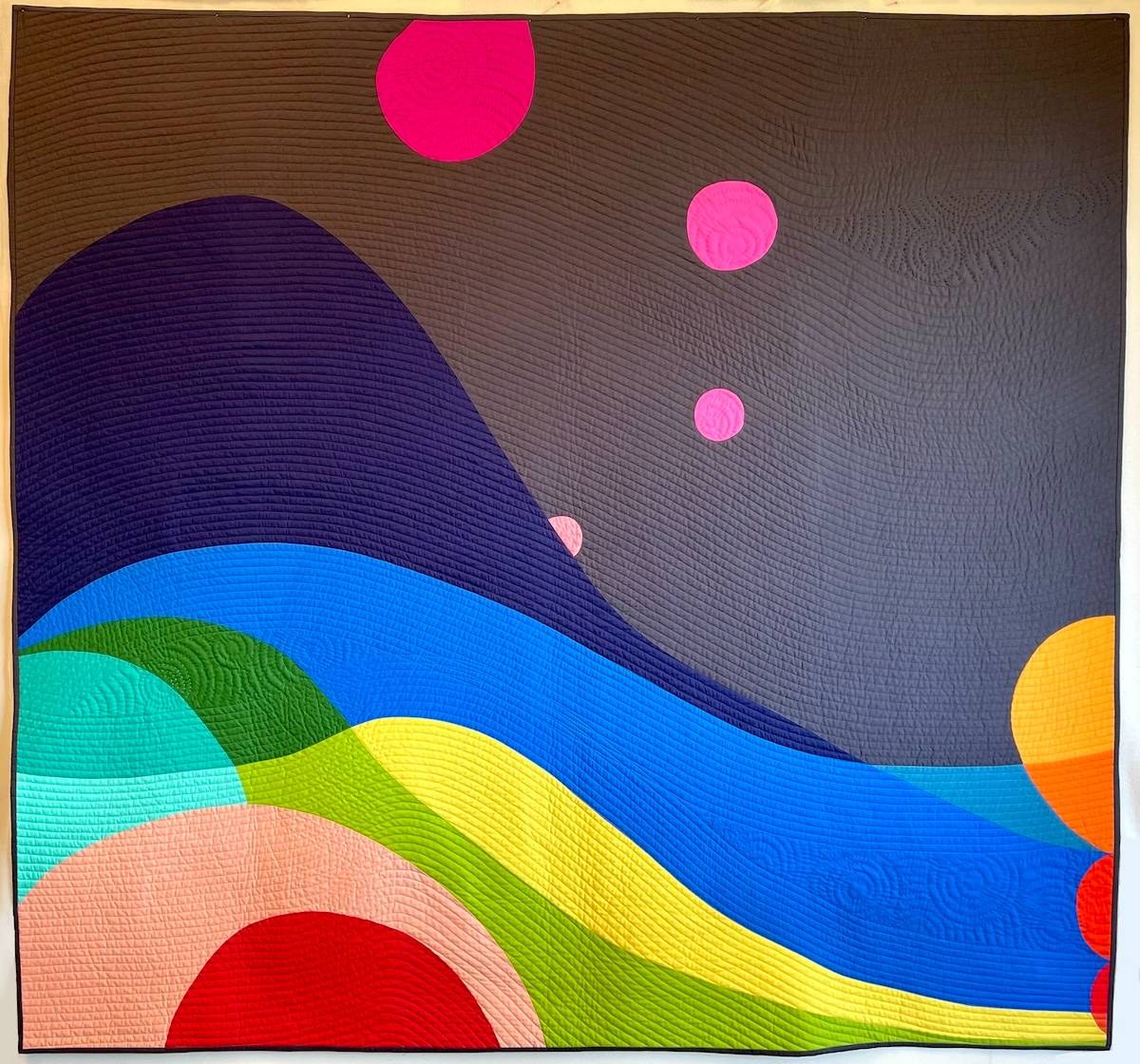
Carolina Oneto makes quilts that feel full of movement, light, and emotion. Before becoming a textile artist, she worked as an engineer and university teacher, and today she blends both worlds in her colorful creations. Her work mixes careful planning with playful discovery, using fabric and color to tell stories without words.
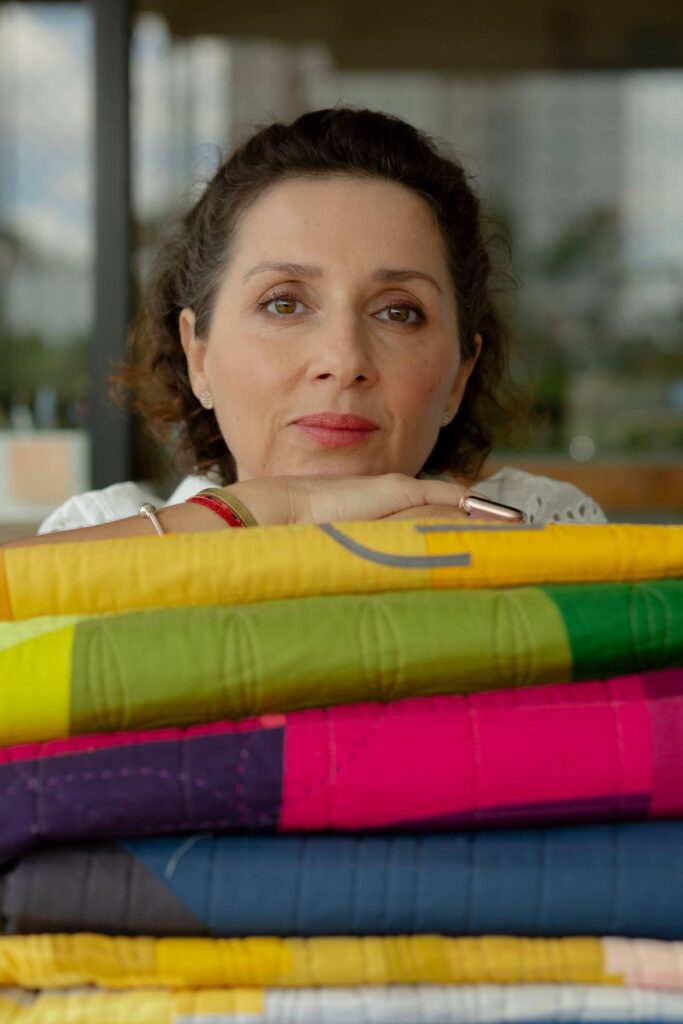
You started your career as an engineer. What made you turn toward quilting and textile art?
I began quilting in 2011, after many years working as an Industrial Engineer and teaching at university. At first, quilting appeared in my life almost as a curiosity, but very quickly I realized it brought together many things I deeply loved: creativity, structure, problem-solving, color, and the possibility of working with my hands.
For me, engineering and art are not opposites. Both are ways of understanding and shaping the world. Engineering taught me how to think in systems, how to analyze relationships, and how small changes can transform an entire structure. I still use that way of thinking in my quilts today, especially when working with composition, color interaction, and balance.
At the same time, textile art allowed me to reconnect with a more intuitive and emotional side of myself. I grew up surrounded by making—women in my family sewed, knitted, crocheted, and worked with textiles—so fabric always felt familiar and meaningful to me. Quilting became the perfect meeting point between precision and freedom, planning and improvisation.
As an Amazon Associate I earn from qualifying purchases. Read more about our affiliate linking policy.
Over time, what started as a personal exploration became my artistic language. Through quilting, I found a way to express ideas about color, movement, depth, and emotion that felt completely my own.
How has your background in math and engineering influenced your creative work?
My background in math and engineering has deeply influenced the way I approach creativity and quilt design. I think it gave me a strong understanding of structure, relationships, and systems, which are all essential in composition.
When I design a quilt, I am constantly analyzing how elements interact: color against color, shape against shape, balance versus tension, repetition versus variation. In many ways, it is similar to solving a complex problem, but in a visual and emotional language instead of a mathematical one.
Engineering also taught me to feel comfortable with process and experimentation. In quilting, I often work through iterations, testing ideas, making adjustments, and allowing the composition to evolve. I enjoy combining intuition with analysis. Sometimes people see art and science as completely separate worlds, but for me they are very connected. Both require observation, curiosity, creativity, and the ability to imagine possibilities that do not yet exist.
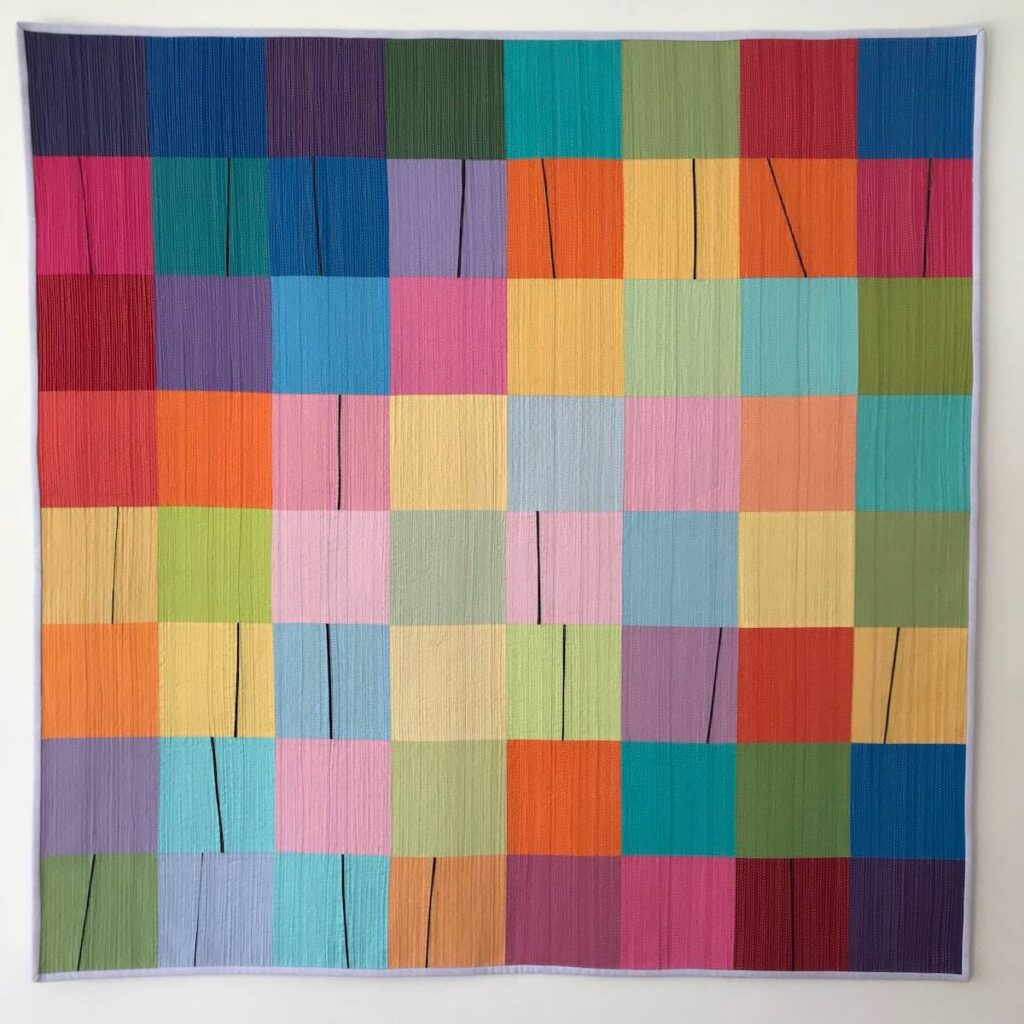
Mathematics also appears in subtle ways in my work: through rhythm, proportion, movement, geometry, grids, repetition, and spatial relationships. Even when my quilts look organic or improvisational, there is usually an underlying structure supporting the composition.
I think my engineering background gave me tools to organize complexity, while textile art gave me a way to express emotion and personal meaning. The dialogue between those two worlds is still at the center of my work today.
How did studying color theory change your work?
Studying color theory completely transformed the way I understand and create quilts. Before that, I chose colors mostly intuitively, based on what I liked or what felt visually attractive. But learning about color interaction helped me realize that color is relative: a color never exists alone, it always changes depending on its surroundings.
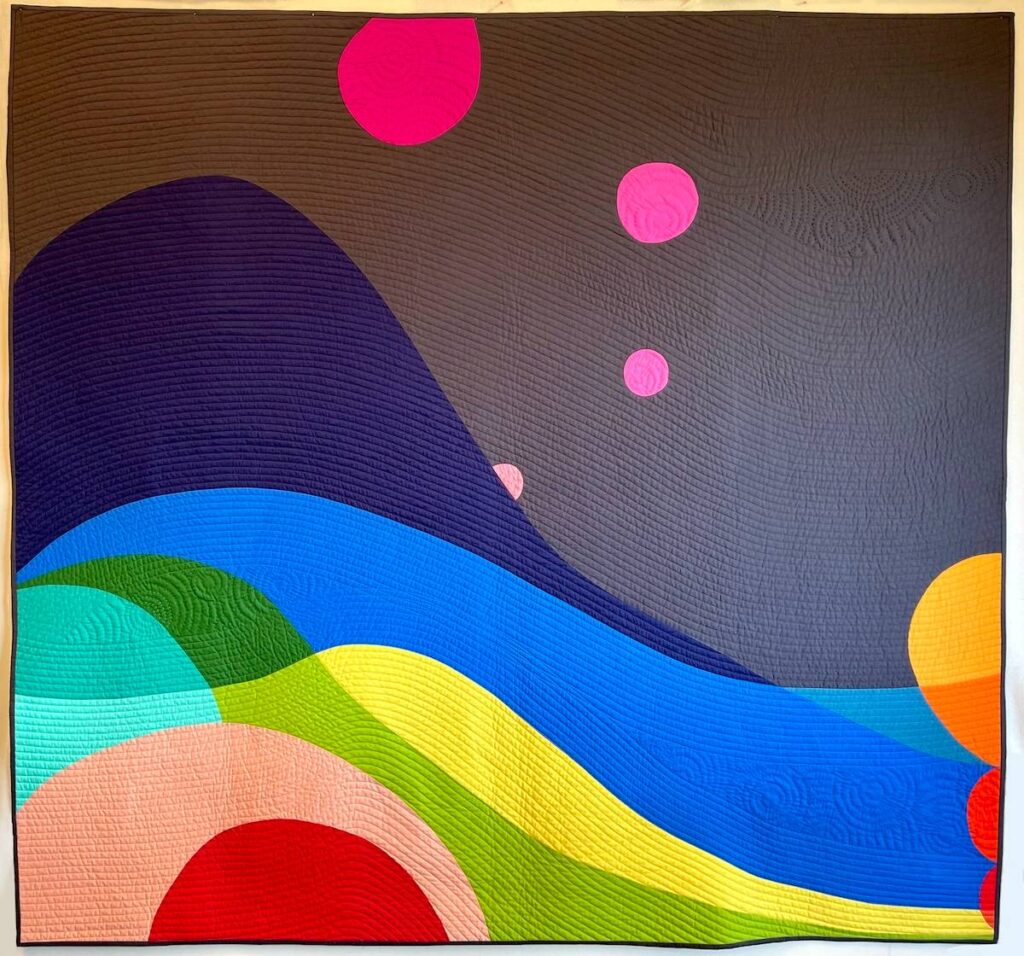
That discovery opened an entirely new world for me. I became fascinated by how hue, value, and saturation can create movement, depth, contrast, atmosphere, and even emotional responses. I started to see color not as decoration, but as a structural element of composition.
Studying books such as Josef Albers’ Interaction of Color and later exploring other color theories deeply influenced my artistic language. I began experimenting more intentionally with transparency effects, advancing and receding colors, luminosity, and subtle shifts in value. Many of my quilts are built around these ideas.
Color theory also gave me confidence. Instead of relying only on instinct, I developed tools to analyze why a composition worked or why it did not. At the same time, I learned that theory should not limit intuition, but support it. Today, my process is a constant dialogue between analytical understanding and emotional response.
I believe color became one of the main voices in my work. Through color, I can create tension, calm, rhythm, energy, or spatial illusion, often without needing recognizable imagery. It is one of the most powerful languages in textile art.
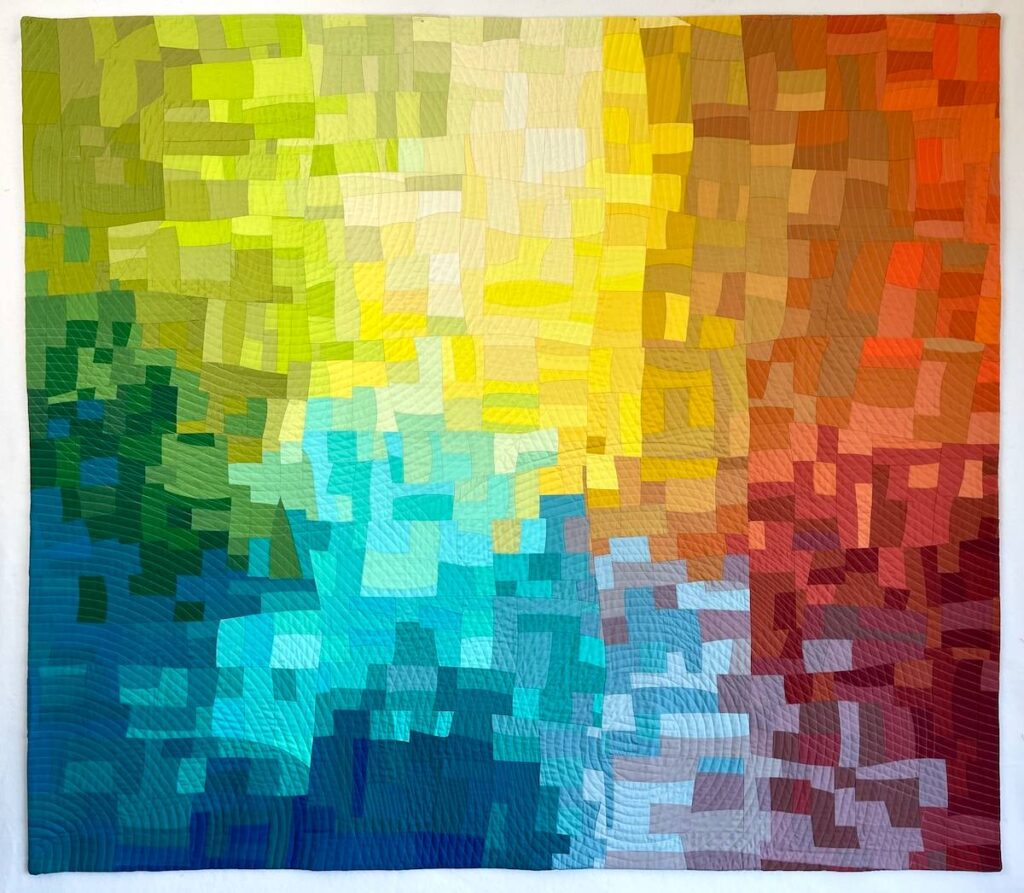
How do you balance structure (planning) with intuition (play)?
For me, structure and intuition are not opposites; they are partners in the creative process. I rarely work in a completely planned way, but I also rarely improvise without any direction. My work usually begins with an idea, a question, a feeling, or a visual concept that gives me a framework to start exploring.
Planning gives me support. It can be a color palette, a compositional idea, a series of shapes, or certain limitations I decide to use. Those structures help me create focus and avoid feeling overwhelmed by infinite possibilities. But once I begin working with fabric on the design wall, intuition becomes very important. I react to what I see, move pieces around, adjust colors, change proportions, and allow unexpected relationships to appear.
I think the design wall is where the real conversation happens between planning and play. It allows me to experiment visually, to make decisions through observation instead of only through preconception. Many of my best ideas appear during that process of responding intuitively to the work itself.
Over time, I have learned to trust both sides equally. Structure helps me organize complexity, while intuition brings energy, movement, and surprise. If a piece has too much control, it can feel rigid. If it has only intuition without enough structure, it can lose clarity. I am always searching for that balance where the composition feels both intentional and alive.
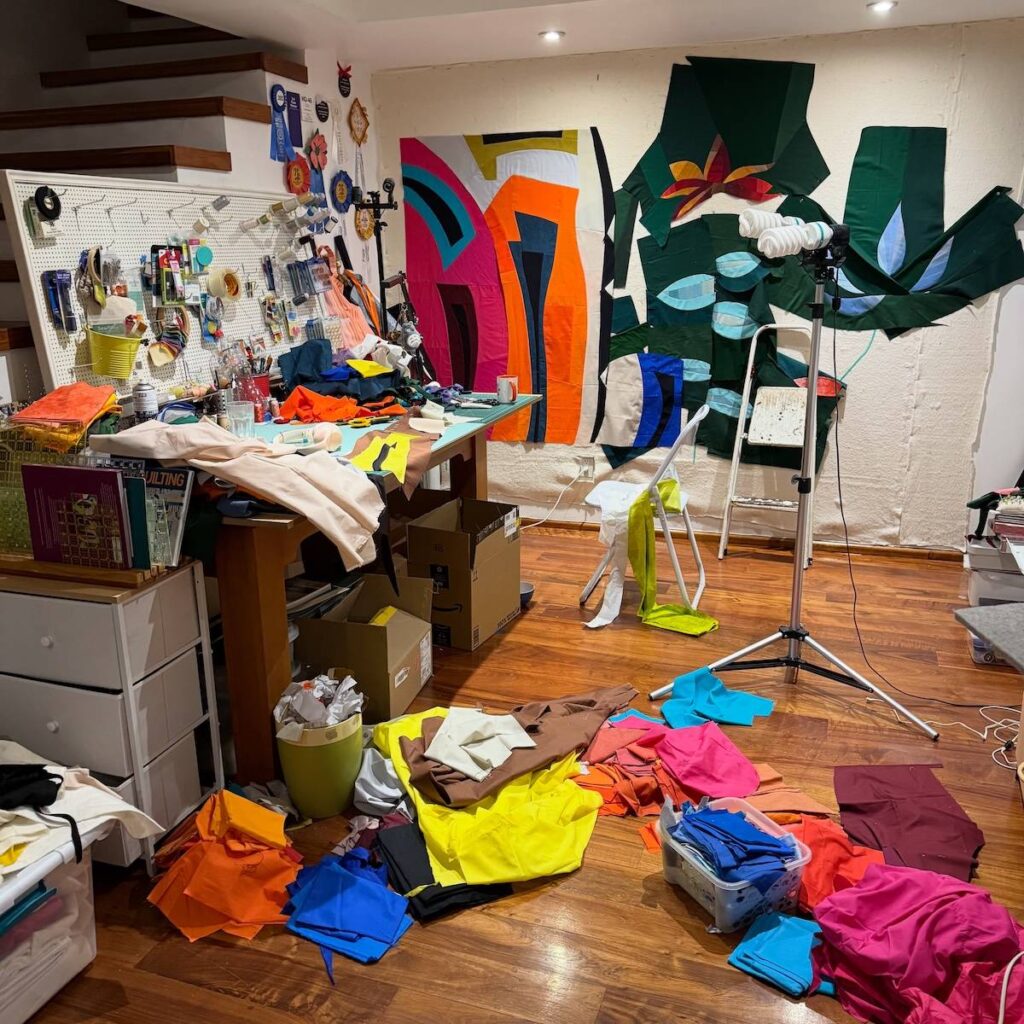
Describe your creative space.
My studio is both a workspace and a creative laboratory. I have two Janome sewing machines that are central to my daily practice, and a large tool organizer where I keep everything visible and easy to access while I work. I also have spaces to store fabrics and quilts, which is important because color organization plays a big role in my process.
One of the biggest changes in my studio recently has been having, for the first time, a large design wall. It completely transformed the way I work because now I can create much larger quilts and step back to observe the entire composition at once. The design wall has become the place where most of my visual thinking happens.
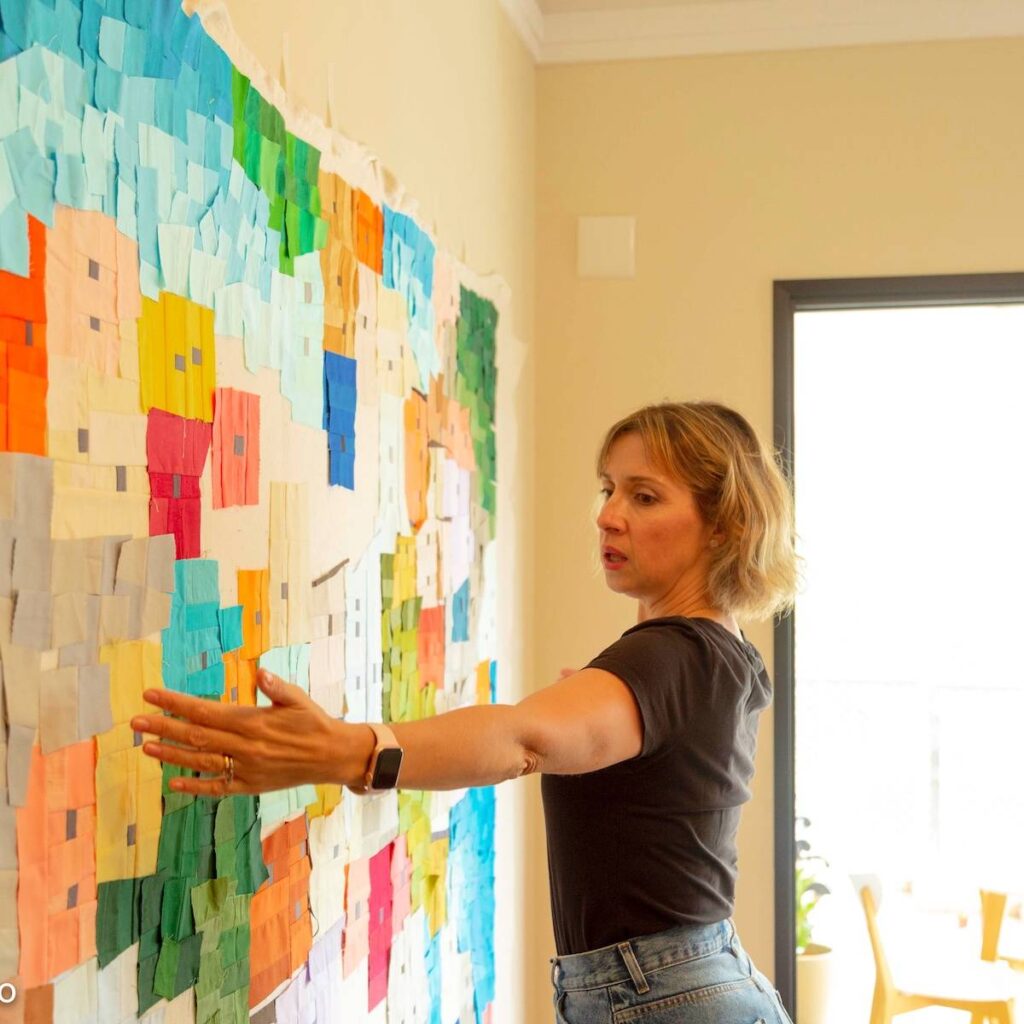
I usually try to keep a maximum of four works in progress at the same time so I can stay focused while still allowing ideas to evolve naturally. I also use the floor constantly when designing. I love spreading fabrics around, testing color relationships, moving shapes, and playing intuitively with composition before sewing everything together.
My studio is not only a place to produce quilts, but also a space for experimentation, movement, and discovery. It reflects both sides of my personality: the organized side that comes from engineering, and the intuitive, playful side that comes from art.
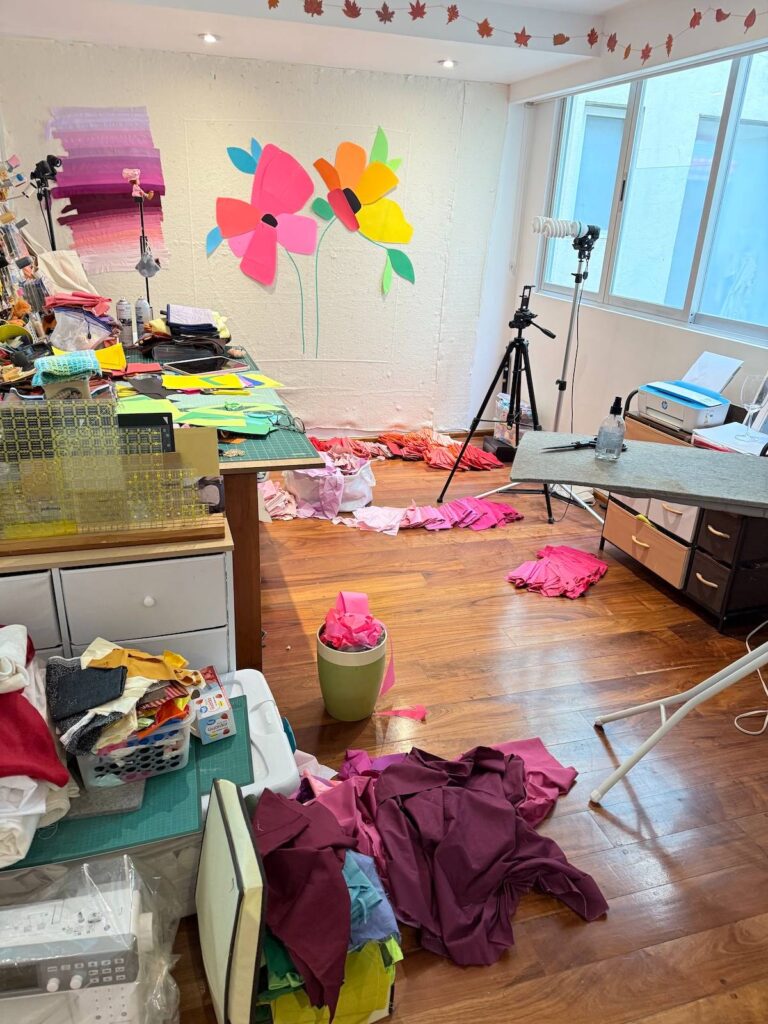
How do you choose your fabrics and colors for a piece?
The way I choose fabrics and colors depends completely on the intention behind each quilt. Sometimes the starting point is an emotion or atmosphere I want to create; other times it may be a compositional idea, a specific color interaction, or even a concept related to movement, depth, or transparency.
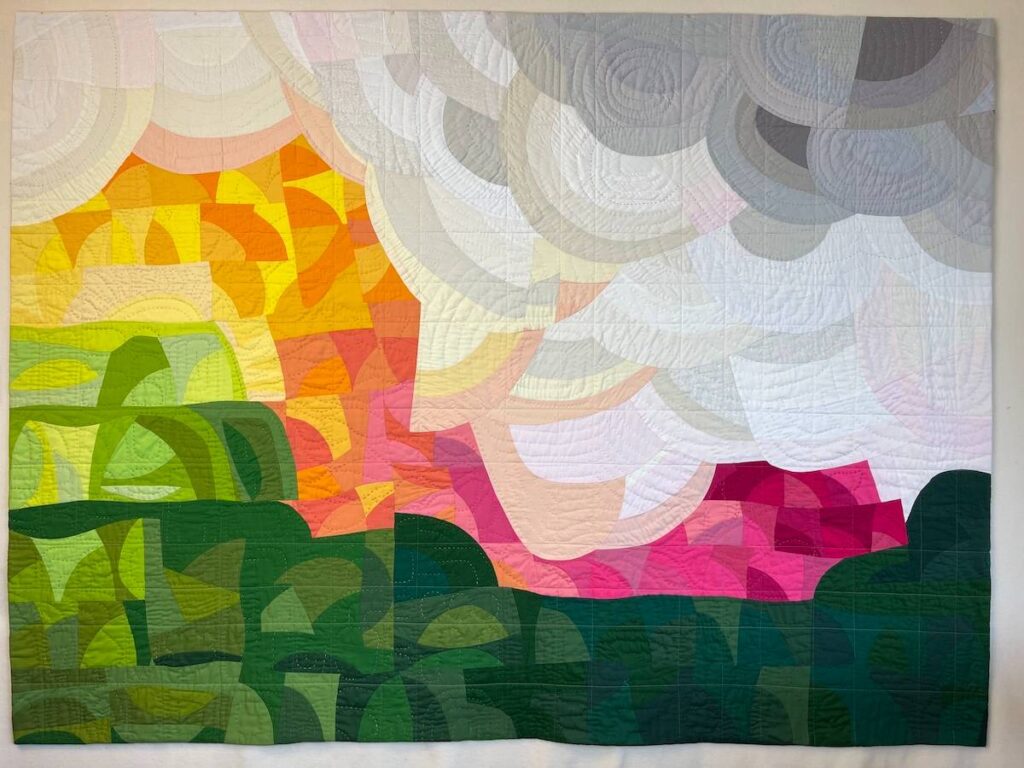
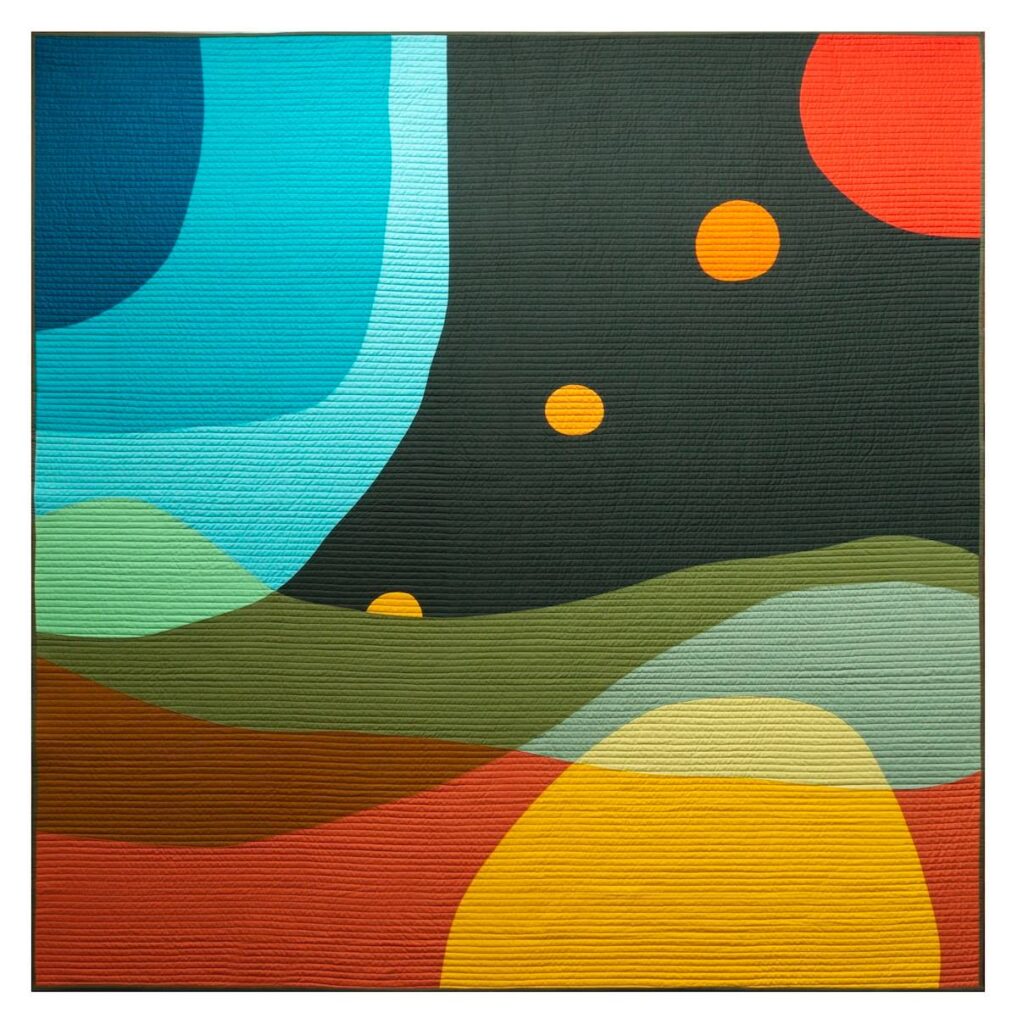
Color is usually one of the first decisions I make because it plays such an important structural role in my work. I often begin by thinking about the relationship between hue, value, and saturation, and how those variables can help create contrast, rhythm, luminosity, or spatial effects. I love using color to create sequences and movement, especially through hue gradients, value gradients, and subtle shifts in saturation. You can find those ideas throughout much of my work.
The way I select fabrics changes depending on the series or the visual effect I want to achieve. For example, in my Curves and Transparencies series, I specifically search for that “third color” that allows me to create the illusion of transparency between two overlapping shapes. In other quilts, the focus may be on movement, depth, contrast, or atmosphere, and the fabrics are selected differently to support those goals.
I also spend a lot of time testing combinations on the design wall and even on the floor, moving fabrics around until the composition begins to feel alive. Sometimes the process is very intuitive and playful, and other times it is more analytical. Usually, it becomes a dialogue between the two.
Each quilt asks for something different, and I think learning to listen to what the piece needs is one of the most important parts of my creative process.
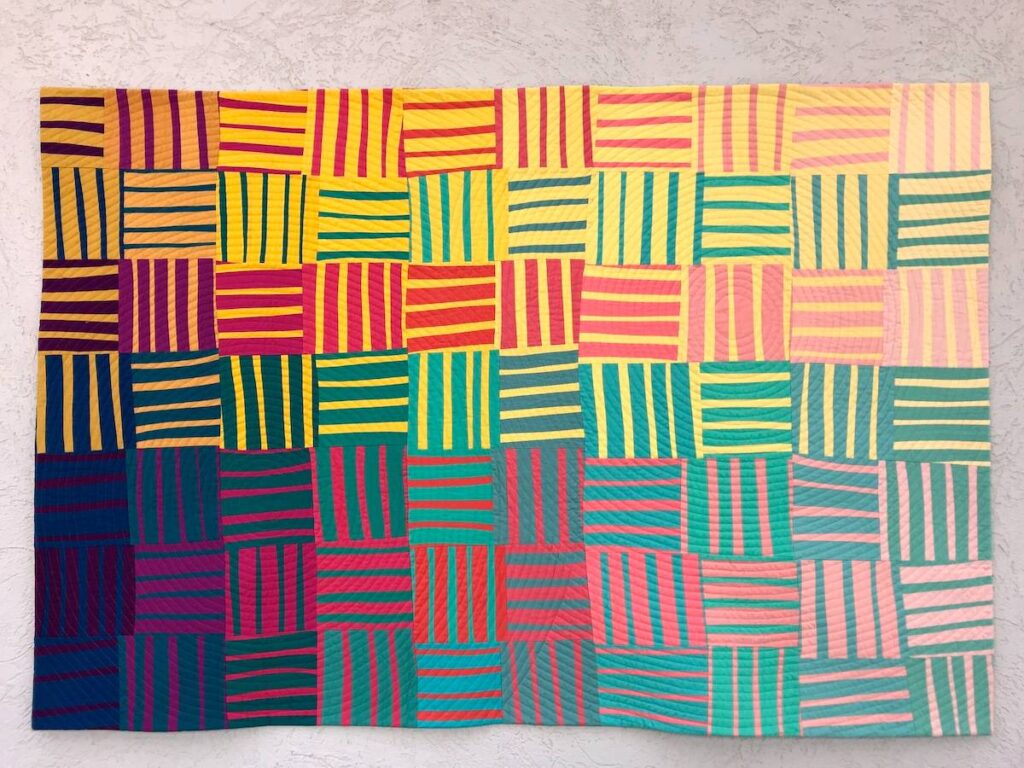
What do you do when you feel stuck or unsure about a piece?
When I feel stuck or unsure about a piece, I try not to force a solution immediately. Usually, it means that something in the composition is not working yet: maybe the balance, the value structure, the movement, or the relationship between colors and shapes.
One of the first things I do is step back and analyze the quilt more carefully. I often check the values because many compositional problems come from value relationships rather than color itself. Sometimes I remove elements, simplify areas, move shapes around, or test different fabrics and colors to see how the composition changes.
The design wall is incredibly important during those moments. I leave the piece there and allow it to rest for a while so I can come back with fresh eyes. I think quilts need time to “speak.” Many times, the answer appears when I stop trying to control everything and simply observe more carefully.
I also move constantly between intuition and analysis. Some decisions come from studying composition principles, while others come from a feeling that something is too heavy, too static, too busy, or missing energy. Learning to trust both ways of seeing has been very important in my process.
For me, being stuck is not a failure; it is actually part of the creative process. Often those moments lead to the most interesting discoveries and transformations in a quilt.
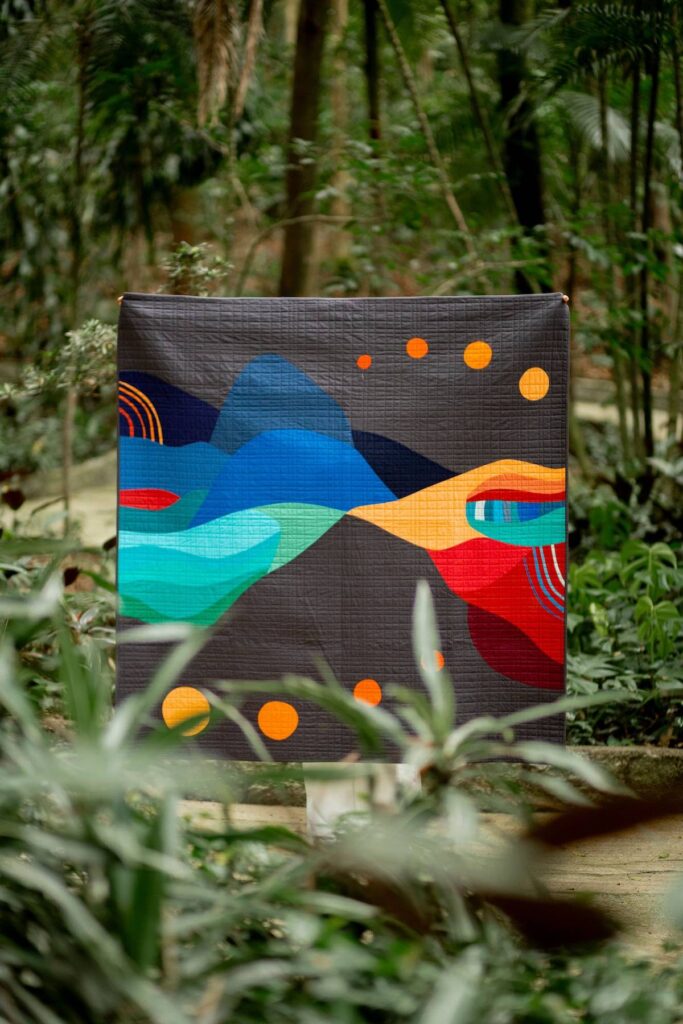
How do you know when a piece is finished?
Knowing when a piece is finished is probably one of the hardest parts of the creative process, and honestly, I do not always have a logical explanation for it. Many times, I simply feel it. There is a moment when the composition finally feels balanced, alive, and complete, and I realize that adding more would not improve it.
Sometimes it also becomes very practical: the fabrics are over, the quilt has already grown too large, or I reach the point where continuing would start taking away from the strength of the piece instead of adding to it. I think learning when to stop is just as important as knowing what to add.
For me, a finished quilt is not necessarily a “perfect” quilt. It is a piece where the different elements—color, shape, movement, contrast, rhythm—begin to work together as a whole. When I can look at it and feel that the conversation inside the quilt has resolved itself, then I know it is done.
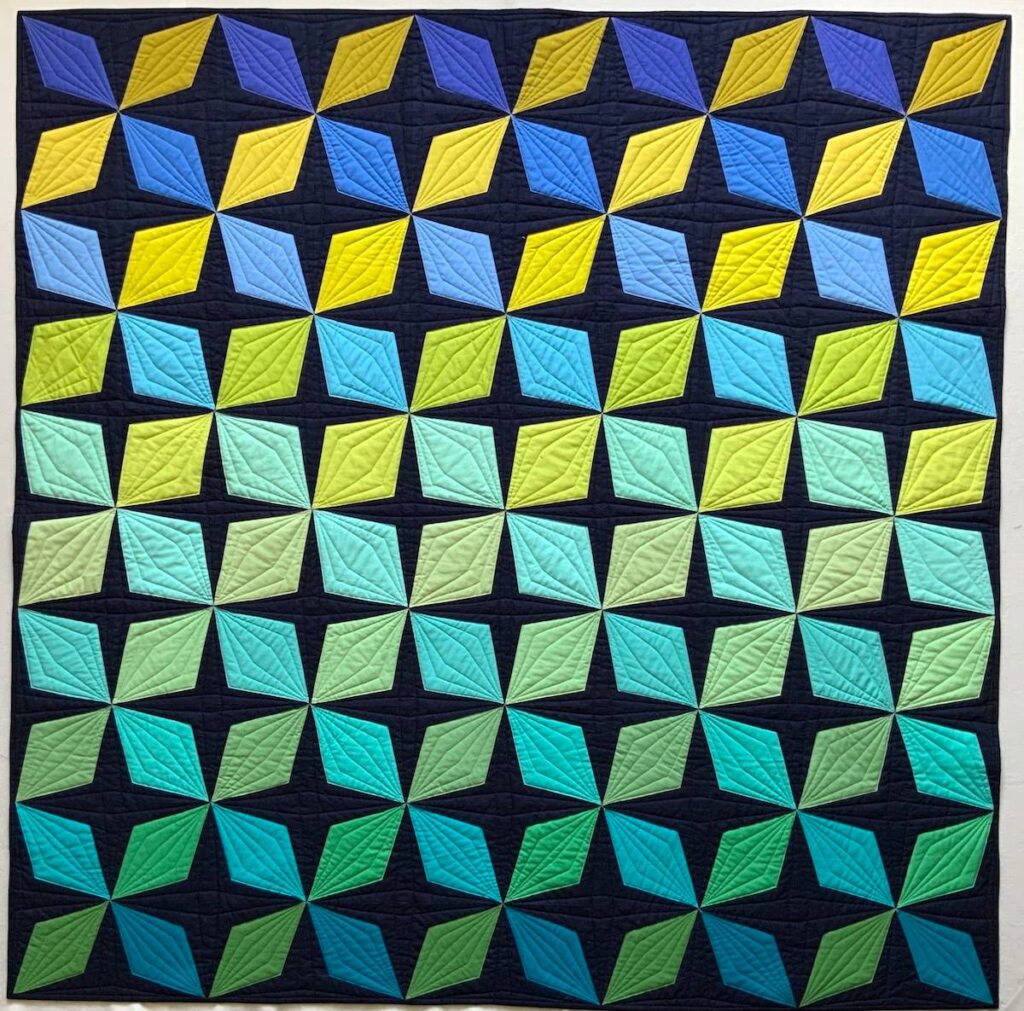
How has your work changed since you first began quilting?
My work has changed enormously since I first began quilting. In the beginning, I started with more traditional quilting, learning the basics of piecing, construction, and technique. That foundation was very important because it gave me the technical skills that I still use today.
Over time, I discovered improv quilting, and that completely opened my creative world. It allowed me to move beyond repeating patterns and begin creating more personal and expressive compositions. Two artists were especially important in that evolution: Lucía Stacchetti in Chile, and later, Irene Roderick. Both influenced me deeply and helped me develop confidence in improvisation, composition, and intuitive design.
Another transformative moment was studying color at the School of Art at the Universidad Católica in Chile. That experience changed the way I understand visual language and completely influenced my artistic direction. I became fascinated by color interaction, value, saturation, movement, and the emotional and spatial possibilities of color.
I think my work today is much more personal and intentional. Over the years, I moved from focusing mainly on technique to focusing on composition, color relationships, and creating quilts that express ideas, emotions, and visual experiences in a contemporary way.
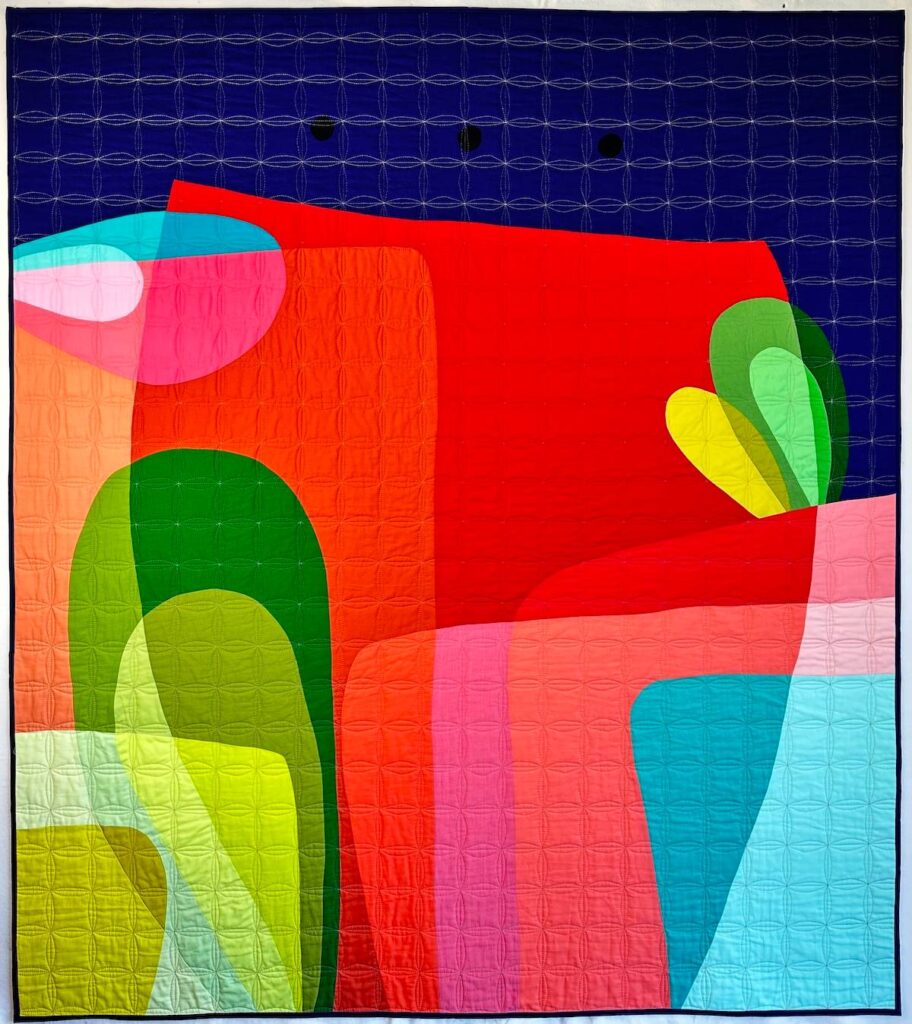
What have you learned about yourself through your art?
Through my art, I have learned many things about myself. I discovered how deeply creative I am, and how much my memories, experiences, and emotions feed my work and imagination. Creating makes me genuinely happy, and over the years I realized that I have a very strong need to express ideas and feelings through my art.
I also learned that I am brave. Leaving engineering to become an artist was one of the most difficult decisions I have ever made. At the beginning, it was very scary to change paths so completely after having built another professional career. But looking back, it was also one of the best decisions of my life.
Art taught me that I love experimentation and discovery. I enjoy taking risks, trying new ideas, and allowing myself to explore without always knowing the final result. At the same time, I discovered how perseverant and hardworking I can be. Building an artistic career requires discipline, patience, and resilience, and quilting has helped me grow in all those ways.
I think art also helped me understand that creativity is not only about talent or inspiration. It is about curiosity, courage, practice, observation, and the willingness to continue even through uncertainty. Quilting became much more than making objects for me; it became a way of understanding myself and the world around me.
Has teaching others changed how you create?
I think the relationship between teaching and creating goes in both directions. The way I create allows me to teach my process, my way of thinking, and the techniques I have developed over the years. Teaching has pushed me to understand my own creative decisions more deeply and to find ways to explain ideas that are often very intuitive, such as color interaction, composition, movement, or improvisation.
At the same time, teaching constantly inspires me. Seeing how different students interpret the same concepts reminds me that there are infinite creative possibilities. Every class becomes a space for exchange, experimentation, and discovery, not only for the students, but also for me.
Teaching also reinforced the importance of process over perfection. When I teach, I encourage students to experiment, trust themselves, and embrace uncertainty, and that philosophy also influences the way I continue creating my own work.
So for me, teaching and creating are deeply connected. They nourish each other continuously. My artistic practice shapes the way I teach, and teaching keeps my creativity open, curious, and evolving.
What keeps you motivated to keep making?
What keeps me motivated to continue making is that creating has become something essential in my life. It is not only my profession, but also a way of thinking, processing emotions, exploring ideas, and understanding the world around me. I feel a constant need to create.
There is always something new I want to explore: a color relationship, a compositional idea, a shape, a feeling, or a visual question that I want to investigate through fabric. That sense of curiosity keeps me moving forward.
I also love the process itself. Even with all its challenges and moments of uncertainty, making quilts brings me joy and gives me energy. Being in the studio, moving fabrics around, discovering unexpected relationships between colors and shapes, and slowly seeing a piece come to life is something deeply meaningful to me.
I think creativity became part of who I am. Creating is not something I do only when inspiration appears; it is something I need continuously in my life.
What advice would you give someone just starting in quilting or textile art?
My advice would be to allow yourself to begin without the pressure of perfection. So many people are afraid of making mistakes, but experimentation, play, and even failure are essential parts of the creative process. Every quilt teaches you something.
I also encourage people to stay curious and explore widely. Learn techniques, study color, look at art outside the quilting world, and pay attention to what truly excites you visually and emotionally. Over time, your own artistic voice begins to appear through practice and exploration.
Another important thing is to trust your process and not compare yourself constantly to others. Quilting and textile art are very personal journeys, and everyone develops at a different rhythm. What matters is continuing to make, observe, question, and learn.
I think it is also important to balance intuition with knowledge. Studying design, composition, and color theory gave me tools that helped me grow enormously, but at the same time, creativity also needs freedom and experimentation. The goal is not to create “perfect” quilts, but meaningful ones.
And finally, enjoy the process. Quilting can be challenging, but it can also bring immense joy, connection, and discovery. Creativity grows through practice, courage, and curiosity.
Where can people see your work?
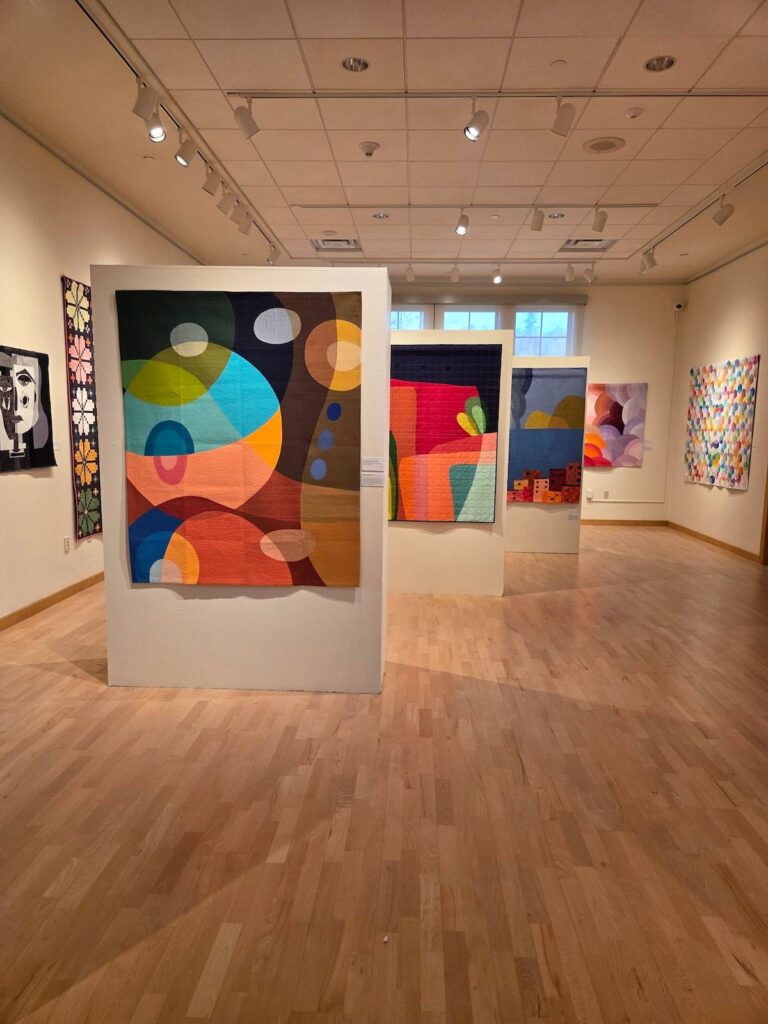
People can see my work mainly through my website and Instagram, where I regularly share my quilts, creative process, classes, and exhibitions. My work is also exhibited in quilt shows and art exhibitions around the world, which has allowed me to connect with wonderful communities of quilters and textile artists internationally.
You can find my work at carolinaoneto.com and on Instagram at @carolina_oneto.
Rapid-Fire Fun:
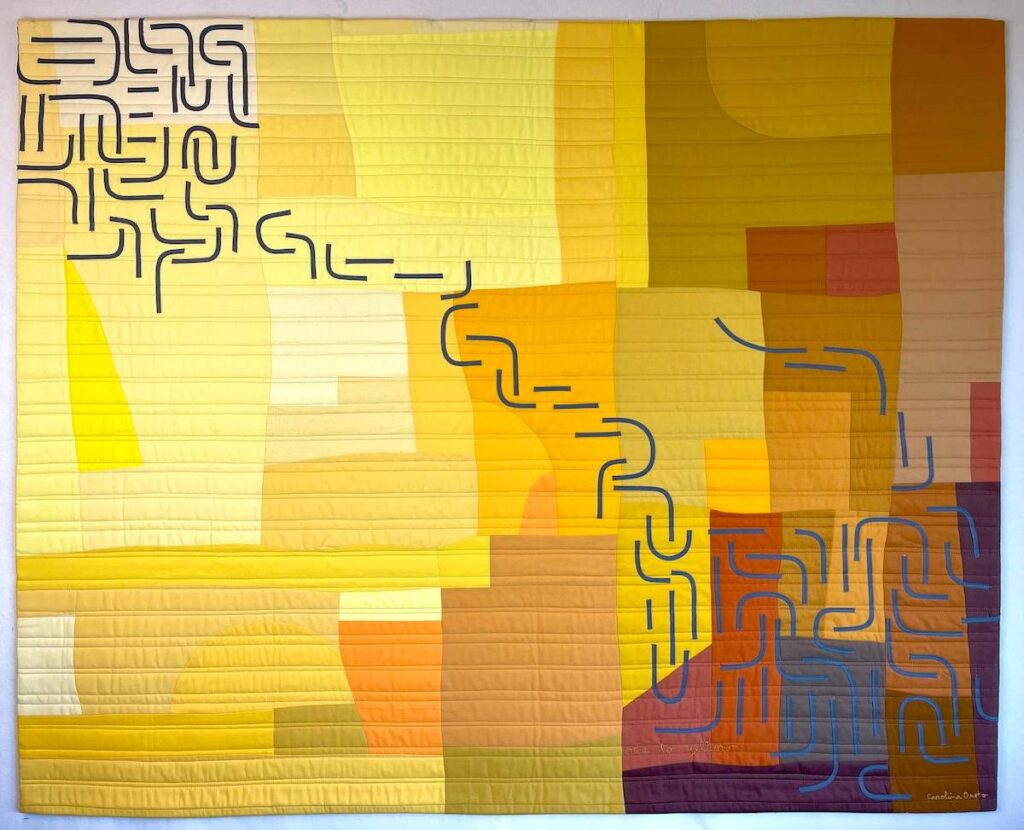
- Favorite color right now? Yellow
- Morning maker or night owl? Both!
- Favorite tool you can’t live without? My sewing machine
- One word to describe your work? Colorful
- What advice would you give your younger self? You are on the correct path, just keep sewing
Interview posted May 2026
Explore more modern quilt inspiration on Create Whimsy.