
It’s worth stepping up close to get a good look at the work of Amy Pabst. She quilts in miniature, with thousands of pieces paying homage to quilters of the past. But there’s nothing dusty and musty about Amy’s light and modern twist on a traditional art form.

Did you have a “gateway craft” as a kid? Which creative projects led you to the work you do today?
Looking back, I can see a few creative endeavors that I had as a child that might have influenced the creative interests I have today. One was that I made stuffed animals frogs that were filled with popcorn kernels (this was during the Beanie Baby craze and I called these little creations “Corny Frogs”). I carefully planned all the fabrics and cutting and sewing and stuffing and sold over a hundred of those little frogs. Another thing I was crazy about as a child was anything in miniature, and I loved to make miniatures from polymer clay to play with, especially food and furniture for my dolls.

Why textiles? Why quilts?
I dabbled in several different art mediums as a young adult, including ceramics, charcoal drawing, and painting. None of these mediums ever really grabbed me though, and I got into quilting by randomly picking up a book about quilts from my local library. I took off fast and kept going. Quilts were never a hobby or pastime; they started off as a full-blown and immediate passion.
As an Amazon Associate I earn from qualifying purchases. Read more about our affiliate linking policy.
Where do you draw inspiration from?
My biggest source of inspiration is other quilters. I spend a lot of time on the internet and going through books looking at quilts that other people have made. The time period I see myself going back to is the late 1800s; there were some fabulous quilts made during that time. I also draw inspiration from the original designs of contemporary quilters as well.

Do you have a dedicated space for creating? If so, what does it look like?
During my first several years of quilting, my sewing space was the kitchen table. This meant I had piles of fabric all over the kitchen, an ironing board wedged in by the fridge, blocks taped to the walls, and that everything had to be picked up and put away for dinner every night. Three years ago I made a dedicated sewing space out of an extra bedroom and it has totally changed my life. I have a giant wooden table that has room for three machines and a full-size cutting mat, a closet and dressers for storage, a laptop with EQ and a printer, a bookcase, and a design wall. It’s wonderful to have so much space, and to be able to leave projects and supplies laying out.

What are the indispensable tools and materials in your studio? How do they improve your work?
My number one favorite tool is a pair of spring handled Fiskars scissors. When I’m working on paper piecing, every piece has to be trimmed to size, and when you have 49 pieces in a block, that makes for a lot of handling of scissors. So the spring handles keep my hands from getting tired.
As far as materials go, my go-to thread is Superior Monopoly. It’s a little fiddly to work with, but the end results are fantastic. I also use George Siciliano’s Foundation Stuff to print all of the foundations for my blocks because it’s an awesome little foundation paper that you can leave in your quilt.

What plays in the background while you work? Silence? Music, audiobooks, podcasts, movies? If so, what kind?
Reading is one of my greatest pleasures in life, so it makes sense that I listen to a lot of audiobooks when I’m sewing. They are especially important when I’m working on miniature piecing, which involves the same motions over and over and can get tedious and monotonous. I have listened to the Harry Potter series several times, and I have apps through my local libraries that I can borrow audiobooks from. The audiobooks shape my creative process a little because I’m concentrating on them all the time when I sew. I even have quilts that are named after some of my favorite fictional characters.
How often do you start a new project? Do you work actively on more than one project at a time?
When I get inspired to start on a new project, I try to harness all of the fresh creative energy and make as much progress at the beginning as I can. I get bored easily, so having more than one project going at a time is essential. When I get tired of one color scheme or design style or technique I can hop over to something else. However, I try not to spread myself too thin. It stresses me out to work on things that will never get finished, and I usually don’t have more than three or four big projects going at a time. I don’t have a big pile of UFOs, just a few quilt tops that need quilted.
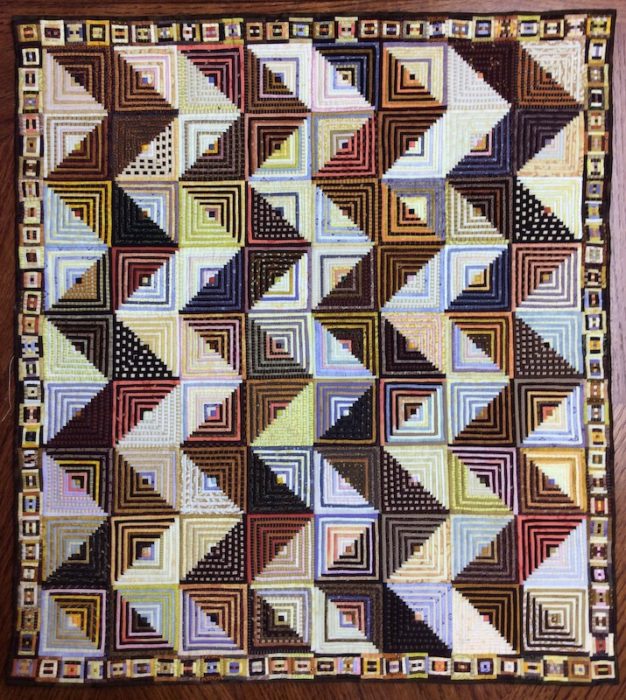
Are there recurring themes in your work? Do you do series work? How does that affect your approach?
I embraced the log cabin block for several years; it was easy for me to piece, and I was good at it, and the layout options were endless. I made several log cabin quilts before I realized I was working in a series. So I read a lot about how fine artists do series work and that helped me find a direction. Working in a series lets me take my work and present it as a cohesive body to the public. So I constantly think about how my quilts interact with each other, and how to develop my ideas over time. Series work also gives me achievable goals. One important thing I’ve learned from working in a series is that not every piece will be a masterpiece; some pieces will be weaker or stronger. But that’s okay, because they still all work together to form a cohesive whole.
What do you do differently? What is your signature that makes your work stand out as yours?
Although I’ve made all sorts of quilts using lots of techniques, I kept going back to miniature foundation piecing. It’s funny when I meet quilters from my area at shows and they suddenly go “Oh! You’re the lady who makes miniatures!” I think the small scale of my work is a little unusual. Although I’m constantly trying to convince quilters to try it because it’s not as hard as it looks.
What appeals to you about working in miniature?
Things that happen on a smaller scale, like doll houses or miniature paintings, really captivate me. I love the idea of something that has to be viewed very up close to be appreciated. More practically speaking, it’s easier to handle small quilts from start to finish.
Do you enter juried shows? Do you approach your work differently for these venues?
I enter several shows every year. My favorites are Road to California, IQA in Houston, and the various AQS shows around the country. I never realized I was a competitive person until I started entering shows; so winning ribbons definitely influenced who I am as a quilter. In fact, one of the reasons I worked on miniature log cabins for so long was that my first couple log cabins did pretty well at national shows. I realized I had found something I enjoyed that I was also good at. So I kind of took off in that direction.

What piece of work makes you most proud? Why?
Right now, the quilts that I am most proud of are my Log Cabin: 100K series. I spent four years working on these quilts, which are made of miniature log cabin blocks. They have between 5000-7000 pieces of fabric per quilt. I made a personal challenge that my series would be considered complete when I reached a total of 100,000 pieces. (Hence the title of the series.) The quilts premiered as a special exhibit at the IQA show in Houston this year; I was able to go see them hanging at the show. It was a surreal experience that I’m still processing, but I’m definitely very proud of those log cabin quilts. I’m hoping they’ll get to hang at other venues/shows.

How do you get unstuck creatively?
From time to time, I get in a sort of creative rut and find that it’s been several days since I’ve sat down and had a good day sewing at my machine. This can be frustrating and depressing. I find the best way to beat this is to work on something mindless and repetitive. But not necessarily something creatively driven, just something to get me back into the sewing groove. So it usually doesn’t take long to get out of a rut.

If you could interview a creative person (past or present), who would that person be? What is it about that person that intrigues you?
I would love to have been able to meet Maud Lewis. Everything about her story and work is really inspiring to me. She was a woman from rural poverty with a major physical disability. She didn’t have any formal art education, but she created some extremely iconic folk art. I’m really proud whenever a woman excels in art.

What is on your design wall right now?
I’ve sort of been experimenting with surface design, so I’ve got a discharge-dyed piece that I’m pondering getting quilted. A couple months ago I saw an Amish quilt at a museum; the moment I saw the quilt hanging across the room I immediately knew I had to make one like it. So I’ve got a little Amish-inspired quilt top that also needs quilted. I’m also working on a large (for me) streak of lightning quilt, which will be about 60” x 70”. So far, I’ve made about one quarter of the blocks for that quilt. Finally, because it’s the Christmas season, I’m working on a micro-pineapple quilt in red, green, and cream. The only reason all four of these projects fit on my design wall is because the blocks are very small!

How do you give back to the quilting world?
Quilting has shaped my life profoundly; I try to give back to the world of quilts and the quilting community. So I lead a local guild and help organize shows. And I love to speak about my passion, especially by doing trunk shows. Since 2014, I’ve been judging professionally, and this year I was certified by the National Association of Certified Quilt Judges. As a judge, I try to be a positive voice that encourages people to keep making quilts and entering shows.

What are some of your quilting goals?
One of my biggest goals is to win one of the purchase awards at the AQS show in Paducah. It would be a thrill to have a quilt go into the permanent collection of the National Quilt Museum. Another goal for the next couple years is a series of small quilts that explore micro piecing with pineapple blocks. Two years ago I sent a miniature quilt to The Festival of Quilts in Birmingham, England. That was such a thrill, so I’m going to try to get more quilts entered in shows in other countries. I’d also like to get involved in the American Quilt Study Group.
[The photo Pure Velvet relates to this question. It’s one of the quilts in my Micropiecing series. The blocks are 1.5” and have 49 pieces]
Interview posted January, 2020.
Browse through more inspiring stories of quilters and their projects on Create Whimsy.