

English paper piecing (EPP) is one of the easiest ways to sew perfectly matched shapes by hand. By wrapping fabric around paper templates before stitching the pieces together, you can create crisp points, smooth curves, and accurate quilt blocks without a sewing machine.
Whether you’re making your first hexagon flower or designing an intricate quilt, these English paper piecing tips will help you work faster, avoid frustration, and get beautiful results. From choosing paper templates and thread to glue basting, stitching, and removing papers, we’ve gathered our favorite tricks in one place.
English paper piecing (EPP) is a perfect project to take with you on the go, or to keep your hands busy on a creative project while watching TV. You start with small pieces of fabric that you attach to paper templates and then stitch the perfect pieces together to make a quilt, table runner, or other project. There are many different ways and techniques to reach the final piece. We’ve got our favorite tips and tricks for English Paper Piecing – to make your project successful.
What is English paper piecing?
English paper piecing is a hand-sewing technique where fabric is wrapped around paper templates before the pieces are stitched together. The paper keeps every shape accurate until the stitching is complete.
Is English paper piecing beginner friendly?
Yes. EPP is one of the easiest quilting techniques to learn because you sew one seam at a time with simple hand stitches.
As an Amazon Associate I earn from qualifying purchases. Read more about our affiliate linking policy.
What supplies do I need?
You’ll need paper templates, fabric, thread, a hand sewing needle, fabric glue or basting thread, scissors, and quilting clips.
What’s the biggest secret to perfect EPP?
Accurate paper templates, consistent seam allowances, and tiny whip stitches make the biggest difference.
What you’ll learn
By the end of this guide you’ll know how to:
- choose quality paper templates
- cut fabric with consistent seam allowances
- glue baste neatly
- sew nearly invisible whip stitches
- handle curves
- prevent thread knots
- remove papers without distortion
- keep projects organized while stitching
- avoid the most common beginner mistakes
New to English Paper Piecing?
Here’s the short version:
- Choose quality paper templates.
- Cut fabric with a generous seam allowance.
- Glue baste fabric around each paper.
- Hold pieces together with clips.
- Whip stitch using tiny stitches.
- Continue adding shapes.
- Remove papers after surrounding seams are complete.
- Press your finished project
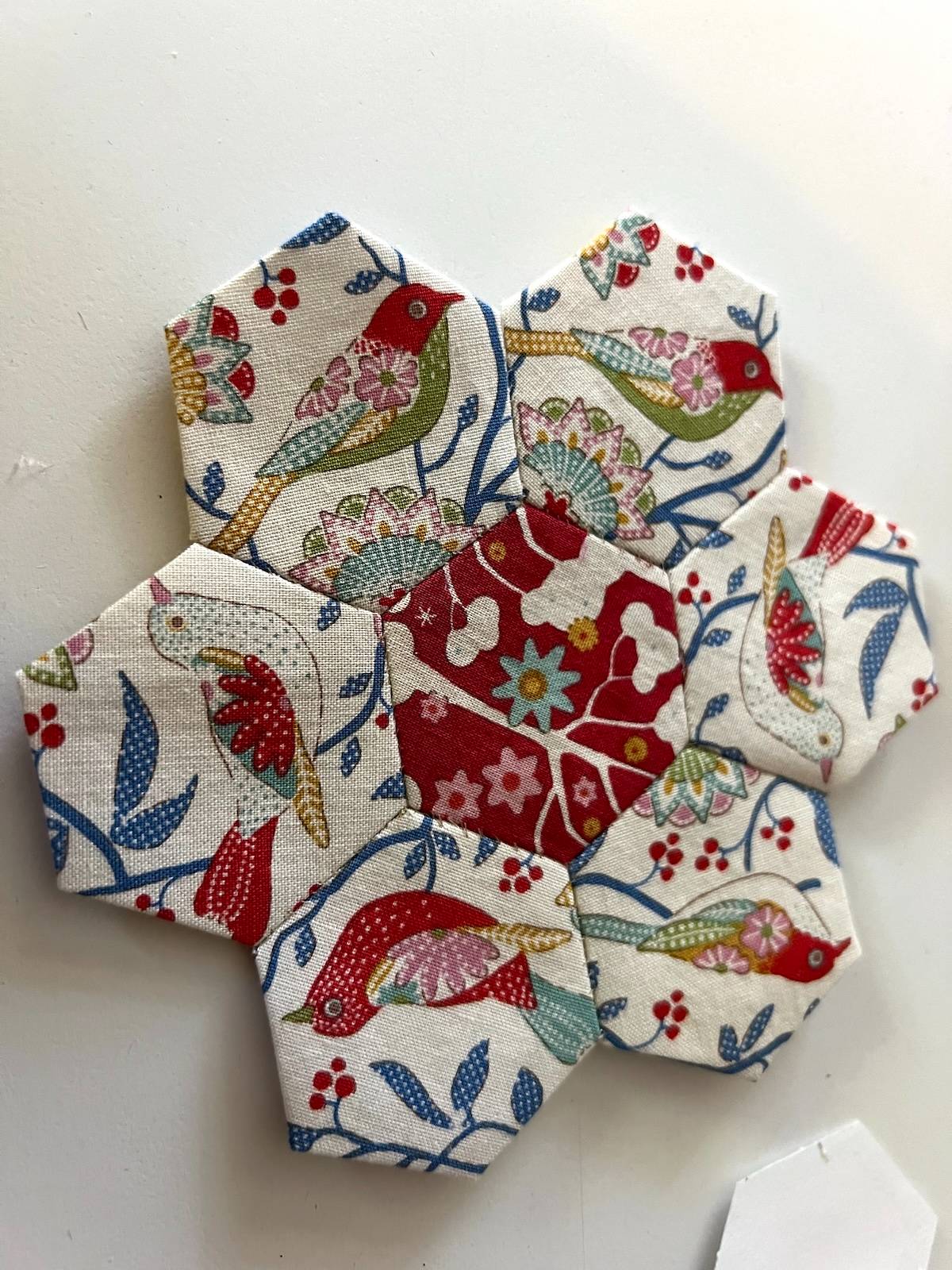
English Paper Piecing Basics
Materials
- Small scraps of fabric
- Precut EPP papers
- Thread
Tools
- Scissors
- Sharp hand sewing needle
- Glue pen
- WonderClips or binder clips
- Acrylic template the size of your precut EPP papers
Instructions
Step 1: Gather your supplies
Choose your paper templates, coordinating fabric, thread, hand-sewing needle, scissors, clips, and either a glue pen or basting thread.
Having everything within reach makes stitching more enjoyable and helps you stay organized.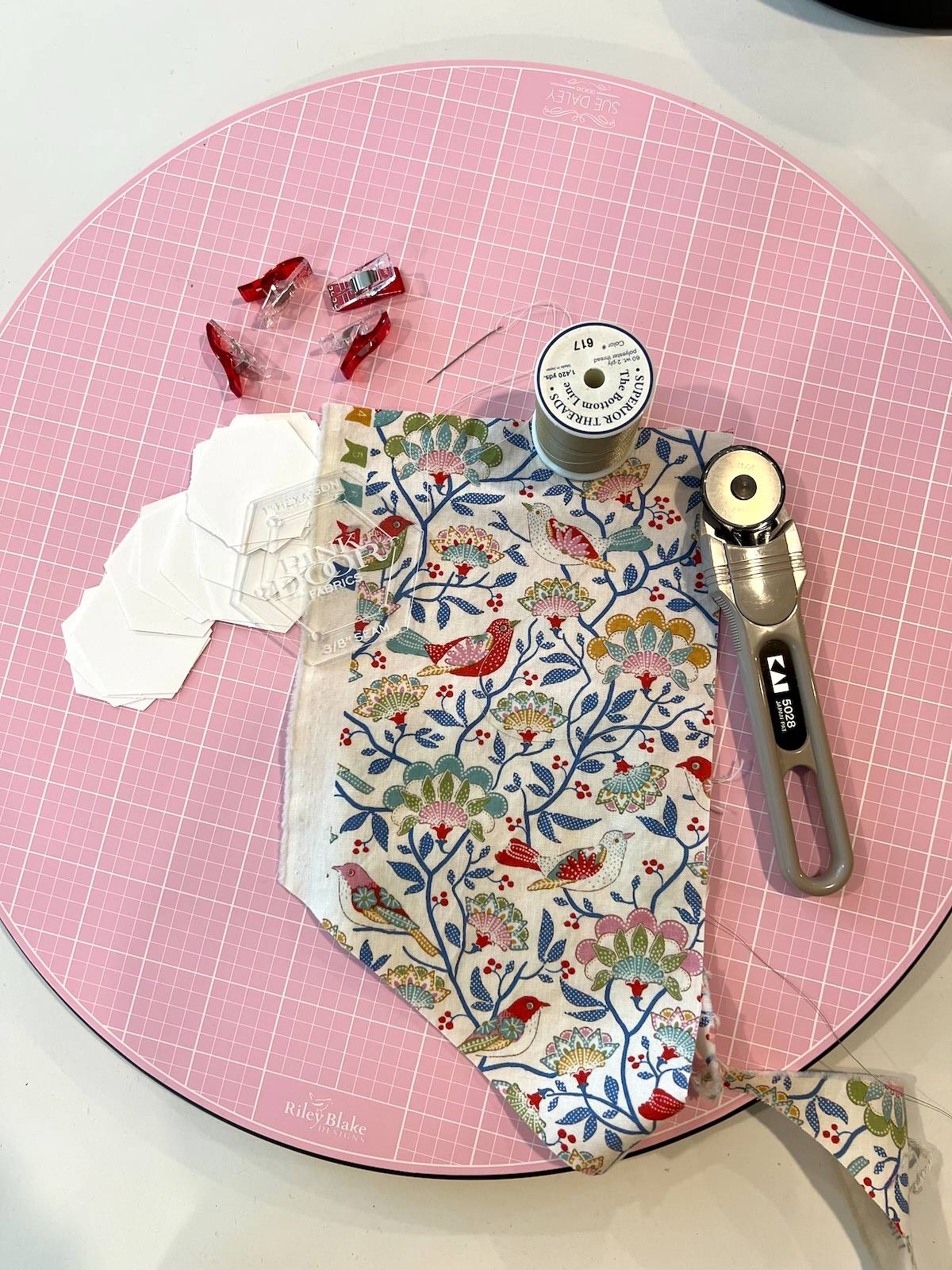
Step 2: Cut your fabric
Using an acrylic template and rotary cutter, cut fabric pieces with an even seam allowance around every paper template.
Keeping the seam allowance consistent helps create smooth folds and accurate points.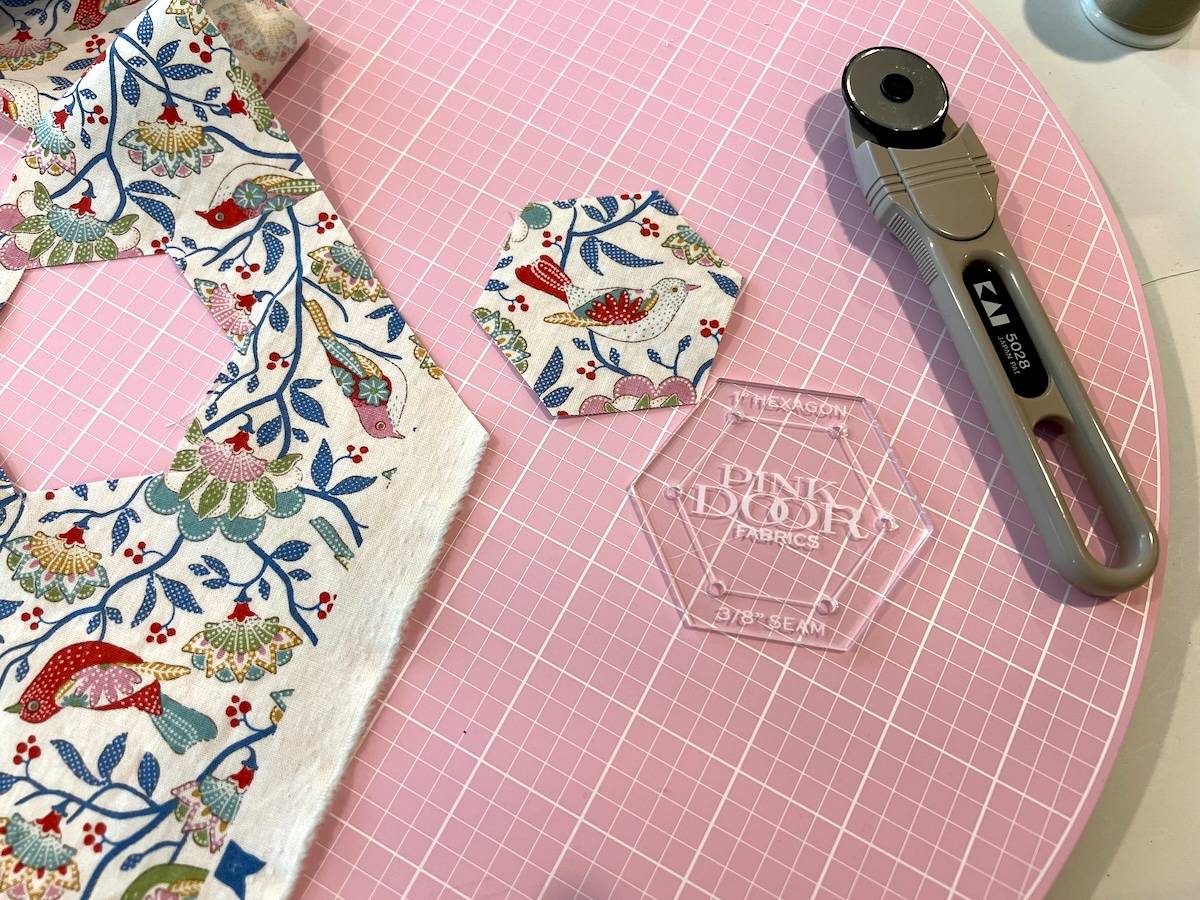
Step 3: Wrap the fabric around the paper
Center the paper template on the wrong side of the fabric.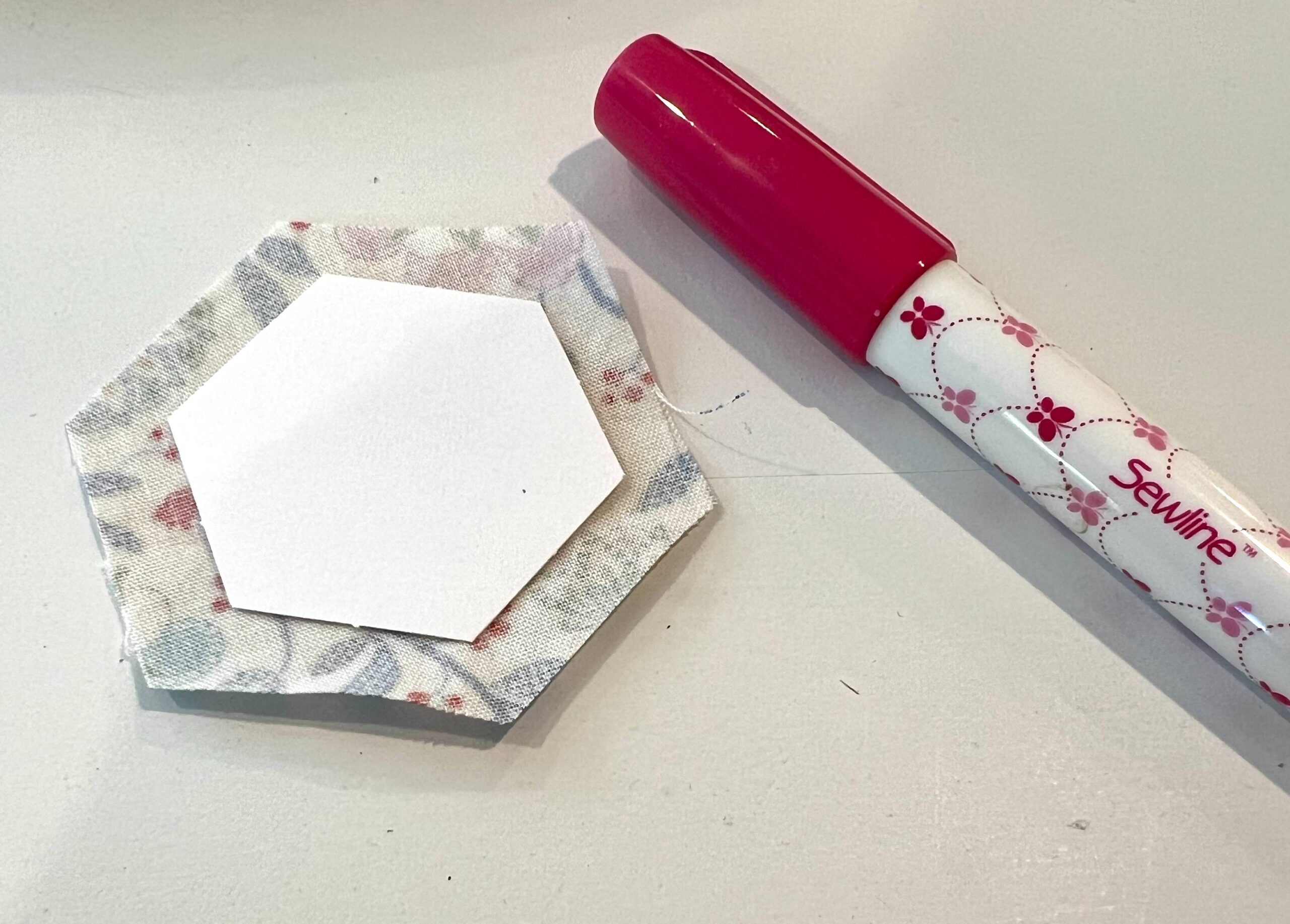
Fold the seam allowance over the paper, working your way around each edge. Secure the folds with fabric glue or thread basting.
The goal is smooth edges without bulky folds.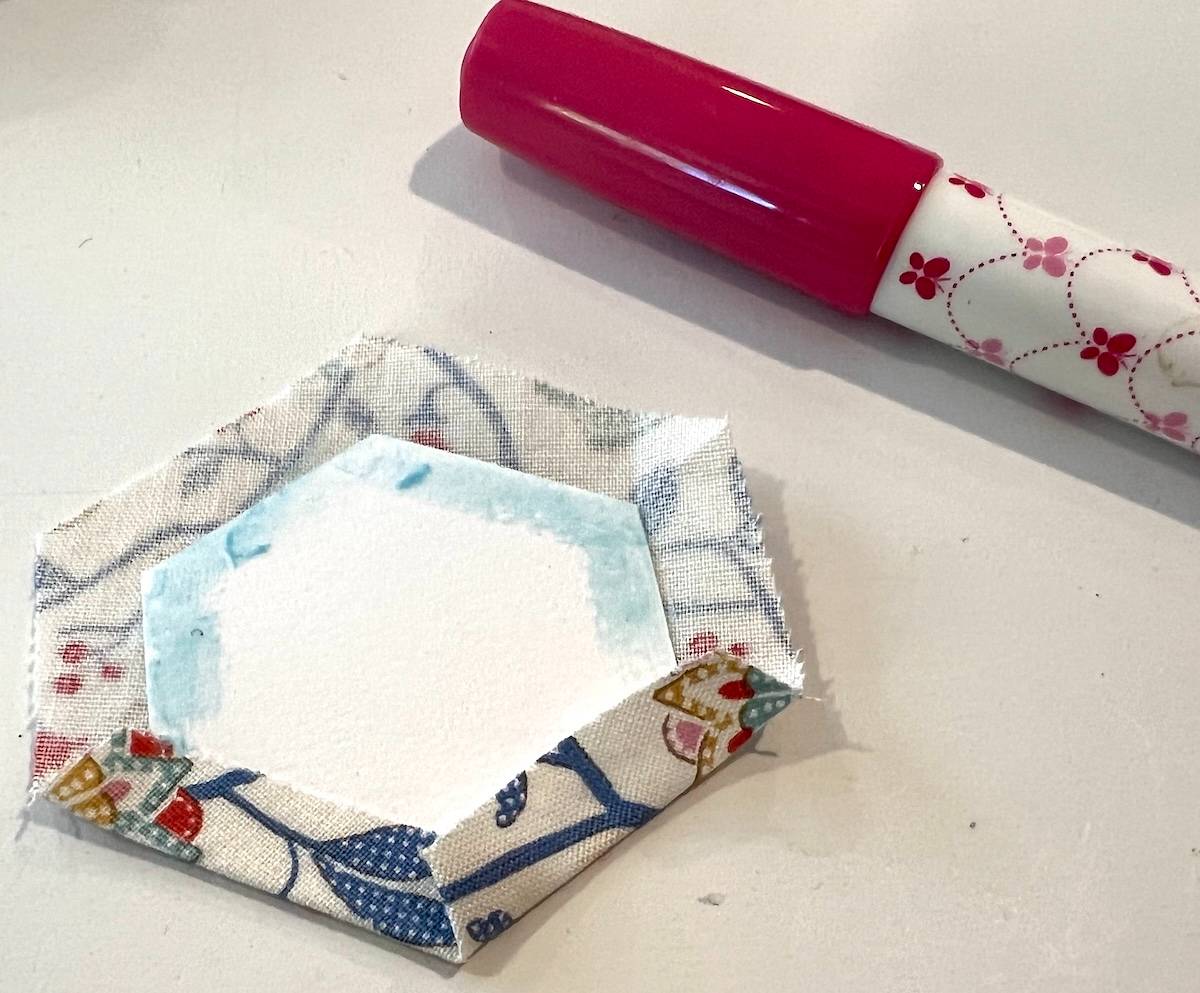
TiP: When gluing, just glue around the outside edge of the paper. This makes it easier to remove the paper when you are finished sewing.
Step 4: Sew the shapes together
Here I've laid out the shapes, with the birds in the right direction around the center. 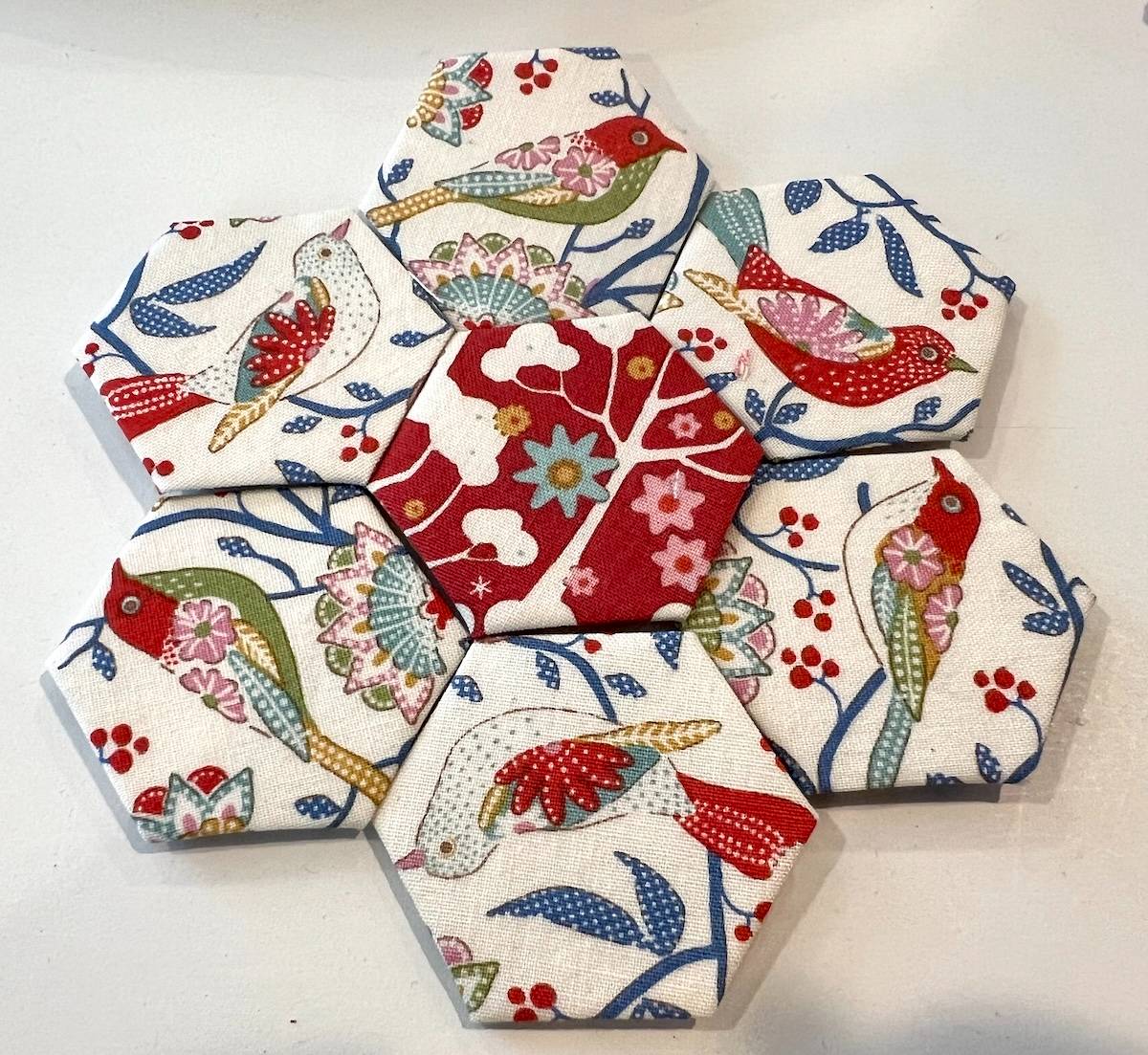
Place two prepared pieces with the right sides together.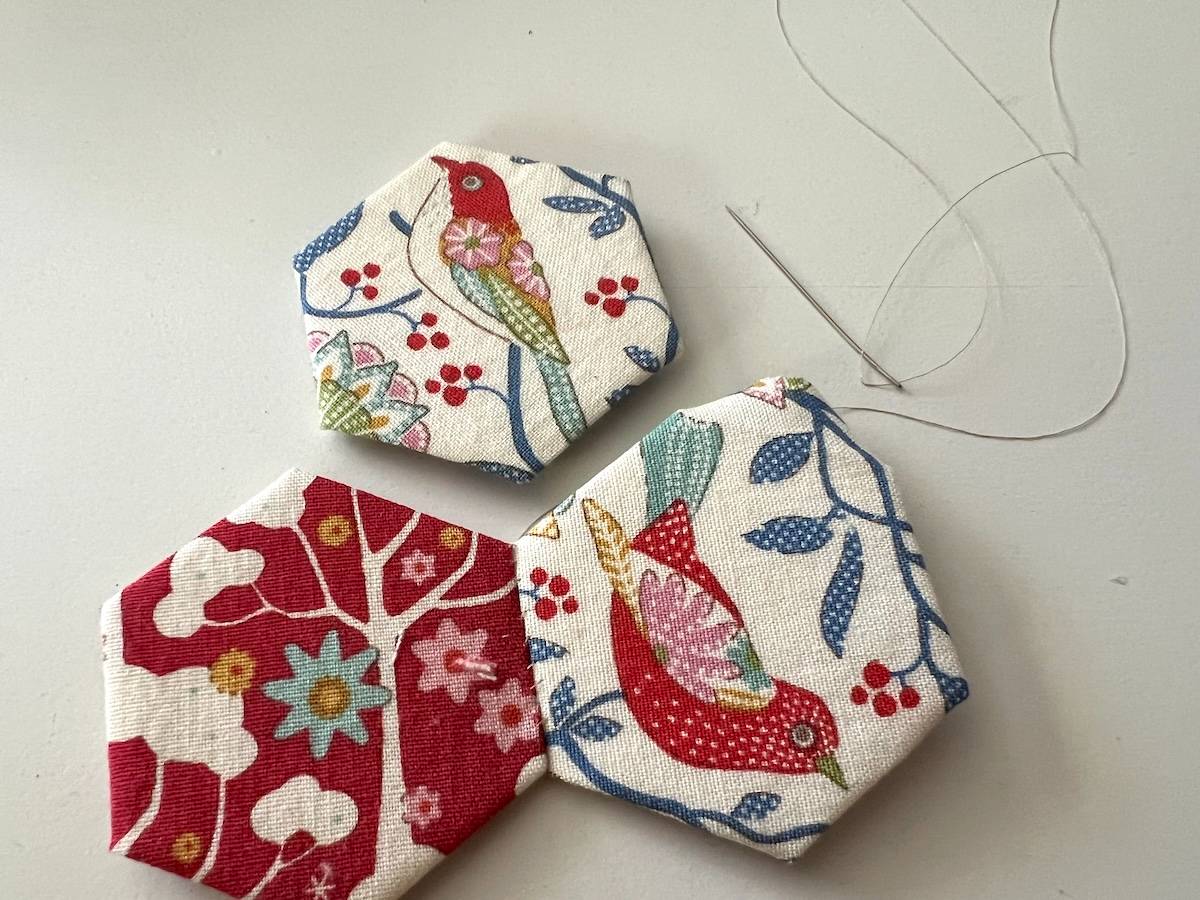
TIP: Hide your knot inside one of the folds.
Use tiny whip stitches along the folded edges, catching only a few threads of fabric with each stitch. Small, even stitches create nearly invisible seams.
Continue adding shapes one at a time until your design begins to grow.
Here all of the hexies have been sewn to the center. 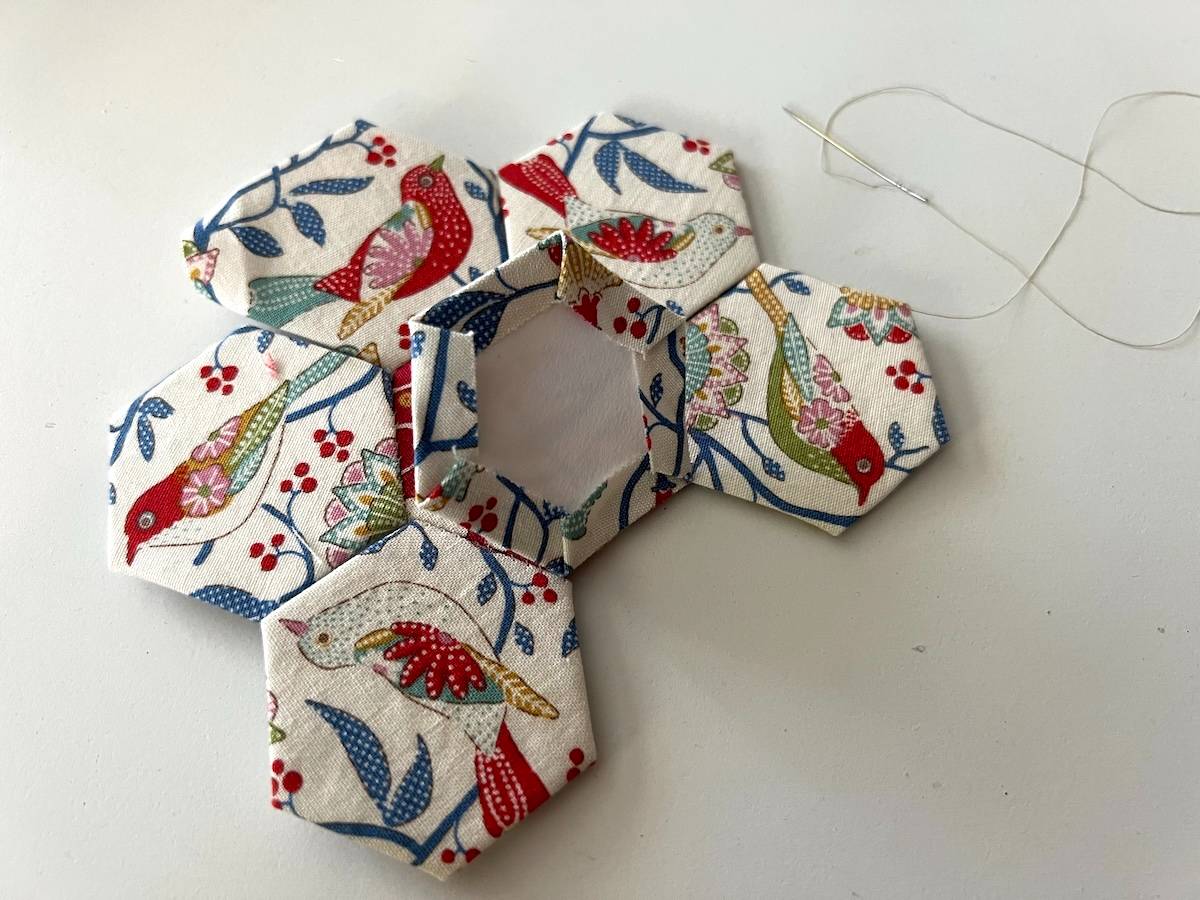
Then, remove the paper from the center ONLY so you can sew the hexies sides together easily. 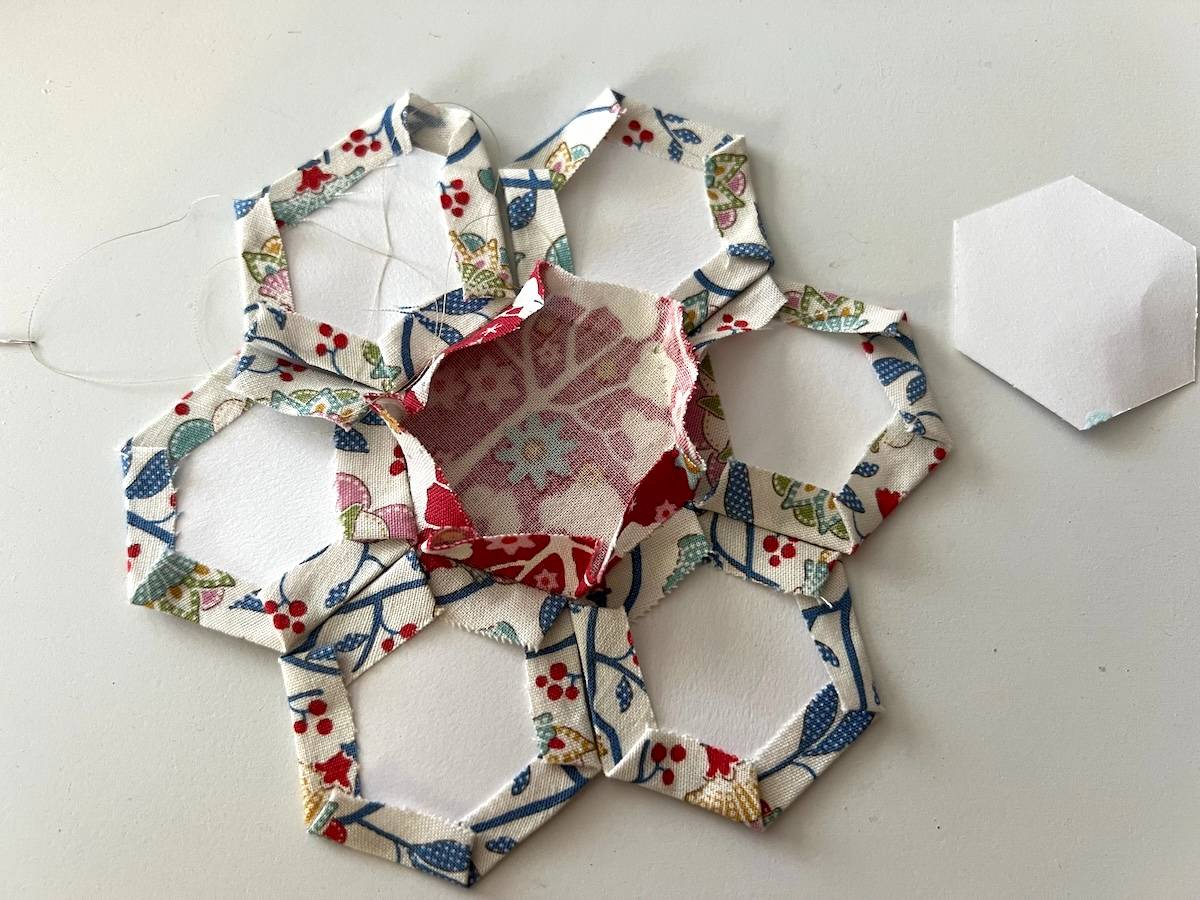
Step 5: Remove the papers
Once every edge surrounding a paper template has been stitched into the quilt, carefully unfold the seam allowances and remove the paper.
Save reusable templates for future projects.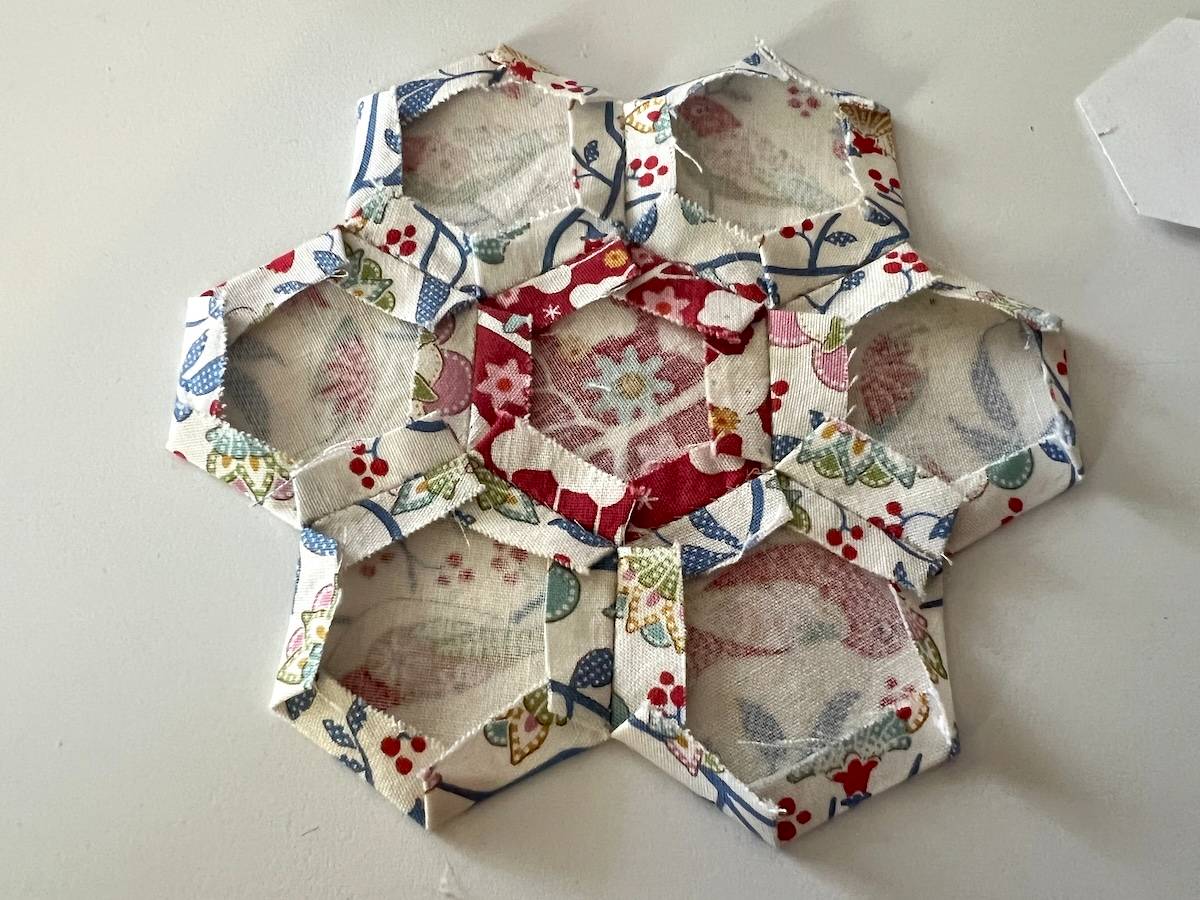
Step 7: Finish Your project
After all of the papers have been removed, give the EPP project a final press.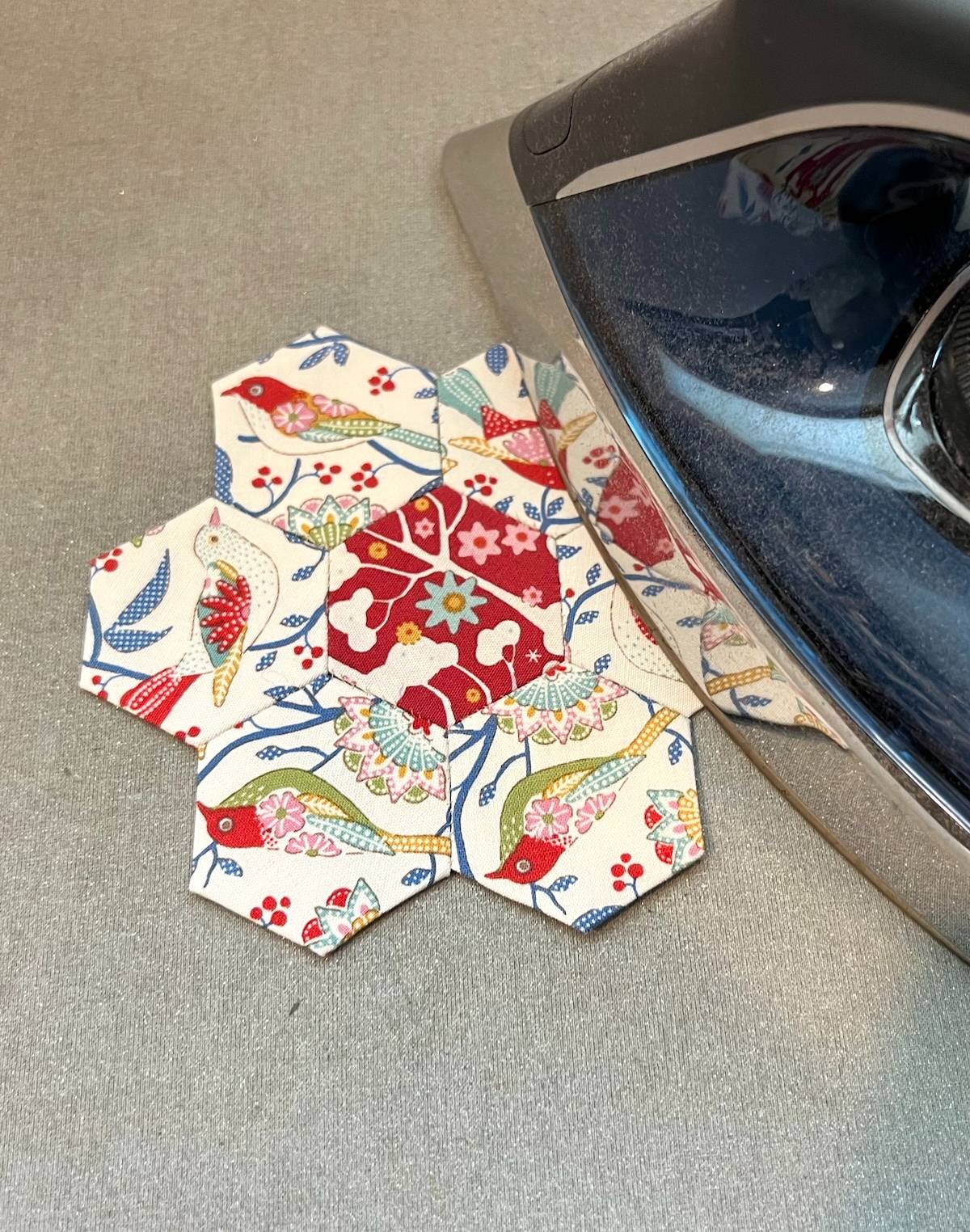
Your English paper-pieced blocks are now ready to be incorporated into a quilt, pillow, table runner, bag, or any project you have planned.
TIP: Selecting paper templates: Use good quality pre-cut paper shapes that can be reused multiple times
You can cut your own templates from heavyweight paper using either scissors or a punch, but it is really so much easier to buy the precut templates.
Spend a few pennies more to buy from a reputable company, and not a no-name brand — having higher-quality paper and accurately cut pieces will make the project easier.
If you can, purchase all of the paper pieces you need for a project from the same company to ensure consistent size and fit. Also, with higher-quality paper, you can gently remove the paper after sewing your pieces together and reuse the template. So – in the long run, it ends up being less expensive.
RECOMMENDED PRODUCT: Paper Pieces 1″ 600-piece hexagons

TIP: Make sure your fabrics are cut accurately
If you are making a lot of pieces for a project, it is worth the investment to purchase the acrylic templates that pair with the paper templates you are using.
As an Amazon Associate I earn from qualifying purchases. Read more about our affiliate linking policy.
You can choose templates with either a 1/4 or 3/8-inch seam allowance. Some stitchers prefer the smidge of extra fabric in a slightly wider seam to wrap around the paper pieces.
Using the acrylic templates, you can use your rotary cutter and quickly cut exactly the right size fabric for perfect seam allowances for your little pieces.
RECOMMENDED PRODUCT: Sew Easy patchwork mini hexagon template set
TIP: Best fabrics for English paper piecing
One of the reasons English paper piecing is so enjoyable is that it works with almost any quilting cotton. Crisp, tightly woven fabrics hold their shape well around the paper templates and make it easier to create neat edges and sharp points.
If you’re just getting started, choose quality quilting cotton with small or medium-scale prints. Busy prints help hide tiny stitches, while solids show every stitch, making them a little less forgiving for beginners.
Other fabrics that work well include:
- Quilting cotton
- Batiks
- Liberty Tana Lawn
- Lightweight linen blends
Avoid thick fabrics like denim, canvas, or upholstery fabrics until you’ve gained more experience. The extra bulk can make it difficult to fold seam allowances neatly around the paper templates.

Make an EPP Tree Ornament with Hexies
Glue basting vs. thread basting
There isn’t one “right” way to baste English paper piecing shapes. Most quilters develop a favorite method, and both produce beautiful results.
Glue basting
Glue basting uses a fabric-safe glue pen to hold the seam allowance around the paper template.
Pros
- Faster to prepare
- Holds fabric securely
- Easy to remove papers later
- Great for beginners
Cons
- Requires a glue pen
- Glue needs to stay on the seam allowance, not the paper
Thread basting
Thread basting uses large stitches to wrap the fabric around the paper.
Pros
- Traditional method
- No glue required
- Easy to reposition fabric
Cons
- Takes more time
- Threads must be removed before finishing
- Many modern EPP stitchers prefer glue basting because it’s quick and tidy, but thread basting is still a wonderful option if you enjoy the traditional process.

TIP: Apply the glue just inside the edge of the paper, on the edge
Applying the glue away from the edge of the paper allows the fabric to attach to the paper while keeping the area where you will sew free of glue.
This helps you avoid two roadblocks to easy stitching: glue on the stitching edge can hinder your sewing and ‘gunk’ up your needle.
TIP: Finger press the fabric to the glue around the template in one direction: either clockwise or counter-clockwise
By having a method for how you finger press the fabric to the glue on the paper template, each piece is consistent, which makes it easier to nest the corners together accurately when sewing.
TIPS: Gluing fabric around curved paper templates
You can sew baste your fabric around your paper template or use a school glue stick, but it is much easier to purchase a glue pen specifically made for English paper piecing.
The smaller glue surface on the end of the pen makes it easier to quickly glue the fabric to the paper and keep all of the glue within the seam allowance. The papers are easier to remove, and the glue pens made for fabric do not leave a sticky residue on your paper pieces or your needles.
TIP: Store your glue pen in the refrigerator. When you aren’t actively working on attaching your fabric to the paper templates, store your glue pen in the refrigerator in a small Ziploc bag. This keeps your pen fresh and prevents it from drying out so quickly.
RECOMMENDED PRODUCT: Sewline fabric glue pens with refills (you’ll need the refills!)

When glue basting curves for English paper piecing, it is especially important to make sure that you leave a gap between the glue and the edge of your paper template. This allows the straight-woven fabric to ease into the curves.

Start with the concave (inner) curves. Clip the seam allowance, if necessary, stopping 1/8-inch from the stitching line. Add glue, then, a little at a time, smooth the fabric over the edge of the paper from front to back. Your index finger is a great tool for this step!

For convex (outer) curves, add glue, then bring the seam allowance from front to back as before, easing the fabric into a smooth edge. The excess fabric will form pleats near the cut edge – they will not show on the front as long as your edges are smooth.
Draw your finger along the basted edge. If you feel bumps, pull up that section, refresh the glue and reposition. For long curves, glue in sections to keep the glue moist during placement.

TIP: The right seam allowance
A consistent seam allowance is one of the easiest ways to improve your English paper piecing.
Most quilters use a seam allowance between ¼ inch and ⅜ inch. Smaller shapes often work better with a slightly narrower seam allowance, while larger shapes may benefit from a little extra fabric to wrap around the papers.
No matter which seam allowance you choose, consistency is more important than the exact measurement. Even seam allowances create smooth edges and make your pieces fit together accurately.
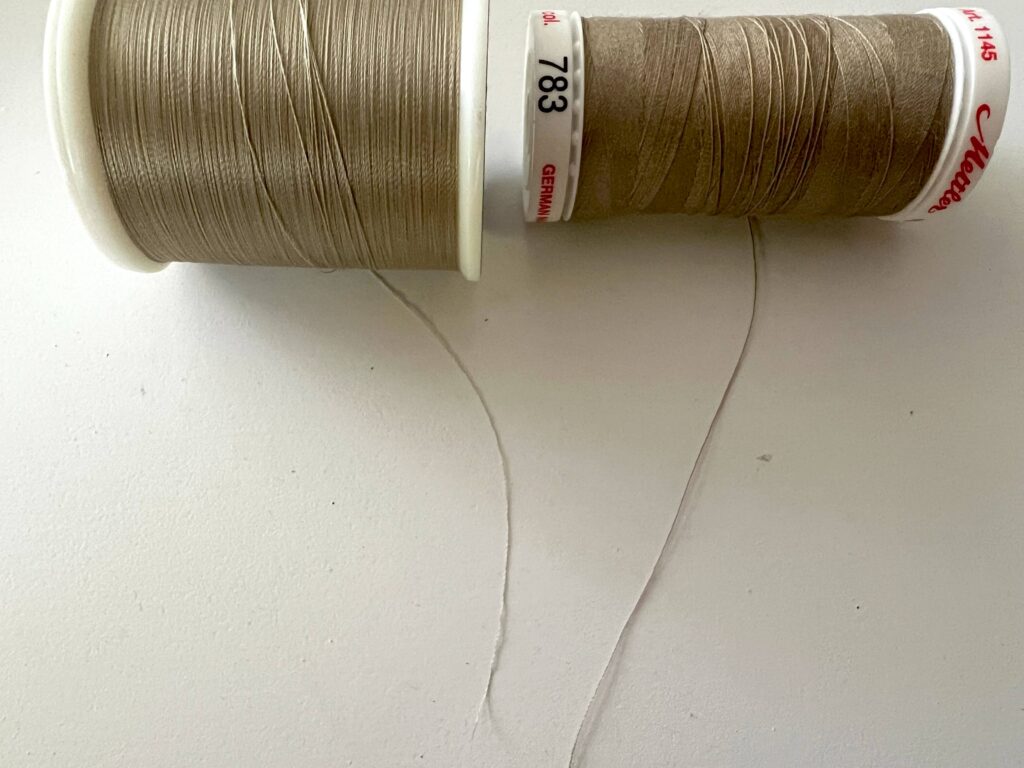
The thread on the left is Superior Threads Bottom Line; the one on the right is regular sewing thread. You can see the difference in thread thickness. A thinner thread is better for EPP projects.
TIP: Using the best thread
Your stitches should almost disappear into the quilt, so thread matters more than many beginners realize.
A fine polyester thread or silk thread is a popular choice because it’s strong, smooth, and less likely to tangle than cotton thread. Choose a neutral color that blends with most of your fabrics, or match the thread to the fabric if you’re working with solids.
Cut shorter lengths of thread, about 18 to 20 inches long. Shorter thread twists less and makes hand sewing much more enjoyable.
When you stitch the templates together, you use very small stitches, close together. If you use a cotton thread, the thread might begin to shred.
Using a strong fine thread makes your stitches less visible and the sewing process easier and less frustrating.
RECOMMENDED PRODUCT: YLI 100wt Silk Sampler Thread or Superior Threads Bottom Line 60wt

TIP: The best needles for EPP
Use a long, fine needle so it is easier to do small stitches.
Many English paper piecers like milliner’s or appliqué needles because they’re thin enough to slip through fabric without leaving noticeable holes.
If you’re new to hand sewing, try a few different sizes until you find one that feels comfortable in your hand. The “best” needle is the one you enjoy using.
RECOMMENDED PRODUCT: Clover Gold Eye Milliner Needles
YOU MAY ALSO LIKE: Clover Needle Threader

TIP: Use quilting clips instead of pins to hold your shapes together
Quilting clips easily hold your basted templates together for stitching.
Pins are not made to get through layers of paper and fabric and can distort your carefully prepared pieces; that will distort your quilt blocks. Quilting clips keep your pieces lined up correctly while you stitch, and they do not leave holes in the paper templates.
RECOMMENDED PRODUCT: WonderClips

SEWING TIP: Knot your needle from the end that comes off the spool and use a thread conditioner
Nothing is more frustrating than sewing along and then a knot forms in your thread. You have to figure out if you can untangle the knot, somehow end the stitching, or unsew what you’ve done and start over.
Learning this trick of which end to knot will prevent a lot of headaches! For added insurance, passing your thread through a thread conditioner keeps it supple and less likely to form knots.
RECOMMENDED PRODUCT: Thread Magic
TIP: Use the whip stitch to sew your pieces together
TIP: How to remove the paper templates
One of the biggest advantages of English paper piecing is that the papers can often be reused several times.
Wait until every edge surrounding a paper template has been stitched before removing it. If you remove papers too soon, the shape may lose its accuracy.
Gently unfold the seam allowances and pop the paper out through the opening. If you’ve used glue basting correctly, the paper should release easily without damaging the fabric.
Stack reusable papers together so they’re ready for your next project.
Can you reuse paper templates?
Yes! Good-quality paper templates can often be reused several times.
Inspect each paper before using it again. If the edges have become bent, rounded, or torn, replace it. Crisp edges help produce crisp points in your finished quilt.
Many quilters keep a small envelope with reusable papers organized by shape and size for future projects.
TIP: Organizing an EPP Project
English paper piecing is wonderfully portable, and a little organization goes a long way.
Keep everything together in a zippered project pouch or small basket. Or, make your own travel kit for English paper piecing! Include:
- prepped fabric shapes
- paper templates
- thread
- needle
- scissors
- glue pen
- clips or pins
Having everything ready makes it easy to pick up your project while traveling, waiting for appointments, or relaxing in the evening.
YOU MIGHT ENJOY: Designing, organizing, and making an EPP video game quilt
Why EPP Is the perfect travel project
Few quilting techniques travel as well as English paper piecing.
You don’t need a sewing machine or ironing board, and each shape is small enough to stitch almost anywhere. Whether you’re riding in the car, flying on vacation, or enjoying a quiet afternoon on the porch, EPP lets you make progress one stitch at a time.
Many quilters keep a small EPP project packed and ready so they always have something creative to work on.
RELATED: How to make a travel kit for English paper piecing
Common mistakes to avoid
Everyone makes a few mistakes when learning English paper piecing. Fortunately, they’re easy to fix.
Avoid these common problems:
- Using seam allowances that vary from piece to piece.
- Pulling stitches too tightly, which can make the quilt pucker.
- Removing paper templates before surrounding seams are sewn.
- Cutting thread that’s too long, leading to tangles and knots.
- Using dull needles that snag fabric. (Yes, needles can get dull!)
- Putting glue directly on the paper template instead of the seam allowance.
- Mixing paper templates from different manufacturers, which may vary slightly in size.
Remember, accuracy comes from consistency, not speed.

This is our Moravian star ornament. With this project, you’ll learn how to fuzzy cut fabrics to create designs.
How to get perfect points every time
You don’t need to pull your stitches tighter to get sharp points. Instead, focus on accuracy before you ever pick up your needle.
Start with crisp paper templates that haven’t become bent or worn. Cut a consistent seam allowance around every shape so each fold wraps the paper evenly. As you baste, smooth the fabric before securing the edges to avoid tiny wrinkles that can add bulk.
When stitching two pieces together, match the corners carefully before taking your first stitch. Tiny whip stitches placed close together will hold the edges securely without creating visible gaps. Finally, resist the temptation to remove the papers too early. The paper templates keep every point crisp until the surrounding seams support the shape.
Perfect points are the result of careful preparation and consistent stitching, not tight stitches or extra effort. Slow down, enjoy the process, and you’ll be amazed at how quickly your accuracy improves.
RELATED: How to make an EPP Star Ornament
TAKE TO THE NEXT LEVEL: How to make an EPP Moravian star ornament

Afternoon, scrap-happy project idea: Make an EPP diamond mug rug
Frequently asked questions
English paper piecing is a hand-sewing technique where fabric is wrapped around paper templates before the pieces are stitched together. The papers help keep every shape accurate until the quilt top is complete.
Yes! EPP is beginner-friendly because you sew one seam at a time. It’s a relaxing way to learn hand stitching while creating precise quilt blocks.
No. English paper piecing is done entirely by hand. Once your quilt top is finished, you can quilt it by hand or machine.
Both methods work well. Glue basting is faster and is a favorite for many modern quilters, while thread basting is the traditional technique and doesn’t require any glue.
Quilting cotton is the most popular choice because it folds neatly around the paper templates. Batiks, Liberty Tana Lawn, and other lightweight woven fabrics also work beautifully.
Yes. Most paper templates can be reused several times as long as they remain crisp and don’t become bent or damaged.
Wait until all of the edges surrounding a paper template have been sewn into the quilt before removing it. This helps your blocks keep their shape.
Uneven seam allowances, worn paper templates, or removing the papers too early are the most common causes. Consistent cutting and careful stitching will help you achieve crisp, accurate points.
English paper piecing is one of those quilting techniques that rewards patience instead of speed.
Each stitch brings your project to life, one shape at a time, making it easy to enjoy the journey as much as the finished quilt.
Whether you’re sewing your very first hexagon or planning an heirloom quilt, these tips will help you build confidence, improve your accuracy, and make every stitch count.
Gather your favorite fabrics, thread a needle, and enjoy the quiet rhythm of English paper piecing.
Browse through more English paper piecing projects and inspiration on Create Whimsy.
Learn how to English Paper Piece with this table topper project on Create Whimsy.


