
From graphic and motion design to art quilting, Lauri Jones has followed her curiosity wherever it leads. Her bold, layered quilts draw on years of creative exploration, blending structure, motion, and play.
You trained in graphic design and worked in motion design. What first pulled you toward quilts and stitched textiles?
My journey has always been driven by curiosity. I’ve kept a creative practice throughout my life, though its form has shifted with different chapters.
When I was working as a motion designer, the daily work fulfilled my need to be creative and make things. But when I transitioned into art education about sixteen years ago, my studio practice became robust again.
I immersed myself in bookmaking and printmaking, and eventually became obsessed with rust printing. I started hand and machine stitching on my prints, and before long I realized — why not try rust printing on fabric instead of paper?
As an Amazon Associate I earn from qualifying purchases. Read more about our affiliate linking policy.
That simple shift changed everything.
Working on textiles opened up an entirely new world for me. As my stitching grew more intricate and layered, it became obvious that I needed to learn how to quilt.
I started quilting about ten years ago and fell in love instantly. I spent the next few years honing my skills, experimenting without restraint, taking classes, joining a guild, and connecting with generous quilters and artists who have inspired me along the way.
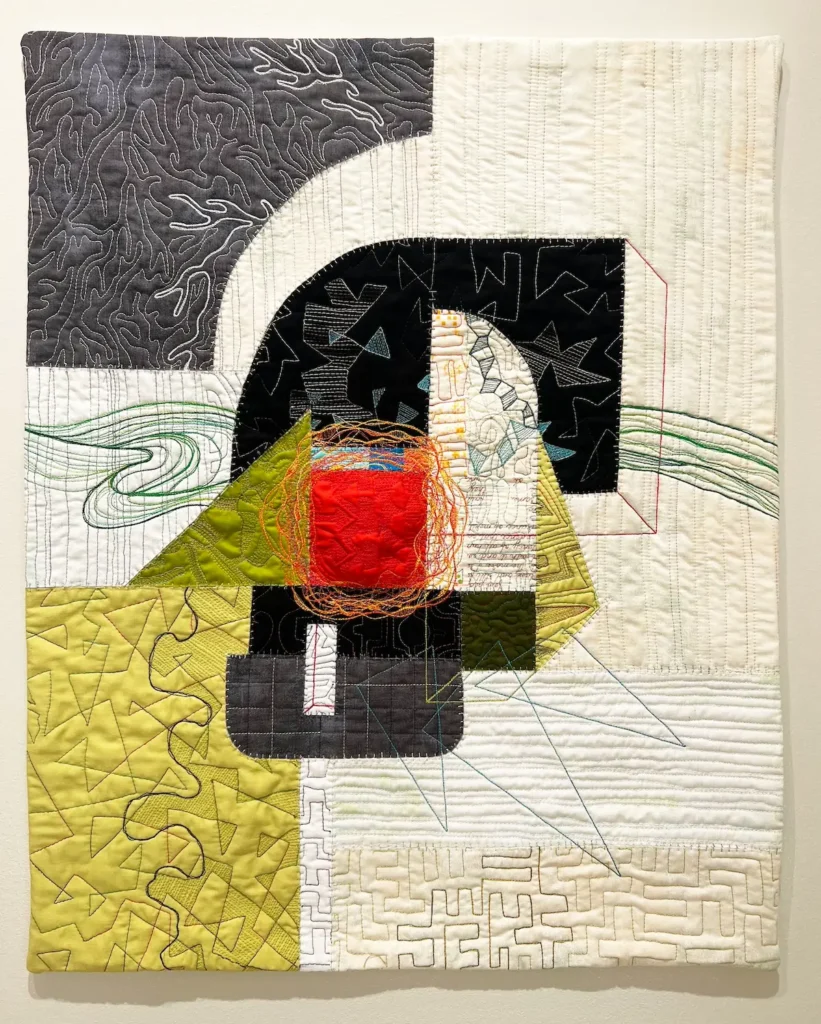
“Nesting” is about the instinctual and emotional labor of creating a home. Drawing inspiration from the persistent efforts of a mother preparing for her family, this work explores the intersection of comfort and protection. Through bold geometry and layered stitching, I hope to evoke the delicate yet resilient structures that emerge when love takes shape in physical space.
The materials and composition echo the dual nature of nesting: it is both an act of fierce guardianship and tender intimacy. Each element in the piece reflects the quiet strength behind the everyday rituals of care. It honors the invisible architecture mothers build—not just with their hands, but with their attention and presence.
How did working in animation change the way you think about composition and movement in your quilts?
My backgrounds in graphic design and motion media have shaped nearly every aspect of how I approach quilting.
The influence is especially clear in my love of grids, geometry, and structure — those design elements are deeply embedded in my visual language. Color is also a huge part of it.
Because I spent years working as a graphic designer, I developed a confidence in making bold color decisions early on; it’s often one of the very first things I commit to when beginning a piece.
Perhaps the biggest impact comes from my time in motion design. Animators are trained to think in layers — foreground, background, transitions, pathways — and that mindset still guides how I build quilts.
I always construct the quilted substrate first, like laying down a textured stage, and then I intuitively find ways to move across it, connecting elements in rhythm and flow.
Even though the final object is static, I’m always thinking about how the eye travels — as if the piece is quietly in motion.
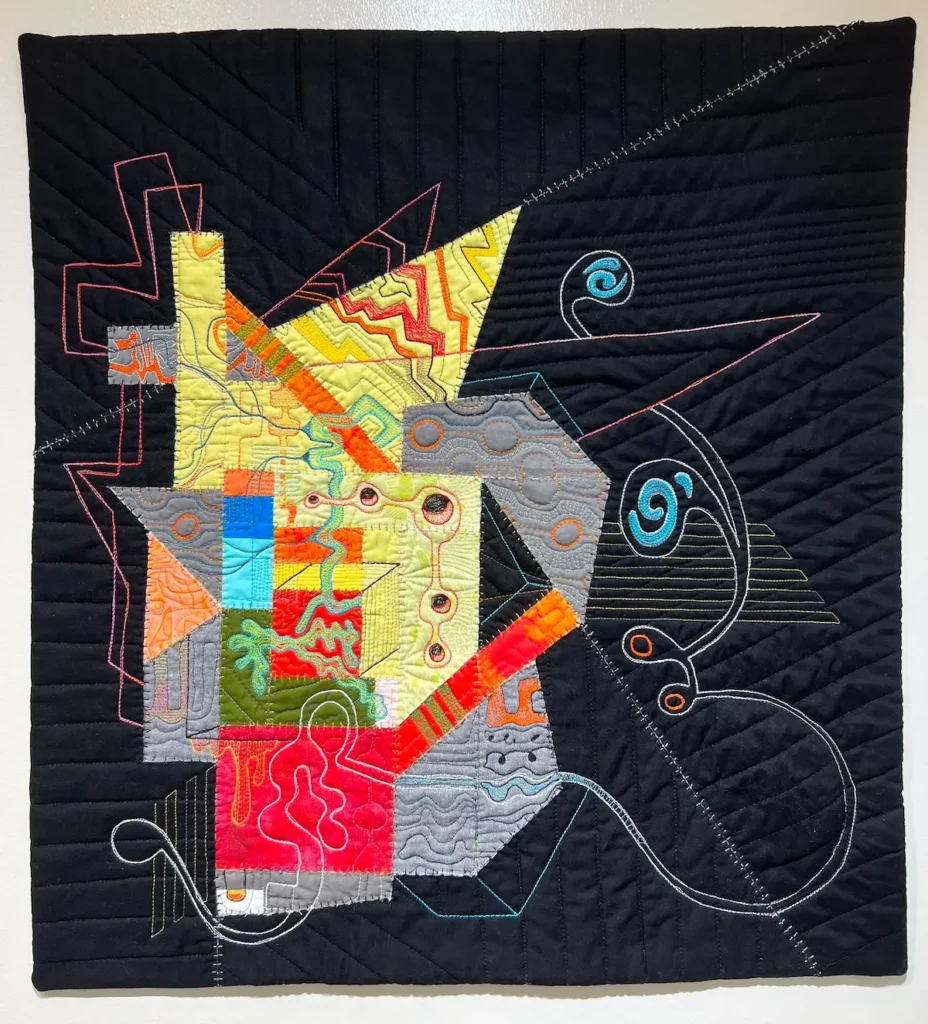
Mad House” is both a tribute and a time capsule—a tactile portrait of family life in its most unfiltered form. It invites viewers to find beauty in the bedlam and to remember that sometimes, the best way to survive the madness is to revel in it.
Where do you go when you need new ideas — walks, music, other artists, museums?
For me, ideas rarely arrive out of nowhere — they show up when my hands are already moving. I’m a big believer in what I call “thinking with my hands.”
When I’m stuck, I don’t wait for inspiration; I go straight to the scrap bin. I cut up old work and reassemble it. I make small quilted experiments. I draw, stitch, collage, shuffle, and recombine. Play is my strategy. The act of making itself is what shakes ideas loose.
That said, I also feed my brain in quieter ways.
I’m a devoted museum wanderer and gallery browser. I adore flea markets and vintage stores. And I have an ever-growing library of art and craft books that I love to page through when I need new visual fuel.
But even then, the spark doesn’t fully land until I translate what I’ve seen back into my materials. For me, inspiration isn’t a lightning bolt — it’s a conversation between hands and mind.
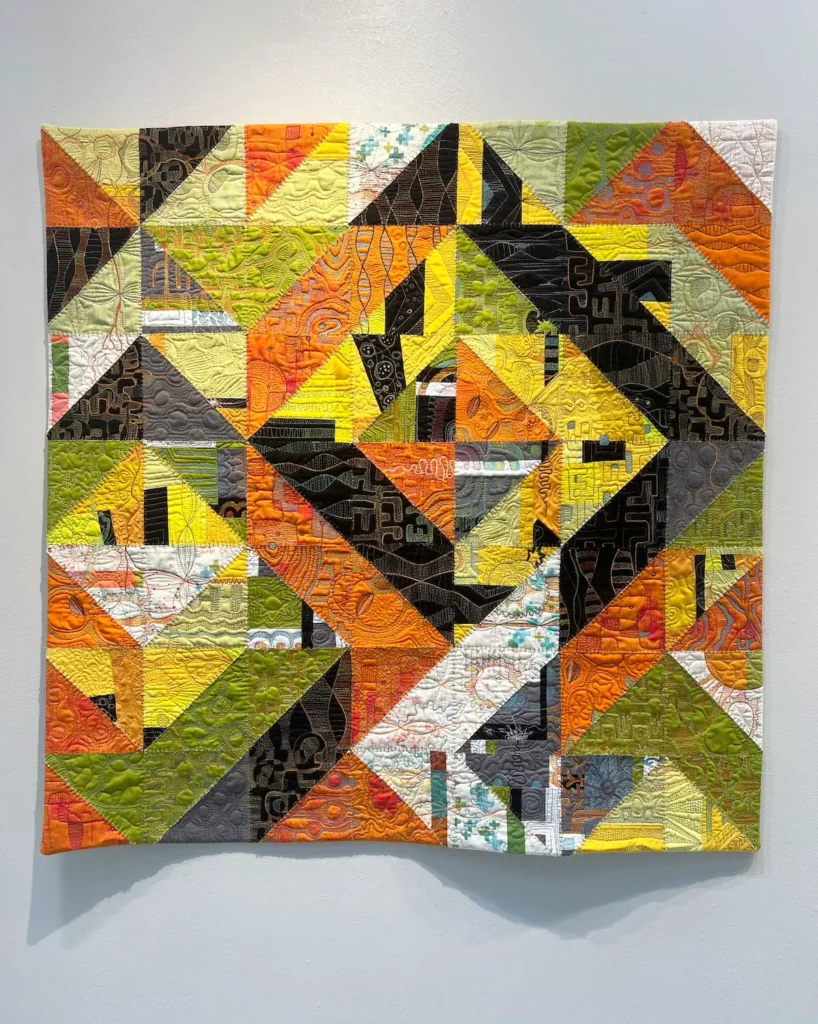
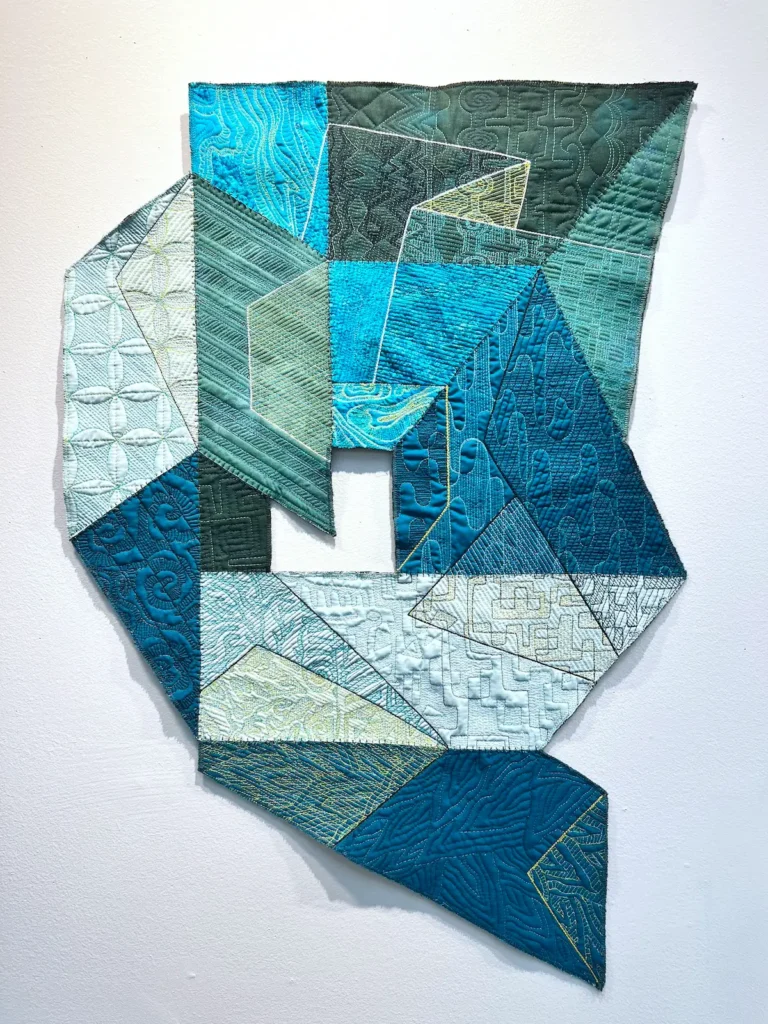
This work explores the complex relationship between nature and nurture.
Nature includes the innate qualities and characteristics we are born with—fixed and unyielding. Nurture is the environmental influences and experiences that shape us over time. While our natural instincts may guide us, our experiences and choices are equally powerful in shaping who we become.
This tension between the two forces is not a battle to be won, but rather a dance that allows them to coexist in harmony. This quilt is a homage to that dynamic partnership, illustrating how both inherent traits and external influences work in tandem to shape the complexity of the human experience.
Describe your creative space.
This is my favorite question, because until recently I didn’t have a dedicated creative space.
For years my studio was the family dining room — great light, plenty of surface area, but everything had to be cleared away anytime a holiday or celebration rolled around. It wasn’t ideal, but it cemented one of my core beliefs: if you wait for perfect conditions to create, you’ll never make anything.
That less-than-ideal dining room is where my quilting practice truly came to life. I refused to let lack of space be an excuse.
So here’s my unsolicited advice to anyone juggling creativity with family life: stop waiting. Claim the dining room table. Take over a corner of the living room. Make a mess. No one is going to grant you space — you have to claim it.
Now that my kids are grown, I’ve moved into my daughter’s former bedroom. It’s smaller than the dining room, but it’s all mine. I painted the walls white, bought in a big work table, and installed the crown jewel of the space: my 90″ x 90″ design wall. That wall is where the real magic happens — I cut shapes, arrange and rearrange, solve visual puzzles in real time.
There’s also a little daybed, perfect for sketching, thinking… and for my dog Peaches, who also knows a thing or two about claiming space.
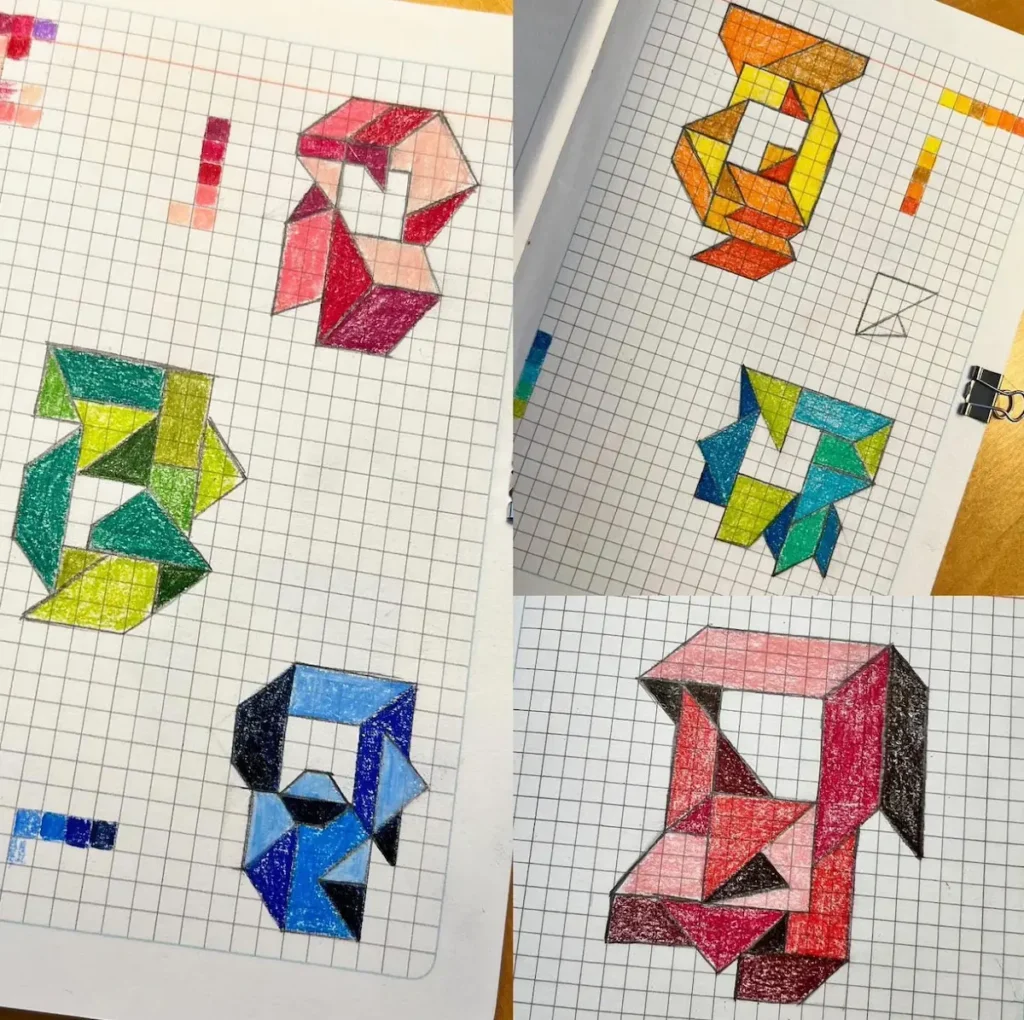
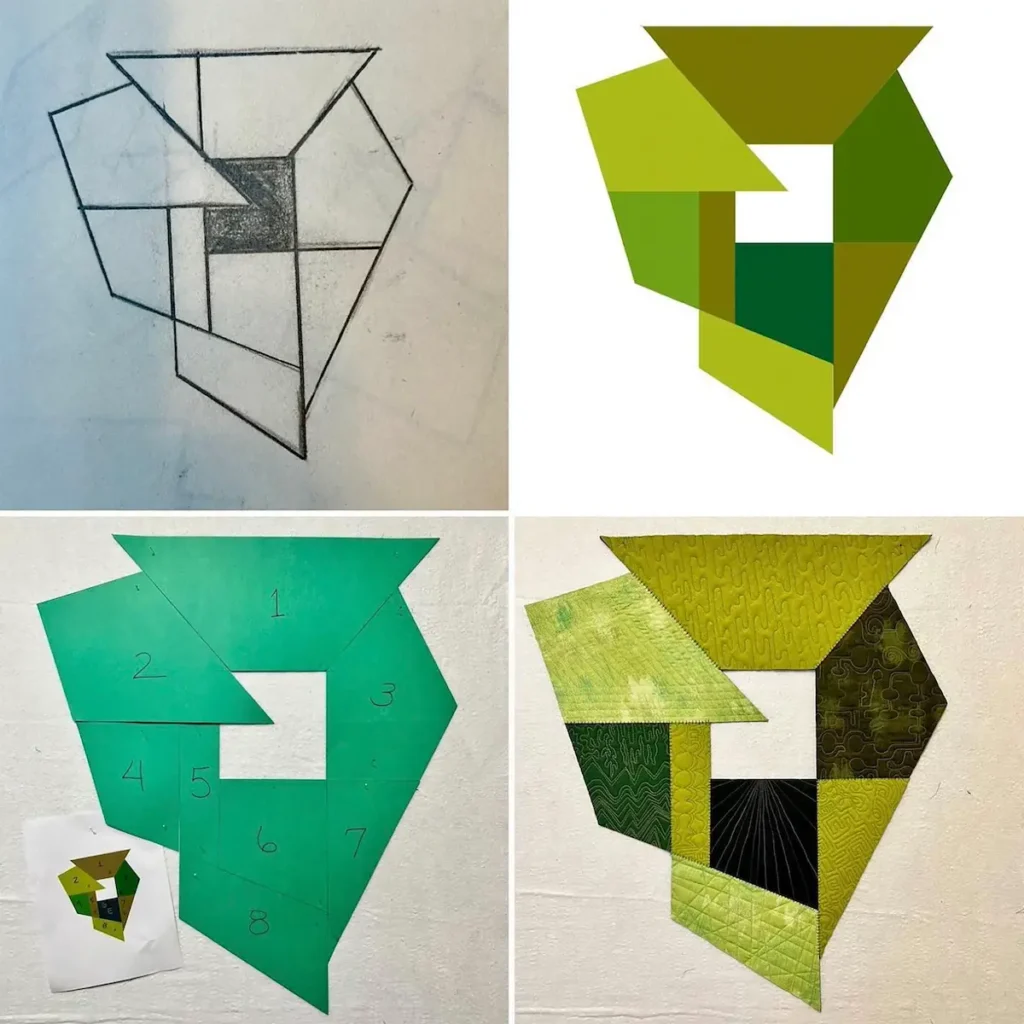
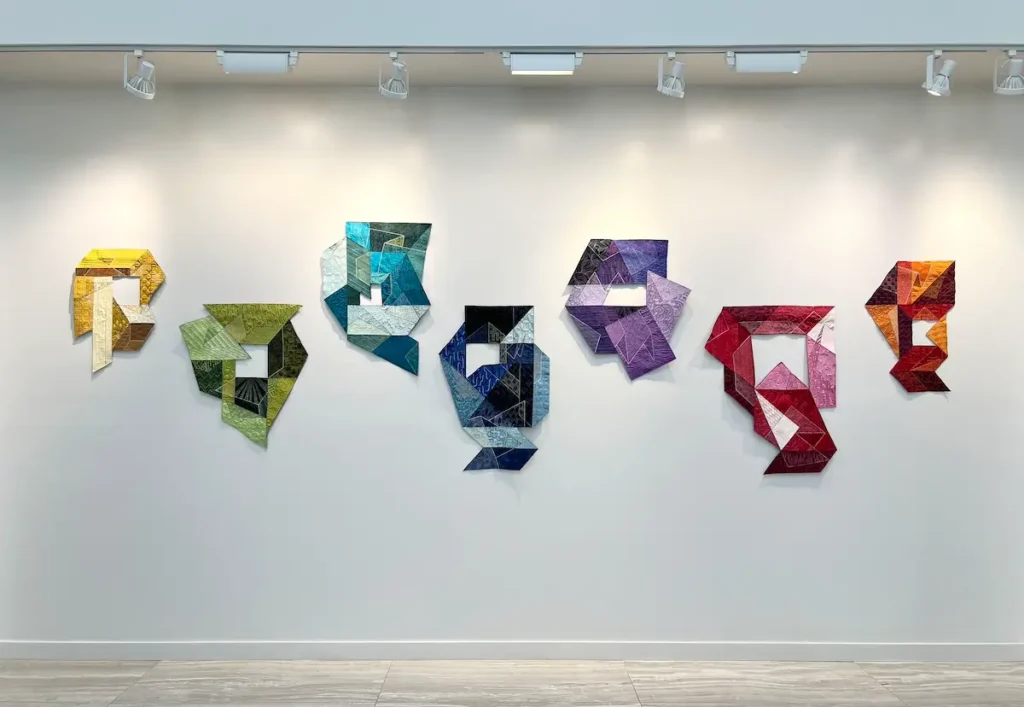
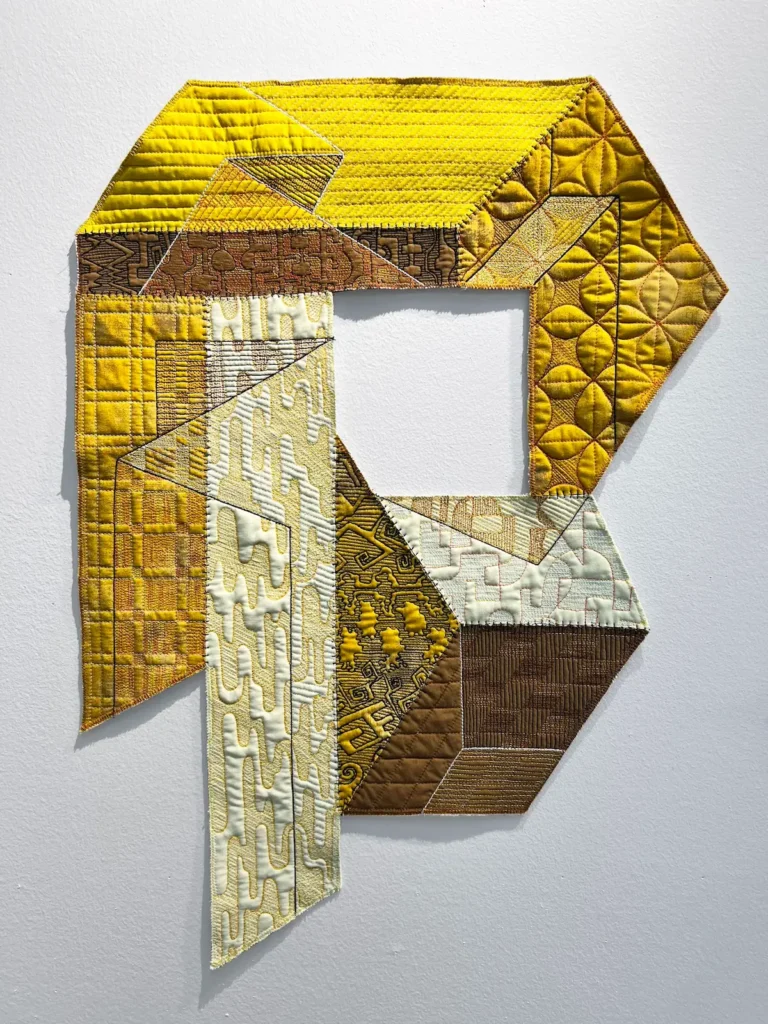
In order to fit, we fold ourselves into recognizable shapes and convenient sizes. We bend and contort. We cover and conform.
With this work, I celebrate taking up space. Leaving space. Sprawling. Revealing. Unfolding.
Do you do sketches or mockups before stitching, or do you let the cloth lead?
I start with sketches—on gridded paper, in a sketchbook, or digitally in Illustrator—exploring color, form, and value. These plans guide the creation of the quilted substrate, which I then photograph and refine in Photoshop, shaping the broader ideas for stitching.
Once the needle meets the fabric, the work takes on a life of its own. Each stitch responds to the geometry of the cloth, the textures I’ve built, and the story that emerges as I move through the work.
It is in this improvisational dialogue with the material that the work truly comes alive.
Tell me the story of how a piece in your current series begins — the very first mark or stitch.
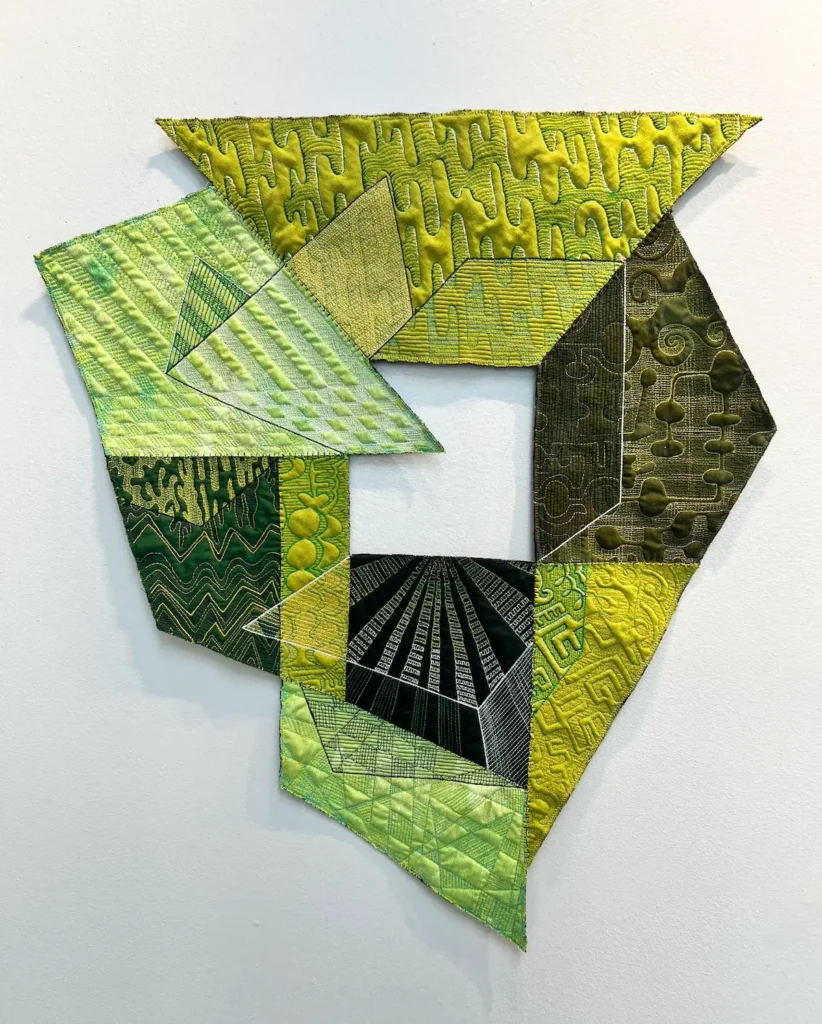
Currently, I’m working on a series called Drunken Mandalas. The idea emerged, as many do for me, through play. I had been deep into a large, meticulous piece called Flow and had grown weary of refining endless details. Though the work was coming along, the joy had drained from the process—I needed to be revived.
It was early summer in Atlanta and everything was bright and alive. I opened my scrap bin, pulled out greens and whites, and blacks and grays. I abandon my rotary tool for a pair of scissors. I hand-cut dozens of misshapen Drunkard’s Path blocks, stitched them together, and began arranging them freely on the design wall—no sketches, no plan, just instinct.
That intuitive play lifted the pressure I’d felt. As I built these crooked mandalas from wonky shapes, I realized the work was about engaging opposites: stillness and motion, preparation and spontaneity, tradition and innovation. The process was liberating. After making significant progress on my two Drunken Mandalas, I returned to Flow and completed it with fresh energy.

With this series, I am reimagining the traditional “Drunkard’s Path” quilt block to
create compositions that explore the tension between commotion and stillness.
The curves in each block make the mandalas feel both energetic and centered.
There’s a rhythm to the repetition, but also a stillness at the heart of each piece. I
use free-motion stitching to add another layer of detail, and those intricate lines
and patterns give the quilts texture and a sense of quiet flow. These pieces are
about holding opposites: stillness and motion, tradition and reinvention.
What signals tell you a piece is finished and ready to leave the studio?
Because my work involves so many layers and complex stitching, the question I’m most often asked is, “How do you know when you’re finished?” My unsatisfying but honest answer is: I just know.
It’s less about when the piece is finished and more about when I am finished. When I’ve given all I can give and learned all I can learn from that particular work, that’s when I know it’s time to let it go.
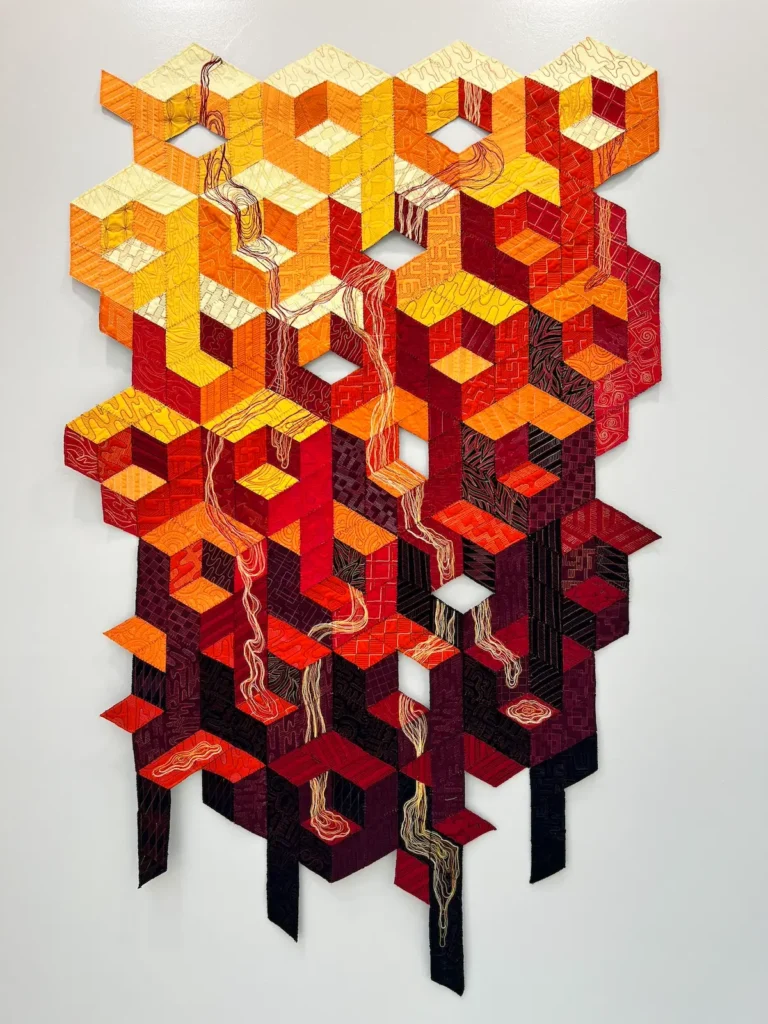
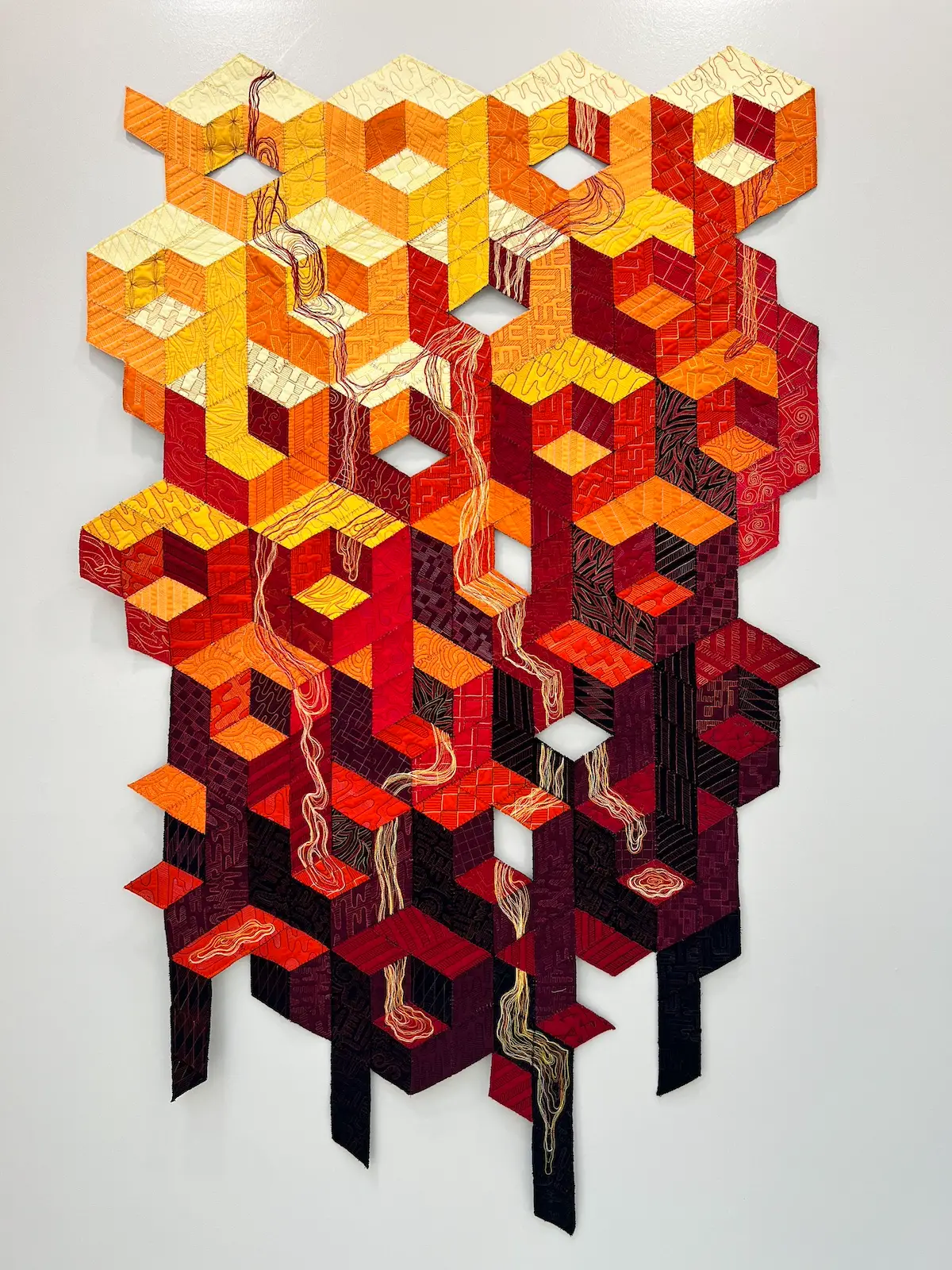
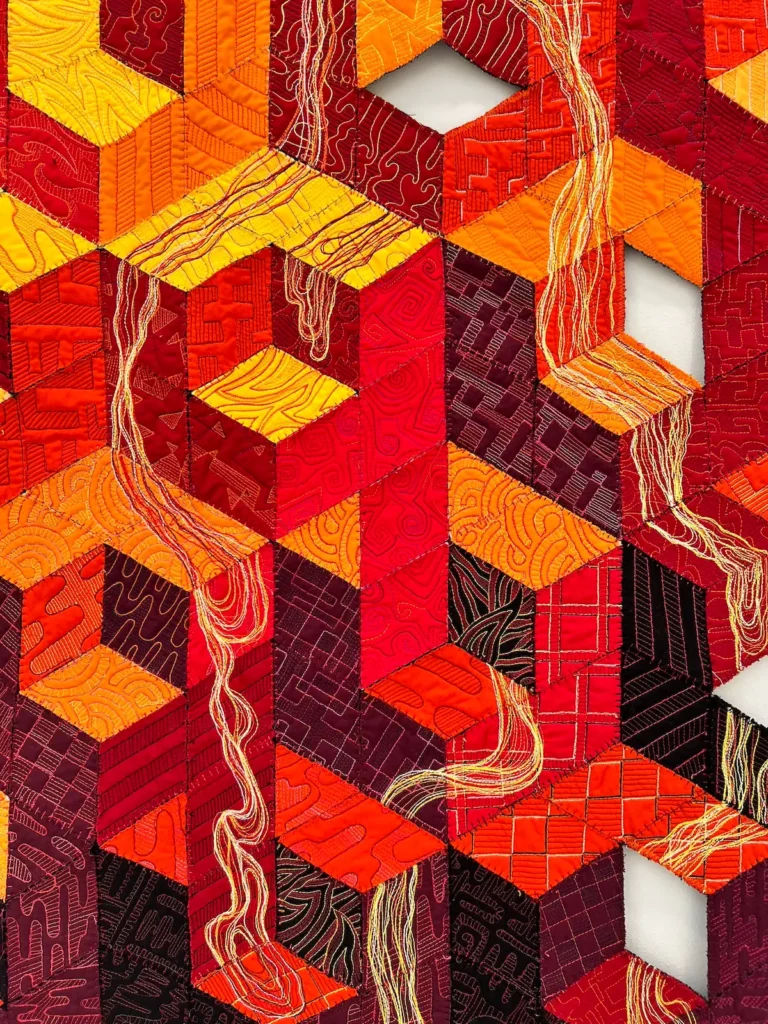
This quilt is a reimagining of the traditional “Tumbling Block” pattern. I’ve always
been drawn to its optical illusion and use of value to play with depth and
direction. The geometric substrate creates order. Free-motion stitching creates
texture and pathways that flow beyond the boundaries of the blocks. Vacant
spaces leave room for the unknown. Though rooted in tradition, this quilt is a
modern meditation on change, resilience, and letting go.
Repetition is strong in stitched work — what does repeating marks mean to you emotionally?
Repeated marks are both grounding and liberating; they allow me to enter a state of flow, to process thoughts and emotions, and to witness the gradual transformation of the cloth. For me, there is comfort and intimacy in repetition—it’s where patience, presence, and care reveal themselves.
How has your work changed since your RISD days — what’s stayed, what’s shifted?
Wow—so much time has passed since I graduated from RISD in 1990! Yet many of the lessons I learned there still shape how I work today.
My professors emphasized experimentation and process, and I discovered the value of bold ideas, material exploration, and learning through failure.
Perhaps most importantly, I developed a deep reverence for craft—the discipline, detail, and integrity that come from working with your hands, and how that connects to clear, thoughtful ideas.
At RISD, I was trained as a designer, which meant prioritizing the needs of the user and communicating with clarity.
Now, as a fine artist, my approach has evolved. I still think about my audience, but I allow my ideas to be more open-ended. I’ve grown comfortable with ambiguity—allowing the work to ask questions rather than provide answers.
What practical advice do you give beginners who want to try art quilting?
For those beginning in art quilting, my advice is to be bold! Learning something new inevitably involves making mistakes, and each one offers valuable insight.
If materials are cost-prohibitive, consider repurposing fabric from thrifted sheets or cotton shirts. I began quilting on a $50 secondhand Brother machine, and it served me well.
If you find energy in community, join a guild, attend local studio events, or connect with other beginners online.
Approach every project as an experiment rather than a masterpiece. Stay curious, take risks, and allow joy and discovery to guide your process.
Where can people see your work?
Instagram @laurijonesartist
www.laurijonesartist.com
Interview posted October 2025
Browse through more inspiring art quilts on Create Whimsy.