
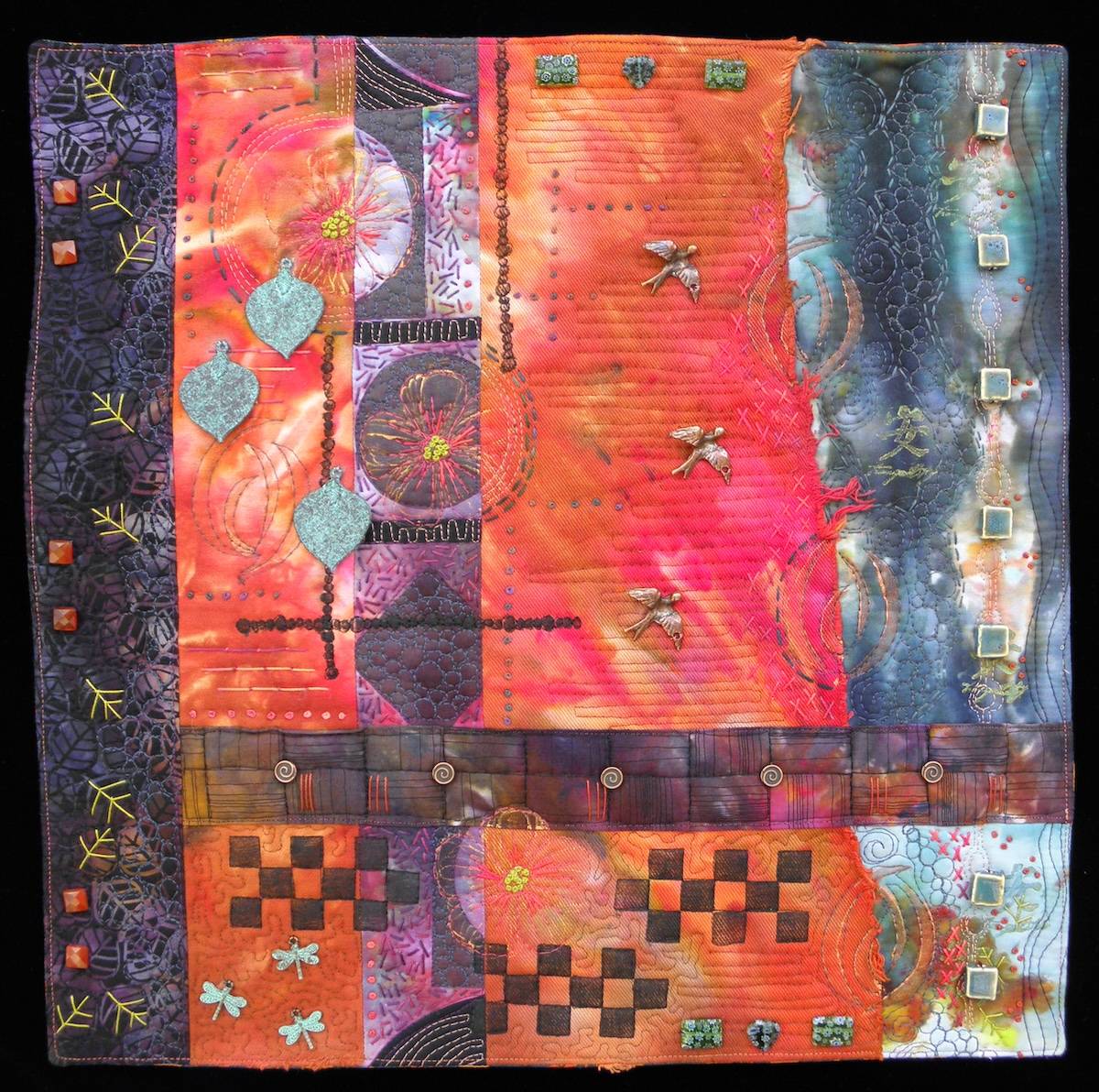
Heidi Zielinski turns fabric, thread, and found textures into beautiful abstract quilts inspired by the natural world. Growing up surrounded by the mountains of Montana gave her a lifelong love of nature, and today that love shines through every stitch. In this interview, Heidi shares how she discovered her creative path, why light plays such an important role in her work, and how she lets each quilt grow one step at a time.
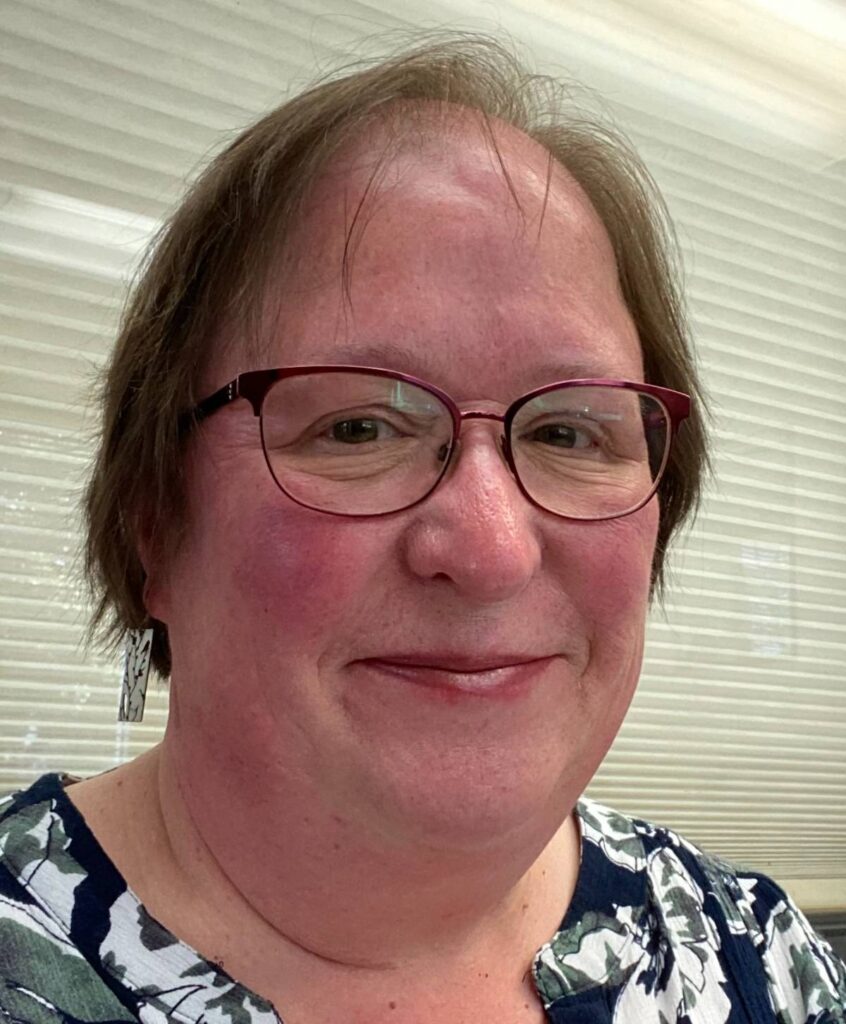
Tell us a little about yourself. Where did you grow up, and what kind of creative experiences shaped you as a child?
I grew up in Missoula in the mountains of western Montana.
My parents took me camping, hiking, backpacking, canoeing, snowshoeing, cross-country skiing, rafting, berry/mushroom picking, fishing, and all sorts of other outdoor/nature related activities.
My mom taught me about flowers and plants, and both my parents were birders, so I learned a lot about the local birds. I basically gained a deep admiration and enjoyment for nature. That has definitely carried into my adult life and is certainly reflected in my fiber art.
As an Amazon Associate I earn from qualifying purchases. Read more about our affiliate linking policy.
I did not have much interest in art when I was a kid. I didn’t draw or paint like my dad who was a watercolor painter of birds in their habitats or my brother who could draw.
I didn’t sew like my mom, who could make anything, or my sister, who made her own clothes—nor did I show any interest in those things, so they never really shared them with me.
I do remember doing a project or two using quilling with paper, and I did a crewel embroidery kit picture that someone gave me once. I tried sewing in 4H one year, but that was a disaster and certainly did not encourage me to continue trying.
Basically, I was not crafty and certainly never thought I had any artistic talent. I majored in Business and wanted to move to a big city. My childhood didn’t seem to have any focus on creativity for me—I was a late bloomer.
Shortly after I got married, when I was about 27, my mom sent me a basic Pfaff Hobbymatic sewing machine so I could do household mending and such. I immediately signed up for a Colorwash quilting class at a local shop and started watching PBS quilting shows.
Working full time and having little in the way of discretionary funds meant I made do with very little fabric, time, or energy for quilting, but I did dabble in it over the next decade or so and learned the important basics.
My mom said if she had known I was going to do that, she would have sent me a better machine! But that machine served me well for some time, and I continue to be a Pfaff machine owner and fan.
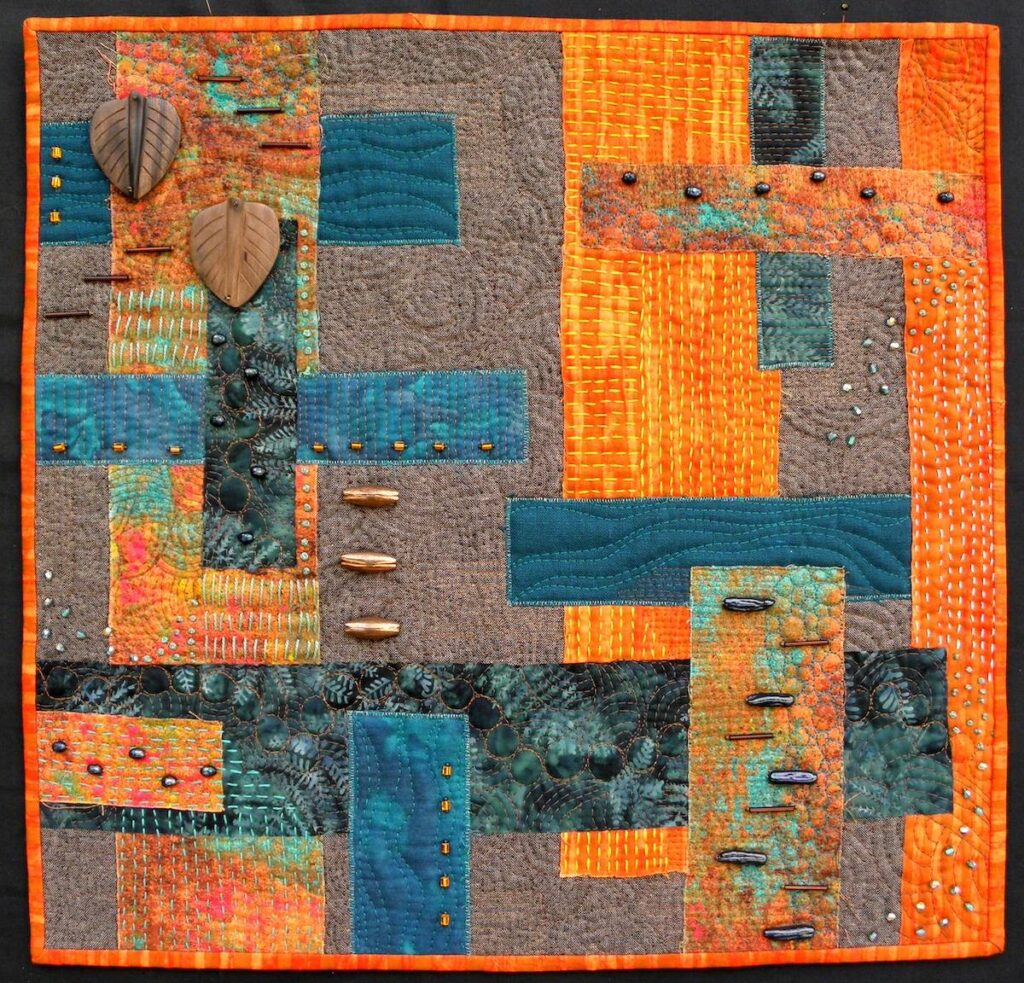
How did quilting grow from a hobby into a serious creative practice for you?
The Colorwash class I took early on had a packet of fabrics that I purchased which gave me a little “stash” to work with. I proceeded to create several quilts using those fabrics and versions of the Colorwash technique.
I innovated the designs to utilize what I had and some of the basic quilting techniques I learned on the PBS TV shows. But I still don’t think I felt like an artist.
I was living in the Chicago area (where my husband was from) for those years and eventually we moved back to Montana and lived near my parents. I worked full time but had access to my mom’s stash, knowledge and teaching skills so I learned from her and made more quilts.
My mom joined an endeavor called “Tarts”, short for textile arts, led by a small business near us run by four creative women. You paid for three months at a time and met with a group of like-minded people monthly to receive a packet of supplies for some kind of surface design technique on art quilts. They told you how to use them, what they learned from doing it and showed their examples. Then you went home and played with it and hopefully came back the next month with a finished piece or at least practice examples, and everyone shared what they learned.
My mom saw what I was creating and encouraged me to join her at Tarts. I challenged myself to have a finished piece every month, no matter how small or simplistic, and I followed through with that and received great support and encouragement from the other “Tarts”.
I sold my first quilt at a group show they sponsored. That was the beginning of my self-awareness that I might actually have some talent for this.
Shortly after that, I decided, probably rather naively, to start my own business called Fiber Into Art by Heidi. My son had started all-day kindergarten, and I had even more time to devote to quilting.
I began promoting my work by applying to national juried quilt shows, approaching galleries, and submitting magazine articles about my work. I was somewhat successful in all these things. I’m not really sure at what exact point I considered myself a real “artist”, but somewhere in all those efforts to “get my work out there”, I found a passion for something that made me feel like I had talent, and people responded to what I was creating.
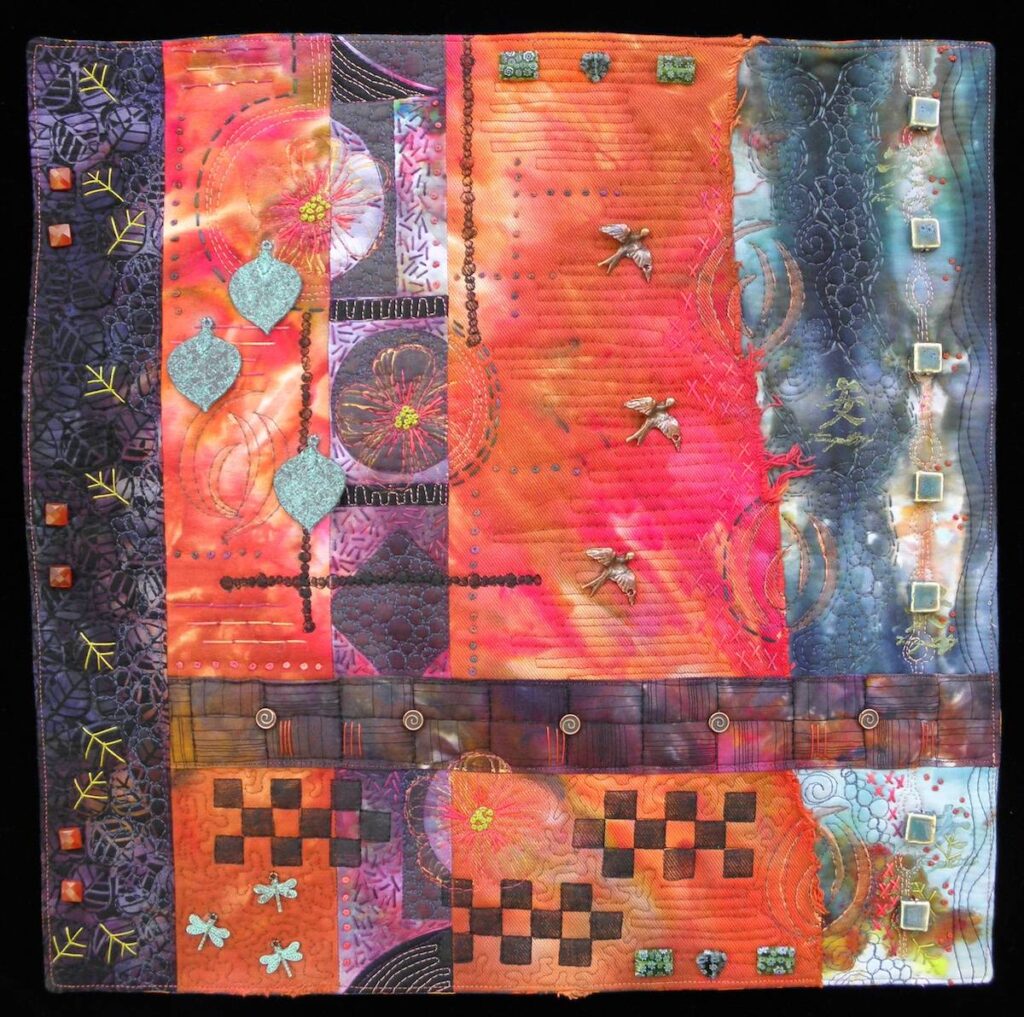
Your work is deeply inspired by the natural world. What kinds of landscapes or moments in nature most often spark ideas?
I have always proclaimed that my work is inspired by nature, but I’ve recently come to the realization that the actual creative process is inspired more by cloth, texture, shape and line.
Nature is the constant influence on where those elements take my work, but I don’t usually start a project thinking about a particular natural landscape or moment in time.
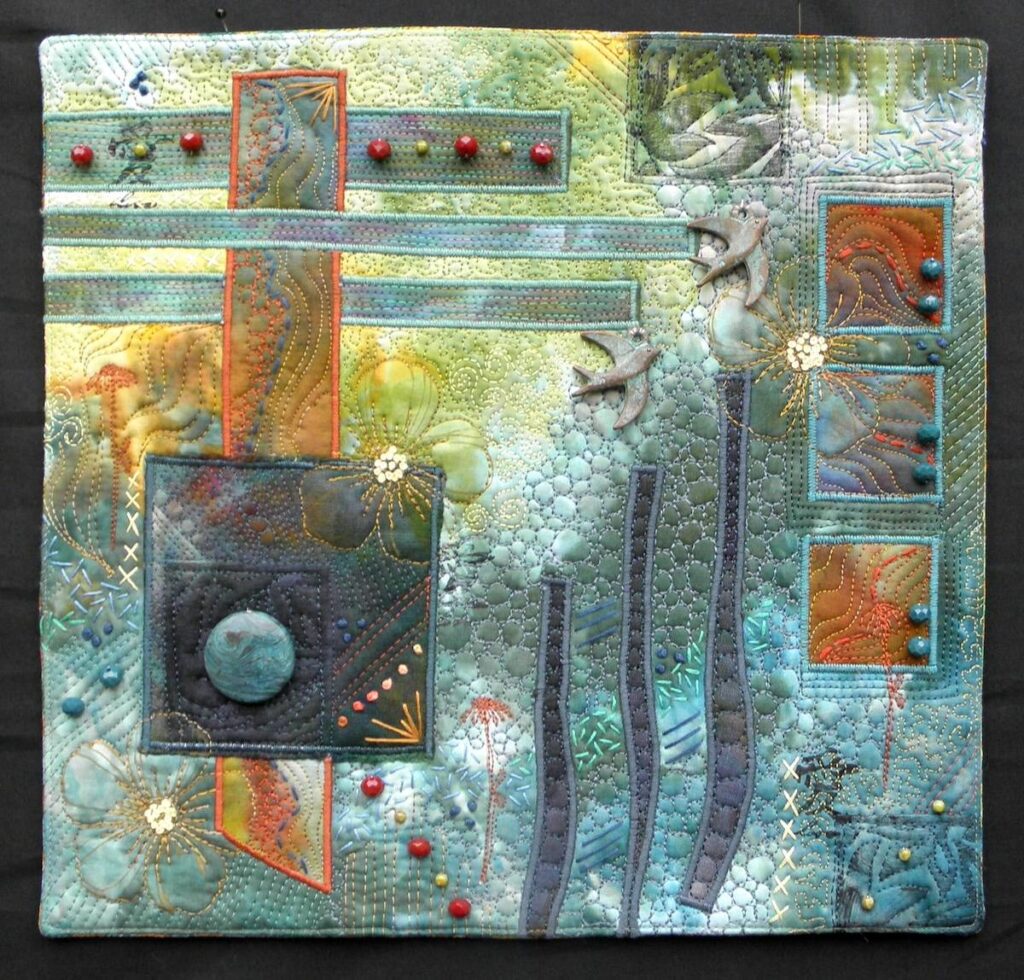
Whenever I am in the woods or meadows or whatever nature landscape I happen upon, I am always snapping pictures with my phone. I don’t use those images specifically in a quilt, but I capture moments of light, shadow, color, life and growth, hoping to feel the same positive, uplifting feeling I have when I am in that moment.
As the creative process moves along, I start to realize what feelings or memories it portrays and how some vignette in the woods, maybe the sky at a particular time of day or the morning light through the trees, is playing a part in how the work evolves.
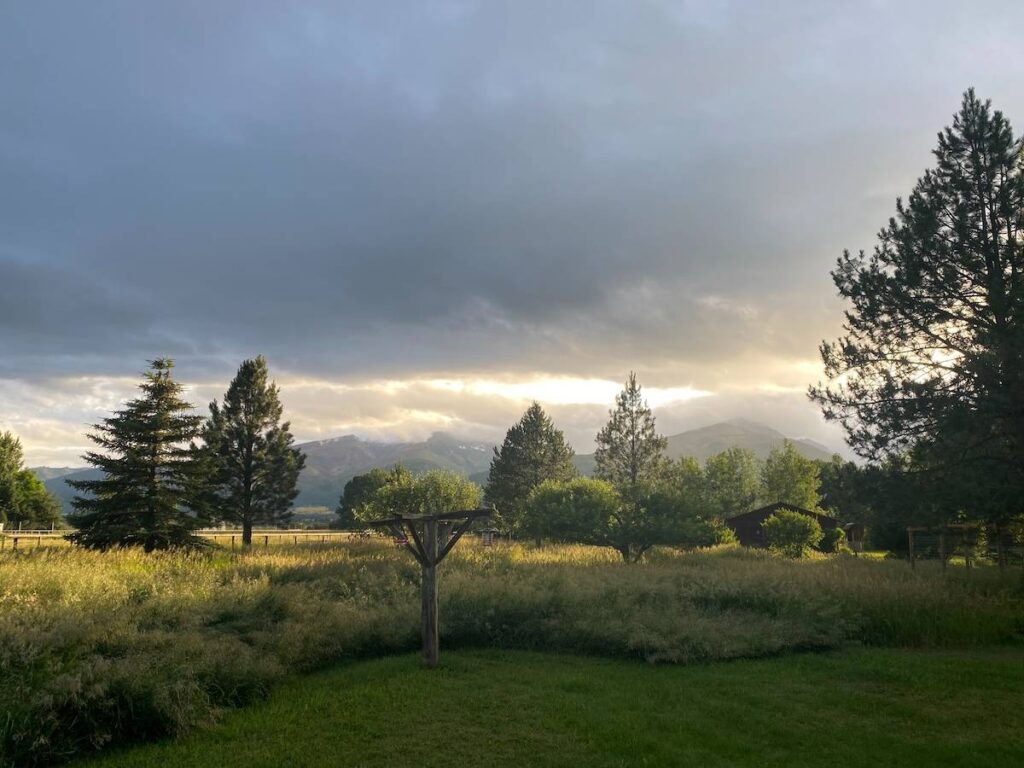
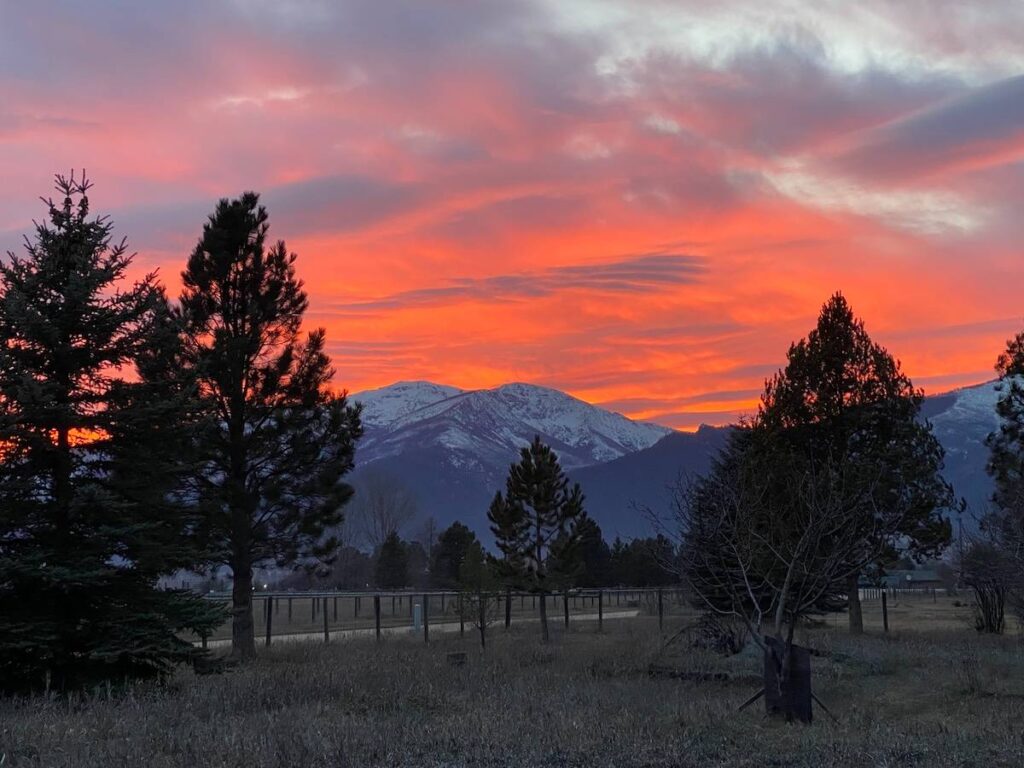
I am enamored with the fading light of evening, which silhouettes the mountain range outside my living room window. I love the way the morning light through the cottonwoods along the creek makes fluttering shadows on my bedroom wall. Every year when we trek to the woods to cut our Christmas tree, I am in awe of the rays of sunlight streaming through the snowy forest because the sun is so low in the sky.
I never tire of wildflowers under the towering Ponderosa pine trees or scattered across grassy hillsides. My eyes and ears are always seeking bird life, whether in my yard, the woods, a meadow, or winging through the skies overhead. All of these things are inspiring, and I love sharing my passion for them through my art.
You often talk about light in your writing. What is it about light that fascinates you as an artist?
I realized that some of the most pleasant times in nature are when the light is playing. That might be a certain time of day when the shadows are long, or the light is filtering through the trunks of trees or peaking out from behind clouds in the sky. It might be sunset or sunrise. Or the reflections of light on water and waves.
There are so many ways that light and shadow play, and those brief moments are captured in my memory and intermingled with thoughts and feelings.
Nature is ever changing from moment to moment, hour by hour, season by season, and the light is one way you see that change happening.
Light might tell you the time of day, what the weather is like, or even what time of year it is. A sunbeam, a fluttering shadow, or even a reflection in a pond are moments in time that I notice and pause to observe.
But I don’t make art that portrays exactly what I see because I don’t think I could capture it properly, nor do I want to. There is more to the “picture” than just what your eyes see. There is the feeling it gives you, the thoughts it invokes in your mind, and the memories it leaves with you.
As an abstract artist, I think I convey those moments as best I can with how I choose to put different fabrics together and then layer them with stitch and embellishment. I’m using texture and color and line to make something beautiful that makes one pause and look and observe its details. And maybe feel the same feelings or conjure up fond memories of a time and place, even if it isn’t specific or even real.
When I look at my work and try to determine where it comes from I see the colors of the woods and meadows, sky and water, rock and tree. The AI description of color says it is “not an inherent property of an object, but rather a sensation produced by the way objects interact with, reflect or emit light.” And that sensation is what I think I’m putting into my abstract fiber art that hopefully gives it meaning to other people who see it.
How do you translate something as big as a mountain view or forest feeling into an abstract piece of art?
Creating my art is a very intuitive process for me and I don’t really plan how I’m going to translate a particular view or feeling, rather I just start creating and it naturally surfaces in the work.
My goal is to portray something that allows viewers to appreciate what I love about my art—usually a connection with nature and a passion for the way abstract art allows us to interpret and feel whatever we see in the work that relates to our own lives, how we want to live, or what makes life good. I rarely have any kind of goal or outcome in mind when I start a piece.
I do, however, often have an idea when I begin creating my design if it is going to be a macro or micro viewpoint—meaning will it be a vista or a landscape or will it be a more intimate vignette from nature but portrayed in a suggestive, abstract way.
Either way, I use asymmetry, repetition, contrast, value, blending, and balance like most artists do to create the work.
Every piece is different, and when I am making them, I am just following the muse for each step of the process. Choosing, cutting, positioning, and stitching the fabrics together, which might include hand-dyed or stamped fabrics. Adding lines and shapes with thread in intricate patterns that are both curvy and straight line and then blending those machine stitched spaces with hand stitches in heavier rich threads that help to achieve balance and make the work cohesive. Then the final step of adding beads, charms, yarn, etc., to help move the eye around the piece, add texture not found in fabric or thread, to add focal points and sometimes to add movement—like flying birds.
It is probably helpful to viewers that my abstract work often incorporates recognizable motifs from nature like trees, leaves, branches, birds, flowers, etc and almost always incorporates colors commonly found in nature. That helps the viewer see nature right away and then hopefully feel the mood and the joy I am trying to share using color, line, texture and shape.
My stash of fabric, thread, and embellishments tends towards earthy and my favorite seasonal autumn palette, but there are also vibrant and colorful fabrics in all shades and tones.
Working completely from my stash, I can use materials to make work that is impressionistic and suggestive without being a picture or an attempt at an accurate depiction of a specific element or vista from nature.
I use commercial fabrics with realistic imagery, stamping imagery with fabric paint, attaching metal charms, and various other means of adding recognizable nature imagery to my work as ways to give my abstract quilts a more immediate visual connection to nature when they are not immediately recognizable as a landscape or portrait of the natural world.
Describe your creative space.
I work in a decent sized spare bedroom in my home which has nice sized windows looking out to our yard and the mountains beyond. The room has shelving and storage units all around the perimeter to house the “stuff” I’ve accumulated. A large table has an inset for my sewing machine and room for an ironing pad and a cutting board. Underneath are plastic storage drawer units—holding more “stuff”!
I have a Pfaff Performance 5.0 sewing machine that I use for basic sewing, satin/zigzag stitching and piecing. I use a Handiquilter Sweet 16 sit-down machine for all my free motion quilting these days—although I used my domestic Pfaff for many years before I acquired the Handiquilter.
I have a myriad of supplies like most art quilters accumulate, such as paint, paint supplies, stamps, stencils, beads/charms, rods for hanging quilts, books, threads, embroidery floss, and pearl cotton, an iron, and of course lots of fabric!!
I also have a space in the garage where I dye fabric using an ice dyeing method. I have lots of dye powder, ready-to-dye fabrics, and plastic tubs for dyeing, as well as bags of ice in the chest freezer ready for play!
Like many creatives, I have a hard time keeping my studio neat and always wish I had more space for storage. Luckily, I have a plan for moving my studio into the space that is currently an attached 2-car garage. It is a long process to carry that out, but I finally have the funds to do it, and we are making plans, which is very exciting!
I look forward to having a design wall, maybe a sitting area, a desk with a laptop and printer, and proper storage for all my art supplies. I’m not sure there could ever be enough storage for all the supplies we art quilters tend to accumulate, but hopefully it will be better organized and more accessible than it is now!
As an art quilter I am basically a mixed media artist with all kinds of techniques and materials that I can and do incorporate into my art quilts.
Everything that I’m about to throw away gets evaluated as to its potential value as part of a future art quilt. And of course, I like to see what i have collected and saved in order to be inspired by it for My art. So, it is visible and cluttered and gloriously abundant in my studio space.
The good thing is, I will never get bored or run out of inspiration for making fiber art with all the choices and options there are for both techniques and materials.
Do you work on one piece at a time, or do you like having several projects going at once?
I usually work on one piece at a time and almost always finish that piece before moving to the next one.
I always encourage my students to finish the work, as unfinished projects tend to become mental baggage that weighs you down, and I think it inhibits you from being excited about creating new work.
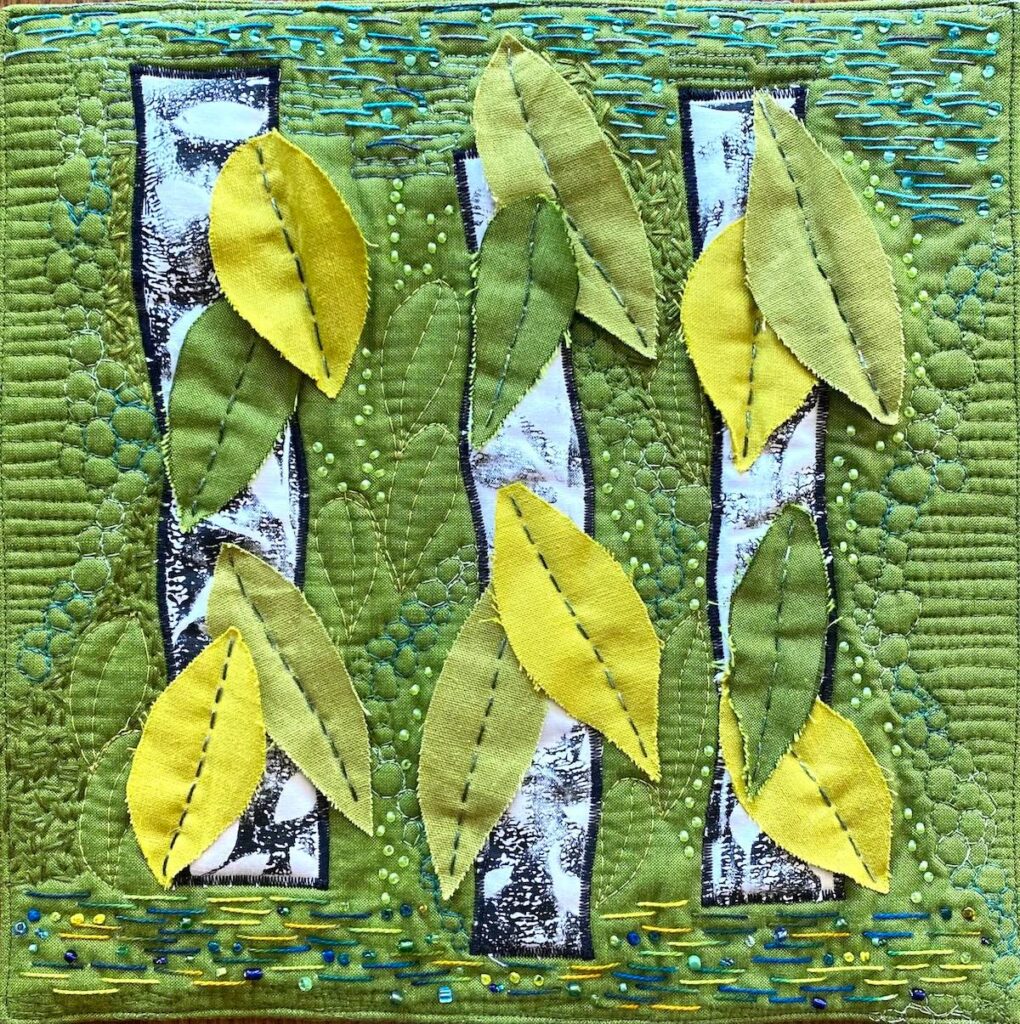
Even if a project doesn’t seem to be going well, I use my process to make it work in the end. I call my process “3 Layers of Design,” which are:
- The Fabric
- The Stitching
- The Embellishment (always optional).
I start with fabric, and that is the fastest part of the process for me, as I try not to agonize over finding the perfect fabrics or the perfect way of putting them together. I just choose a palette of fabrics that I like and think will work together, and I get started with cutting and designing—knowing that I can use the next layer of design to help bring it together. The goal is to move towards a balanced piece of art that is pleasing to the human eye.
The first layer doesn’t have to be perfect in order for the piece to end up successful.
When I move to the second layer, which is stitching (both free-motion machine stitching and hand embroidery), I use the colors, textures, patterns, and lines of stitching to create paths for the eye to follow.
I might create focal points, maintain negative space by blending the threads with the fabric, create contrast to draw attention to an area, or create movement and rhythm.
Once the stitching layer is done, I will bind or add a facing to the quilt and then decide about any embellishment.
My rule is that the embellishment needs to make the piece better, or it doesn’t get added. If it is just a favorite bead or a shiny bauble that doesn’t really do anything to help the piece be more balanced and pleasing, then it doesn’t need to be there.
I almost always “audition” embellishments, and most of my work does have them, but sometimes the fabric and stitching are very successful and don’t need any help, so I don’t embellish it. That is also a key to knowing when to stop embellishing—when it isn’t making the piece better.
I almost never abandon a piece I start because I know that I can make it work through my layers of design. I finish the quilt and move on to the next one. Even if it isn’t perfect or my favorite at least it is finished and I can let it go.
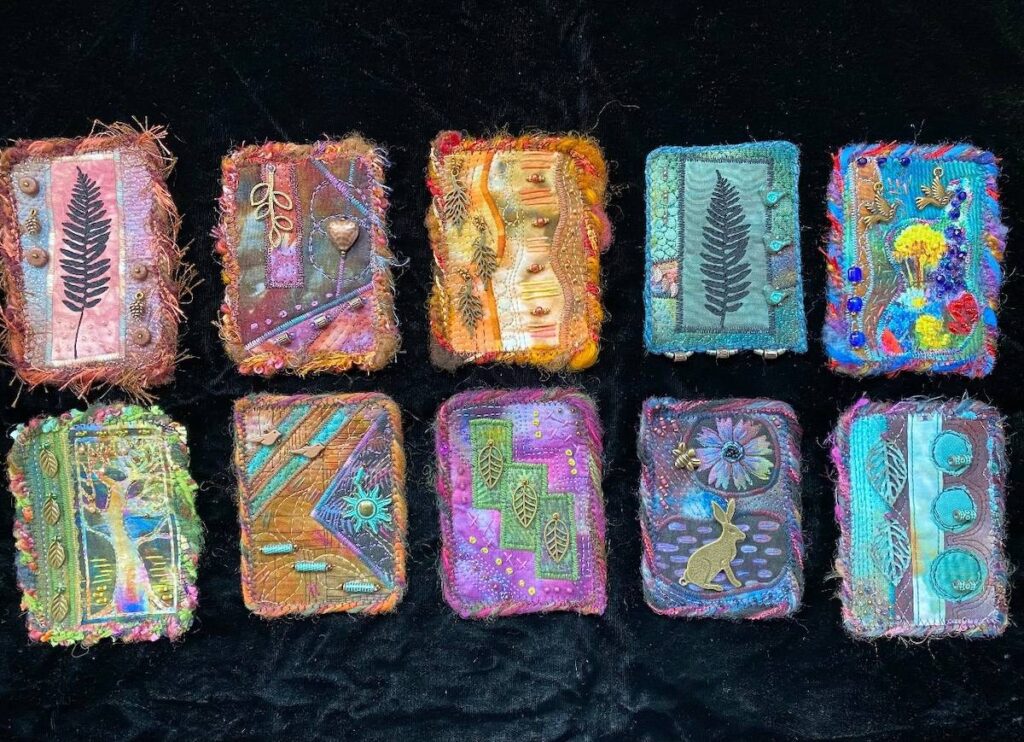
Occasionally I will start some small abstract collage quilts where I use the same background for maybe 4-6 of them and then do the fabric collage layer for each of them (in different fabrics and designs), then add some stitching to each of them, then some embellishment.
They are all done at about the same time, and that really feels like I accomplished something. It is a good feeling to finish a piece, and even if you don’t think it is “perfect” or your best work, it is good to have it done so you can move on.
I am always surprised at how many pieces that I don’t really feel are successful sell to someone who loves them. Different pieces will speak to different people. I love that about art.
Your work uses both machine stitching and hand stitching. What does each bring to the piece?
My organic style of machine quilting is somewhat unique to my work and I tend to do a lot of stitching on my quilts using lots of different threads.
The stitching is the second layer of design in my process. I use the stitching to help bring the fabric design together by blending, adding movement or areas of eye rest, creating highlight/contrast, or adding a “spark” to the work when it is needed.
The stitching helps to create lines and paths for the viewer’s eye to follow around the piece. The hand embroidery adds a stronger textural element and bolder lines of color. I use both embroidery floss and pearl cotton, and those threads are thicker and thus more prominent than the machine quilting threads.
Both machine and hand stitching have their charm, and I use them both in most of my work these days.
As a side note, I use only two stitches in my embroidery: French knots and straight stitches. I use those two stitches in many different ways and with many different threads, and have found that they are perfectly adequate for my needs, so I rarely use anything else. It is one way to simplify my artistic process—which you can see by my finished work can get somewhat complicated!
How do you decide when a piece needs more texture or dimensional elements?
Texture is a strong influence for me as I like to touch things like bark, shiny or fuzzy leaves, seed pods, flower petals, rocks, etc.
It’s also one of the things I love about fabric—the touchability and the variety of sensations from cotton, linen, velvet, silk, yarns, embroidery threads, wool, etc.
I can’t tell you how many times I have lamented that we did not have the irresistibly soft and cuddly Minke fabric back when I was a kid! I incorporate texture in many different ways by using different types of fabric, and that texture is more than just how it feels to the touch; it has a visual and tactile purpose.
I add texture in various ways using yarn, fabric shapes, cheesecloth or sheer fabrics, flanges or pleats, fabrics that have a loose or irregular weave or surface, raw edges, lace or other trims, etc.
When I’m choosing fabric for a quilt, I might run across something very textural, and it strikes me as a good element to add to that particular piece. Sometimes I have in mind before I start a quilt that I want to cut out an area or slice it and insert something.
Sometimes I decide I want to play with a textural fabric or add dimensional elements—although I don’t usually know specifically what that will look like. Whatever I am inspired to do with the fabric is where I let it take me.
Dimensional elements like dangling leaves, draped cheesecloth, or cutouts require a little bit more planning ahead to create them or determine at what point in the process they will be incorporated.
It takes some dedication to the process to do the fussy stuff! And it usually takes more time and attention to accomplish. As I get older, I find that I really need more uninterrupted time to work on the challenging pieces. There is thinking, problem-solving, and decision-making involved in every step of the process in order to achieve that desired outcome of something that is balanced and beautiful.
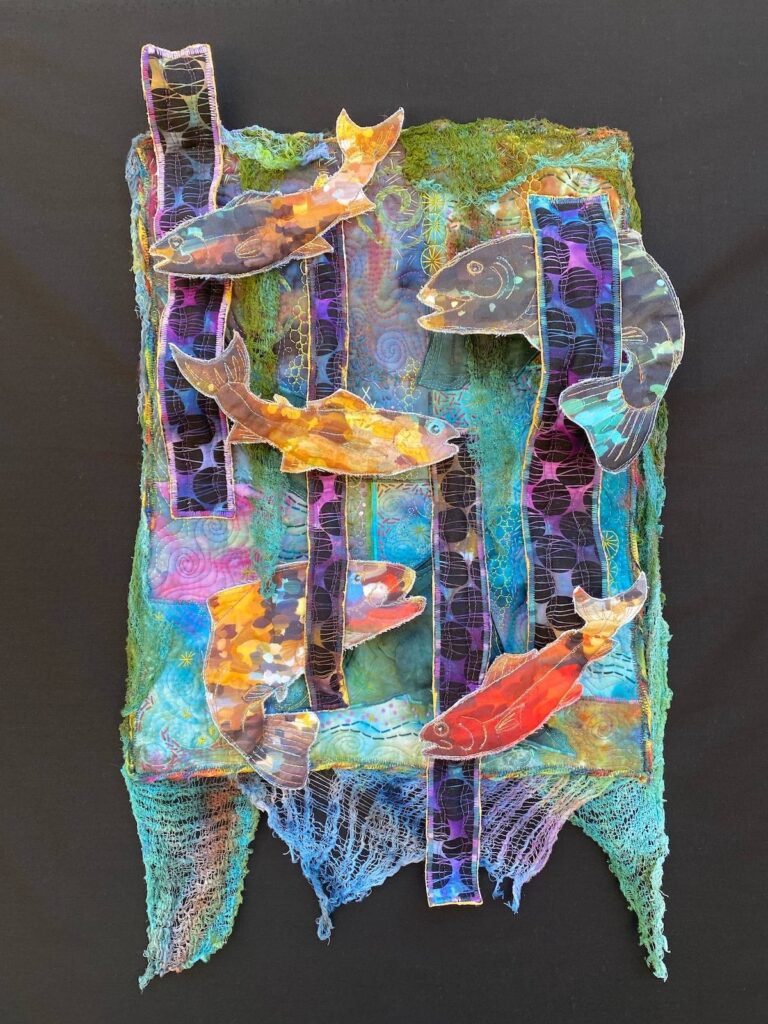
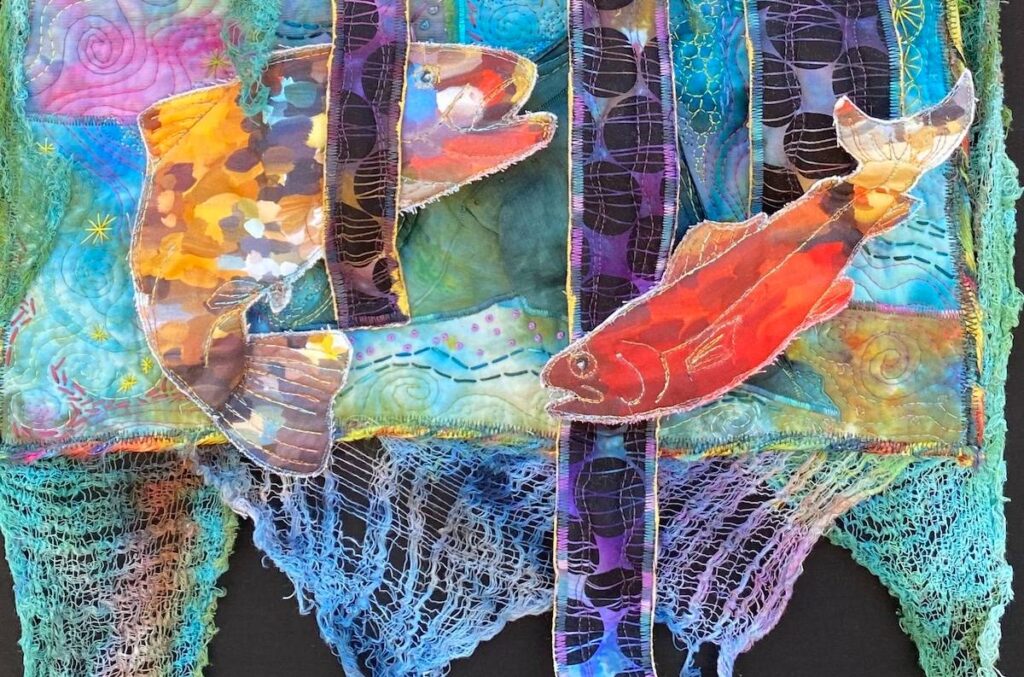
When you start a new piece, do you have a clear plan, or do you let the quilt evolve as you work?
I definitely let the work evolve. I rarely have a plan, and I think that makes the process easier for me because I don’t have to try to achieve some image I have in my head that may never manifest itself.
I work through the process using inspiration to decide what to do next—without spending a whole lot of time agonizing over every step. I start with some fabric that inspires me and choose other fabrics to go with it. Then I start creating a composition either with piecing or raw edge applique, or both.
I usually complete the fabric layer fairly quickly without trying to create the perfect design because I know that I can bring it together and improve it with the next two layers of design. This process works well for me.
I don’t usually think about the threads or the quilting designs while I am creating the fabric design layer. I just start a design that is pleasing to me, and it is often a quite simple composition. Then the machine and hand stitching will begin to make the piece more complex, but also cohesive and balanced.
I usually just select a thread that I know I want to use and then stitch whatever motif comes to mind first. I have some things that I do regularly in my work, like repeating a color of thread and a stitching motif in three places, because it seems to help make the work balanced. I’ve been told, and I will readily admit, that I use a lot of threes because they just seem to work. Three collage elements/shapes, three areas of stippling with red thread, three patches of hand-embroidered X’s, three beads, three charms…
There are occasions when I have a rough plan for a piece because I am making something for a challenge or theme. I find that more difficult and usually will do some drawings in a sketchbook to get some ideas for where I might go with it. I still let the process and what is happening with the materials inspire me along the way, so I don’t have an exact idea of what it will look like in the end.
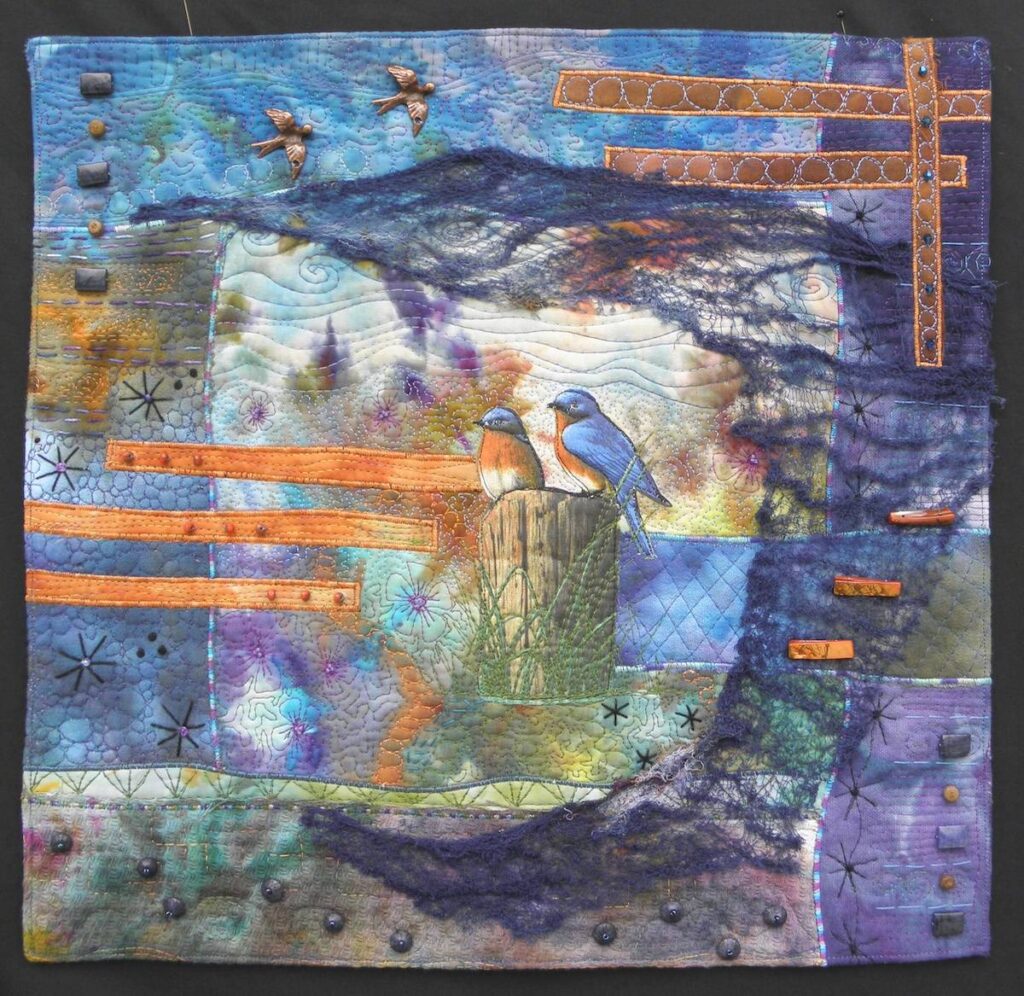
What kinds of creative challenges do you run into when working with layered textiles?
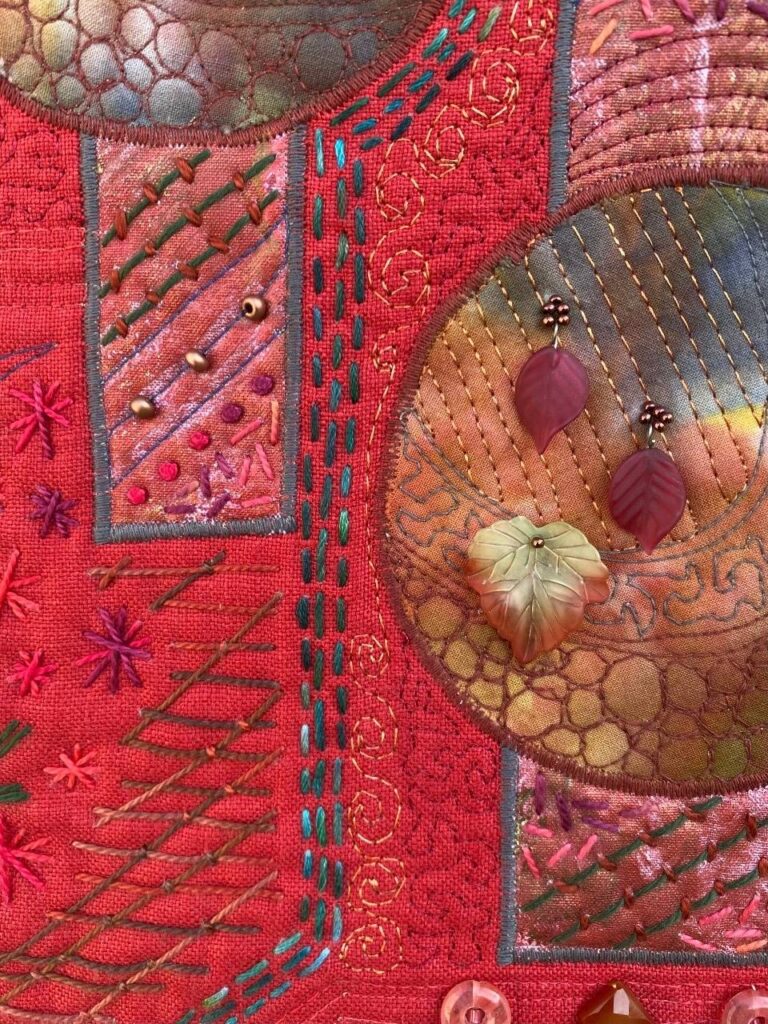
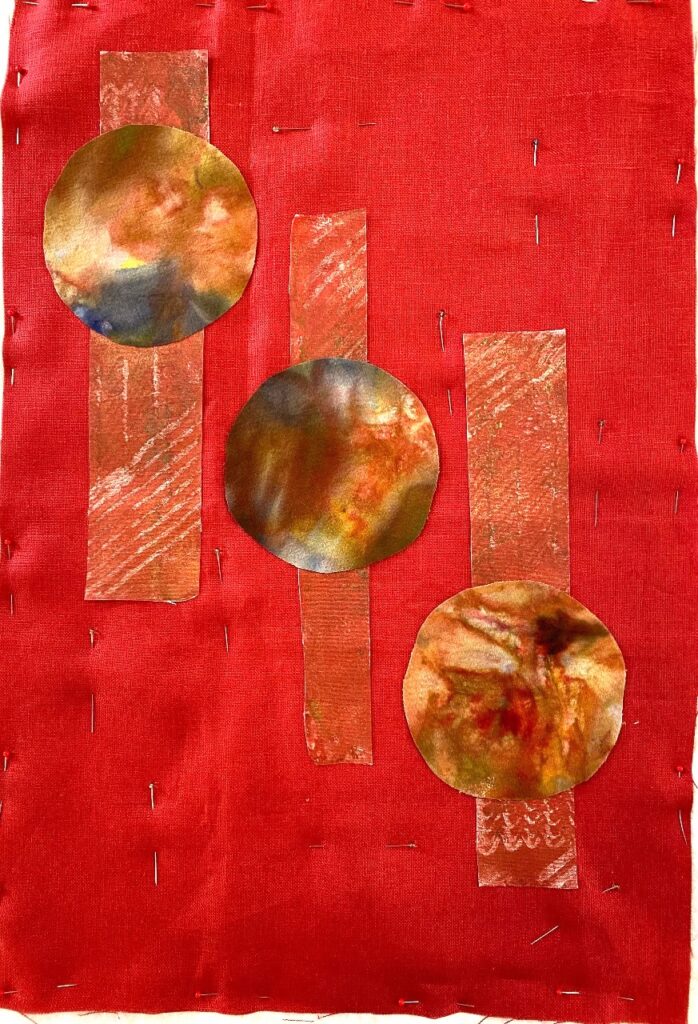
My style of raw edge applique allows me to collage layers of fabric together without worrying about too much bulk to sew through. I use a glue stick to tack the pieces in place rather than using fusibles and that also helps reduce fabric layers. I can overlap and underlap the collage elements which is one reason I like the raw edge applique. I often weave linear elements together or have shapes that are both under and over other elements. It is a very flexible method of collage design.
A good sewing machine and the right needle are helpful for managing the layers of cloth and other design elements. I stitch over cording or multiple yarns twisted together with little difficulty because my machine pulls the elements through evenly using a built-in walking foot.
Most machines have some sort of walking foot attachment, if not a built-in foot. It is a great tool for feeding materials under the presser foot evenly and without causing puckers or slipping. Using fabrics with different textures and thicknesses can be challenging, but a walking foot definitely helps.
Space is often a challenge when designing quilts. You need room for sewing, cutting, ironing, and planning/designing. Having a design wall is the ideal way to plan your design, but I have moved to doing smaller pieces that I can design on my cutting table. The doctor who did my neck surgery said working looking down so much (sewing, hand stitching/beading, designing, cutting, ironing…) may have contributed to the problems. I’m hoping to have a design wall in my new studio space!
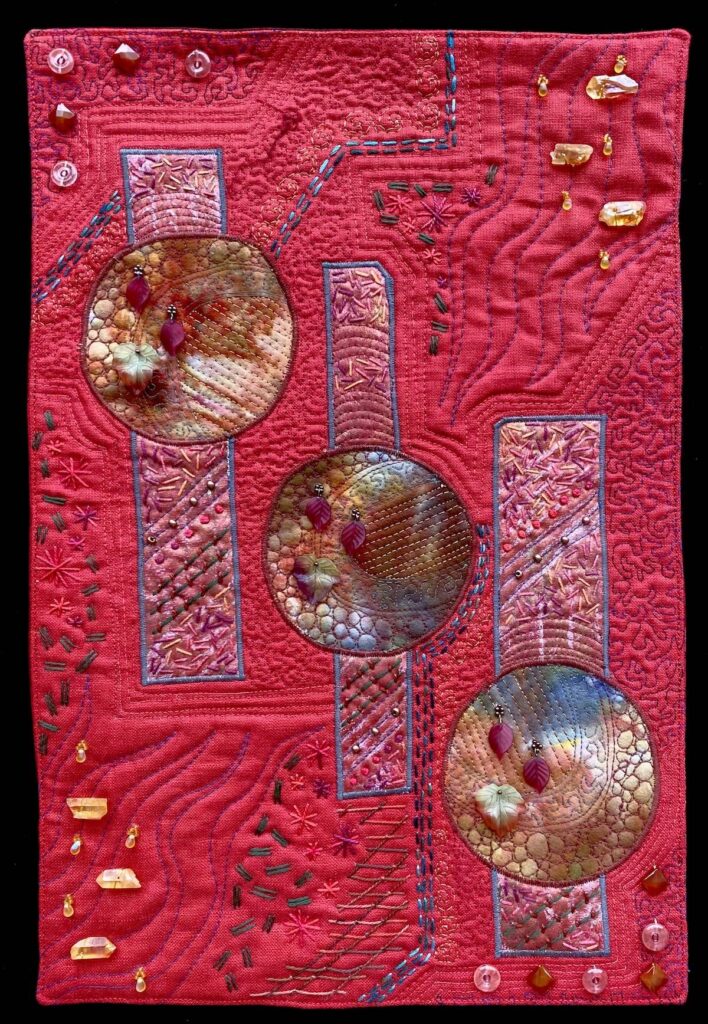
What have you learned about balancing complexity and simplicity in your designs?
This is a great question, which I try to help my students deal with in my classes.
Not everything you do on a piece should be a focal point in the work and sometimes people new to embellishing tend to add it that way.
Some elements of design need to be the structure or supporting cast. It is important to maintain some negative space in a piece, and I will often quilt that space with a thread that matches the fabric. No matter what design you stitch, it will create a textural interest there, but it will be less distracting to the viewer’s eye and not move attention away from the focal point areas.
Some areas of the artwork are meant to draw the eye using color, movement, or texture, and some parts are meant to be areas of eye rest and calmness.
I often show my work and point out how “simple” the fabric design is—a background with very few collage elements stitched to it.
My viewers/friends will then laugh because the piece is nowhere near “simple” by the time I have accomplished the stitching and embellishing. But it illustrates how the fabric layer does not have to be anything complicated in order for the piece to end up interesting and exciting.
I love the transformation that takes place, and the “in-process” photos I take are always interesting to see as they document the thought process. Those three layers of design basically take the work from flat and simple to textural, balanced, and complex. They start out rather boring and end up having feeling and life.
Even if I create a monochromatic art quilt—one color family in different values with maybe some sparks of another color added—the work is not boring or static.
I use the layers of design to create movement, continuity, blend/meld elements together, add contrast, and make the piece appealing to the human eye. Our eyes like to see balance. I achieve that through repetition, using elements in groups of 3, utilizing diagonal lines, incorporating both straight and curvy stitching patterns, adding long lines with couched yarns, skinny applique strips or lines of zigzag stitching, and maintaining neutral areas for eye rest.
There are many ways to achieve balance as a piece progresses, but it is always about how the eye moves around the work to discover everything and not move off the piece or be overwhelmed.
I consider balance the most important of the elements of art in my work, and it is the one I try to achieve with every piece I make.
When you feel stuck creatively, what helps you move forward again?
I honestly rarely have a creative block, but there are definitely times when I’m not working in the studio as much as I’d like.
Usually, it is life-interruptus with a too-full calendar or challenges that might or might not be related to my art. I would rather be in the studio creating more than almost anything else. I can go in there and pull together fabrics and finish something in a few days when I have the uninterrupted time to create.
That process of turning somewhat random fabrics into a beautiful piece of art is so rewarding and really fun. I love every step of the way–except for maybe making the hanging sleeve (that’s not the fun part)!
Some things that help me continue to be creative are taking pictures with my phone, being involved in mostly fiber-related creative groups, reading magazines, perusing and ordering new beads online for my stash, and even sorting fabric in my bins.
Being around other creatives and sharing thoughts and ideas is almost always inspiring.
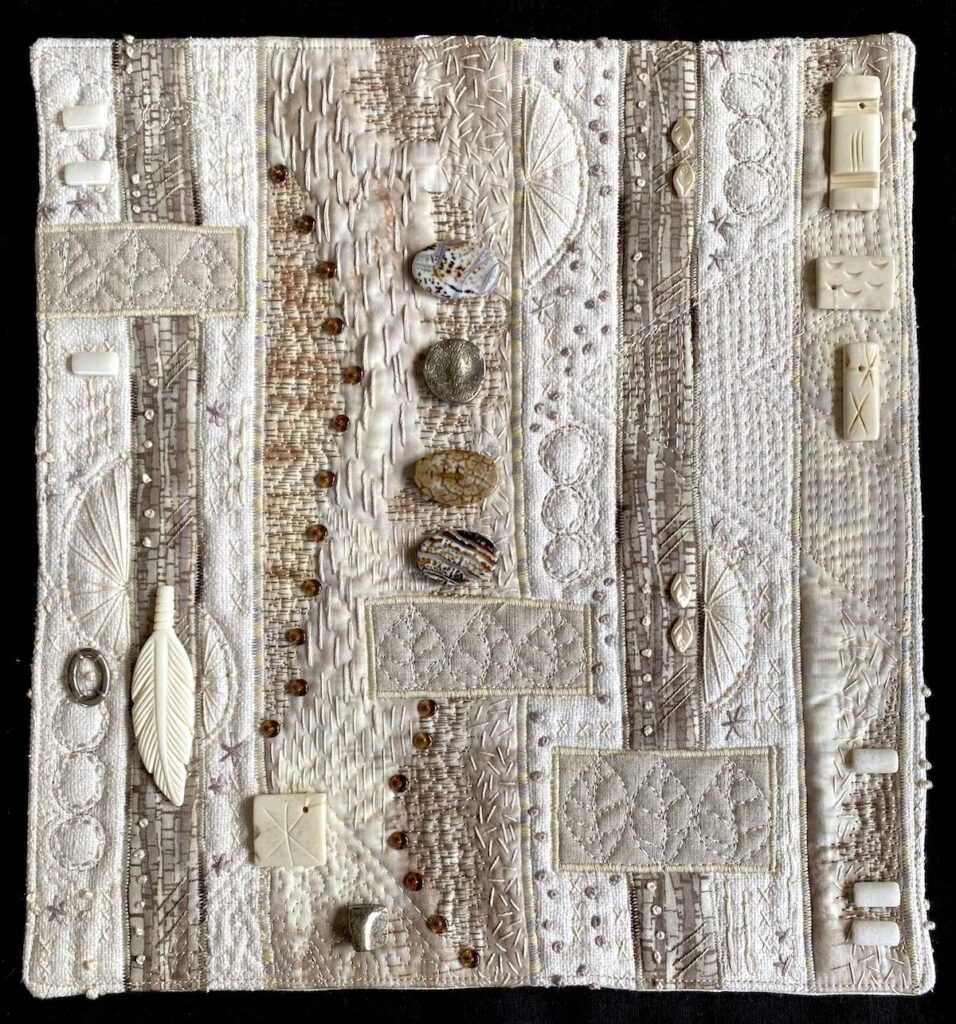
I try to buy fabric that inspires me or that I know can eventually be the impetus for a new piece of art, but I also buy the basics: neutrals, light colors, backgrounds, linens, black, white, black & white. Even a lovely neutral linen can inspire a beautiful nature-inspired art quilt by incorporating nature motifs in the stitching, natural stone beads, bird or leaf charms, or even nubby textural artisan yarns. Oh, the possibilities!
I really never run out of inspiration to create art quilts. It is a passion that I didn’t discover until I was almost 40 years old, and now I can’t get enough of it.
How has your work changed since you first started making art quilts?
Well I have certainly improved my free motion quilting and since it is integral to my work that is a good thing. To be honest, like everyone else I still have problems with tension and stitch length when free motion stitching but I do love my machines for how well they handle those challenges.
My quilting style is very organic in that I intertwine the different areas of a stitching design with other designs in a very loose and flowing way. I don’t ever mark for stitching. I do my embroidery in much the same way, repeating thread color and stitch pattern but not exactly the same. I add both straight-line and curvilinear motifs to balance the artwork, and they flow together and around each other in an organic way.
I have played with many, many different techniques over the years but I have found some that I like to use and that work well for me and I pretty much stick to those.
Every once in a while, I throw in something different, but I really tend to have my go-to techniques. Those include the raw edge applique, hand embroidery, couching, beading, stamping with fabric paint, dangling elements (beads/fabric), ice dyeing, and of course, the free motion quilting.
I have been experimenting with gelli-plate monoprinting for the past few years and will likely do more of that, but it is a messier activity that requires the space and time to play with it. My work has incorporated many of these techniques over the years, and I am learning more about how to use them.
When I started making art quilts, for many years, I used all commercial fabrics. Now I use many of my ice-dyed fabrics, and sometimes I combine them with the commercial fabrics.
I like to over-dye black and white or other light colored print fabrics in order to add those printed elements to the work, which makes it even more interesting. It also makes the work feel more unique to me and very personal.
The colors and patterns achieved with ice dyeing are one-of-a-kind and beautiful, which makes them fun to use. It is a very serendipitous process, and you never know what you are going to get, so you have to embrace it. I love that!
I like to think my work has changed over the years to be a little more sophisticated, and I have learned how to keep it from being too busy while adding lots of design elements.
I incorporate a LOT into one of my quilts, and I have tried to keep all that interest and excitement without a piece becoming overwhelming or loud.
It is rewarding when I look at a finished piece and I see an artwork that is balanced, cohesive, and pleasing to the eye. Hopefully viewers don’t look at it and see overdone.
I like the fullness of all of the details that I put into my work. It makes it rich and interesting and sometimes joyous. I find it rewarding to be able to turn raw materials into something that I like and that others like as well.
What advice would you give someone who wants to turn their creative passion into a meaningful art practice?
The way to turn your passion into meaningful art is to do the work. In my case, and maybe yours too, the “work” is not really work because I love it so much and have a true passion for it. But it does require some discipline and dedication to time, materials, space and finishing pieces.
If you can’t give it the time, you will likely not progress as much as you like, but the time can be in small chunks if it is on a regular basis. If you can’t acquire the materials, you might not have what will inspire you to produce art. For me, that requires a “stash” of fabric, threads, beads, etc., that I can work from without having to try to buy something I want for a piece. I never do that, and if I did, I probably wouldn’t be able to find that “perfect” thing anyway.
I make what I have work, but I do have a good-sized stash to choose from. Sometimes using something that isn’t the perfect fabric will make the piece more interesting.
If you don’t have space, it can be challenging, but you can make do with a small space and be successful. Many people do!
Finishing pieces is to me the most important factor in being successful at producing art. If you start a project and then don’t think it is working and abandon it you then have loose ends that will nag at you. UFO’s they call them (Unfinished Objects) and they are a stumbling block to accomplishment.
Finish it, learn from it, and start a new piece. Feeling that sense of accomplishment that you completed a piece of art is much better than knowing that you have a half-done piece sitting in a bin somewhere that you are probably never going to touch again. It takes up space both in your storage and in your head. Finish it and show it to someone. If you don’t like it, you don’t have to share it, but sometimes other people will see something in it that you did not. Maybe what you learned from this one will make the next one something you do want to share.
Making your art meaningful requires listening to your muse, following your instincts, making art that you like. I try not to make art for buyers or who I think might be buyers. I make art I like and that makes the process so much easier when your process thrives on inspiration. Trying to make something that is another person’s inspiration is much more challenging.
A meaningful art practice can be as simple as making art that you enjoy and are proud of. In my case, it became more meaningful by sharing it with others through galleries, magazine articles, online postings, a website, and juried national quilt and art shows—as well as locally with quilt guilds and other fiber groups and friends. But you don’t have to sell your art for it to be meaningful to you. Many people gift or donate their art to others or hang it in their own home.
When I look at some of my very early work, I notice all the flaws and imperfections, but I also usually have a fondness for how I chose to use the fabric and thread and how much I learned from finishing those early pieces. Taking on any kind of skill is a process of learning, practicing, and evaluating what you are doing. That is doing the work. When students ask me how to get better at free motion quilting, I tell them to practice. Practice on a layered sandwich of fabric and batting, on a small quilt, on a quilt you don’t care about, even on paper. Draw with your needle and practice the different kinds of stitches you want to use. Nothing will get you to be good at free motion quilting more than practice.
Where can people see your work?
I show at a local gallery in Missoula, MT, called The Artist’s Shop, where I have been a consignment artist since 2009.
I have a website at www.heidizielinski.com, and I post regularly on my Fiber Into Art By Heidi Facebook page and occasionally on Instagram.
On Facebook I post images of new pieces and work in progress, as well as about shows, classes, and whatever else I am doing.
I enter juried shows across the country, so occasionally you might spot one of my pieces there.
I have written numerous magazine articles in various publications and hope to do more in the near future, so you can watch for those.
In 2021, I was invited to film four segments for episodes of Quilting Arts TV, which airs on PBS stations across the country and PBS Create, and they are replayed quite often. I was in series 2900 (3 episodes) and 2901 (1 episode).
My goal when I established my business was to “get my name and work out there,” so that has been a focus of my efforts. I was featured twice on the art website www.artsyshark.com so you can search for my work and accompanying narrative on that page.
Rapid Fire Fun:
Favorite color combo right now? I’m itching to do something with black and white because it makes such a statement in a piece, especially when combined with bright colors like red or fuchsia.
One material you always reach for? Nubby hand-spun yarns to add texture and line to my work, usually couching them on using a machine zigzag stitch and often twisting multiple yarns together.
A place in nature that always inspires you? Oddly enough, my living room! Big windows that look out at the Bitterroot mountain range and St. Mary’s Peak and over the Lee Metcalf Wildlife Refuge, so that macro view is outstanding at any time of year and any time of day. We have a nice-sized yard with ponderosa pines, apple trees, spruce, willow, and cottonwoods. Those trees and the creek along our property attract lots of birds and animals, as well as the numerous birds that fly over from the refuge out to the fields. My favorite time of day is when I’m sitting in my recliner doing handwork or watching TV, and the light fades so the mountains are silhouetted against the evening sky. The past few weeks, there has been snow on the peak and large orange poppies scattered randomly and blooming in the yard, which both tend to glow softly in that fading light. So calm, so beautiful. Such rich dark colors. Inspiring.
One word that describes your creative process? Organic.
Interview posted July 2026
Browse through more art quilt inspiration on Create Whimsy.