
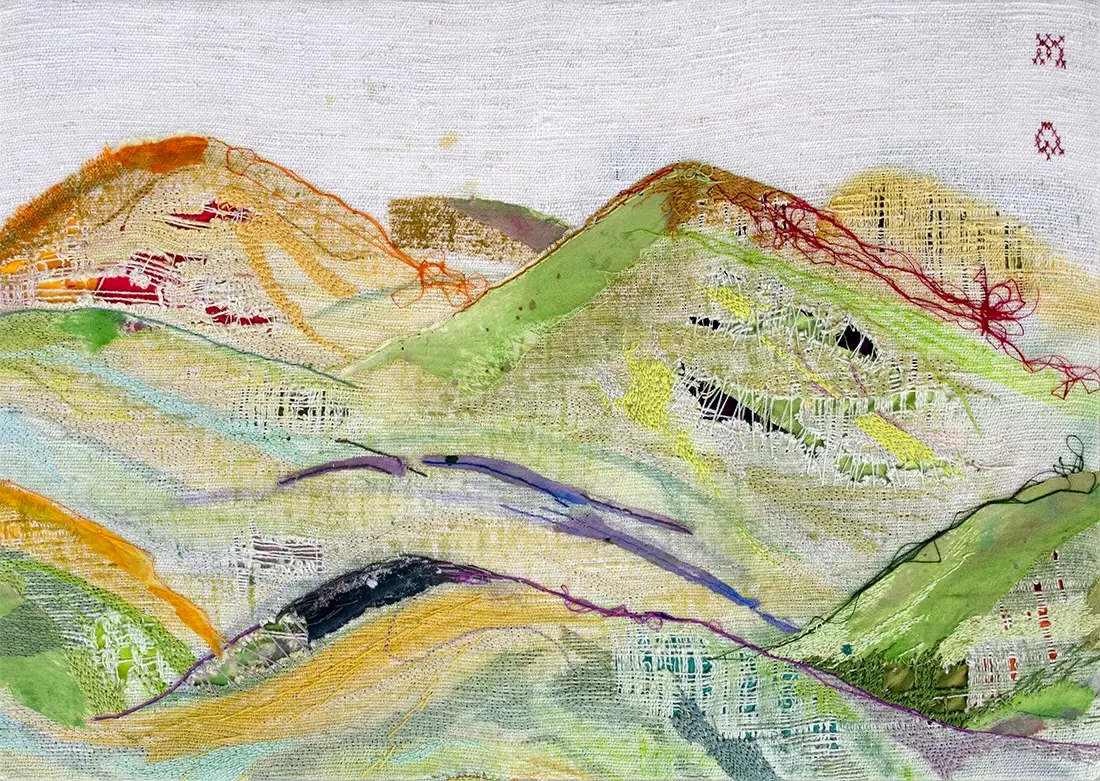
Textile artist Lynda McDonald finds beauty in worn things, turning fabric and thread into layered, imaginative art. Inspired by torn posters, weathered surfaces, and the wild beauty of Northern Ireland, she follows her ideas wherever they lead, discovering unexpected stories in cloth and stitch.
Can you take us back to the beginning? What first drew you to art and embroidery, and when did you realize that making art was something you wanted to pursue?
A wonderful art teacher at secondary school went out of his way to ensure I attended art college by helping me gain an A Level qualification (which our school didn’t provide), pulling together a portfolio and personally driving me to the interview. I got accepted.
This circumvented my career advice, which was to be a secretary or a nurse. I loved the anarchic freedom of art college. I realised that life could be hedonistic.
This experience enabled me to feel involved in the Art world… From then on, I just absorbed anything to do with art, and this became my first and major love and the most sustaining.
As an Amazon Associate I earn from qualifying purchases. Read more about our affiliate linking policy.
You studied Creative Embroidery at the University of Ulster. What do you remember most about those early years of learning, and how did your studies shape the artist you are today?
I was so young, first time away from home and so excelling in my freedom in those early years at college, that I sadly did more carousing than applying myself to study.
Threatened with course failure by my tutors, who included the wonderful textile artist Janet Ledsham, I realised I had to actually produce something! I think that it was only in my final year that I became entranced by fabric and thread.
I also came across a book in the college library, Roger Cardinal’s ‘Outsider Art’, and this introduced me to artists such as Madge Gill, whose large-scale embroideries I was able to see 40 years later, at the William Morris Gallery. I haven’t yet found the courage to go large-scale, but I hope some day to emulate her wild sense of imaginative expression.
Looking back at your earliest work, what do you see in it that still feels like you? What has changed the most since then?
I was really struggling to develop work for my upcoming degree show.
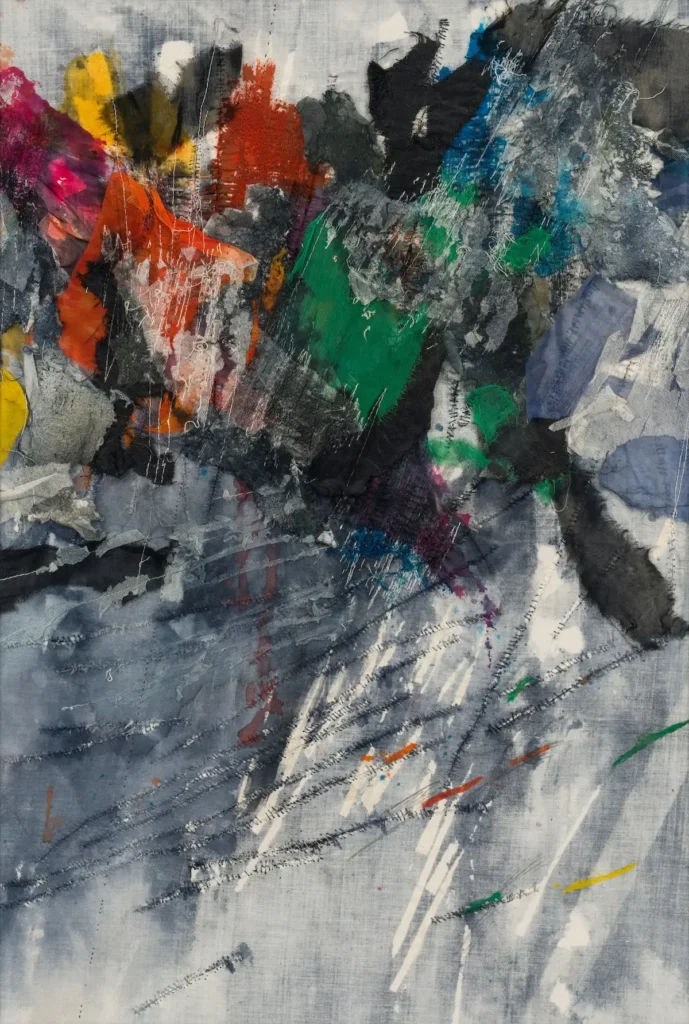
Although I had taken lots of photographs of torn & tattered billposters I was totally lost as to how to turn this inspiration into an art-piece. I remember a colleague suggesting I just tape some calico to the wall and throw paint at it.
I looked out the window, saw some red, green and blue cars in the car-park, so I threw the paint, choose those colours of fabric, slashed and restitched it, and this remains my favourite piece, ‘Billposters 1’.
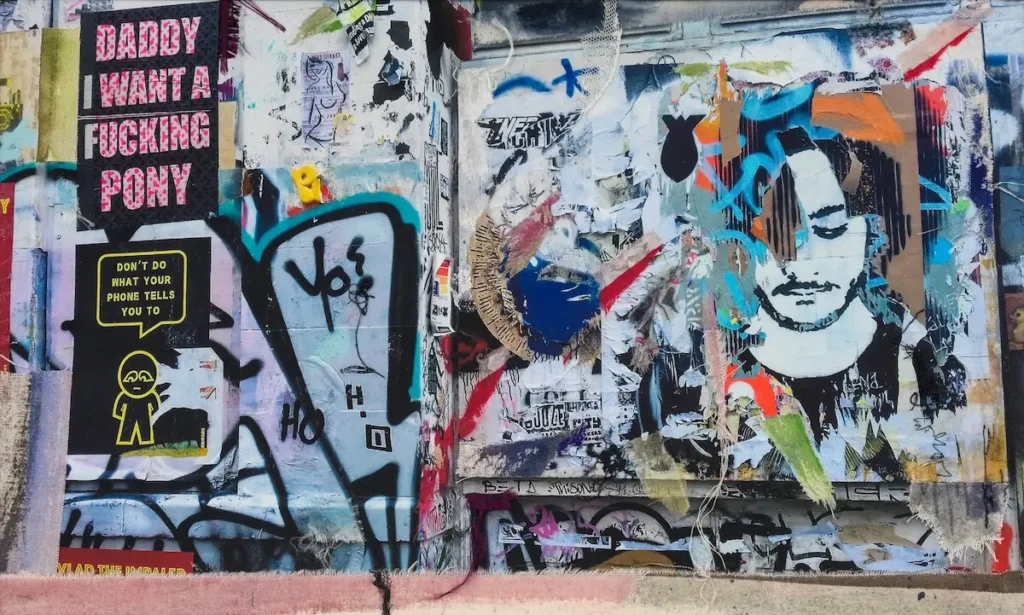
I still love billposters, evident in ‘Dirty Martinis’ which came 40 years later. Maybe I’ve become more considered in my approach, but I don’t know if that’s a good thing.
You describe wabi-sabi as an important influence on your work. How would you explain this idea to someone who has never heard of it, and what does it mean to you as an artist?
I hadn’t realised, until many years after my graduation, when I first heard the term Wabi Sabi, that this was the effect I had initially been inspired by and was trying to recreate through fabric and stitch.
To me, it just means seeing beauty in decay, in the torn and tattered billposters, in a rusting, corroded object or a paint-weathered shed.
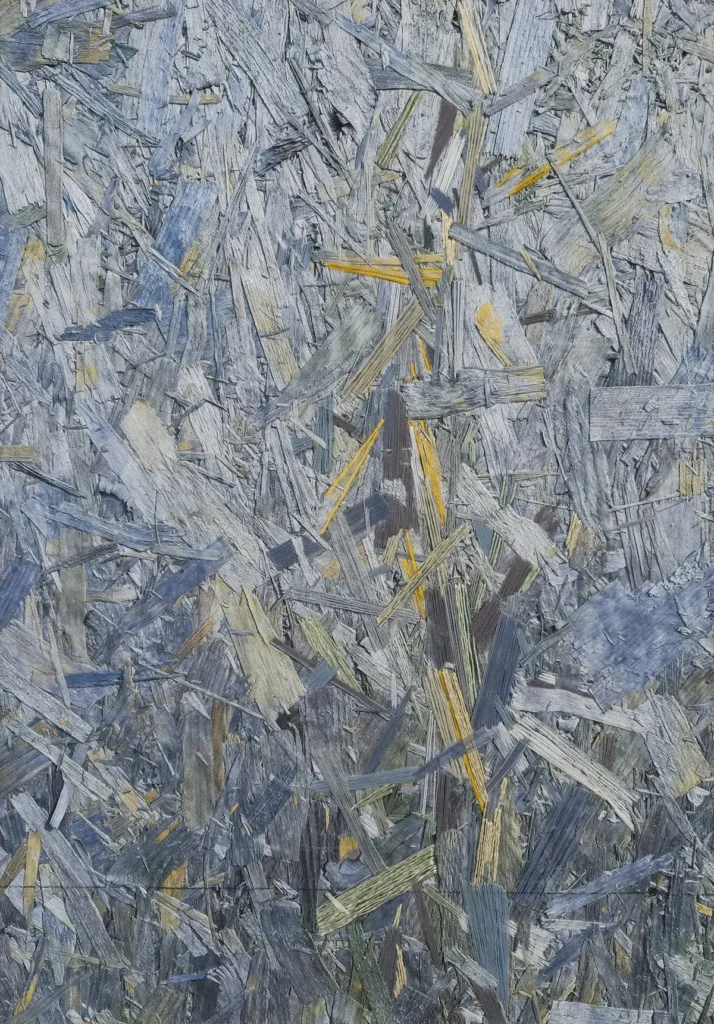
This remains my inspiration because it allows me to play with collage, layering, and recreating surface texture. ‘Line Drawing’ is basically just straight stitch on canvas, emulating the colours and shapes of a paint-weathered particle board on a garage door in Cornwall.
You now live on a peninsula in Northern Ireland, surrounded by water and a landscape shaped by nature. How does your home and its surroundings influence the work you make?
Having lived in London for 40 fabulous years, and having recently swopped this frantic city life for a rural idyll, my work has obviously changed.
Although my method remains the same, my visual landscape and subsequent output is very different.
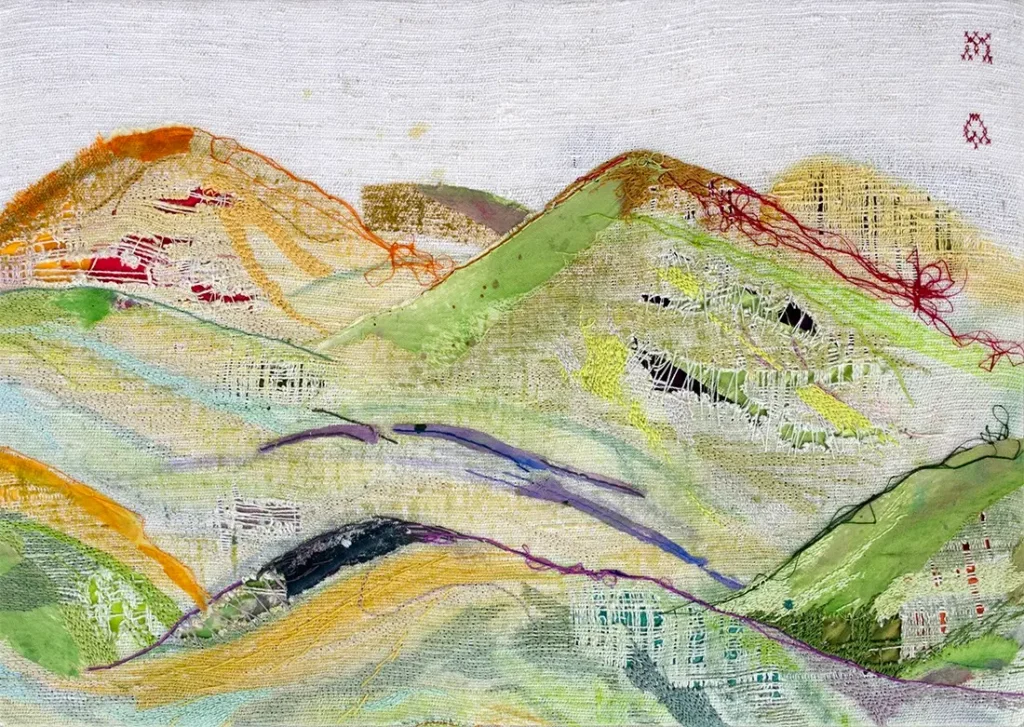
I live in an Area of Outstanding Natural Beauty (AONB), renowned for its ‘basket of eggs’ topography, because of all the little smooth, egg-shaped drumlin hills formed by deposits of the last ice age. I look at these drumlins every day from the windows in my house, so I almost felt an obligation to render them in embroidery.
My latest piece, ‘Drumlins’, feels calmer than previous work, and I enjoyed the more meditative nature of hand embroidery as opposed to machine embroidery. I think I also wanted to maintain the quietness of my environment.
Describe your creative space. Can you walk us through a typical studio session, from the moment you begin working to the point when you decide it is time to stop? What helps you settle into your creative space?
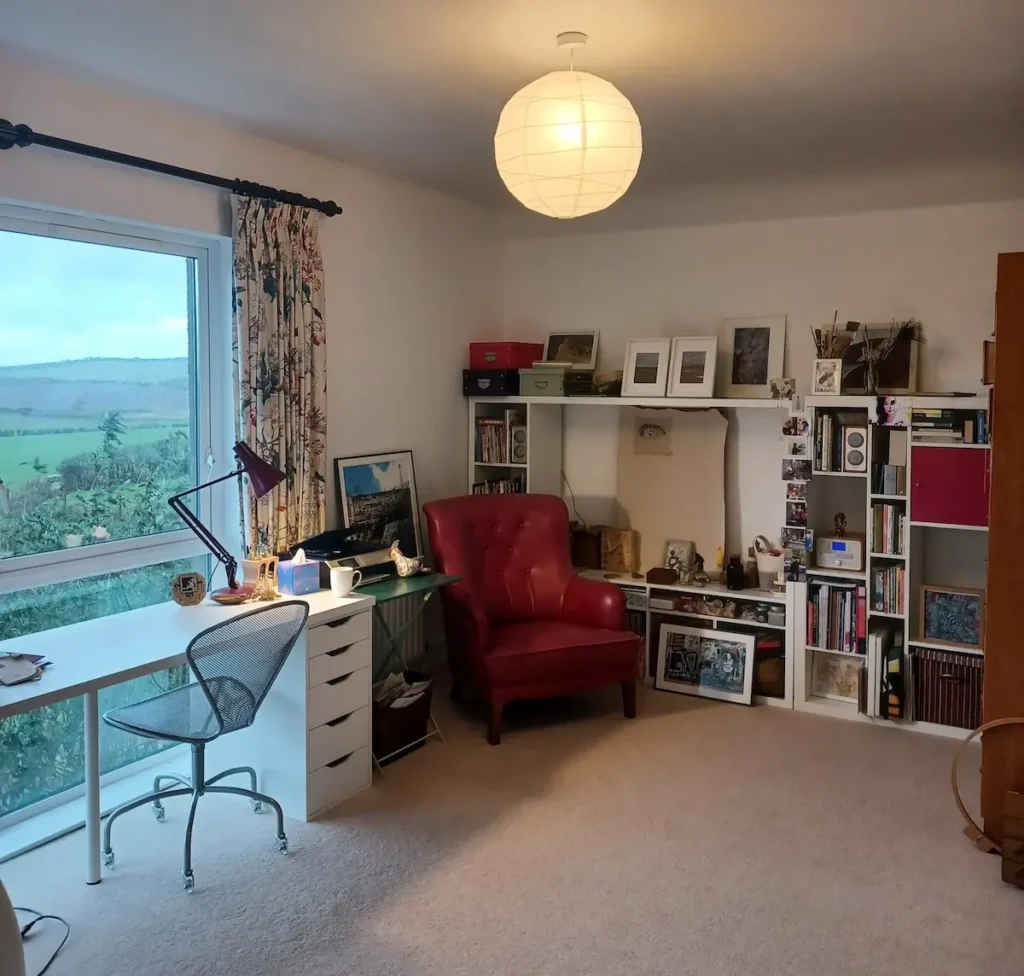
For the first time, my creative space is now a lovely, dedicated room with all my threads and fabrics in one place. I seem to spend a long time in here doing nothing. Its very quiet, I don’t have the radio on, there are no distractions.
Getting started on a new piece is the most difficult part, but once I’m decided on something, I can generally spend most of the day here. I don’t do commissions and, since leaving London, I am responding less to Calls for Entry so there are no deadlines or pressure. I am just embroidering for myself.
Do you begin with a clear idea of what you want to make, or do you often start with a material, a mark, or a small detail and see where it takes you?
It depends. I rarely have an image in my head of a final piece, it kind of evolves.
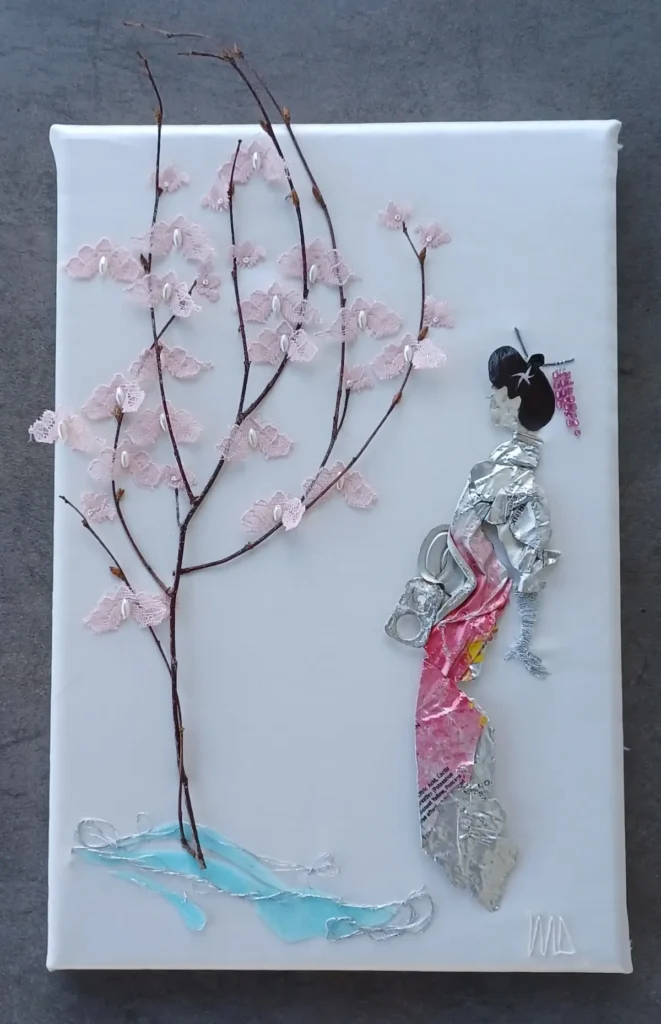
The one exception is probably ‘Recycled Geisha’. Its the first time I’ve worked with a found object. This old tin can was lying in our road and it literally had the shape of a geisha. I didn’t have to manipulate or change the can in any way, I just added the hair, headpiece, and hand. The tree is a twig with some torn lace, and the water is a piece of beach plastic. She was already there.
You work with both hand and machine embroidery. What draws you to each method, and how do you decide which one a piece needs?
I haven’t used my machine in a while. I’ve become a bit of a scaredy-cat about using it. However, my next piece is going to be a large abstract and in order to get a painterly effect I’ll need to machine-sew the large areas of colour.
I think I’m just been enjoying the meditative nature of hand embroidery and the feel of the threads and the fabric.
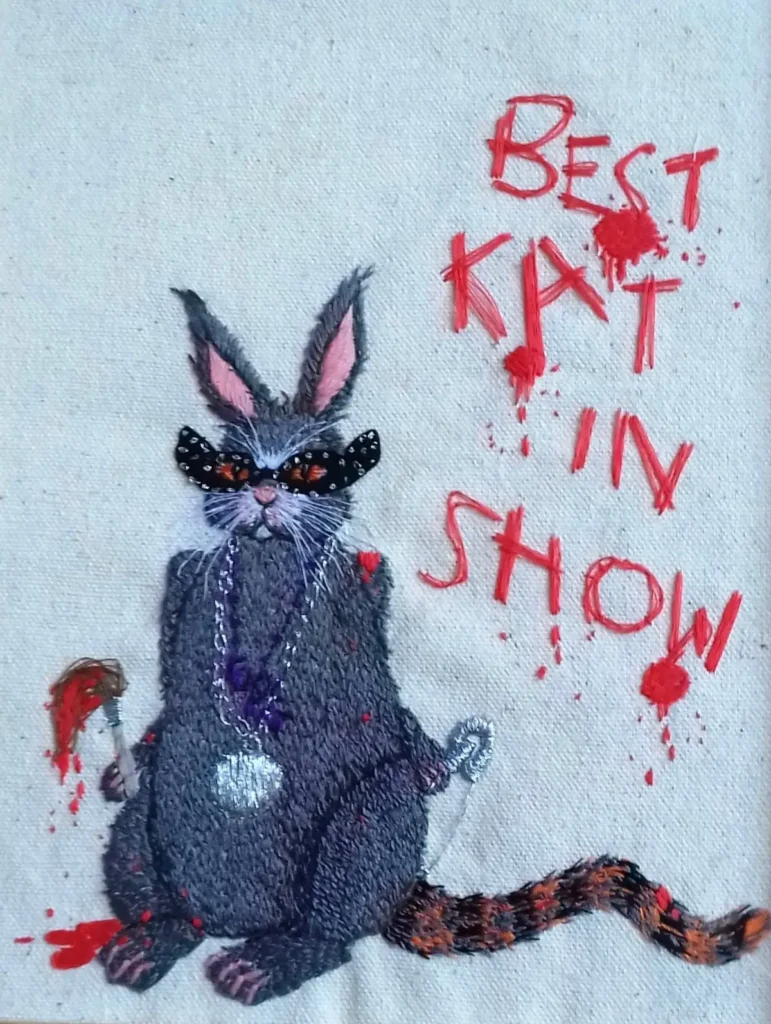
Hand embroidery is so slow though. One piece,’The Imposter’, took forever because I stupidly sewed him with single-strand threads. He was in response to a Call for Entries for artworks of cats & dogs; preferring rabbits, I entered him instead. I still miss him because we spent so long together!
What does your studio look like when you are working on several pieces at once? Do you enjoy having lots of things in progress, or do you prefer to focus on one piece at a time?
I generally work on one piece at a time, unless I am really stuck on a piece that I have to leave aside.
You describe your creative process as “following the thread.” Can you share an example of a piece where one small idea led you somewhere unexpected?
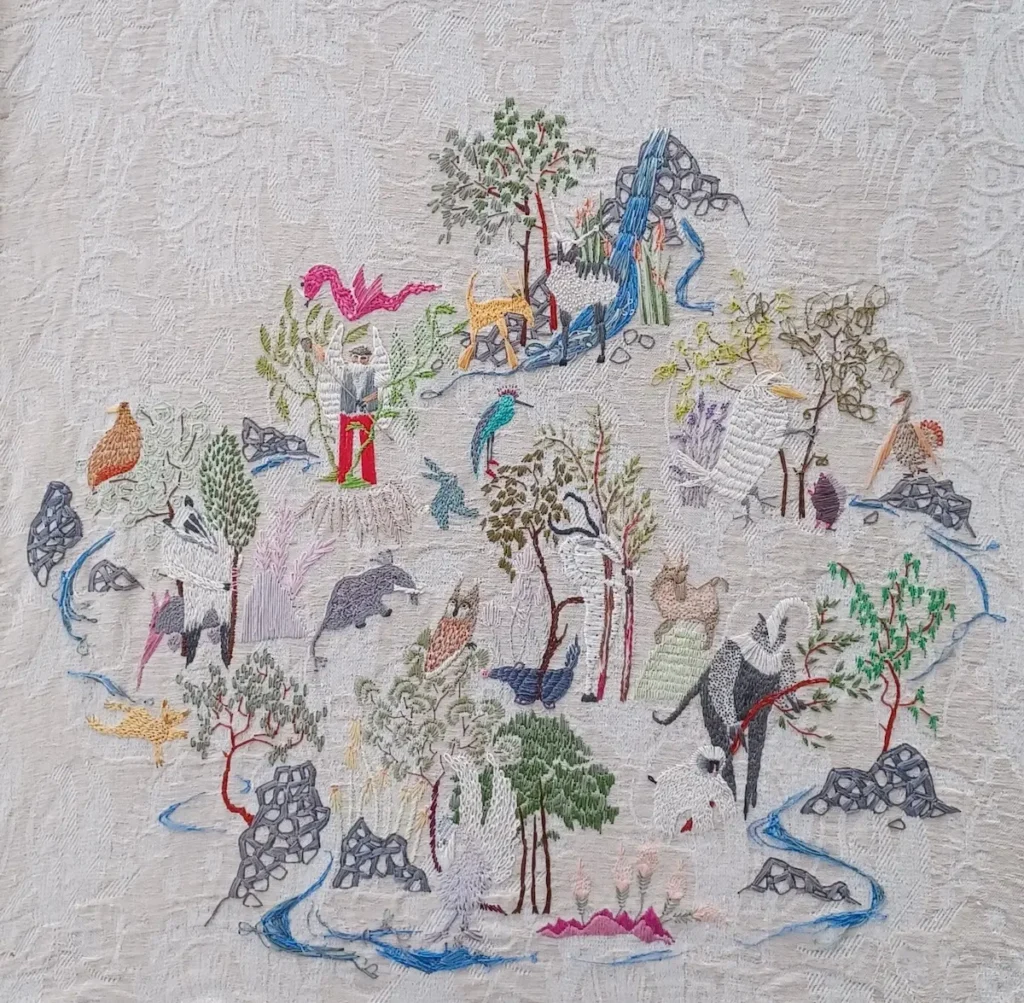
The Sentinels are my best example of this. This hand embroidery was completely spontaneous, nothing drawn or traced…straight to needle and thread!
By chance I came across a remnant of vintage jacquard linen, which turned out to have a magic element…the particular pattern in the fabric suggested the totality of the embroidered piece.
Although the images weren’t woven into the fabric, when I looked closely, they just, literally, appeared to me. Each time I embroidered a tree, a creature would come to life beside it…the other little animals scattered around were also there, waiting to be liberated.
In order to unify the piece I added the rocks and the water and these additions served to ‘ground’ the embroidery. It became apparent that the finished piece would be circular and this helped give a sense of enclosure.
The rocks harken back to imagery in Indian & Persian manuscripts, and water is an essential giver of life. Although the outlook for our planet is dark, I wanted this piece to portray a sense of something otherworldly guiding us…something mysterious and joyful.
How do you decide when a piece is finished? With layered textiles and stitching, there is always the possibility of adding another mark or detail. How do you know when to leave things alone?
I don’t always get this right.
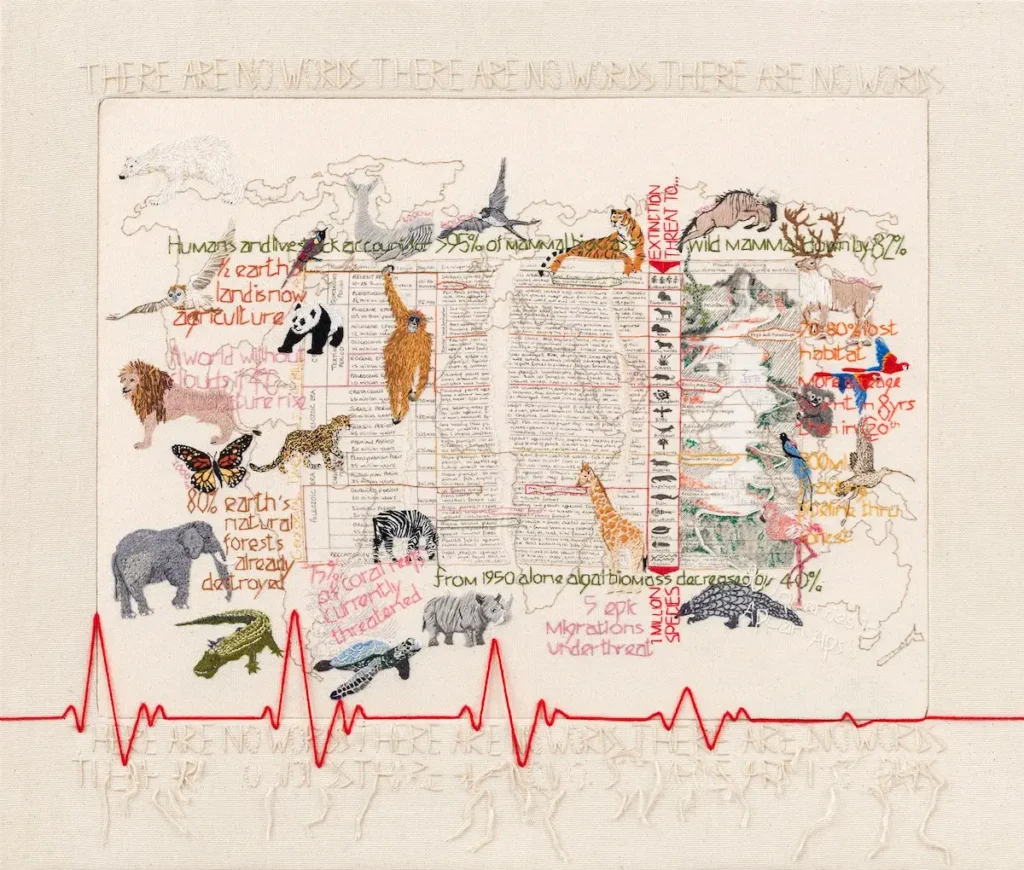
This happened with ‘Life?.’ I had left it aside for about a year because I didn’t know how to finish it. Eventually, I came up with the idea of the flatlining heartbeat and the additional mount, as there are literally no words to describe the destruction we’re wreaking on our planet.
The downside of putting work aside though, is later adding bits that don’t need to be there.
I completed ‘Life?’ just after the dreadful fires in Australia, so I felt obliged to include a koala bear…and a bird-of-paradise. This completely spoilt the nice curve I had incorporated and makes that section look overly busy! Although this piece was a finalist in the Hand & Lock Embroidery Prize, this mistake still irks me.
What does a life filled with making give you that other parts of life do not? Is it a way to think, a way to find calm, a way to connect with the world, or something else entirely
I feel so incredibly lucky and blessed to have creativity in my days – I think that loving art or music or literature gives you a friend for life.
Also, a concern on leaving London to make a new home in a completely random place was whether I would find any of ‘my people’. Then of course I met some artists…sorted!
But, as well as that, my art is an expression of me. I like not knowing what other art pieces are inside me, I like exhibiting my work. I like talking to people about art. Mainly, I like looking at joyful, beautiful works of art created by people in our long past.
It gives me hope.
Many people find it hard to make time for their own creative work, especially when life is busy. What helps you protect time for making, and what advice would you give someone who wants to return to art after a long break?
I had a break of 30 years. Eventually, my stressful NHS job necessitated my need to find some headspace.
I compressed my hours and dedicated Mondays to doing something creative, which eventually led me to a life-drawing class.
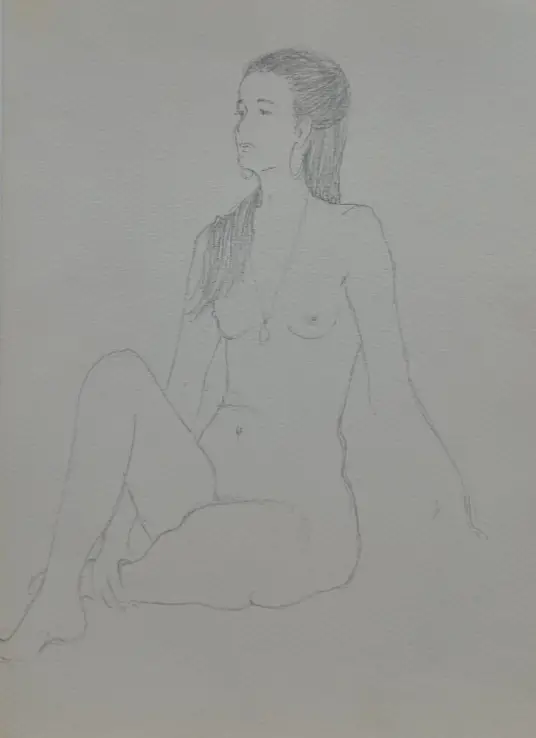
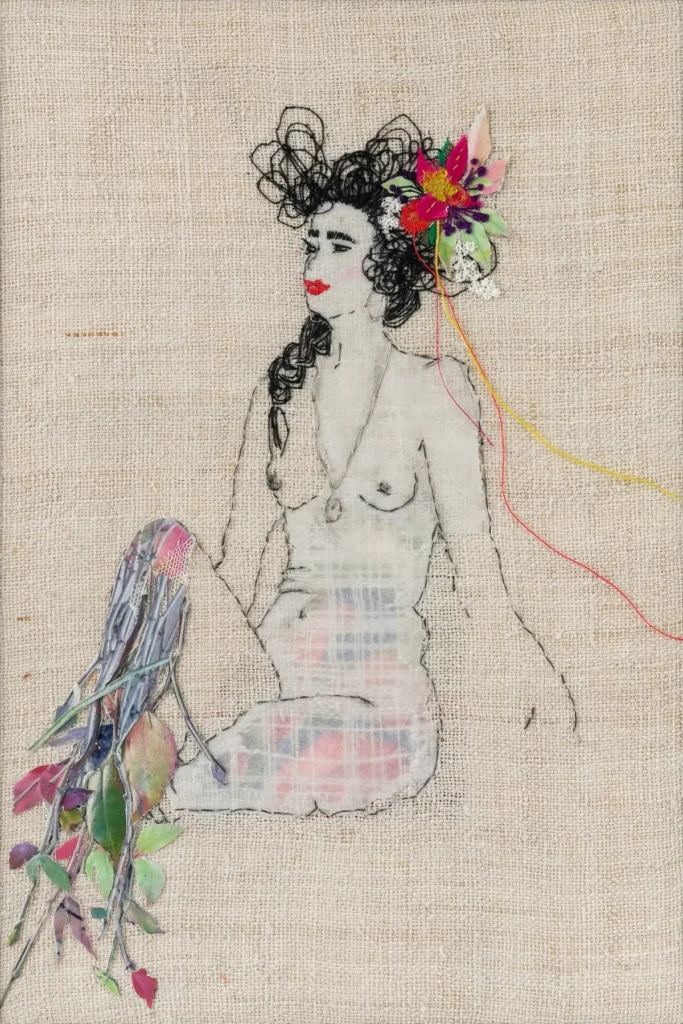
It was the first time I had put pencil to paper in all that time. I had forgotten what it was like to be ‘in the zone’. One of my first drawings then became one of my first embroideries, ‘Spirit of Frida’, in response to a Call for Entries.
This embroidery was selected for the exhibition, and we all had to attend dressed as Frida Kahlo. It was such fun that I was hooked and haven’t stopped since.
All I can suggest is to choose a distinct time – say 2 hours in the week – and prioritise it as your me-time to do something, anything…just turn up. Be there.
What are you curious about right now? Are there new materials, techniques, ideas, or places you would like to explore in your work?
I want to go bigger, with a more abstract approach to landscape but including an intricate area of hand embroidery. To do this I’ll need to paint bold areas of colour in acrylic and reacquaint myself with my sewing machine. I may incorporate some found items…who knows, not me!
Where can people see your work?
Home | Lynda McDonald Art
@lyndamcdonaldart
- Rapid-Fire Fun:
- One thing always on your worktable? – my little pincushion creature.
- A color you never tire of? – green
- A place that inspires you? – this watery peninsula
- A favorite word to describe your work? – fulfilling
- What’s bringing you joy today? – the sky after storm Boelo
Interview posted October 2026
Explore hand embroidery inspiration and projects on Create Whimsy.