
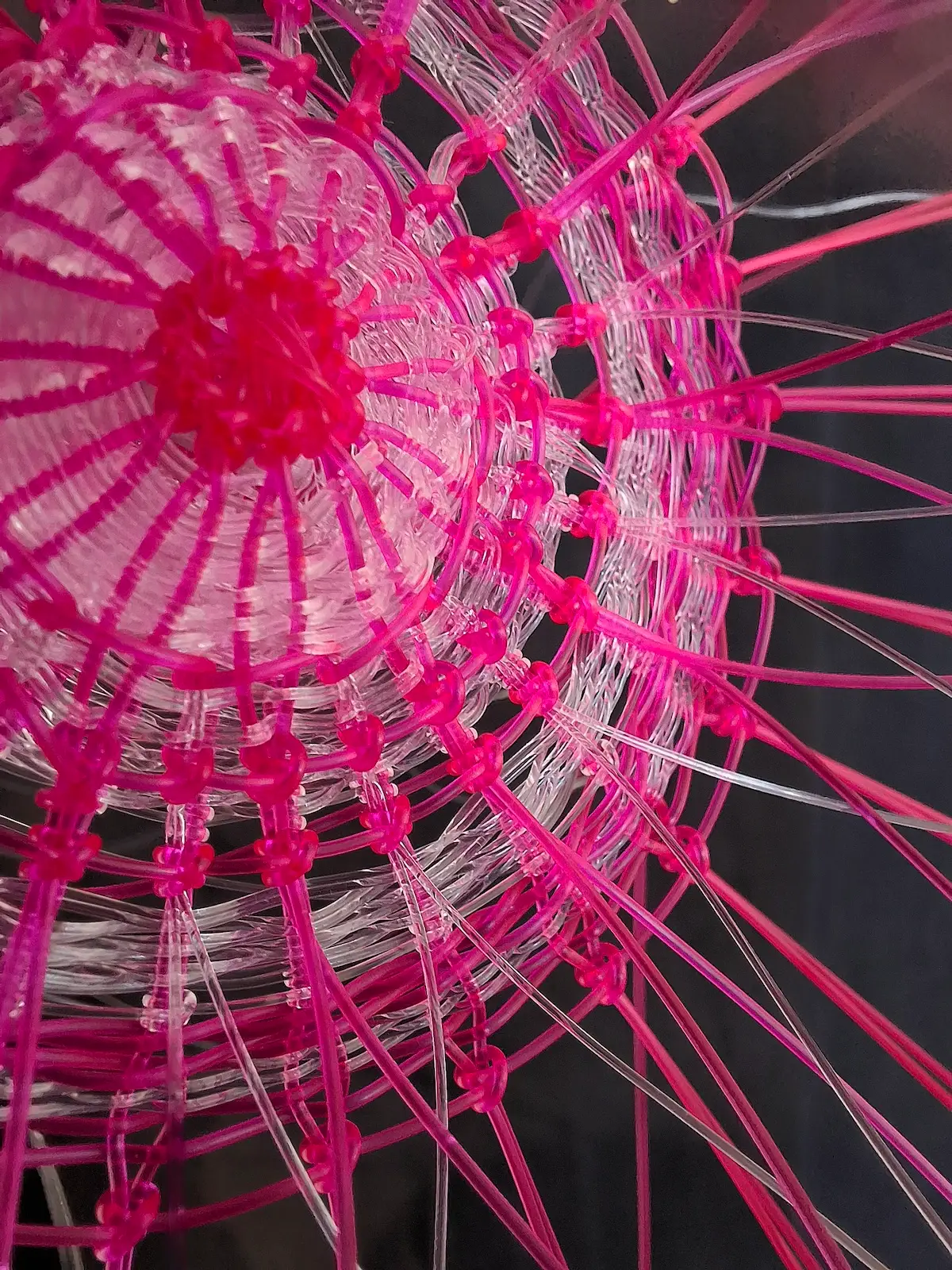
Lucy Sugden weaves the wonders of nature into beautiful works of art, capturing the delicate shapes, colors, and light found in her garden. Using reclaimed fibers and even discarded fishing line, she creates rich textures and surprising details that invite us to look closer and see the natural world in a new way.

You’ve been making things since you were very young. What do you remember about those early days of making, and what did creating give you even then?
I remember always being drawn to and enjoying textiles, learning to knit and sew. Making art and crafts made sense to me, I understood how to create, and it came naturally in ways that academic subjects didn’t, which I had to work hard at to understand.
You went on to art college and studied Constructed Textiles, specializing in tapestry weaving. What was it about weaving that grabbed your attention?
It was different from the other weaving techniques we studied. In one sense it seemed so simple, a weft faced weave of repeating row under over, over under warp yet it was complexed, with rows broken into shape, colour and texture. The possibilities felt endless and I could easily create three dimensions rather than just flat tapestries.
As an Amazon Associate I earn from qualifying purchases. Read more about our affiliate linking policy.
After graduating, you stepped away from weaving for about a decade while raising your family. What was it like to return to your loom in 2017? Did you come back to weaving in the same way you had left it, or had you changed as a person and maker during those years away?
After graduating the question of how to actually make a living from art opened up, and I naturally found my way into developing and delivering arts education several while creating and exhibiting my work sporadically for nine years before starting my family.
Returning to my practice once my children were older, I found that my core principles and ethos had shifted. They directly impacted how I thought about materials, making me really question what fibres I chose to create with.
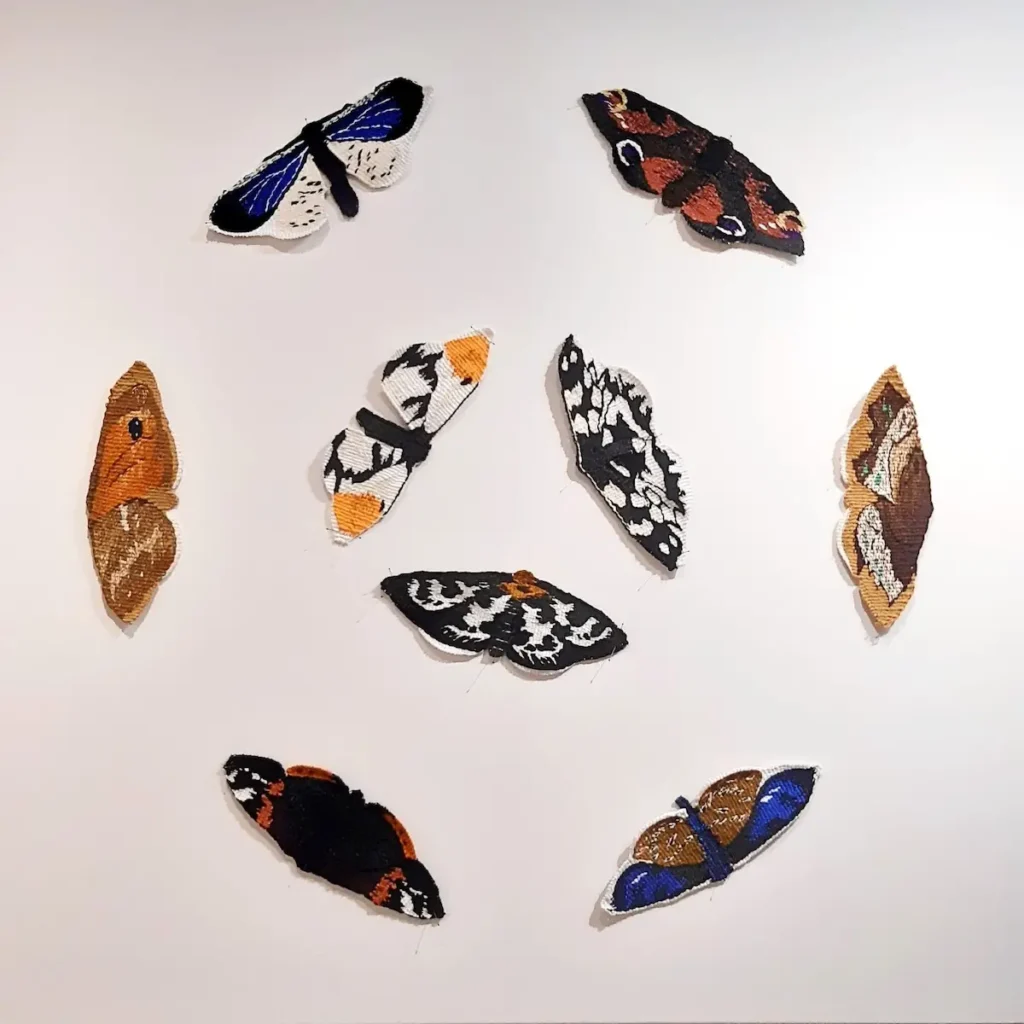
Your garden is such an important part of your creative life. What do you see there that makes you want to reach for your loom?
It’s not always what I see as much as it is a feeling of grounding, calm, beauty, wonder, awe, and excitement. At the moment, I am very much intrigued by visiting moths and the structures of flowers and seed heads, specifically the interplay between moths, flowers, and the plants that nourish them and their caterpillars.

You’ve written about the “quiet singing” of translucent petals and the glint of an insect’s wing. What is it about light and tiny details that captures your attention? What do you think weaving has taught you about paying attention?
The sparkle and dazzle of a glint, something at the bottom of the garden, hiding in foliage or catching your eye as you walk past, that commands a closer look. Only then do you start to see the real beauty and intricacy, the delicacy, pattern and detail.
Tapestry weaving is a slow technical process, it takes time before you start to fully understand it, and the same goes for watching and understanding the interconnections of ecosystems.
When you are inspired by something in nature, how do you decide what to keep and what to leave out?
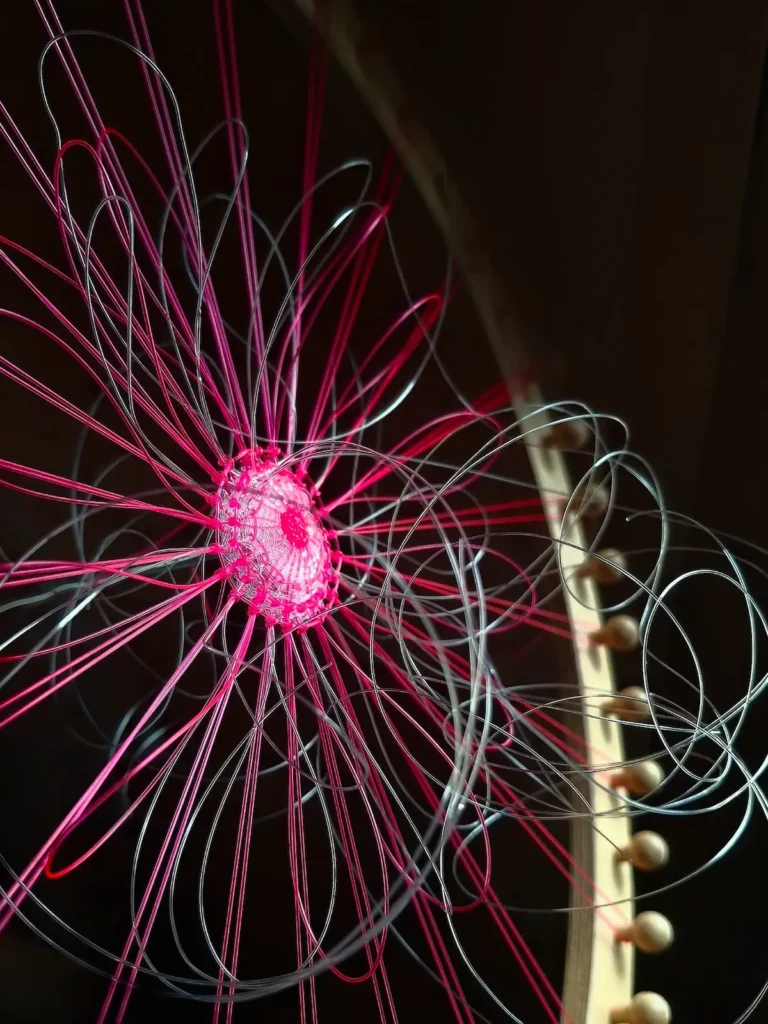
I interpret inspiration differently on my circle loom than I do my tapestry loom.
Tapestries tend to be more detailed, both in design, weave, idea and concept, and might incorporate various elements of an idea.
Creations on my circle looms are much quicker and generally evolve as I weave.
With both it comes down to concept and design dictating what gets included and what gets left out.
Do you sketch, photograph, collect words, make notes, or simply keep an image in your mind when an idea first appears?
Ideas for tapestries come from something I question or that I want to highlight from watching and considering garden life, I take photographs, make notes and spend time contemplating, sometimes ticking over an idea and questioning it for months before I start working on the design and finally creating at the loom.
Your work can feel peaceful at first glance, but there are often deeper stories underneath. How important is it to you that a piece has something more to discover?
It depends on the piece. Tapestries take time to develop conceptually, and because the weaving process is so slow, I find these pieces naturally carry a deeper message. However, I leave that for the viewer to discover if they wish too.
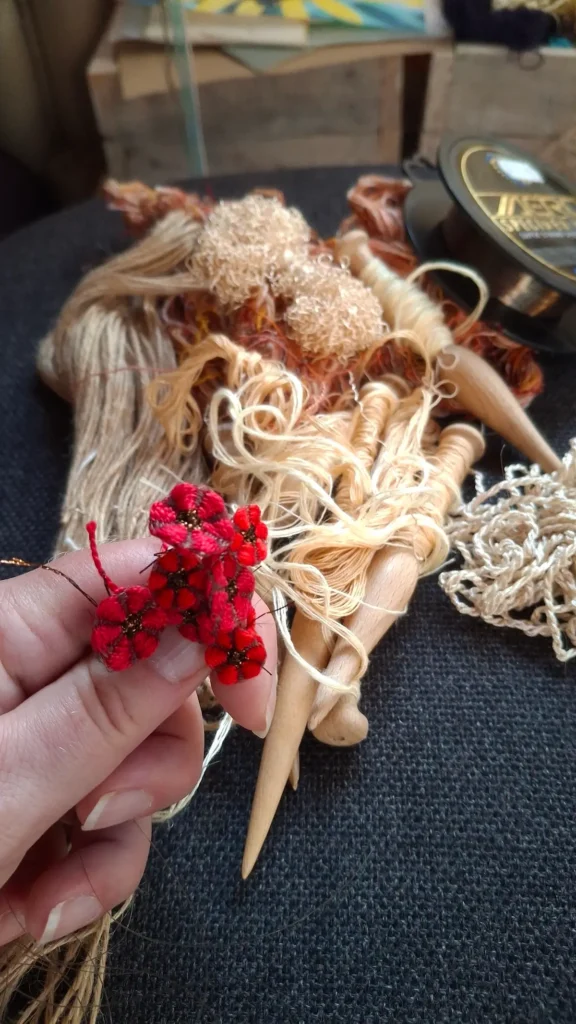
You work with reclaimed and unwanted fibres, including donated materials and waste fishing line. When did using discarded materials become an important part of your practice?
It began when I returned to my practice after having children. My use of fishing line, which is of course a plastic fibre, became a real dilemma for me, as the environmental impact of plastic wasn’t widely known when I first started working with it.
By using waste materials, I’m not taking new resources from our already depleted environment, instead, I’m repurposing what would have otherwise been thrown away. That approach sits much better with me than buying new fibres.
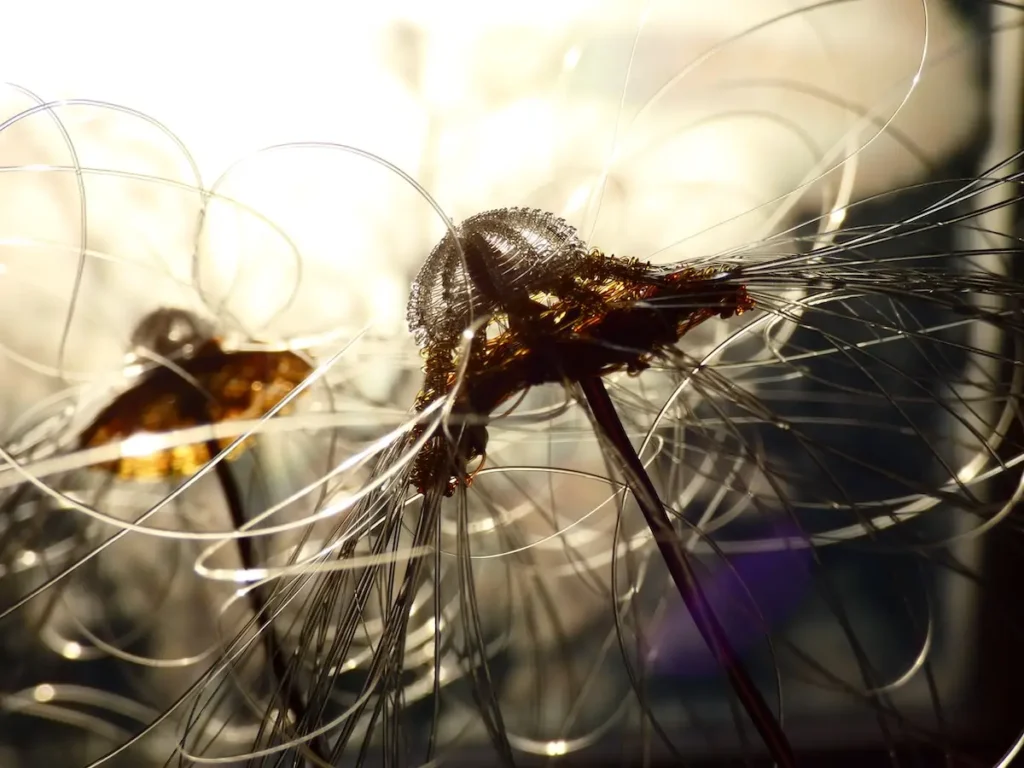
You’ve said that fishing line is one of your favourite materials to weave with. What does it allow you to do that traditional wool or cotton does not?
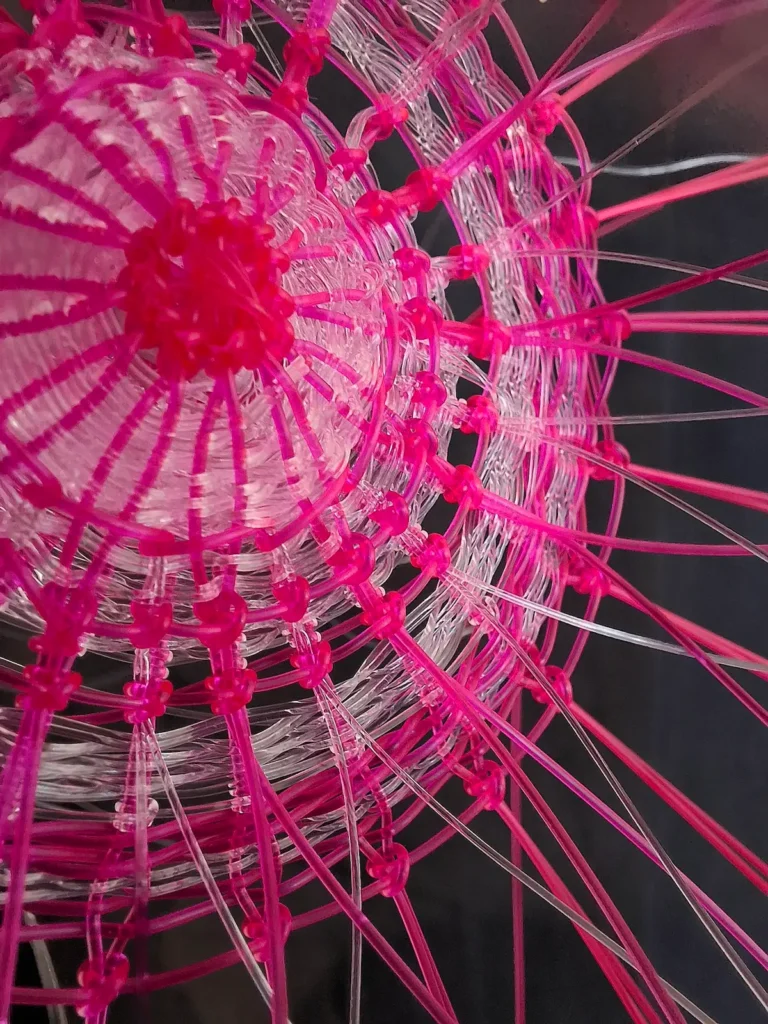
Play with light. Its translucency creates effects wool and cotton can’t achieve, though I do still love weaving natural fibres as well, and I enjoy the interplay of combining fishing line and natural fibres.
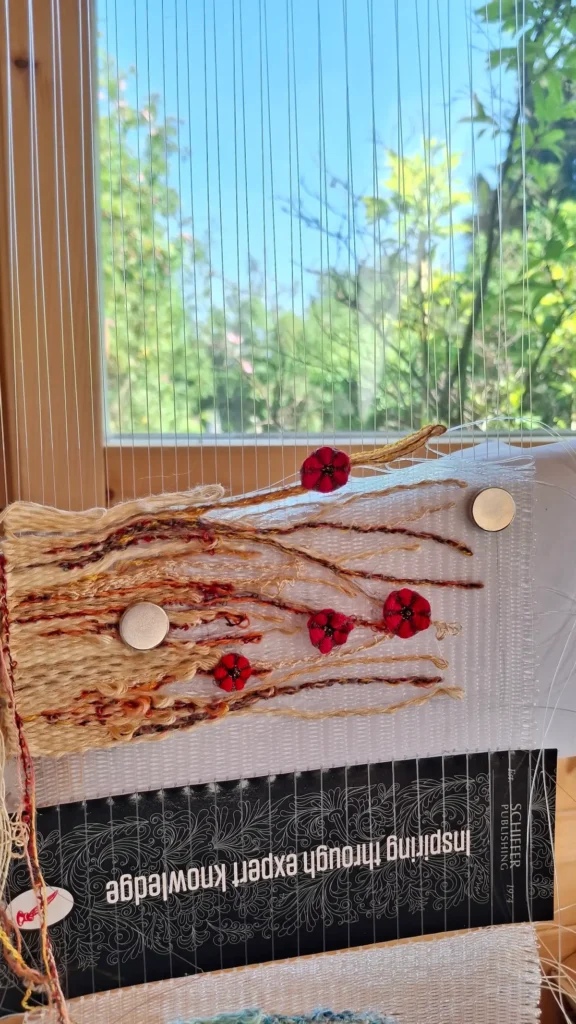
Because you work with salvaged fibres, you don’t always know what materials will be available. Does that limitation ever become part of the creative challenge?
Always.
Once I have an idea and design, I collect all the fibres I have in the colours I plan to use, then try to figure out if there will be enough to complete the piece.
There have been a couple of occasions where I miscalculated and ran out of a fibre before completing an area withing a tapestry. At that point, I have no choice but to stop, reconsider that section, and rework it using a different fibre, or adjust my design.
Working with only what I already have rather than buying in whatever I think I need really reinforces how precious resources are. It forces me to use everything wisely and make sure nothing is wasted.
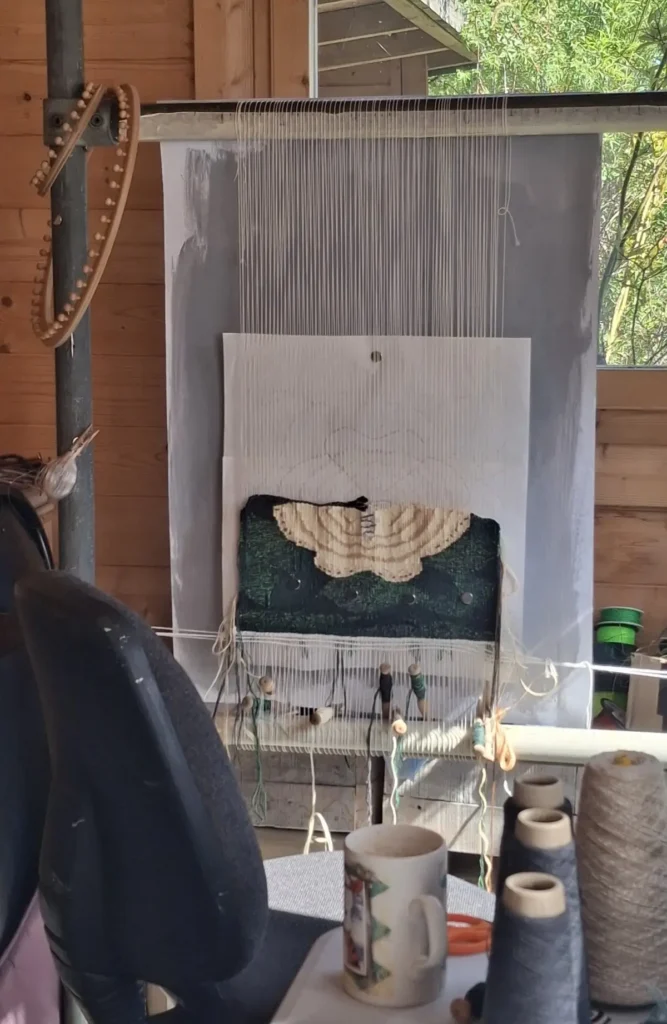
Can you take us inside your studio and describe what a typical day at the loom looks like?
It isn’t often I spend a whole day at the loom, as after a few hours I need to stretch and move.
However, when time allows and I am fully absorbed by a piece, hyper focus sets in and I can spend hours at the loom. I pick the warps that run vertically up and down my loom with my fingers which I pass blended bundles and bobbins of wefts through, going under and over in turn as I build the shapes of the design.
I’ll be sitting on my height adjustable chair, surrounded by reels of fishing line and cones of wool, boxes of surplus craft stash on the floor and table next to me, with butterflies and bobbins of mixed colour wefts waiting their turn to be woven.
Because I teach and run workshops, my garden studio is split into two working spaces. My loom sits at one end by large windows overlooking the garden. In warmer months, with the windows wide open, it feels like I’m sitting within nature, listening to the birds and insects going about their day, it’s a very tranquil place to be. The other end of the studio is set up with my desk, books, stacked teaching looms and materials.
Your large scaffolding loom has been with you since you graduated. What makes that loom such an important part of your story?
Without it I couldn’t weave my tapestries. Upon graduating, one of my uncles asked me if there was anything he could do to help me get my career started, so I told him some scaffolding would be ideal to build a loom like the ones I learned on at university. He sourced and gifted me the scaffolding. It’s unassuming, practical, and perfect, an extension of me.
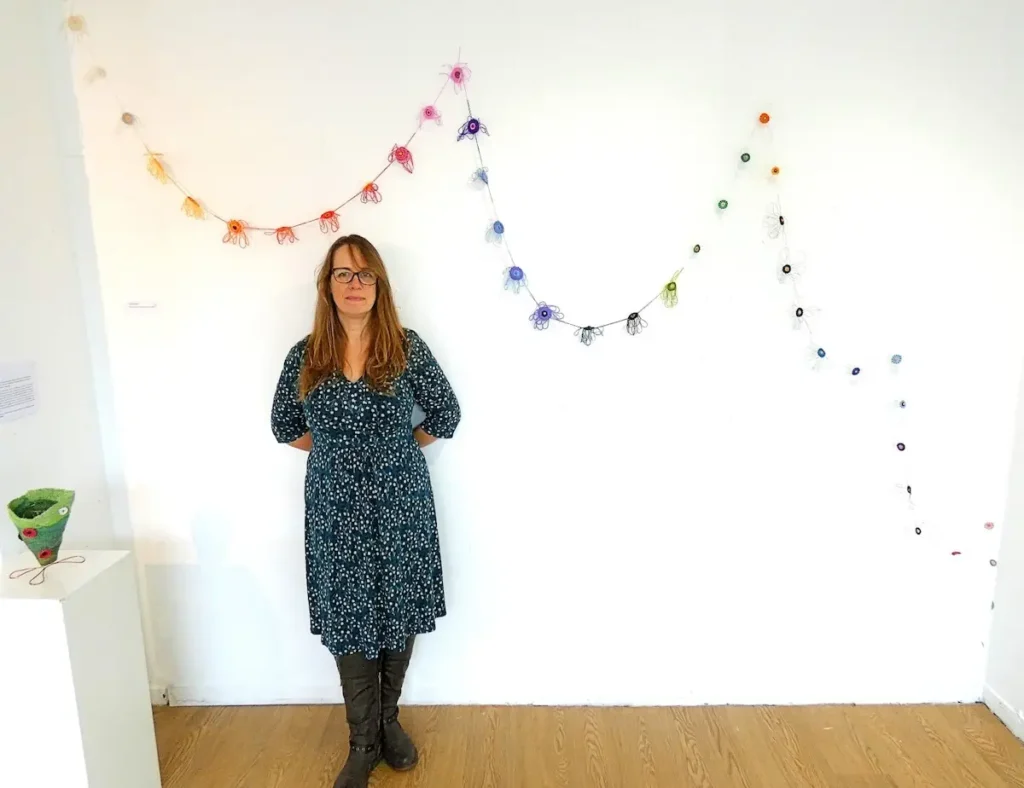
When you begin a new piece, do you usually know exactly where you are going, or does the weaving lead you somewhere unexpected?
Tapestries on my scaffolding loom are generally fully considered beforehand, complete with woven samples and a cartoon to follow. However, because the time taken to weave a tapestry is mostly thinking time, the piece I’m working on naturally opens up questions and ideas for future tapestries. On the other hand, florals on my circle loom tend to develop intuitively as they are woven, with new designs and ways of working emerging as I weave.
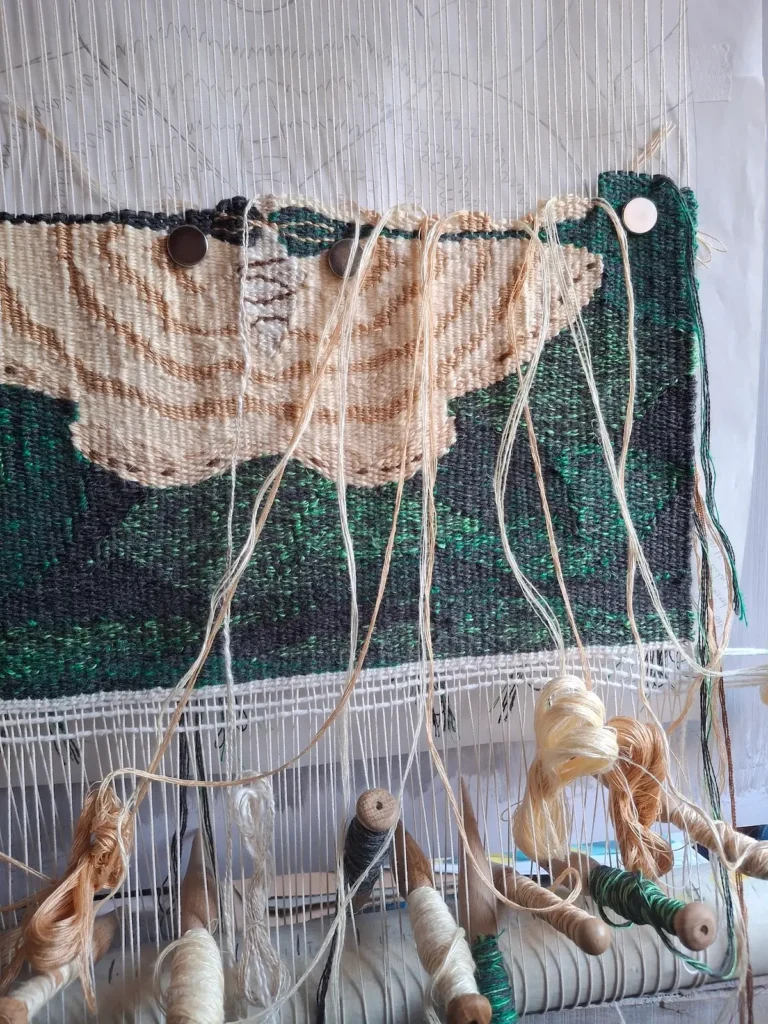
Tell us about a time when a piece wasn’t working. How did you figure out what needed to change?
I think the only times a piece hasn’t been working are when I wasn’t happy with a colour choice or blend in a specific area. When that happens, it simple means ‘unweaving’ the offending section reweaving with a colour choice that works.
How do you know when to keep working on an idea and when to let it go?
If it is still intriguing and questioning me then I’ll keep working it, if the reason or challenge is no longer there, it naturally falls away and I move on.
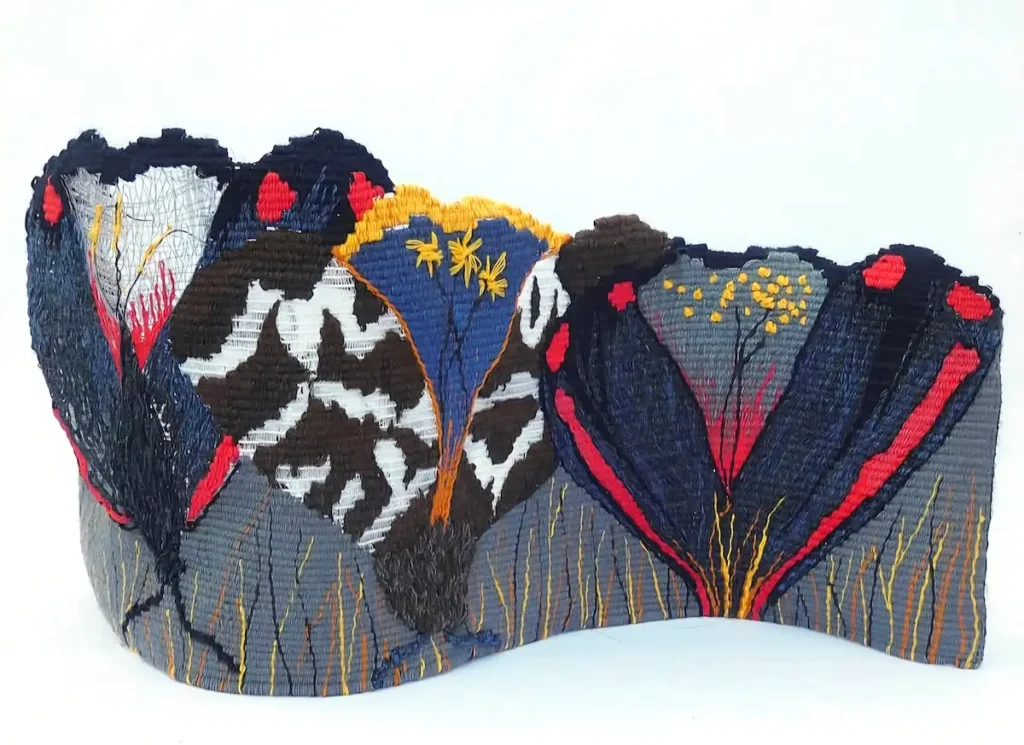
Teaching is another important part of your creative life. What do you love about helping someone else discover weaving for the first time?
When it clicks and you see it pull them in, at the end of the session they tell you how mediative it they found it, that’s when I know it wove it magic, if you’ll pardon the pun!
What has surprised you most about the life you have built as an artist?
Community. You spend so much of your time working alone, yet this wonderful, supportive community forms and grows around you.
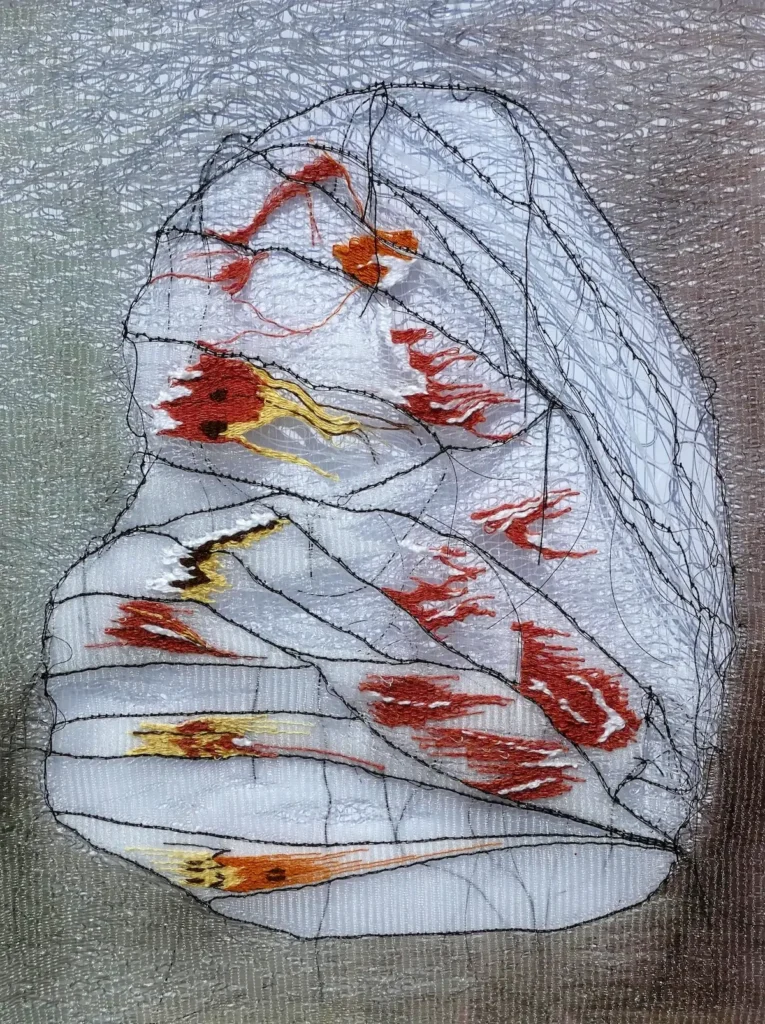
You’ve been exploring three-dimensional weaving for several years. What possibilities are exciting you right now?
Going bigger using pulled warps and embedded wires, I’ve had an idea for a couple of years that I haven’t yet found the time to develop, but many pieces I’ve created lately feel like they’re laying the foundations for what I’ll need to realise my concept.
Where can people see your work?
On my website lucysudgen.co.uk on Instagram, Facebook and YouTube as LucySugdenWeaving and in galleries in the Uk
Web- https://lucysugden.co.uk/
Instagram – https://www.instagram.com/lucysugdenweaving
Facebook – https://www.facebook.com/lucysugdenweaving
YouTube – https://www.youtube.com/channel/UClx6vzy4mykjY61_QlFktTw
Rapid-Fire Fun:
- Favourite part of the weaving process? The challenge
- A piece of advice you would give someone who is just beginning to weave? Find some fibres you like and play
- Favourite thing growing in your garden? Ecosystems
- What are you currently curious about? Moths
- And finally, what makes you want to get back to the loom tomorrow? The possibilities
Interview posted October 2025
Explore more weaving inspiration on Create Whimsy.