
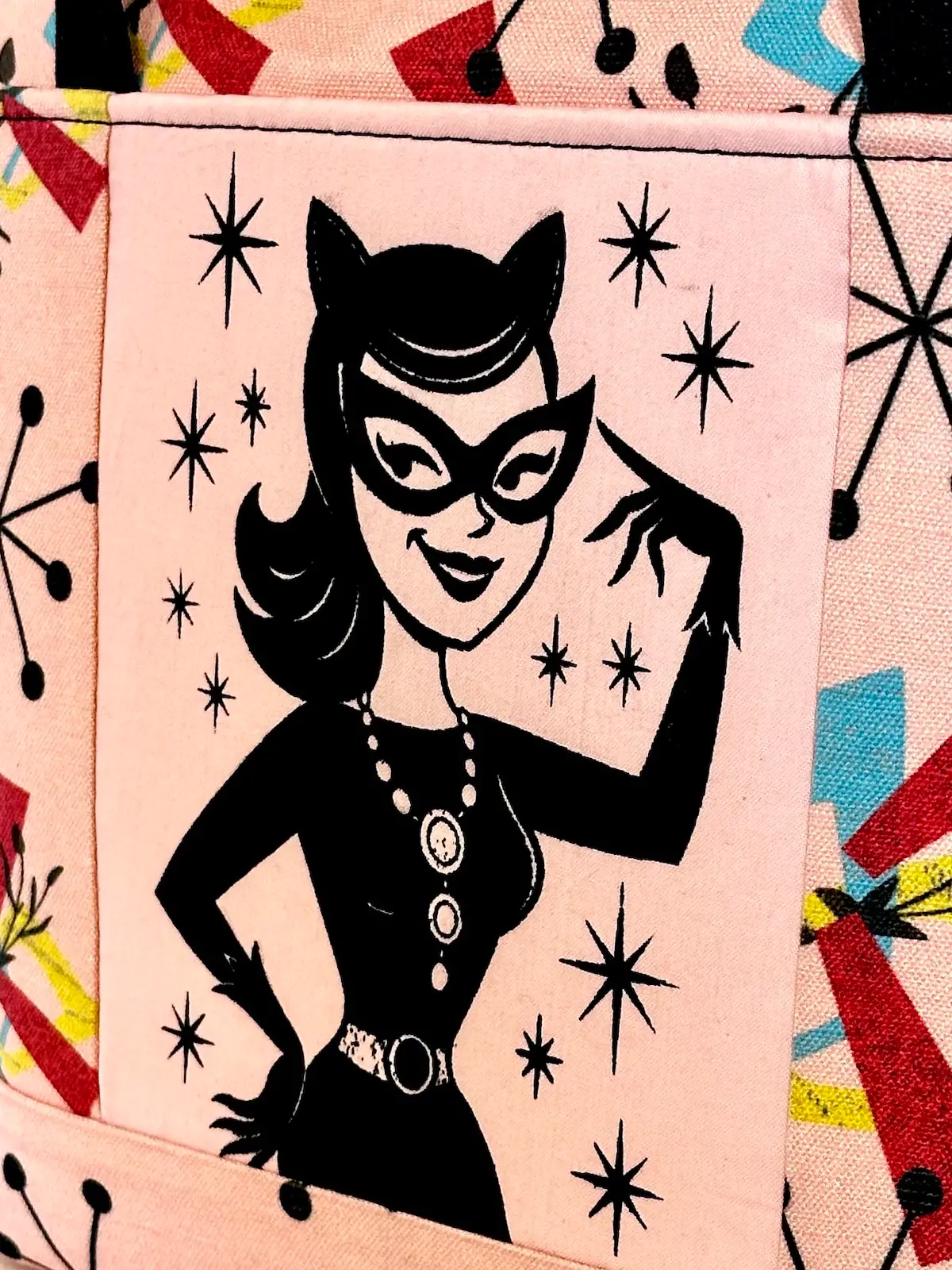
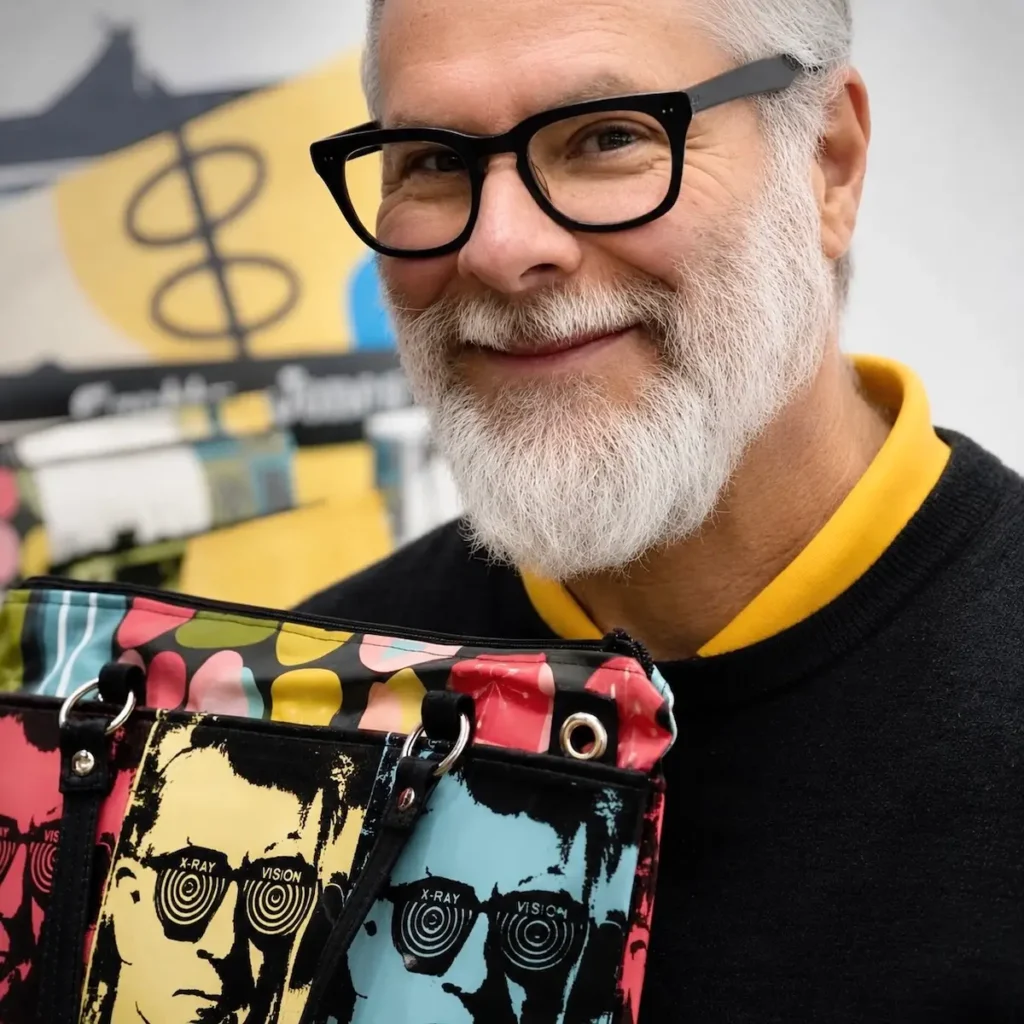
Scotty Jones of Urthy Fiber Art turns vintage images, bold colors, and playful patterns into one-of-a-kind handbags and accessories. Inspired by mid-century design and a love of making things by hand, his work blends nostalgia, humor, and a few unexpected surprises. His goal? To make people smile and bring a little joy to everyday life!
Do you remember the first thing you loved to make with your hands? What drew you to making things?
One of the first things I remember making was little yarn pom-poms using cardboard circles cut out as templates. I was fascinated by how something as simple as wrapping yarn around cardboard, cutting it, and tying it together could become something entirely different.
My grandmother, Mae Lewis, was a hand quilter who taught me to sew when I was about nine years old. She had an enormous influence on my love of working with textiles and making things with my hands.
I think what drew me to making things was the magic of transformation. Taking ordinary materials and turning them into something beautiful, useful, or just plain fun. I’ve always been curious about how things are made and loved the challenge of figuring things out for myself.
As an Amazon Associate I earn from qualifying purchases. Read more about our affiliate linking policy.
That curiosity has stayed with me throughout my life. The materials and techniques have changed, but the excitement of seeing an idea come to life hasn’t.
You learned to sew from your grandmother when you were a child. What do you remember about those early sewing lessons?
What I remember most vividly is my grandmother’s beautiful old Singer sewing machine. It was a late 1800s treadle machine, decorated with elaborate Egyptian decals. To a young boy, it was an absolutely mysterious and fascinating contraption. All those moving parts, the ornate decoration, and the idea that this machine could somehow turn pieces of fabric into something useful. I was captivated.
There was something incredibly satisfying about guiding fabric beneath the needle and watching those perfectly spaced stitches appear. I had no idea at the time that sewing would eventually become such an important part of my life.
And the best part? I still have that beautiful old Singer. It’s a treasured connection to my grandmother and the woman who first introduced me to the joy of making things with my hands.
Your grandmother also helped shape your love of vintage and fine craft. What did she teach you that went beyond sewing?
My grandmother was a Quaker, and I think her appreciation for simplicity, practicality, and making things well had a lasting influence on me. She understood the value of repairing something rather than simply replacing it, and there was a quiet respect for the time and effort that went into making things by hand.
Her home wasn’t filled with antiques, but there were older objects that fascinated me. I think being around those things helped develop my appreciation for vintage design and objects with a history.
Perhaps the most important thing I took away from her was an appreciation for craftsmanship, for the skill, patience, and ingenuity that go into creating something. That appreciation has stayed with me, both in my own work and in the work of other artists and craftspeople I admire.
When did you first begin to think of yourself as an artist or maker? Was there a moment when you realized this could become an important part of your life?
I think I’ve always considered myself a maker. As a kid, I would set up a little store on my grandmother’s enclosed front porch and sell macramé plant hangers and bracelets that I’d made. Apparently, I had an entrepreneurial streak even then!
I even consigned my creations to a little gift shop in the lobby of the Spencer Hotel. My mother would drive me there once a month to deliver my latest creations. Looking back, I suppose I was running my first little art business before I even knew what an art business was!
I don’t remember a particular moment when I decided I wanted to be an artist. Making things was simply something I did, and it always felt like a natural part of who I was. The idea of calling myself an artist came much later, but the desire to create, experiment, and share what I’d made with other people has been there for as long as I can remember.
You work with sewing, textiles, screen printing, and design. How did those different parts of your creative life come together to become Urthy Fiber Art?
I think Urthy Fiber Art is really the culmination of a lifetime of making things and exploring different creative interests. Sewing was there from the beginning, but over the years I became fascinated with graphic design, textiles, and particularly screen printing, which I learned through an apprenticeship.
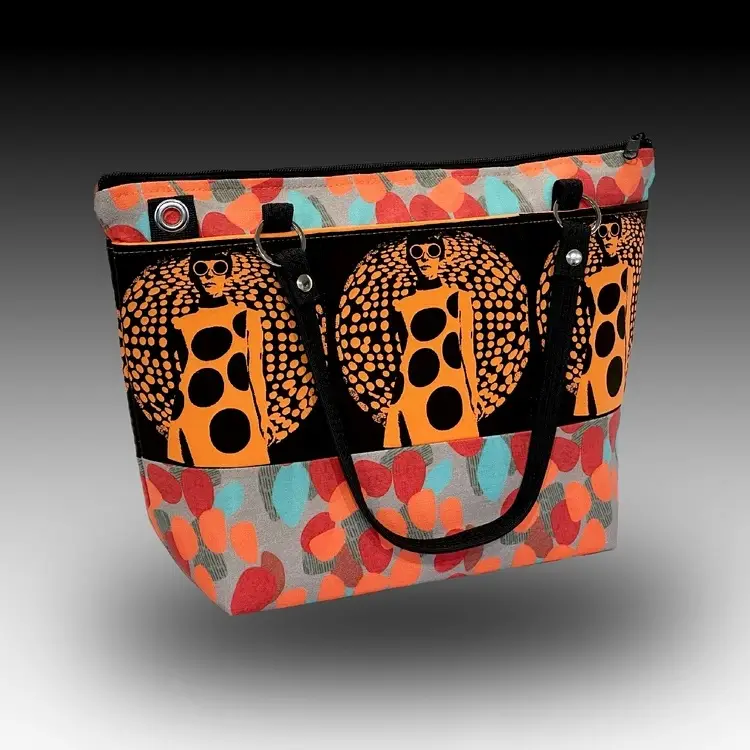
I’ve always loved bold graphics and the visual language of mid-century commercial art. Over time, those interests began coming together, combining my own hand-pulled screen prints with original textile designs and constructing them into handbags and accessories.
What I love about the process is that I get to be involved in nearly every aspect of creating a piece, from the initial artwork and fabric design to pulling the prints and sewing the finished bag. It allows me to combine my love of two-dimensional art with the challenge of making something three-dimensional and functional.
There wasn’t really an aha moment when it all came together. It was more of a natural evolution, one interest leading to another until eventually they all found their way into Urthy Fiber Art. And honestly, I think it’s still evolving.
You have talked about your mother and grandmother and the memories they gave you. How do those memories find their way into your work?
My mother and grandmother are both woven into my work, although in very different ways. My grandmother’s influence is there in the making itself, in my appreciation for textiles, craftsmanship, and the satisfaction of creating something with my hands.
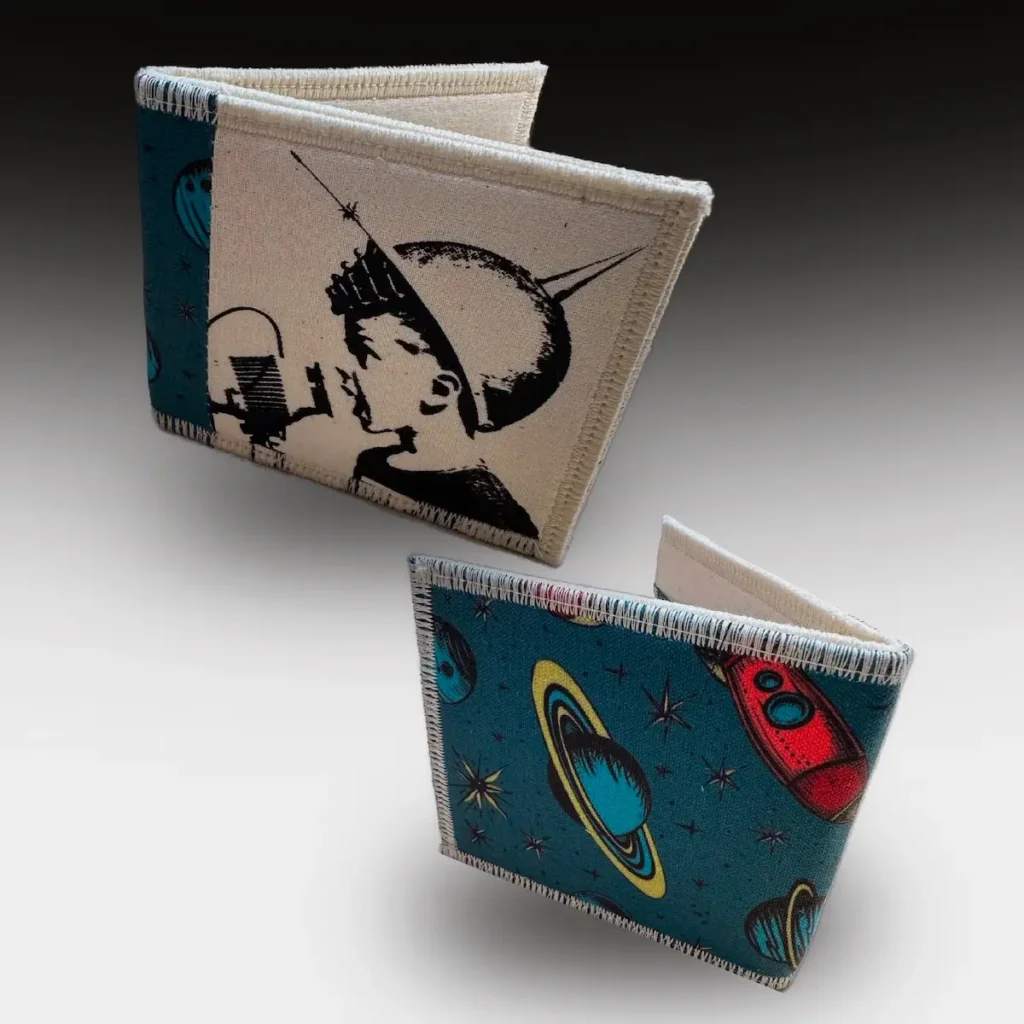
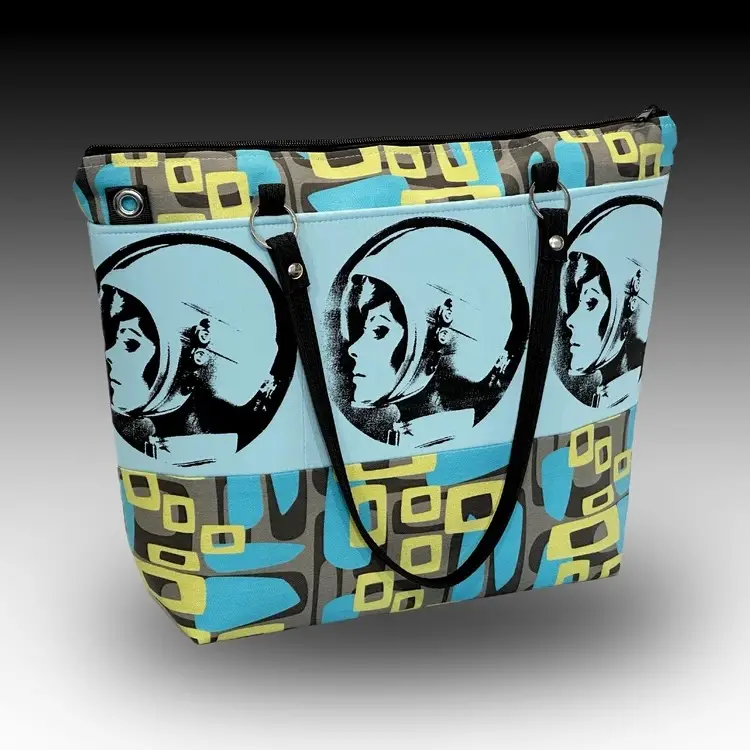
My mother’s influence found its way into a piece I created called The Space She Left. It’s a portrait of my mother reimagined as an astronaut, combining my love of retro space-age imagery with something deeply personal. The title has a double meaning, referring both to the space explorer in the image and the space her absence has left in my life.
It’s a departure from the playful imagery people generally associate with my work, but it still speaks the same visual language. I was especially honored when The Space She Left was selected for publication in Fiber Art Now magazine.
I think that’s one of the wonderful things about making art. Memories, experiences, and emotions have a way of finding their way into what we create, sometimes without us even realizing it. My work is often colorful, nostalgic, and a little humorous, but occasionally there’s something much more personal beneath the surface.
When you find an old photograph, do you imagine the person’s story? How much of that imagined story becomes part of your artwork?
Oh, without a doubt! I’m fascinated by old photographs, especially those forgotten snapshots you might find in a box at a flea market. I can’t help wondering who these people were, what their lives were like, and what stories they might have to tell.
I love the idea of taking someone who has been forgotten by time and giving them a newfound relevance through my artwork. I create my own stories around these images, building a visual language through hand-drawn elements and digital collage. Sometimes the story is humorous, sometimes a little absurd, and occasionally something more thought-provoking.
I’m not necessarily interested in recreating their actual history. I’m more interested in the possibilities of who they could become. There’s something wonderfully satisfying about taking an image from the past and giving it an entirely new life in the present.
Your work has a playful, nostalgic quality, but there is often something a little unexpected hiding in the imagery. What do you hope people feel when they discover one of your pieces?
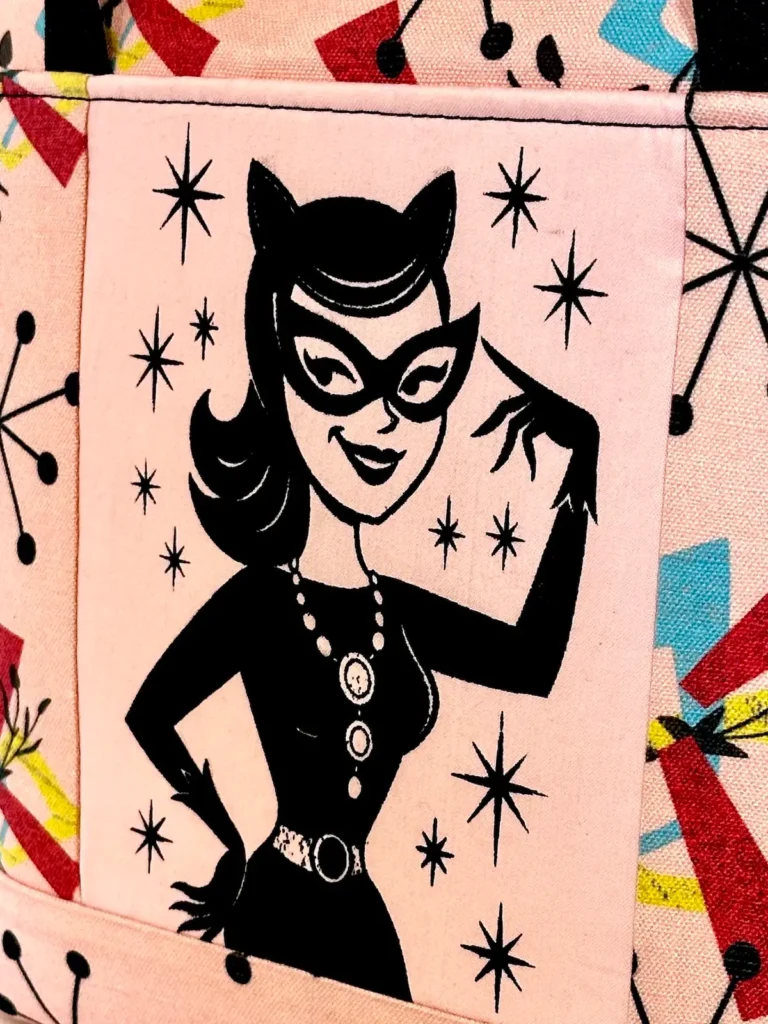
First and foremost, I hope it makes them smile! I love watching people discover my work, especially when something in the imagery catches them off guard. There’s often a moment when they look a little closer, notice an unexpected detail, and suddenly the whole image takes on a different meaning.
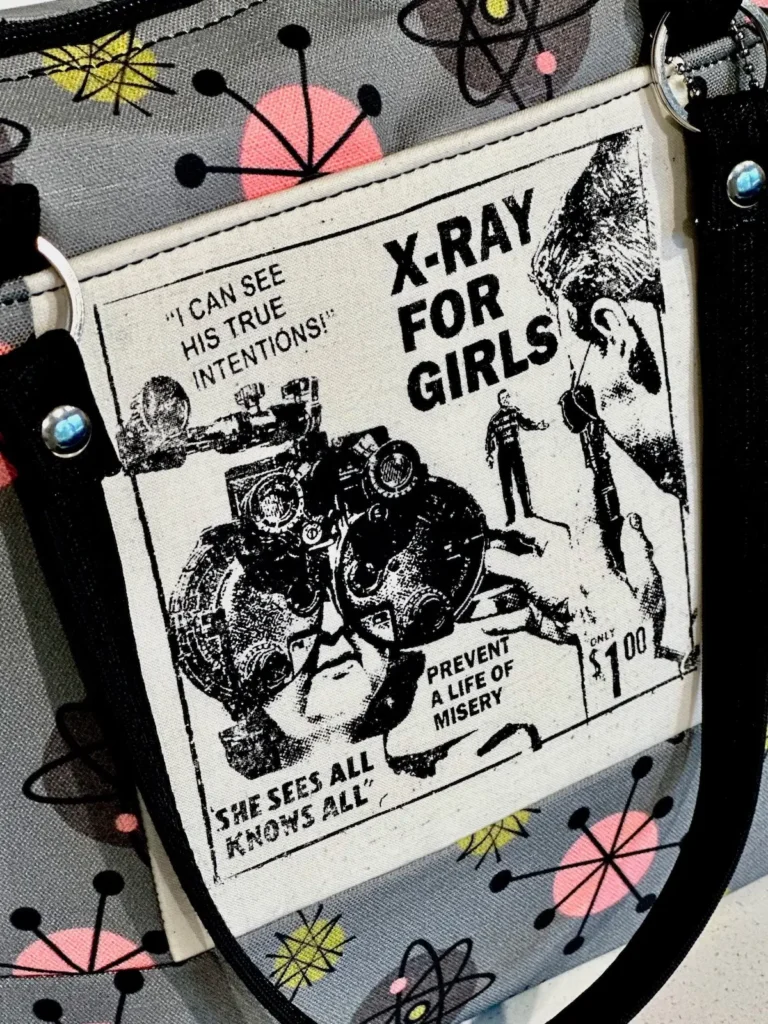
I’m drawn to the optimism, humor, and sometimes wonderfully absurd visual language of mid-century advertising and popular culture. I enjoy taking those familiar images and giving them an unexpected twist. A little nostalgia, a little humor, and occasionally a bit of irreverence.
I don’t necessarily want people to take my work too seriously, but I do hope they’ll take a second look. If someone walks away smiling, laughing, or thinking about something they hadn’t noticed at first, then I’ve accomplished what I set out to do. Life is too short to carry a boring bag!
Describe your creative space.
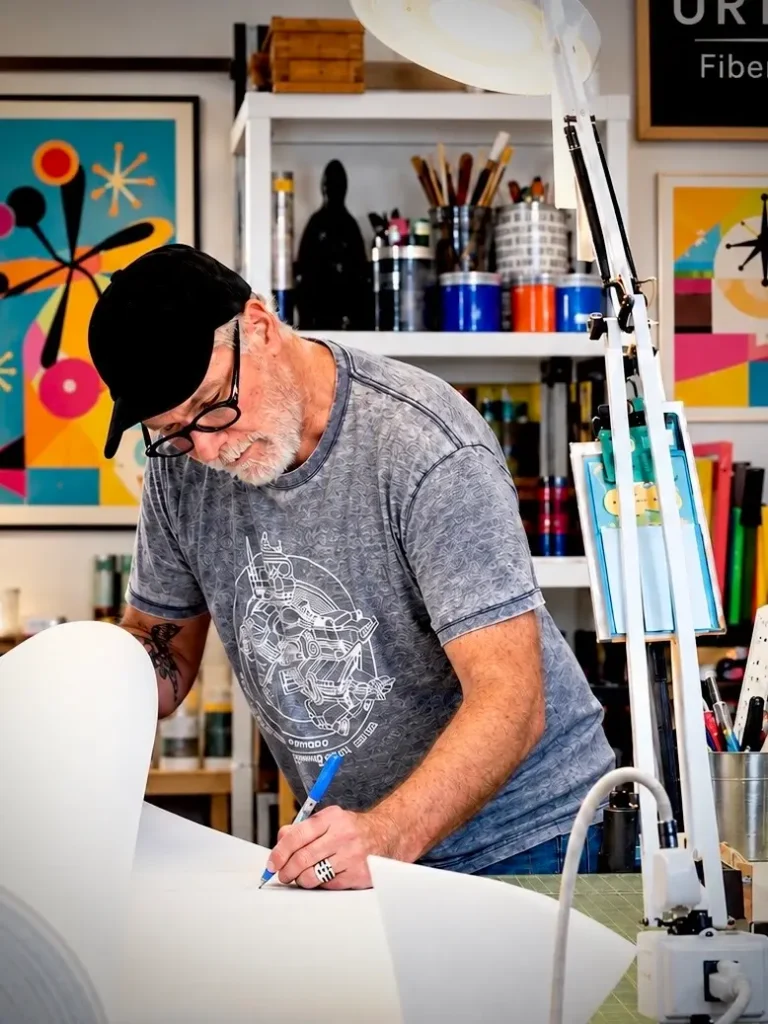
Organized chaos! My creative space is filled with things that inspire me, from vintage toys and 1950s lamps with fiberglass shades to artwork I’ve collected from artist friends over the years. It’s a wonderful jumble of color, nostalgia, and interesting objects, all sharing space with my sewing machines, screen-printing equipment, fabrics, and whatever project I happen to be working on.
I love being surrounded by things that have personality and history. Sometimes inspiration comes from the most unexpected places, a color combination on an old toy, the shape of a vintage lamp, or a piece of artwork hanging on the wall.
It might look a little chaotic to someone else, but to me it’s a space filled with possibilities. And I usually know where everything is. Usually!
What does a typical day in your studio look like? Is there such a thing as a typical day?
I’m not sure there is such a thing as a typical day! One day I might be sitting at my drawing table developing a new design, the next I’m pulling prints in the screen-printing area, and the day after that I’m spending hours behind one of my industrial sewing machines constructing handbags.
Of course, there’s also the less glamorous side of being a working artist: answering emails, updating my website, photographing work, managing inventory, and preparing for the next art fair. Sometimes I feel like I wear about a dozen different hats!
I do love the variety, though. I can move from designing something on my iPad to printing it on fabric and eventually turning it into a finished piece. There’s always something different demanding my attention, and honestly, I think I’d get bored if every day looked the same.
You work on vintage sewing machines. What do you love about sewing on an older machine rather than a newer one?
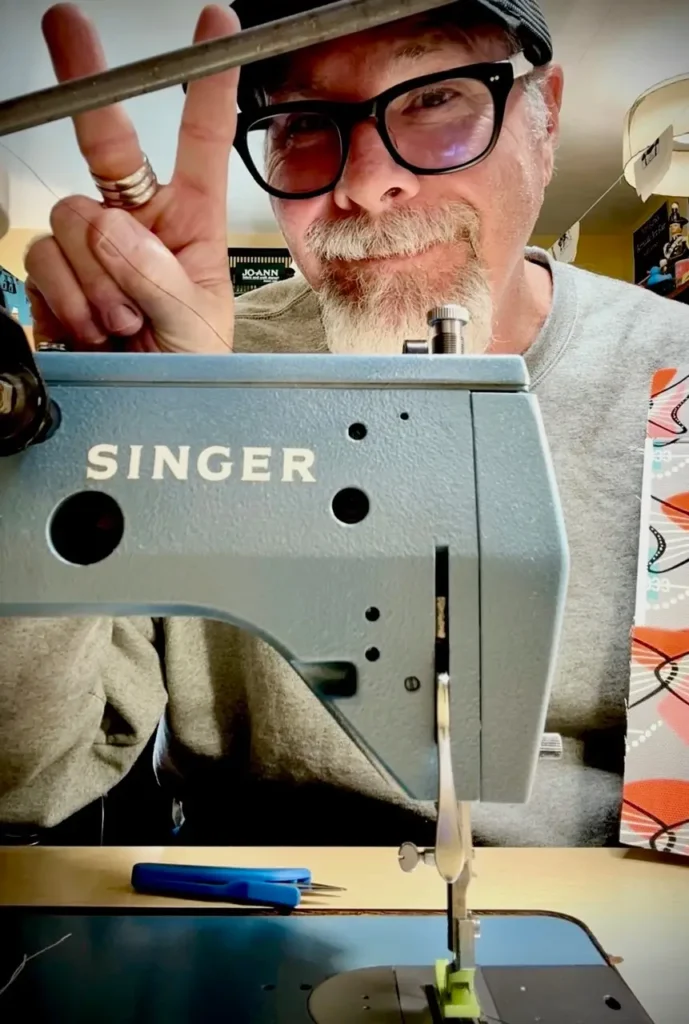
I have a real affection for old sewing machines, particularly vintage industrial machines. They’re beautifully engineered, incredibly durable, and were built to do a job and do it well. There’s something very satisfying about working with a machine that’s been sewing for decades and still performs beautifully.
My workhorses are vintage industrial Singers, including my beloved 20U, which I’ve affectionately named Wildfire, and my Singer 17-41 cylinder arm machine. The cylinder arm is particularly useful for constructing handbags because it allows me to maneuver three-dimensional pieces around the narrow sewing surface. I love the mechanical simplicity of these older machines. No computerized screens or complicated electronics, just beautifully engineered machinery doing exactly what it was designed to do.
I also appreciate that these machines are serviceable and repairable. Rather than replacing an entire machine when something goes wrong, you can often repair or adjust it and keep right on sewing. I suppose that appeals to the part of me that values craftsmanship and objects made to last.
And frankly, I just love the sound and feel of an old industrial sewing machine running. There’s nothing quite like it!
You combine screen printing with sewing and textile design. Which usually comes first: the image, the fabric, the shape of the bag, or something else?
At my foundation, I’m a graphic artist, so everything begins with a piece of digital artwork. That’s where I explore imagery, color, composition, and pattern. From there, the artwork eventually becomes either a hand-pulled screen print or an original textile design.
The real fun begins when I start bringing those elements together. I consider how a particular screen print interacts with a fabric design, how the colors and patterns complement one another, and how that combination might work on a particular handbag shape.
Ultimately, it’s the relationship between the screen print and the textile design that determines the finished piece. I don’t necessarily begin with a handbag in mind. I begin with the artwork and let it lead me toward what the finished piece will become.
Can you walk us through how an idea becomes one of your finished pieces? Start with the first little spark and take us all the way to the finished work.
Inspiration can come from just about anywhere. It might be an old photograph, a piece of vintage advertising, an interesting shape, or an unexpected combination of colors. Sometimes an idea has been rattling around in my head for weeks before I finally sit down and do something with it.
I begin developing the artwork digitally, often combining hand-drawn elements with digital collage. There’s a lot of experimentation at this stage, moving things around, adjusting colors, adding or removing elements until the composition feels right. Some ideas come together quickly, while others require quite a bit of wrestling!
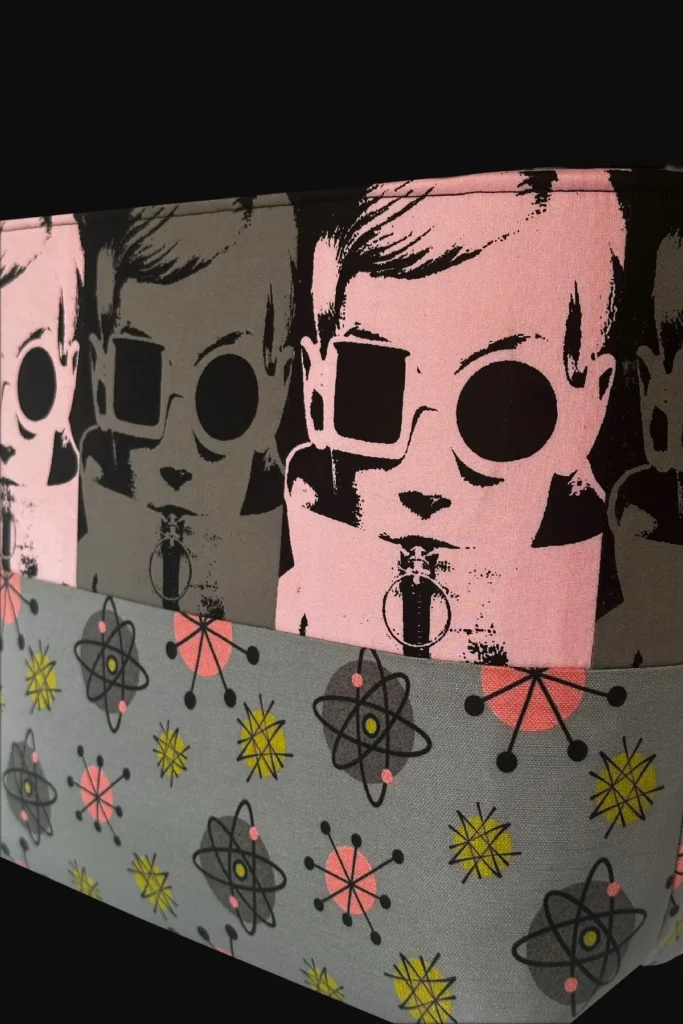
Once I’m happy with the artwork, I decide whether it will become a screen print or a repeating textile design. For screen printing, I create a stencil using photo emulsion, expose the screen, and hand-pull the image onto fabric. My textile designs are digitally printed onto cotton fabric.
Then comes one of my favorite parts, bringing the two together. I experiment with different combinations of prints, patterns, and colors until I find a pairing that really works. That combination helps determine which handbag shape will best showcase the artwork.
From there, it’s time to construct the bag. I cut the fabric and structural materials, build the body of the bag, and sew everything together on my vintage industrial sewing machines. There’s quite a bit of engineering involved in making a handbag that not only looks interesting but is sturdy, functional, and comfortable to carry.
Finally, there’s that wonderful moment when I step back and look at the finished piece. Something that began as a little spark of an idea has become a tangible object that someone can actually use and enjoy. That’s still pretty exciting to me, no matter how many times I’ve done it.
How do you know when an idea is worth following? Do you ever have to let an idea sit for a while before you understand what it wants to become?
Usually, I know an idea is worth pursuing when I can’t stop thinking about it. It keeps popping into my head, and I find myself imagining different ways to develop it. That kind of curiosity is generally a pretty good indication that there’s something worth exploring.
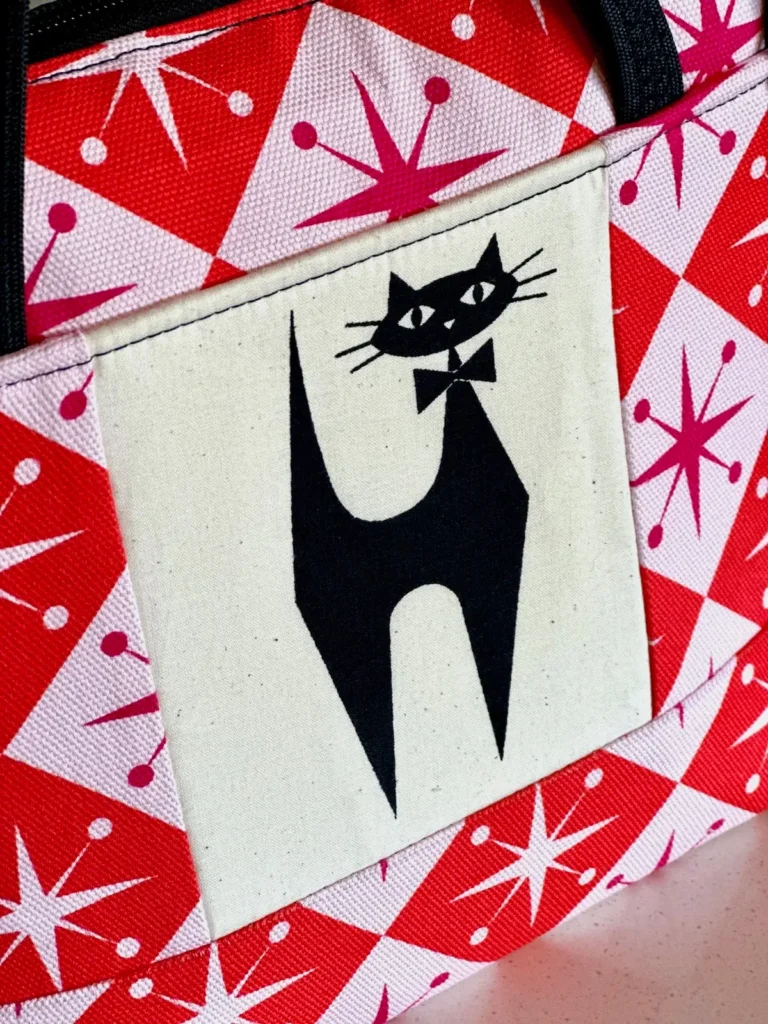
But not every idea is a winner! My recent textile collections, Atomic Pop and Mod Voltage, are perfect examples. Both involved countless hours of experimenting with color, composition, scale, and pattern. There were designs I thought would be wonderful that simply didn’t work once I began developing them. Some went through multiple revisions, while others ended up on the cutting room floor.
Sometimes I’ll set an idea aside and return to it weeks or even months later with a fresh perspective. Other times, I have to admit it was a better idea in my head than it was in reality.
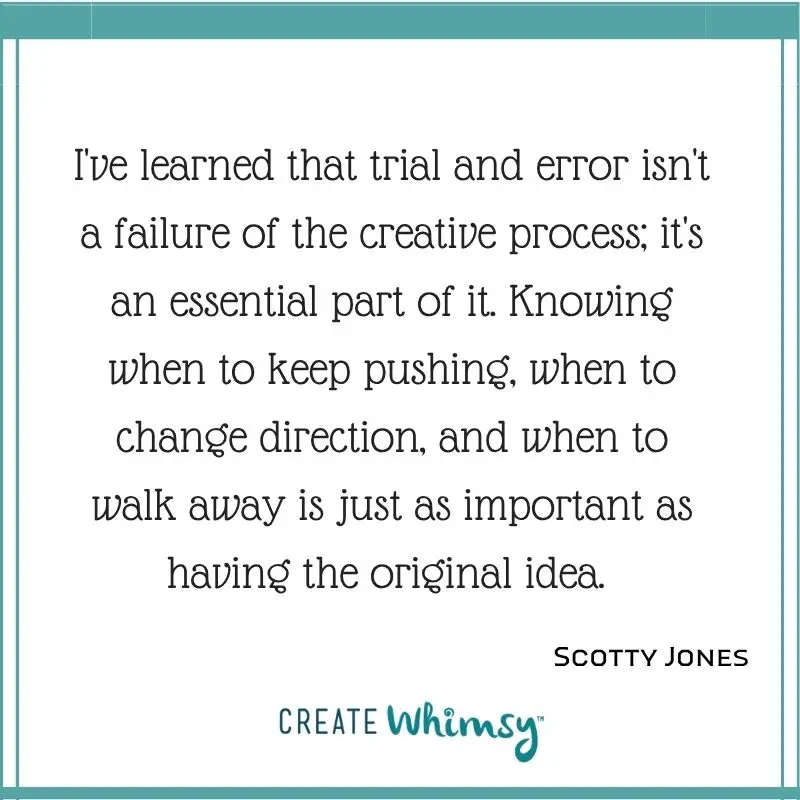
I’ve learned that trial and error isn’t a failure of the creative process; it’s an essential part of it. Knowing when to keep pushing, when to change direction, and when to walk away is just as important as having the original idea.
How has your creative process changed as you have gained experience? Are you more willing to take risks now?
Absolutely! If anything, I think I’ve become more willing to take creative risks as I’ve grown older and gained experience. I’ve learned that just because something works doesn’t mean you should keep doing it forever. I often think about Frida Kahlo’s words about how everything moves, changes, and eventually floats away. Nothing stays the same, and I don’t believe our creative work should either.
In fact, I’m in the middle of one of the biggest creative shifts of my career. This February, I’ll be debuting an entirely new look for Urthy Fiber Art at American Craft Made in Baltimore. I’m stepping away from designs and approaches that have served me well for years in favor of something bolder, more vibrant, and creatively challenging.
It’s a little terrifying to abandon what you know works, but it’s also incredibly exciting. My artistic voice is still very much there, just expressed in a whole new way. I’m not interested in reinventing myself so much as pushing myself forward.
I think the greatest risk an artist can take is becoming too comfortable. I’d much rather take a chance on something new than spend the rest of my creative life repeating myself.
You have spent many years traveling the art-fair circuit. What have you learned about being an artist from meeting the people who buy and live with your work?
One of the greatest rewards of traveling the art-fair circuit is meeting the people who connect with my work. My designs often evoke memories or a sense of nostalgia. Someone might recognize an image that reminds them of their childhood, their grandmother’s kitchen, or something they haven’t thought about in decades. I love hearing those stories.
At its heart, my work is happy work. It’s colorful, playful, and meant to bring a little joy into everyday life. There’s something wonderful about watching a person’s face light up when they discover a piece that speaks to them, especially when it brings back a happy memory.
I’ve learned that once a piece of art leaves my studio, it takes on a life of its own. The person who buys it brings their own memories, experiences, and interpretations to it. Something that began as my creative expression becomes part of someone else’s story.
And I think that’s one of the most meaningful things I’ve learned from all those years on the road. Art doesn’t have to be serious or complicated to make a genuine connection with someone. Sometimes making somebody smile is more than enough.
What advice would you give to someone who has an idea for a creative business but is afraid to call themselves an artist or maker?
First of all, don’t wait for someone else to give you permission to call yourself an artist. If you’re creating something that comes from your own imagination, you’re already doing the work. You don’t need a degree, a fancy studio, or a long list of accomplishments to justify it.
I’m largely self-taught, and I’ve learned an enormous amount simply by trying things, making mistakes, and figuring out how to do them better the next time. You have to be willing to make some pretty terrible things along the way. That’s how you learn!
If you’re thinking about turning your creativity into a business, start small, but take yourself and your work seriously. Learn the business side, understand the value of your time, and don’t be afraid to put your work out into the world. Not everyone is going to love what you make, and that’s perfectly fine. You’re not making it for everyone.
Most importantly, don’t let fear keep you from finding out what you’re capable of. I started out selling macramé plant hangers on my grandmother’s front porch, and look where that led!
Rapid-Fire Fun
- Favorite color to work with? Orange!
- Favorite vintage find? A vintage fiberglass lampshade.
- Favorite sewing machine? My Singer 20U, affectionately named Wildfire.
- A song that belongs in your studio? “Wig Wag” by Club des Belugas.
- What is one word you hope people use when they describe your work? Joyful.
- What’s bringing you joy today?
- Right now, it’s the excitement of exploring new creative possibilities. I’m working on an entirely new body of work, experimenting with bold colors, patterns, and ideas that are pushing me outside my comfort zone. There’s something incredibly energizing about not knowing exactly where an idea will take you.
- I’m finding a lot of joy in the creative process itself, in the experimenting, the discoveries, and even the occasional spectacular failure! After all these years, I still get excited when something I’ve imagined begins to come together.
- And perhaps that’s what brings me the most joy: knowing that there’s still so much I want to make, so much I want to learn, and so many creative adventures ahead of me.
Scotty’s website: https://www.urthyfiberart.com/#/
Follow Scotty on Instagram: https://www.instagram.com/scottyjones_urthyfiberart/
Interview posted October 2026
Explore more bag projects and inspiration on Create Whimsy.