
From the Renaissance streets of Urbino, Italy, to colorful beaded sculptures, Maracole Bijoux has always loved trying new ways to make art. Her jewelry is playful, bold, and full of personality, turning tiny beads into wearable works of art. With a love of color, unexpected ideas, and a willingness to “fail forward,” Maracole continues to explore where her creativity will take her next.
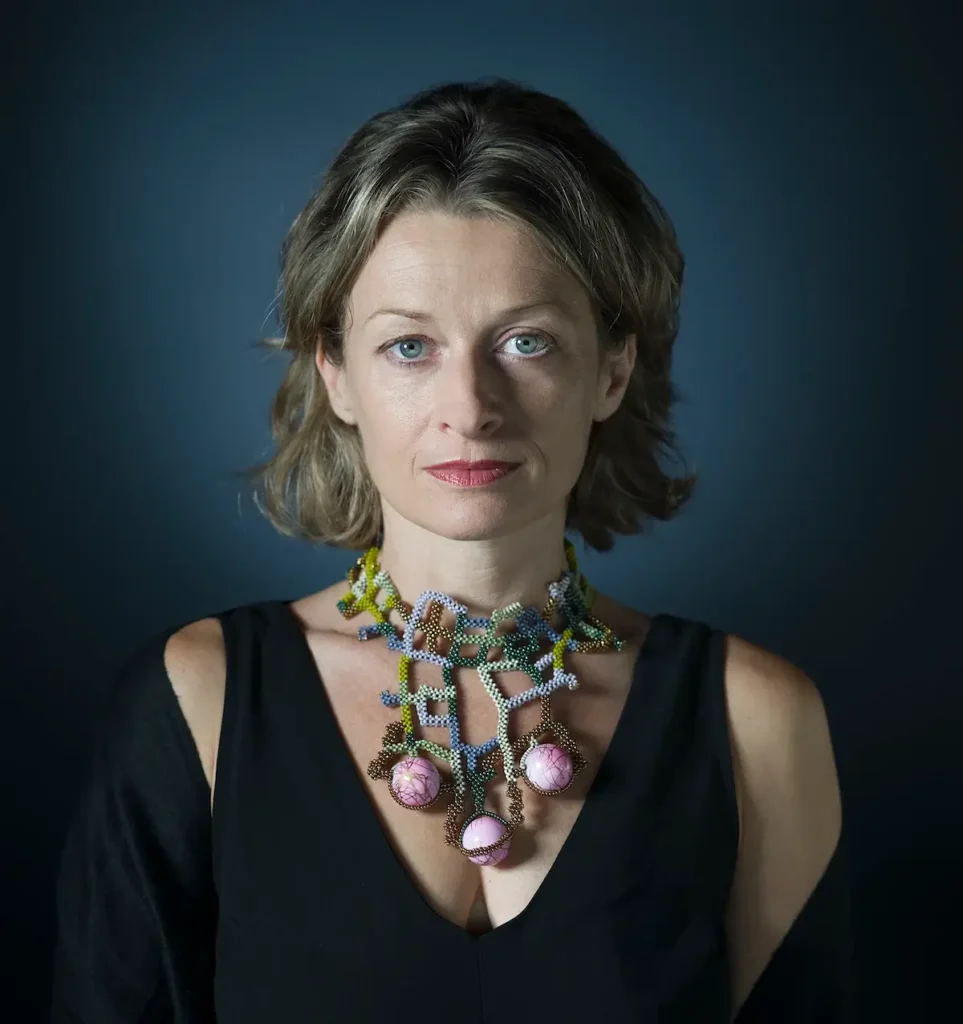
You grew up in Urbino, Italy, surrounded by Renaissance art. What do you remember most about growing up there, and how has it shaped you as an artist?
It was marvelous, I had the best childhood (I am Gen X) and even as an adolescent I have never ceased to experiment with new artistic techniques.
My mom was very supportive of my artistic education, and she had me take classes of all sorts, from mask making by Venetian artisans, to egg tempera painting, to sculpting clay and illustrating with ink.
In college, I took also book binding, which is quite unusual these days. I was lucky enough to be able to study at “Scuola Del Libro”, a renowned art institute specialized in drawing, animation and illustration for children’s books. Our classes were held inside the Ancient Palace of the Duke of Montefeltro. We were the last class that benefited from that; they later on relocated the institute to a safer and newer facility.
As an Amazon Associate I earn from qualifying purchases. Read more about our affiliate linking policy.
I truly loved those years. Watching the slopes from the window of the high tower, sunsets and seasons succeeding… We had snow in winter, still at the time. It was just magical. A little bit like Hogwarts for Harry Potter and friends, I suppose.
As I relocated to Rome years later, to work in children entertainment, I had the chance to hang out with top illustrators and writers of comic books, and at the time it was like being part of a secret club. Aww, I do miss that time, now that everything has turned fast speed and AI. But this is another story.
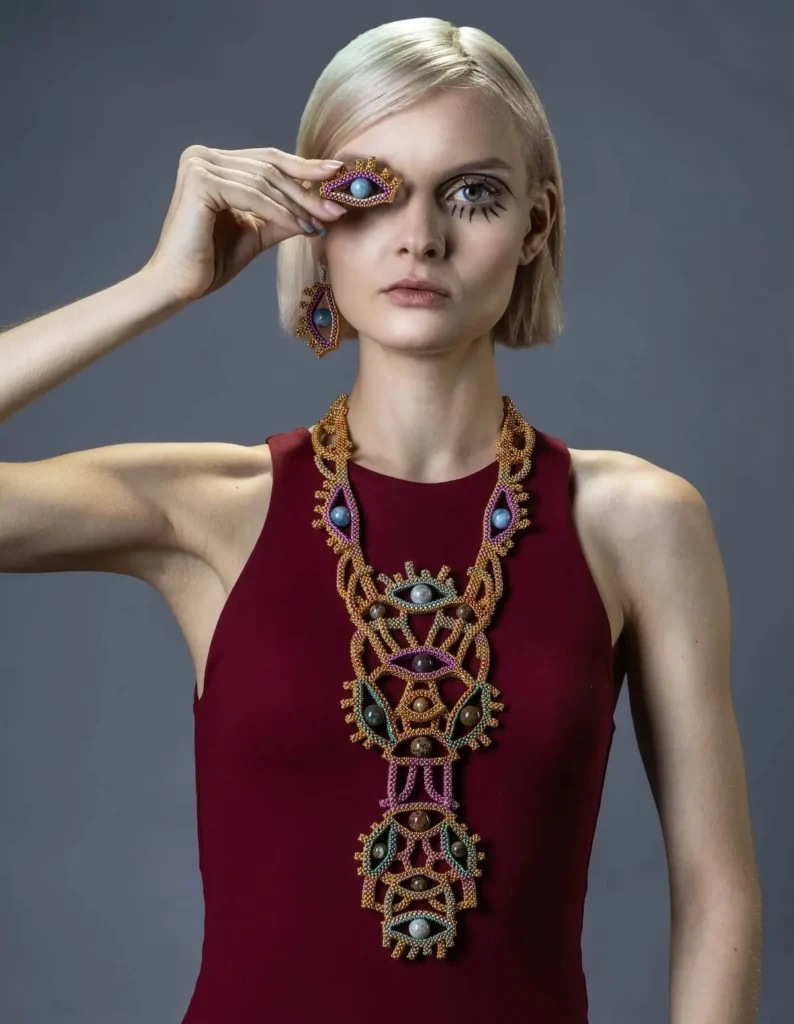
Before jewelry, you studied animation and game design. What lessons from those creative worlds still show up in your work today?
The first thing that comes to mind is the ability to keep on schedule.
As an animator, you learn how to adapt your creative pace to a pipeline and how to make fast decisions, and, in general, translate creativity into productivity.
I have learned how to remain focused and deliver a finished product by a certain date. It is about structure, something that many creatives struggle with (at least, this is what I’ve heard).
The other thing that is obvious is how my background in animation and children’s entertainment has forged my aesthetics. My work is informed with whimsicality and humor, in shapes, colors, and in the proportions of the elements.
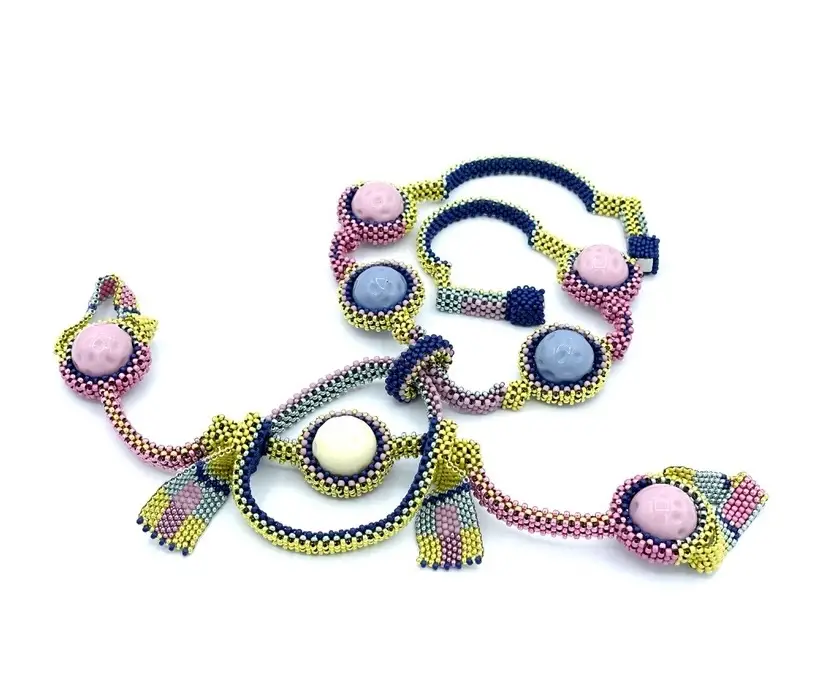
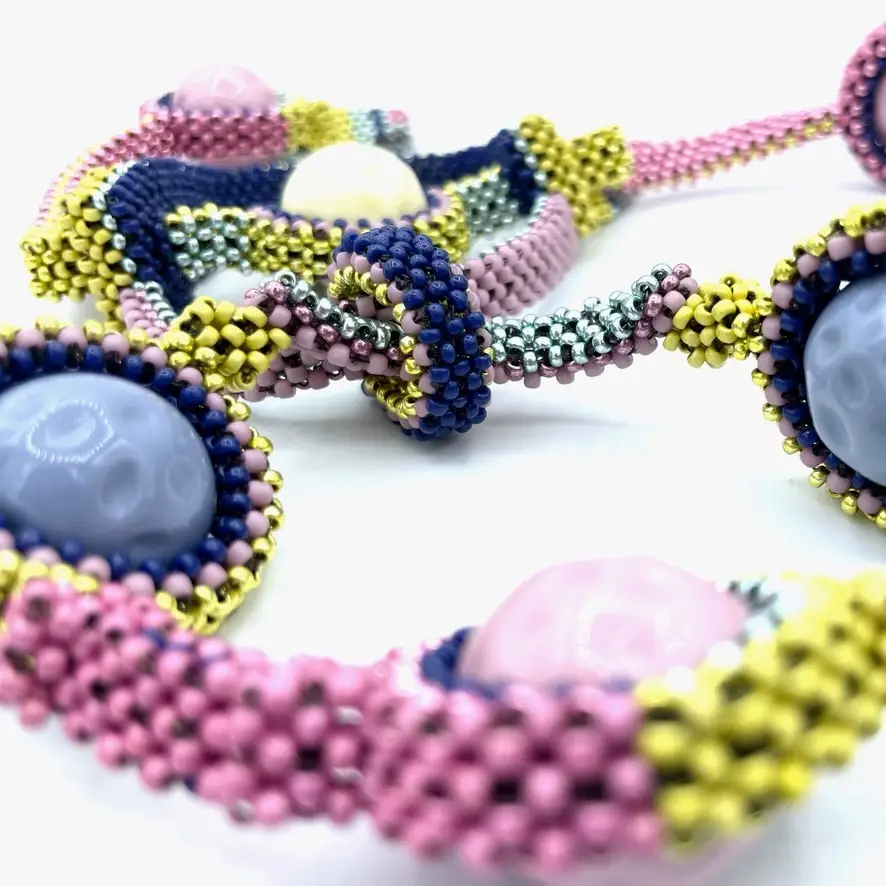
You have explored many kinds of art over the years. What keeps pulling you back to wearable art?
Well, I have always wanted to be a painter, a pop surrealist painter. But I am not good at it, or at least I don’t think my margin for improvement could be considerable enough to become as good as I would like to be. Who knows, maybe one day.
I have always loved creating three-dimensional work. Even in animation, I have always loved puppet animation and stop motion more than the traditional technique with drawings.
When it comes to art making, I have been exploring ceramics and textile sculptures as a form of three-dimensional art. From textiles, I moved on to wearable art for a second, and I explored hat-making. I was posing with my work, and as an art model, I have always enjoyed creating memorable costumed characters with my wearables.
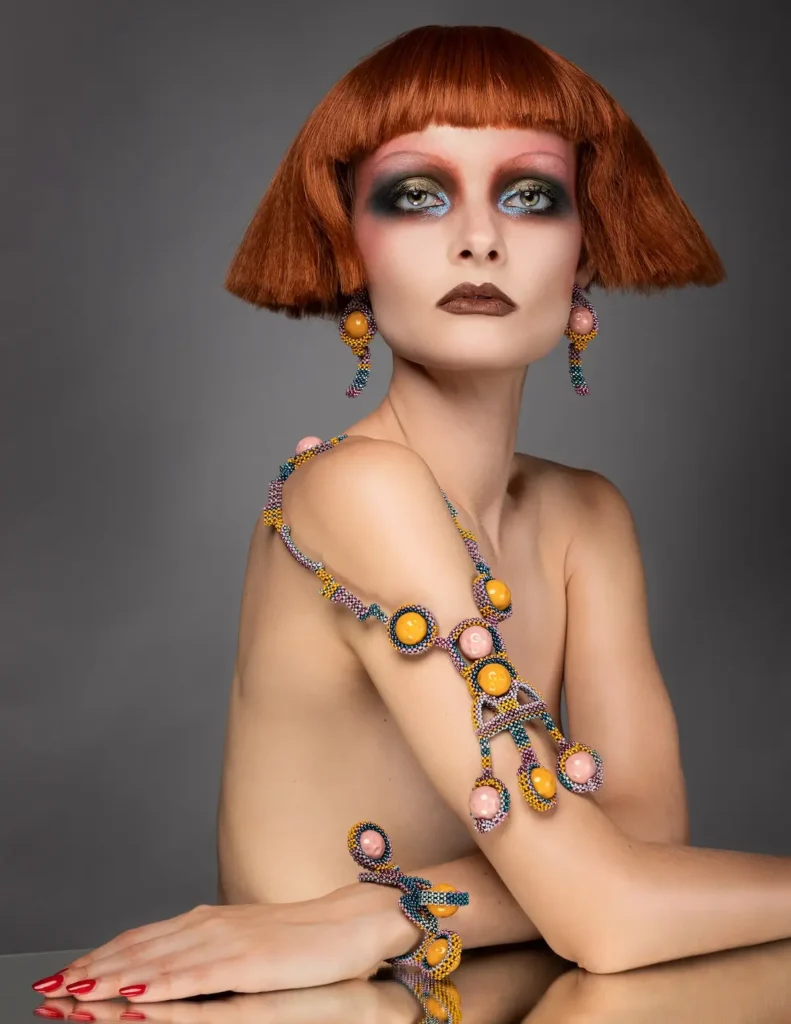
When I discovered seed beads, back in 2018, I was fascinated by how a minuscule dimensional object could be woven with other minuscule objects to become something large and volumetric, like a flexible sculpture. I would like, in fact to explore pretty soon, beaded sculptures and other ways to apply beads to large surfaces, to make works of art that are not necessarily wearable.
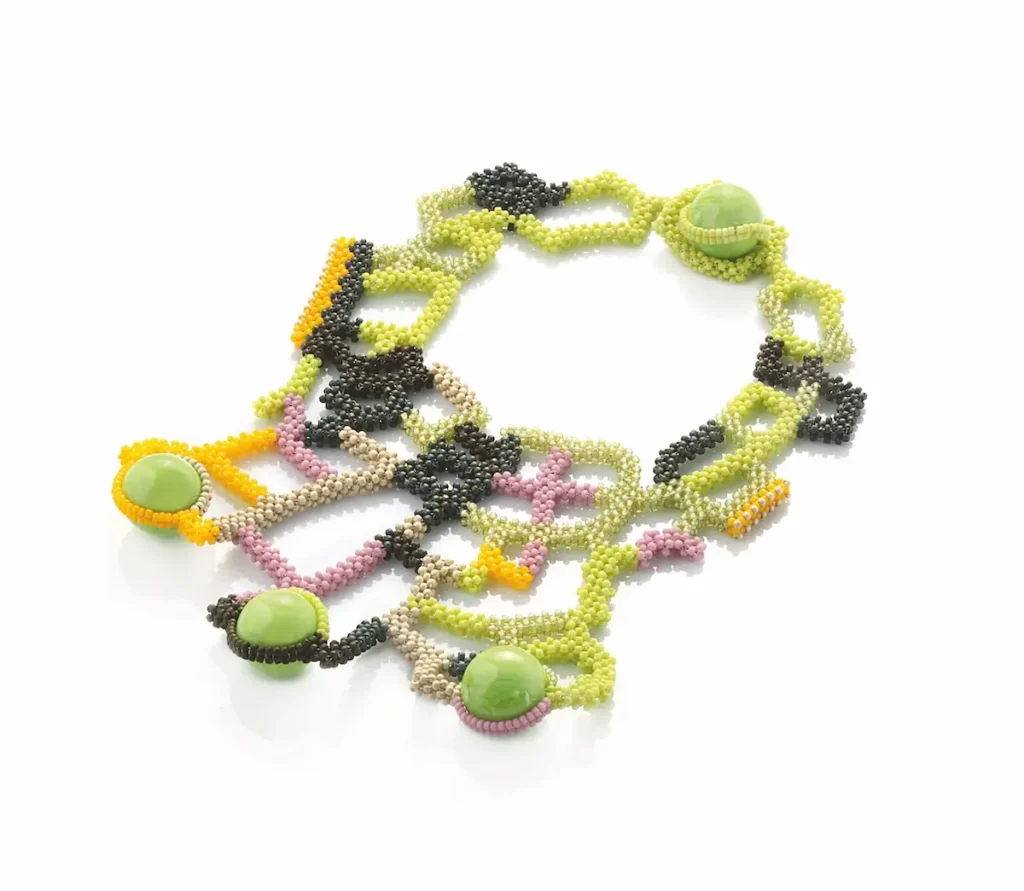
Your work often feels like tiny pieces of modern art. When did you begin thinking of jewelry as wearable sculpture?
Initially I was not even thinking at making wearables. I liked the texture and the colors, and I started with ropes.
Then I realized that a rope is called a “lariat”, and I started selling my beaded ropes as lariat necklaces. I naturally evolved from that simple form to more complex and larger pieces, and the fact that people love to wear jewelry made it easier for me to become a jewelry maker rather than a sculptor.
It was not necessarily intended in the first place: I went with the flow, so to speak.
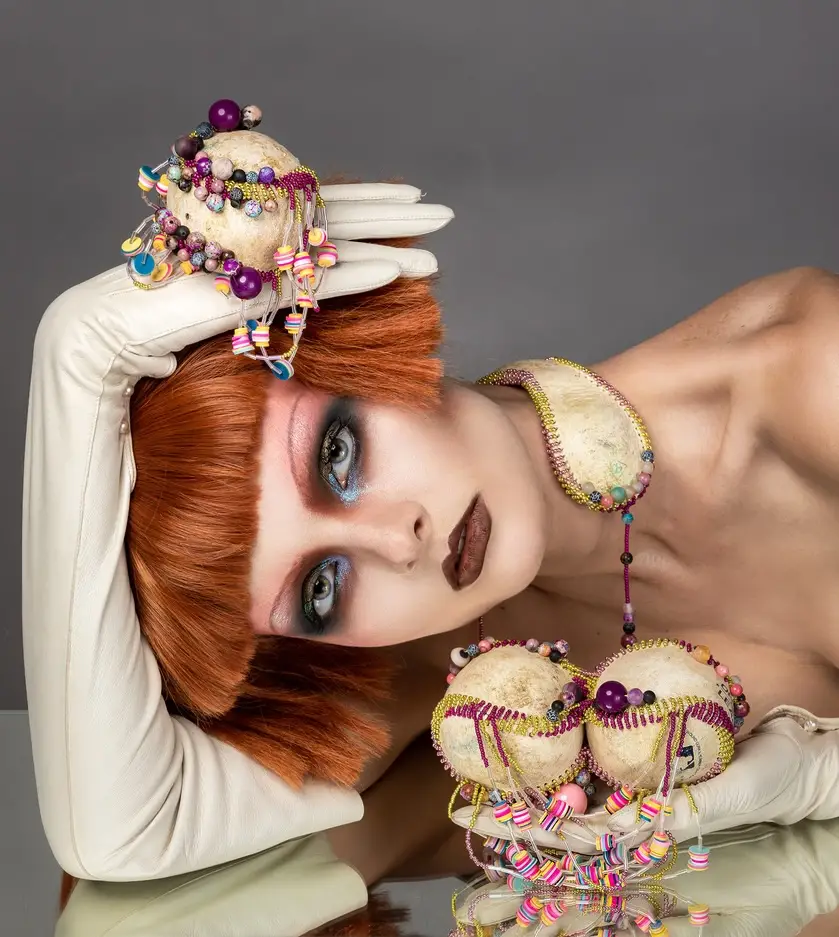
How has your work changed over the years?
I went from sheer experimentation to building a jewelry line.
This process implied the identification of a narrative and a vocabulary that made my work identifiable. At first, I eliminated not necessary embellishments and generated simple lines. I reduced my stitches to one and one only, Cubic Right Angle Weave, to give my work the look of a paper cutout.
Spheres and playful shapes are part of my vocabulary from the beginning, as well as bright colors and stripes, but lately I went bigger.
My latest design, “Creaturo” doll collection, is an ongoing project that might take on a completely different level. I hope I will have time to introduce new elements in my work, such as more playful elements like LEGO bricks and polymeric clay beads that I make myself.
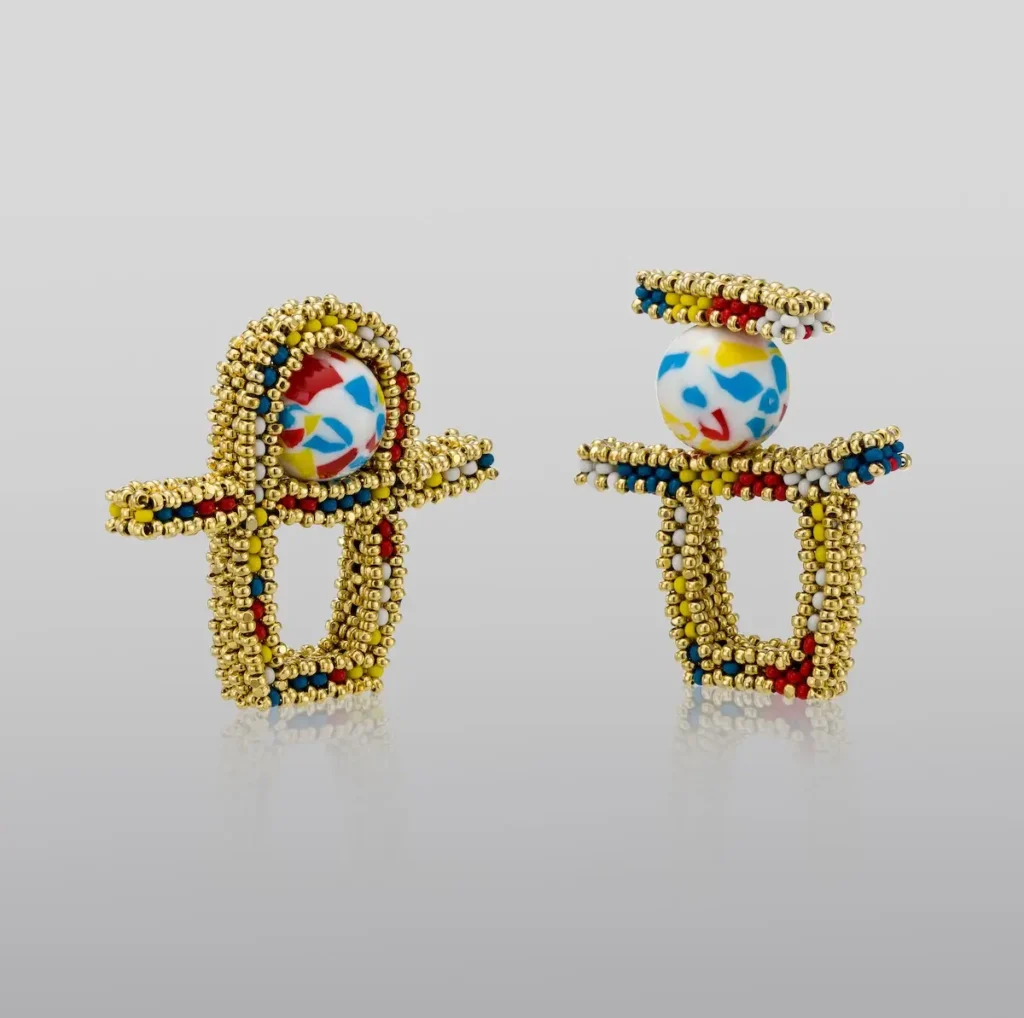
Where do your best ideas usually begin?
Sometimes is a sketch, a vision. Other times it’s something that I see in a gallery or a museum, and ignites a desire to make something similar, with beads.
I used to have vivid dreams about beaded pieces that were so magical and elaborate that I could not even sketch them in the morning. Would have been very nice if I could have translated those visions into physical objects.
How do color, shape, and texture work together when you’re designing a new collection? Is inspiration something you go looking for, or does it tend to surprise you?
Inspiration is always surprising. And it surprises me. It comes from nowhere, and when it comes, I feel reconnected to my divine nature.
Sometimes inspiration comes with a beautiful, unexpected gift, a sign to unravel, a dream, or something a person says. It’s that moment when the idea “clicks” that is pure magic.
I am a total Carl Jung enthusiast, so everything connected to the subconscious mind fascinates me.
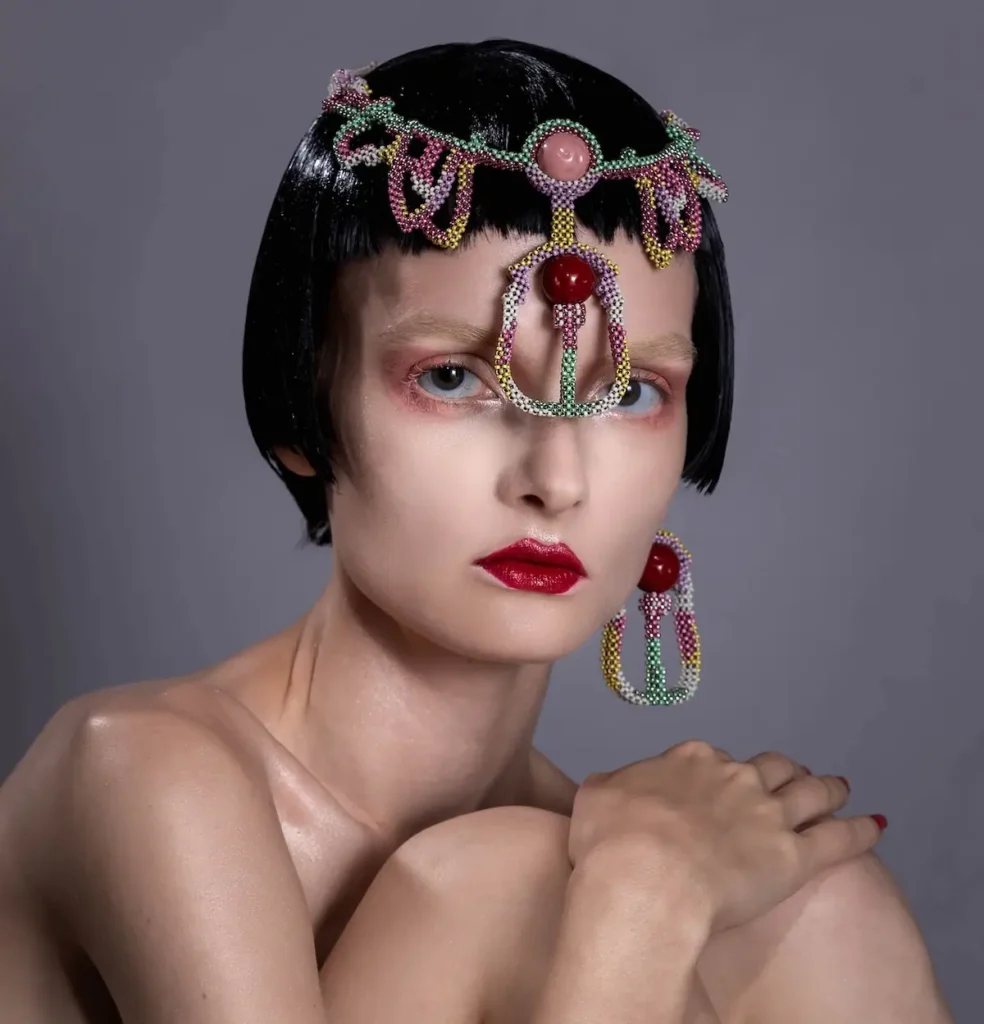
When you’re beginning a new collection, where do you start?
I always start from the focal beads. I see something that grabs me, and then I decide on the color palette and texture of the seed beads. The shape comes only at the end.
Do you sketch first, build with your hands, or let the materials lead the way?
I always let the material lead the way.
I never sketch beforehand: I need to know the shape of an idea in order to be able to sketch it. So what happens is that I generate the piece first, and I sketch it later. I have a genuine pleasure in sketching my pieces after I create them.
On the contrary, sometimes I just sketch things that I love to draw and that I find impossible to translate into real objects. In fact, I have pages and pages of beautiful sketches of pieces that will always remain at the stage of ideas. Or pretty illustrations. But I think this has to do with my background in animation and illustration: I just like to sketch things.
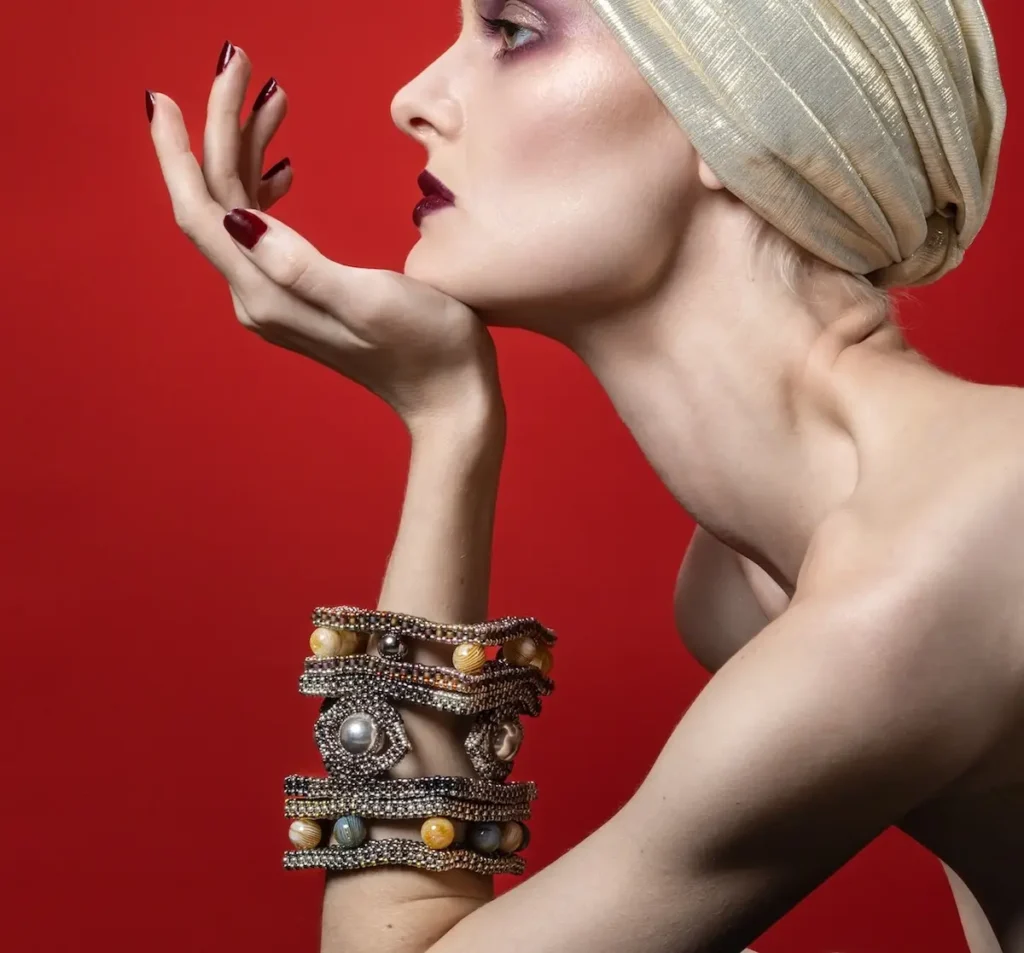
Has a mistake ever led you to discover something even better?
Oh yeah, all the time.
When I was a ceramicist, I learned that it’s fundamental to overcome our fear of re-making a piece, or part of a sculpture. Once one passes that moment of anxiety, or even of pure terror, what comes next is always a discovery. The piece becomes much better, it takes form and life.
The cut of that part was necessary; it was obligatory. As creatives, we need to fail forward; otherwise, the work will remain mediocre, unevolved, or safe, as someone calls it in the art world. You don’t want to create safe works of art!
Your work is collected by museums and shown in galleries, but it is also made to be worn. What does it feel like when someone chooses to wear one of your pieces?
I still have a subdue anxiety when people try on my pieces, for instance at trade shows. I have a bit of an “impostor syndrome”, so I would go like: OMG what if they realize it’s just woven beads? I mean, it’s not sturdy like metal. What are their expectations? Then if they buy it, I am so grateful and I just can’t believe someone else would like to wear one of my creations. I am still truly mesmerized at this fact.
What advice would you give someone who is still searching for their own artistic voice?
Actually, I am still looking for mine, as things evolve and change constantly. One can’t ever stop growing. I would say that the most challenging experience is not to repeat oneself for too long. Trying to express oneself through a specific style and vocabulary, which makes the work recognizable and unique, but at the same time to evolve and explore as much as possible.
What do you hope people feel when they put on one of your pieces?
I hope that they feel happy inside, like I do feel when I accomplish a lovely design.
Where can people see your work?
My website https://maracole.com/ and Instagram https://www.instagram.com/maracole_artwear/
I have an interview and two clips on Beading Globally (YouTube channel) with Valery Hector. One of my necklaces is in the permanent collection at “The Musuem Of Beadwork” in Portland, MA. A brooch of mine is at the “Ilias Lalaounis Jewelry Museum” in Athens, Greece.
Rapid-Fire Fun:
- One material you always reach for? Plastic, (lucite, rubber and industrial resins), as sad as it is.
- A color you never get tired of? Pink.
- One place that always inspires you? The beach, to enjoy my beachcombing.
- Museum or flea market? Museum (I am Italian).
- One word that describes your work? Playful.
Interview posted September 2026
Explore more beading projects and inspiration on Create Whimsy.