
What if you could wear a landscape? Fiber artist Virginia Catherall does just that with her remarkable knitted creations. Inspired by deserts, lakes, mountains, and wildflowers of the American West, she turns yarn into wearable scenes from nature.
From the bright blue sky over the Great Basin to the colorful blooms of Joshua Tree, Virginia’s knitting captures the beauty of the land one stitch at a time. Her work blends art, science, and craft, inviting both viewers and knitters to look at the natural world with fresh eyes.
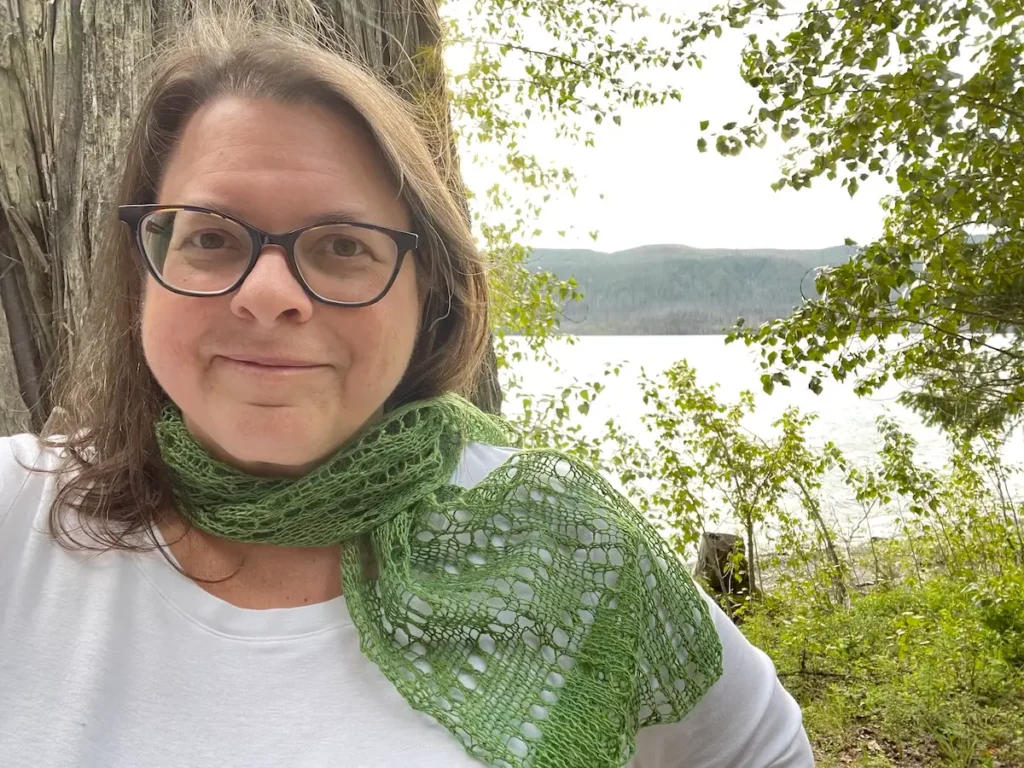
When did you first start making things with yarn?
Like many people, I learned to knit at a young age from my grandmother (for whom I am named). She was an accomplished knitter, knitting her work suits on the Red Car in LA while commuting to work in the 1940s. But, alas, she taught me to knit in the 1970s when everything she made was all chunky polyester and very ugly to my eyes. So I gave it up.
It wasn’t until I was in graduate school in the Bay Area in the 1990s that I taught myself to knit again. I was grinding my teeth from the stress of school, and the doctor told me to take up knitting to help me relax. This time it stuck, I think because the knitting world was so much more diverse and modern; Vogue Knitting was a big influence then. Seeing that knitting could be stylish, I kept with it, but mostly it was because my sister learned again at the same time, and I had an accomplice to help through the early frustrating learning days.
As an Amazon Associate I earn from qualifying purchases. Read more about our affiliate linking policy.
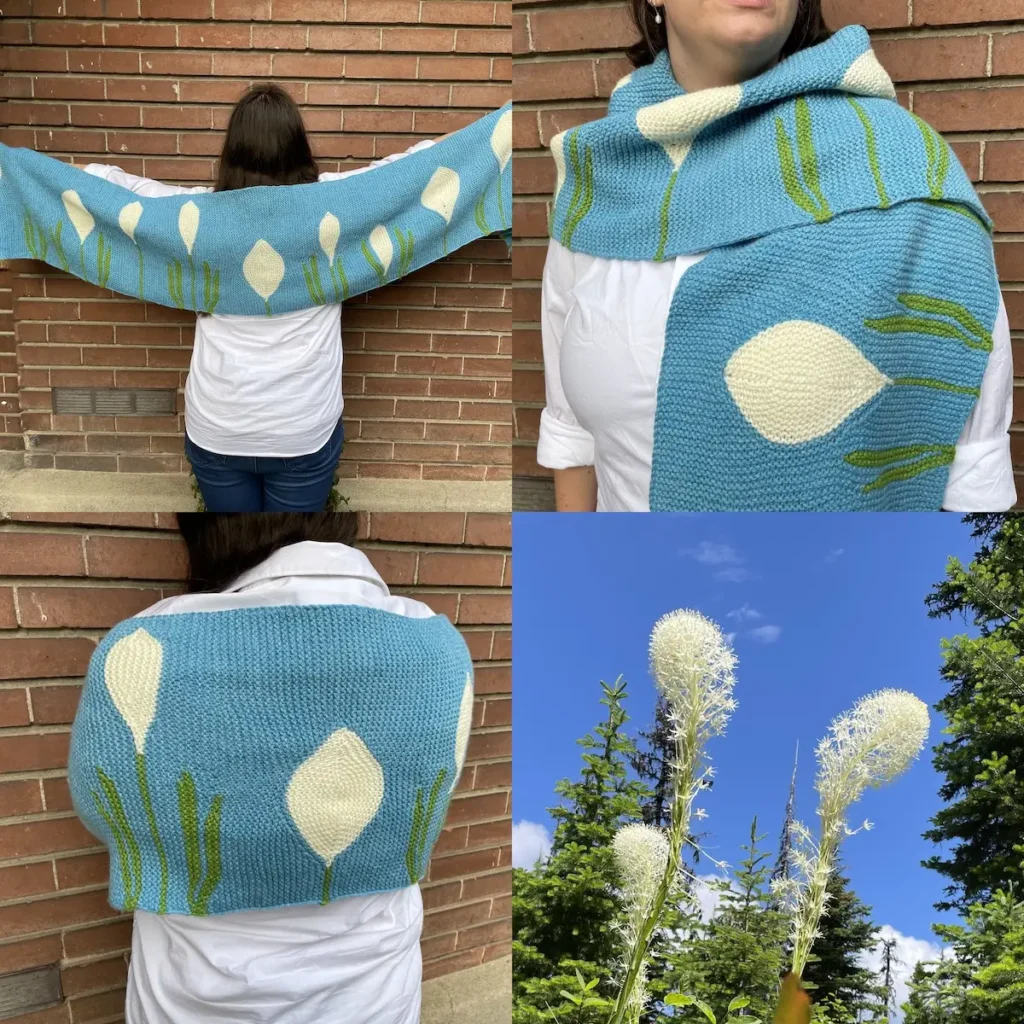
Hand-knit merino wool
Beargrass is prolific in Glacier National Park, where it lines up along meadows, bright white blossoms standing starkly against the blue sky. As a member of the lily family and not actually a grass, beargrass is also known as soap grass, quip-quip, and Indian basket grass, and is a favorite of the bears in the park who use it to line their dens (but don’t eat it). Remember that picking flowers in Glacier National Park is prohibited! This artwork and pattern was produced as Artist-in-Residence at Glacier National Park.
Was there a moment when knitting shifted from “something fun” to “something important”?
I knit a lot of scarves, mittens, socks, and baby sweaters after I learned to knit in graduate school. I became an expert knitter of other people’s patterns. I felt confident in being able to envision what knitting would look like from patterns. But I did not knit my own designs. All that changed in 2011.
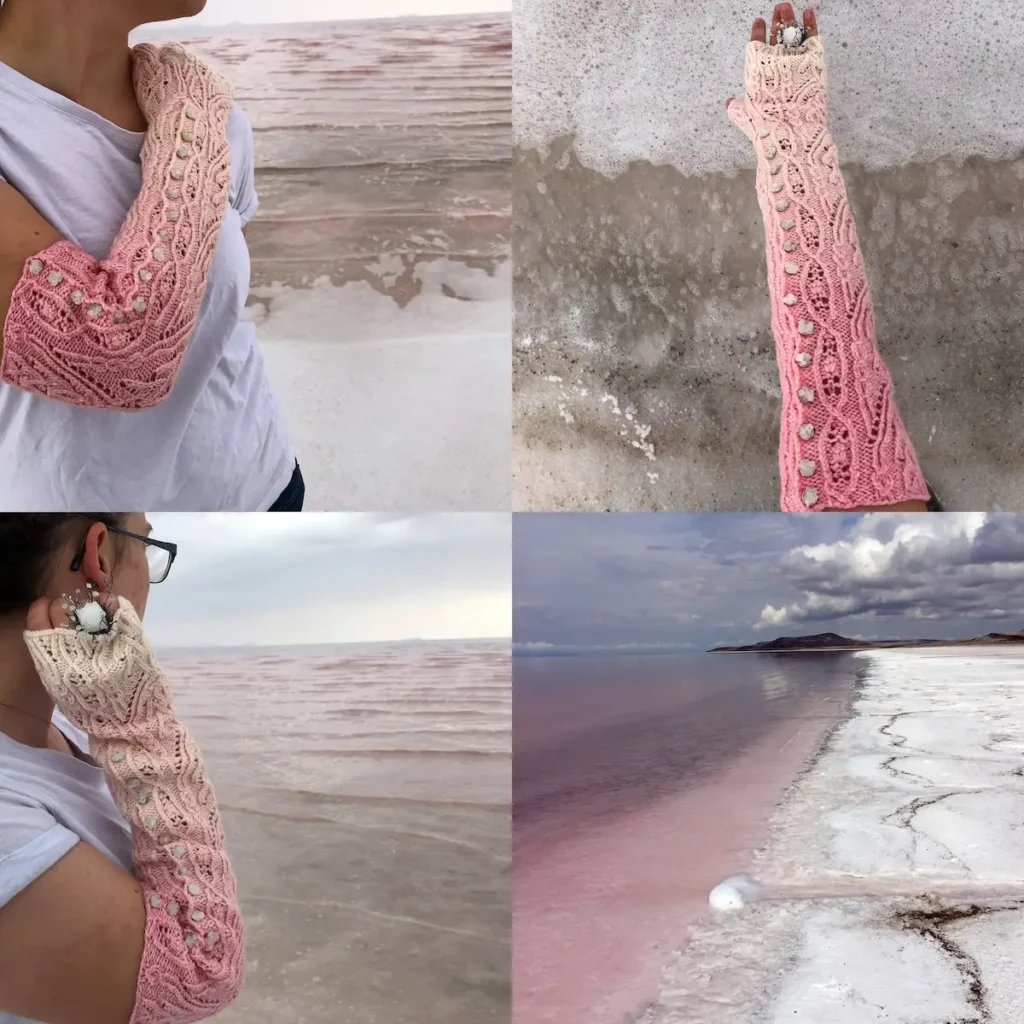
Wool and nylon, salt and silver buttons
Hand-knit and hand-made buttons by artist Mary Lambert
Salt deposits along the shores of the Great Salt Lake have been harvested for culinary purposes for millennia. Father Escalante’s journal of 1776 described how native American Indians used the salt deposits. Mountain man Jedediah Smith harvested Great Salt Lake salt, and even John Fremont and Kit Carson commented on how easy it was to pick up salt off the lake shore. Today, salt harvesting is big business, but an individual can still find beautiful salt crystals ranging from pink to white waiting to be harvested along the salty shores. This was exhibited in the 2018 Utah Statewide Annual Craft and Photography Exhibition in Salt Lake City, UT.
I was traveling with a friend over the salt flats in northern Utah on our way to Nevada when we ran out of gas. As we were waiting for help to arrive, I started noticing the beauty of the salt flats. I was overwhelmed by the stark, flat landscape, the expanse of white and bright blue overhead, with rings of dark brown mountains at the edges of the horizon.
I lamented the fact that I could not capture this to remember it. I was not an accomplished photographer, barely able to draw, and was not confident in my painting skills. But as I sat there, I thought: I can knit, and I am good at knitting! What would happen if I knit this inspiration?
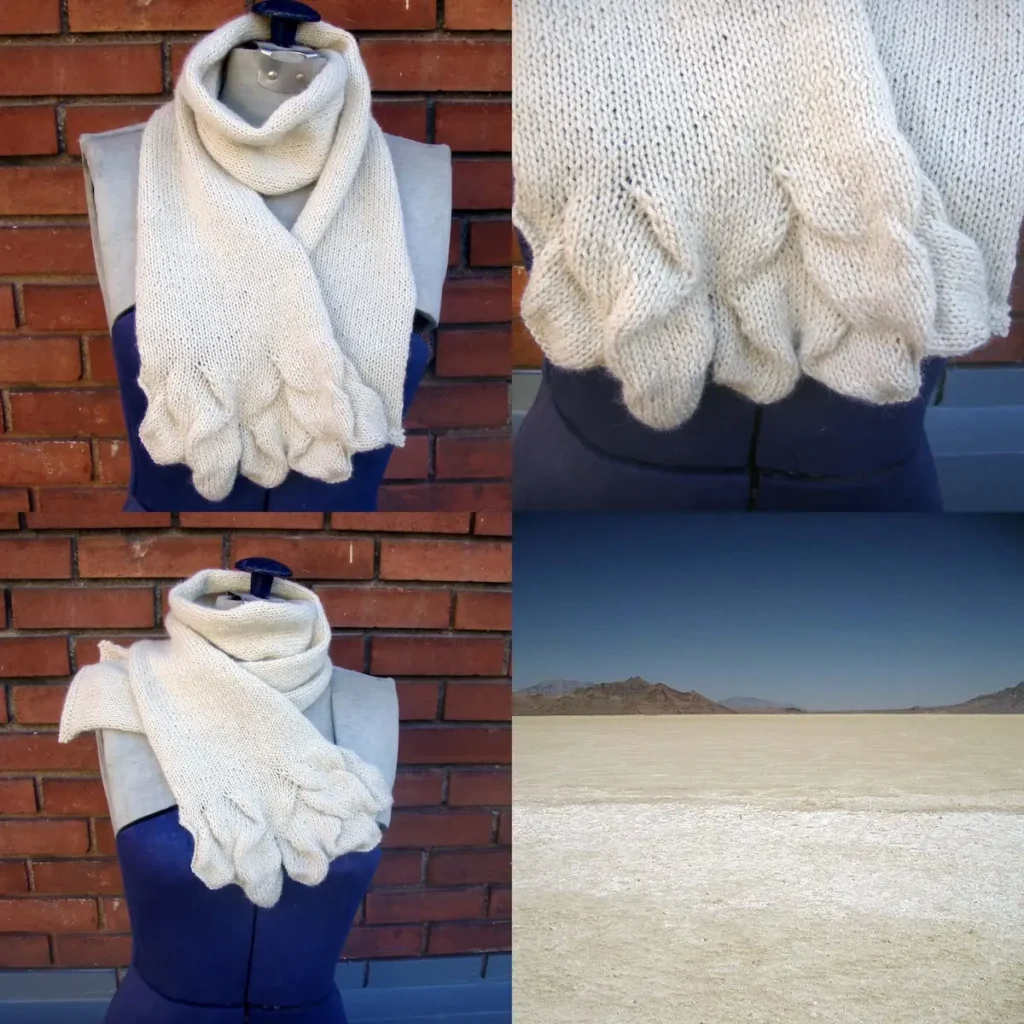
Hand-knit alpaca and wool
The Bonneville Salt Flats in Utah are beautiful and terrible. The large flat expanse of white is rimmed by salt-covered rocks at the near edge. They say that the salt desert is so flat you can see the curvature of the Earth.
So I immediately went home, designed a piece of wearable art that evoked the open flat expanse of the salt flats, with small salt-encrusted rocks at the edges. I loved the piece, and I wrote the pattern out for anyone else who wanted to knit it too. I decided to enter it into our state design exhibition…but it was rejected. I definitely thought that was the end. It was a good idea, but I was never putting myself out there with this crazy idea of wearable knitted landscapes again.
Luckily, I had a friend at the state art council who suggested I enter the work into the state art exhibition instead. So I took a leap of faith again, and this time, not only was it accepted, it won the Juror’s Award too! That’s when I knew that my knitting art does have an audience and I should stick with it.
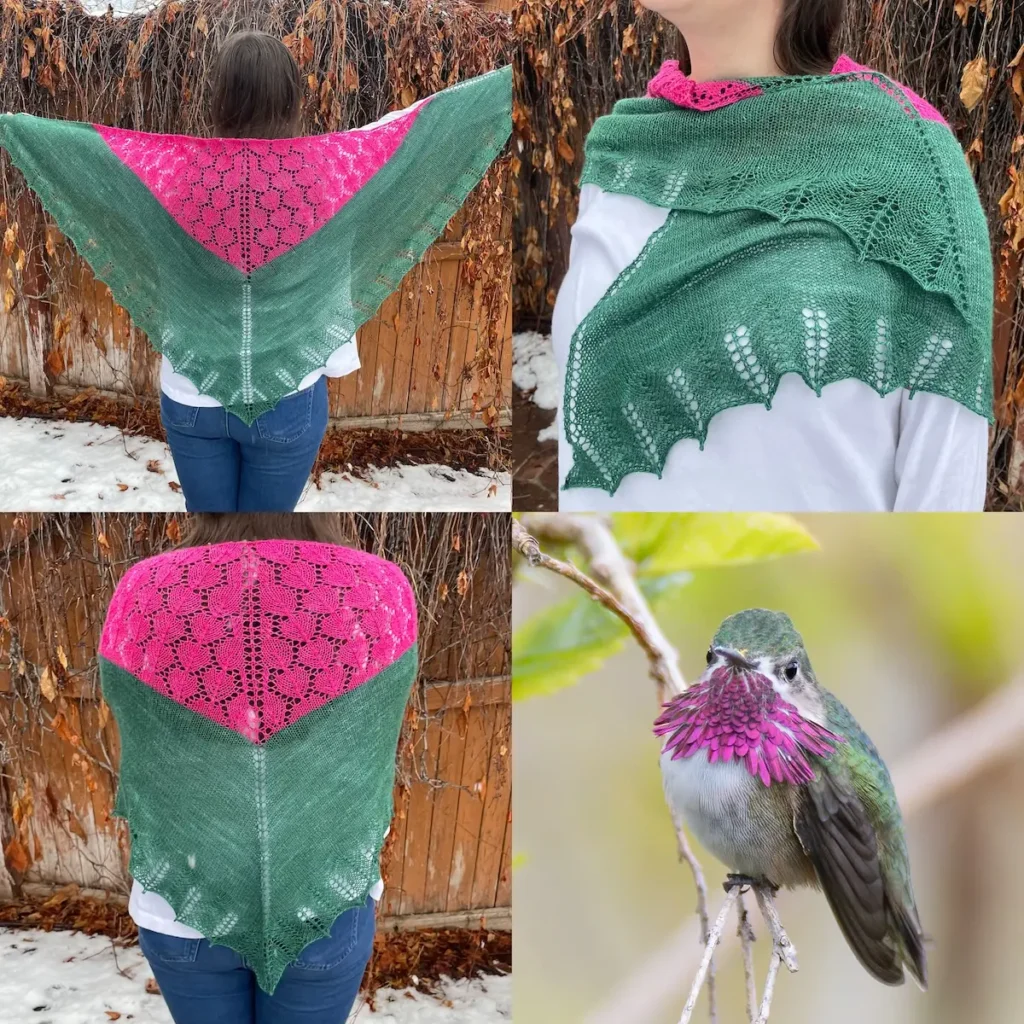
Hand-knit merino wool and silk
If you are lucky enough to see a Calliope Hummingbird in Glacier National Park, take note of its vibrant gorget. A gorget is a patch of colored feathers found on the throat of male hummingbirds. Gorgets are typically iridescent. and the Calliope sports a beautiful fuchsia patch that can be seen even when he is flitting about the park. This artwork and pattern was produced as Artist-in-Residence at Glacier National Park.
What inspired you to begin exploring landscapes through knitting? Is there a story behind your business name lake•salt•knit?
From then on, I used my hometown landscape as inspiration for my knitted wearable art. Great Salt Lake became my muse, and I spent a lot of time exploring the lake and the Great Basin, its stark beauty, and varied landscapes. I created a blog to document my process and called it lake•salt•knit to pay homage to my hometown, Salt Lake City, but to emphasize the landscape more by putting the lake first.
This idea of landscape as inspiration is best explained in my artist statement: “As a knitting and textile artist, my work has a close affinity to the land. My art echoes the geography of my place; a type of knitting “terroir” that brings the landscape into the forefront of my life. Many of my wearable artworks focus on interpreting the science, geography, and biology of an ecosystem within the traditional craft of knitting. And because of this study and practice, I have honed my thinking about environmentalism, conservation, and preservation of land.”
In addition, as part of my art, I hope viewers think about the traditional medium of knitting in a new way through not only viewing my art but through making their own work of art – made possible through published knitting patterns of my pieces. My art allows for a pattern to be published for other people to be able to knit their own version of the artwork. And in knitting a work inspired by the landscape, I hope the knitter/crafter will learn, appreciate, and come to understand one element of a complex ecosystem.
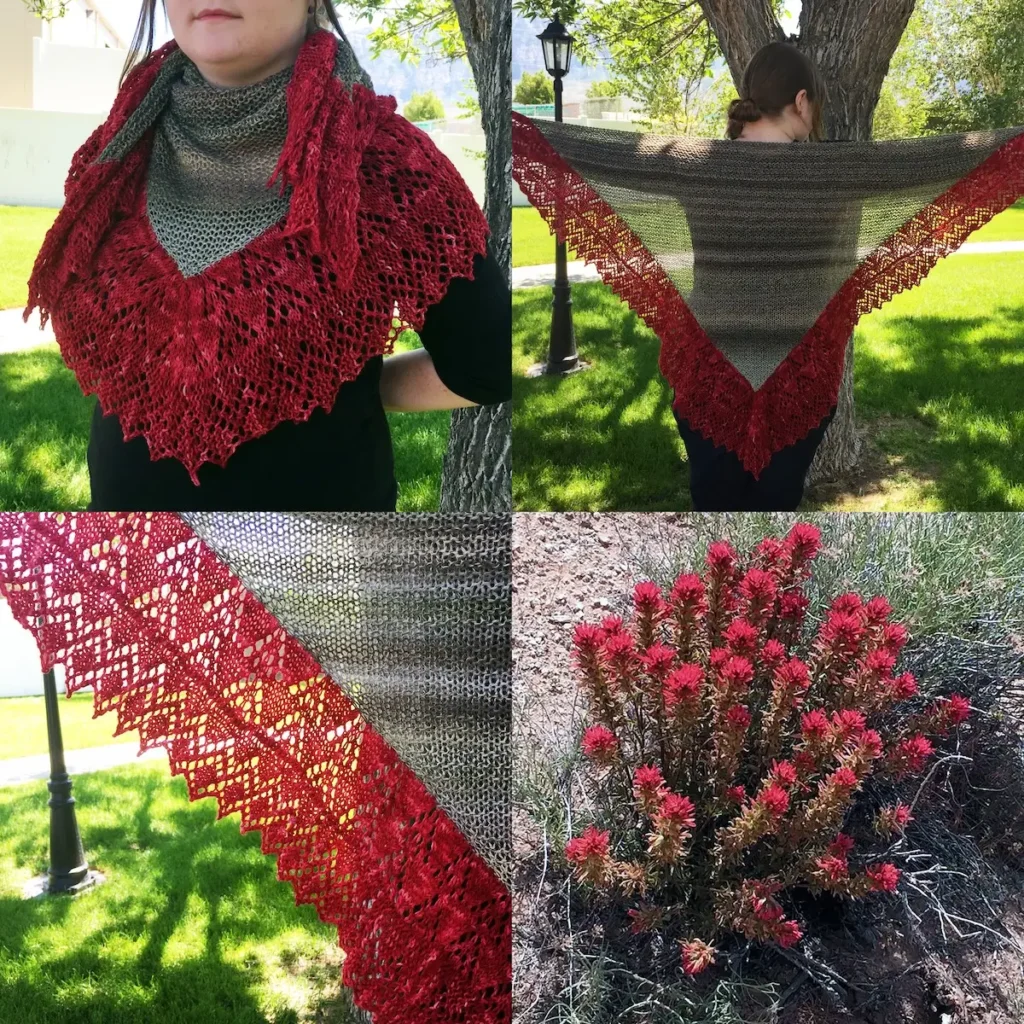
Hand-knit wool/nylon
In the spring and summer, the Black Rock Desert in Nevada is dotted with brilliant Indian paintbrush wildflowers. This native plant has bright red bracts that are often confused for their flowers, which are small and inconspicuous. When walking in the desert, you feel surrounded by the spiky red plants as if you are wrapped in paintbrushes. This shawl uses a traditional Shetland half-hap construction and wraps you in the color and shape of Indian paintbrush. This piece was created as an Artist-in-Residence at Black Rock Desert National Conservation Area.
How do you choose a location or subject to translate into fiber?
Sometimes the locations choose me! I loved knitting wearable landscapes and wanted to branch out, so in 2015 I applied to be artist-in-residence for Black Rock Desert National Conservation Area in Nevada. And to my surprise they chose me! I was able to spend a couple of weeks living in the area, getting inspiration from that amazing desert landscape. Even though, Black Rock Desert is part of the Basin and Range environment like Great Salt Lake, its land was so different from what I had been getting inspiration from up to then.
I loved the pieces I created at Black Rock and was able to have an exhibition in Reno of my work. From then on I was hooked on experiencing different landscapes. I applied to more residencies and was able to be artist-in-residence for Great Basin National Park in 2016, Capitol Reef National Park in 2019, Glacier National Park in 2023, and Joshua Tree National Park in 2026. Each of these residencies resulted in a variety of artwork; all wearable landscapes that also have patterns available for others to knit these incredible National Parks.
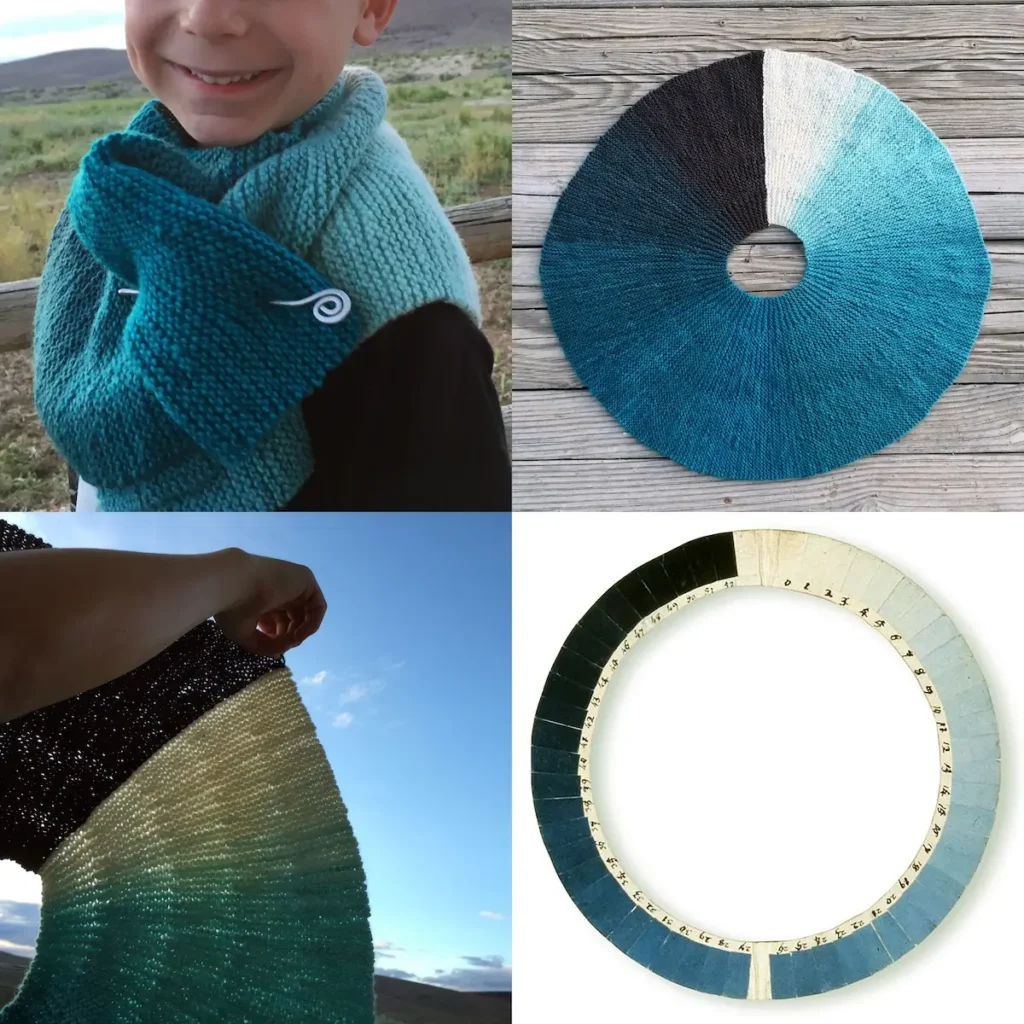
Hand-knit wool
A cyanometer is an instrument for measuring the blueness of the sky. It was invented in 1789 by scientist Horace-Bénédict de Saussure, who correctly surmised that blueness was dependent on the amount of water vapor suspended in the atmosphere. In the Great Basin of the American West, the dry desert air makes the sky rest firmly in the bluest area of the cyanometer. This piece was created as an Artist-in-Residence at Black Rock Desert National Conservation Area.
How do you begin a new idea — is it a place, a memory, a color, or a feeling?
I try to experience the landscape and when a texture, color, shape, or idea captures my attention, I start thinking about how I can translate it into knitting. Then I experiment a lot by swatching and trying out different stitches. Those trials become more fleshed out and I write up notes as I knit to write the pattern later.
Alternatively, I sometimes write a whole pattern before trying to knit it, then tweaking the pattern as I go along. Every once in a while, I knit a whole piece and then take it all out to re-knit it to make it what I am envisioning.
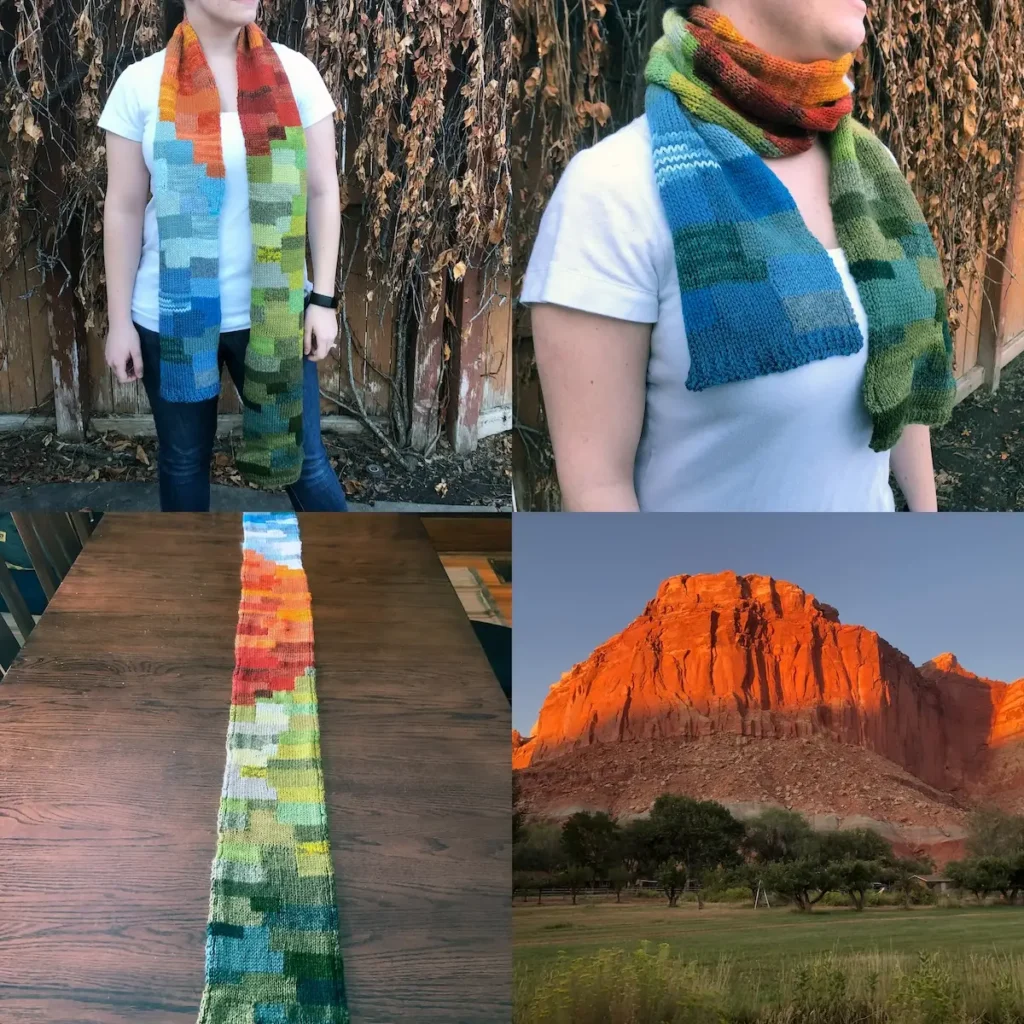
Hand-knit wool, silk, cotton, bamboo
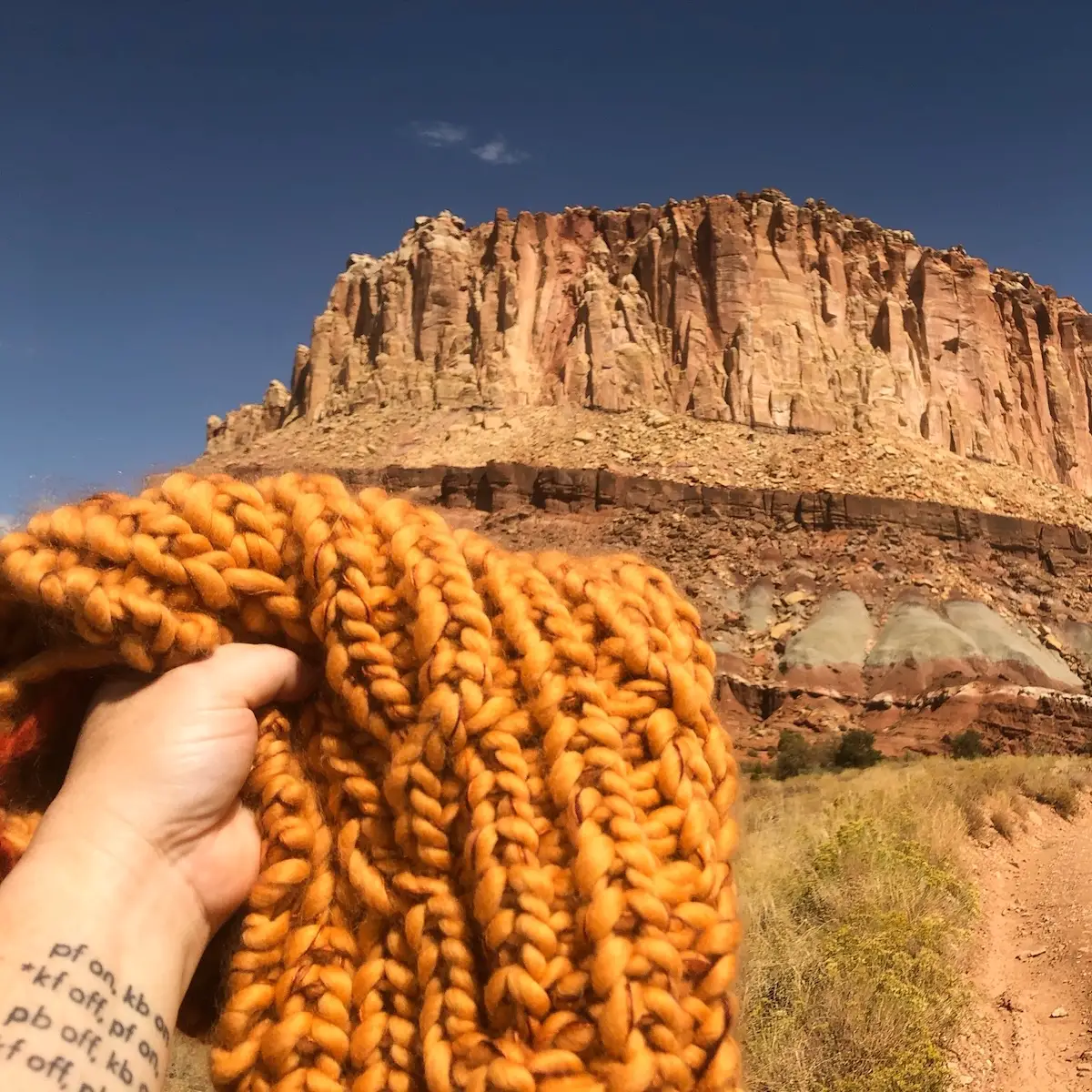
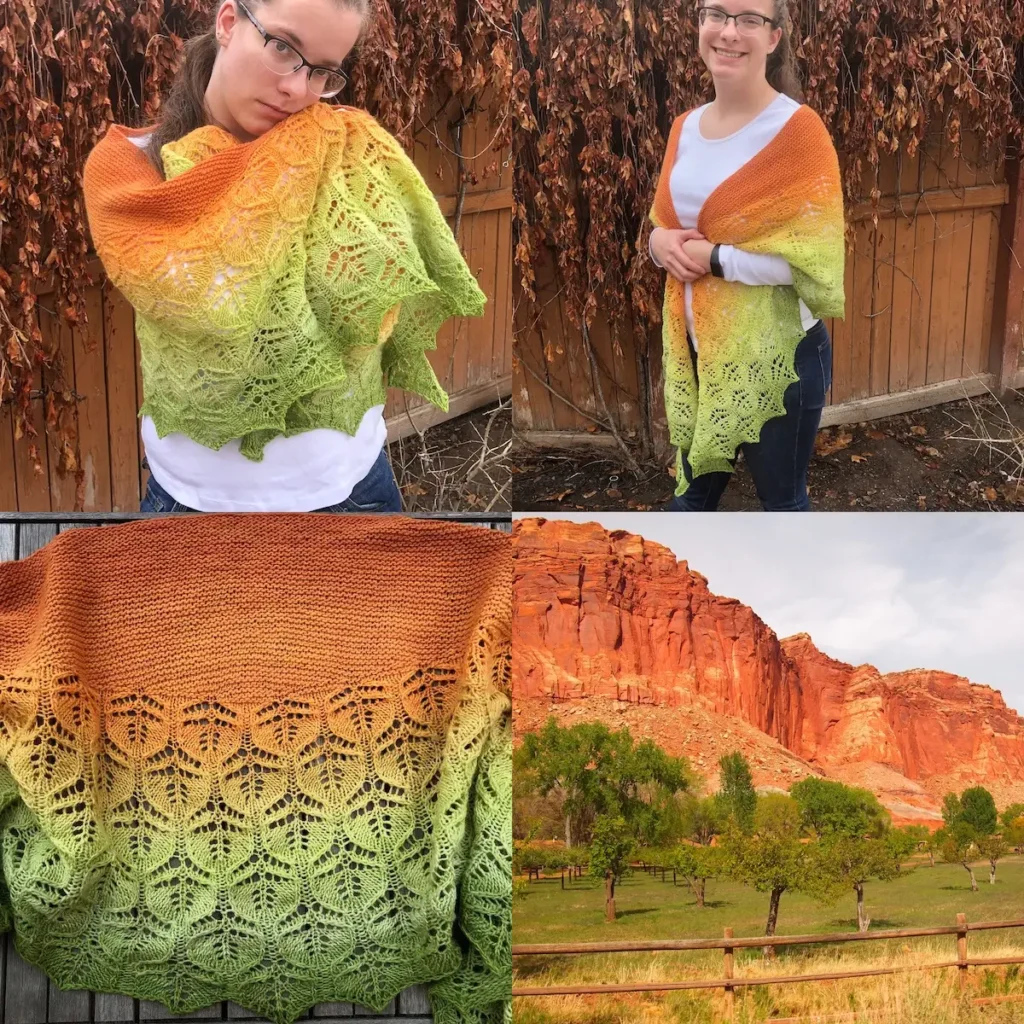
Hiking through Capitol Reef National Park, you are surrounded by the sublime colors unique to the Waterpocket Fold. The lush green Fruita valley is dwarfed by the soaring red rock reef, which then gives way to an intense blue of the dry desert sky. This artwork was produced under the Artist-in-Residence Program at Capitol Reef National Park.
What’s the hardest part about making large or detailed pieces?
The absolute hardest part is how long it takes to knit anything. I am a fairly fast knitter, but it still takes hundreds of hours to create a piece, not even counting the time for designing, swatching, and failed attempts. The idea and vision come very quickly for me. I have an idea in my head of what it should look like, then I have to go through hours of knitting to see it come to fruition.
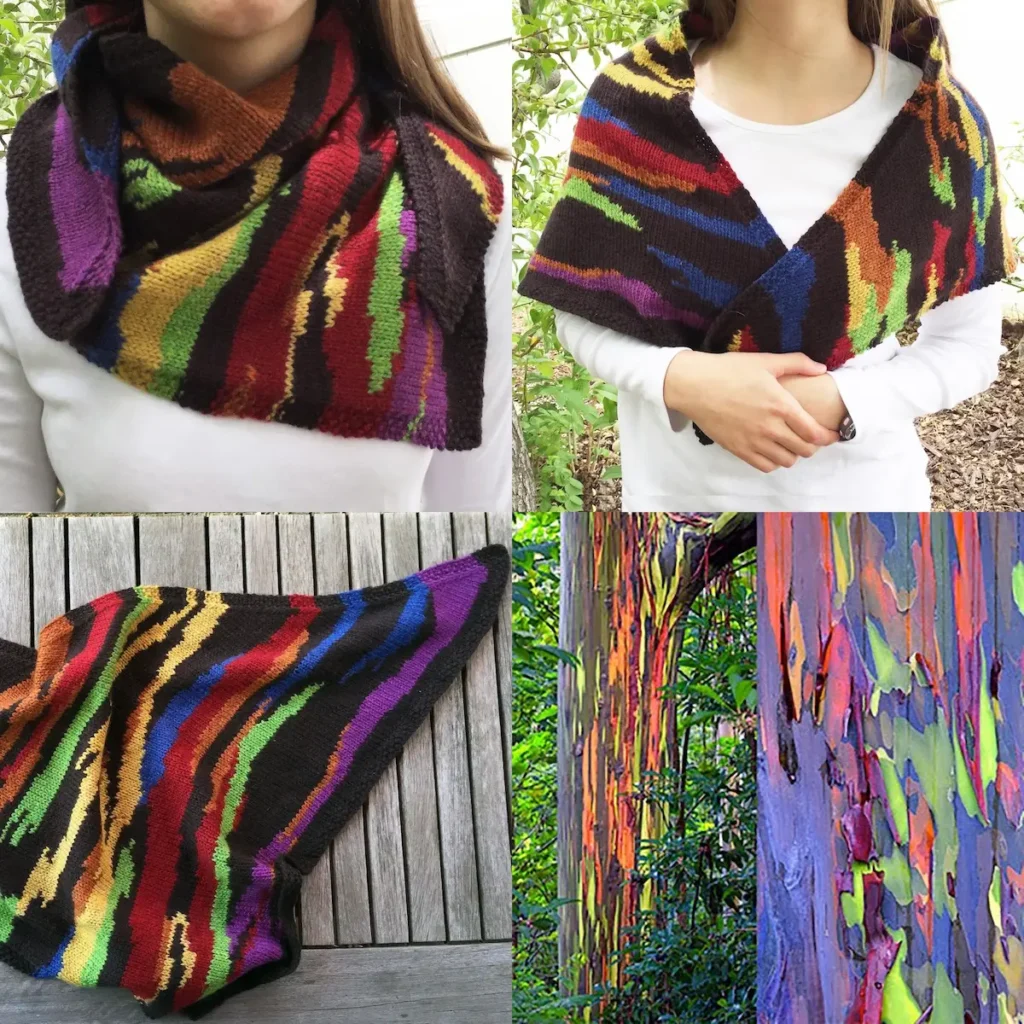
Hand-knit wool
Rainbow eucalyptus, or eucalyptus deglupta, is found naturally on many Pacific islands. The unique chromatic bark is its most distinctive feature. Patches of outer bark are shed annually at different times, showing a bright green inner bark. The green bark then darkens and matures to give blue, purple, orange, yellow, green, and maroon tones. Although rainbow eucalyptus is widely grown on plantations for pulpwood to make paper, it is sought after as a statement tree in many landscape designs because of its showy bark.
Do you see your pieces more as art or useful objects, or do you love both sides?
Absolutely both sides.
The uniqueness of each piece I make allows the wearer to be more conscious of what the object is and why they are wearing it, elevating Craft from a functional item to a conscious and deliberate work of art.
The act of creating something so entwined with the land itself sparks a stewardship and urge to conserve that land. Through craft and art, I hope to engender an appreciation, love, and wonder of the natural world.
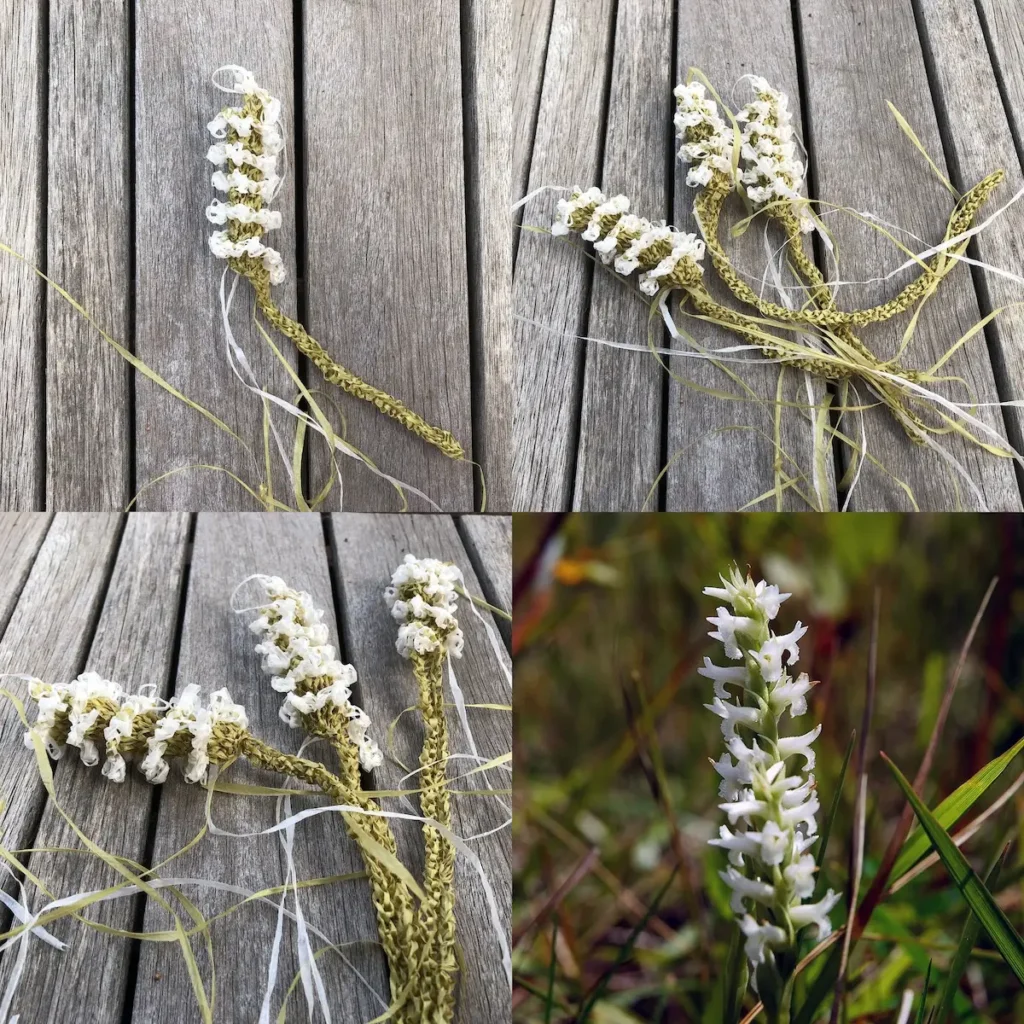
Hand-knit linen paper
Spiranthes is a genus of orchids known commonly as ladies’ tresses because of the spirally-flowered stem that resembles neatly braided hair. Ute Ladies’ Tresses was newly described and named in 1984 after Native American women indigenous to the American West. This endangered species can be found along stream beds and wetlands in the Great Basin and Rocky Mountains, but is extirpated in Salt Lake City, where it once thrived.
Has your work ever pushed you beyond your comfort zone?
Yes! I started experimenting with knitted sculptures.
I wanted the pieces to have structure and stand on their own, so I began knitting with paper yarn. The paper yarn I use is based on flax and is from Japan. It is fragile but becomes stronger when it is knit up in stitches. I was afraid that knitted sculptures would not be seen as real sculptures, but those sculptures are some of the most exhibited pieces I have made.
I started a series called Species of Concern that depicted endangered and threatened plants and flowers in the West. These small, delicate knit works convey the delicacy and rarity of these endangered plants.
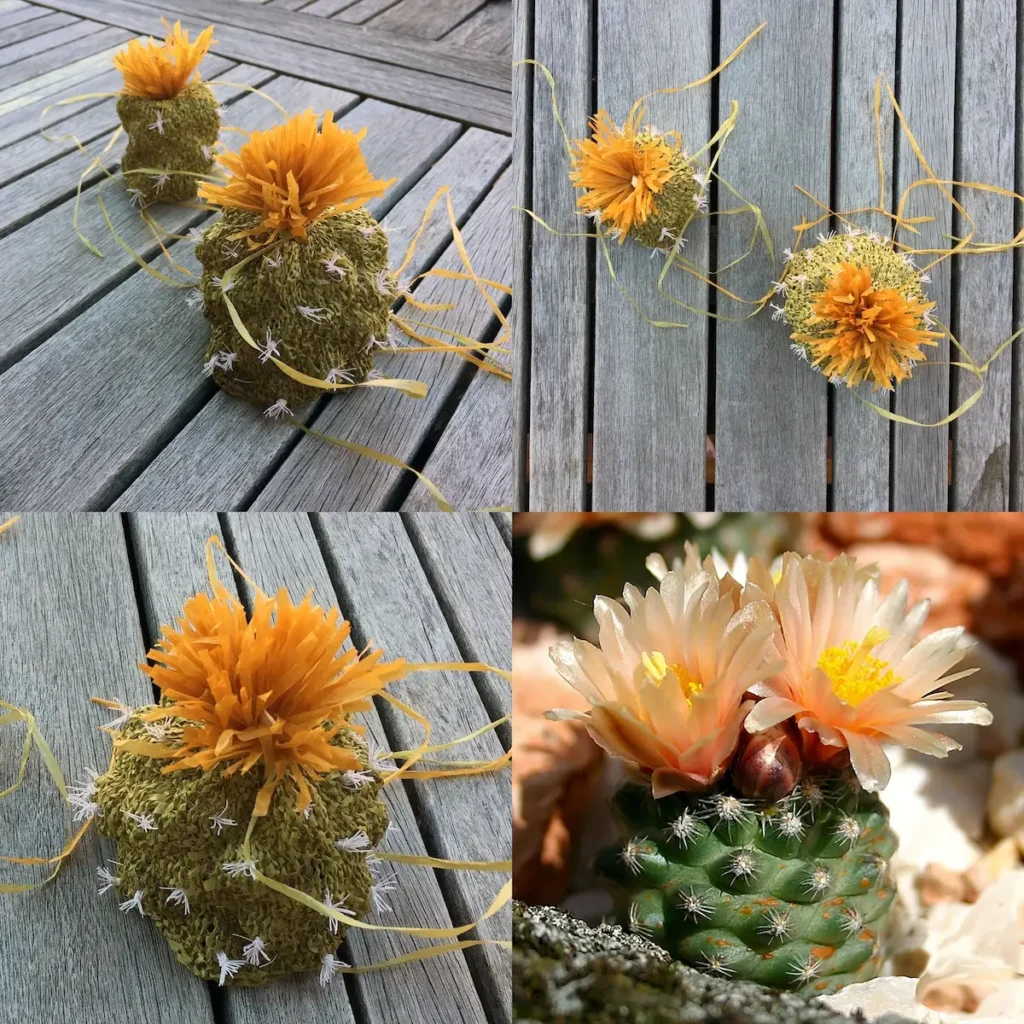
Hand-knit linen paper, pulp paper
The San Rafael Cactus is a very rare and endangered species that only grows on a small strip of Utah’s San Rafael Swell. It spends most of its life underground during cold or dry seasons. Its rare appearance and diminutive size makes it easily overlooked during the few days it emerges to flower every year.
Describe your creative space.
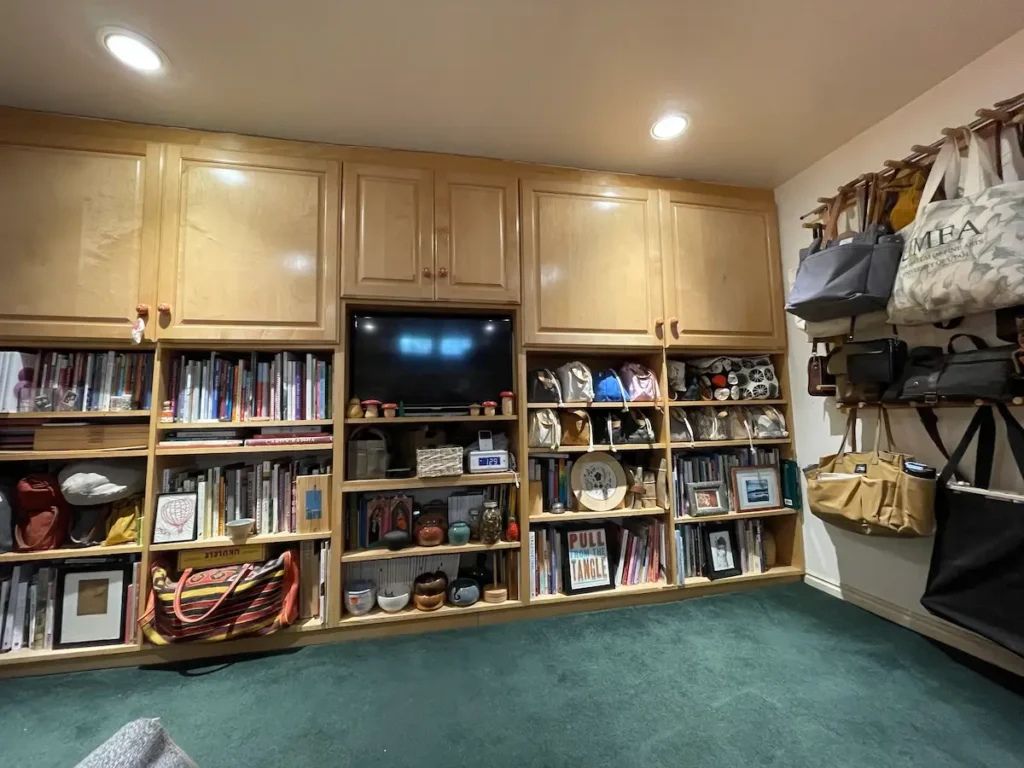
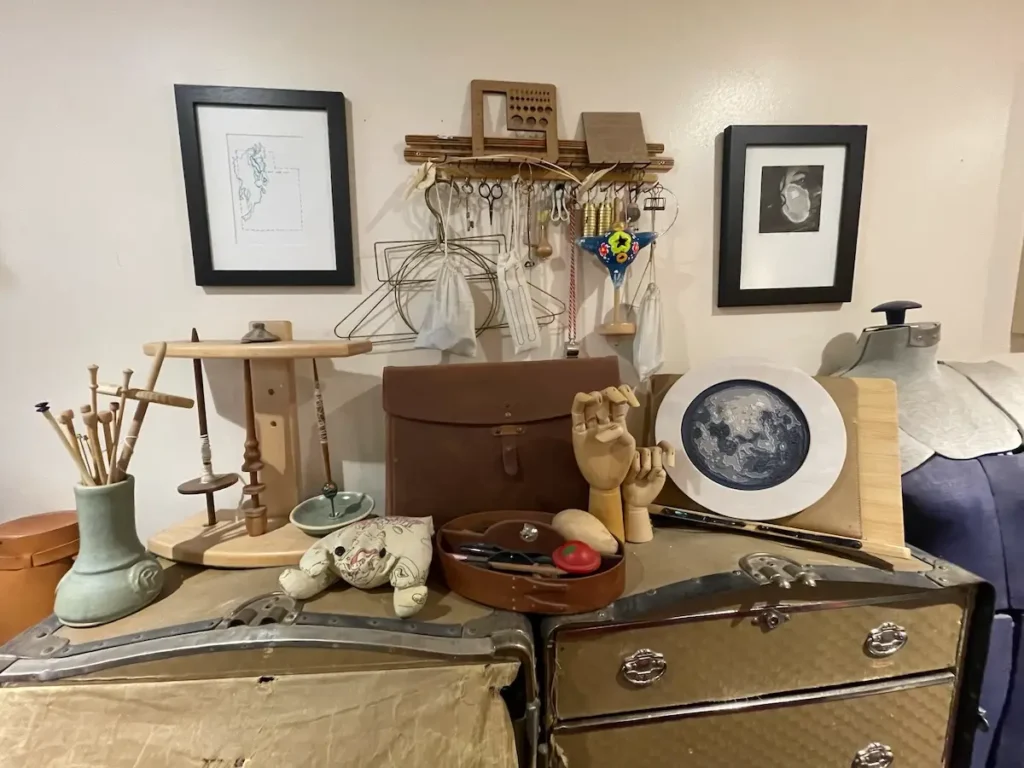
Lucky for me, knitting is portable. I knit everywhere and any spare moment. It isn’t uncommon for me to knit 6-8 hours a day (on top of my 9-5 job!). But I do have a type of “studio” which is really my family room that holds all my tools, books, yarn, and projects. I do sometimes knit in my studio, but mostly I am knitting anywhere I can.
What has knitting taught you about life and yourself?
When I first started making knitted art I always felt I had to explain or apologize or give a lecture on craft vs. art. But I am slowly realizing that I don’t need to do that. I have come to accept my craft as art as so many other makers have done in the past.
There is a quote I love from a knitter and musician, Jeni Hankins:
“As we …we hold yarn, thread, needles, … in our hands, we are participating in something that might appear to others as humble, niche, or folksy. But we know we are spinning round ourselves the cocoon of history, the ancestral movements of billions of hands, and the collective rhythm of practice and persistence.”
Hand-knit merino wool
The historic town of Fruita, within Capitol Reef National Park, is no longer inhabited by pioneers. But visitors can still pick ripe fruit from the lush orchards under the looming orange cliffs of the Waterpocket Fold. This artwork was produced under the Artist-in-Residence Program at Capitol Reef National Park.
What’s the best piece of creative advice you ever received?
I know it sounds trite, but it really is liberating to understand. Failing is important, everyone fails and fails again. It is not shameful to try and then fail.
As Robert F. Kennedy said: “Only those who dare to fail greatly can ever achieve greatly.” But even with his profound words, it’s also ok to fail greatly and not achieve; it is the trying and doing that matters.
What are you most proud of in your creative journey?
I am most proud of taking what I know how to do and presenting it as art. It was a big scary leap to go from knitting functional items other people designed to knitting unique functional items I created and called art. I am happy I took the chance that others could see my knitting as art too!
Where can people see your work?
On my blog: lakesaltknit (www.lakesaltknit.com)
On Ravelry: lakesaltknit (user) or Virginia Catherall (designer)
On Instagram or Threads: lakesaltknit
Rapid-Fire Fun:
Favorite yarn color right now? Desert browns and greens with a pop of fluorescent pink (I am knitting inspiration right now from my residency in March in Joshua Tree National Park, where the cactuses were all blooming!)
One tool you can’t live without? A good pair of snips.
Mountains or lake? Mountains
One word that describes your creative style? Biomimicry
Dream place to get inspired? Utah’s red rock country
Interview posted April 2026
Browse through more knitting inspiration on Create Whimsy.
More of Virginia’s amazing work:
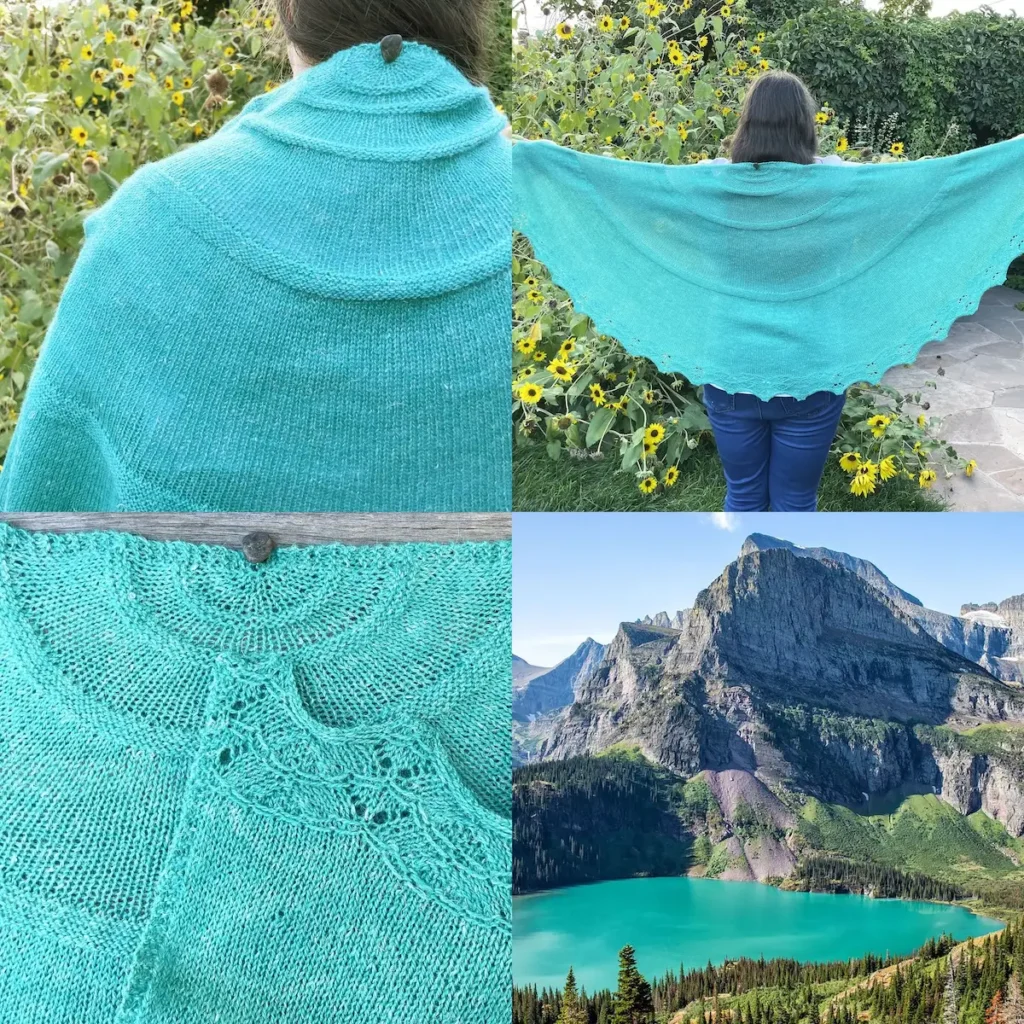
Hand-knit wool, alpaca, and linen
The stunning turquoise at Grinnell Lake in Glacier National Park is created from the rock flour accumulated from Grinnell Glacier. Rock flour is very light and stays suspended in the water. When the light hits the surface, the silt distorts the wavelengths of light, reflecting back more of the green and blue end of the spectrum, making beautiful turquoise ripples when a pebble is dropped at its edge. This artwork and pattern was produced as Artist-in-Residence at Glacier National Park.
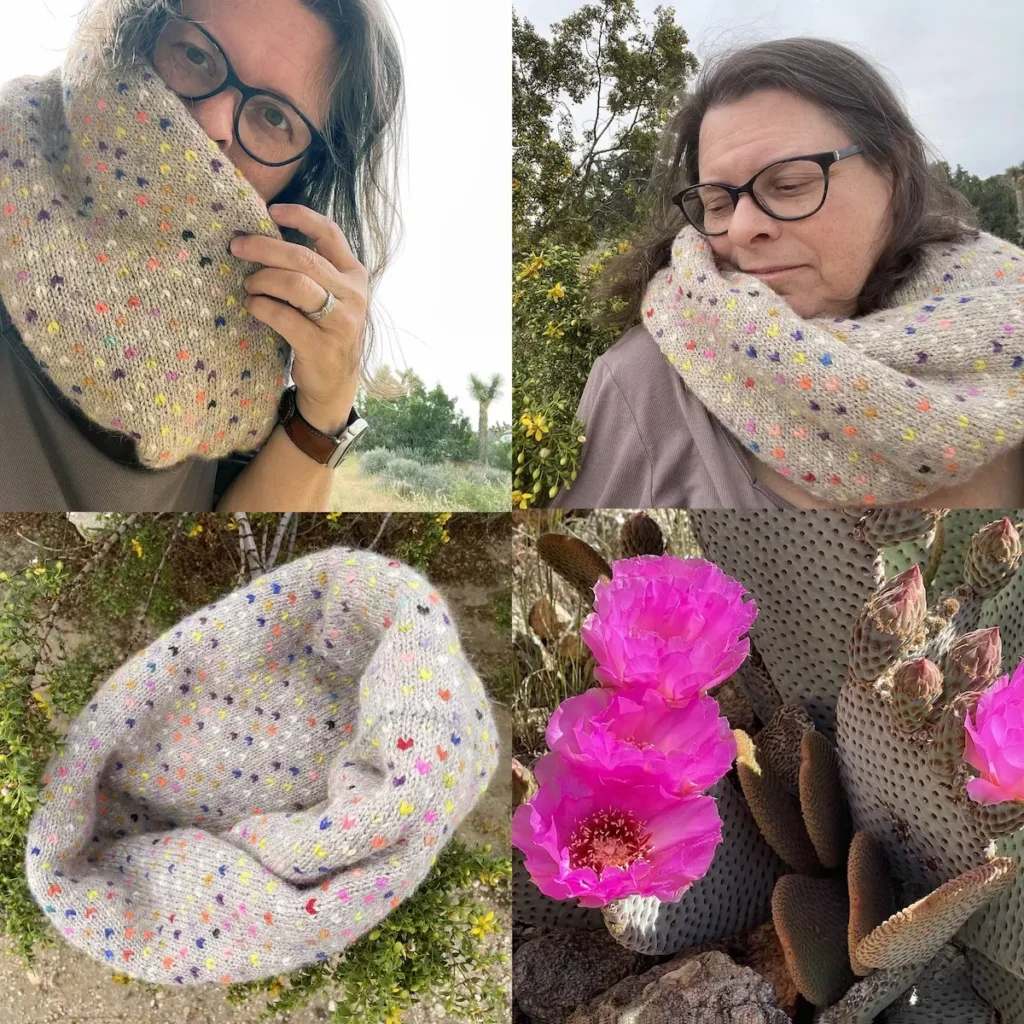
Hand-knit wool, alpaca, and linen
An abundance of colors peppers Joshua Tree National Park in March. I recorded the color of wildflowers I saw during my month-long stay in the park and knitted them into this cowl. An exercise in data visualization that not only records the colors, but also the days spent in the beautiful desert. This artwork was produced as Artist-in-Residence at Joshua Tree National Park.
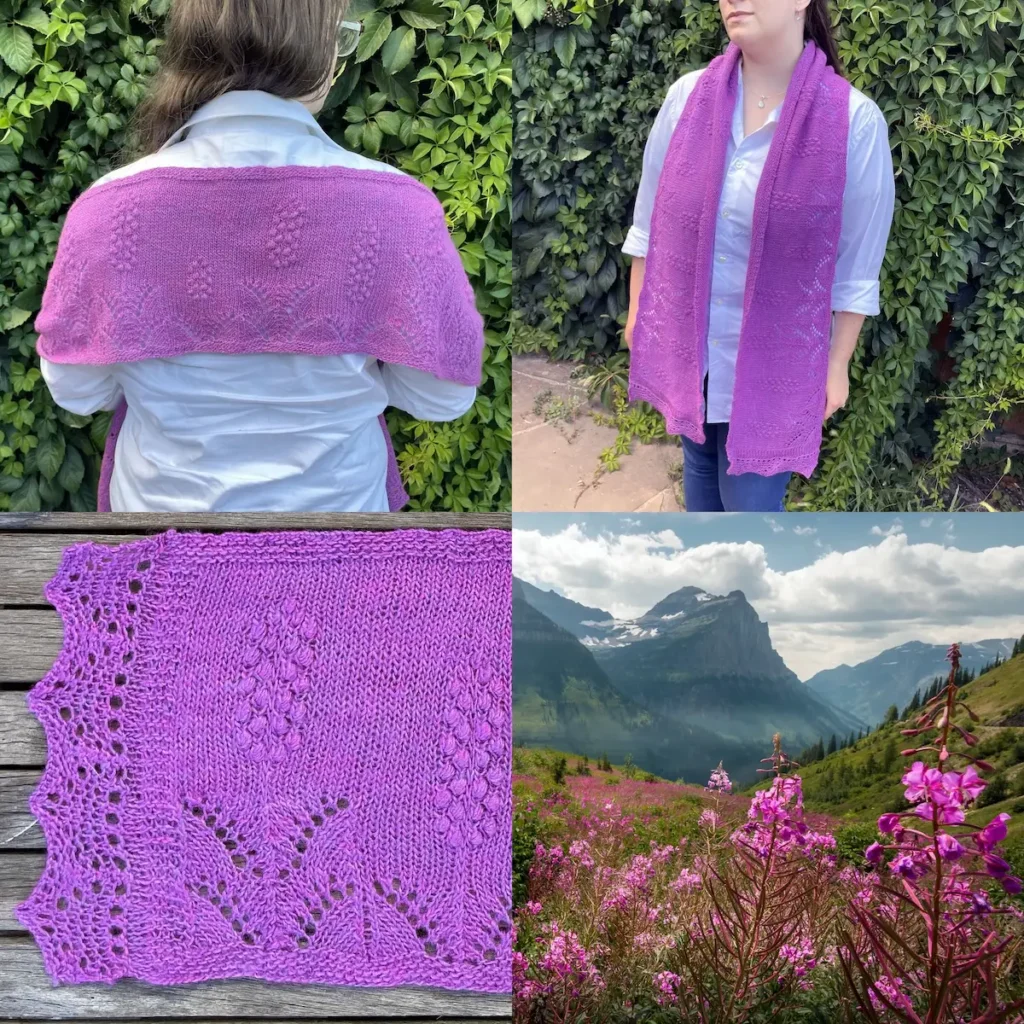
Hand-knit Merino wool
Fireweed is abundant in Glacier National Park. Its bright purple flowers thrive in open meadows, roadsides, and forest edges. Fireweed’s name comes from its ability to grow rapidly in areas affected by fire. With seeds that spread rapidly by wind, Fireweed can dominate a meadow, bathing the land with vibrant color. This artwork and pattern was produced as Artist-in-Residence at Glacier National Park.
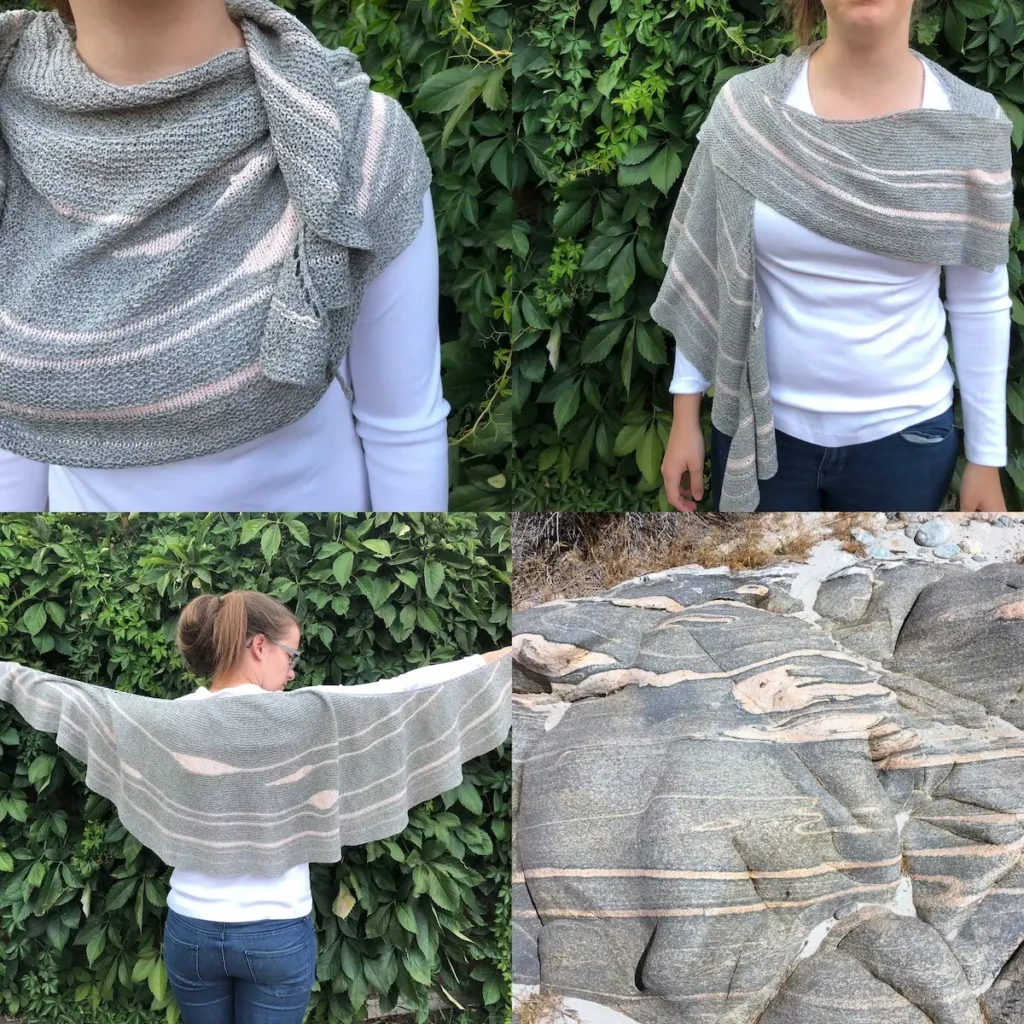
Hand-knit silk, quartz chips
On the southern tip of Antelope Island, called Unicorn Point, lies some 1.7 billion-year-old gneiss. Gneiss comes from the old German word gneist or “spark,” announcing the glittery veins in the rock. This otherworldly rock is made of feldspar with pink bands of granite and quartz wandering and dancing through the formation, glittering and sparking in the sun.
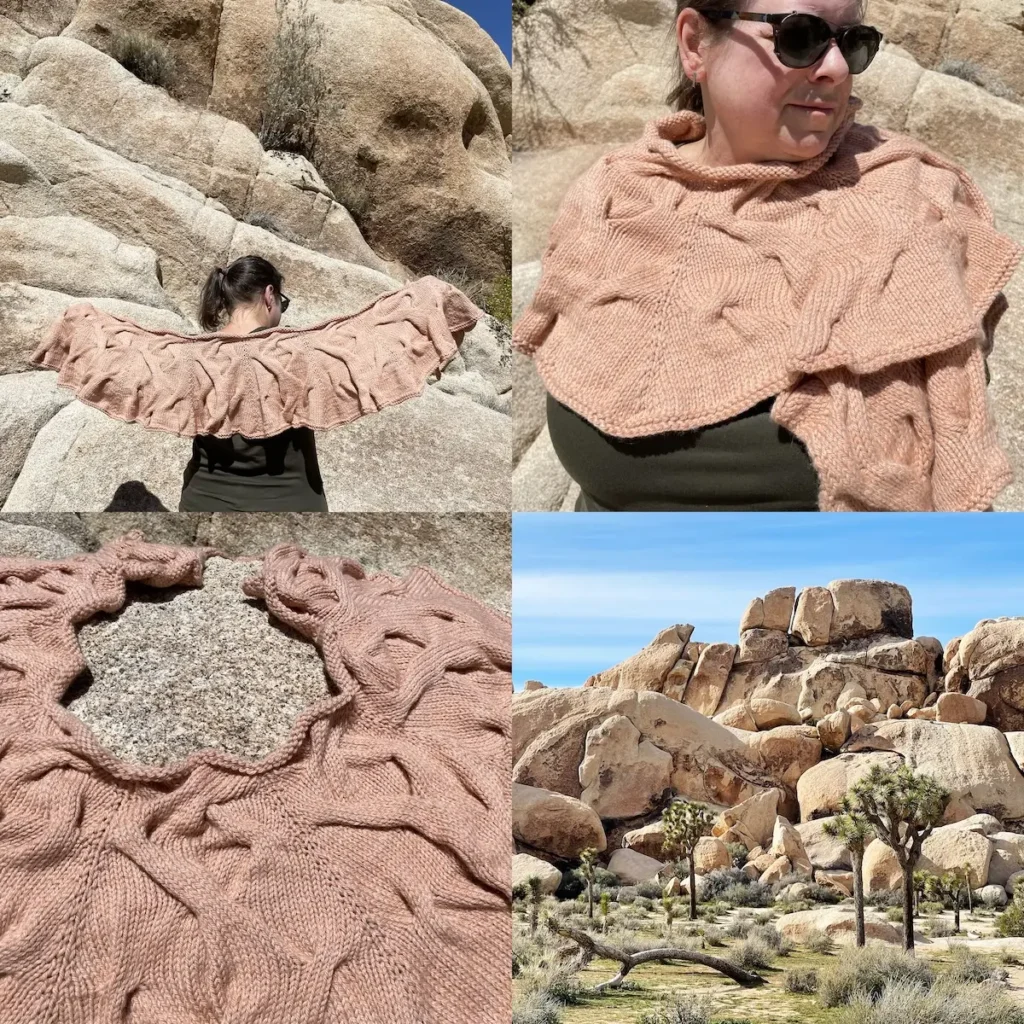
Hand-knit wool
Hall of Horrors in Joshua Tree National Park is made of several rock formations with scrambling boulders, small slot canyons, and beautiful desert scenery. The nooks and crannies of these outcroppings are great to get lost in, finding surprising places to cool from the desert heat. This artwork was produced as Artist-in-Residence at Joshua Tree National Park.
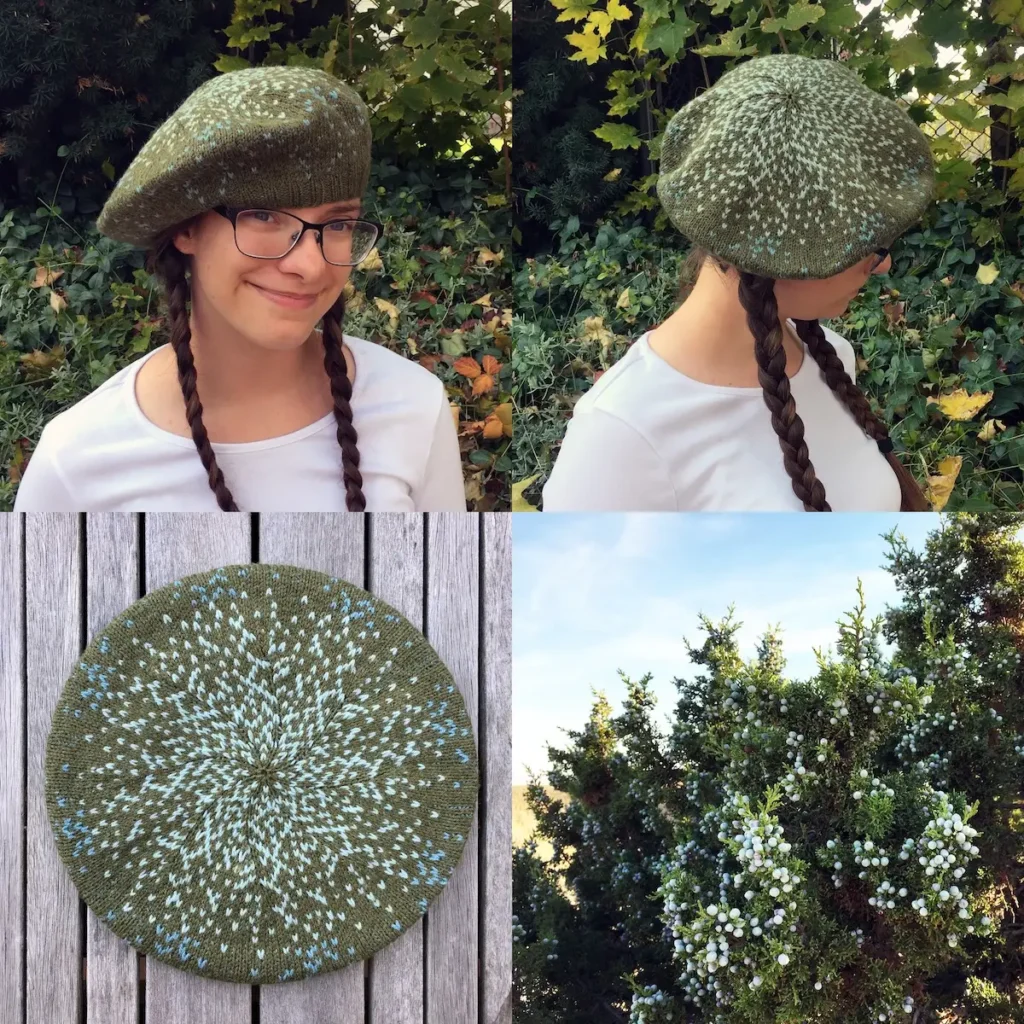
Hand-knit wool and silk
Juniper is one of the most abundant and widely scattered trees in Great Basin National Park. It is typically found growing among pinyon and sagebrush. They are very hearty and can live to be 650 years old. Juniper berries are the female seed cone (not a true berry) with unusually fleshy and merged scales, making it look like a berry. The berries can be dried and made into beads for jewelry and are also deliciously eaten by jackrabbits, foxes, coyotes, and people. This artwork was produced under the Darwin Lambert Artist-in-Residence Program at Great Basin National Park.
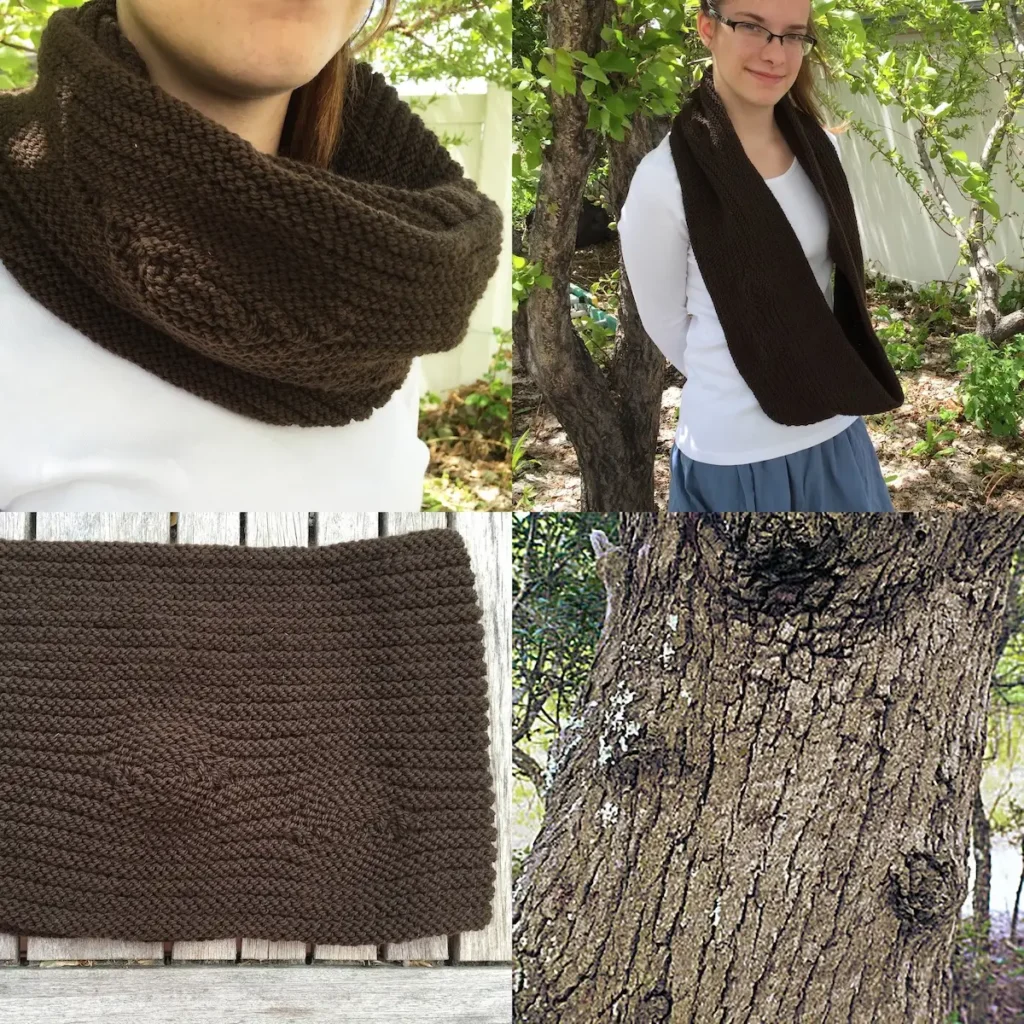
Hand-knit wool
Oak trees are a common symbol of strength and endurance. Its bark is very resistant to insect and fungal attack because of its high tannin content, which also gives oak its characteristic dark brown color. The tannin-rich bark was used by tanners for processing leather, and oak galls were used for centuries to make dark brown manuscript ink. The thick bark develops deep ridges called rhytidome, Greek for wrinkle, consisting of dead cork layers that protect the tree. All these characteristics earn the oak its reputation as a strong, enduring, and steadfast tree.
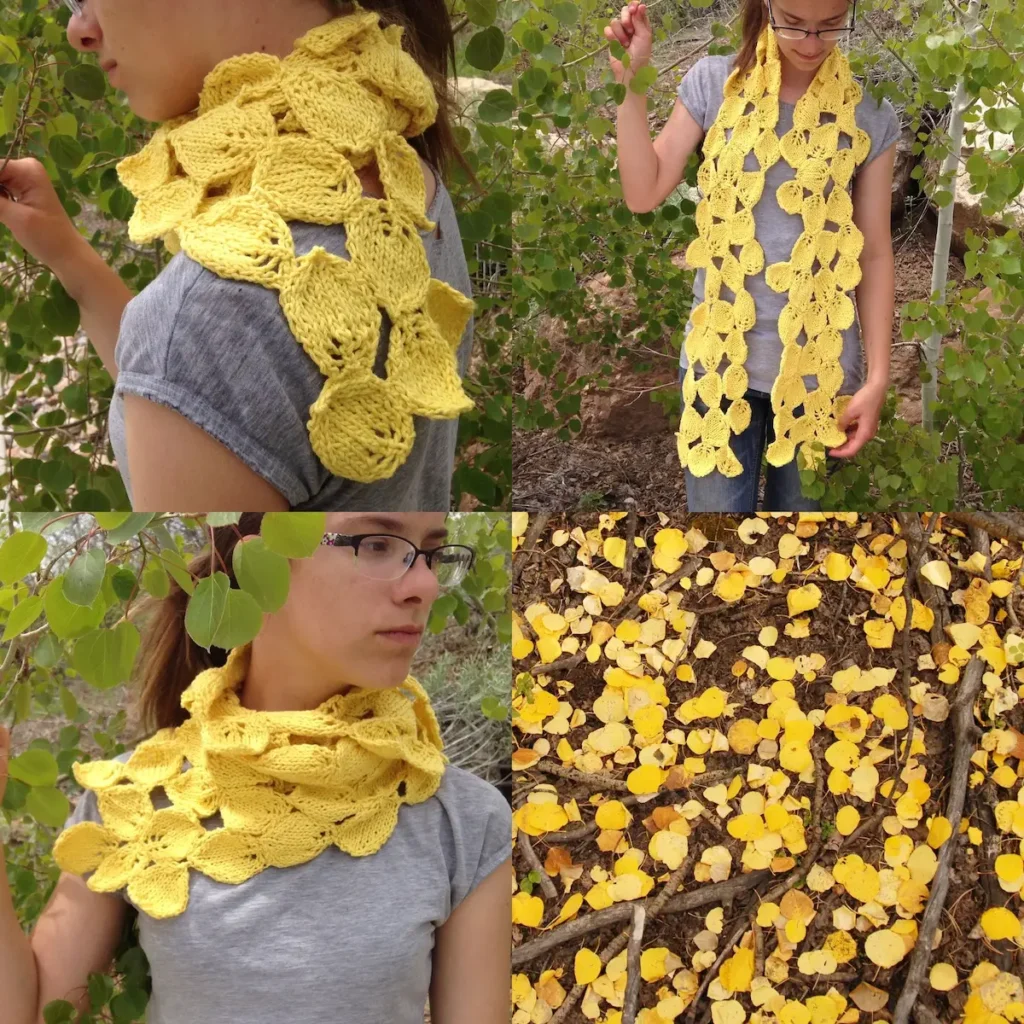
Hand-knit linen/cotton
Quaking aspens are the ubiquitous tree in Utah. Seen as a scourge in the city because you can never get rid of them, they are nevertheless a beautiful tree. In the summer, their brilliant green leaves shimmer and shake and tremble with the slightest breeze. In the fall, they have a blazing yellow circle of a leaf, and the bare white and black bark stand out starkly against the snow in winter. One reason we see so many quakies is their unique way of propagating, by sending up shoots from a massive root system. One colony, named Pando, is considered the heaviest and oldest living organism in the world. It is six million kilograms and about 80,000 years old… and is located right in the middle of the state of Utah.
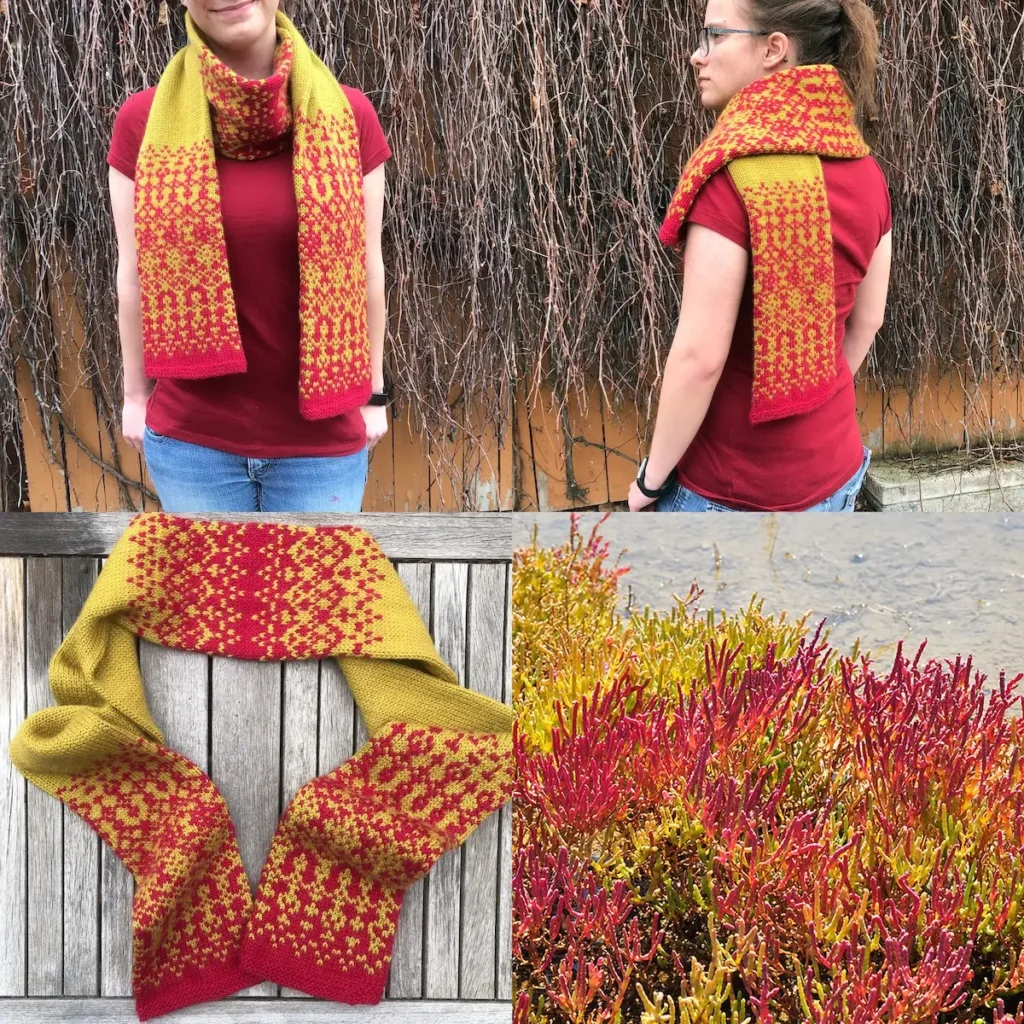
Hand-knit merino wool and cashmere goat
Pickleweed is abundant in the liminal edges of the Great Salt Lake. Around the most saline part of the salt marshes, pickleweed thrives by expelling salt from its cells to outer leaf tissue. As the days grow shorter and cooler, this leaf tissue begins to change to a brilliant red color, contrasting and mixing with the green pickled stems.
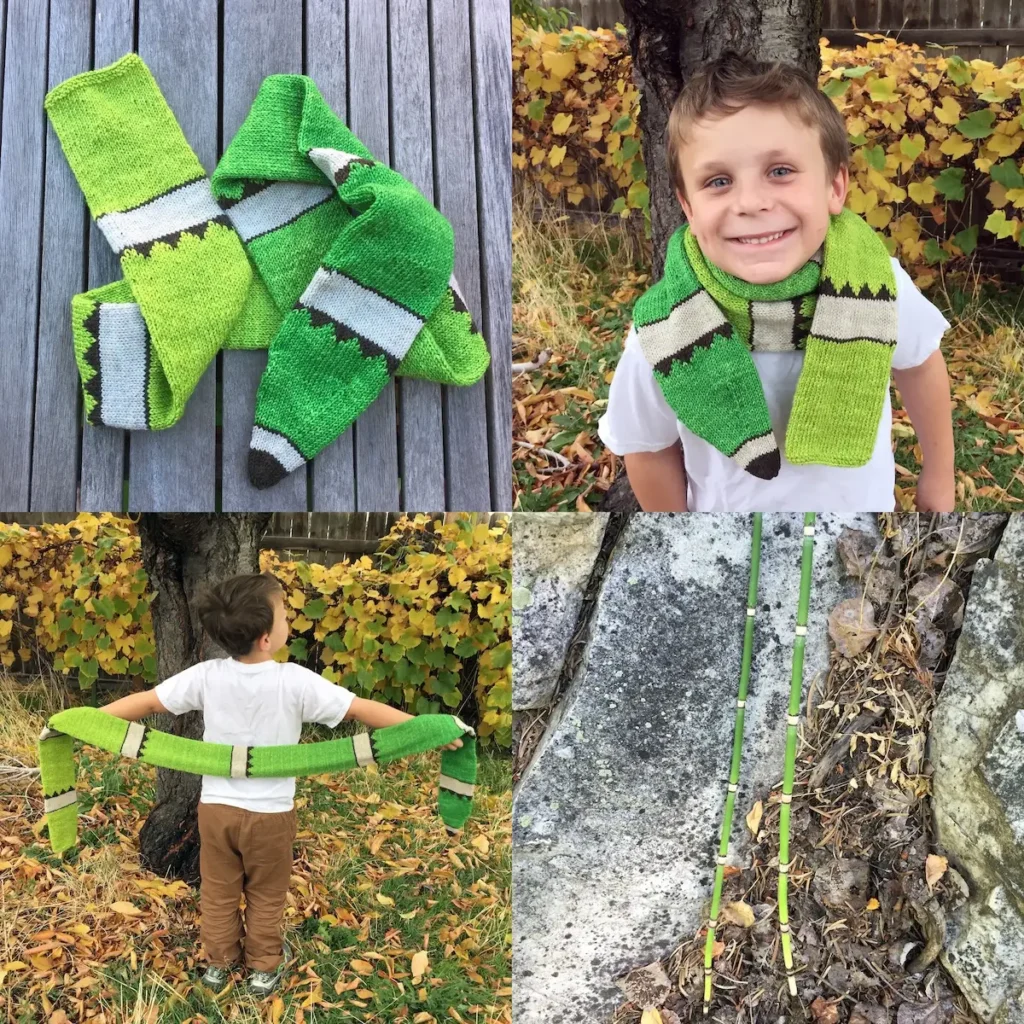
Hand-knit wool
Horsetail or Equisetum grows in wet sandy soil and can be seen in riparian habitats in Great Basin National Park. The stems grow from a rhizome deep underground and sport nodes along their length. The spacing pattern of the nodes, where they get closer together near the top, inspired John Napier to discover logarithms. The nodes of the horsetail also inspire childlike wonder as they are picked apart and examined to understand the curiosity of nature. This artwork was produced under the Darwin Lambert Artist-in-Residence Program at Great Basin National Park.
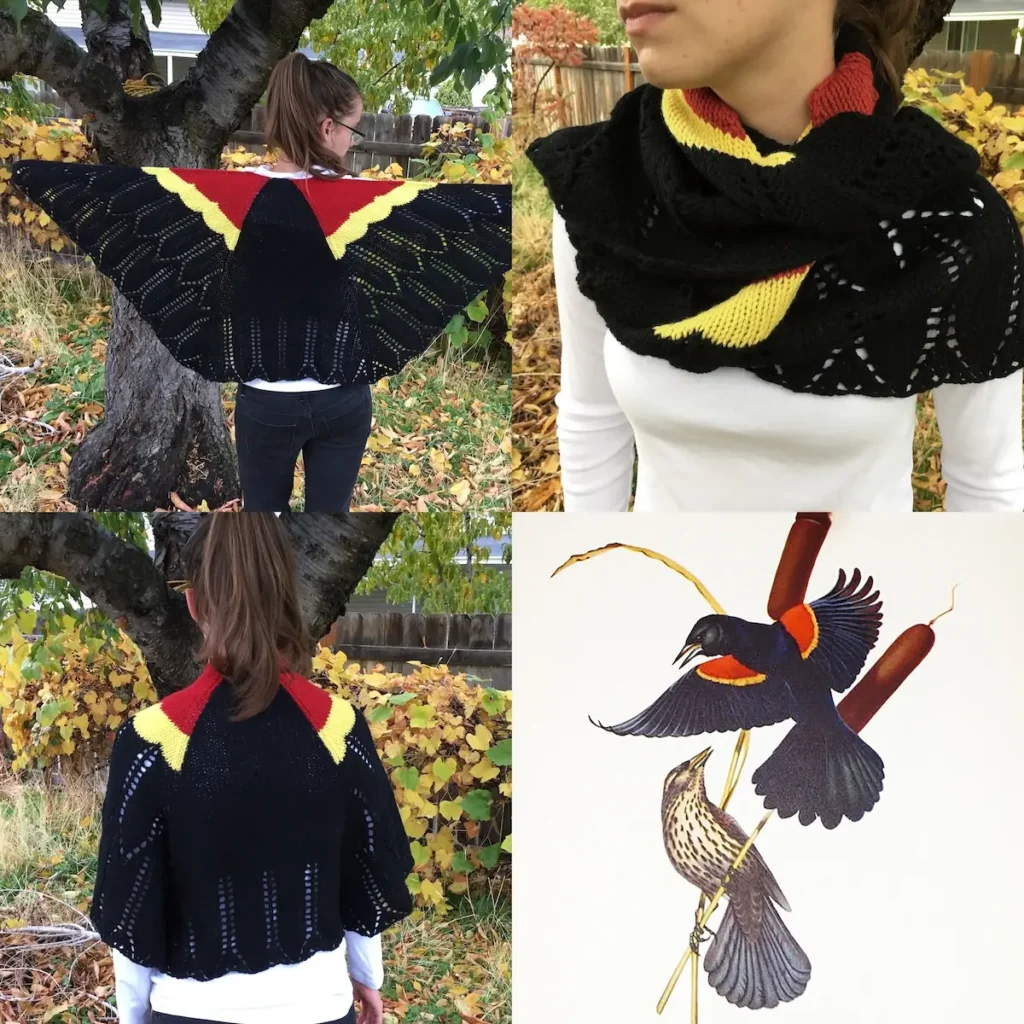
Hand-knit wool
Red-winged blackbirds are a familiar sight in Great Basin National Park. They can be spotted in marshy fields and the grassy edges of wetlands. The males’ beautiful red and yellow shoulder patches stand in stark contrast to their deep black feathers. Singing atop cattails, the males flaunt their epaulets, making a showy spectacle for their female onlookers. This artwork was produced under the Darwin Lambert Artist-in-Residence Program at Great Basin National Park.
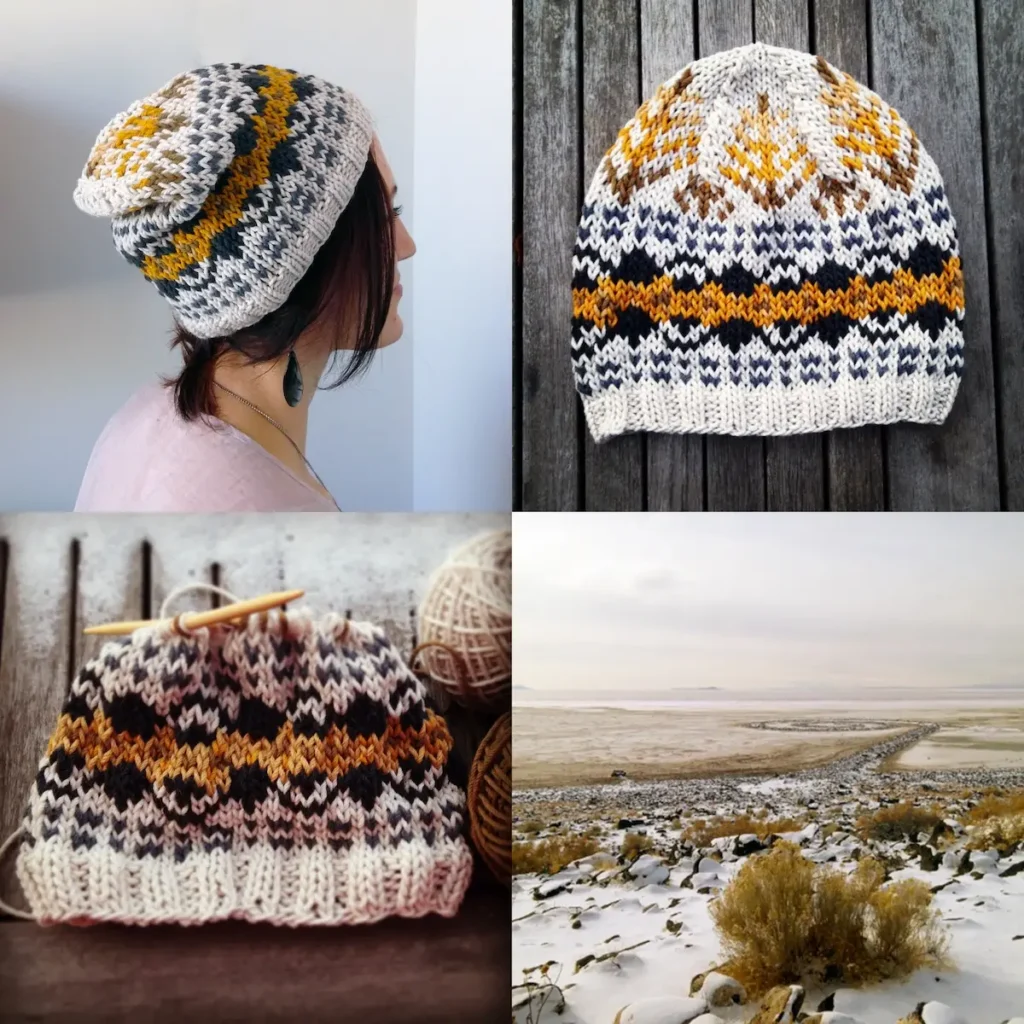
Hand-knit alpaca, merino wool
In the northeast corner of Great Salt Lake is a remote stretch of land called Rozel Point. This wild part of Utah was chosen by Robert Smithson in 1970 as the site of his iconic earthwork, Spiral Jetty. To Smithson, its isolated setting was an important part of the work; viewing the art was a journey both physical and metaphysical. A winter journey to Rozel Point becomes a study in the beauty of art as well as muted nature. Yellow and brown dormant plants are set against black basalt and white snow, creating a feast of mid-winter color.
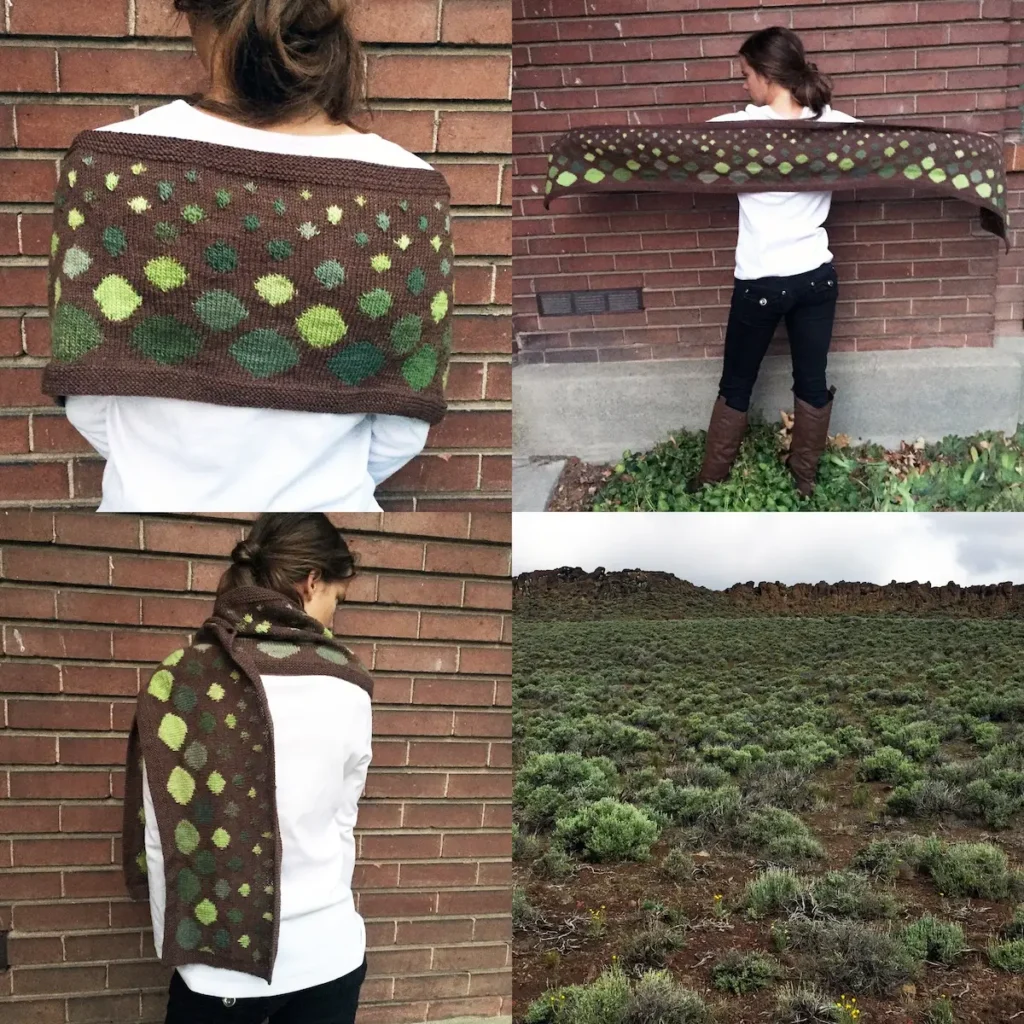
Hand-knit wool and nylon
Artemisia tridentata, or sagebrush, is the state flower of Nevada. Native to the North American west, this member of the daisy family flourishes in dry deserts like the Great Basin. In Black Rock Desert, you can stand in a panorama of receding sagebrush and see nothing else but the mountains on the horizon, surrounded by the pungent fragrance of this beautiful flowering shrub. This piece was created as an Artist-in-Residence at Black Rock Desert National Conservation Area.
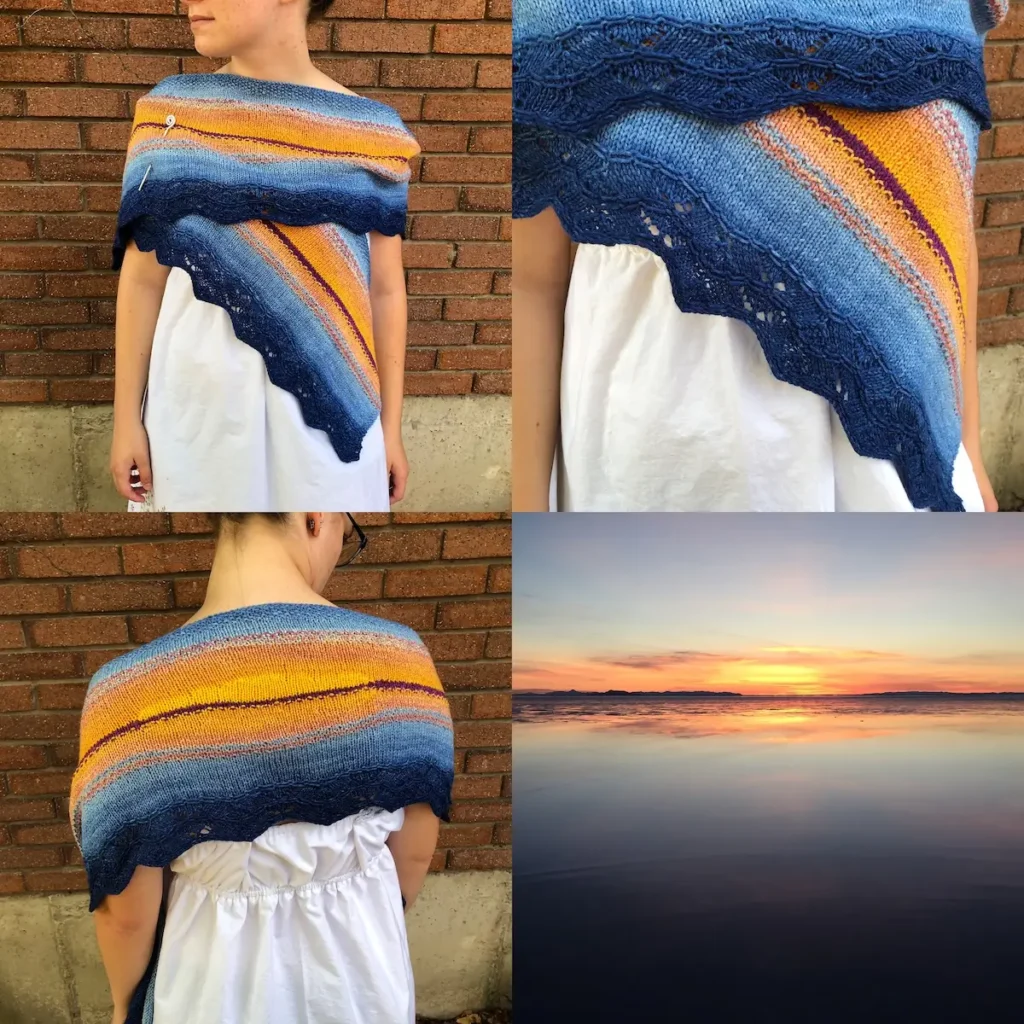
Hand-knit merino wool
Sunrise on Bonneville Salt Flats in western Utah is a spectacular showstopper. The thin layer of water on smooth white salt reflects all the oranges and blues of a rising sun. This symmetrical landscape can make you off kilter and gives the impression that you are walking in the sky.
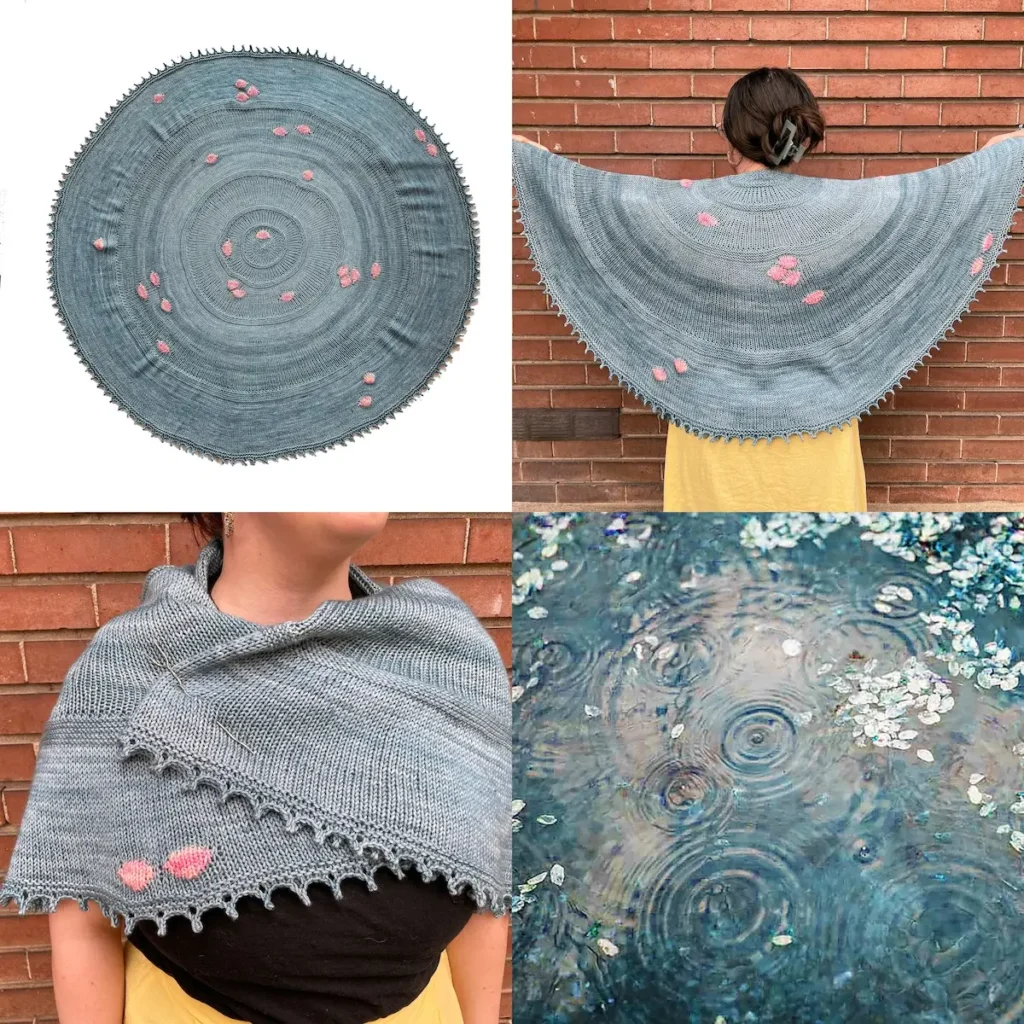
Hand-knit merino wool
Cherry blossom petals
floating in a puddle
a pebble dropped in the middle
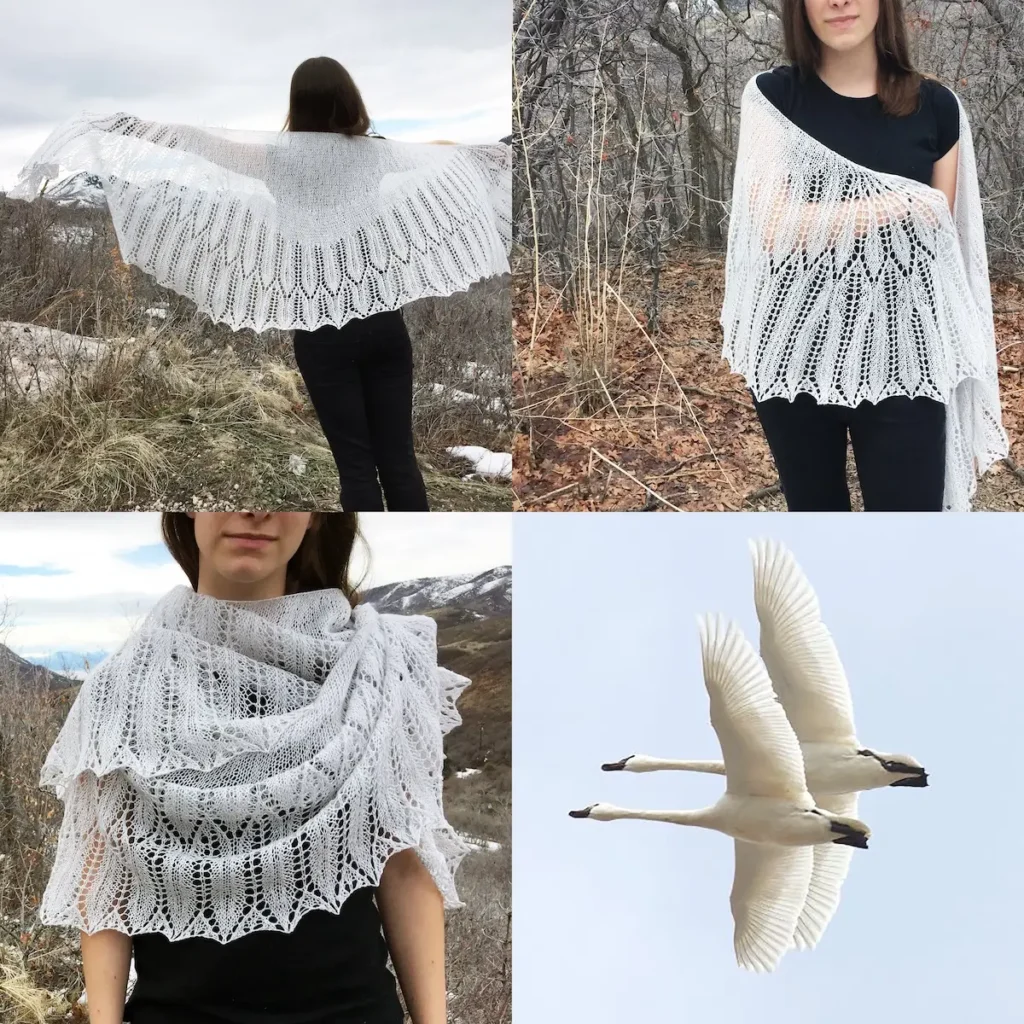
Hand-knit cashmere goat, linen/flax
Tundra swans migrate through the Farmington Bay Waterfowl Management Area in Utah twice each year. In the fall, about 40,000 swans fly through on their way to California, where they spend the winter. Then in the spring, they fly back to the Arctic tundra. With a massive wingspan of up to six feet, a wedge of Tundra Swans can dominate the skies during migration. A bevy of these birds creates a graceful dance in the sky.
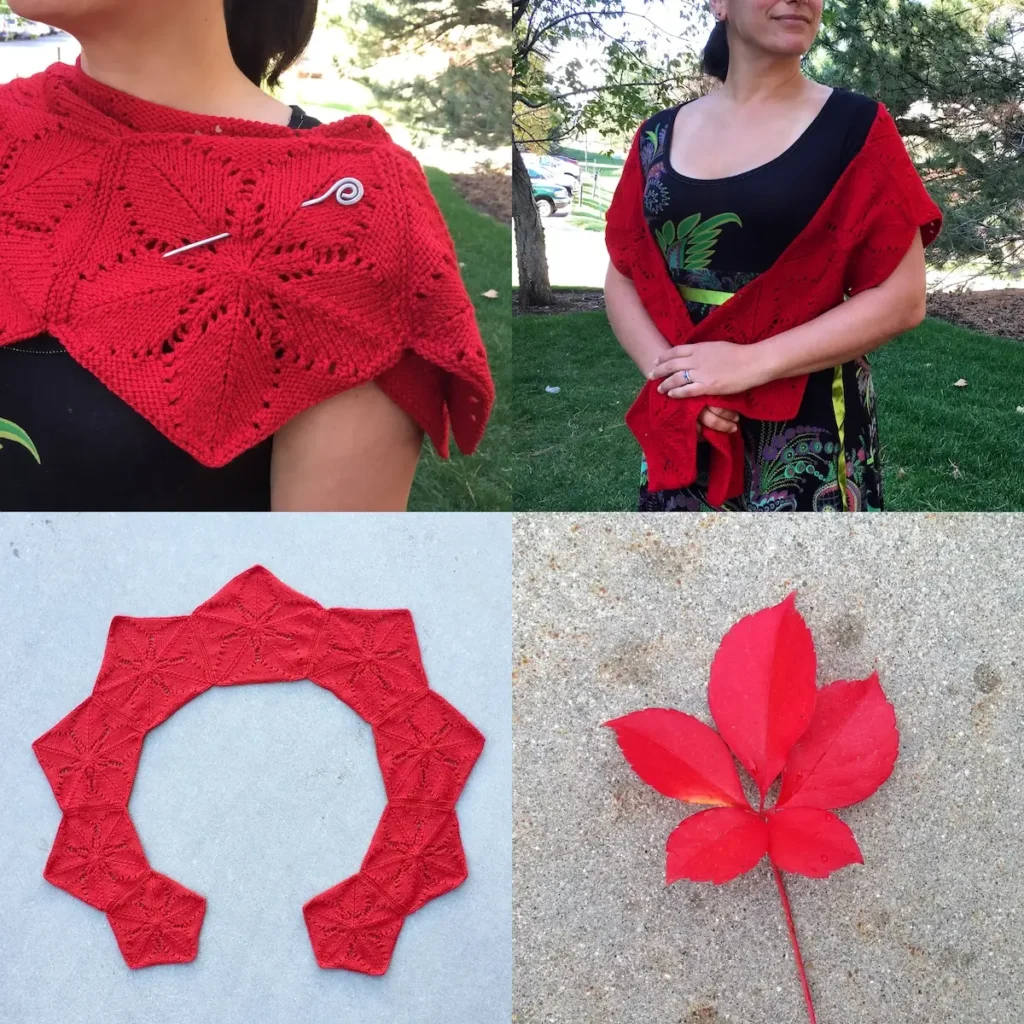
Hand-knit wool
Virginia Creeper, sometimes called woodbine, is found in eastern and central North America as well as Utah, one of the only western states where it is native. It has five leaves centered on each stem and grows rapidly, covering anything in its path. It has brilliant red foliage in the fall that drapes beautifully like a shawl on whatever it has enveloped.
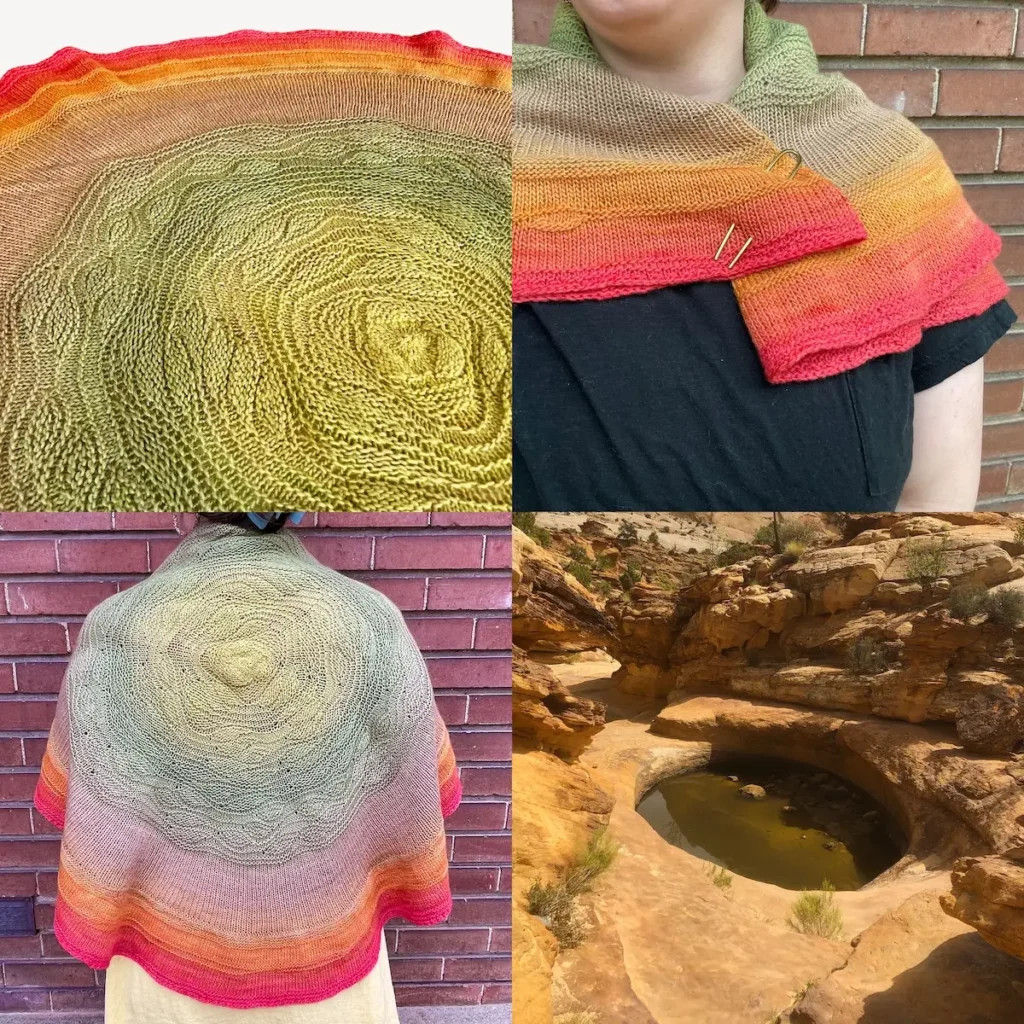
Hand-knit merino wool
Waterpockets are incredibly important to the desert ecosystem. These natural potholes hold ephemeral water after rains and can be lifesaving for many animals, including humans. Capitol Reef National Park has so many in the cliffs above the town of Fruita that the monoclinal wrinkle in the earth’s crust there is named after them: The Waterpocket Fold.
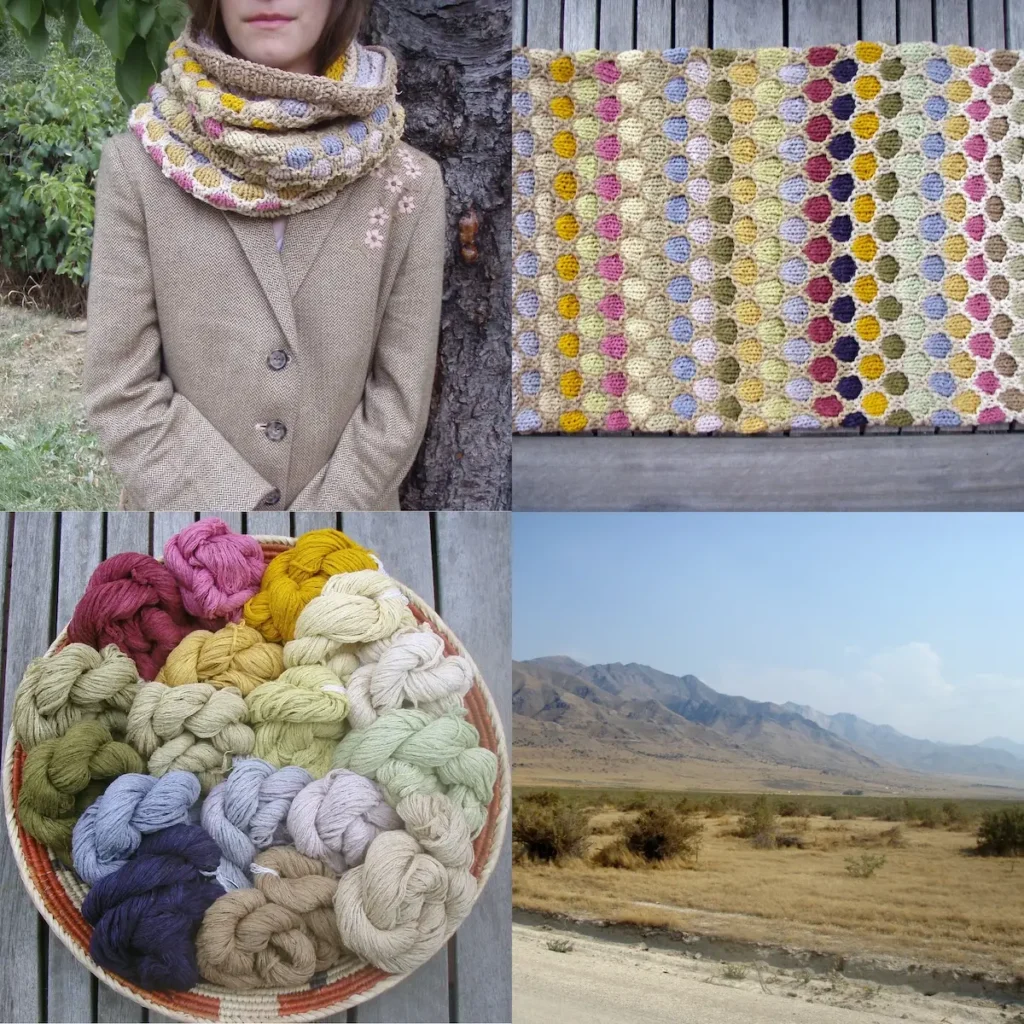
Hand-knit reclaimed silk with natural dyes
Utah’s West Desert is full of insects, hardy plants, and great stretches of desolate wilderness. But the muted colors and stark landscape are beautifully serene. Dusty colors from natural dyes echo the colors from the West Desert and contrast with the tans and browns of the desert background.