
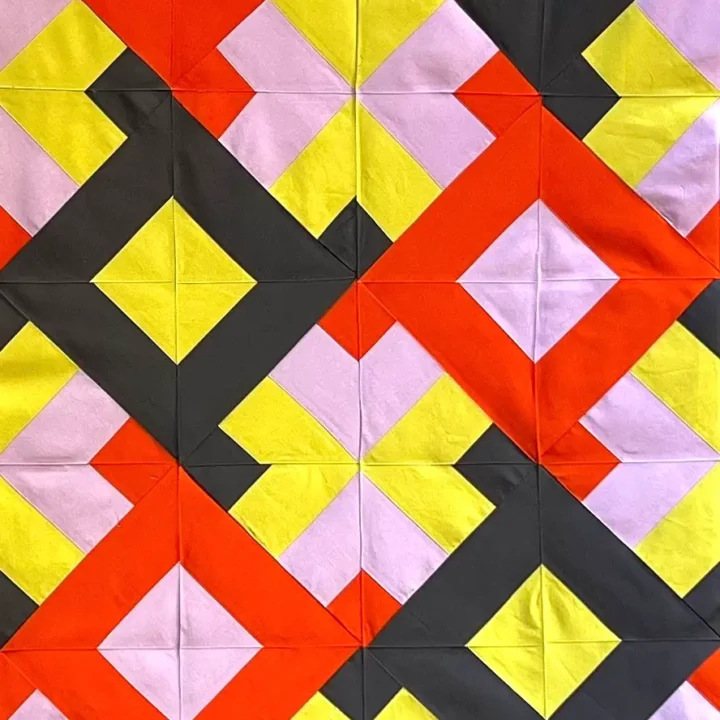
Want a quilt block that looks much more complicated than it is? The Hidden Wells quilt block is made with simple strips of fabric, but a few clever cuts and a little block rotation create surprising designs. It is a fun project for a confident beginner and a great way to play with color, fabric order, and quilt layout.
To make a traditional Hidden Wells block, sew four strips of fabric together, cut the strip set into squares, sew pairs of squares together, and then cut them diagonally to reveal four new blocks. The real fun starts when you put those blocks on your design wall and begin rotating them into different patterns.
What is a Hidden Wells quilt block?
A Hidden Wells quilt block is a strip-pieced quilt block made from four strips of fabric. The strip set is cut into squares, the squares are sewn together in pairs, and those pairs are cut diagonally in both directions.
The result is four smaller quilt blocks with a surprisingly complex design.
Is the Hidden Wells quilt block easy to make?
Yes! The sewing is straightforward, so this is a good project for a confident beginner. The most important things are accurate 1/4-inch seams, consistent strip widths and careful handling after the diagonal cuts.
As an Amazon Associate I earn from qualifying purchases. Read more about our affiliate linking policy.
What size strips do I need for Hidden Wells?
For the traditional method shown here, all four strips are cut the same width. I use 2-1/2-inch strips, which are sewn into an 8-1/2-inch-wide strip set. The strip set is then cut into 8-1/2-inch squares, creating finished blocks of about 5-7/8 inches. This is a great project for your jelly rolls!
You can experiment with different strip widths to make different-size blocks.
Can I make different Hidden Wells designs?
Absolutely! Change the fabric order, colors, strip width or even the number of strips to create different looks. Once you make a few blocks, spend some time rotating them on your design wall. You may be surprised by how many different patterns you can create from the same basic block.
What You’ll Learn
- How to make a Hidden Wells quilt block from fabric strips
- How to sew an accurate four-strip set
- How to cut the strip set into squares
- How to sew and cut the squares to reveal the Hidden Wells design
- How to handle bias edges without stretching your blocks
- How to experiment with color, fabric order and block layout
Quick Start
Skill level: Confident beginner
Finished block: About 5-7/8 inches with 2-1/2-inch strips
Time: About 50 minutes
Fabric: Four strips cut to the same width
Techniques: Strip piecing, rotary cutting and basic patchwork
Best for: Quilts, table runners, pillows, wall hangings and scrap-friendly projects
A Little Hidden Wells History
The Hidden Wells quilt pattern is credited to quilt teacher and designer Mary Ellen Hopkins, who popularized the technique in the 1980s.
I’ve made Hidden Wells several times, and every version has looked different depending on the fabrics and colors I used. I especially love that the basic sewing is simple, but the finished quilt can look much more complicated.
Choosing Fabric for Hidden Wells
Hidden Wells is a great quilt block for playing with color.
For a design with lots of definition, choose fabrics with different values, such as light, medium and dark fabrics. Solids and low-volume prints make the individual shapes easy to see.
You can also use large prints, small prints or a collection of scraps. Busy fabrics can create wonderfully unexpected designs, although they may make the individual shapes harder to see.
One easy way to check your fabric choices is to take a photo with your phone and switch it to black and white. If you can still see differences between the fabrics, you probably have enough value contrast.
If you have a jelly roll, you already have 2-1/2-inch-wide strips that work beautifully for this project. Just remember that jelly roll strips are not always the full width of fabric, so you’ll make fewer blocks from each strip.
Here is a chart that shows you what size block you’ll get starting with different strip widths of fabric.

Have fun and play around starting with different widths of your strip sets. The important point is that each strip set needs to be the same. You can vary the widths of the four (4) fabrics, try five (5) fabrics, or three (3) fabrics. Each combination will give you different patterns to play with!
Here are the basic directions for making the Hidden Wells quilt block pattern:
How to Make the Hidden Wells Quilt Block Pattern Tutorial
Learn the basics of how to make the Hidden Wells quilt block and have fun with all of the different combinations for both color and design creating your own quilt! This is a simple quilt and perfect for beginners.
This quilt block tutorial is the traditional Hidden Wells quilt block where every strip of fabric are equal widths.
Materials
- Four (4) strips of fabric WOF (width of fabric) all the same width. I used 2-1-/2 inch cut width strips which creates a finished block size of 5-7/8"
- Coordinating thread for sewing
Tools
- Sewing machine
- Iron
- Pressing surface
- Quilter's ruler
- Rotary cutter
- Cutting mat
Instructions
Step 1: Cut four fabric strips
Cut four strips of fabric the same width.
For my example, I cut four strips 2-1/2 inches wide.
Before sewing, decide what order you want your fabrics to appear in. Keep that order consistent when you make additional strip sets so your blocks will have the same basic design.
Tip: If you are making a scrappy quilt, take a quick photo of your fabric order before you begin. It can help you remember which combination you liked.
Step 2: Sew the strips into a four-strip set
Sew the first two strips together with right sides together using a 1/4-inch seam allowance. 
Sew the second two strips together, right sides together using a 1/4-inch seam allowance. I like to chain stitch when sewing the strips together. That means, line up your strips and keep sewing them until all of the strip sets are sewn together in one long strip. 
Take the two sets of strips and sew them together, forming a four-strip set unit that is the length of the fabric. Again, sew the right sides together using a 1/4-inch seam allowance.
Here are my two sets of four strip sets sewn and pressed. The width of each strip set is 8-1/2 inches wide. See our article on pressing seams for quilting. 
Step 3: Cut the strip set into squares
Measure the width of your sewn strip set.
For this example, the strip set is 8-1/2 inches wide, so cut it into 8-1/2-inch squares.
With 40-45-inch-wide fabric, each strip set will make about five squares.
Important: Measure your actual strip set before cutting. If your sewn strip set is not exactly 8-1/2 inches wide, use its actual measurement rather than automatically cutting 8-1/2-inch squares.. 
Step 4: Pair two squares and rotate one
ake two of your strip-set squares.
Place them side by side. Rotate one square 90 degrees so the fabric strips run in a different direction.
The rotation is what begins to create the Hidden Wells design.
Once you like the orientation, place one square on top of the other with right sides together.
Step 5: Sew around all four sides
Sew around all four sides of the layered squares using a 1/4-inch seam allowance.
You are essentially making a two-layer square that will be cut apart in the next step.
Keep your stitching consistent and make sure you sew completely around all four sides.
Here is my pile of blocks sewn together around all four (4) sides. 
Step 6: Cut diagonally in both directions
Now comes the fun part!
Using your quilter's ruler and rotary cutter, cut the sewn square from corner to corner diagonally.
Then turn the piece and make a second diagonal cut from the opposite corners. 
You now have four new quilt blocks. 
Here is one of the sewn together sets cut into the four quilt blocks. 
All of my blocks are cut and now ready for pressing. 
Important: After these diagonal cuts, all four outside edges of each new block are on the bias. Bias edges can stretch easily, so handle the pieces gently. Don't pull or drag them across your cutting mat.
Step 7: Press the new blocks
Carefully press each of your four new Hidden Wells blocks.
Because the outside edges are on the bias, press gently rather than moving the iron back and forth across the block.
If you like to use spray starch, a light application can help stabilize the blocks and keep them flatter.
The goal is a flat, square block without stretching the edges.
Here are all of my blocks pressed. 
Step 8: Play with your layout
This is my favorite part!
Take your new blocks to a design wall, table or other large surface and start arranging them.
Rotate the blocks in different directions. Try repeating a pattern, grouping similar colors together or creating a more random scrappy arrangement.
Take a photo of each layout you like. It makes it much easier to compare your options before you sew the blocks together.
Once you find a layout you love, sew the blocks together to create your quilt top.
Here is my finished layout. 
Common mistakes when making hidden wells
Cutting strips different widths
For the traditional Hidden Wells block shown here, all four strips need to be cut to the same width. If the strips are different widths, your finished design will change.
Using an inconsistent seam allowance
A consistent 1/4-inch seam allowance helps keep your strip set and finished blocks the expected size.
Not pressing the strip set
Press your seams as you go so the strip set stays flat and accurate.
Stretching the bias edges
This is the big one. Once you make the diagonal cuts, the outside edges of the new blocks are on the bias. Handle them gently and avoid pulling on the edges – they can easily stretch.
Cutting without measuring
Don’t assume your strip set is exactly the measurement in the instructions. Measure it before cutting your squares.
Losing track of your fabric order
If you are making several strip sets, it is easy to accidentally reverse the fabric order. Take a photo of your layout before sewing or keep the strips stacked in order.
Hidden Wells Block Ideas
Once you’ve made the basic block, there are lots of ways to change the look.
Make it scrappy
Use different fabric combinations for each strip set. Coordinated scraps can make a lively quilt with lots of movement.
Use a jelly roll
Jelly rolls contain 2-1/2-inch-wide strips, making them an easy starting point. Because the strips are already cut, you can get right to the sewing.
Change the strip width
Try wider or narrower strips to change the proportions of the finished block.
Change the number of strips
The traditional Hidden Wells block uses four strips, but you can experiment with three, five or more strips. The construction and final design will change, so make a test block first.
Change the fabric order
Even the same fabrics can create different designs when you change their order in the strip set.
What can you make with the hidden wells quilt blocks?
Hidden Wells blocks work well for more than a full-size quilt. Try making:
- A baby quilt
- A throw quilt
- A table runner
- A wall hanging
- A pillow cover
- A small quilted gift
- A quilt sampler
If you only want to experiment with the technique, make a few blocks first. You may discover that you like one layout much better than another.
Frequently asked questions
A Hidden Wells quilt block is made by sewing strips of fabric together, cutting the strip set into squares, sewing pairs of squares together and cutting them diagonally to create four new blocks.
Yes. The sewing itself is simple, making Hidden Wells a good project for a confident beginner. Accurate cutting, consistent 1/4-inch seams and careful handling of the bias edges will help you get the best results.
For the traditional version in this tutorial, cut four strips 2-1/2 inches wide. The four strips create an 8-1/2-inch strip set, which is then cut into 8-1/2-inch squares.
You can use different strip widths to create different-size blocks.
Using 2-1/2-inch strips and the measurements in this tutorial, the finished Hidden Wells block is approximately 5-7/8 inches square.
Yes! Jelly rolls contain 2-1/2-inch-wide strips, so they are a convenient choice for this project. Because jelly roll strips are shorter than a full width-of-fabric strip, you’ll get fewer blocks from each strip.
Yes, but remember that a fat quarter is not as long as a full width-of-fabric strip, so you will get fewer squares from your strip set.
The diagonal cuts create bias edges on all four sides of the new blocks. Bias fabric can stretch easily. Handle the blocks gently and avoid pulling them while pressing or moving them.
There isn’t one right layout. Rotate the blocks on a design wall or table and try several arrangements before sewing them together. Changing the direction of the blocks can create completely different overall patterns.
What to make next
If you enjoy the surprise of making something simple and then cutting it apart to create a new design, try a few more Create Whimsy quilt projects.
Our Disappearing Nine Patch quilt uses the same satisfying idea of making a simple unit, cutting it apart and rearranging the pieces.
For another strip-pieced design, try our Rail Fence quilt pattern.
If you want to explore even more strip-piecing possibilities, our Bargello quilt tutorial turns simple fabric strips into dramatic movement across a quilt.
And if you are new to quilting, our Complete Beginner’s Guide to Quilting is a good place to explore the basics.
Have fun with Hidden Wells
The best part of the Hidden Wells quilt block is that you don’t have to stop with the first design you make. Change the fabrics, change the strip order, rotate the blocks and see what happens.
Start with a few blocks, put them on your design wall and play. You may find a completely different quilt hiding in the same pieces.
Browse through more free quilt patterns on Create Whimsy.
